Showing posts with label Kristen Scott-Thomas. Show all posts

Tuesday, April 10, 2012

Salmon Fishing in the Yemen

Swimming Upstream
or
The Fish, The River, and The Games We Play

You look at the title and already the questions start. Salmon Fishing in the Yemen?  What's up with that?  It sounds quixotic—salmon fishing in a desert environment.  Impossible.  Useless.  Theoretically possible, certainly.  "Like a manned mission to Mars is theoretical," says Professor Alfred Jones (Ewan McGregor), but not very practical.  But a rep agency has a sheikh client (Amr Waked) who wants to do it.  It will generate a lot of things: money into the coffers of the fisheries and wildlife people; publicity for the P.M. (as orchestrated by Patricia Maxwell, played with a vibrating steeliness by Kristin Scott Thomas); electricity for the sheikh's kingdom.  So it has its practical side—it gets bureaucrats functioning, people working, so who cares about the feasibility, even if its a crap-shoot (or more properly, a carp-shoot).  Like fishing.

Even Jones, the functionary put in charge of the project, needs some luring to wrap his mind around the project.  "I have a standing with the scientific community—a reputation!"  "A mortgage.." counters his wife in a practical marriage.  He thinks everyone spear-heading the project needs a net.  And his demands start to loom large, asking the sheikh's representative, Harriet Chetwode-Talbot (Emily Blunt) to get the engineers who designed the Three Gorges Dam in China to do the blue-printing and then "get two of those big Russian transports—Antonovs?—One for the fish and another for all the money we'll need."

He gets the engineers (which impresses), but a little research and a talk with the sheikh and a tour of the building site gets Jones hooked and convinces him that it just might work—a blind cast, to be sure, but he's made a lot of those.  And like angling, it takes a lot of patience.  As his benefactor says, you've got to have faith.  Any faith will do.  Even if it's the faith one has putting your hook in the water.

Not unlike the faith you have to have going into any Lasse Hallström movie. He burst onto the international film scene with My Life as a Dog (a film I still haven't waded through, despite sitting on my desk for a month) and he became Miramax's "go-to" guy for prestige pictures for "blue-hairs"—a director of such discriminating taste, that one could actually accuse him of avoiding the subject, so as not to offend.*  The effect can either be good or bad, and I approach a Hallström chronicle with caution.  For every The Shipping News, there's a Once Around.  Every What's Eating Gilbert Grape is matched by An Unfinished Life.  Something to Talk About isn't, really, and Chocolat feels a bit hollow.  "Yeah, it was fine," you say when it was over, "but..."  Not exactly thrilling.  Tamped down.  Safe.  Unexceptional.  The story gets told, but it doesn't move the senses or the emotions.  The movie gets made, gets seen, but disappears from the mind like spun sugar in water.  But every few movies, the elements jell.

Salmon Fishing in the Yemen is one of his better efforts, but is still very restrained, though the elements of terrorist drama that pop up tend to disrupt the generally genial tone of the thing.  And like a fine day of fishing, it all comes down to the casting.  McGregor is terrific here, lilting accent intact, and feeling more genuine than he has since The Ghost Writer.  Blunt is given a bit more emotion than she's been allowed her last few movies, and Waked is a sage, calm presence.  And as far as the movie goes, one is charmed with the conceit of the film as a love metaphor—of taking a flyer in relationships, and committing to something beyond yourself, even if the odds are long and the obstacles high. But, ultimately, it's in one's nature to swim upstream, to rise above, because it is our nature.

Salmon Fishing in the Yemen is a Matinee.


* I always remember conservative commentators talking about what a fine film The Cider House Rules was—because it was about an abortion doctor who established an orphanage for "unwanteds"—most probably because they hadn't seen it, for if they had they might not have had such high praise for a film dealing with child and sexual abuse and incest.


Tuesday, December 7, 2010

Easy Virtue

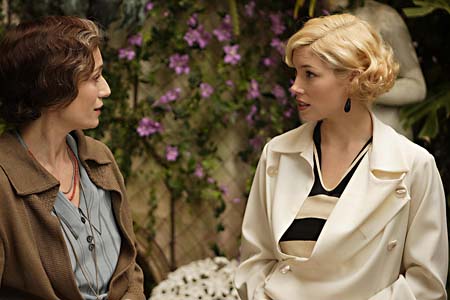
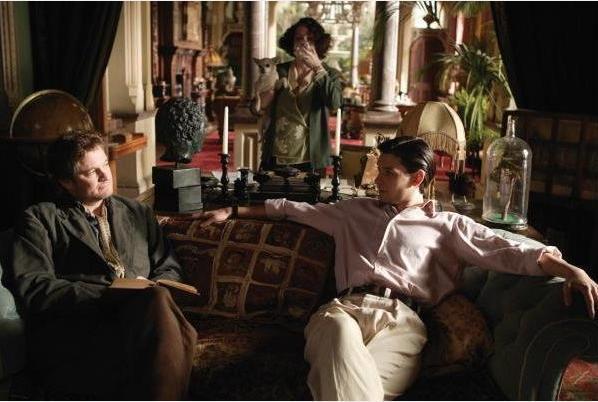
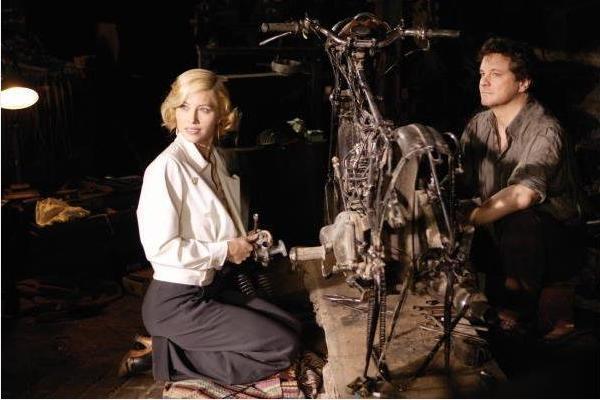
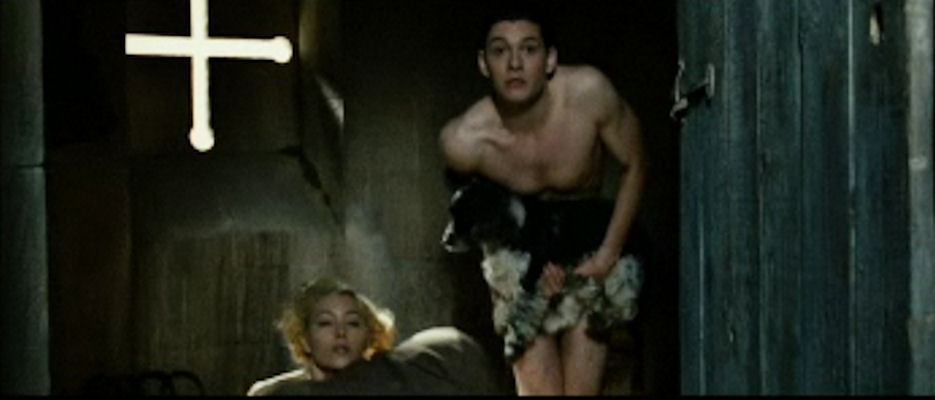
Easy Virtue (Stephan Elliott, 2008) Okay, it may be a weak recommendation to say this may be the best performance Jessica Biel has ever given, but she holds her own in a good cast that includes Kristin Scott Thomas (as a society woman who has seen far better days) and Colin Firth (the head of the household, who has only returned bodily from WWI), who are quite bent out of their stiff upper lips that their son (Ben Barnes) has married 1) an adventuress, 2) a race-car driver, 3) a widow, and 4) an (gasp!) American—all in the form of a comely Biel.

"What am I to do with this bauble of a woman?" fusses Mrs. Whittaker.  "Hang her?" says her barely-engaged husband.

The Noel Coward play has been filmed once before (by Alfred Hitchcock in 1928, during his silent era...consider that, a silent version of a Noel Coward play) and Elliott's version tries mightily to make it more hip, making Biel's Larita Whittaker more of a liberated woman, rather than just a libertine, and her inability to navigate the iceberg-laden chilly waters at the Whitaker residence (which, at their most hapless, resembles something that might appear in Meet the Parents) puts a strain on her puppy-loveish young marriage.

Try as she might to ingratiate herself into the family, it all turns perfectly horrid, with no help from her cluelessly entitled young husband (who thinks he can have it all, and can't fathom why everybody doesn't just get along).  Fact is, the Whittaker estate isn't so much a home as a castle, protecting itself from the cruelty of the outside world, and only those touched by that cruelty have the grace to rise above, if they can.  Larita gravitates to the unsmiling Mr. Whittaker for advice, his cynicism to keeping up appearances, coinciding with a wish she cannot fulfill for her husband's/his son's sake.

There has to be a better way, if not for the family then for herself.   What else can they do to her

Discover her secrets, maybe.

The two films diverge at this point: Hitchcock's hinges on a portrait done of Larita that colors her husband's death; Elliott's has that portrait, too (amusingly), but comes up with a more modern tragedy for Larita to cover up that wouldn't have "played" in the 20's, when Coward first wrote the play.  It gives the film a depth, and distinguishes Larita from the rest of the family-members, and leads to an inevitable conclusionCoward's way out.

A truffle; a bon-bon; a baubleEasy Virtue has a grand time sending its message on the clash of the classes, filling it with period tunes (and ending with one out of period, but apt), and a cast making the most of Coward's words.  Not one to be dismissed.


Wednesday, November 17, 2010

Nowhere Boy


"Playing the Chords You're Dealt"
or
"Portrait of the Walrus as a Young Man"

"Half of What I Say is Meaningless/
But I Say it Just to Reach You/
Julia"
John Lennon, after Khalil Gibran

It's always going to be John Lennon who is the focus of dramas based on The Beatles; there have been a couple already (even two about his assassin) and PBS has Lennon Naked in the wings.  No biographies of McCartney (no drama, really), Harrison (no dharma, really), or Starkey (trying to think of the last movie about a drummer...).  It's always Lennon.  Partially because he's capital-F Fascinating, but also because he was so capital-F "F'd up."

All of The Beatles were born into a world in flux, all born during the second World War, and, in turn, they would change the world, as they themselves were changed by having that world screaming at their feet.  But, that's The Beatles story.

Lennon's story is as fractured as his snarky-twee published stories are.  Raised by his strict Auntie Mimi and his jocular Uncle George, he barely escaped the Strawberry Field Salvation Army orphanage—a place that he would ultimately turn into a personal childhood playground, given the choice—(Odd, that Lennon was forever looking at alternatives to his situation as an answer...even the bad ones—he was never satisfied, until the end).  His father, Alf, was a merchant marine and never home.  His mother, Julia, was a perpetual teen-mother, bi-polar, substance-abuser and sex-addict.  Mimi took John to keep him close to Julia (rather than with Alf), while simultaneously keeping them apart.  No wonder he was never comfortable.

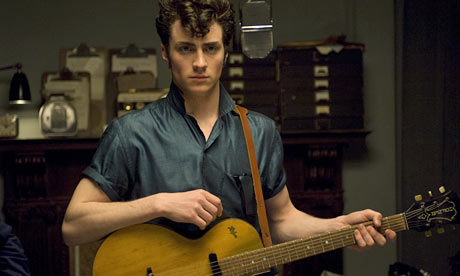
Sam Taylor-Wood's Lennon bio-pic Nowhere Boy (one of the few real references to Beatles songs in the thing) tells the story of Lennon's turbulent teen years—can you imagine being in charge of Lennon when he was going through puberty?—when he was flushing through some independence, experiencing second-hand death, sex, and music, all swirling through a loyalty-abandonment battle when he meets his long-lost Mother...and begins to understand the circumstances of his own almost Dickensian story.  That Julia also inspires his dedication to music, and the forming of his band The Quarreymen (the proto-Beatles), whose first concert starts to lock in the relationships that would inform the rest of his life, makes this movie a bit like being fortunate enough to watch a lightning strike.  It makes great drama,  and the screenwriter Matt Greenhalgh does a masterful job of making a familar story fresh, and putting in the comedic grout that informed Lennon's manner, while also capturing in smart, short-touches portraits of McCartney (Thomas Sangster) (their first meeting is wonderfully indicative) and Harrison (Sam Bell).

Kristin Scott Thomas does a great job of showing the brittle side of Aunt Mimi, while also quietly showing why she was such a good co-conspirator with her chargeAnne-Marie Duff's Julia is a girl-child, too immature to be a mother, as she always wants to be the girl-friend.  But the miracle is Aaron Johnson, who doesn't really look like Lennon (in the same way that Joaquin Phoenix never looked like Johnny Cash in Walk the Line), but has done such a fine job of looking at documentaries and studying the much filmed Lennon, that he has the manner down...so much so, that he begins to resemble him, mostly in motion, until you just accept the impersonation.  We've seen our share of bad Beatles imitations, but Johnson captures the illusion in all its facets of the diamond in the rough, and the Spaniard in the Works.

Nowhere Boy is a Matinee.


Friday, August 15, 2008

Tell No One

"Margot at the Funeral"

One is left calculating what "Tell No One" reminds one of–equal parts Hitchcock and Chandler, the gritty BBC procedural mysteries,with a little bit of "The Fugitive" thrown in–but it only occurs to one to tick these things off after the film's conclusion. One is too immersed in the complicated story to look for stylistic roots while its going on. Besides that, one can't seem to unclench the chair-arms while the roller-coaster ride is going on.

"Tell No One" (aka "Ne le dis a personne") starts slowly enough. In its first minutes, it sets up an anniversary celebration between childhood sweethearts Alexandre and Margot Beck (François Cluzet and Marie-Josée Croze).

And then, as they say on the magazine shows, "
things go horribly, horribly wrong."

Flash-forward eight years, and pediatrician Alexandre is still grieving the loss of his wife. The police are snooping around, because at the time of her murder, he was their prime suspect. But now, nearing that fateful anniversary, the gendarmes are starting to ask questions again. And the recent discovery of two buried corpses nearby only complicates the matter.

The cold case suddenly starts heating up, and making Beck quite hot under the collar.

Two sets of investigators are tracking him. Then, he begins to get cryptic e-mails, the first one ending with the ominous phrase "Tell No One. They Are Watching." Attached to the message is a file that he's having trouble opening. Usually the hunted man has all sorts of road-blocks put in his path; the vagaries of incompatible software have now joined the mystery lexicon.

To reveal anything more is to spoil the enjoyment of the unravelling of the story, but it involves chases, subterfuge and criminal activity in very high and very low circles, good cops and bad cops and wet-works operatives.*

Oh, and everything he knows is wrong. But that's okay–he's a man who doesn't know too much.

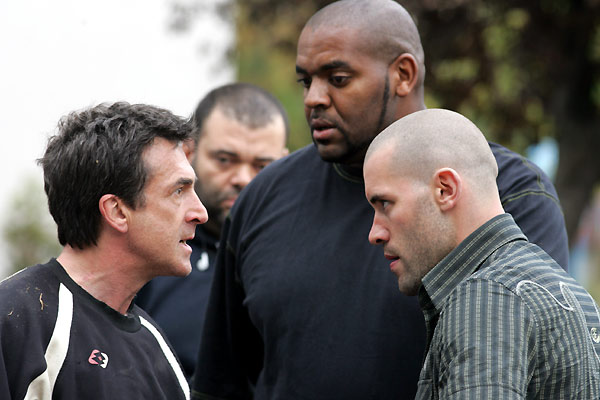
"Tell No One" is based on Harlan Coben's 2002 novel of the same name, and the switching from Jersey to France matters not a jot. Some changes have been made to the story (with Coben's appreciation), and is well-crafted by director Guillaume Canet, and none of the seams show or give you any clue for what's coming ahead. You're carried along finding new information along with the lead, played extraordinarily well by François Cluzet. He has a quiet every-man kind of face, but Cluzet takes that quality and turns it on its ear. His performance reminds me of Bob Peck's in the excellent "Edge of Darkness," and both films have similar ways of presenting new information casually. But every character is well-etched–that's part of the film's great charm–but special mention has to be made of Kristin Scott Thomas who drops as effortlessly into this french-language role as she does into her typical "English Rose" roles. And if Croze seems somewhat familiar, you might remember her as Jean-Dominique Bauby's first language therapist in "The Diving Bell and the Butterfly," and the Dutch assassin in Spielberg's "Munich."

"Tell No One" tells its story with the chilly efficiency one expects from a thriller, but what is surprising is that it does it with so much feeling and heart. Highly recommended. Go tell everyone about this one.

"Tell No One" is a full-price ticket. This is not one to miss.

* In fact, the one story element that doesn't jibe I can't reveal because it would give everything away!