Showing posts with label Aaron Johnson. Show all posts

Friday, December 14, 2012

Anna Karenina (2012)

Artificial Intelligence
or
Anna! Karenina! The! Musical!

Tolstoy's "Anna Karenina" is considered by many the greatest novel ever written, and has been adapted so many times (two of them starring Greta Garbo!), one is tempted to name any version "The Last Remake of Anna Karenina."  So, the task for director Joe Wright and scripter Tom Stoppard must have seemed daunting, or as one of Zsa Zsa Gabor's later husbands stated it: "You know what you have to do, you just have to find a way of making it interesting."

Well, this one is interesting, alright.  And it hues closely to Tolstoy's novel in the way that a CliffsNotes Edition sticks close.  All the plot points are there, the characters whittled down to their bare essences, or eliminated altogether, and breezily delivered in a theatrical manner, save some significant exceptions.  Truth is, Wright makes this version of Anna Karenina the way Baz Luhrmann would, as a grand, operatic experience staged in an extraordinarily choreographed with the emphasis on the "arch" (as in "playfully and affectedly roguish") in Proscenium Arch.
  

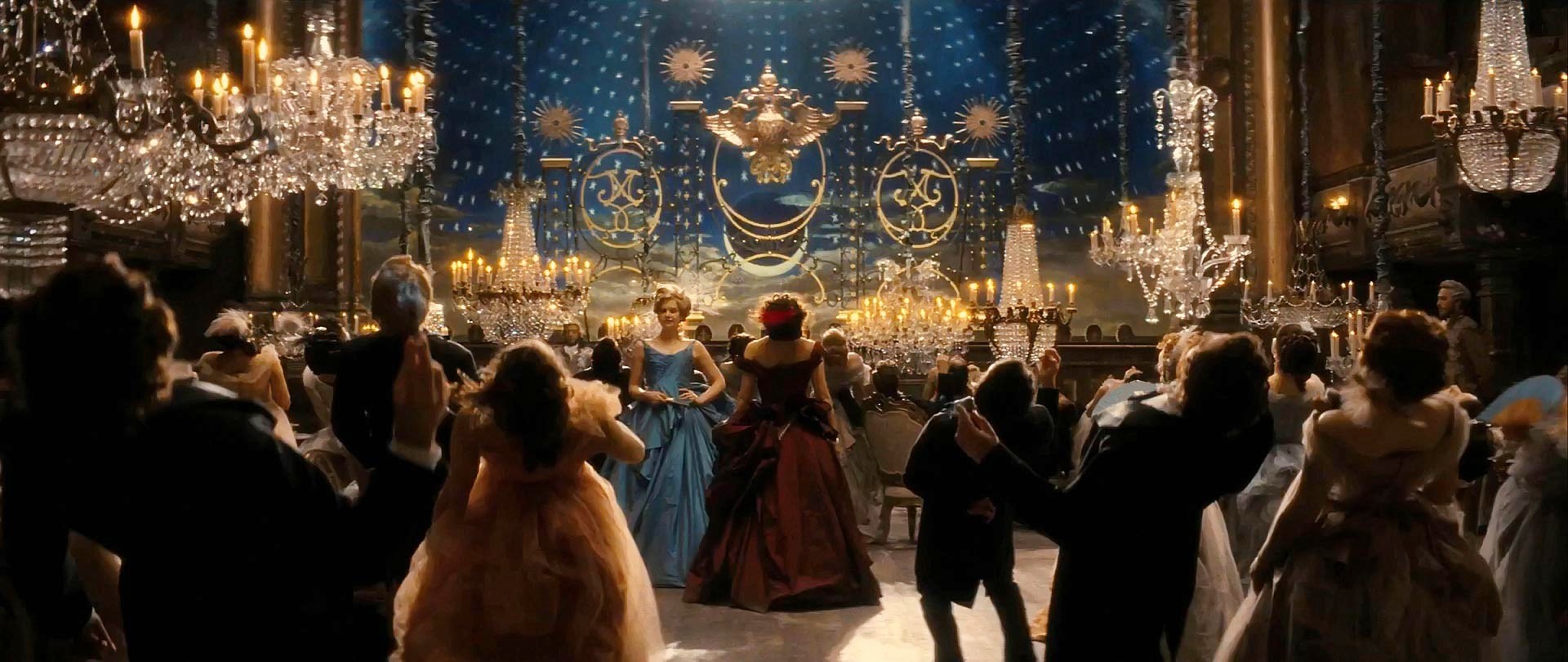
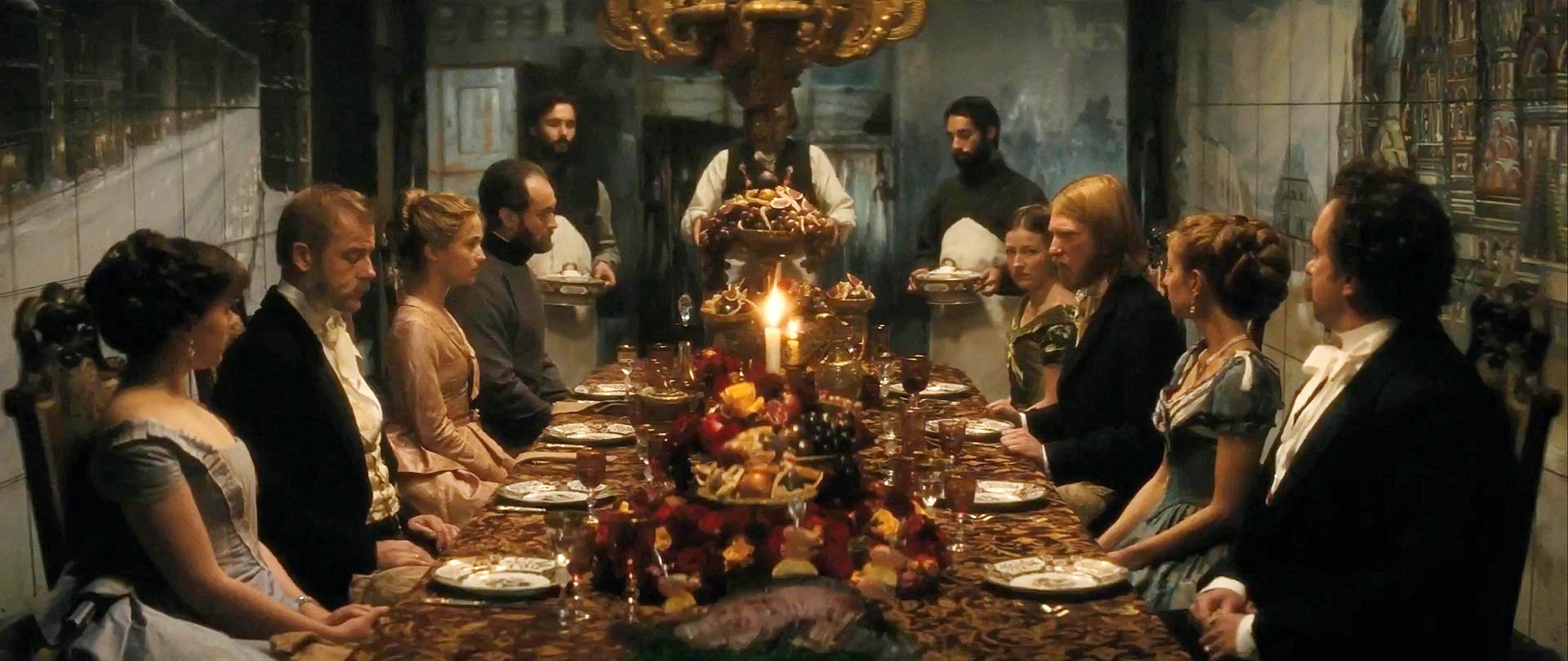
Jim Emerson had a fascinating article (based around Skyfall) on his "Scanners" blog on the difference between a "theatrical" film and a theatrical film and its use of space as defined by the limitations of the frame and a stage directors' tendency to reflect that frame with its own limitations resembling the dimensions of a stage.  Wright fully embraces that concept and goes further; for the main story of the hoi-polloi and their social and political gamesmanship, all of the action takes place within the false spaces of a theater (at times even using the rafters as locations for traditional street-scenes): train and carriage scenes are decidedly set-bound with no effort made to reflect a "real" world outside the windows; transitions are made "in-camera" without editing, so a very stagy and choreographed bureaucratic work set-up with synchronized rubbing stamping (set to Dario Marianelli's interesting score) segues to a restaurant scene by merely having the "extras" trade in their black business suits for waiter-whites; a formal society ball is not an intricate commingling of dancers that Wright so effectively engineered in Pride and Prejudice, but is an elaborate ballet, where the participants barely touch and their hand movements are intricately swanning in nothing that approaches a traditional dance (at times, to keep track of the principals, the foreground dancers in our field of vision "freeze" to better make out the focus of our attention).  Like Francis Ford Coppola's set-bound version of Bram Stoker's Dracula, It's all very elaborate, "stagey," false, and at times clever but, a lot of the time, merely "showy," like a musical with no libretto, something to separate this "Anna" from the more realistic, even if filmed in-studio, versions.  

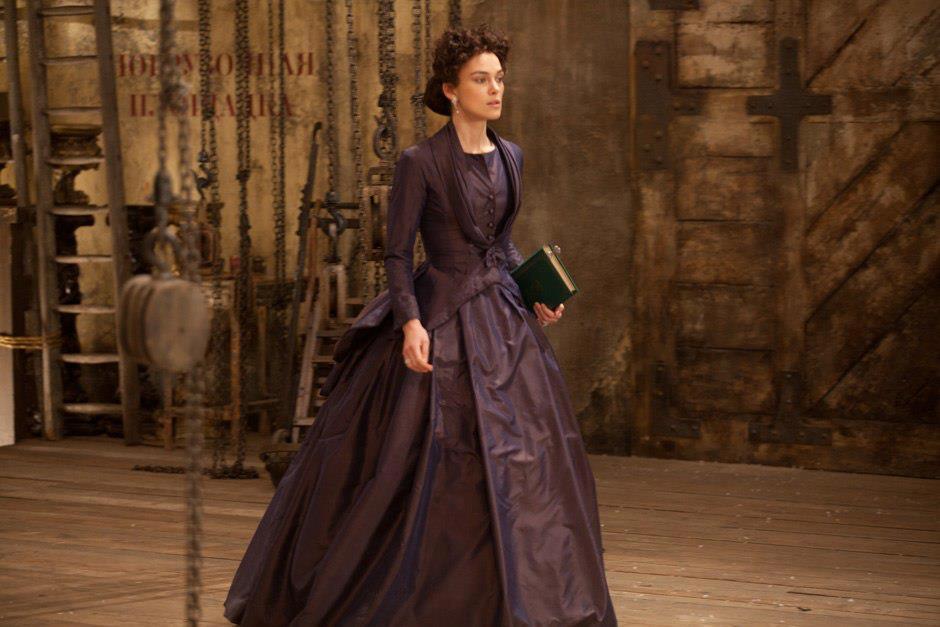
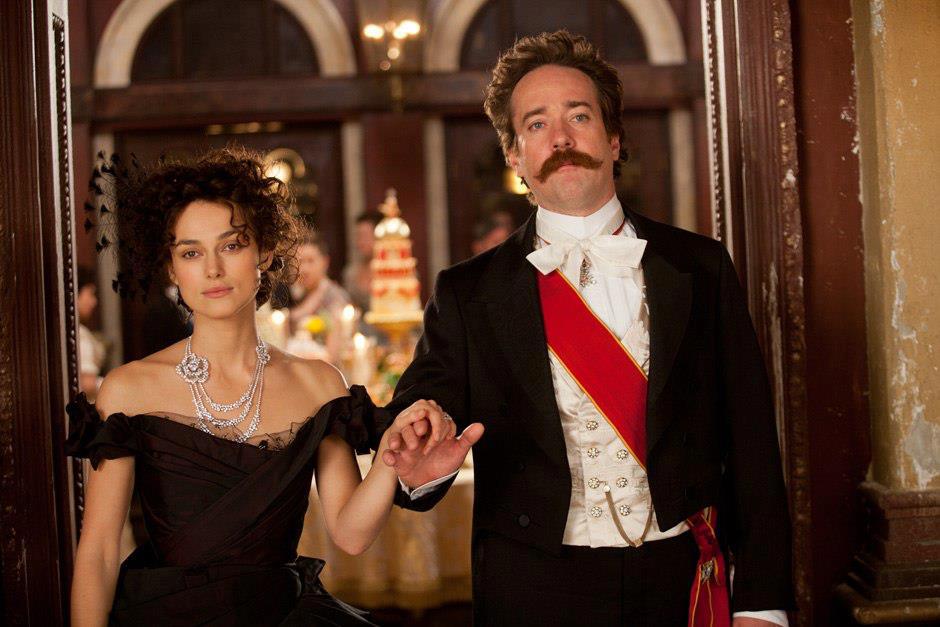
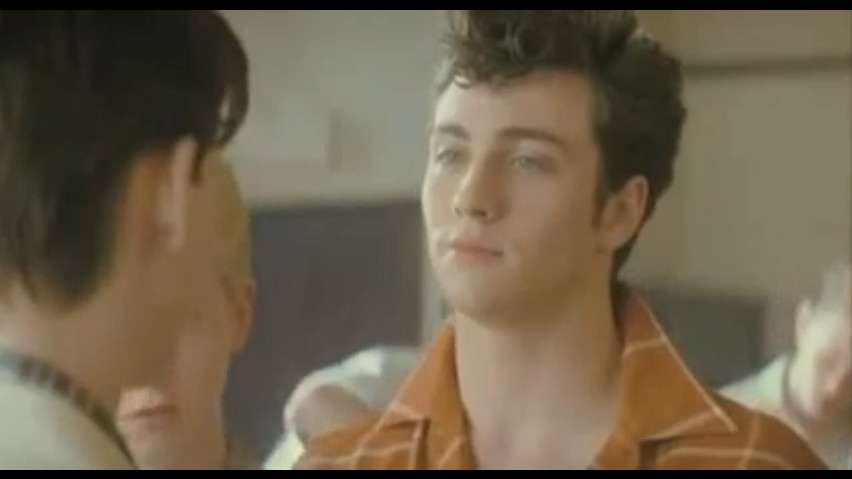
The performances run that way, too.  Keira Knightley is an exasperating Anna, conflicted but fatally committed to fully expressing whatever is on the surface of her heart.  Her P & P co-star, Matthew McFadyen is a burlesque cousin Oblonsky, fatuously showy in a way that reminds of Kevin Kline performing a burlesque role.  Jude Law—not one of my favorite performers—here is exceptional as Anna's cuckolded husband, and is so restrained and non-theatrical, that it sets him apart from almost every other performer, isolating him, and is a good short-hand way of showing why Anna might be dissatisfied with him.  Olivia Williams has a small part as the Countess Vronsky, whose son (Aaron Taylor-Johnson) is the very florid object of fascination for Anna.

Anna (Keira Knightley) runs from Vronsky at the Ball
and experiences a little fore-lightening from an approaching train.

It's dangerous in a Joe Wright theater.

But, almost the entire film is deliriously fascinated with the artificial that it undercuts the very real passion and consequences of actions of the people in the film, reducing them to "players" as opposed to human beings.  I say "almost" because Wright does change things up to "open up" the segments featuring Levin (Domhnall Gleeson) and Kitty (Alicia Vikander), who already have their disappointing encounter with Vronsky and move on.  When they reunite, their segments are set in a real world of sky, clouds and fields befitting the couple who exemplify wisdom, forbearance and patience.  Wright puts them in our world, relegating the others to an artificial world that is essentially stage-managed (even at the end with a coda of Karenin and the remains of his family, it is contained in the stage-world that Wright has chosen to house his film.

It's different, even interesting in an oddly disrespectful manner, as the flightiness of the bourgeoisie and their concerns are merely shadow-play and window-dressing—it is true to an extent—but by pushing the metaphor so aggressively, it undercuts any feeling one has for the players in the majority of the film itself, and reveals itself as resembling the tut-tutting of the hypocrites who turn against Anna.  I'm not sure that Tolstoy had that intention (even strained through Stoppard), and this film might have benefited  from a less facile presentation that required less stage-craft and something more resembling (I don't know) empathy?


Anna Karenina is a Cable-Watcher.


Wednesday, November 17, 2010

Nowhere Boy


"Playing the Chords You're Dealt"
or
"Portrait of the Walrus as a Young Man"

"Half of What I Say is Meaningless/
But I Say it Just to Reach You/
Julia"
John Lennon, after Khalil Gibran

It's always going to be John Lennon who is the focus of dramas based on The Beatles; there have been a couple already (even two about his assassin) and PBS has Lennon Naked in the wings.  No biographies of McCartney (no drama, really), Harrison (no dharma, really), or Starkey (trying to think of the last movie about a drummer...).  It's always Lennon.  Partially because he's capital-F Fascinating, but also because he was so capital-F "F'd up."

All of The Beatles were born into a world in flux, all born during the second World War, and, in turn, they would change the world, as they themselves were changed by having that world screaming at their feet.  But, that's The Beatles story.

Lennon's story is as fractured as his snarky-twee published stories are.  Raised by his strict Auntie Mimi and his jocular Uncle George, he barely escaped the Strawberry Field Salvation Army orphanage—a place that he would ultimately turn into a personal childhood playground, given the choice—(Odd, that Lennon was forever looking at alternatives to his situation as an answer...even the bad ones—he was never satisfied, until the end).  His father, Alf, was a merchant marine and never home.  His mother, Julia, was a perpetual teen-mother, bi-polar, substance-abuser and sex-addict.  Mimi took John to keep him close to Julia (rather than with Alf), while simultaneously keeping them apart.  No wonder he was never comfortable.

Sam Taylor-Wood's Lennon bio-pic Nowhere Boy (one of the few real references to Beatles songs in the thing) tells the story of Lennon's turbulent teen years—can you imagine being in charge of Lennon when he was going through puberty?—when he was flushing through some independence, experiencing second-hand death, sex, and music, all swirling through a loyalty-abandonment battle when he meets his long-lost Mother...and begins to understand the circumstances of his own almost Dickensian story.  That Julia also inspires his dedication to music, and the forming of his band The Quarreymen (the proto-Beatles), whose first concert starts to lock in the relationships that would inform the rest of his life, makes this movie a bit like being fortunate enough to watch a lightning strike.  It makes great drama,  and the screenwriter Matt Greenhalgh does a masterful job of making a familar story fresh, and putting in the comedic grout that informed Lennon's manner, while also capturing in smart, short-touches portraits of McCartney (Thomas Sangster) (their first meeting is wonderfully indicative) and Harrison (Sam Bell).

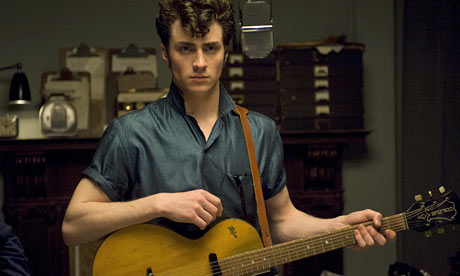
Kristin Scott Thomas does a great job of showing the brittle side of Aunt Mimi, while also quietly showing why she was such a good co-conspirator with her charge.  Anne-Marie Duff's Julia is a girl-child, too immature to be a mother, as she always wants to be the girl-friend.  But the miracle is Aaron Johnson, who doesn't really look like Lennon (in the same way that Joaquin Phoenix never looked like Johnny Cash in Walk the Line), but has done such a fine job of looking at documentaries and studying the much filmed Lennon, that he has the manner down...so much so, that he begins to resemble him, mostly in motion, until you just accept the impersonation.  We've seen our share of bad Beatles imitations, but Johnson captures the illusion in all its facets of the diamond in the rough, and the Spaniard in the Works.

Nowhere Boy is a Matinee.


Wednesday, April 21, 2010

Kick-Ass

"Super-hero-Nihilistic-Crypto-Fascist Bull-shit"


"Kick-Ass" is the latest comics off-shoot to hit the movies and the comics and film geeks have only increased the amount of saliva that's escaped their lips. There hasn't been this much anticipation for a movie since...oh, "Watchmen" and before that, "Snakes on a Plane." Both films, though eagerly awaited, and generating reams of MB's of blog-love, were disappointments as income generators for the studios who translated the hype into an actual commitment to...ya know...actually GO to see the movie. Failure to commit? Or premature ejaculation?

Don't know. Probably both.

But, "
Kick-Ass" is geared right to the enlarged heart of fan-boys, a celebration of the super-hero concept that preaches empowerment to the wish-fulfilling power-seekers, who wish-oh-wish-oh-wish that they could have a freak-accident or some inspiring tragedy or be born on another planet that can turn them from one of the disenfranchised to one of the disenfranchised—who can kick your ass.

That the movie opens the day after Tax-Day cannot be a coincidence.

It's a revenge-fantasy-placebo to those who feel they're being taken advantage of by people who've "got all the breaks" or who have power that the wannabe- hero covets. I've read a lot of comics (still do), but am critical enough to see them for what they are: Spandex Fascist Fantasies, whether you're
a Big Blue Boy Scout or you strike terror into a superstitious cowardly lot. The tables turned for me when I read a "Superman" comic where Lois Lane expressed surprise Superman knows her address. "Of course, Lois," says Mr. X-Ray Vision. "I know where everybody lives."

Creeeepy.

That re-red-boot of "
Superman" was written by John Byrne, and he is of the group of comic-book writers who are a little too reflexive in their writing, because what they know is comics history and movies, and when you read one of their breathless narratives you know what movies they've been seeing as plot-lines and lines of dialogue are lifted with and without acknowledgement. They're pop-culture pin-ball machines of borrowed movie phrases and plots that ping into comic-books and pong back into movies and television (enough to make me go *Tilt!*). One can't escape the sense that the ideas are as recycled as the pages they're printed on, and that these writers are riding the coat-tails (or capes) of the ink-stained brethren who have blazed trails before them. They provide a familiar comfort, but not an awful lot of insight. In that class of well-read writers are Brian Michael Bendis, Frank Miller...and Mark Millar.

Millar is the original...and I say that ironically...author of "
Kick-Ass" which he put to paper with artist John Romita Jr. (the second generation of Romita artists—he also provides illustrations and a nifty 3-dimensional "comic-book-within-a-comic-book sequence for the film). And his story is a sort of "Watchmen-tykes" version of Alan Moore's break-down of the conventions of comic book heroism, going beneath the costumes and exploring the motivations beyond what is described in "Kick-Ass" as "a combination of optimism and naivete"—it goes into realms of dysfunction, survivor's guilt, masochism, politics and aberrant sexuality. But "Kick-Ass" doesn't have the depth of Moore's work, while also borrowing from themes in Rick Veitch's "Brat Pack."

"
Brat Pack" is a pretty seamy examination of hero side-kicks, but there is an unstated empathy for the kids who go out "adventuring" at the behest of their driven mentors. The kids in "Kick-Ass" aren't given that much consideration, and it's all done in the name of "fun." Certainly the film has been sold by countless previews on the comedic aspect of the story.

But they leave out
the brutal beatings and stabbings, the use of firearms by hero and villain alike—there really isn't any moral delineation between the two factions and their techniques are similar—you are told that one is "good" and the other is "bad," but other than that "optimism and naivete," the two could be the same—protecting their own.

The age is bothersome. "
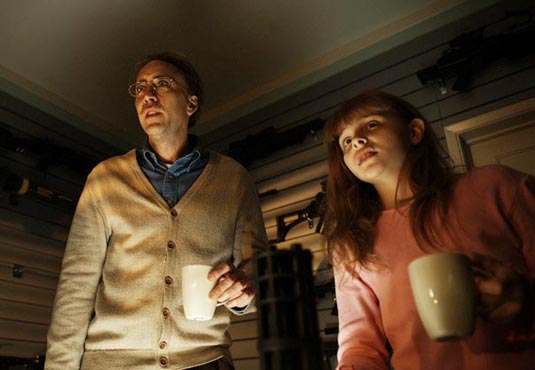
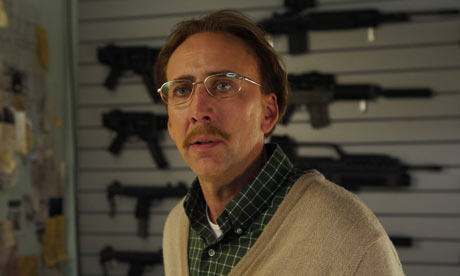
Kick-Ass" (a fine Aaron Johnson) and "Red-Mist" (an annoying Christopher Mintz-Plasse) are high-school age, but little "Hit Girl" (who is the best—albeit startling—thing in the movie as played by the chirpy Chloe Moretz) may be 10 or 11, and works at the behest of "Big Daddy" (Nicolas Cage), her gun-nut revenge-obsessed father. It's a bit off-putting to see her running up walls, firing hand-guns with complete abandon, whirling butterfly knives into the torsos of her victims, and chopping off legs and stabbing pushers through the sternum with a sword-capped baton. Her costume is a kinky combination of kevlar and plaid skirt. "Big Daddy" is a marksman in a bat-man suit. He loves his little girl and wants her protected in all his planned mayhem—an introductory training exercise testing the validity of her costume stopping bullets is the funniest thing in the movie—but how much love is there throwing your kid into harm's way for your own blood-lust?
This stuff is off-putting. Kids will want to see "Kick-Ass" but you've got to be a little stupid in the head to take them. The film is Rated "R" by the MPAA legitimately, but I notice why isn't spelled out. I'll tell you: persistent intense bloody violence—not "comic book action" as the euphemism goes—sexuality (and some sensuality and half-way nudity), constant endangerment to children, torture, disturbing images—one character is burned alive, drug use, and an endless stream of obscenities, some of which emanate from "Hit Girl." We're talking jaw-dropping F-clusters, and anatomy euphemisms that she didn't pick up at the school-yard—she's home-schooled (wait to go, Dad).

As I mentioned,
"Hit Girl" is fun—a "girl wonder" with acrobatic abilities and weapons accuracy that would put her in Olympic competition if it weren't for the blood-spatter in the front rows. And Chloe Moretz is a "find." I can just imagine Quentin Tarantino googling for pictures of her on the Internet. Nicholas Cage's "Big Daddy" is a tad weird. In costume, Cage uses a staccato way of speaking that's simply a bad Adam West imitation.

Ponder that phrase for a moment: "a...bad...Adam West imitation."

The other kids are a trifle...
Corey...for my taste. A little too cute in their geekitude. And Mark Strong's rackets king-pin is merely his Lord Blackwood from "Sherlock Holmes" with less style.

Matthew Vaughn can be a fine director, "Layer Cake" and "Stardust" being prime examples of him at his best two out of three. He stages the action in the same ramp-edited brutal style as "Watchmen" with the occasional bow to John Woo. And it never drags, and is quite clever in places. It ends with the vow of a sequel, with a purloined line from another super-hero movie. Been there, done that.

But "Kick-Ass" appeals to the worst of the The Fan-Boy Love Association, those "
Lost Boys" who never grow up, the "Beavis and Butt-heads" who clap and "huh-huh" at every disfigurement and perforation, and who point to the horrific validation of their comic fantasy story as being "realistic" and "adult." This isn't adult. This is fascist-framed thuggery for entertainment, whose paucity of idealism just turns into another validation for bullying to get yours.

I don't need a lunk-headed super-hero movie to do that. I can watch the news. It's a depressing, horrific spectacle—super-hero kiddie-porn.

Sing along with me now (you know the song):
I-it's
Super-hero-Nihilistic-Crypto-Fascist Bull-shit
Sado-masochism from a comic-writing half-wit
All the subtle nuance of a drive-by shooting mob hit
Super-hero-Nihilistic-Crypto-Fascist Bull-shit


"Kick-Ass" is Cable-watcher (when the kids aren't home).

Yes. Yes, he is.