Showing posts with label Matthew Vaughn. Show all posts

Tuesday, June 7, 2011

X-Men: First Class

"The X Factor"
or
"Don't 'X,' Don't Tell"

Movies from Marvel Studios seem to be running the pattern of "Star Trek" movies (at least in my eyes), the "even"-numbered ones tend to be best, while the "odd"-numbered ones are a little clunky.* That's certainly the case with the "X-Men" franchise.  Bryan Singer's first film did a lot of heavy lifting adapting the comic to the screen, but there was a virulent strain of exposition, and some jostled positioning of the characters in what is essentially an action soap opera.  The best thing about it was its casting, but its big confrontation was poorly done.  X-II, also  directed by Singer, with all the introductions out of the way, concentrated on story and moved along smoothly with an emotional end-point that seemed to matter. Singer left to complicate the "Superman" movies, and left X-III in the hands of Brett Ratner, who produced a very expensive film that looked cheap, felt cheap and really screwed up the X-Men line-up.  Ratner was required to use an expensive cast which ate up a lot of the film's budget, and the results on-screen suffered, despite the audience familiarity of the stars.  There really didn't seem to be anywhere for another film to go, without some heavy gene-splicing of the cast.

So, here's the fourth "X-Men" Movie (we won't talk about X-Men Origins: Wolverine—we already have) X-Men: First Class, a sort of re-boot of the series, although keeping elements from the original films that everybody seems to like.  They could have easily made it an "X-Men Origins" film.  It starts where the first film began—at a concentration camp in Poland as Erik Lensherr (here Bill Milner, but he'll grow up to be Michael Fassbender**) watches helplessly (for the moment) as his parents are imprisoned in a concentration camp.***  The parallel story is of young Charles Xavier (Laurence Belcher, then James McAvoy ) who finds a metamorph in his kitchen (Morgan Lily, but she'll be played as a young adult by the ubiquitous Jennifer Lawrence), whom, recognizing a fellow mutant-traveller, he takes in as a sister.  Their lives progress and Lensherr, who has developed powers over metal, hunts down the Nazis (particularly Kevin Bacon) who killed his parents and tortured him, while Xavier attends Oxford with his "sister" Raven, achieving top honors—and why wouldn't he, as he can read minds and project thoughts.

What is nice about X-Men: First Class is it takes real-world events of the time that Lee and Kirby were creating the series in the early 1960's—in this case, the nuclear gamesmanship of 1962 when the U.S. planted missiles in Turkey, which was then challenged by the Russians planting nukes in Cuba, thus lighting the match for the Cuban Missile Crisis in October of that year, which came within a sub-crew's breath of a nuclear X-change between the two very real "super-powers."  Singer is credited with the story, and however counter-intuitive it might have been to place it there (and it does create a couple of continuity errors), it "works" and works gang-busters.  With Singer's story and the direction of Matthew Vaughn (getting stronger and stronger with each movie), it feels more like a 60's groovy spy story than your standard super-hero fare, and for once—save for a poignant moment in X-II—the consequences of the plot really seem to matter. 

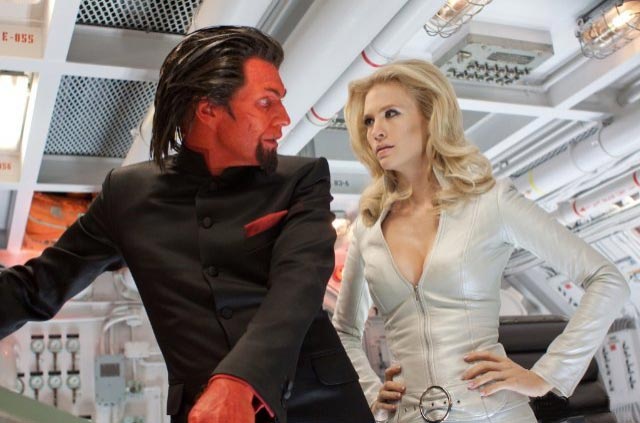
Those familiar with the "X-Men" comics will know of "The Hellfire Club"**** and it turns out that organization of nefariousness and debauchery fits in well with the swinging '60's.  Led by Sebastian Shaw (Bacon), with henchmen Azazel (Jason Flemyng), Riptide (Álex González) and Emma Frost (January Jones), they've pulled the mental strings of military puppets on both sides to set up the nuclear stand-off, and as Shaw absorbs energy, a nuclear holocaust wouldn't kill him, it would only make him stronger.  Banding together with the CIA, (uneasily, except for agent Moira McTaggert—Rose Byrne and another played by Oliver Platt), Xavier joins forces with Lensherr, in classic "the enemy of my enemy is my friend" style, and begin recruiting other mutants to form a secret society of operatives hiding in the shadows to do undercover work against the Hellfire Club.  Pretty soon, things become dire enough that they must come out of the cold and overtly take a stand, certainly taking their place among "the best and the brightest."

It's your classic "oppressed minority" story (something Lee and Kirby knew all too well when they were doing the comics—both were Jews, which was common among the pioneers of the creators of the superhero comics genre), but during the 60's it was a civil rights metaphor that only became more overt as the years went on.  Singer pitched his initial The X-Men concept as a "meeting between Martin Luther King and Malcolm X," but it was more than that; Singer gave it a "hiding in plain sight" slant towards gay rights that involved not only opposition to the mutants but out-right hysteria (something the scenario buys into with the "recruitment" angle, long a charge of anti-gay paranoia). 

So, you have a superhero flick that acknowledges its comics roots by employing a style from the movies of its origin's time-frame, with a rather clear-eyed look at a real-life crisis (mutants weren't involved, although I've always had my suspicions about Robert McNamara), some nice performances, grand-standing direction, good action set-pieces, and a few nice surprises for fans of both the comics and the previous films.  X-Men: First Class manages to be more than the sum of its parts, certainly the best of the series and among the best of the genre, thanks to its scope and style and its own undefinable, uncanny "X"-factor.


X-Men: First Class is a nifty Matinee. "First Class," indeed.


The First "X-Men" comic (from 1963)


* Iron Man being an exception.
** Fassbender is terrific, playing contained rage and menace throughout, but when he lets go with the emotional histrionics, there is just enough control to it to make you worry what would happen if he "really" let go.

*** They even use Michael Kamen's music from the first film in the scene.

**** Although writer Chris Claremont and artist John Byrne site "A Touch of Brimstone"—a controversial episode of the British TV series "The Avengers" (and it's important to make that distinction with Marvel)—there's been a long history of actual Hellfire Clubs. 

Wednesday, April 21, 2010

Kick-Ass

"Super-hero-Nihilistic-Crypto-Fascist Bull-shit"


"Kick-Ass" is the latest comics off-shoot to hit the movies and the comics and film geeks have only increased the amount of saliva that's escaped their lips. There hasn't been this much anticipation for a movie since...oh, "Watchmen" and before that, "Snakes on a Plane." Both films, though eagerly awaited, and generating reams of MB's of blog-love, were disappointments as income generators for the studios who translated the hype into an actual commitment to...ya know...actually GO to see the movie. Failure to commit? Or premature ejaculation?

Don't know. Probably both.

But, "
Kick-Ass" is geared right to the enlarged heart of fan-boys, a celebration of the super-hero concept that preaches empowerment to the wish-fulfilling power-seekers, who wish-oh-wish-oh-wish that they could have a freak-accident or some inspiring tragedy or be born on another planet that can turn them from one of the disenfranchised to one of the disenfranchised—who can kick your ass.

That the movie opens the day after Tax-Day cannot be a coincidence.

It's a revenge-fantasy-placebo to those who feel they're being taken advantage of by people who've "got all the breaks" or who have power that the wannabe- hero covets. I've read a lot of comics (still do), but am critical enough to see them for what they are: Spandex Fascist Fantasies, whether you're
a Big Blue Boy Scout or you strike terror into a superstitious cowardly lot. The tables turned for me when I read a "Superman" comic where Lois Lane expressed surprise Superman knows her address. "Of course, Lois," says Mr. X-Ray Vision. "I know where everybody lives."

Creeeepy.

That re-red-boot of "
Superman" was written by John Byrne, and he is of the group of comic-book writers who are a little too reflexive in their writing, because what they know is comics history and movies, and when you read one of their breathless narratives you know what movies they've been seeing as plot-lines and lines of dialogue are lifted with and without acknowledgement. They're pop-culture pin-ball machines of borrowed movie phrases and plots that ping into comic-books and pong back into movies and television (enough to make me go *Tilt!*). One can't escape the sense that the ideas are as recycled as the pages they're printed on, and that these writers are riding the coat-tails (or capes) of the ink-stained brethren who have blazed trails before them. They provide a familiar comfort, but not an awful lot of insight. In that class of well-read writers are Brian Michael Bendis, Frank Miller...and Mark Millar.

Millar is the original...and I say that ironically...author of "
Kick-Ass" which he put to paper with artist John Romita Jr. (the second generation of Romita artists—he also provides illustrations and a nifty 3-dimensional "comic-book-within-a-comic-book sequence for the film). And his story is a sort of "Watchmen-tykes" version of Alan Moore's break-down of the conventions of comic book heroism, going beneath the costumes and exploring the motivations beyond what is described in "Kick-Ass" as "a combination of optimism and naivete"—it goes into realms of dysfunction, survivor's guilt, masochism, politics and aberrant sexuality. But "Kick-Ass" doesn't have the depth of Moore's work, while also borrowing from themes in Rick Veitch's "Brat Pack."

"
Brat Pack" is a pretty seamy examination of hero side-kicks, but there is an unstated empathy for the kids who go out "adventuring" at the behest of their driven mentors. The kids in "Kick-Ass" aren't given that much consideration, and it's all done in the name of "fun." Certainly the film has been sold by countless previews on the comedic aspect of the story.

But they leave out
the brutal beatings and stabbings, the use of firearms by hero and villain alike—there really isn't any moral delineation between the two factions and their techniques are similar—you are told that one is "good" and the other is "bad," but other than that "optimism and naivete," the two could be the same—protecting their own.

The age is bothersome. "
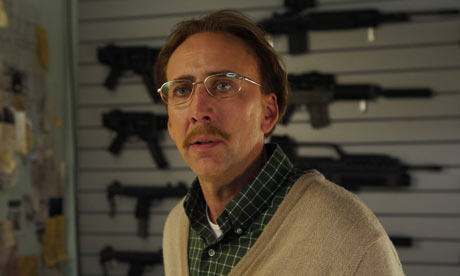
Kick-Ass" (a fine Aaron Johnson) and "Red-Mist" (an annoying Christopher Mintz-Plasse) are high-school age, but little "Hit Girl" (who is the best—albeit startling—thing in the movie as played by the chirpy Chloe Moretz) may be 10 or 11, and works at the behest of "Big Daddy" (Nicolas Cage), her gun-nut revenge-obsessed father. It's a bit off-putting to see her running up walls, firing hand-guns with complete abandon, whirling butterfly knives into the torsos of her victims, and chopping off legs and stabbing pushers through the sternum with a sword-capped baton. Her costume is a kinky combination of kevlar and plaid skirt. "Big Daddy" is a marksman in a bat-man suit. He loves his little girl and wants her protected in all his planned mayhem—an introductory training exercise testing the validity of her costume stopping bullets is the funniest thing in the movie—but how much love is there throwing your kid into harm's way for your own blood-lust?

This stuff is off-putting. Kids will want to see "Kick-Ass" but you've got to be a little stupid in the head to take them. The film is Rated "R" by the MPAA legitimately, but I notice why isn't spelled out. I'll tell you: persistent intense bloody violence—not "comic book action" as the euphemism goes—sexuality (and some sensuality and half-way nudity), constant endangerment to children, torture, disturbing images—one character is burned alive, drug use, and an endless stream of obscenities, some of which emanate from "Hit Girl." We're talking jaw-dropping F-clusters, and anatomy euphemisms that she didn't pick up at the school-yard—she's home-schooled (wait to go, Dad).

As I mentioned,
"Hit Girl" is fun—a "girl wonder" with acrobatic abilities and weapons accuracy that would put her in Olympic competition if it weren't for the blood-spatter in the front rows. And Chloe Moretz is a "find." I can just imagine Quentin Tarantino googling for pictures of her on the Internet. Nicholas Cage's "Big Daddy" is a tad weird. In costume, Cage uses a staccato way of speaking that's simply a bad Adam West imitation.

Ponder that phrase for a moment: "a...bad...Adam West imitation."

The other kids are a trifle...
Corey...for my taste. A little too cute in their geekitude. And Mark Strong's rackets king-pin is merely his Lord Blackwood from "Sherlock Holmes" with less style.

Matthew Vaughn can be a fine director, "Layer Cake" and "Stardust" being prime examples of him at his best two out of three. He stages the action in the same ramp-edited brutal style as "Watchmen" with the occasional bow to John Woo. And it never drags, and is quite clever in places. It ends with the vow of a sequel, with a purloined line from another super-hero movie. Been there, done that.

But "Kick-Ass" appeals to the worst of the The Fan-Boy Love Association, those "
Lost Boys" who never grow up, the "Beavis and Butt-heads" who clap and "huh-huh" at every disfigurement and perforation, and who point to the horrific validation of their comic fantasy story as being "realistic" and "adult." This isn't adult. This is fascist-framed thuggery for entertainment, whose paucity of idealism just turns into another validation for bullying to get yours.

I don't need a lunk-headed super-hero movie to do that. I can watch the news. It's a depressing, horrific spectacle—super-hero kiddie-porn.

Sing along with me now (you know the song):
I-it's
Super-hero-Nihilistic-Crypto-Fascist Bull-shit
Sado-masochism from a comic-writing half-wit
All the subtle nuance of a drive-by shooting mob hit
Super-hero-Nihilistic-Crypto-Fascist Bull-shit


"Kick-Ass" is Cable-watcher (when the kids aren't home).

Yes. Yes, he is.