Showing posts with label Chloe Moretz. Show all posts

Friday, October 25, 2013

Carrie (2013)

To Carrie Out the Lord's Vengeance
or 
"Mama, Don't Ruin it!"

I've been working on a review of Brian De Palma's latest film Passion the last couple of weeks (still working out how I feel about it—on a superficial enjoyment level it doesn't succeed very well, but if you appreciate craft and detail there is a lot to digest, and it makes you realize that a lot of older directors go through that shift where the details are more important than the Big Picture) and was watching an interview with De Palma* about the film (which I'll include again when I get around to finishing it) and at one point the subject of Kimberly Pierce making a new version of Carrie was broached.  

"We're friends", he said of Pierce, who made Boys Don't Cry and Stop-Loss. "I've seen some stuff and it looks good."  But the more telling comment from the talk is when someone brings up Piper Laurie (who played mother Margaret White in his version) and De Palma remarks: "Piper thought we were making a comedy."

As well she might have.  Stephen King's "Carrie" is a hoot to read (you can do so—textually—here), but it isn't if you take it too seriously.  Which is odd. King cackles and galumphs through his writing, something he also did when he took to acting and directing his films.  Which is why the best King adaptations have a surreal sense of giddy humor about them—they have to be a little over-the-edge, dangling their feet in the muddy waters of madness to be really, really good.  It's why George Romero made good King adaptations. And Kubrick (despite King's protestations).  And Carpenter.  And Reiner.  And De Palma.  But, if you get all solemn and reverential about them, they fall flat as pancakes.


Pierce gets precipitously close to that edge, but doesn't tumble over it.  She includes a couple of things that De Palma, and the screenwriter of both versions—and the musical version—Lawrence D. Cohen, left out of King's book, which are the opening scene of Carrie's birth (the harrowing circumstances alluded to in the first chapter) and a sub-plot involving Sue Snell.  Quite a few things are better—the kids...look like kids, not twenty-somethings from television sit-com's posing as teens.  The good of that is that the performances are more awkward and more vulnerable.  The downside is that they are all dewy lumps that don't have a lot of distinctiveness to them, so one is caught for a second wondering "which one is this, again?"  I mock the ages of the older Carrie cast-members, but they had the experience and chops (from those sit-coms, presumably) to make their characters known as soon as they entered a shot.  The 2013 kids are...awkward...looking like they're ready for a direction-cue in the middle of a take.  For example, as pretty and competent as Gabriella Wilde is (she plays this version's Sue Snell, the "remorseful" girl played first by Amy Irving), most of the time she's blandly waiting for her next line with a concerned furrow and not much else behind it.


One essential thing (given the times, making this Carrie somewhat relevant) is the inclusion of the evil genie of new media into the mix.  Every kid here has a cell-phone.  Every kid is documenting their lives like would-be film-makers (and Pierce throws in random samples of such stuff for bridging sequences, showing "normal" high school activity). But, the most innovative use of it comes when Carrie has a "period" in school that isn't scheduled and the girls in her high school gym class viciously taunt her, there's the added inevitability that some goonish lout will whip out their I-phone (usually banned from bathrooms for this very reason) to record the event.  At that point, the truly bad-bad girl of Kris Hargenson (a brunetted Portia Doubleday here, future Mrs. de Palma Nancy Allen then) decides to go one step further, post it on YouTube, and it's then that punishment is meted out to the class. For Kris, this is unfair—she doesn't want to be an out-cast as she sees Carrie is and lashes out, digging herself deeper and deeper into detention, punishment and malicious revenge—and that video is used to twist the knife during the horrific prom sequence.  It raises the stink of public media being thrown into the mix of private bullying and how it has escalated the trauma of humiliation by bringing mob mentality into the pecking order, empowering the mean-spirited far beyond their reach, and narrowing the victim of options for safe zones that might bring light (and perspective) to their situation.  At that point, humiliation becomes torture and isolation becomes impenetrable.


As I said, if you take this stuff too seriously, it becomes no fun at all.  And while Pierce's heart is in the right place, standing up for the repressed outcast and removing the puerile nudity of De Palma's version, she also goes a bit too far, making things less horror-ific, and more disturbingly real.  For example, taking the loony ecstasy that Laurie brought to her fundamentalist (no fun; all mental) mother—Julianne Moore's version is seriously deranged, scratching herself to bleeding at the slightest provocation—and making Moretz's Carrie a very active revenge-seeker (where Spacek's interpretation was all evil-eye and mannequin-stiff, Moretz directs the carnage like a magician), the changes make her much less sympathetic as a character.  Even though both movies show Carrie "learning her craft" by checking out resources in the library (I thought schools were banning books right and left—heck, they even ban "Carrie!"), the new Carrie seems to have more control than Spacek's, whose bursts of revenge felt like an id monster that would combust things with a look.  This one concocts tortures and lingers over them like a cat playing with a mouse.  Hey, control is great, but at what point does the tortured become the torturer?  At what point do we lose sympathy for her and see her as just another maniac terrorizing a school?  At what point does that earnestness work against the intent?


So.  Good attempt.  Maybe even worth the effort.  But, at some point, this new Carrie manages to undermine the reason it was generated in the first place—to give us a really good scare.  Perhaps real life events have just caught up and overwhelmed the perspective of seeing entertainment in this, or, to make debating points, the filmmakers just eked out some of that entertainment value.  But, I remember leaving the first Carrie feeling sympathy for the devil, seeing it as a tragedy.  This time, it seemed everything was a natural consequence of tinkering with forces beyond one's control, especially if self-control is in short supply.  There was no catharsis, and at that point, Carrie just stands for nothing, a nihilistic bloody mess. 

Carrie is a Rental.


*


Wednesday, May 16, 2012

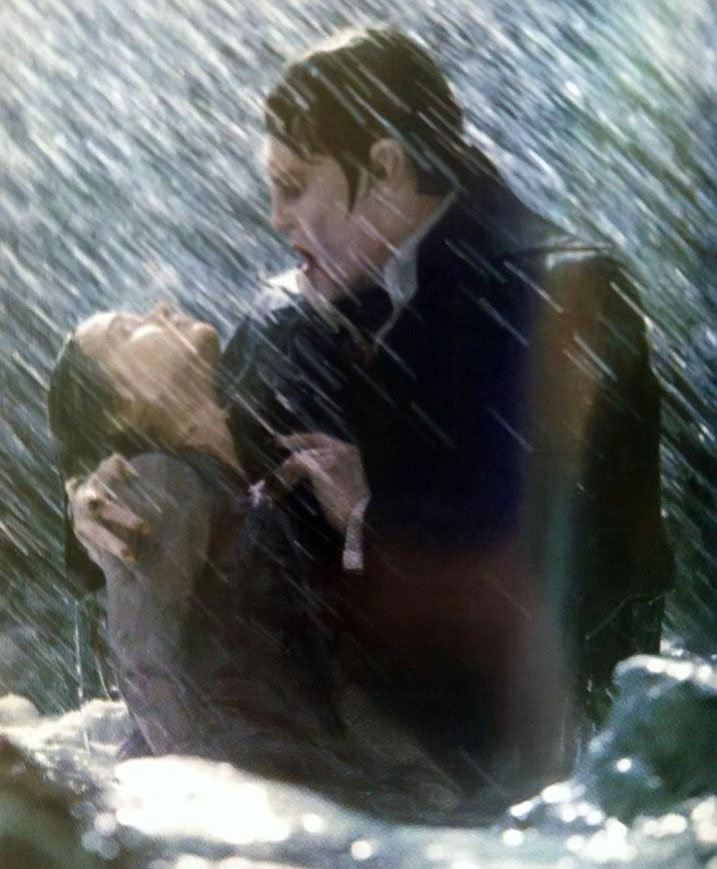
Dark Shadows (2012)

Camping Vamps and Risible Damp
or
"What Strange Terrain is This?"

"Dark Shadows" has been a cult favorite for Baby-Boomers for 40 years (ouch!), long before it was fashionable to have vampires as fodder for young adults.  The ABC soap opera ran for several seasons of afternoons replacing the standard plot-lines of cheating spouses and long-lost family secrets with long-buried family relatives and a full range of gothic ghoulery that plundered every horror story in the crypt-library, including vampires, werewolves, Frankenstein-ish monsters, time-travel, parallel dimensions and ghost stories.

It was a TV habit of mine when I was a kid, timed perfectly to be the after-school tonic for a parochial school education, an occult chaser for the catechism, all those crucifixes I was surrounded by during the day being used for other purposes.  It was also a fixation for Tim Burton and Johnny Depp, Burton digging the horror genre and Depp grooving on the character of Barnabas Collins (played by the late—or is he?—Jonathan Frid, who puts in a very brief cameo here along with a couple of other cast-mates), the reluctant vampire who pursued hearts, rather than the blood that pumped through them.  The result of their dual obsessions is this version of Dark Shadows, produced by Depp, directed by Burton.

"It is said that blood is thicker than water," narrates Barnabas Collins (Depp), over the strains of Robert Colbert's alto flute-through-echoplex composition "The Secret Room" from the original series.  "It binds us, confines us, curses us."  For a moment, things are fairly serious as the 18th century story of young Collins scion Barnabas is unearthed, with his spurning of the witch Angelique Bouchard (Eva Green) and her subsequent dark revenge, killing the Collins elders, forcing the suicide of Barnabas' love Josette and turning him into an eternally cursed vampire.  She subsequently sets the townsfolk on the monster who chain him into a coffin and bury him for all eternity.

Depp and Burton get it right at the beginning: Barnabas learns his fate.
The worst-laid plans of mages and men...Eternity is cut short around 1972 as the construction of a new McDonald's in Collinswood unearths Barnabas and he lays waste to a construction crew (who must have been getting overtime working at night!) with an explanatory "You have no idea how thirsty I am!" 

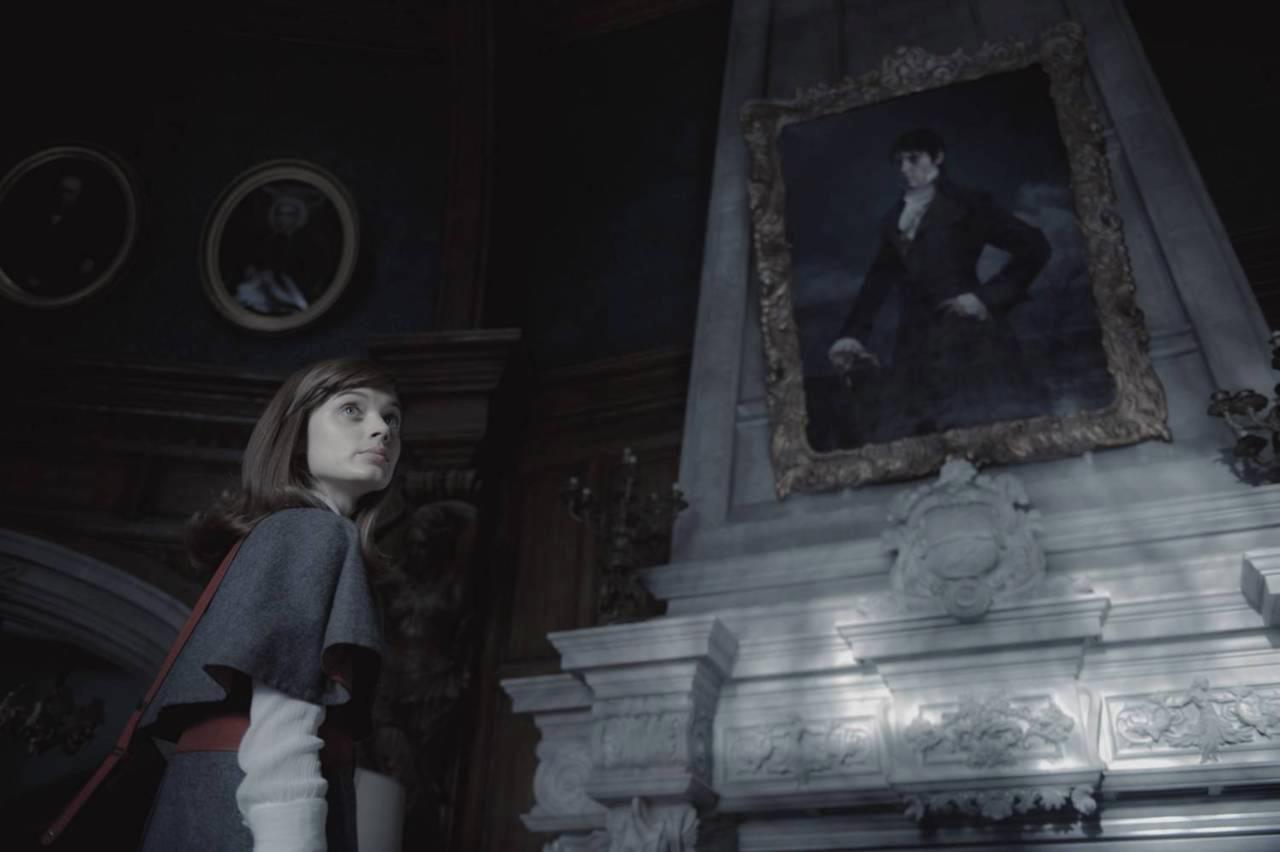
On a parallel course, Maggie Evans (Bella Heathcote, the latest in a long line of Burton ingenues with thin necks topped by big heads with huge eyes and "big" hair) is on a train to Collinswood where she has applied for a job as a governess to young David Collins (Gulliver McGrath), who is having psychological issues from the disappearance of his mother at sea.  Abruptly, she decides to change her name to Victoria Winters, indicating a past she wants to run away from, as The Moody Blues tune "Knights in White Satin" burbles over the soundtrack.  Hey, Burton may be onto something here.  The combining of '70's kitsch and some of its more mordant songs with the gothic mood of "Dark Shadows" works well, setting the tone of the series and the morbid fascination my generation had with it.  Can "Don't Fear the Reaper" be far behind?

Then, things get a little weird.  She's picked up by a VW van of hippies, and there's some stoned comedy about how they're so wasted, and Vicky is cool, man, and it's easy laughs and you wish it was more clever.  It becomes apparent quickly that Burton will be playing this for laughs, which is fine (he always does to a certain extent), but the original material is already so melodramatic and over-the-top that the humor undercuts the effectiveness of what drama there is that ekes through the dramatic stares and the vamping poses.  "Dark Shadows" was always "camp" entertainment in the broad sense, but to broaden it even further nullifies whatever chills and thrills can be drained from it.  This is why Frid's performance on the show was such an anchor for it—he played it absolutely straight, and in fact, ramrod-stiff; you didn't make fun of Barnabas for fear of his wrath—or his breaking down in tears.

Depp's Barnabas is tortured, of course, but risibly so (in a performance that's a combination of Frid's formality, some Max Schreck thrown in, and a bit of Ed Wood cast-mate Martin Landau's incarnation of Bela Lugosi).  And there's the "otherness" factor that Depp brings to so many of his roles, as if he's in a different movie from everybody else—he walks through it, and everybody reacts, usually comedically and derisively.  In part, that's the point: it ties in with Burton's feelings growing up as being an outsider-geek, looking on at the rest of the world that he found strange, while it found him odd (and there's a mirroring through-line of humor throughout the film of Barnabas, out of his time, observing to some horror the eccentricities of 1970's life, that reflects it).*

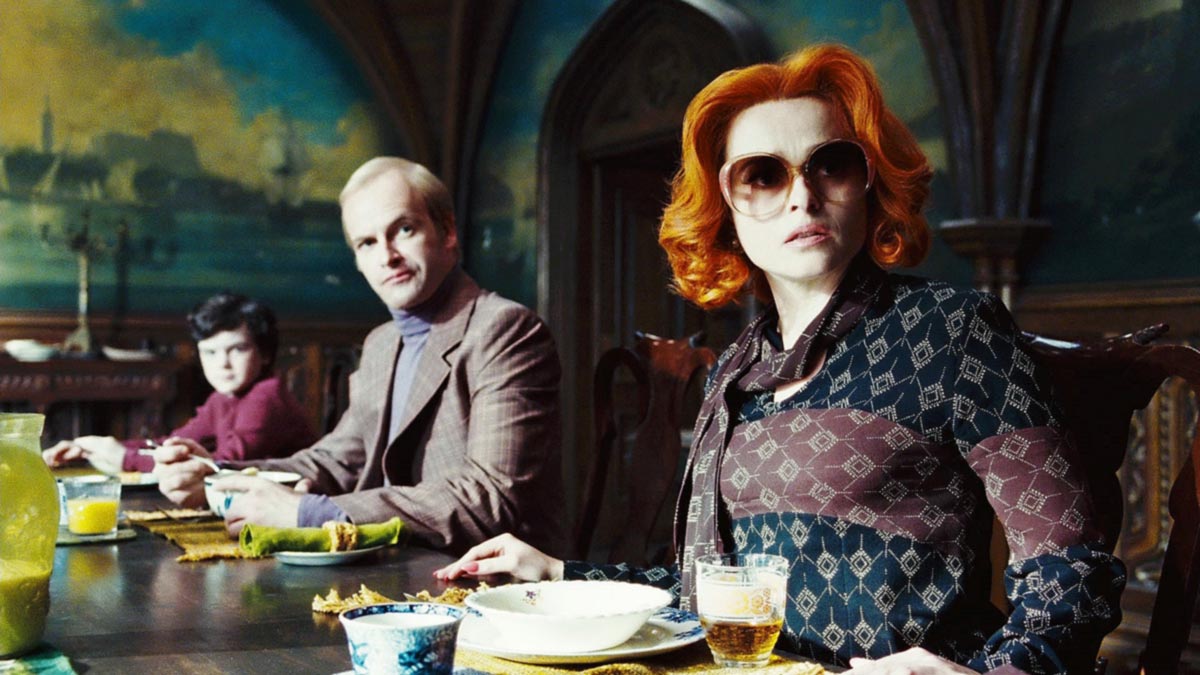
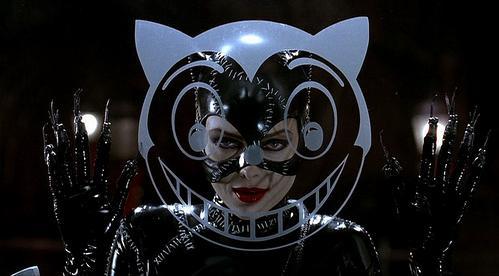
But Collinwood's odd family doesn't bat an eye when Victoria shows up and doesn't react to the disrepair of the gothic Collinwood mansion or to David's assertion that he speaks to his dead mother, and she follows quite readily when the ghost of Josette appears floating down the hallways, whispering "He's coming..."  Barnabas' arrival, in Victorian array and the palest of skin, and the oddest of manners only brings up temporary suspicions, but the matriarch of the house (Michelle Pfeiffer, who played Burton's Catwoman) readily accepts him as family, even after revealing his vampirism.  The cast is uniformly fine, gamely being archly camp throughout, but the one performer who's best at it is Green, who clearly relishes the villainess role and has fun with it, taking it in some very odd, even poignant places.

It looks great.  Burton's films always do, with a superb design sense and his knack for picking terrific, seemingly impossible angles to shoot from.  But, like a lot of Burton films, it tends to fall apart in story, snatching hasty explanations and deus ex machina to get out of trouble, or to provide the director with a bizarre concept that may seem right in retrospective sub-context, but that comes out of nowhere, randomly and jarringly.  One has to stop, back-track, only to realize that, no, this has never been mentioned before, and why now?

One suspects it's a whim, a passing "wouldn't-it-be-crazy-if" thought passed between Depp and Burton as they geek out, rocking in their corners, internal logic no longer mattering as much as a superficial entertaining notion.  As such, Dark Shadows accomplished their goals.  Yeah, it's entertaining, but highly insubstantial, a mere spirit of a movie.

Dark Shadows is a Rental.


The first Dark Shadows movie (left) and the original Barnabas Collins, Jonathan Frid


* This also sets up a series of sight-gags that are somewhat clever, as Barnabas never seems to be able to find appropriate sleeping arrangements at Collinwood.

Wednesday, October 27, 2010

Scare Me Once, Shame on You. Scare Me Twice...


"Just So You Know, I Won't Be Your Friend"

Let Me In is an American remake of Let the Right One In, the terrifically creepy 2008 Swedish film—(here's my review of that here).  For those who hate sub-titles, this is probably a good thing.  And what's good about the original is slavishly copied here, but director Matt Reeves (Cloverfield) does some good things (and a couple bad) to move the situations from frozen Sweden to a wintry Los Alamos, New Mexico.* The best thing is the acting.  Let Me In includes such great thesps as Richard Jenkins (a fine actor and more people will see him in this than any other film he's done) and Elias Koteas.  But, it's the kids who are the best thing about it.  Anyone who's seen Kick-Ass already knows Chloe Moretz is terrific, but this is less of a joke-performance, and plumbs the depths of what she can do dramatically.  Her  waif, Abby ("I'm 12...more or less") starts out alarmingly strange, but as the movie progresses, the character turns more vulnerable and sympathetic—far more than Lina Leandersson in the original.  But, the stand-out here is Kodi Smit-McPhee as the initially screwed-up Owen, a victim in danger of continuing in an unthinking cycle of violence.  McPhee's Owen wears his heart on his sleeve—he just won't show it on his girlish face—but as the movie progresses, that face starts to beam (he is far more expressive than the Swedish version's KÃ¥re Hedebrant, in fact, both kids in the first have a Teutonic reserve that is appropriate for that film's style, but would seem catatonic in this version) as he approaches his relationship with Abby with the same vulnerable hopefulness he just can't allow in his other interactions.

Reeves does manage to make some things his own, as well.  He mostly discards the firsts glacial blue color palette for a neon orange that suffuses scenes, and he nicely captures a bit of the gender-bending feel of the first, though differently.  Also, he very cleverly stages some of the violent sequences obliquely, thrusting them in the stage-rear of the frame while the main focus is going on in the foreground.  The more human attacks are handled extremely well, surprisingly—alarmingly so, but the movie veers into goofiness whenever more occultish violence occurs.  The director holds on the scenes too long, and even though a lot of it is done in back-lit cameo, the effects make it look like the perp is less a savage beast than a crazed monkey with a banana-buzz.  Sure, there should be some giddy thrill involved in horror, but "giddy" shouldn't translate to guffaws.  He also makes crystal-clear the true horror of the piece, something that only occurred to me, after a bit of time of contemplation—for some reason, I like my "OMG" moments to be outside the theater.  And he gums up the last scene of the film with a too-nostalgic pop reference that negates its effectiveness.

Still, after having dismissed the idea of an American remake with "may it never see the light of day," I have to admit that this one doesn't suck badly.

Let Me In is a Matinee. 


"Paramount Pictures would like to thank the family of the deceased..."

I'm surprised that Matt Reeves wasn't pegged to direct Paranormal Activity 2, considering he pulled the same cinéma vérité trick with his Cloverfield as Oren Peli did with the first PA.  Reeves might have actually done something different, as opposed to this corporate product generated to merely try and tap the success of the first.  Right off the bat, the vibe for this one is different, with the Paramount honchos putting the corporate brand in the very first crawl (which is partially used for the title of this piece)—a subterfuge, anyway, as it is "only a movie" and Paramount Pictures isn't thanking anybody, they're just trying to take your money, while fulfilling their initial wish to re-make the first movie (which was made independently for $11,000) under their corporate umbrella, thus inflating the cost to $2,750,000, while, cluelessly, also hoping to duplicate the original's success.  Guess what, Paramount?  The Paranormal Activity's financial success depended on the negative cost being so damned low.  That won't happen when you're paying gaffers, best boys, painters, assistant directors and assistants to the executive producer (all missing from the original) a sizable wage.*

They also can't duplicate the original's artistic success, either, such as it was.  The first film took a nugget of a good idea and ran with it, employing some audience knowledge of video conceits and, like any good horror-meister, letting the audience do their dirty work, trusting that what the sweating masses in the dark will come up with will be far more horrible than what actually occurs.  A couple of shock-cuts, and you leave them quivering in fear.

But Paranomal Activity 2 really doesn't do anything else than go through the same motions.  Oh, there is more coverage, thanks to an in-home security system that is installed after the initial "things that go crash on vacation" incident.  There is no 80herz hum that accompanies every incident, just some indeterminate sound effects (which are re-capped—and exposed as rather cheap—in the end-credits...End Credits?  That kinda destroys the illusion, too).  And this one is exposed to be more or less a prequel to the original...except that the actors shared by both look quite a bit older this time when the time-frame should be the same. 

It's just one of those moments of bone-headedness on the producers'/director's parts that show all they're interested in is going through the motions and collecting the cash, even if their efforts undercut the basic spookiness of the movie.  It's Corporate movie-making at its dumbest, laziest and most crass.  For example, you can't have a corporate movie release without some product placement (like that recognizable bottle of Sunny Delight in the kitchen, or the dramatically worthless talk about Burger King), which goes somewhat against the grain of a "captured" video source—and gaffe-spotters will have a field-day with this one—at one point, dad cracks a sexual joke by saying "Release the Krakken!" (the line from Clash of the Titans).  That would be funny, if it wasn't a glaring mistake.  That line of Liam Neeson's from the 2010 movie only became a catch-phrase this year...and the movie is supposed to be taking place...in 2006.  Oopsy!

There was no reason, other than plunder, for this movie to be made, and while one can say that the performances are decent, and it delivers enough jolts that you forget that dogs and children are the potential victims here, this is one best not attended.  Bad movies and bad movie franchises should be given the same advice as demon-poltergeists: "Just ignore it and maybe it will go away..."

Paranormal Activity 2 is a Waste of Time.


* Yes, it DOES snow in Los Alamos, New Mexico, and it has nothing to do with a Nuclear Winter.

** One of those Executive Producers is Akiva Goldsman, whose name seems to appear on any movie that sucks.

Wednesday, April 21, 2010

Kick-Ass

"Super-hero-Nihilistic-Crypto-Fascist Bull-shit"


"Kick-Ass" is the latest comics off-shoot to hit the movies and the comics and film geeks have only increased the amount of saliva that's escaped their lips. There hasn't been this much anticipation for a movie since...oh, "Watchmen" and before that, "Snakes on a Plane." Both films, though eagerly awaited, and generating reams of MB's of blog-love, were disappointments as income generators for the studios who translated the hype into an actual commitment to...ya know...actually GO to see the movie. Failure to commit? Or premature ejaculation?

Don't know. Probably both.

But, "
Kick-Ass" is geared right to the enlarged heart of fan-boys, a celebration of the super-hero concept that preaches empowerment to the wish-fulfilling power-seekers, who wish-oh-wish-oh-wish that they could have a freak-accident or some inspiring tragedy or be born on another planet that can turn them from one of the disenfranchised to one of the disenfranchised—who can kick your ass.

That the movie opens the day after Tax-Day cannot be a coincidence.

It's a revenge-fantasy-placebo to those who feel they're being taken advantage of by people who've "got all the breaks" or who have power that the wannabe- hero covets. I've read a lot of comics (still do), but am critical enough to see them for what they are: Spandex Fascist Fantasies, whether you're
a Big Blue Boy Scout or you strike terror into a superstitious cowardly lot. The tables turned for me when I read a "Superman" comic where Lois Lane expressed surprise Superman knows her address. "Of course, Lois," says Mr. X-Ray Vision. "I know where everybody lives."

Creeeepy.

That re-red-boot of "
Superman" was written by John Byrne, and he is of the group of comic-book writers who are a little too reflexive in their writing, because what they know is comics history and movies, and when you read one of their breathless narratives you know what movies they've been seeing as plot-lines and lines of dialogue are lifted with and without acknowledgement. They're pop-culture pin-ball machines of borrowed movie phrases and plots that ping into comic-books and pong back into movies and television (enough to make me go *Tilt!*). One can't escape the sense that the ideas are as recycled as the pages they're printed on, and that these writers are riding the coat-tails (or capes) of the ink-stained brethren who have blazed trails before them. They provide a familiar comfort, but not an awful lot of insight. In that class of well-read writers are Brian Michael Bendis, Frank Miller...and Mark Millar.

Millar is the original...and I say that ironically...author of "
Kick-Ass" which he put to paper with artist John Romita Jr. (the second generation of Romita artists—he also provides illustrations and a nifty 3-dimensional "comic-book-within-a-comic-book sequence for the film). And his story is a sort of "Watchmen-tykes" version of Alan Moore's break-down of the conventions of comic book heroism, going beneath the costumes and exploring the motivations beyond what is described in "Kick-Ass" as "a combination of optimism and naivete"—it goes into realms of dysfunction, survivor's guilt, masochism, politics and aberrant sexuality. But "Kick-Ass" doesn't have the depth of Moore's work, while also borrowing from themes in Rick Veitch's "Brat Pack."

"
Brat Pack" is a pretty seamy examination of hero side-kicks, but there is an unstated empathy for the kids who go out "adventuring" at the behest of their driven mentors. The kids in "Kick-Ass" aren't given that much consideration, and it's all done in the name of "fun." Certainly the film has been sold by countless previews on the comedic aspect of the story.

But they leave out
the brutal beatings and stabbings, the use of firearms by hero and villain alike—there really isn't any moral delineation between the two factions and their techniques are similar—you are told that one is "good" and the other is "bad," but other than that "optimism and naivete," the two could be the same—protecting their own.

The age is bothersome. "
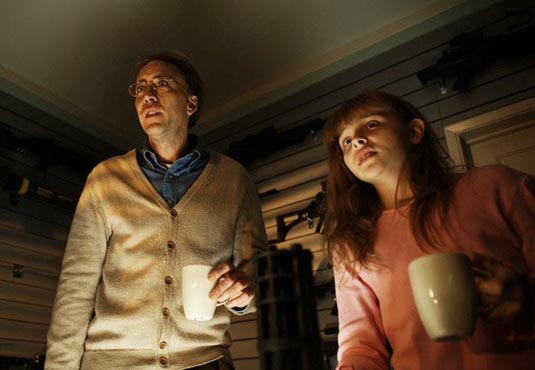
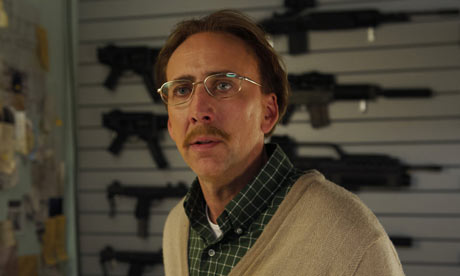
Kick-Ass" (a fine Aaron Johnson) and "Red-Mist" (an annoying Christopher Mintz-Plasse) are high-school age, but little "Hit Girl" (who is the best—albeit startling—thing in the movie as played by the chirpy Chloe Moretz) may be 10 or 11, and works at the behest of "Big Daddy" (Nicolas Cage), her gun-nut revenge-obsessed father. It's a bit off-putting to see her running up walls, firing hand-guns with complete abandon, whirling butterfly knives into the torsos of her victims, and chopping off legs and stabbing pushers through the sternum with a sword-capped baton. Her costume is a kinky combination of kevlar and plaid skirt. "Big Daddy" is a marksman in a bat-man suit. He loves his little girl and wants her protected in all his planned mayhem—an introductory training exercise testing the validity of her costume stopping bullets is the funniest thing in the movie—but how much love is there throwing your kid into harm's way for your own blood-lust?

This stuff is off-putting. Kids will want to see "Kick-Ass" but you've got to be a little stupid in the head to take them. The film is Rated "R" by the MPAA legitimately, but I notice why isn't spelled out. I'll tell you: persistent intense bloody violence—not "comic book action" as the euphemism goes—sexuality (and some sensuality and half-way nudity), constant endangerment to children, torture, disturbing images—one character is burned alive, drug use, and an endless stream of obscenities, some of which emanate from "Hit Girl." We're talking jaw-dropping F-clusters, and anatomy euphemisms that she didn't pick up at the school-yard—she's home-schooled (wait to go, Dad).

As I mentioned,
"Hit Girl" is fun—a "girl wonder" with acrobatic abilities and weapons accuracy that would put her in Olympic competition if it weren't for the blood-spatter in the front rows. And Chloe Moretz is a "find." I can just imagine Quentin Tarantino googling for pictures of her on the Internet. Nicholas Cage's "Big Daddy" is a tad weird. In costume, Cage uses a staccato way of speaking that's simply a bad Adam West imitation.

Ponder that phrase for a moment: "a...bad...Adam West imitation."

The other kids are a trifle...
Corey...for my taste. A little too cute in their geekitude. And Mark Strong's rackets king-pin is merely his Lord Blackwood from "Sherlock Holmes" with less style.

Matthew Vaughn can be a fine director, "Layer Cake" and "Stardust" being prime examples of him at his best two out of three. He stages the action in the same ramp-edited brutal style as "Watchmen" with the occasional bow to John Woo. And it never drags, and is quite clever in places. It ends with the vow of a sequel, with a purloined line from another super-hero movie. Been there, done that.

But "Kick-Ass" appeals to the worst of the The Fan-Boy Love Association, those "
Lost Boys" who never grow up, the "Beavis and Butt-heads" who clap and "huh-huh" at every disfigurement and perforation, and who point to the horrific validation of their comic fantasy story as being "realistic" and "adult." This isn't adult. This is fascist-framed thuggery for entertainment, whose paucity of idealism just turns into another validation for bullying to get yours.

I don't need a lunk-headed super-hero movie to do that. I can watch the news. It's a depressing, horrific spectacle—super-hero kiddie-porn.

Sing along with me now (you know the song):
I-it's
Super-hero-Nihilistic-Crypto-Fascist Bull-shit
Sado-masochism from a comic-writing half-wit
All the subtle nuance of a drive-by shooting mob hit
Super-hero-Nihilistic-Crypto-Fascist Bull-shit


"Kick-Ass" is Cable-watcher (when the kids aren't home).

Yes. Yes, he is.