Showing posts with label Michelle Pfeiffer. Show all posts

Wednesday, May 16, 2012

Dark Shadows (2012)

Camping Vamps and Risible Damp
or
"What Strange Terrain is This?"

"Dark Shadows" has been a cult favorite for Baby-Boomers for 40 years (ouch!), long before it was fashionable to have vampires as fodder for young adults.  The ABC soap opera ran for several seasons of afternoons replacing the standard plot-lines of cheating spouses and long-lost family secrets with long-buried family relatives and a full range of gothic ghoulery that plundered every horror story in the crypt-library, including vampires, werewolves, Frankenstein-ish monsters, time-travel, parallel dimensions and ghost stories.

It was a TV habit of mine when I was a kid, timed perfectly to be the after-school tonic for a parochial school education, an occult chaser for the catechism, all those crucifixes I was surrounded by during the day being used for other purposes.  It was also a fixation for Tim Burton and Johnny Depp, Burton digging the horror genre and Depp grooving on the character of Barnabas Collins (played by the late—or is he?—Jonathan Frid, who puts in a very brief cameo here along with a couple of other cast-mates), the reluctant vampire who pursued hearts, rather than the blood that pumped through them.  The result of their dual obsessions is this version of Dark Shadows, produced by Depp, directed by Burton.

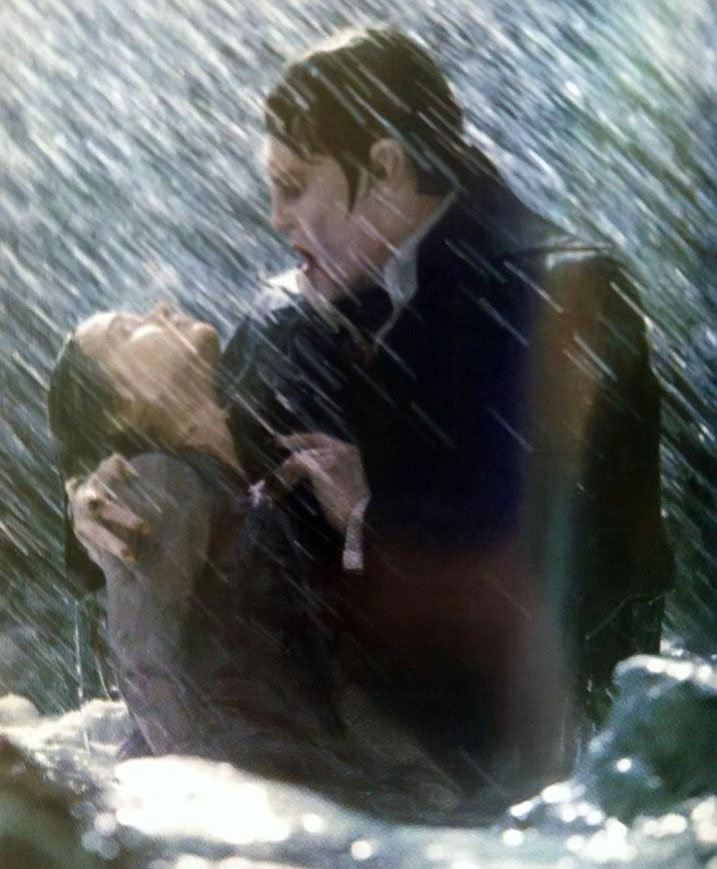
"It is said that blood is thicker than water," narrates Barnabas Collins (Depp), over the strains of Robert Colbert's alto flute-through-echoplex composition "The Secret Room" from the original series.  "It binds us, confines us, curses us."  For a moment, things are fairly serious as the 18th century story of young Collins scion Barnabas is unearthed, with his spurning of the witch Angelique Bouchard (Eva Green) and her subsequent dark revenge, killing the Collins elders, forcing the suicide of Barnabas' love Josette and turning him into an eternally cursed vampire.  She subsequently sets the townsfolk on the monster who chain him into a coffin and bury him for all eternity.

Depp and Burton get it right at the beginning: Barnabas learns his fate.
The worst-laid plans of mages and men...Eternity is cut short around 1972 as the construction of a new McDonald's in Collinswood unearths Barnabas and he lays waste to a construction crew (who must have been getting overtime working at night!) with an explanatory "You have no idea how thirsty I am!" 

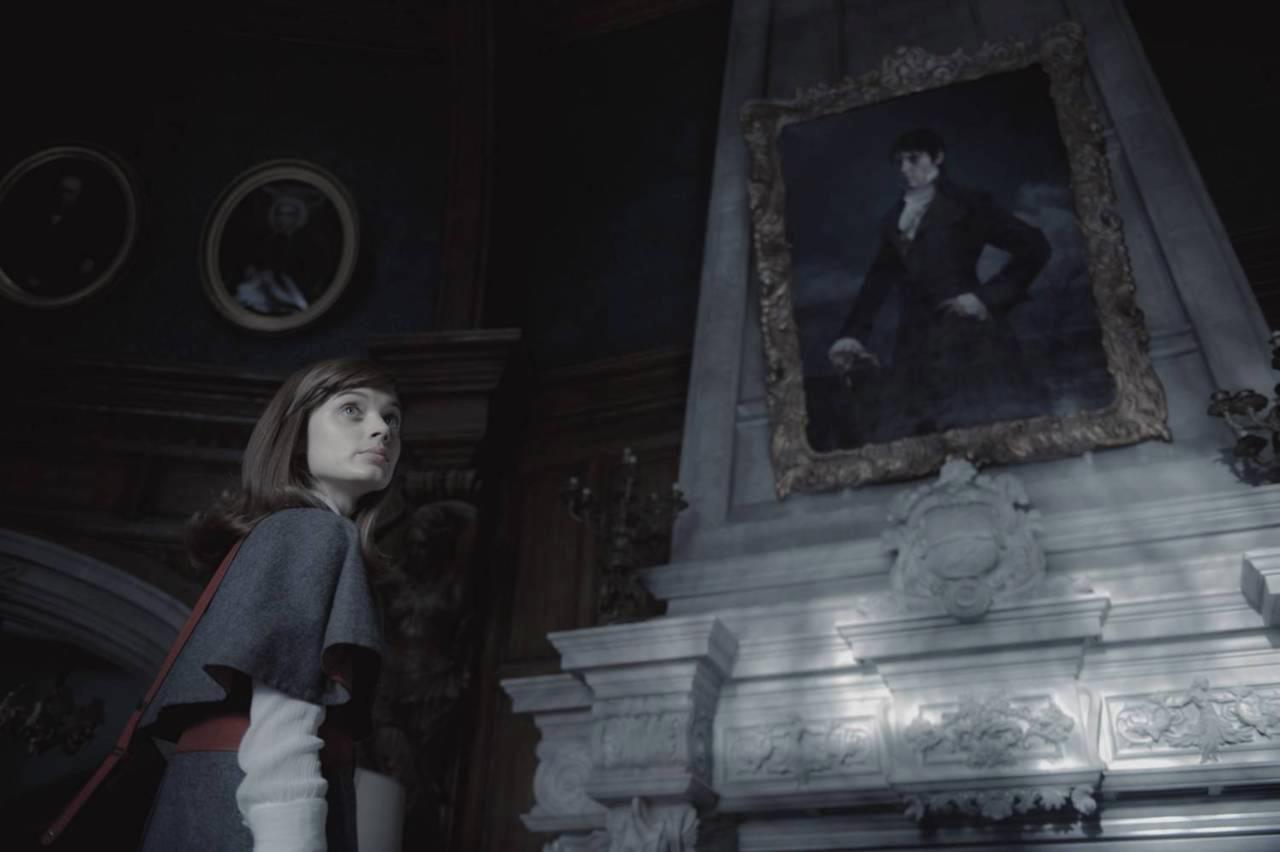
On a parallel course, Maggie Evans (Bella Heathcote, the latest in a long line of Burton ingenues with thin necks topped by big heads with huge eyes and "big" hair) is on a train to Collinswood where she has applied for a job as a governess to young David Collins (Gulliver McGrath), who is having psychological issues from the disappearance of his mother at sea.  Abruptly, she decides to change her name to Victoria Winters, indicating a past she wants to run away from, as The Moody Blues tune "Knights in White Satin" burbles over the soundtrack.  Hey, Burton may be onto something here.  The combining of '70's kitsch and some of its more mordant songs with the gothic mood of "Dark Shadows" works well, setting the tone of the series and the morbid fascination my generation had with it.  Can "Don't Fear the Reaper" be far behind?

Then, things get a little weird.  She's picked up by a VW van of hippies, and there's some stoned comedy about how they're so wasted, and Vicky is cool, man, and it's easy laughs and you wish it was more clever.  It becomes apparent quickly that Burton will be playing this for laughs, which is fine (he always does to a certain extent), but the original material is already so melodramatic and over-the-top that the humor undercuts the effectiveness of what drama there is that ekes through the dramatic stares and the vamping poses.  "Dark Shadows" was always "camp" entertainment in the broad sense, but to broaden it even further nullifies whatever chills and thrills can be drained from it.  This is why Frid's performance on the show was such an anchor for it—he played it absolutely straight, and in fact, ramrod-stiff; you didn't make fun of Barnabas for fear of his wrath—or his breaking down in tears.

Depp's Barnabas is tortured, of course, but risibly so (in a performance that's a combination of Frid's formality, some Max Schreck thrown in, and a bit of Ed Wood cast-mate Martin Landau's incarnation of Bela Lugosi).  And there's the "otherness" factor that Depp brings to so many of his roles, as if he's in a different movie from everybody else—he walks through it, and everybody reacts, usually comedically and derisively.  In part, that's the point: it ties in with Burton's feelings growing up as being an outsider-geek, looking on at the rest of the world that he found strange, while it found him odd (and there's a mirroring through-line of humor throughout the film of Barnabas, out of his time, observing to some horror the eccentricities of 1970's life, that reflects it).*

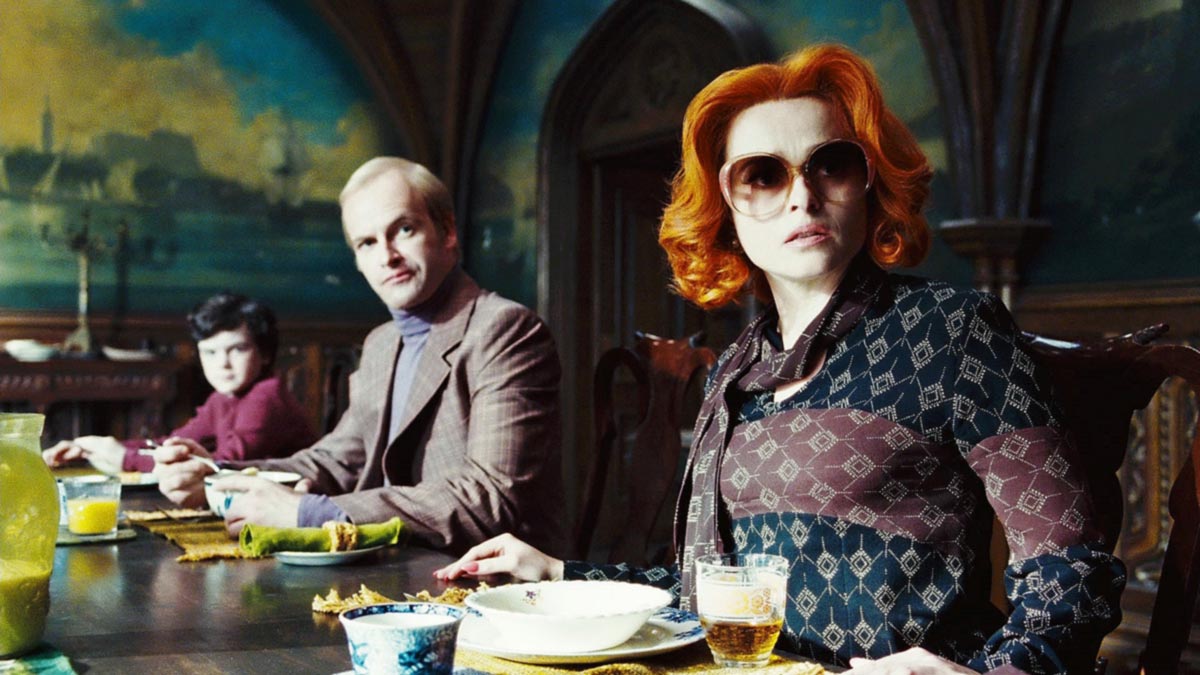
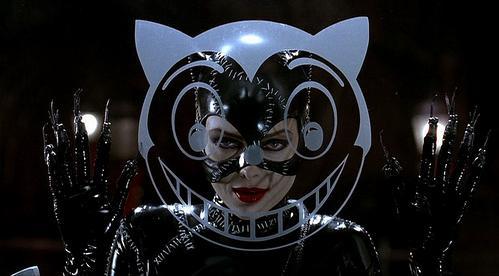
But Collinwood's odd family doesn't bat an eye when Victoria shows up and doesn't react to the disrepair of the gothic Collinwood mansion or to David's assertion that he speaks to his dead mother, and she follows quite readily when the ghost of Josette appears floating down the hallways, whispering "He's coming..."  Barnabas' arrival, in Victorian array and the palest of skin, and the oddest of manners only brings up temporary suspicions, but the matriarch of the house (Michelle Pfeiffer, who played Burton's Catwoman) readily accepts him as family, even after revealing his vampirism.  The cast is uniformly fine, gamely being archly camp throughout, but the one performer who's best at it is Green, who clearly relishes the villainess role and has fun with it, taking it in some very odd, even poignant places.

It looks great.  Burton's films always do, with a superb design sense and his knack for picking terrific, seemingly impossible angles to shoot from.  But, like a lot of Burton films, it tends to fall apart in story, snatching hasty explanations and deus ex machina to get out of trouble, or to provide the director with a bizarre concept that may seem right in retrospective sub-context, but that comes out of nowhere, randomly and jarringly.  One has to stop, back-track, only to realize that, no, this has never been mentioned before, and why now?

One suspects it's a whim, a passing "wouldn't-it-be-crazy-if" thought passed between Depp and Burton as they geek out, rocking in their corners, internal logic no longer mattering as much as a superficial entertaining notion.  As such, Dark Shadows accomplished their goals.  Yeah, it's entertaining, but highly insubstantial, a mere spirit of a movie.

Dark Shadows is a Rental.


The first Dark Shadows movie (left) and the original Barnabas Collins, Jonathan Frid


* This also sets up a series of sight-gags that are somewhat clever, as Barnabas never seems to be able to find appropriate sleeping arrangements at Collinwood.

Thursday, September 3, 2009

Hairspray (2007)

"Hairspray" (Adam Shankman, 2007) I'm not big on musicals. Rarely are they better than their source material and the songs, more often than not, are filler with "Moon/June" lyrics that fail to impress. My idea of clever musicals are "Guys and Dolls" and "The Music Man" that carry their music fantasies with a little bit of arrogant panache, daring you to not take it as seriously as regular dialog. My expectations of musicals are pretty low (which is good, I think, as it gves them more of a chance), and my expectations of "Hairspray"—despite rave reviews of the stage version that debuted *huzzah* in Seattle—were quite low. You just knew that a musical of "Hairspray" wouldn't be as edgy as the John Waters original. It was going to have to be neutered to be made "safe."

Plus, it has
John Travolta in it. I can't remember a John Travolta* movie where I was impressed with him. I was probably going in with the wrong attitude.

Because I enjoyed the Hell out of it. Word is that the movie version is a bit more stream-lined and a lot less camp than its stage-version. That may have helped, because "Hairspray" (the musical; the movie) is joyously anarchic, popping baloons gleefully as it goes—maybe laying it on a bit thick, as it goes—but as an expression of the freeing power of rock n' roll, few movies can top it. Especially the serious ones.

The year: 1962, pre-Kennedy assassination (it would have to be) in segregated Baltimore. For Tracy Turnblad (
Nikki Blonsky—this girl needs to work more), life is surviving school in time to get home to watch "The Corny Collins Show" (with James Marsden, going full-wattage cheese), a dance party television show, featuring her dancing dreamboat Link Larkin (Zac Efron, not quite legitimizing the hysteria over him). Her dreams come true when one of the teen-dancers takes a leave of absence ("Nine months," she doesn't need to explain) giving Tracy and her blond twig girlfriend Penny Pingleton (Amanda Bynes) a chance to audition. She has many obstacles: station owner Velma von Tussle (Michelle Pfeiffer, whom my wife described as "voluptuously hideous"—yes, indeed**), and her parents, Wilbur and Edna Turnblad (Christopher Walken and John Travolta).

Now, here I must stop.
Christopher Walken rarely fails to please, but it's a too-rare treat to see him sing-and-dance, which he obviously loves. And Travolta, in drag and dressed in a fat suit with a raspy ovah-the-"twop" Maryland accent?

He's great. Except for his accent slipping during the songs, he's damned near pitch-perfect, doing dance moves weighed down in prosthetics (and in high-heels no less), and providing a sympathetic life-force to the proceedings. Everybody's terrific in it, including old guys Paul Dooley and Jerry Stiller (who played Tracy's dad in Waters' original). Then there's Queen Latifah, who plays the "fill-in" host on Corny Collins' once-a-month "Negro Day"—the black dancers cordoned off from the white dancers by a rope partition—proving once again she is the Rock n' Roll Renaissance woman, who can rise above bad material, and soars with the good.

But it'd all be naught if not for the songs (
well-staged with choreography-friendly directing by Shankman that recalls past movie musicals) by Scott Wittman and Marc Shaiman. Shaiman's ear for 60's rock styles is flawless and the words by Wittman and Shaiman are clever and sassy and occasionally downright rude.

Original "Hairspray" auteur
John Waters even shows up (in an early cameo as a flasher). Word is that he's working on a screenplay for a sequel. If the product is half as fun as this singing step-child of his work, it will be a must-see.


* Since writing this, I remember I thought he did an extraordinary job of carrying Nicolas Cage's tic's in "Face/Off."

** Pfeiffer has a torchy song—"Miss Baltimore Crabs"—that she vamps though in such high-style that it catches one off-guard...until one remembers "Oh yeah...Susie Diamond."

Friday, August 28, 2009

The Russia House

"The Russia House" (Fred Schepisi, 1990) "Nowadays, you have to think like a hero merely to behave like a decent human being!" Barley Scott Blair (Sean Connery), barely getting-by book publisher, deep in his cups at a Russian Book Fair, seals his fate with those words. He soon finds himself wanted by both British Intelligence and the Russians, both looking for a hero in a final End Game in the Cold War in John le Carré's indictment of spies who don't have the sense to come in from the cold.

Scott Blair is a hapless go-between for secrets, dispensed by a radical Russian scientist code-named "Dante"* (
Klaus Maria Brandauer) who is willing to betray his country for The Good Fight for World Peace. He's enlisted his lover Katya (Michelle Pfeiffer) to contact Blair—the one man "Dante" trusts to smuggle his journals into the West for the purpose of publishing them. But "The Russia House," that wing of the Intelligence Service looking East, gets wind of it first and enlists Barley in an effort to learn as much about Russian nuclear capabilities as they can. Soon, he's wired for sound, followed by surveillance by the Brits (working with U.S. Intelligence) and embarks for a Russia about to collapse in Sovier dis-Union. He's starting to fall himself—for Katya—but, constantly monitored and miked, he'll have to resort to whispering sweet nothings in her ear. It couldn't be more appropriate.

It's a master-stroke to get Connery to play this non-spy in John le Carré's literary world of "anti-Bond's." His long association with 007 is cast aside as
he approaches the role bearded, curley-haired and gray, crotchety...and vulnerable, set upon by the author's tweedy grey men smug in their patriotism but lacking in honor. Tom Stoppard's screenplay takes a few bends out le Carré's labyrinthine plot, but none of the complications in the ethics and politics of strange bedfellows in matters of the State and the heart. The production is top-notch, filmed in Portugal and the Soviet Union, with an eye-popping cast of character actors supporting the Connery, Pfeiffer, Brandauer troika. On the British side are James Fox, Michael Kitchen, Ian McNeice, and...Ken Russell! The Americans are Roy Scheider, J.T. Walsh, and John Mahoney, all salamander-cool and not to be trusted.

But the best part of "The Russia House" is the sub-text, which is all le Carré's. Distrustful of his brethren in the spy-hood, the author has always been able to forecast a new sin for them to exploit or fall prey to, and David Cornwell (le Carré's nom de réalité) could see the upcoming glasnost and perestroika and see the forsty battles continue unthawed. Nothing worse or nosier than a spy with nothing to do and not know it. So he looked forward and looked to the past and compared and contrasted.

Remember this, if you must: a bitter cad who sticks his neck out for nobody, a committed idealogue fighting impossible odds, and the woman who is caught in between them. It's "Casablanca." But the milieu is wrong. Where the 1945 film is about choosing "the cause" and "the good fight" in a "mixed up, crazy world," in the world of "The Russia House," lives are being lost in a quest for worthless secrets...worthless because the other side already has them. The only thing to be gained in the cat-and-mouse games being played are the budgets being authorized for the cat and the mouse. In such a compromised clime, the problems of two little people amount to much more than a hill of beans, they are a world-entire of pledges to be kept and sanctity to be upheld. They are the only ideals left amidst the corruption. In such a world, the fundamental things no longer apply. And by basing his story on that timeless tale of love and sacrifice, le Carré throws into stark relief the world of today and that world.
Of a "mature, grown-up love" held against a world playing games...no matter what the future brings, as time goes by.

* In the book, he was, more appropriately, "Goethe"—the man who wrote about making deals with the devil, rather than about his territory.

Wednesday, November 14, 2007

Stardust

"Getting killed by pirates...heart eaten by a witch...meet Victoria--I can't seem to decide which is worse!"

Matthew Vaughn's film of "Stardust" is so far removed from his last film, "Layer Cake," that it would take a Babylon Candle to bridge the two (Don't know what a "Babylon Candle" is? Then you'll have to see the film. You should anyway). "Layer Cake" was a whooping, swooping kitchen-sink-and-porsches story of drug-dealing in contemporary London. And while some of the stylistic touches are the same for "Stardust," the story couldn't be more different. For instead of modern-day Britain, he is spinning his camera through Neil Gaiman's Faerie-Land.

Gaiman's reach is all things mythical, from the twee to the atrocious--across the stars, underground, beyond the pale and underneath your fingernails. He borrows from all sources, and puts them through his own personal salad-shooter and spits them out with his own dressing. In his work you'll find echoes of Shakespeare, Marlowe and Milton, G.K. Chesterton and Jorge Luis Borges and the Brothers Grimm, Greek mythology and Roman gods, History and Urban Legend, The Arabian Nights and the Book of the Dead, The Bible and the DC/Marvel Multiverses. I've been reading Gaiman with delight (no pun intended) for years, starting with his "Sandman" saga, which dragged on for maybe a dozen more issues than necessary because he had so many stories he wanted to get to, but I also love his "Violent Cases," and much of his book-work. It is with some trepidation that one watches his forays into film--Jon Peters owns the film-rights to "Sandman," for instance, and Gaiman wrote the English translation for "Princess Mononoke," and worked on "Mirrormask," and there's talk of filming "Good Omens," the book he co-wrote with Terry Pratchett. That's scary talk. For what it's done to the works of Alan Moore, Hollywood looks like a gold-plated abortion clinic, and one wonders if they could do any justice to Gaiman's work. Even to attempt to film his "Signal to Noise" would be to destroy it.

"Stardust" makes the transition fairly well, though it eliminates the faeries and sprites that populate Gaiman's world like smoke, dust and flotsam do in Ridley Scott's (they also serve as little "Rosencrantzes" and "Guildensterns"). They throw in a sock-o finale, and the film has none of the delicacy of Charles Vess' illustrations from the graphic novel that Gaiman expanded to book-length. In fact, it has the sensibility several refinements up from Monty Python-design. But it does retain Gaiman's special form of "myth-busting," the wink-and-a-nod to the "real" world that suffused "The Princess Bride," but without the Borcht Belt cinched around its waist.

What's interesting is how Paramount is selling it...or not selling it, as the case may be. Looking at the poster, you'd think it was one of the endless string of pre-teen or teen fantasy novels adaptations that are filling the Previews, or as reverent as "Chronicles of Narnia," when nothing could be further from the truth, (but there are enough spinning helicopter shots of big landscapes to reassure the Suits that it has a "Lord of the Rings" quality). It's frequently hilarious in surprising and snarky ways, especially in the casting. Michelle Pfeiffer may not be the best at holding an accent, but her comic timing, and willingness to play against her looks is delightful. Robert DeNiro makes an entrance and you worry that he's been put in the wrong movie, but then he comes through with flying colors. Peter O'Toole does wonders with his limited screen-time as the Lion-King of a family of blue-bloods, and Rupert Everett shows up long enough to tweak his image hilariously. It's a fun, fine, un-gooey fairy tale that charms and delights. It's not doing well at the theaters, so do yourself a favor and go. Don't wait for Paramount to get their act together to convince you.

"Stardust" is a matinee