Showing posts with label James Marsden. Show all posts

Friday, September 14, 2012

Robot & Frank

Future Tense: Past Imperfect
or
Wiping the Memory

Frank (Frank Langella) is a "retired" jewel thief, and getting old.  By day, he sits around the house, getting up late and reading a book—that old, antiquated form of reading in the future.  When he has half a mind to, he'll wander into town and visit the library, and flirt with librarian Jennifer (Susan Sarandon), and do a little light shop-lifting.  At night, he indulges in some light lock-picking...a man has to have a hobby.

But, living isolated, 30 years divorced with two grown kids with their own lives, he's solitary...and failing.  It's tough for son Hunter (James Marsden) to keep an eye on him, so he gets Frank the latest thing...a robot caretaker (performed by Rachael Ma, voiced by Peter Sarsgaard*) to get Frank on a regulated schedule, cook him healthy meals, clean, and program some beneficial activities.

To Frank, the robot is one big rectal thermometer, and he spends the initial first few days trying to find a way to turn the thing off or, at least, a way to get under its metal skin (those lock-picks might come in handy!).  Frank grouses, kvetches, protests and Robot (he never gets around to naming it) re-directs, gently persuades, all according to a program that looks for improvement, adjusts its approach and gently pushes.  It is altogether clear that Robot is more capable of change than Frank.  But, they're stuck with each other, in sickness and in health, until the old thief notices the precision and flexibility of the robot.  Maybe they might be of some use to each other, after all.

It's a great idea for a story, and the capacity for old dogs and programs to learn new tricks.  It might be a little too "out there" to make Frank a jewel thief, as the tale would be just as compelling, the interactions (the best part of the film) as interesting without it, but without that angle there wouldn't be much of a plot.  And the movie falls flat in the same area most speculative movies fall flat  the sociological aspect.  Oh, they get little technology details fine (there's one futuristic electric car, all the others are very contemporary) and the fashions are a little forward (but not hysterical ala The Hunger Games), but everything feels exactly the same as now.  There are no details, beside the talk of "brain-centers" and the demise of the bound book, about what the effect of these mechanical man-servants on people's lives, or the plight of the mentally challenged in this world.  This future does not look compelling, and after saying the film is set in "the near future," the idea is pretty much abandoned.**

But, that's the details.  For the most part, Robot & Frank clanks along, with a nicely done performance by Langella, the central interaction between the titular characters being the heart, soul and well-greased gears of it.

Robot & Frank is a Matinee.

* Sarsgaard's performance is in the same soft, reedy, solicitous manner that, I suppose, is de rigeur post-HAL 9000—Kevin Spacey did the same thing in Moon—but one wonders if one can do anything else with it, besides, of course,  fussy butlers.

** I could also quibble about one relationship being a little too neatly tied together, but to say anything else would be spoiling things.

Thursday, September 3, 2009

Hairspray (2007)

"Hairspray" (Adam Shankman, 2007) I'm not big on musicals. Rarely are they better than their source material and the songs, more often than not, are filler with "Moon/June" lyrics that fail to impress. My idea of clever musicals are "Guys and Dolls" and "The Music Man" that carry their music fantasies with a little bit of arrogant panache, daring you to not take it as seriously as regular dialog. My expectations of musicals are pretty low (which is good, I think, as it gves them more of a chance), and my expectations of "Hairspray"—despite rave reviews of the stage version that debuted *huzzah* in Seattle—were quite low. You just knew that a musical of "Hairspray" wouldn't be as edgy as the John Waters original. It was going to have to be neutered to be made "safe."

Plus, it has
John Travolta in it. I can't remember a John Travolta* movie where I was impressed with him. I was probably going in with the wrong attitude.

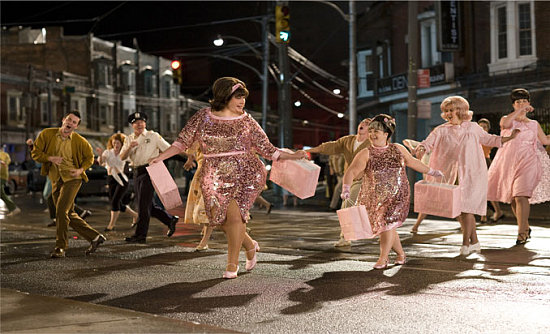
Because I enjoyed the Hell out of it. Word is that the movie version is a bit more stream-lined and a lot less camp than its stage-version. That may have helped, because "Hairspray" (the musical; the movie) is joyously anarchic, popping baloons gleefully as it goes—maybe laying it on a bit thick, as it goes—but as an expression of the freeing power of rock n' roll, few movies can top it. Especially the serious ones.

The year: 1962, pre-Kennedy assassination (it would have to be) in segregated Baltimore. For Tracy Turnblad (
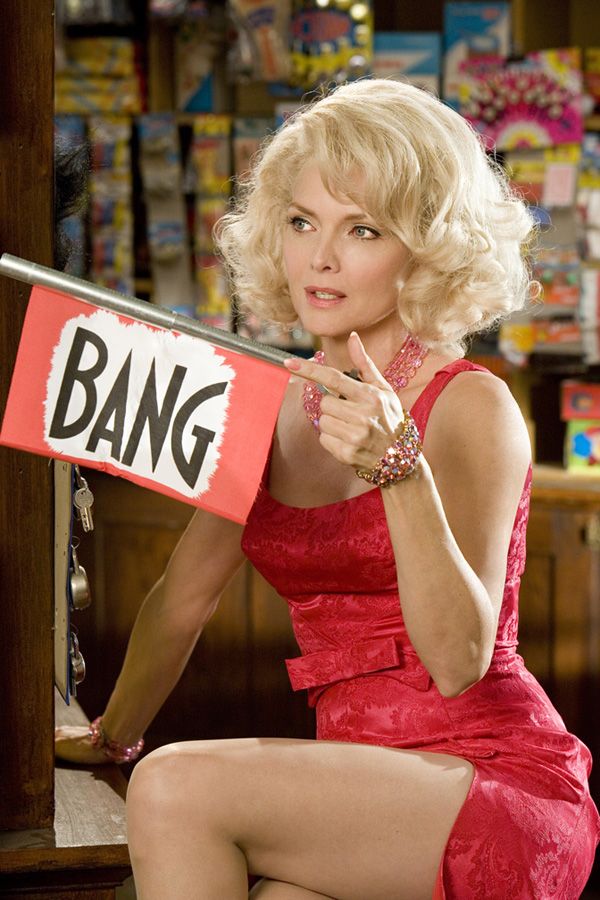
Nikki Blonsky—this girl needs to work more), life is surviving school in time to get home to watch "The Corny Collins Show" (with James Marsden, going full-wattage cheese), a dance party television show, featuring her dancing dreamboat Link Larkin (Zac Efron, not quite legitimizing the hysteria over him). Her dreams come true when one of the teen-dancers takes a leave of absence ("Nine months," she doesn't need to explain) giving Tracy and her blond twig girlfriend Penny Pingleton (Amanda Bynes) a chance to audition. She has many obstacles: station owner Velma von Tussle (Michelle Pfeiffer, whom my wife described as "voluptuously hideous"—yes, indeed**), and her parents, Wilbur and Edna Turnblad (Christopher Walken and John Travolta).

Now, here I must stop.
Christopher Walken rarely fails to please, but it's a too-rare treat to see him sing-and-dance, which he obviously loves. And Travolta, in drag and dressed in a fat suit with a raspy ovah-the-"twop" Maryland accent?

He's great. Except for his accent slipping during the songs, he's damned near pitch-perfect, doing dance moves weighed down in prosthetics (and in high-heels no less), and providing a sympathetic life-force to the proceedings. Everybody's terrific in it, including old guys Paul Dooley and Jerry Stiller (who played Tracy's dad in Waters' original). Then there's Queen Latifah, who plays the "fill-in" host on Corny Collins' once-a-month "Negro Day"—the black dancers cordoned off from the white dancers by a rope partition—proving once again she is the Rock n' Roll Renaissance woman, who can rise above bad material, and soars with the good.

But it'd all be naught if not for the songs (
well-staged with choreography-friendly directing by Shankman that recalls past movie musicals) by Scott Wittman and Marc Shaiman. Shaiman's ear for 60's rock styles is flawless and the words by Wittman and Shaiman are clever and sassy and occasionally downright rude.

Original "Hairspray" auteur
John Waters even shows up (in an early cameo as a flasher). Word is that he's working on a screenplay for a sequel. If the product is half as fun as this singing step-child of his work, it will be a must-see.


* Since writing this, I remember I thought he did an extraordinary job of carrying Nicolas Cage's tic's in "Face/Off."

** Pfeiffer has a torchy song—"Miss Baltimore Crabs"—that she vamps though in such high-style that it catches one off-guard...until one remembers "Oh yeah...Susie Diamond."