Showing posts with label Matinee. Show all posts

Tuesday, December 31, 2013

Saving Mr. Banks

"Just Because It's Fiction Doesn't Make it a Lie"*
or
"Cavorting, Twinkling, and Prancing to a Happy Ending Like a Kamikaze"

Mary Poppins was a bitch.  That's been my joke for a long time, especially given the reputation that Disney's film of Mary Poppins (this year voted to the National Film Registry) has of being just as sugar-gooey as cotton candy in an Orange County heat wave.  It isn't.  And I've gotten several startled looks from adults who then see the film and, yes, they do see that aspect of it, despite the step-in-timing chimney-sweeps, the dancing penguins, and the moments of larkiness. It's not all a jolly 'oliday with Mary. In the end, it's a little bittersweet, and she ascends into a Peter Ellenshaw matte painting of London that isn't dabbled in sunlight, but is a melancholy smearing of smoke and darkening skies.

That's probably due more to Travers' own stipulations to the Disney crew than to anything.  Disney could be dark—dinosaurs died and there was "Night on Bald Mountain" in Fantasia, Pinocchio had its moments jack-assery and Monstro swallowing, Bambi's mother died, and 101 Dalmations almost got skinned—and provided moments of terror and threat in its films, as long as everything turned out all right as the final song paraded people up the aisles. But, Mary Poppins would have been a slightly different movie if it hadn't been for Travers' nannying the scripters and Disney with her chalk-lines drawn in the sand.  For that, we should be grateful.


Maybe less so for Saving Mr. Banks, the Disneyfication of the Disneyfication of "Mary Poppins."  It's "based on a true story," which means (as Blake Edwards coined the phrase) it's "true except for a lie or two," and in the western parlance of John Ford, "when the truth becomes legend, print the legend."  They couldn't have made this movie without Disney and "the Disney version," so, obviously the filmmakers are going to take a charitable stand on the studio's side of things (for example, Richard Sherman, who's played by Jason Schwartzman in the film, says that, rather than, as in the film, taking a personal approach when Travers came to work with the film-makers, Disney took off for Palm Springs and didn't come back until she left).  But, the more you find out about P.L. Travers (her nom de plume), the more you realize that they're taking the edges off her, as well.  Travers was a fantasist, and her largest work was the construction of her life, ever-changing, malleable, inconsistent and to her specifications as the mood and the myth suited her. "Mary Poppins" suited her just fine, and her demands for what was and was not acceptable are well documented in the many scripts versions filled with the word "No" in the margins, and the audio tape of the back-and-forth's between her and the scripters and song-writing team (which she insisted on, and which is played as coda over the end-credits).  Emma Thompson, who listened to them all in her preparation for the role, called her "vile."**


"Two artists at the height of their powers-like two gorillas fighting:"*** 
A study in contrasts between Disney (Hanks) and Travers (Thompson)
Fascinating, complicated, but vile in the instance.  And understandable in her concerns for what she considered "family," and that is where the film is at its most charitable and lovely.  Where Saving Mr. Banks shines is in the film's presentation of Travers' carefully hidden back-story, of her growing up in Australia to a charming, but erratic alcoholic father (played by Colin Farrell...think about that, Colin Farrell in a Disney movie), a frail mother (Ruth Wilson), and a precariousness to the family that, until her father is demoted from his bank managership, she had not previously known existed.  The movie goes back and forth between the disappointing assaults on her stipulations at Disney and her memories, some of which inspired the work she fights so egregiously to defend.  Meanwhile, Disney (Tom Hanks, who pushes "folksy" mighty hard to play a role almost too familiar to play), with theme parks to build and other movies in the pipeline, is left vexed and perplexed that the "Disney magic" isn't working at all well on "Pamela."

How could it?  I remember one writer describing the movie adaptation business for one of his works as "holding the coat for the man who's assaulting your child."  Disdainful of animation and films in general and Disney's work in particular, the movie's Travers reluctantly comes to Hollywood, where she is inundated by welcoming gifts in the form of "all things Mickey" in her hotel room to the point where she feels under siege. Any pleasantries are seen with suspicion for agendas, hidden.  And for the Disney dwarves, the task is mining anthracite because they're playing to a vision of Travers from her books, but not from her history and will always come up short until they know the origin story...which she'll never tell.  

The process, by which the movie-makers back-and-forth to keep the starched corners of the character, and the tone from being perpetually giddy, would be long and tedious to sit in a movie, and so compromises have to be made. Let's just say things didn't happen the way they happen in the movie—there was no meeting of the minds and no sharing of histories; Disney was a businessman and entrepreneur who knew a good thing when his daughters saw it and Travers wanted to keep her house.  Battles were chosen; compromises were made...in Mary Poppins and Saving Mr. Banks.  That same give and take, that same grace under fire, to produce the best work regardless of the truth, permeates both films in their way.  The truth is just one more hurdle to a good story.

So, one can gripe—although Thompson is the very definition of "practically perfect in every way" here and should cause no consternation—but if one does, they're being a little bit intransigent and dealing with their own "issues," reflecting, again, the issues of the film.  It's a film that ultimately charms.  Anyone immune to it can, as everyone on both sides of the conundrum seemed to agree, "go fly a kite."

Saving Mr. Banks is a Matinee.  I'm not so sure I'd take the kids.


Julie Andrews, Uncle Walt, and Dr. Travers on best behavior

* P.L. Travers

** In one of those perfect symmetry moments, Thompson, in her satiric acceptance speech winning the Golden Globe for her adaptation of Jane Austen's "Sense and Sensibility" imagined Austen's own disregard for her just-awarded work: "P.S. Managed to avoid the hoiden, Emily Thompkinson, who has purloined my creation and added things of her own. Nefarious creature."

*** Thompson, in an interview, describing why she was drawn to the script and the story.  

Tuesday, December 24, 2013

The Hunger Games: Catching Fire

Feeding the Beast
or
To Kill a Mocking-jay

I mocked The Hunger Games rather mercilessly when it came out (as if it would prevent a single sou from entering its coffers) , because even though it was a hot publishing phenom' and a breathlessly anticipated movie, the original concept was a bit derivative without being very divergent (yeah, that's a snark for a future film there).  So now, the second of The Hunger Games films (of four total) Catching Fire has come out (with a new director, Francis Lawrence, of Water for Elephants and I Am Legend as a bit of an improvement over Gary Ross, even with Steve Soderbergh assisting) and this one's a better film.  For one thing. "this time it's political," and the easy targets of reality TV and the excesses of the rich (with an eye towards the Roman Empire and its parallels of bread and circuses) are a bit less strident, although they haven't disappeared.  They're just presented a little better this time.  And the politico's of the Capitol are being a bit more cagey than they were previously.

Katniss Everdeen (Jennifer Lawrence) now finds herself the most watched human in Panem.  Her victory in the 74th Hunger Games along with Peeta Mellark (Josh Hutcherson) has earned her and her family a cushy residence in Victor's Village and the vulture-like scrutiny of Panem's leader, President Snow (Donald Sutherland, as creepily confident as if he were selling you orange juice).  He sees the way that Katniss has reached out to Panem's people and now she's the centerpiece of a swelling revolutionary movement.  A personal presidential visit amounts to a threat that she'd better be convincing in her devotion to the State.  "I'll convince them." assures Katniss.  "No." replies Snow slowly.  "Convince me."


And with that, the stakes are raised.  A "Victory Tour" is planned for the remaining districts (the ones that haven't been nuked), but at each appearance of Katniss and Peeta something happens that brings out the riot police.  At the suggestion of the Capitol's new gamesmaster (check out this name) Plutarch Heavensbee (Philip Seymour Hoffman, keeping a straight face), who comes up with a plan to put more pressure on Katniss and speeding the inevitable moment when the public turns against her.  Then, with the next Hunger Games competition occurring (the 75th), it is decided that, rather than having a "Reaping" lottery among the populace, the competition will be between past Victors, considered by the State now to be potential inspirations and inciters to riot.

So now, the Games are between past champions (including Jeffrey Wright, Jena Malone, and Amanda Plummer), some of whom are just as determined to win, while others are angry at being targeted again, but there will be only one survivor.  


It's a better film with more tricks up its sleeve, and the media manipulation is played by all sides—it may be an illusion but Stanley Tucci's teeth actually look whiter this time—with a terrific set-up for the next films that comes out of left field...if you haven't read the books.  It's an entertaining change-up from the situations of the original, and promises to be even more intersting next time out.


The Hunger Games: Catching Fire is a Matinee. 


Wednesday, December 18, 2013

The Hobbit: The Desolation of Smaug

Maintaining Good Working Hobbits
or
A Dense Overlay of Smaug

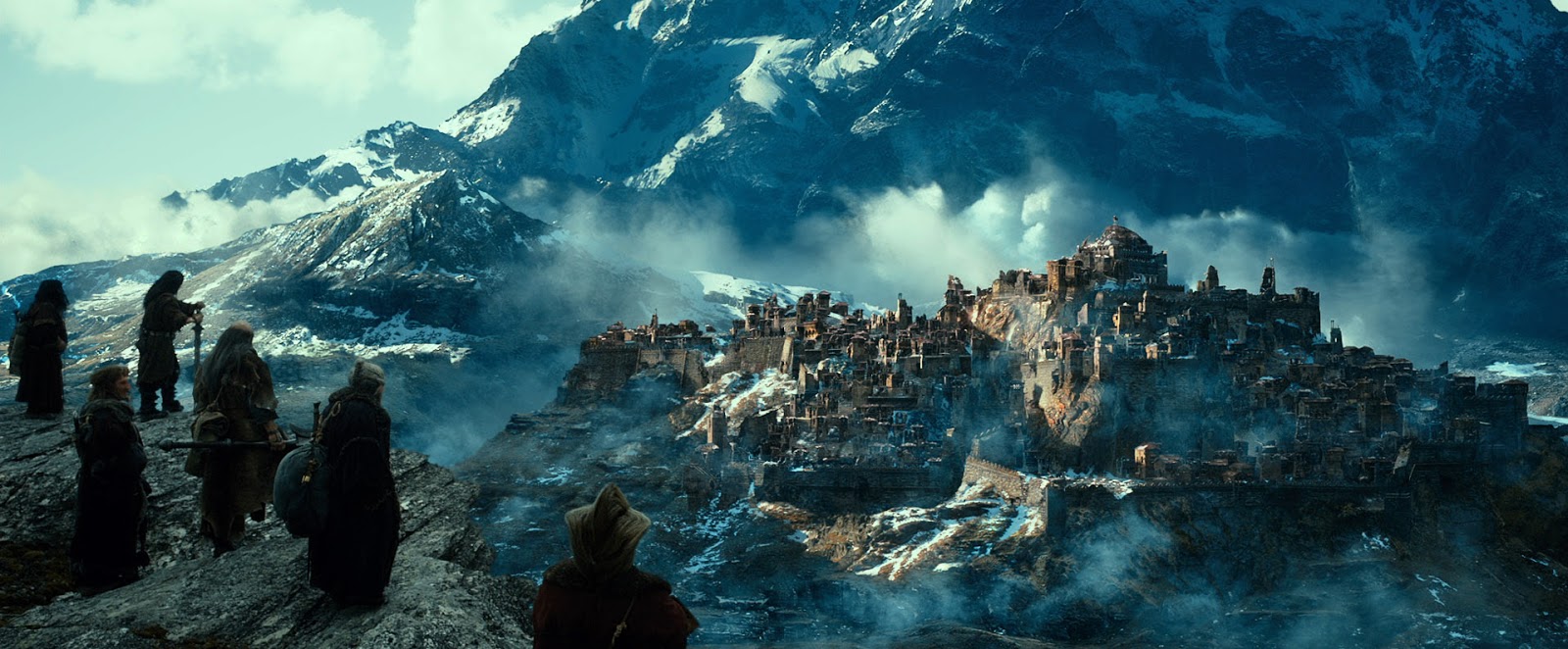
The second of Peter Jackson's three "Hobbit" films, The Hobbit: The Desolation of Smaug is, predictably, more of the same.  It's a three hour ramble, a complication and a darkening of the tone of the first film—as usually happens with the second of a trilogy, so that we, the audience, can climb out of our emotional valley in time for the resolution of conflicts in the third.  Standard Operating Procedure.  We are given a quick recap of the first film—going back in time to when Gandalf the Gray (Ian McKellan) first put the idea into the head of Thorin Oakenshield (Richard Armitage) and getting the dwarf crusade rolling.  Once the summary is done (in brief: Gold, Mountain, Dragon, Dead King, Arkenstone, New King, No Elves Allowed), they skip over An Unexpected Journey and head back to the Gandalf, Bilbo and the dwarves on the path to Lonely Mountain (Sindarin Erebor), orcs still snapping at their behinds and making their way to the entrance of Mirkwood.

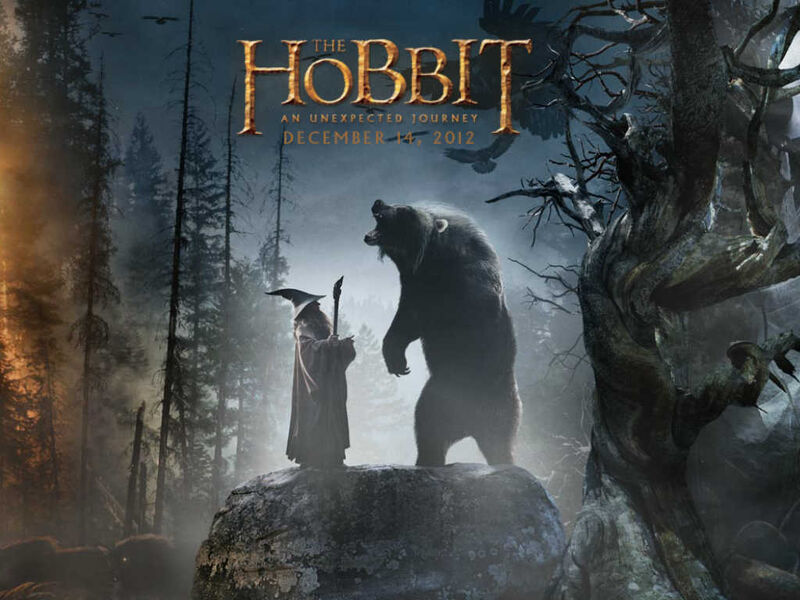
A quick visit to the skin-changer Beorn (Mikael Persbrandt), who usually appears in the form of a bear—not much is made of him, even though he got his own poster with Gandalf last time—and they get to Mirkwood (by pony), at which point Gandalf goes "walkabout"—he does this every movie and they probably split the story to accommodate a "Gandalf disappearance"—so the wee folk must enter the spooky forest alone, with a promise from the wizard that he'll meet them at "the Lookout."


"The Lookout"—he said he'd meet us; he should be easy to find...

Anyone familiar with the book knows that you don't find out where G.theG. goes until the last chapter, and that was after Tolkien had written "The Lord of the Rings" and got continuity-conscious.  But, here, we do get to see where (hint: he went there LAST movie), and Jackson's The Lord of the Rings gets set up all good and proper (except Benedict Cumberbatch is voicing the character now—wonder if Jackson will Lucasize everything to make it all match up).   The dwarves and hobbit are concerned with icky things and splendors that one would associate with a place called Mirkwood, and the ring that Bilbo snatched from Gollum is starting to exert its unholy influence turning the peaceful little guy into a berserker bad-ass.  Travel packages with unruly companions and nasty accommodations with large pests and diffident natives will do that to anyone.  But, Bilbo proves his worth on more than one occasion and eventually they do make it to the Halls of Lonely Mountain, a few shy of a full dwarve-deck and make their way to a meeting with the titular character that's been hoarding all the gold and keeping it for himself—the ultimate one percenter of Middle Earth.

Bilbo above the canopy of Mirkwood
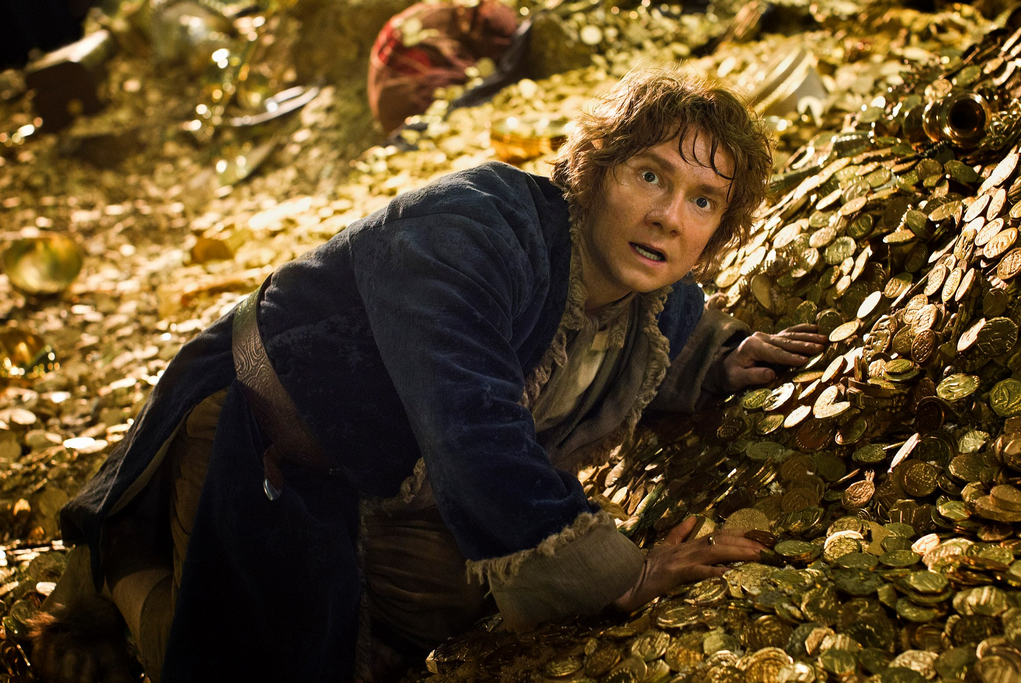
Smaug is the dragon, living in the massive storage caves of the Mountain, and he spends his time, far from desolate, sleeping among the gold and treasures of the dwarves like a big scaled, fire-breathing Scrooge McDuck. When Bilbo's attempts to find the Arkenstone awaken him, there is quite an extensive cat-and-mouse game as the small hobbit scurries around the cumbersome dragon.  Or I should say Cumberbatch, as the ubiquitous actor provides a nicely arch resonant voice to Smaug, which is accompanied by a lip-curling animation to enhance it.  This is where the film shines, as the territory is new, the imagineering of the dragon is fresh, and the surprises are many.  After the previous two hours, that's a bit refreshing.

For if there's a problem with Peter Jackson's version of The Hobbit, it's that, by now, we are so familiar with the way he does things that nothing much really resonates anymore.  The heavily belabored ripostes by the actors seem a bit too predictable—when Bilbo changes his story to gandalf that he found his courage in the goblin caves last movie (rather than The Ring), there's a close-up of Gandalf as he says what half the audience is expecting: "You'll need it." Really, that one and "You should be" are certain candidates for Screenwriting 101 "easy irony" along with "You just don't get it, do you?" and "They're standing behind me, aren't they?"  

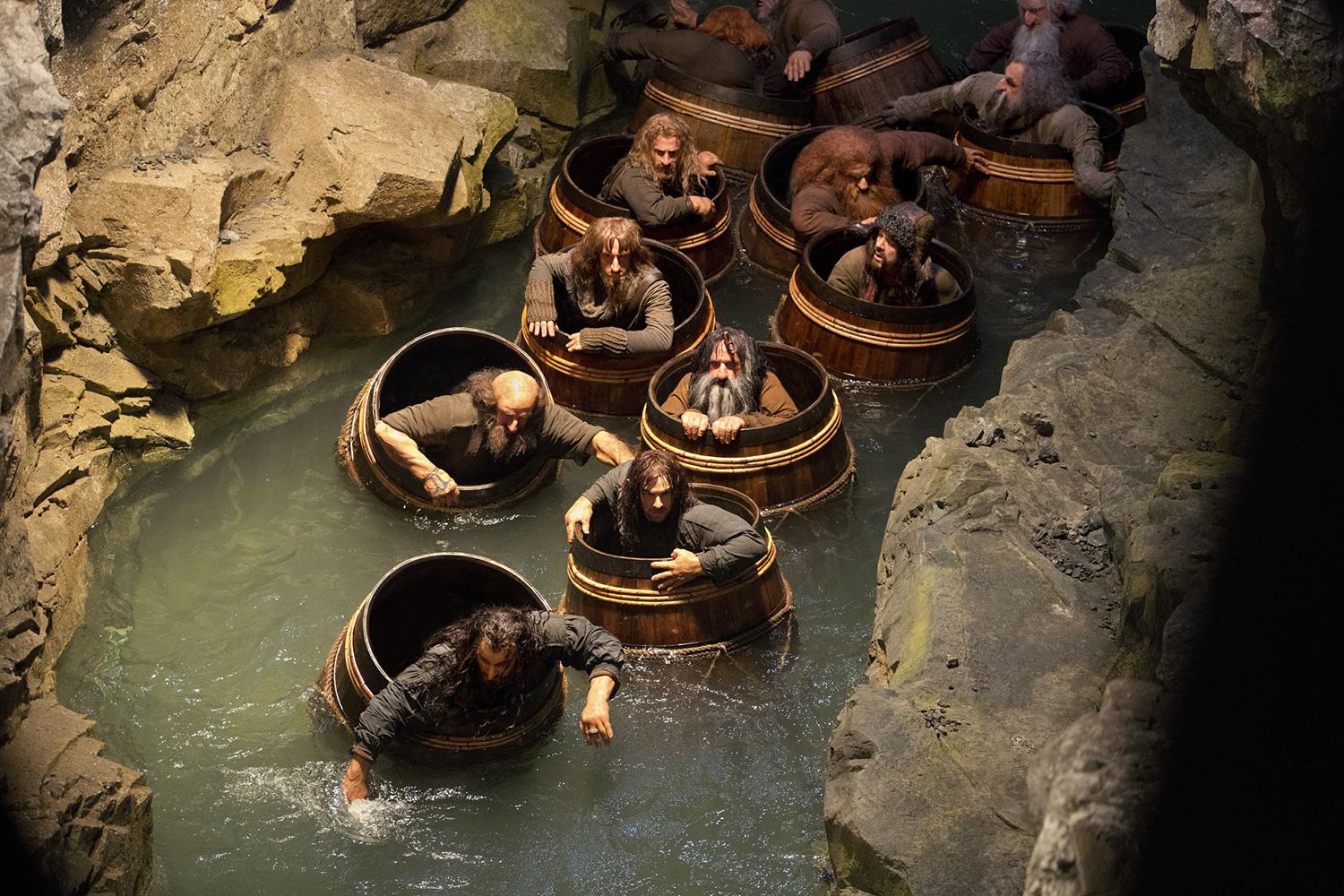
And the action sequences, this time assistant-directed by actor Andy Serkis. go on and on, in ever-increasing silliness.  If last movie set a more rollicking, silly tone than The Lord of the Rings (in part by the influence of Guillermo del Toro), now the joke's wearing a little thin.  Extended fights between orcs and elves are no longer thrilling, they're a demonstration of every possible way you can kill something with an arrow.  An extended rush down a rapids in barrels is accompanied by additional orc-elf fighting, where the barrels are used for any other purpose besides transport, as every tree-limb and branch over-hanging is used as a foot-hold.  Some of this criticism isn't fair, because if this had been the first film in a trilogy of Tolkien adaptations, the marvels of the film would send people off a CGI cliff in amazement.  It might take at least forty-five minutes to tumble down it, though.


One should, however, point out that the "we've been down this glade before" problem didn't occur with Jackson's earlier Tolkien trilogy, where there was enough material to keep things seeming fresh each film, and Jackson and his screenwriters did enough juggling of the narrative to keep things seeming new from film to film.  Their attempts here amount to trying to add a romantic element between the elf warrior Tauriel (Evangeline Lily) and the dwarf Kili (Aidan Turner), much to the consternation of Legolas (Orlando Bloom, back in action).  And while it provides a reprieve from tumbling and shooting and other too-frantic sequences, it does take away from the basic focus on the titular Bilbo Baggins (Martin Freeman) whose story this is.  Freeman's performance is, again, terrific, bringing all sorts of fretting elements to play, and making the transformation of his hobbit into a killer more than a little disturbing.

The vistas are staggeringly rendered, but some short-changing has been done with the characters in action sequences—Orlando Bloom seems to be the chief character robbed of some pixels, here and there, and the attempt to de-age him to a younger self doesn't really work (I've never seen it done convincingly, so far).  the only real surprises come in snatches of casting with Lee Pace, disappearing into the role of the elf Thronduil, Lily's elven warrior, and Stephen Fry's Master of Laketown.   Be on the lookout for some Laketown spies and you might even find Stephen Colbert for a brief second.  Oh, and Jackson gets his own "Hitchcock moment" out of the way very quickly.

Oh.  And SPOILER ALERT there's another movie coming, so this one ends at a rather inopportune time.  You only have to wait another year.

The Hobbit: the Desolation of Smaug is a Matinee.

"Conversations with Smaug" drawn by J.R.R. Tolkien
"Conversations with Smaug" drawn by WETA

Saturday, November 9, 2013

Enough Said

Yadda, Yadda, Yadda....
or
Ex-Men and Women: Daze of Futures Past

It's refreshing to see a rom-com where the entangled are not "zygotes in love," young puppy-lovers with their whole lives in front of them as they go walking off into the sunset, or walking along the sandy-beach, or kissing in front of fireworks while the music swells and we head for the exits.  That's about the time where the "They Lived happily Ever After" credit of "The End," sometimes with the cutesy "(?)," burns itself into the acetate, and I give a guttural chuckle while the thought of there being a sequel where everything goes to shit burns itself into my grey matter.

Most rom-coms, even the most cynical ones, are first acts, where the lessons learned and the hurdles tripped over only get us to the threshold of commitment and then leave us with the unasked question: "So, how's THAT working out?"

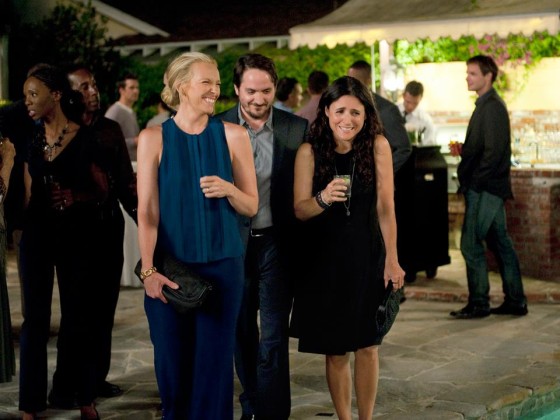
But, when you're dealing with adult rom-com's there's always that bittersweet quality where flirtations are recognized to be temporary sparks, and that work is involved and sometimes relationships need to be tailored like clothes as people change and grow either too comfortable or not comfortable enough.  If nothing fits, then it's time to do some spring cleaning and donate stuff to somebody else.  That's the situation with people in Enough Said, the latest film by Nicole Holofcener, who's doing her best to off-set the male-centric movie landscape in the States.  This one centers around Eva (Julia Louis-Dreyfuss) a single mother, once divorced, working as an in-home masseuse, who's dreading the departure of her daughter (Tracey Fairaway) for college, and feeling needy, probably because it's one thing to be a married "empty nester," but a single one?  Misery loves company.

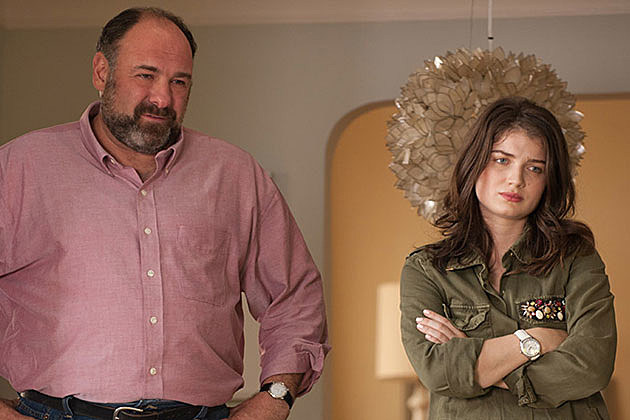
That's why her meeting Albert (James Gandolfini) at a party is such a lucky break. Divorced, nebbish-y, his daughter (Eve Hewson) is also going away to college. There's no real attraction at the beginning, and there's really nothing there, but a casual date is fun, and she finds herself relaxing with him.  Her therapist-friend (Toni Collette) is supportive, as is her daughter, such as she can be.  Even one of her clients she's bonded with, Marianne (Catherine Keener), thinks it's a great idea.

It's going great...just great...great.  Yeah.  Then, she starts to notice that the things that irritated Marianne about her ex, are things that Albert does all the time.  It's not that they are particularly irritating, but...she never noticed them before, and now that she's noticing them...yeah, they are pretty irritating things.  And, considering that those things broke up Marianne's marriage to him, Eva decides that maybe she'd better fire a couple of shots across Albert's considerable bow to see if she can change him before things get any more serious.  For Albert, it starts to sour their relationship because (as he says) "it's like I'm with my ex-wife..."

This is kinda sit-commie.  A little too convenient (story-wise) that everybody should be in such proximity that they get caught up in each other's orbits (minor quibble), and you want to apply some malicious reiki to Eva's neck—if it weren't for the fact that this is a kinder, gentler version of Louis-Dreyfuss' Elaine Benes from "Seinfeld.," so wrapped up in herself that she's quite unaware that she's an emotional black hole, starting to suck the energy out of people to fulfill her needs, and is so in pursuit of "the new" that she tends to shaft the familiar (a not uncommon trait). The wonderful thing about Louis-Dreyfuss (besides being able to channel her dark side in her sleep) is how she is still able to make Eva engaging.  She has to be, for the attraction to work. And Gandolfini is superb in this, vacillating between shy comfort and wariness, constantly looking at people out of the corner of his eye as if looking at them directly will reveal too much or put his vulnerability out there to be skewered. Good cast all around and they do make the most of the material, of adults who are still in need of love and finding that available hugging arms are in increasingly short supply.  

Enough Said is a Matinee.


He talks during movies and rattles his popcorn, so I couldn't date him.
Louis-Dreyfuss and Gandofini in Enough Said.

Wednesday, November 6, 2013

The Fifth Estate

Assuaging Assange
or
Jury Tampering in the Court of Public Opinion

Julian Assange is not a happy camper...camping in the Ecuadorian embassy ("behind Harrod's" as his portrayer Benedict Cumberbatch describes it) in London. He has let it be known in his own little publicity campaign that he does not like The Fifth Estate, and that it is entirely propaganda from unreliable and untrustworthy sources.  I'll take his word for it, as that's been his business model for Wikileaks for quite a few years. 

The problem is that Assange would not be happy with ANY movie of the story unless HE wrote, produced and directed it, so that he could control the information flow to fit his view of events.* Anyone would, really, in the best of all possible worlds. The difference between anyone and Assange is that he actually thinks he could, and not only that, that he should.

The trouble is, Mendak, it may be your story, but it's not your money financing it, and you're kind of a bad risk, if you know what I mean.  

And, if he would do it, he would insist on doing it himself, even though film is a collaborative medium.  Collaboration, however, might dilute the message, and so, really the only person who could be trusted with it is Assange.  Wait for his version in a couple of decades.  That's the trouble with hubris and megalomania, you always get your message out last and console yourself that you got The Last Word.


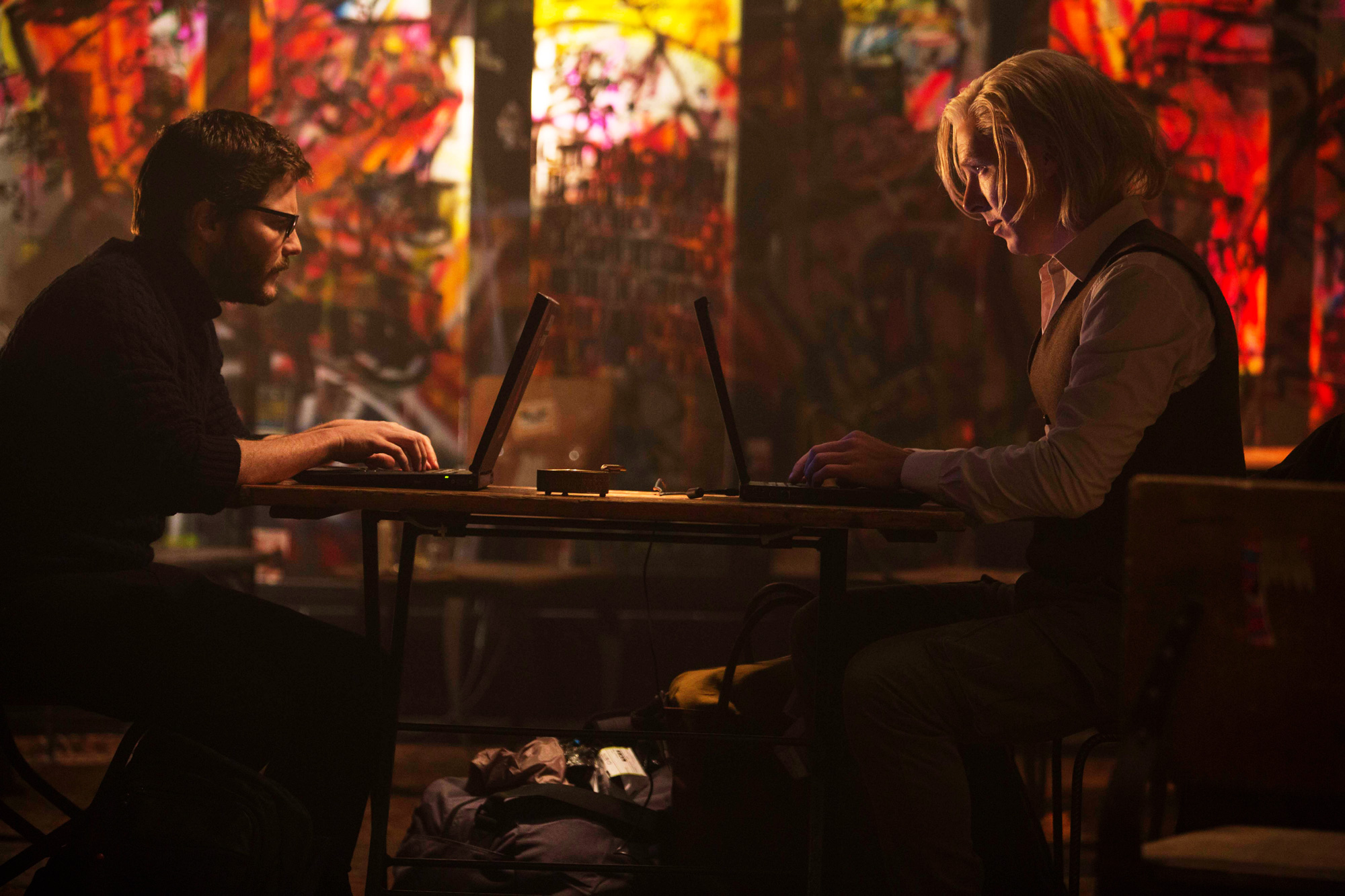
(Well, now that I've revealed my prejudices that I think Assange is a creep and something of a deluded creep...) Bill Condon's film is a return to form on the controversial biographical films he's done in the past (Kinsey, Gods and Monsters), and after mucking about in the very black and white"Twilight" series, here struggles to have any sort of perspective, controversial or otherwise, for a story that is still in process.  It also sweats to make something dramatic out of typing away at laptops, which is intrinsically dull, and about as engrossing as watching a movie about a writer who's writing—good in book form, maybe, but unless you go off into some sort of fantasy-land, it's a completely no-thrills scenario.  

For anyone who's been following the Assange story—which was several headline-making revelations ago—The Fifth Estate does less with the recent Iraq War revelations (some of which—like the "Collateral Murder" video weren't even revelations, having already been published in other sources) than it does with the early ground-breaking days of WikiLeaks, Assange's recruiting of Daniel Domscheit-Berg (Daniel Brühl)—whose book "Inside WikiLeaks" is one of the sources on which Josh Singer (former writer for "The West Wing" —during the non-Sorkin years—and "Fringe") based his screenplay—and the heady days when it exposed corruption in Kenyan elections and dummy-accounting in the Caymans at Julius-Baer.  The worst-kept secret of all was who was running WikiLeaks. Although Assange was the very public face of the site, he would state that there were hundreds of people behind the site, doing due diligence, checking sources, and vetting information that was see the light of day there.

Truth was, there were no "hundreds of people;" it was Assange and Berg and whatever server cluster the two could configure, cobble and co-habit.  Vetting was cursory phone calls, or maybe a clandestine meeting beforehand.  As far as redacting anything that might threaten lives,** that was nearly impossible (and logistically impossible with the release of diplomatic communications that numbered 400,000 in 2010).  As WikiLeaks' revelations become bigger and broader in cope and size, the tiny staff is overwhelmed, keeping an Oz-like public face (Assange's), but not even willing to acknowledge that they might be overwhelmed and out of their depth.  Thus, the "open" source hides the biggest secret of all—there's no infrastructure to the web-site other than Assange and Berg.

The "reveal" of this information is done in a "cutesy" illustrative manner.  At one stage, Berg wants to talk to the other WikiLeaks members that he's been trading communiques with about sources and information, something Assange is initially reluctant to do.  Then, when it becomes a "make or break" request, he gives in, showing Berg his "hold card"—that the other people Berg has been instant-messaging and e-mailing have merely been alternate Assange accounts.  He's only been talking to Julian, which Berg imagines as a scene out of Being John Malkovich crossed with The Apartment of an infinite number of desks in an office, all with Julian Assange sitting behind them.  It's a little too literal and maybe just a little condescending to spell it out so baldly to the audience, but ultimately that visual metaphor is stretched as, at critical junctures, that infinite number of Assange's keeps coming back to make fantasy-narrative points that seem unnecessary (other than to conjure up that all those Assange's are going to write the complete works of Shakespeare someday).  

The acting is, across the line, superb: Cumberbatch does a fascinating Assange, adroit, and self-contained, like a chess-player, usually thinking about something else than the topic of conversation, and his final bit—an in-character dismissal of "the two films" coming about WikiLeaks (presumably this film and Alex Gibney's documentary) is a cautionary warning; Brühl, seems to be the go-to guy to play Germanic naifs after Good bye Lenin!, Inglourious Basterdsand Rush, and here plays Berg as an all-too-willing apprentice looking for a mentor; Laura Linney, Stanley Tucci, and Anthony Mackie play American diplomats trying to deal with the fall-out, while David Thewliss and Peter Capaldi play two reporters for The Guardian with suspicious hesitance about their "source."


It's a good dramatization, filling in character holes which Gibney's documentary left unexplored.  The two together make a good summary of events that, as yet, have no ending, but have managed to rock the world, making the cyber-world look frighteningly like a glass-house sitting in a field filled with stones.

The Fifth Estate is a Matinee.


* The same attack came from Assange about this year's Alex Gibney documentary We Steal Secrets: The Story of WikiLeaks, which tells the same story, but through interviews and through Gibney's journalistic sensibilities (which produced Enron: The Smartest Guys in the Room, Taxi to the Dark Side, Gonzo: The Life and Work of Hunter S. Thompson, Casino Jack and the United States of Money, and Park Avenue: Money, Power and the American Dream).  Critics have been far harsher on The Fifth Estate than We Steal Secrets, either because 1) the documentary is considered more "legitimate" than the dramatic version; 2) Assange's attacks seem to "stick" better to a dramatic recreation than a documentary, or 3) they actually (at a rate of 95% to 37%—which is quite a swing) prefer the techniques of the documentary to The Fifth Estate . But, then, according to Rotten Tomatoes, they've been harsher on The Fifth Estate than the Stallone-Schwarzenegger yarn Escape Plan, which is just inconceivable, and brings Rotten Tomatoes' validity as an indicator of quality and worth as a taste aggregator into suspicion.

** Assange has said that no "outed" operative has been killed, due to the leaks (although The Fifth Estate fictionalizes one such source (Alexander Siddig) being forced to evacuate with his wife and children (in the same way that Patton fictionalizes what might have happened in WWII if, because of Eisenhower's decision to send gasoline to British tanks instead of American ones, if a tank company all of a sudden ran out of fuel behind enemy lines).  1) Assange is probably not a good source for that kind of information as he'd only get it from "whistle-blowers" who might not want to take claim for any deaths (nor would Assange).  2) It's not going to come from American sources who might not want to further risk others (ie "known associates") of anyone affected by it, despite making the case that there WAS some "collateral murder" (to coin a phrase) and making assange and WikiLeaks look bad.  As someone far more Machiavellian once said "The absence of evidence does not mean the evidence of absence."

Friday, October 18, 2013

Captain Philips

Shakin' the Cam/Rockin' the Boat
or
"Everything's Going to Be Okay"

Paul Greengrass, who has succeeded in bringing a visceral documentary feel to even his fiction films (The Bourne Supremacy/UltimatumThe Green Zone) is back in "Based on a True Story" territory with Captain Phillips, which is about the 2009 cargo ship taken over by Somali pirates, which, in the course of events, resulted in its titular captain being taken hostage for ransom.

Currently, some of the crew of the hijacked cargo ship are in the midst of a multi-million dollar lawsuit with the Maersk line over the events and "in the press" are disparaging the movie's events and the character of Phillips ("anonymously" for legal reasons—as most heroes would do it) now that the movie is released.  Their peril was stopped hours after it began.  At that point, their safety was assured and the drama stopped. Phillips was stuck in a lifeboat with the pirates for a few days more, and faced an untenable situation that only seemed to worsen as the hours went on.*

Anyway, a lot of bad-mouthing about Phillips being portrayed as a hero in this situation.  He's not (although the resulting PR feeding-frenzy-makers like to bandy the word "hero" about at the slightest positive act).  He's a victim, more passive than aggressive, trying to survive the situation as much as possible. That much is clear.  Earlier this week, we'd did a review about truth and fiction and the compromises film-makers make to save time, money and confusion.  We're not willing to go over the same territory twice in one week.

So, how's the movie?


Quite good, in that edge-of-your-seat uneasiness way. The drama—and melodrama—comes from the "unknown" factors and the "wild card" desperation of the pirates themselves (they're portrayed as excitable, drug-addled** child-men with no other options), simmering at the boiling-popint that only intensifies when the scene shifts from the vast cargo ship to the tiny lifeboat that Phillips and the hijackers occupy for the next few days, while the ship's crewmen, the shipping company, and the Navy get their respective acts together. Those expecting a quick-cutting flying fistifest ala "Bourne" are going to slunk away with pouty-mouths—there ain't that much action here, and when the film gets really good, there's no room for any.  No, most of the movie is a waiting game, everybody waiting for an opportunity to make a killing, one way or another.  And if something doesn't go anybody's way, there's an escalation of a few seconds until things calm down, then there's a lag where we're waiting for something to go wrong again, and it does...so that the film is an emotional roller-coaster ride for the audience (other than the evidence that Capt. Rich Phillips has his picture all over the place seeming very much alive).


So much of the film depends on the presence of Hanks in the starring role; we spend the most time with him and the actors portraying the Somali's, who have the same sense of menace throughout (although some pains are made to make sure that Barkhad Abdi's ring-leader, Muse, is set apart from the others—the others come down to "the driver," "the injured kid," and "the wild-eyed crazy one").  

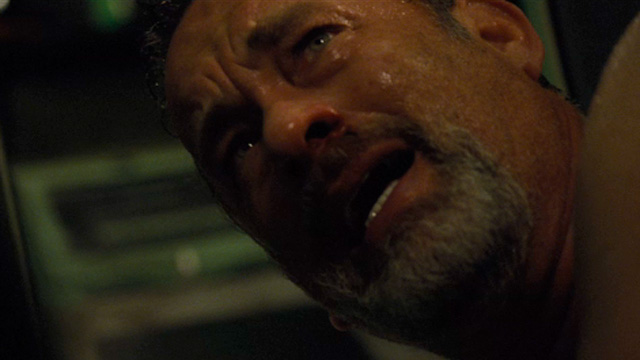
It recalls a story about the marketing of Apollo 13, which originally had a poster of the perilous situation—the spacecraft leaking oxygen going around the dark side of the Moon—but fearing for their investment, the producers opted for one that had Tom Hanks front and center in a claustrophobic layout.  The reason for this being that audiences might not care for the situation depicted in the earlier poster, but if there's a poster where Tom Hanks is worried that he's in trouble, that might bring a sympathetic audience in, hoping that the popular actor would attract a crowd.  And so the actor-specific poster (despite an all-star cast) was substituted. One wonders if it might be the same reason that Executive Producer Kevin Spacey is not portraying Phillips; maybe folks wouldn't worry about Spacey so much, but Hanks' every-man persona might make a monetary difference at the box office.  In any case, Hanks does a fairly good job at maintaining a veneer of calm while an undercurrent of panic roils through him.  But where he really shines—to the point where it's amazing to see—is the way he projects the character's shock at the end of the film, and one has to applaud Hanks for displaying a total break-down without once making us recall his crying for a volleyball.*** Despite his reputation as a male version of America's sweetheart, he is a good enough actor to still surprise and move, over one's objections.

Captain Phillips is a Matinee.


* My first question to those union sailors would be "If Phillips died, would you still be pursuing the lawsuit?" They're damned if they would, and damned if they wouldn't.

** In the film, they're constantly chewing khat.

*** That would be his loony-toons turn in Cast Away.  If I had a nickel...

Tuesday, October 15, 2013

Rush (2013)

Winning Isn't Everything...
or
Keep Your Friends Close, But Your Enemies in the Rear-View Mirror (They May be Closer Than They Appear)

The main reason I wanted to see Rush was that it has a script by Peter Morgan, whose work from The Queen, The Last King of Scotland, Frost/Nixon, The Damned United, Hereafter* have all been thought-provoking, literate screenplays and one wondered how he could provide that in a racing film, a sub-genre focused more on visceral momentum and the visual and where the weakest sections have always been those outside of the cars and off-track.

This one, though, it completely opposite in the tradition of Howard Hawks' race-track movies. And it's all true (except for a lie or two).  It tells the story of two (eventual) Formula 1 drivers, Niki Lauda (Daniel Brühl), Austrian, teutonic, disciplined, engineer and James Hunt (Chris Hemsworth), British, louge, seat-of-your-pants, tactician. They couldn't be more different except that both want to be the best and will do anything, risk anything to get there.


And they're both damned good drivers.**

Both are bad boys in their own ways.  Lauda comes from a prominent Austrian family, but does not want to go into the family business, which disowns any acceptance of Niki's ambitions to drive professionally.  So, he finds a race-team going bankrupt, buys it cheap by cashing in his life insurance policy, and takes over, re-building the car's engine from scratch.  Hunt knows a rich boy, Lord Hesketh (Christian McKay) with money to throw away and a party every hour.  In the film, the two despise each other immediately.  The first time Hunt sees Lauda at a Formula Two race (one of those examples of "a lie or two"), director Ron Howard throws a rainbow refraction from Hunt's POV, bringing a mysticism over the moment that might be a bit too much.


That first race, they bump and spin.  Hunt can't pull himself back into the race, his engine conks out, but Lauda, with some difficulty, throws himself the right way and is able to race his way to victory.  Hunt starts to berate Lauda about it, but the Austrian is dismissive—it was the car, not the driver, Lauda had the better car and was able to get back in.  Hunt's still pissed, insults Lauda by saying he looks like a rat, then goes off and parties with Hesketh, the crew and any woman within arm's length, as is his habit.  It's the start of a rivalry that will have its up's and down's, but that is the character-arc that both drivers have, and will have throughout the entire movie.  Their focused competition will push each of them to doing crazy things on and off the track.

It makes a good story.  Except for a lie or two.

It may not seem like much, but it's the Ron Howard way to make movies. Like a good race-track, eliminate any bumps in the road that might add dimension, nuance, or raise a question in the mind that might distract.  If you set up a joke, show the pay-off at the next cut.  If there's a building-up montage, make sure you show the results first thing.  If you want to show the treadmill of being famous, put David Bowie's "Fame" on the soundtrack (released in 1975, it fits the period). 


A shot like this is used quite a bit: it makes you go "hmmm."

In Rush, there's no ambiguity, no wasted shot, not a moment of contemplation or self-doubt.  It runs the rule of every Howard movie (that I've seen, at least, which is all except two) of being so audience friendly that it barely needs an audience, as there is no room for interpretation. At all.

It's not manipulation (all movies are manipulative, even documentaries), so much as keeping it very, very simple—least-common-denominator simple.  It makes a better movie to have Hunt and Lauda just despise each other throughout the movie until the crisis of Lauda's accident.  And even then, the bantering between them has a nice nasty streak running through it.  It would have completely messed up that story through-line if (say) Hunt and Lauda were closer than Morgan and Howard impress...which they were—they were flat-mates for awhile, and enough that Rush would have resembled The Odd Racing Couple if they had shown it—but that would have ruined the all or nothing, go for broke, all-in, simple kind of impression the film-makers are trying to evoke.  If it feels good, why complicate it?  And Howard's films, even the depressing ones, are feel-good movies (I mean, A Beautiful Mind is about schizophrenia and he still managed to bring forth a teary-smile at the end...and won an Oscar for it!).


Really, this is just to increase my Internet "hits."
Olivia Wilde as model Suzy Miller—she's in the film for as long as you're looking at this picture.

So, what am I saying, that it isn't "arty" enough?  No.  It's plenty arty, with a humorous set design and costuming that will make anyone under 30 think we were all mad (and we were, hey, but don't linger at the mirror, yourself). Howard and his cinematographer Anthony Dod Mantle (he bounces between Lars von Trier and Danny Boyle, so of course it's arty), manage to shoot making left turns repeatedly interesting to look at, without becoming fetishistic about it (more Grand Prix than Le Mans, more Frankenheimer, less Katzin), and they have a tendency to repeat a lot of good shots, rather than trying to find every possible angle with which you can photograph a moving car.  So, there's a consistency there of quality over quantity.  And the core of the story—of these two outliers, both unlikable but admirable, racing to the drumming of their own pistons, finding inspiration in each other and realizing it, makes it an interesting movie, and worth seeing.

Rush is a Matinee.


Niki and James, when Lauda came back to racing six weeks after his accident.


*  He was also involved in the early stages of Tinker, Tailor, Soldier, Spy and Skyfall.

** Here's a Lauda quote (a real one) about Hunt:"We were big rivals, especially at the end of the [1976] season, but I respected him because you could drive next to him—2 centimeters, wheel-by-wheel, for 300 kilometers or more—and nothing would happen. He was a real top driver at the time."  That's the sort of admiration Lauda would allow himself—an appreciation of undeniable skill.