Showing posts with label Toni Collette. Show all posts

Saturday, November 9, 2013

Enough Said

Yadda, Yadda, Yadda....
or
Ex-Men and Women: Daze of Futures Past

It's refreshing to see a rom-com where the entangled are not "zygotes in love," young puppy-lovers with their whole lives in front of them as they go walking off into the sunset, or walking along the sandy-beach, or kissing in front of fireworks while the music swells and we head for the exits.  That's about the time where the "They Lived happily Ever After" credit of "The End," sometimes with the cutesy "(?)," burns itself into the acetate, and I give a guttural chuckle while the thought of there being a sequel where everything goes to shit burns itself into my grey matter.

Most rom-coms, even the most cynical ones, are first acts, where the lessons learned and the hurdles tripped over only get us to the threshold of commitment and then leave us with the unasked question: "So, how's THAT working out?"

But, when you're dealing with adult rom-com's there's always that bittersweet quality where flirtations are recognized to be temporary sparks, and that work is involved and sometimes relationships need to be tailored like clothes as people change and grow either too comfortable or not comfortable enough.  If nothing fits, then it's time to do some spring cleaning and donate stuff to somebody else.  That's the situation with people in Enough Said, the latest film by Nicole Holofcener, who's doing her best to off-set the male-centric movie landscape in the States.  This one centers around Eva (Julia Louis-Dreyfuss) a single mother, once divorced, working as an in-home masseuse, who's dreading the departure of her daughter (Tracey Fairaway) for college, and feeling needy, probably because it's one thing to be a married "empty nester," but a single one?  Misery loves company.

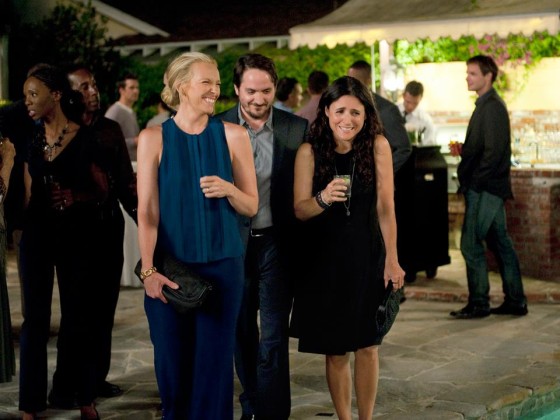
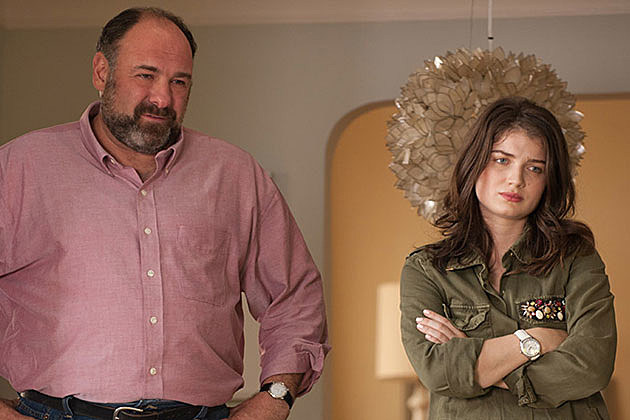
That's why her meeting Albert (James Gandolfini) at a party is such a lucky break. Divorced, nebbish-y, his daughter (Eve Hewson) is also going away to college. There's no real attraction at the beginning, and there's really nothing there, but a casual date is fun, and she finds herself relaxing with him.  Her therapist-friend (Toni Collette) is supportive, as is her daughter, such as she can be.  Even one of her clients she's bonded with, Marianne (Catherine Keener), thinks it's a great idea.

It's going great...just great...great.  Yeah.  Then, she starts to notice that the things that irritated Marianne about her ex, are things that Albert does all the time.  It's not that they are particularly irritating, but...she never noticed them before, and now that she's noticing them...yeah, they are pretty irritating things.  And, considering that those things broke up Marianne's marriage to him, Eva decides that maybe she'd better fire a couple of shots across Albert's considerable bow to see if she can change him before things get any more serious.  For Albert, it starts to sour their relationship because (as he says) "it's like I'm with my ex-wife..."

This is kinda sit-commie.  A little too convenient (story-wise) that everybody should be in such proximity that they get caught up in each other's orbits (minor quibble), and you want to apply some malicious reiki to Eva's neck—if it weren't for the fact that this is a kinder, gentler version of Louis-Dreyfuss' Elaine Benes from "Seinfeld.," so wrapped up in herself that she's quite unaware that she's an emotional black hole, starting to suck the energy out of people to fulfill her needs, and is so in pursuit of "the new" that she tends to shaft the familiar (a not uncommon trait). The wonderful thing about Louis-Dreyfuss (besides being able to channel her dark side in her sleep) is how she is still able to make Eva engaging.  She has to be, for the attraction to work. And Gandolfini is superb in this, vacillating between shy comfort and wariness, constantly looking at people out of the corner of his eye as if looking at them directly will reveal too much or put his vulnerability out there to be skewered. Good cast all around and they do make the most of the material, of adults who are still in need of love and finding that available hugging arms are in increasingly short supply.  

Enough Said is a Matinee.


He talks during movies and rattles his popcorn, so I couldn't date him.
Louis-Dreyfuss and Gandofini in Enough Said.

Saturday, August 31, 2013

The Way, Way Back

The Summer of Our Discontent
or
"Little Mr. Sunshine"

The summer "coming of age" movie is such a staple that it might be worthy of its own genre label, rather than merely being relegated to a sub-category. It's a natural, really. The timing seems right and appropriate for the subject of change. Summer always seems to be a time of transitions: from one school year to the next; from bring a graduate to a freshman, walking out of one door and into (and hopefully through) another one. And while the rest of the year is taken up by schooling, the ample three months of idle time gives one plenty of opportunity for other extracurricular learning—life-lessons from the school of hard knocks.

Take Duncan (Liam James), for instance (please, someone has to...) in the new film by Jim Rash and Nat Faxon (they won an Oscar for their superb script for The Descendants).  Fourteen, a 'tweener, his parents are divorced and Mom (Toni Collette) has taken up with another man. Trent (Steve Carrell), who has a daughter Steph (Zoe Levin).  It is clear as this pint-sized Brady Bunch goes to an ocean beach house that it is not going to be anything resembling a beach-home.  Duncan doesn't want to be there; he'd rather be with his Dad this Summer.  Whether that preference has driven a previous wedge between Trent and Duncan is not know.  What is known is that Trent is something of a jerk to Duncan.  "One a scale of 1 to 10, what do you think you are?" he asks Duncan sequestered to the back of the station wagon on the ride to.  "Six," says Duncan, noncommittally.


"I think you're a 3," says Trent imperiously.  "I just don't see you putting yourself out there..."


If Trent wanted to see Duncan put out, that remark was a good start.


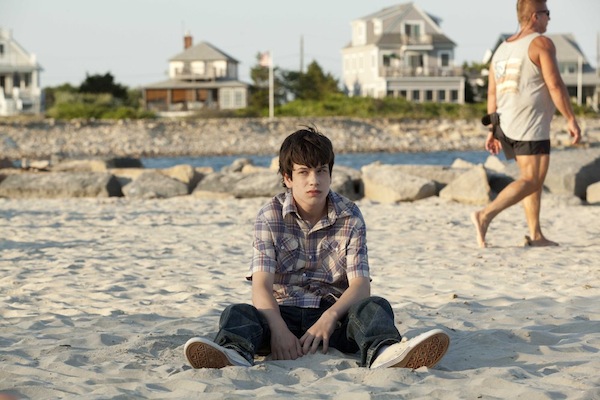
Duncan (Liam James) has a "thousand mile stare"
Duncan settles into the teen routine of being a hot-house plant in a dark room, grunting monosyllabically at anyone over 30.  He can't relate to Trent's friends and neighbors, like the barely-together Betty (Allison Janney)—she has two kids, Susanna (AnnaSophia Robb) and Peter (River Alexander) and Kip (Rob Cordrry) and Joan (Amanda Peet).  And Mom, trying to heal after a divorce, is there for Trent.  Duncan tries to be invisible and stay out of the way, and is emotionally unavailable.

It isn't until he finds Steph's abandoned pink bike (with tassles on the handlebars) that things begin to pick up speed and he feels like less of a trapped and pacing animal.  The bike gives him some mobility, some freedom, and it only has one seat, which is fine by him.  He starts to explore the beach-town and runs into Owen (Sam Rockwell at his loose best) who runs the local water-slide park, Water Wizz.  Duncan gravitates there and that's when his Summer starts to get fun.  Owen takes him under his crooked wing, adding Duncan as park-help, and introducing him to what will be his new family, including Caitlin (Maya Rudolph), the responsible to Owen's irresponsible, and concessioners Roddy (Faxon) and Lewis (Rash).  Pretty soon he's in a routine, interacting with sort-of adults and fitting in.

But, it causes conflicts within families; his long hours at the park causes concerns at home and puts him in further conflict with Trent, who has his own disappearing act issues.

It is no great shakes as a film, but it is a good movie, a movie you might enjoy.  It is merely competent, well-written, extraordinarily cast and acted (the standouts being Rockwell and Steve Carell who works against type and proves himself capable of playing a deliberate jerk, instead of just a clueless one.  And Rash and Faxon prove themselves as adept at directing as they are at screenwriting.  In a disappointing Summer, this counts for a lot.  And like Duncan's situation at Water Wizz, this little wayward breath of fresh air from the usual carnage perpetrated on screens is a welcome relief.

The Way, Way Back is a Matinee. 


The only explosion in The Way, Way Back


Sunday, December 16, 2012

Hitchcock

Hack-job
or 
Making Everyone a little Psycho

Making a movie is a boring enterprise.  Boring and thrilling at the same time.  Lots of sitting around, wasting time, waiting for the crew to be ready for that moment when you can't waste any time, the adrenaline is pumping, and things have to go right...over and over and over again until they do.

For Alfred Hitchcock, the thrill of movies wasn't in the filming (which lots of directors like because it's so social and a "rush"), or in the editing (where so many directors "find" their films), it was in the planning, the story-writing and the story-boarding—making the blueprint for the film that could be followed easily and by-the-numbers.  The best parts of his movies were not in performances (although they could be great*), but in the ideas that shape the film and make it worth watching...and worth watching again.  Watching that process, however, would probably not make a very compelling movie.

The trials and tribulations of the making of his landmark horror film Psycho was detailed in Steven Rebello's fun little read "Alfred Hitchcock and the Making of Psycho," and are now derailed in Hitchcock, a fictional adaptation of the book, which has as much to do with the events of making Psycho, as the film Psycho has to do with the book it was based on, which, truth to tell, Hitchcock never read.**

Well, few people have read Rebello's book, either (which is a shame, really) and so the chief "scenarist" James McLaughlin (who wrote Man of the House and co-wrote Black Swan...hmmm) and director Sacha Gervasi (who co-wrote The Terminal for Spielberg and whose only previous film was the documentary Anvil! The Story of Anvil!) have "written to silence"—as so may of the actual participants are dead—relying on "conventional wisdom" rather than facts to make their odd little combination of docu-fantasy.  Partially, this is because when it comes to movie-making (as opposed to life) truth is duller than fiction, but it is also more complicated and takes longer to explain and so we depend on a futzy short-hand to get to the point faster.  "Conventional Wisdom" in Hollywood is the same as "Based on a True Story."

Oh, don't get me wrong.  There are instances where the facts are there: Hitchcock's wife and collaborator Alma Reville did spot the "blink" (actually it was a throat swallow) in the pull-out from Janet Leigh's face after the murder (requiring a cut to the shower-head) and the "nudity" (which was solved with a black bar at the bottom of the screen); resistance was high to Psycho which Hitchcock chose to fulfill his contract for Paramount Studios—they did want something like North By Northwest, which made a lot of money for M-G-M—but not so much when Hitchcock revealed he was going to do it "for cheap" with his television crew—it's always about return for investment; he did come up with the brilliant advertising campaign for the film (like he'd previously done with his other films); much is made of the financial failure of Vertigo*** (ironic as it's—this year—considered "the greatest film ever made") as well as Hitchcock's insecurities and frailties (which were legion and they're all up there on the screen in his movies) and there are dribs and drabs of trivia sprinkled throughout the film.  But, they are far out-weighed by what is wrong.

What's wrong with this picture?  Oh, where to start?
What it gets wrong would fill another book by Rebello.  The film's obsession with Ed Gein—that is more attributable to author Robert Bloch than Hitchcock—feels wrong and wrong-headed, more to do with the screenwriter's issues than the subject's (I doubt that Hitchcock had the elaborate Gein fantasies that are imagined here).  The emphasis of Alma's collaboration with writer Whitfield Cook (Danny Huston)—who contributed to one good Hitchcock adaptation, Strangers on a Train, and one bad one, Stage Fright—is blown completely out of proportion from a mere consulting gig.  And the twist of the knife is the Hitchcock pathology, especially his treatment of women (the "Hitchcock Blondes," the grey suits, the make-overs, the favorites—Kelly and Bergman) despite the fact that Hitchcock always gave the more interesting parts and special attention to his actresses ("Hitch always threw the picture towards the girls" was Cary Grant's summation), not only for himself...but also his audience.

But what Hitchcock valued was loyalty. So he'd work with the same craftsmen over and over again out of loyalty, out of trust, out of convenience—past collaborators were one less complication to worry about.  And if they failed to deliver, he wouldn't work with them again, without a word of explanation as he hated confrontation.  "He was a coward," as Suzanne Pleshette opined.  Of course, he was.  His movies are naked displays of his phobias, foibles and fantasies.


And the films endure, because his frailties are just like ours.


Hitch is no longer alive to defend himself, but quite a few collaborators are. One wonders why Pat Hitchcock, Alfred and Alma's daughter, who usually runs defense for the Hitchcock Family Legacy, is silent while so many the current gaggle of films—this one and HBO's "The Girl"—are starting to piss on his grave.  But, then, the evil that men do lives after them, the good is oft interred with their bones.  So, let it be with Hitchcock.  His films are a testament to both good and evil, and our ability to rise above.  The films have lived on, decades after the man, and show no signs of falling out of fashion.  That's his lasting legacy.

 
For fans of the director, there is no such thing as bad news, but this movie truly is.  The performances are winning, though, as Scarlett Johansson occasionally convinces you she's studied up on Janet Leigh's mannerisms, although James D'Arcy plays Anthony Perkins as if he was playing Norman Bates and there was more to the man than that (reflecting the film's focus on rumor and gossip, rather than facts), we don't know what Alma Reville was like, as she stayed mostly behind the camera, but Helen Mirren's performance is fun and winning.  Anthony Hopkins' Hitchcock, however, is problematic—although it's not entirely his fault.  Hopkins is a brilliant mimic, and his own rich voice disappears in the deliberate cadence and sibilance of Hitchcock's own.  But (like much of the film), the portrayal is a bit too dependent on Hitchcock's public persona as a droll dead-pan.  This Hitchcock never smiles—perhaps it would have cracked the elaborate make-up Hopkins must wear to even resemble the director—and is entirely too mordant and lines up with "conventional wisdom" about the man, a view that, as Hitchcock himself cultivated it, he's a little responsible for.  As such, the portrayal comes across as a bit one dimensional, and one-sided.


One could get exercised about these things (and I obviously have), but as Hitchcock himself would say, "...it's only a mooo-vie."


Just not a very good one.  The best that can be said about Hitchcock (the movie) is that Alma's influence and great work is now a part of conventional wisdom, instead of the director's best-kept secret.


Hitchcock is a Cable-Watcher.


Yeah, that Hitchcock could be a tyrant on the set, alright...
Hitchcock's Best-Kept Secret: the incomparable Alma Reville


 * Hitchcock was often misquoted as saying "Actors were cattle" as if they were just a commodity to be "herded," when what he SAYS he said was that actors "should be treated like cattle."  Friend and Hollywood cut-up Carole Lombard responded by setting up two bovine pens on the set of Mr. and Mrs. Smith (1941), one for her and another for her co-star Robert Montgomery.

** In his near-definitive interview book "Hitchcock/Truffaut," Francois Truffaut spends a lot of time—too much time, really—going on about how lousy Robert Bloch's novel, "Psycho," is, and Hitchcock dismisses his comments by saying "I never read it.  I read the studio synopsis (the plot summary by studio "readers"), and the only thing I was interested in was the shower sequence and killing off the star half-way through the movie..."  

*** Funny thing.  Tippi Hedren has made what my father used to call "a big stink" about Hitchcock destroying her career after the financial failure of Marnie—never working with her again—and supposedly bad-mouthing her to other directors, producers, and all of Hollywood.  But, after Vertigo "tanked" at the box-office, Hitchcock never worked with James Stewart again, feeling like it was partially Stewart's presence in the film that caused the poor turn-out.  Stewart very much wanted to work on North By Northwest, but Hitchcock made every effort to lure his old collaborator Cary Grant out of his on again/off-again retirement to star in the film.  It was all part of Hitchcock's own ambivalence about hiring "name" actors for "his" projects, as often the dictates of producers and studios did not match the needs of the part.  But, again, that takes a long time to explain...and so we get stuck with "conventional wisdom."

Tuesday, January 22, 2008

Little Miss Sunshine

"Little Miss Sunshine" fulfills all the traditions of the indie film (Eccentrice characters, check. Road trip, check. Pervasive streak of dark humor, check), and has a terrific cast (Alan Arkin is always worth seeing, Greg Kinnear, Toni Collette, and utility player Steve Carell), there is some terrifically off-hand writing which is the only reason the various outcomes of the story aren't immediately telegraphed once each character is introduced. But it's a fine diversion, but one has to ask--"Best Picture nominee? Really? Really?"