Showing posts with label Allison Janney. Show all posts

Saturday, August 31, 2013

The Way, Way Back

The Summer of Our Discontent
or
"Little Mr. Sunshine"

The summer "coming of age" movie is such a staple that it might be worthy of its own genre label, rather than merely being relegated to a sub-category. It's a natural, really. The timing seems right and appropriate for the subject of change. Summer always seems to be a time of transitions: from one school year to the next; from bring a graduate to a freshman, walking out of one door and into (and hopefully through) another one. And while the rest of the year is taken up by schooling, the ample three months of idle time gives one plenty of opportunity for other extracurricular learning—life-lessons from the school of hard knocks.

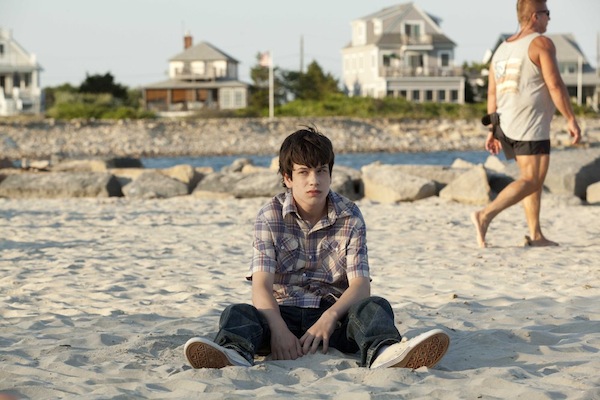
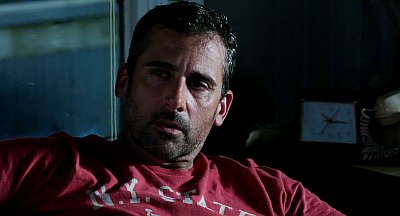
Take Duncan (Liam James), for instance (please, someone has to...) in the new film by Jim Rash and Nat Faxon (they won an Oscar for their superb script for The Descendants).  Fourteen, a 'tweener, his parents are divorced and Mom (Toni Collette) has taken up with another man. Trent (Steve Carrell), who has a daughter Steph (Zoe Levin).  It is clear as this pint-sized Brady Bunch goes to an ocean beach house that it is not going to be anything resembling a beach-home.  Duncan doesn't want to be there; he'd rather be with his Dad this Summer.  Whether that preference has driven a previous wedge between Trent and Duncan is not know.  What is known is that Trent is something of a jerk to Duncan.  "One a scale of 1 to 10, what do you think you are?" he asks Duncan sequestered to the back of the station wagon on the ride to.  "Six," says Duncan, noncommittally.


"I think you're a 3," says Trent imperiously.  "I just don't see you putting yourself out there..."


If Trent wanted to see Duncan put out, that remark was a good start.


Duncan (Liam James) has a "thousand mile stare"
Duncan settles into the teen routine of being a hot-house plant in a dark room, grunting monosyllabically at anyone over 30.  He can't relate to Trent's friends and neighbors, like the barely-together Betty (Allison Janney)—she has two kids, Susanna (AnnaSophia Robb) and Peter (River Alexander) and Kip (Rob Cordrry) and Joan (Amanda Peet).  And Mom, trying to heal after a divorce, is there for Trent.  Duncan tries to be invisible and stay out of the way, and is emotionally unavailable.

It isn't until he finds Steph's abandoned pink bike (with tassles on the handlebars) that things begin to pick up speed and he feels like less of a trapped and pacing animal.  The bike gives him some mobility, some freedom, and it only has one seat, which is fine by him.  He starts to explore the beach-town and runs into Owen (Sam Rockwell at his loose best) who runs the local water-slide park, Water Wizz.  Duncan gravitates there and that's when his Summer starts to get fun.  Owen takes him under his crooked wing, adding Duncan as park-help, and introducing him to what will be his new family, including Caitlin (Maya Rudolph), the responsible to Owen's irresponsible, and concessioners Roddy (Faxon) and Lewis (Rash).  Pretty soon he's in a routine, interacting with sort-of adults and fitting in.

But, it causes conflicts within families; his long hours at the park causes concerns at home and puts him in further conflict with Trent, who has his own disappearing act issues.

It is no great shakes as a film, but it is a good movie, a movie you might enjoy.  It is merely competent, well-written, extraordinarily cast and acted (the standouts being Rockwell and Steve Carell who works against type and proves himself capable of playing a deliberate jerk, instead of just a clueless one.  And Rash and Faxon prove themselves as adept at directing as they are at screenwriting.  In a disappointing Summer, this counts for a lot.  And like Duncan's situation at Water Wizz, this little wayward breath of fresh air from the usual carnage perpetrated on screens is a welcome relief.

The Way, Way Back is a Matinee. 


The only explosion in The Way, Way Back


Tuesday, September 27, 2011

The Help

"The Other Side of the Bridge Club (Insuring Domestic Tranquility)"
or
"You Ought Not to Joke About the Colored Situation"

You go into The Help with a certain amount of trepidation.  Will it be so politically correct as to have no bite?  Will it be a "TWGSTD" movie, where the true story of the oppresssed is supplanted by "the drama" of a privileged person's conscience to help?* Will it be a Neapolitan "Chick-Flick," all sugary ice cream of different flavors and colors?  We've seen plenty of those, and one would hope that we've evolved out of our tribalism enough that film-makers—even commercial film-makers—hedge their story by surrounding the center with white-washing vanilla.**

Stanley Kramer, after all, has been dead for ten years.

With The Help, it's a hesitant answer of "Yes" and "No."  "Yes," the story has elements of "White Guilt" saves the day, but only in the short term, and said Guilty Party, Eugenia "Skeeter" Phelan (known as "Long-Haul" to her high school friends for actually attending and graduating college and pursuing a journalism "job," rather than settling for domestic tranquility) may have a sense of accomplishment, but it costs her.  And the issue of "You think you're gonna help us?" is very pointedly brought up by the character of Minny Jackson (played by her real-life inspiration, Octavia Spencer, in an excellent performance).  Say it, sister.  Nice touch of dignity, that. 

Young Miss "Skeeter" (Emma Stone), is ambitious, as are all the white women in the segregated community of Jackson, Mississippi; her ambitions don't center around who throws the nicest bridge club setting (or has it thrown for them), or making a name for herself preserving the traditions of The South.  She wants to be a journalist, which, given the times, relegates her to ghosting a "best-bleach-for-the-sheets" column for the local newspaper.  But, gnawing at her no. 2 pencil is what happened to the woman who raised her as a child.  No, not mother Charlotte (Allison Janney, who tends to periodically rise above her material), but the house-servant, Constantine Jefferson (the always wonderful Cicely Tyson—I've missed her), who accepted and applauded her graceless duckling ways in a city of debu-taunting swans, and who disappeared while she was away at college, never to return.  The vacancy of Constantine and her story inspires her to talk to the "help" about their stories, and how they maintain during their domestic servitude.  Fearing a backlash from amongst the womens' society, she initially only gets to talk to a reluctant Aibileen Clark (Viola Davis, whose movie this is**), who tells her of her early days and of her family's molasses-like progress from house-"slaves" to house-"servants."

It involves the telling of tales on the pastel and flower-printed white woman she works for, a friend of "Skeeter's" (Anna Camp) and of the Red Queen of the Bridge set, Miss Hilly Holbrook (Bryce Dallas Howard, a subtle, ethereal actress, allowed to go "broadly comic," which, as when Meryl Streep does it, is not pretty).*** Set about the time of the Medgar Evers murder, where any sort of racial consciousness-raising was cracked down upon by Jackson police and strict curfews enforced, The Help has a tendency to overlook the more serious event in the timeline of its narrative, veering more towards comedy in Tate Taylor's adaptation (Taylor is a lifelong friend of novelist Kathryn Stockett's and acquired the rights to her novel before publication), but there is enough genuine tension in scenes of servants trying to get home by curfew, that the plight of the women in the serving class, and the genuine danger they faced in up-braiding their employers, and the structure imposed on them, simmers under the surface.  Even in the face of somewhat trivially humiliating comeuppance, any sense of triumphant table-turning seems negligible against the long road to some sense of justice, however piddling (though entertainingly apt to provide a shit-eating grin) those small victories might be. 

As such, The Help, like those small victories, is a measured success.

(And I appreciated the handy list of uses for Crisco).

The Help is a Matinee.


* "The White Guy Saves The Day," ala "Robinson Crusoe," Dances with Wolves, Glory, Guess Who's Coming to Dinner, Mississippi Burning, The Last Samurai, Avatar, heck, even "Transformers"...

** The closest it comes to teetering over the edge is in a sub-plot of an ostracized Southern belle from the other side of the tracks (played by Jessica Chastain), who embodies a white version of Southern social stigma, and, in a reverse of the normal Hollywood strategy of "white moves first," is shown "the ropes" by one of "the help," an act that becomes mutually beneficial.

*** Octavia Spencer is a real "find" here and a shoo-in to get a Best Supporting Actress nomination come Oscar season, but I hope that Academy voters will also give a Best Actress nod to Davis, whose tremulous fire in her role would make it her second nomination in three years—her first being Doubt, in which her one-speech scene managed to outshine Meryl Streep, Amy Adams and Philip Seymour Hoffman.

**** As if this embarrassment of acting riches wasn't enough, Miss Hilly's mother is played by Sissy Spacek, who continues to play ordinary roles in a most extraordinary way.


Thursday, July 9, 2009

Away We Go

"We're Completely Untethered, Burt!"

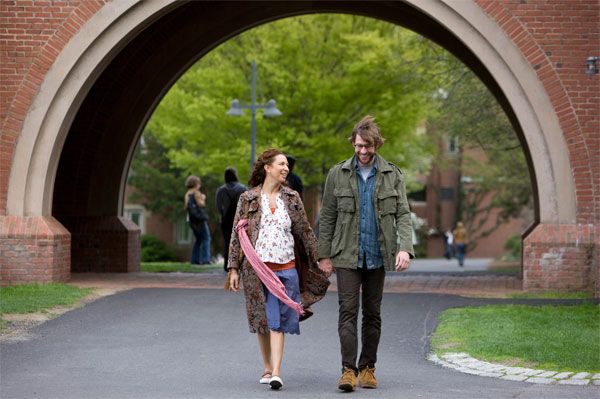
Burt Farlander (John Krasinski) and Verona de Tessant (Maya Rudolph) are two professionals in their mid-30's living in a single-wide in the woods—he sells insurance futures, she illustrates medical texts—he wants to get married and she doesn't; they're having a baby. That almost changes everything. They go and break the happy news to his parents (Catherine O'Hara and Jeff Daniels) who have suddenly decided to live in Belgium a month before the baby is due.

That changes everything. Because without grand-parental responsibilities*, Burt and Verona can live anywhere in the world with their kid, near anyone they want to. And so begins an Odyssey of sorts to find the perfect place to be a family.

"Away We Go" is a bit of a deceptive title. There are several ways they can go, and the film boils down to episodes where they can look on with horror at possible futures.

1. "Away to Phoenix:" they visit Verona's former editor (
an hysterical Allison Janney) and her family; the kids are off-world zombies, paid no heed by the parents who are crass alcoholics with no life.

2. "Away to Tucson:" they visit Verona's sister (
Carmen Ejogo), who works at a resort, attachment-proof, and has the impropriety to bring up Mom and Dad to Verona.

3. "Away to Madison:"
they visit an "aunt" LN (Maggie Gyllenhaal), whose life-style is healthy, pretentious and stifling—"No separation, no sugar, no strollers" (sure, it sounds good, but in practice it's a fascist nightmare)

4. "Away to Montreal:" they visit college friends (
Chris Messina and Melanie Lynskey) who have an adopted, well-adapted multi-cultural family for whom the parents are caring and giving but conceal a secret pain.

5. "Away to Miami:" Burt's brother (
Paul Schneider) has an emergency—his wife has left him, leaving the care of his young daughter solely to him, which terrifies him.

The scenario's veer from the uproarious to the melancholy, each one holding up a mirror to Burt and Verona about nightmare scenarios that could conceivably be their future. The laughs are plentiful, pierced occassionally by sadness. Sure, it's a
Sam Mendes film ("American Beauty," "Road to Perdition," "Revolutionary Road"), but it's the first time Mendes has directed out and out comedy—you can't expect him to go completely slapstick after those studies in tragedy.

But, it's the sweetness you remember—
Mendes is the most heavy-handed of directors to the point of oppression (and he still can't go a whole movie without his cold null-center compositions), but "Away We Go" breathes a bit with the light touch that consummate ad-libbers Krasinski and Rudolph bring to the playing. The other characters verge into caricature (with O'Hara and Daniels together, how can it not?), but Mendes' two stars have quicksilver abilities to exploit the comedy in potentially sticky situations. Krasinski's man-boy who likes to play grown-up is a perfect match for him, and Rudolph is one of the few SNL alum's who can sustain an entire character for an entire movie. It's a trifle, but it's the first movie the director has made that makes you want to order a bullet chaser with your popcorn.

"Away We Go" is a Matinee.

* "It's not like your parents are doing anything," Burt deflects Verona. "My parents are dead," she reminds him. (pause) "Still..," he starts to argue.

Thursday, March 27, 2008

Juno


"Like the city?"

"No."

Juno is full of self-conscious attempts at hipster cred. The first half of the movie hardly features a single straight line; everything is an exercise in cooler-than-thou slang. Ellen Page, as the titular Juno, attempts to topple Thora Birch from Ghost World (who had previously deposed Christina Ricci) for the Indie Goddess crown. She's an artist, she has strong opinions, she has an alienated humanitarian affect, she's into cool music and isn't afraid to wear black or tell grown-ups where to stick it. But had that been the point of the film, critics would have rolled their eyes instead of swooning.


The second half redeems the film's overexposed style. The supporting cast radiates human warmth. Michael Cera, playing the same character Michael Cera always plays, is so damn adorable that he could serial murder half of Ohio and everyone would still love him. Juno's parents and friends queue up winsome scene after scene, providing the safety net for Ellen Page to do her reckless rebellion act. But after strutting around like Holden Caulfield for the first half of the movie, Page has to expose all her vulnerability and pain in the second reel. I won't give you any spoilers, but this is where the movie shines... with a poignant ending that will almost make you believe in love again.
This is a full price feature.