Showing posts with label Jeff Daniels. Show all posts

Tuesday, September 13, 2011

Traitor

This week, we're re-publishing some reviews of the films from the post 9-11 environment.

"I Wouldn't Make Any Plans, Man..."

Traitor is a taut, tough little thriller about the FBI (yes, the FBI) trying to track down a group of Islamic jihadists with plans to pull off a continuing string of bombings throughout the world. Their focus is one Samir Horn (Don Cheadle), born in the Sudan, and who disappeared while working for the government in Afghanistan. Word is that he found his faith working for the mujahadin, and now he's been tracked selling detonators to a terrorist faction in Yemen.

There, two FBI agents, Clayton (Guy Pearce, this time with a convincing soft Southern accent) and Archer (Neal McDonough) are tracking the faction's movements, and during a raid, Horn is captured, but will not turn over any evidence to help the investigation. In prison, he is doubted by the jihadists as a possible informer to the U.S., and a target by some of the prisoners. Outside, he is not trusted at all, but as long as he's detained, he's not a threat.

Then, he breaks out.

At this point, to reveal any more of the plot might be unfair to anyone who wants to see a well-done "War on Terror" thriller, done in the shakiest "Bourne" style, with powerhouse performances by Cheadle, Pearce, McDonough and Jeff Daniels. Real tension is achieved throughout the story, as the stakes get increasingly higher. And writer-director Jeffrey Nachmanoff, working from a story by Steve Martin* (yes, that Steve Martin) keeps things simple and straight-forward--pretty amazing, given that his last credit was for screen-writing The Day After Tomorrow. Without much on his resume to indicate that he was capable of this, it will be interesting to see what he does in the future.

The other neat thing is seeing Don Cheadle in full "action-star" mode--tight, lean and fast, he pulls off several well-done fight scenes, while never sacrificing the wariness and intelligence in his eyes. At this point, it should be pretty obvious that Cheadle can play just about anything, and have the audience with him the whole way.

"Traitor" is a Matinee


* Sleeping on it, Martin's participation seems apt, rather than surprising. The denouement is the product of a Master of the Absurd, and thinking further on it, in the War on Terror, Absurdism is only a realization away from the insanity of the unthinking zealot. Maybe in the War on Terror, we need fewer strategists and more comedians. "Laugh? I killed 'em!"

Saturday, December 26, 2009

Fly Away Home

"Fly Away Home" (Carroll Ballard, 1996) I mentioned to a co-worker that I'd seen this movie and liked it. "What!" she gaped. "The goose movie?!"

Yes, damn it, "the goose movie."

Based on the true efforts of naturalists who imprint orphaned geese how to migrate, it's been shapoed into a fun, odd movie that imprints young minds with a story of responsibility while creating a film with the same sense of wonder, but a little less of the austerity that Ballard brought to the 1985 "
The Black Stallion" and 1990's "Never Cry Wolf."

Fairweather father Tom Alden (
Jeff Daniels) flies to New Zealand where his daughter (Anna Paquin) and ex-wife have been involved in a car accident that kills the mother. Alden takes the traumatized Amy back to his Canadian farm, where he continues his experiments in perfecting ultra-light gliders and activism for protecting the surrounding wild-lands from developers. An early bulldozing of green-space disturbs a nest of geese, and Amy takes the eggs and oversees their hatching.

But geese are odd ducks. Amy being the first human they see, the goslings assume she's their mother, and so she feeds, cleans, exercises and cares for the birds, to the grudging acceptance of her father and girlfriend (Dana Delany). "Imprinting" goes both ways. The geese are stuck on Amy, and she is devoted to them. This runs them afoul of the local game warden who insists that their wings be clipped to prevent them from flying off during migratory season. See, geese learn the paths from their parents...and orphaned geese...well, their proverbial goose is cooked.

Horrified, Amy and her father hatch a plan to imprint the migration path on the geese by piloting a pair of powered ultra-kights from Canada to the sunnier climes of Florida. First, Amy must learn to fly. Then, they have to coax the birds to follow her ultra-light. Then...well, the task has all the potential catastrophes as a "Mission: Impossible" plot. Experts are skeptical. The air-space is restricted. The flights unauthorized. One of the geese is injured. But, as they say, the plan is so crazy, it...just...could...work.

Freely adapted from
Bill Lishman's book and own experiences imprinting new migratory paths on geese and whooping cranes, it's one of those perfect children's movies that doesn't speak down to kids, keeps them engaged, and gives them something to get excited about, while also keeping adults intellectually enthralled rather than insulted. And Ballard and his "Black Stallion" cinematographer—the gifted Caleb Deschanel—brings that same eye for the beautiful image and the defining detail that have made his other films engaging studies of man's relationship to Nature.

At the same time the film is a coming-of-age film of a child coping with the death of a parent by becoming one and fighting for the life of her new charges. Finally, it is also a film of letting go for human beings and for birds, of letting Nature takes it course and trusting in lessons taught. It's one the whole family can enjoy.

Thursday, July 9, 2009

Away We Go

"We're Completely Untethered, Burt!"

Burt Farlander (John Krasinski) and Verona de Tessant (Maya Rudolph) are two professionals in their mid-30's living in a single-wide in the woods—he sells insurance futures, she illustrates medical texts—he wants to get married and she doesn't; they're having a baby. That almost changes everything. They go and break the happy news to his parents (Catherine O'Hara and Jeff Daniels) who have suddenly decided to live in Belgium a month before the baby is due.

That changes everything. Because without grand-parental responsibilities*, Burt and Verona can live anywhere in the world with their kid, near anyone they want to. And so begins an Odyssey of sorts to find the perfect place to be a family.

"Away We Go" is a bit of a deceptive title. There are several ways they can go, and the film boils down to episodes where they can look on with horror at possible futures.

1. "Away to Phoenix:" they visit Verona's former editor (
an hysterical Allison Janney) and her family; the kids are off-world zombies, paid no heed by the parents who are crass alcoholics with no life.

2. "Away to Tucson:" they visit Verona's sister (
Carmen Ejogo), who works at a resort, attachment-proof, and has the impropriety to bring up Mom and Dad to Verona.

3. "Away to Madison:"
they visit an "aunt" LN (Maggie Gyllenhaal), whose life-style is healthy, pretentious and stifling—"No separation, no sugar, no strollers" (sure, it sounds good, but in practice it's a fascist nightmare)

4. "Away to Montreal:" they visit college friends (
Chris Messina and Melanie Lynskey) who have an adopted, well-adapted multi-cultural family for whom the parents are caring and giving but conceal a secret pain.

5. "Away to Miami:" Burt's brother (
Paul Schneider) has an emergency—his wife has left him, leaving the care of his young daughter solely to him, which terrifies him.

The scenario's veer from the uproarious to the melancholy, each one holding up a mirror to Burt and Verona about nightmare scenarios that could conceivably be their future. The laughs are plentiful, pierced occassionally by sadness. Sure, it's a
Sam Mendes film ("American Beauty," "Road to Perdition," "Revolutionary Road"), but it's the first time Mendes has directed out and out comedy—you can't expect him to go completely slapstick after those studies in tragedy.

But, it's the sweetness you remember—
Mendes is the most heavy-handed of directors to the point of oppression (and he still can't go a whole movie without his cold null-center compositions), but "Away We Go" breathes a bit with the light touch that consummate ad-libbers Krasinski and Rudolph bring to the playing. The other characters verge into caricature (with O'Hara and Daniels together, how can it not?), but Mendes' two stars have quicksilver abilities to exploit the comedy in potentially sticky situations. Krasinski's man-boy who likes to play grown-up is a perfect match for him, and Rudolph is one of the few SNL alum's who can sustain an entire character for an entire movie. It's a trifle, but it's the first movie the director has made that makes you want to order a bullet chaser with your popcorn.

"Away We Go" is a Matinee.

* "It's not like your parents are doing anything," Burt deflects Verona. "My parents are dead," she reminds him. (pause) "Still..," he starts to argue.

Saturday, December 13, 2008

The Lookout

"The Lookout" (Scott Frank, 2007) When one samples a lot of movies, one notices trends. Sometimes, they're small things like the string of copy-cat movies that ride the financial coat-tails of a box office smash. Maybe it's a theme, like 'pregnant woman" movies, or "kids who have sex meet a grisly death."

Or superhero movies, be they
light, grim, or attitude-of-the-month.

Maybe I don't get out much, but it seems odd that a lot of the teen "thrillers" I've seen lately begin with a spectacular and traumatic car-crash. Is that part of the teen-zeitgeist that the acquisition of the freedom that "wheels" represent also is uppermost on their minds as the most ironic of deaths--
especially at a time when they're feeling most invulnerable. They can't imagine a "Dead Man's Curve" that could turn them into "teen angels" when they've seen themselves as an immortal "Leader of the Pack." There's something emblematically horrific about the symbol of your freedom turning against you.

And so, teen thrillers have the air of a driver's education blood-bath film about them.
The "Final Destination" films had a spectacular highway smash-up. "Disturbia" opened with one that traumatized the hero.

So, too, does "The Lookout," screenwriter Scott Frank's directorial debut. Frank's made a reputation for tough-guy neo-noirs along the lines of "
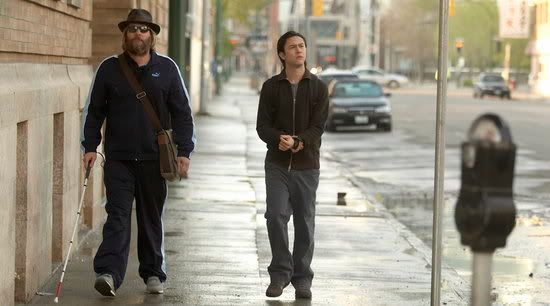
Get Shorty ," Minority Report," "Out of Sight,"—he has inexplicably written the screenplay for "Marley & Me"—and "The Lookout" is in the same vein. Chris Pratt (Joseph Gordon-Levitt) was a promising high-school athlete who, due to a stupid driving accident, has a variation of short-term memory loss and a crippling case of "Survivor's Guilt." For one, he has to make lists to keep him task-focused, and for the other he lives with his blind room-mate, Lewis (Jeff Daniels--fine, understated work). Cognitively, he's so "in the moment" that the only job he can reasonably function at is as clean-up crew at a local bank. That puts him under the watchful eye of a skanky team of heisters who blackmail Chris into being their entree into the facility.

One wishes that with a screenwriter of Frank's freshness that "The Lookout" would keep you guessing, but it does not—playing out as one might expect a movie with this particular character arc, would. This is no "
Memento" that would turn the complications and moral implications of a brain condition like this on its medulla oblongota. Here, Scott treats it as a deficiency that needs to be overcome for the world to work right for the young Mr. Pratt. And there are enough complications that affect him personally that he is compelled to pull himself out of his funk, and get his head on straight. Sounds a bit rote--a bit Hollywood-convenient--when boiled down to those essentials. But there are compensations with the likes of actors like Daniels, and Bruce McGill, and Carla Gugino lending supporting roles.

One hopes for better things from the talented Frank, but considering he's in line to helm the next attempt to jump-start a "Planet of the Apes" franchise for 20th Century Fox, they might be empty hopes.

Thursday, September 18, 2008

Traitor

"I Wouldn't Make Any Plans, Man..."

"Traitor" is a taut, tough little thriller about the FBI (yes, the FBI) trying to track down a group of Islamic jihadists with plans to pull off a continuing string of bombings throughout the world. Their focus is one Samir Horn (Don Cheadle), born in the Sudan, and who disappeared while working for the government in Afghanistan. Word is that he found his faith working for the mujahadin, and now he's been tracked selling detonators to a terrorist faction in Yemen.

There, two FBI agents, Clayton (Guy Pearce, this time with a convincing soft Southern accent) and Archer (Neal McDonough) are tracking the faction's movements, and during a raid, Horn is captured, but will not turn over any evidence to help the investigation. In prison, he is doubted by the jihadists as a possible informer to the U.S., and a target by some of the prisoners. Outside, he is not trusted at all, but as long as he's detained, he's not a threat.

Then, he breaks out.

At this point, to reveal any more of the plot might be unfair to anyone who wants to see a well-done "War on Terror" thriller, done in the shakiest "Bourne" style, with powerhouse performances by Cheadle, Pearce, McDonough and Jeff Daniels. Real tension is achieved throughout the story, as the stakes get increasingly higher. And writer-director Jeffrey Nachmanoff, working from a story by Steve Martin* (yes, that Steve Martin) keeps things simple and straight-forward--pretty amazing, given that his last credit was for screen-writing "The Day After Tomorrow." Without much on his resume to indicate that he was capable of this, it will be interesting to see what he does in the future.

The other neat thing is seeing Don Cheadle in full "action-star" mode--tight, lean and fast, he pulls off several well-done fight scenes, while never sacrificing the wariness and intelligence in his eyes. At this point, it should be pretty obvious that Cheadle can play just about anything, and have the audience with him the whole way.

"Traitor" is a matinee

* Sleeping on it, Martin's participation seems apt, rather than surprising. The denouement is the product of a Master of the Absurd, and thinking further on it, in the War on Terror, Absurdism is only a realization away from the insanity of the unthinking zealot. Maybe in the War on Terror, we need fewer strategists and more comedians. "Laugh? I killed 'em!"