Showing posts with label 1996. Show all posts

Saturday, February 5, 2011

From Dusk Till Dawn

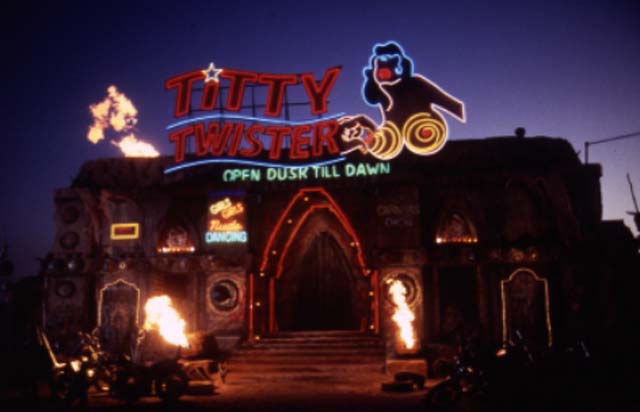
From Dusk Till Dawn (Robert Rodriguez, 1996) Quentin Tarantino had just won an Oscar for co-writing Pulp Fiction, and followed it up by writing this mocking over-the-top vampire movie.  He grabbed Desperado director Rodriguez to direct it (so he could concentrate on his acting—and he's not bad here), starting a career-long association, and George Clooney used it to re-start his movie career while still in his "E.R." bobblehead days, back before he decided he'd take his movie choices seriously. 

He wasn't doing that here.  This one's a black-crested lark of comic violence and obscene intentions, a nihilistic exploration of...well, absolutely nothing.  It's what Rodriguez and Tarentino do at their worst—make crap they like, but is so "inside" as to be a private joke for their own giggling pleasure.

The Gecko brothers (Clooney, Tarantino) are nihilistic criminals trying to make their way over the Mexican border.  After an incendiary one-stop robbery, they kidnap a family, the Fullers (Harvey Keitel, Juliette Lewis, Ernest Liu), to smuggle them across the border where they end up at the infernal strip-club, The Titty Twister, which holds a deep dark secret once the sun goes down—it's run and jobbed by vampires.  Yup, an 24 hour-a-day joint filled with blood-suckers.  But, for some reason, opening up the saloon doors doesn't eliminate the staff and add a new layer of dust to the floor.  Nor, would the nightly slaughter of customers fail to attract a new clientele.

Odd, that.

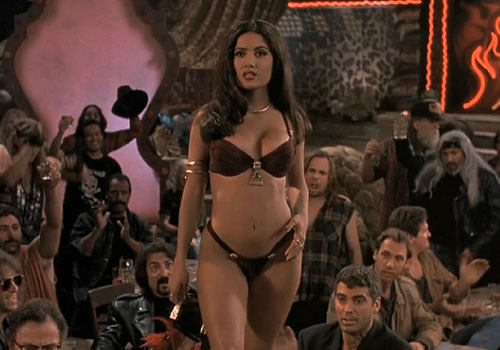
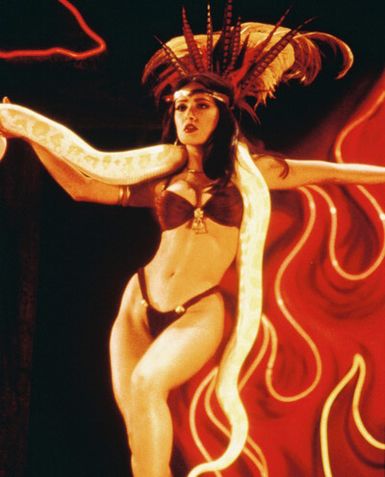
But, it does provide a lot of bulbous make-up effects, a lot of ultra-squishy violence done to living and dead alike, and appearances by B-movie stalwarts Fred Williamson, Cheech Marin, and make-up maven Tom Savini—who didn't do any of the make-up.  By the end, there are so many holes in people that it almost outnumbers the holes in the plot (QT's Richard Gecko sustains an early gunshot clean through his hand—you can see through it—and yet he keeps using that hand in the film, even though the bones in his palm have been blasted through, which is a nice trick—howdy dood that?).  Richard's a creepy sleezoid, while Clooney's Seth Gecko is just a cocky little bastard.  It must have felt good to get that out of his system, but the results are so thoroughly hackneyed and cock-eyed and cartoonishly vile that one has to have a pretty bad day kicking puppies to get any real enjoyment out of it.  A highlight is Salma Hayek's stripper performance—where she doesn't strip. 

Fortunately, nearly everyone in the movie has gone on to better things.  So should you.

Wednesday, August 11, 2010

Executive Decision


"Executive Decision" (Stuart Baird, 1996) Good "bottled" actioner on many fronts: one of the better pre-911 films that used terrorist hijacking as a plot-point, superstar editor Stuart Baird's best film as a director, and probably the best movie Steven Seagal ever appeared in.  It's also a tense film with a superb cast that will keep you on tenderhooks until the last moment.


A Boeing 747 domestic airliner is hijacked from Europe, heading for the U.S.  Intel expert Dr. David Grant (Kurt Russell) suspects a powerful chemical agent is on-board that the terrorists will slam into a major city, wiping out its population.  Special Forces Lt. Colonel Austin Travis (Seagal) has been burned on Grant's reports before, and insists that he accompany his team of wet-ops (Joe Morton, John Leguiziamo, B.D. Wong) on a mission to take back the airplane and take out the terrorists (led by David Suchet, whose baleful expressions betray none of the glint he brings to Agatha Christie's Poirot).


It may be the best decision he never wanted to make.  Grant may be a fish out of water in the field, but as a beginning flying student, he at least has some core competency in the simultaneously wide open spaces and cramped environs of an airplane.  Still, the mission's going to be tough to do in-flight.  But, a prototype stealth-plane with collar could be sent up to rendezvous with the 747 unseen, allowing the team to slip on-board undetected...that is, according to its "blue-sky" engineer Dennis Cahill (Oliver Platt).  There is no other choice but to take a flyer and make the attempt.  But, of course, complications arise, not the least of which are the buffeting forces that aren't antcipated when the tiny "Remora" shuttle is attached to the gargantuan air-ship. 


The hectic transfer creates an untenable situation for the ops team: one of their experts is critically injured, the command position must be filled by Grant and Cahill (who were never supposed to be on the hi-jacked plane), and their communication gear is compromised so they ahve no way of relaying information back to Washington, who are on a parallel course to track, and possibly, shoot down the plane before it enters U.S. air-space.  The Special Forces are therefore forced to move forward with their plans, operating in a communications blackout, and in the dim confines of the 747's infrastructure, in order to save the plane and their own lives.   With help from one particularly plucky air hostess (Halle Berry—the hysterical Marla Maples Trump is no help at all*) the team must first identify the hi-jackers, secure the nerve gas, dodge the fighters, and get the plane down safely.

Even before the events of 9/11 (or even because of them), it's a smart, interesting, tense little film that sets up an impossible mission, and throws as many complicating hurdles at the SF crew before it can be resolved.  It's a disaster movie, so things go disasterously, the stakes rising as the plane edges towards the East Coast.  Russell (who's always a welcome presence in a film) makes for a believable "only-book-smart" field-man, effectively giving audience-intel through the "what the hell" panic behind his spectacles, and the superb supporting cast all create characters you care about and root for.  A great combination of tense action with good, no-nonsense writing that never cuts the audience or the movie any slack.


* "You're fired, honey..."

Saturday, December 26, 2009

Fly Away Home

"Fly Away Home" (Carroll Ballard, 1996) I mentioned to a co-worker that I'd seen this movie and liked it. "What!" she gaped. "The goose movie?!"

Yes, damn it, "the goose movie."

Based on the true efforts of naturalists who imprint orphaned geese how to migrate, it's been shapoed into a fun, odd movie that imprints young minds with a story of responsibility while creating a film with the same sense of wonder, but a little less of the austerity that Ballard brought to the 1985 "
The Black Stallion" and 1990's "Never Cry Wolf."

Fairweather father Tom Alden (
Jeff Daniels) flies to New Zealand where his daughter (Anna Paquin) and ex-wife have been involved in a car accident that kills the mother. Alden takes the traumatized Amy back to his Canadian farm, where he continues his experiments in perfecting ultra-light gliders and activism for protecting the surrounding wild-lands from developers. An early bulldozing of green-space disturbs a nest of geese, and Amy takes the eggs and oversees their hatching.

But geese are odd ducks. Amy being the first human they see, the goslings assume she's their mother, and so she feeds, cleans, exercises and cares for the birds, to the grudging acceptance of her father and girlfriend (Dana Delany). "Imprinting" goes both ways. The geese are stuck on Amy, and she is devoted to them. This runs them afoul of the local game warden who insists that their wings be clipped to prevent them from flying off during migratory season. See, geese learn the paths from their parents...and orphaned geese...well, their proverbial goose is cooked.

Horrified, Amy and her father hatch a plan to imprint the migration path on the geese by piloting a pair of powered ultra-kights from Canada to the sunnier climes of Florida. First, Amy must learn to fly. Then, they have to coax the birds to follow her ultra-light. Then...well, the task has all the potential catastrophes as a "Mission: Impossible" plot. Experts are skeptical. The air-space is restricted. The flights unauthorized. One of the geese is injured. But, as they say, the plan is so crazy, it...just...could...work.

Freely adapted from
Bill Lishman's book and own experiences imprinting new migratory paths on geese and whooping cranes, it's one of those perfect children's movies that doesn't speak down to kids, keeps them engaged, and gives them something to get excited about, while also keeping adults intellectually enthralled rather than insulted. And Ballard and his "Black Stallion" cinematographer—the gifted Caleb Deschanel—brings that same eye for the beautiful image and the defining detail that have made his other films engaging studies of man's relationship to Nature.

At the same time the film is a coming-of-age film of a child coping with the death of a parent by becoming one and fighting for the life of her new charges. Finally, it is also a film of letting go for human beings and for birds, of letting Nature takes it course and trusting in lessons taught. It's one the whole family can enjoy.

Tuesday, December 2, 2008

Everyone Says I Love You

"Everyone Says I Love You" (Woody Allen, 1996) First off, the title of Woody Allen's attempted musical should read "Everyone...Says I Love You" because the meter is essential. It comes from the song that takes a large junk of time-spanning narrative from the Marx Brothers comedy "Horse Feathers." That haunting and addicting song by Bert Kalmar and Harry Ruby** stays in the mind a long time. And the songs Allen employs, a mix of 20's/ 30's standards ("Makin' Whoopee," "My Baby Just Cares For Me") drop the narrative to a dead stop in a way that the musicals being emulated never did.* The musical pieces feel like an interruption rather than an extension of the story, or a poetic expression of the character's thoughts, though brief attempts are made to do so. The song that works best is the first one ("Just You, Just Me") that starts without warning, out of Allen's standard white-on-black opening credits (in silence). Then Boom! We're singing...actually Edward Norton is singing in a gentle, reedy pleasant voice. Norton comes off best, genuinely attempting to "sell" the song and sentiment (and it's fun to see a joyful Norton--early in his career--galumphing out of the way of dancers, and doing a better version of the Woody Allen stammering switch-backs than the director can manage***). Everyone--save Drew Barrymore--sang their own songs, and they do pretty well, though Julia Roberts is very off-key, and Tim Roth, playing a recently paroled con, sings inconsistently sweetly. The biggest disappointment is Allen's number sung in a barely-there voice. His song is not so much plaintive, as shy and non-committal...and wrong.

The plot is as slim as anything Allen's done: a series of brief encounters with the engagement of Holden Spence (Norton) and Skylar Dandridge (Barrymore) at its hub. But Allen undercuts the effervescence of the musical format by basing the main story on the efficacy of inspired love, or love-at-first-sight. Love is an illusion he says, just like breaking into song with a full orchestra backing you up in a movie. Great. It's a bit like being inspired to song by reading The Wall Street Journal. The cast is the usual first-rate one: Alan Alda, Goldie Hawn, Lukas Haas, a young Natalie Portman and Billy Crudup, Julia Roberts, Gaby Hoffmann, and Tim Roth

Besides that opening plunge into musical-land, the charm of it all is only sporadically amusing, if warm-hearted--Allen, during instrumental portions of the songs, intercuts beautifully shot (by
Carlo Di Palma) landscapes ala Fox musicals. But, there seems a long, dry spell before further joys, and, as it does so often in Allen's films, the best is saved for last--a dance between Hawn and Allen by the river Seine, which nearly matches in grace what Astaire and Rogers achieved by mixing dance and story through the use of movie-magic--the one kind of magic Allen does believe in. Although the two are far, far less capable dancers, Allen compensates by putting Hawn on a wire-rig, and she, seemingly effortlessly, floats high into the air with a natural gracefulness, and alights to earth as if weightless. It is pulled off with such suddenness and beauty that one is caught off-guard, and stunned, like that sudden drop into song at the film's beginning. It's one of the most charming...and surreal moments in the body of Allen's work. ****

*But the elephantine musicals of the 60's and 70's--that's another story.

**
Groucho: Everyone says I love you
but just what they say it for I never knew
it’s just inviting trouble for the poor sucker who
says I love you

Take a pair of rabbits who
get stuck on each other and begin to woo
and pretty soon you’ll find a million more rabbits who
say I love you

When the lion gets feeling frisky and begins to roar
there’s another lion who knows just what he’s roaring for

Everything that ever grew
the goose and the gander and the gosling too
the duck upon the water when he feels that way too
says quack quack quack

Chico: Everyone says I love you
the great big mosquito when-a-he sting you
the fly when he get stuck on the fly paper too
says I love you

Every time the cow says moo
she’s a-make the bull-a very happy too
and the rooster when he holler cock-a-doodle-doodle-doo
says I love you

Christopher Columbo he write the queen of Spain a very nice a-little note
and he’s a-write I love you, babee and then he get himself a great a-big a-boat
he’s a wise-a-guy

What do you think Columbo do
when he’s a-come here in 1492?
he said to Pocahontas achi vachi vachi voo
that means you little son of a gun, I love you

Zeppo: Everyone says I love you
the cop on the corner and the burglar too
the preacher in the pulpit and the man in the pew
says I love you

Every one, no matter who
the folks over eighty and the kid of two
the captain and the sailor and the rest of the crew
says I love you

There are only eight little letters in this phrase you’ll find
but they mean a lot more than all the other words combined

Everywhere the whole world through
the king in the palace and the peasant too
the tiger in the jungle and the monk in the zoo
says I love you


***

****

Friday, August 29, 2008

Looking for Richard (1996)

Looking for Richard (1996, Pacino)
As fascinating and frustrating to watch as it must have been for Al Pacino to make this documentary. It charts his four-year quest to explore Shakespeare's Richard III, initially with the ambition to find a way to make it more accessible to contemporary American audiences. The film is a mixture of rehearsal and performances (though there was never a full-length production) interviews with actors and academics, and footage of Pacino and his collaborator,
Frederic Kimball prowling the streets on both sides of the Atlantic, collecting vox populi, arguing and discussing with each other and at one point, setting off the fire alarm inside Shakepeare's birth-place as they attempt to make sense of the play and sense of Pacino's obsession with it. Whether intended or not, what comes through at the end is how much Pacino resembles his main character in so many ways: single-mindedness, manipulativeness though for very different ends. It makes you appreciate the power of Shakespeare and admire the talent and drive of Pacino, as well as the stars he gathers around him in his quest.

Looking for Richard is available on DVD from Fox and also features
John Geilgud (interview), Vanessa Redgrave (interview), Kevin Kline (interview), Kevin Spacey, Alec Baldwin, Estelle Parsons, Winona Ryder, Penelope Allen, Kevin Conway, F. Murray Abraham, Aidan Quinn, Kenneth Branagh (interview), James Earl Jones (interview), Rosemary Harris (interview), Derek Jacobi (interview)