"Planet Terror" (Robert Rodriguez, 2007) I believe in the Jeffersonian ideal of self-improvement. I believe in those tenets born from the Enlightenment, that man, left to his own devices, will grow, fend for himself, and improve himself to make his life, and those of others, richer and more full.
And then, I see a movie like "Planet Terror" and I want to burn every H-D camera in the world. There are a lot of critics--many of whom I respect--who sang the praises of "Grindhouse," when it briefly slunk, shambling, into the multi-plexes in the Summer of 2007.** All I can say is that if "Planet Terror" is any indication (and I haven't seen Tarantino's "Death-Proof" half of the film), they are seriously wrong-headed.
A critic has an odd job: if they're doing it right, it's a bit like trying to find a pony in a pile of manure. You can find artistry in the unlikeliest places: Spaghetti westerns displayed the amazing eye and burning dramatic sense of Sergio Leone (who influences Tarantino and Rodriguez***); cheap "B"-movies formed the twisted spine of the film noir genre. Artistry can come from anywhere. And it's a critic's job to be on the look-out for it, even in genres considered "low," and by film-makers who one might have a prejudice towards. But that's on a good day.
Example: I've never enjoyed the films of Ed Wood, outed by Michael Medved back in the day when his "Golden Turkey Award" books spawned his dubious movie/social critic career. You'd think that from his descriptions that Wood's films would be a laugh-riot, full of boners and prat-falls. They're not. They're exercises in incompetence that are pathetic and pitiable. Rather than taking any cruel joy out of his films, I experienced a kind of bored disgust, I don't have fun watching incompetence. Tim Burton got it right about Ed Wood; he didn't know quality from a rubber octopus-and loved his own work with a romantic's blindness. He still made movies that suck.
I know what they were going for in "Grindhouse." They were trying to go back to the "C"-movie days of double-bill films that tried to eke out a profit by appealing to the lowest common denominator--the kids-and-cretins-circuit--something that Dimension Films--"Grindhouse's" distributor--routinely does, as well. Some of the greatest directors of movies--some of the brightest--honed their craft in the AIP's and worse. But once they got their chops, they stopped making crap. They aspired. They wanted more. Only someone of limited creativity (or a moron...or a deeply cynical artist) would knowingly aspire to garbage, and so reluctantly, I'm bestowing that label to Robert Rodriguez--the "deeply cynical artist" one, as he's very creative, and certainly not a moron. Left to his own devices, Rodriguez can do some entertaining work--the El Mariachi films, the "Spy Kids" films, and they're made with an economy that's something short of miraculous--but team him with his mentor, Quentin Tarentino and it all turns to shit (QT has a mercifully brief role in "Planet Terror," as an over-acting rapist, where he proves, once again, that he's the male equivalent of Pia Zadora). The guy's got the chops, no doubt about it. But he has one thing missing in his many talents--taste. They don't teach that at film school, and you can't get it at the video store. "Taste" is what you get when you aspire, and it can even be with the schlockiest material known to man ("Touch of Evil," "Psycho," "The Godfather"...I can go on and on about artists who reached to make a silk purse out of a sow's ear,****), but to revel in schlock, to aspire to it...and have the results be so...marginal, so...bad, and not even in a funny way, but pitiable, well, you start to wonder what it is you saw in these guys before. There is one "pony" moment in "Planet Terror" and that is the "old man" performance of Michael Parks, who appears to think he's in another movie. Wouldn't be the first time.
Sometimes, critics, in their zeal to be ahead of the curve, or to appear "hip," will go a bit too far and end up over a cliff, or in the ditch. But that's what happens when you start looking for ponies.
Sometimes, a turd is just a turd.
------------------------------------------------------------------------
"Planet Terror" is such an artless mess, with poor performances  by some actors who should have known better (Bruce Willis and Jeff Fahey), and a lot of actors who don't (principally Rose McGowan and Quentin Tarentino), goofy, squishy special effects of the fake vomit variety, and a pervasive air of nastiness that the one joke that works--a "Missing Reel" insert at the heart of a sleazy sex scene--reveals the emptiness of the thing, the cavalier disregard for the audience, and the apparent "who gives a shit" attitude of the film-makers. The acting goes beyond camp into the realm of the absurdly arch and hammy. People were employed on this film and hopefully they got paid, though given the meager accomplishments of this film they might have been compensated with a credit for their resumes. "Planet Terror" is a waste of time, both mine and the people involved in making it, and that's the worst thing you can say about any movie.
** I also heard the gleeful anticipation of fan-boys (the kind who post at AICN) that it was going to be "SOO COOOOL!"
*** For that, Leone is probably spinning--verrry sloooowly--in his grave, a place Tarentino seems to be spending a lot of time these days.
**** Jerry Lewis tells the story of one night editing a film when Stanley Kubrick steps into the room, smoking, asking if he can hang out and watch what they do in the process, and Lewis and his editor try to work out a thorny continuity problem. Lewis finally decides to move on and says: "You can't polish a turd." There's a silence at the back of the room, and then Kubrick pipes up: "You can if you freeze it..."
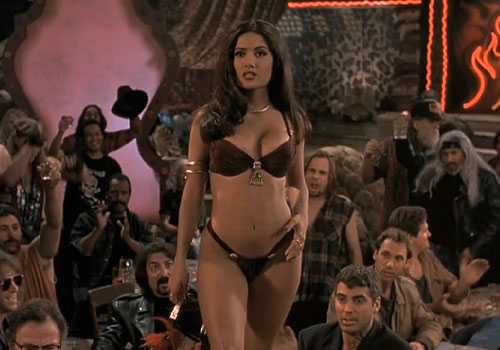
 From Dusk Till Dawn (Robert Rodriguez, 1996) Quentin Tarantino had just won an Oscar for co-writing Pulp Fiction, and followed it up by writing this mocking over-the-top vampire movie. He grabbed Desperado director Rodriguez to direct it (so he could concentrate on his acting—and he's not bad here), starting a career-long association, and George Clooney used it to re-start his movie career while still in his "E.R." bobblehead days, back before he decided he'd take his movie choices seriously.