This was part of a series of reviews of the ASUW Film series back in the '70's. Except for some punctuation, I haven't changed anything from the way it was presented, giving the snarky, clueless kid I was back in the '70's a break. Any stray thoughts and updates I've included with the inevitable asterisked post-scripts.
This Friday's films in 130 Kane Hall at 7:30pm are "Closely Watched Trains" and "Lacombe, Lucien." "Closely Watched Trains" aka "Ostre sledované vlaky" (Jirí Menzel, 1966) "Closely Watched Trains" is a wry, sometimes hysterical Czech film by Jiri Menzel, a person you've probably never heard of and have already forgotten.* It tells the story of Miloš Hrma, an insignificant young man in the scope of WWII, whose father was retired at 48 and now spends his day lying around and keeping track of the comings and goings of the train. Another relative was a hypnotist and a couple years back, he tried his skills on an advancing Nazi tanke-gruppe and was promptly crushed to a pulp (I am telling you this because there is no way in Hell that you'll be able to read the sub-titles in the opening minutes).** These are only two examples of Menzel's comedy-of-errors style of telling his story.
Menzel takes little incidents of the story of Miloš's work-a-day situation standing at the train platform—a job he wanted "just so he could strut on the platform." And his stories are sometimes hilariously satirical (for an example, there is an hysterical look at a town Nazi explaining the war situation and in a blase manner explaining that withdrawals from the American forces are such wonderful tactical maneuvers). Sometimes (most of the time), the stories are very ribald; one of the sub-plots is Miloš's constant failure with women, which, in context with the habits of a fellow platform-strutter, makes him turn to a suicide attempt in a dilapidated hotel. The hotel is being worked over by a fellow with a pile-driver. In this scene what is going to happen—how the two will intersect—is very apparent, but the sequence's effect is that it displaces the humor of the situation (which passed with the audience's first realization of what, inevitably, will happen) with suspense. Will it happen before Miloš is dead? It's an effective sequence because it anticipates viewer reaction and changes it to the further effect of the film.
In the last half-hour, Miloš is used like a pawn in a chess game in an attempt to head off a Nazi munitions train. It's outcome is consistent with the rest of the film, but there is no sense of real tragedy at the end, more an explosion of fulfillment. You may find "Closely Watched Trains" a very entertaining film.
Just a reminder (he said, slapping his forehead with his palm) I wrote this back in February 1977, and, although sorely tempted, I didn't change anything besides punctuation (and had to get fairly creative with that!). "Closely Watched Trains" won the Oscar for Best Foreign Film in 1968, and is one of three films I remember most fondly from the Winter ASUW series—the other two being "Hari-Kiri" and "Il Posto"—"Trains" probably because it's crack comic timing reminded me of my beloved Warner Brothers cartoons, with a dash (a mad dash!) of Buster Keaton thrown in for good measure. And the comedy came from character, not from out of the blue.
This review is more than thirty years old, but it's heartening—in fact, a bit miraculous—that Jiri Menzel is still making movies, his last being "I Served the King of England," which was also about young professionals learning their craft to uproarious results.
* This was near the end of the series and I was getting a bit punchy by this time, but that's no excuse for insulting the audience that one is trying to "encourage" to go see a film.
** As I recall they were "white-on-white" and virtually indecipherable. Criterion has put out the DVD of "Closely Watched Trains" and they're more scrupulous in their translations and making sure that they're legible. Criterion is a great DVD publisher.
Wednesday, September 30, 2009
Olde Review: Closely Watched Trains

Saturday, August 22, 2009
Olde Review: Purple Noon
This was part of a series of reviews of the ASUW Film series back in the '70's. Except for some punctuation, I haven't changed anything from the way it was presented, giving the snarky, clueless kid I was back then a break. Any stray thoughts and updates I've included with the inevitable asterisked post-scripts.
This Saturday's films in 130 Kane at 7:30 pm are thrillers: one sophisticated; the other unsophisticated, but God, it's neat, and they are Rene Clément's "Purple Noon" and Brian DePalma's "Sisters" "Purple Noon" or "Plein Soleil" (René Clément, 1960)Clément's "Purple Noon" was shown on TV Thursday night under a different title—"Lust for Evil"—and in a dubbed English version. Even if you saw it on Channel 9,* you should go see it Saturday night because, let's face it, movies always lose something on the television screen,** especially if they're dubbed in a sort of ill-fitting English as the televised version was.
"Purple Noon" is the story of two somewhat irresponsible young men. They tour the streets at night looking for trouble, rousting whoever they can. And in the course of the plot, one of them is murdered by the other. But how can Alain Delon, who plays the murderer, get away with it? Well, it happened out at sea, they were alone on the victim's boat (the victim's fiancé in a fit of pique had gone ashore), there were no witnesses.
But won't people, especially those close to the victim notice his disappearance? Delon has a plan for that: he is an excellent forger, he has the victim's belongings, his passport, and he can imitate his voice. And the fascination in this story is in the second portion. Will Delon be detected by those who knew the victim—especially the fiancé? Will he get out of all the close calls? How will he avoid it? It's a run through a maze and it culminates without a nice surprise ending.
And Clément's direction can sometimes come up with pleasant little touches that leave the viewer just a little bit amazed, as in the murder on the boat (that is over so quickly) only to be replaced by the problem of getting rid of the body, a task that is made more difficult by a sudden storm at sea that seems to rise up in moral vindictiveness over Delon's act. It's a nice touch, and "Purple Noon" is a nice, somewhat sedate little thriller.
Broadcast February 12, 1977
I didn't know from Patricia Highsmith in college. I discovered her quite later. Her delightfully dark amoral little tales filled a musty little hole in my heart for years. I did not know Highsmith when I saw "Purple Noon" in college, nor could I know that what I was seeing was the original, slimmed down and altogether superior French version of "The Talented Mr. Ripley."
It's bad form to speak ill of the dead (although Ripley would do it with his usual lack of conscience), but Anthony Minghella's 1999 version of the tale starring Matt Damon, Jude Law and Gwyneth Paltrow was too puffed up and proud of itself to make an effective thriller. It felt staged and lethargic (and that is the last thing a Ripley movie should be), whereas Clément is a witty, nimble director who will never let any cruel irony go unexploited.
Highsmith wrote five "Ripley's"—called "The Ripliad," only three of them have been made into films, two of them twice—and five men have played Ripley, besides Delon. Dennis Hopper played him in Wim Wenders' "The American Friend" (adapted from "Ripley's Game"), Matt Damon in the Minghella film, John Malkovich in the second "Ripley's Game" adaptation, and Barry Pepper in "Ripley Under Ground." Highsmith died in 1995 of leukemia (not foul play).
* Channel 9 was, and is, Seattle's main PBS affiliate—public television—and at the time of writing plays movies on Friday nights. The fare is some package of American movies that might have fallen off the populist radar—for every "Lone Star" there's a "Fiddler on the Roof"—that are old enough that they're not on standard rotation on the so-called "movie channels." I suspect they wouldn't be caught dead playing a foreign film—unless it involved cooking.
** Bear in mind this was the 70's—pre-HD, pre-plasma-screens, pre-home theater—when the ol' cathode-ray tubes didn't do justice to the pan-and-scanned images that were culled from the wide-screen prints—which was because they were 36" in diagonal.
Friday, February 27, 2009
Olde Review: All About Eve
This was part of a series of reviews of the ASUW Film series back in the '70's. Except for some punctuation, I haven't changed anything from the way it was presented, giving the snarky, clueless kid I was back in the '70's a break. Any stray thoughts and updates I've included with the inevitable asterisked post-scripts.
This is a companion piece to "Sunset Boulevard."
"All About Eve" (Joseph L. Mankiewicz 1950) "All About Eve" is not unlike "Sunset Boulevard." It deals with the lust for glamour in show business—in this case, the theater in New York, not the neighborhoods of studios in Hollywood. It, too, was made in 1950, its female characters, for the most part, actresses, are...uh, abnormal. And it, too, is biting, but places its knives-in-the-back in a ci-vi-lized manner, and twists it...delicately...not with Wilder's carving techniques.
What we have is Bette Davis as Margot Channing, a spoiled child-actress, now on the shady side of 40, but still playing ingenue roles. What we have is Anne Baxter as Eve Harrington, a young ingenue who gazes adoringly at her idol, Margo Channing. What we have is Addison DeWitt (played by George Sanders as drily as a total-vermouth martini), the chief stiletto of the critical press, but you've also got Gary Merrill, Celeste Holm, Thelma Ritter, (and, in a very brief role, Marilyn Monroe) in a highly literate script which gives almost everyone some role they can sink, or cut, their acting teeth on, in a story that has "everything but the blood-hounds snapping at their rear end" (and, in a way, that happens, too.)
You see, we meet all these people as Eve is receiving the Sarah Siddon Award for Best Stage Performance of the Year. A joyous occasion for everyone, right? The very young actress gets a big break—everyone's happy, right?
No, the principal characters are either looking embarrassed, wonderingly perplexed, mad, or just cold to the event. It's flashback time to see why such a double-reaction to the prestigious theater event. And in a "Citizen Kane-switch," one flashback is narrated in turn by several people. And we are through this told "All About Eve"...but also Margo, Addison, everybody. Everybody's soul is laid bare through the dialogue and the quirks and pops of the performances of the cast. It's a thoroughly entertaining two and a half hours, and its light cynicism will take of the staleness of "Sunset Boulevard" out of your mouth. It will do that, but will hardly make hopeful young starlets complacent.
Broadcast on KCMU-FM on February 3-4th, 1976
I still love this movie and I find it invaluable as a source for great lines. Go ahead. Go to the IMDB listing for "All About Eve" (all you have to do is click on the name at the head of the review*) and go to "Memorable Quotes." There's at least a couple pages of them. All smart, literate and bitchy. I used one in January 2009, as a sub-head for the blog-title (Addison DeWitt's non-self-deprecating "While you're waiting you can read my column. It'll make the minutes fly like hours." Only he could say that about himself--everybody else would be cut down for a remark like that, sort of like only Nixon being able to go to China.) Another favorite of mine is in this olde review: "Wow. Everything but the blood-hounds snappin' at her rear-end" as expressed by the inimitable Thelma Ritter. There's one involving Marilyn Monroe's hungry starlet, Miss Casswell, as she enters a theater-party. She scans the room looking at the producers: "Why do they all look like unhappy rabbits?" DeWitt leans in and confides: "...because they are." Smart. Literate. Bitchy.
And curiously old-fashioned. One doesn't get too far in that list before it comes to the Margo Channing monologue about the value of her life—a speech that always made me uncomfortable: "Funny business, a woman's career - the things you drop on your way up the ladder so you can move faster. You forget you'll need them again when you get back to being a woman. That's one career all females have in common, whether we like it or not: being a woman. Sooner or later, we've got to work at it, no matter how many other careers we've had or wanted. And in the last analysis, nothing's any good unless you can look up just before dinner or turn around in bed, and there he is. Without that, you're not a woman. You're something with a French provincial office or a book full of clippings, but you're not a woman. Slow curtain, the end."
Oh, really! Pretty prosaic for a smart script. Even though this was written in the late 1940's, it still rankles a bit unless you're, say, Anita Bryant. There's also the way Addison DeWitt and Eve Harrington come across as asexual monsters for whom career is everything and a "normal" lifestyle is to be shunned and mocked.** Being a careerist is a bad thing in "All About Eve." Chasing after love, whether you're good at it or not is the holiest of holies. As I said, this was written in the 40's. One of my favorite quotes from 2008 is Richard Dreyfuss' one about being directed by Oliver Stone in "W.": "You can be a liberal and still be a fascist." Just as you can be smart, literate, and bitchy, and still come across like a schoolma'rm.
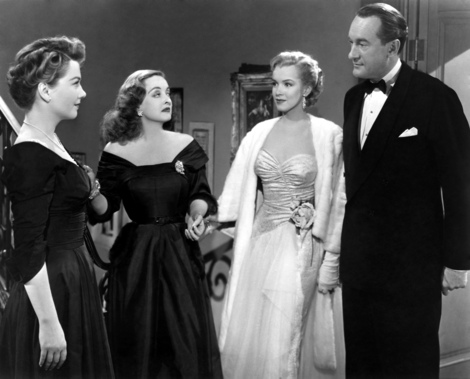


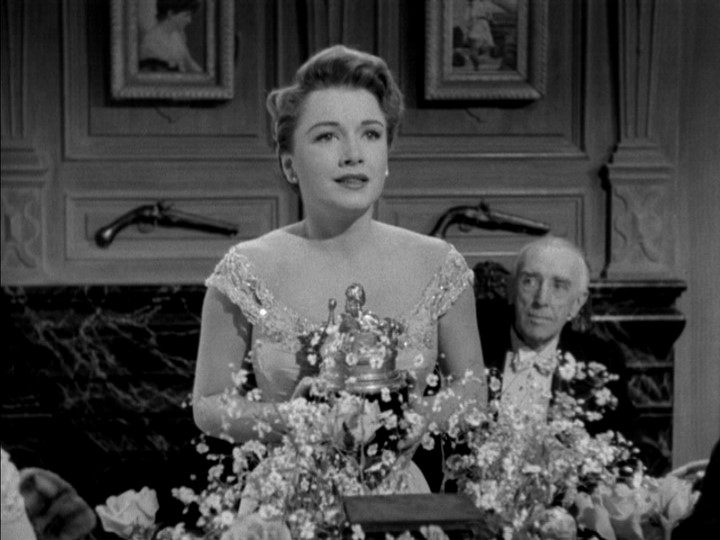
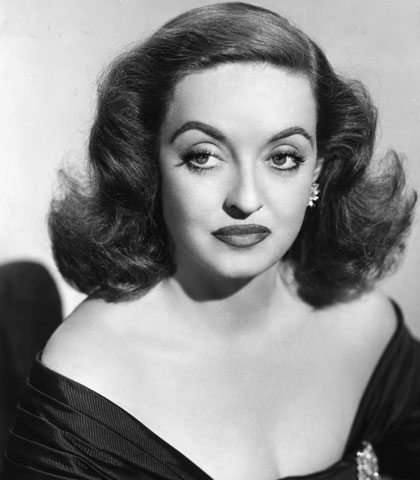


"All About Eve" was one of the first films to be made part of The National Film Registry.
It has a "100% Rating" on the Rotten Tomatoes site. Can't do better than that.
* That would be the start. It's an old habit of mine to think interms of "reels." The "head" is the start, and the "tail" is the finish, or the part that tucked into the reel's hub.
** The wikipedia article on "All About Eve" suggests that Addison and Eve are gay, thus making their aberrant behavior a result of their sexuality. "Okay, but whatever you do, don't tell Chuck."

Friday, February 13, 2009
Olde Review: Sunset Boulevard
This was part of a series of reviews of the ASUW Film series back in the '70's. Except for some punctuation, I haven't changed anything from the way it was presented, giving the snarky, clueless kid I was back in the '70's a break. Any stray thoughts and updates I've included with the inevitable asterisked post-scripts.
So, ya think being a famous actress is an easy life, huh? Fool! Everything you know is wrong! So learn a lesson from this Friday's ASUW Films in 130 Kane: Billy Wilder's "Sunset Boulevard" and Joseph L. Mankiewicz's "All About Eve."
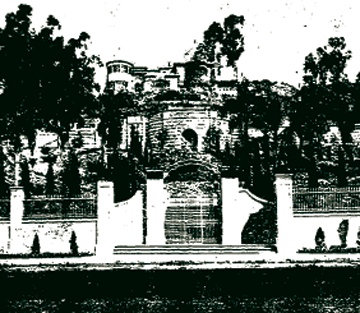
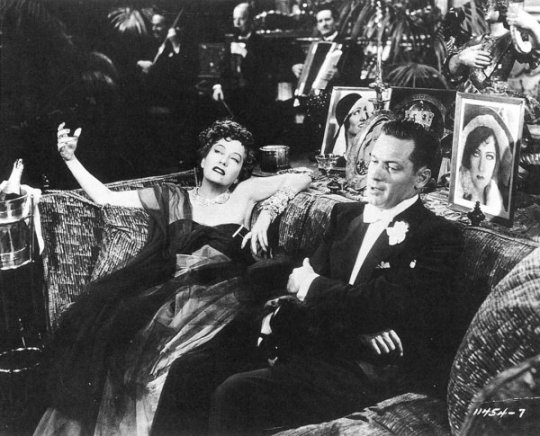
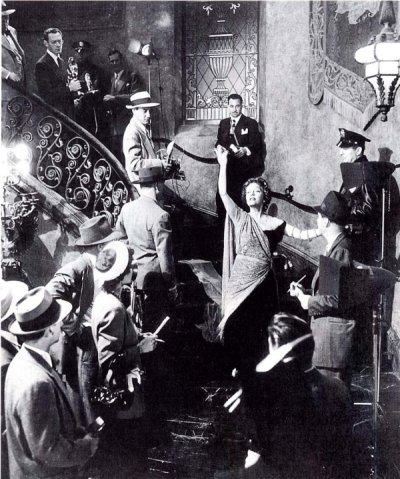
"Sunset Boulevard"  (Billy Wilder, 1950) "Sunset Boulevard" is probably the most vituperative, back-stabbing, self-hating, malicious and just-plain-cynical look at the glamour of Hollywood. It is also a brilliant film with a capital "B" directed by one of America's foremost directors, Billy Wilder. Joe Gillis, is a down-on-his-luck writer who, when, being chased by his creditors, happens upon the estate of Norma Desmond, a once-great silent film queen.
Now, consider the casting: Norma Desmond, "once-great silent film star" is played (and played brilliantly) by Gloria Swanson, "once-great silent film star." Her servant, Max von Mayerling, once-great-director-destroyed-by-Hollywood's-system, is played by Erich von Stroheim, once-great director-destroyed -by-Hollywood's-system. Hack writer Joe Gillis is played by William Holden who, more than any other actor is director-writer Billy Wilder's cinematic alter-ego. It is cruel in how it treats the old discarded Hollywood, and it is cruel (and probably right) in the view of the 1950's Hollywood being just as bad with its over-eager starlets and corrals of hacks like Gillis. It is filled with a black steaminess—a fetid atmosphere (something I felt again this Summer walking down Hollywood Boulevard). It shows a view of Hollywood as something like a Venus Fly-trap, something that looks lovely and inviting from a distance, but once you get up-close you find that is merely a plot to attract and drag you in.
Another thing: this movie is full, dense with ideas and brilliant strokes by its creators with reverberations that go beyond the film. When you leave the theater it haunts you even more effectively than a finely crafted horror film. It is a horror movie—with a black widow spider at the hub of a web, dragging everything around her touch into degradation and death. Maybe I should say that, in the first of bizarre touches that create the film's atmosphere, that Joe Gillis narrates the film, even as we see him floating face-down dead in Norma Desmond's swimming pool.
Broadcast on KCMU-FM on February 3-4th, 1976
Quite a few other films (and one highly-rated television series) have used that "speaking from the grave" bit since. It's the ultimate authority for putting things in perspective. But that was Wilder being conservative (as an aside, I find it funny that I call Wilder one of America's great directors--he is/was also Germany's, as well). He initially wanted Gillis to sit up in the police morgue and start telling the story from his slab.
I think you can make a case for "Sunset Boulevard" being prime film-noir (and maybe an American Grand Guignol), as Wilder was adept at it—he also directed "Double Indemnity" and "Ace in the Hole," which would be his next picture for Paramount. The only thing leavens the bite a bit is the dark humor of it all, inspired by the excess and fatuousness of the movie-making scene. It's not so amazing that Hollywood let Wilder do this film. Every few years some disgusted writer or director claims to make an expose that'll blow the lid off Hollywood, be it "A Star Is Born," or "The Big Picture," or "S.O.B.," or "An Alan Smithee Film: Burn Hollywood Burn."
Yeah, yeah. They all pale in comparison to "Sunset Boulevard" which starts in the gutter and stays there until its last shimmering-with-Vaseline fade to pitch-black. It doesn't surprise me at all that Gloria Swanson returned to movies for this part.* It's a fearless performance, full of self-awareness and assured brio. It would stay with her the rest of her life, and she would play a benign version of the role in what little work she did later on. It is interesting that Erich von Stroheim agreed to his butler role as he was a silent film director (and star) whose career was stalled by the extravagant budgets on his films—in fact, the "Norma Desmond" film that she shows Gillis was directed by von Stroheim (the barely-released "Queen Kelly").** It's also curious that Cecil B. DeMille participated in it, but not really. Although extremely conservative, it gave DeMille an opportunity to trumpet his new version of "Samson and Delilah," (and get paid doing it). That's the movie he's shown filming in his scenes.***
It's also neat that Franz Waxman, the movie's composer, snuck in the Paramount News-reel Theme in a couple places in the score. There are lots of in-jokes like that.
Not sure I agree with myself about the Billy Wilder/William Holden alter-ego thing, as you could also apply it to Jack Lemmon and Walter Matthau.
And the movie's DID get small.
"Sunset Boulevard" is one of those must-see films. Just have a shower ready for after.
* The part was offered to Greta Garbo, Mae West, Mary Pickford and Pola Negri, who all turned it down, out of vanity or, in Pickford's case, horror at the material. Montgomery Clift was to play Joe Gillis, but quit two weeks before filming began. Clift was engaged in an affair of sorts with an older woman at the time, and probably thought comparisons would have been made.
** There's a story for you: financed by Joseph P. Kennedy (father of John, Robert and Edward) who was having an affair with the star, Gloria Swanson, and directed by von Stroheim, who was fired after a third of the picture had been shot. It was originally intended to be four hours long. That was a short subject compared to von Stroheim's original cut of "Greed" (1924), which ran for 9 hours. MGM's first feature length film, von Stroheim cut it down to 5 hours, then it was taken away from him by the studio and Irving Thalberg had it shortened to 2 1/4 hours. The rest of the film, and all the out-takes were melted down for the silver content. Max von Mayerling could be based a bit on German director Josef von Sternberg, who made Marlene Dietrich a star, and had something of a co-dependent relationship with her. Wilder tapped a rich vein when he wrote "Sunset Boulevard," as he did when he took on the press and its role in celebrity in "Ace in the Hole," (which, maybe because he didn't spare his scrutiny of the public's ability to be hood-winked, didn't do at all well at the box office. You don't bite the hand that feeds you...not directly, anyway).
*** Later, during the days of the Black List, DeMille would continually refer to Wilder (who was quite liberal) as "Billy Vilder" accentuating his German roots (as if his accent could disguise it!). The publicity angle is nothing new for deMille; he was a huckster. He started a campaign to have chiseled displays of the ten commandments erected in major city's courts for his 50's epic "The Ten Commandments." These are the same monuments that conservatives are falling all over themselves to preserve--even though they started out as movie SWAG.
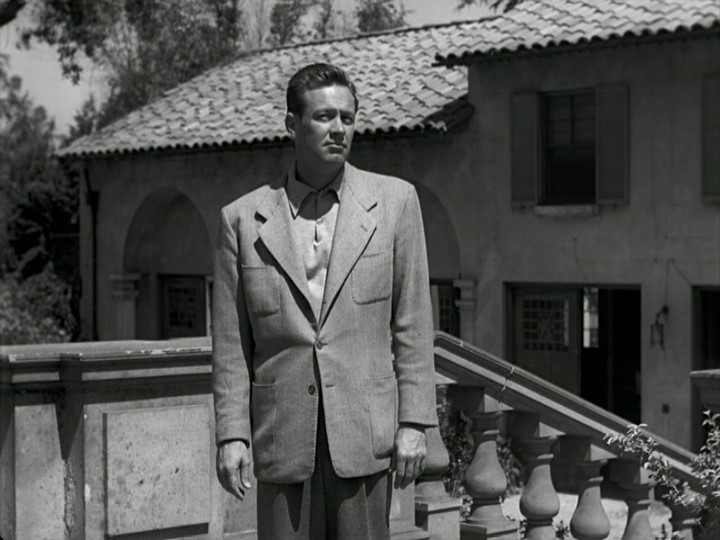





Friday, February 6, 2009
Olde Review: The Emigrants/The New Land
This was part of a series of reviews of the ASUW Film series back in the '70's. Except for some punctuation, I haven't changed anything from the way it was presented, giving the snarky, clueless kid I was back in the '70's a break. Any stray thoughts and updates I've included with the inevitable asterisked post-scripts.
This Saturday's ASUW film program is something very special: Jan Troell's "The Emigrants" and "The New Land"—an unglossed, beautifully done look at a Swedish community's emigration to America.
"The Emigrants"/"The New Land" aka "Utvandrarna"/"Nybyggarna" (Jan Troell, 1971) When it was released in Sweden, Jan Troell's film was all of a piece—a several hours epic called "The Emigrants." Americans are notorious for not being able to sit that long to watch one movie, and so for American distribution, it was cut into two parts (as was Richard Lester's "The Three Musketeers"). Fortunately, the film had a natural break in the middle, as Troell's film was based on two books in a trilogy* by Vilhelm Moberg, so there was little, if any, damage to the story as far as continuity.
And it is quite a story: the tales of how the emigrants left everything they had, searching for a nirvana they heard about called America, and then, when arriving, found the stories were stories and that their struggles had to continue...as there was no way back. (These stories) have always had a special place in the history of film, especially American film. Audiences have long taken an interest in the struggles of their forebears—one of the reasons why ABC's "Roots" has gone through the ratings roof this week. One can possibly attribute this to a kind of lazy pride, clutching the courage and struggles of our ancestors to ourselves. And if so, so what? We're all entitled to a little pride in their accomplishments. It might provide the springboard for some equally courageous acts in our lives. And this pride in the past struggles reaches across racial/religious lines: we can feel proud at the struggle of other peoples' against their misfortunes. Hence, the great popularity displayed by "Roots" this week.
What about the movie, huh?)**
Oh...yeah. Jan Troell's treatment of the sometimes gentle, sometimes violent story of "The Emigrants" is to treat it gently, "matter-of-factly." He has compassion for his community, but that compassion will not allow him to prevent the cruelties of the journey, the country and the people of America. And there is a poetry in this style. Stanley Kubrick found it in "2001: A Space Odyssey," and "Barry Lyndon," and Troell has it throughout "The Emigrants" and "The New Land," with only one exception in the latter.
The film starts in Sweden as Karl-Oskar Nillsson is pressured by family needs to take a wife and we are presented with Kristina. It is Liv Ullmann and her life previous to the marriage to Karl-Oskar is presented to us in a brief, languorous series of shots that entail an entire life of child-like freedom—sheltered, playful and entirely composed of little incidents, little insignificant moments, that thoroughly define her character and will stay with us throughout both movies as we see her struggle and grow old too early with her husband. Those moments remained in my mind through the films, and I saw them a year apart.
Those few moments of insignificance that tell the story are what define Troell's style of story-telling. It means that the actors are put under a great strain to present authentic portraits of people, and the cast led by Max von Sydow and Ullmann come through with a total feeling of lived-in performances. You believe every one of the actors are who they are, that the relationships are real, (and) they are a community. There's not a false moment there in a film that is totally composed of moments suspended in time.
I'm not going to go through a list of favorite moments—there are too many that they are a jumble in my mind. but there us one: Karl-Oskar hacking his way through foliage—surveying—walking through this alien country. He pauses, takes his axe and hacks into a tree. He writes his name on the unbarked portion and then, in a way summarizing the whole of what has gone before, lies under the tree and tips his hat over his eyes, his back supported by the tree—his land. It's a scene of total satisfaction. And you felt that satisfaction with him because you've been through it with him. That scene ends "The Emigrants" and begins "The New Land" and I envy anyone who enters 130 Kane Saturday night and can experience—in one sitting—this epic that is only small in scale.

Broadcast on KCMU-FM on January 28-29th, 1977
Thirty-two years on, if you mention "The Emigrants" to me, that scene is the one that pops up—of Max Von Sydow silently lying under the tree, his hat over his eyes, in a moment of peace and solitude that it has taken an entire movie to achieve. It is remembered fondly. "The Emigrants" was nominated for four Academy Awards including Best Picture and it's hard to imagine it making its way through the rabble in this day and age to become one of The Five. It's narrative structure (what I was painfully trying to explain here) is supported by its images, rather than a straight-ahead narration. The camera sits back and observes, making no editorial comment, picking up telling details by accident as if it was a documentary—a documentary where the light is just right and everything is extremely picturesque.
But it is no more oblique because of it, and it is presented without pretension or artifice, except to make it all look as good as can be. There was a market for this kind of of film in the 60's and early 70's, although one doubts that one could convince today's casual movie-goer of making plans to see these two films about the emigrant experience in early America—that field's been plowed in the minds of today's audience, and it might not be an evening's entertainment to see people working hard to build a life out of the dirt.
But it's worth it, if only to see von Sydow and Ullmann—two of Ingmar Bergman's stökk company—in a couple of their best roles. But there are benefits in seeing a good story well-told.
A couple of observations: "Roots" was on everybody's collective mind when this review was written, so it was probably natural to stem off of it, but there's a bit too much made of it, the review is about "The Emigrants," after all; The comparison to "2001" is apt as far as story-telling style, but not "Barry Lydon"—"Lyndon" has an omniscient Narrator, while "The Emigrants" does not. The review really doesn't do much service to the films, which are marvellous. Troell went "Hollywood" for an ill-advised remake of John Ford's "The Hurricane" (starring Mia Farrow!), then returned to Sweden, where he continues to work today.
* Actually a tetralogy: "The Emigrants" (1951), "Unto a Good Land" (1954), "The Settlers" (1961), and "The Last Letter Home" (1961). (or is it a "quadrilogy?")
** ABT***
*** "About Bloody Time"
Friday, January 30, 2009
Olde Review: The Conversation
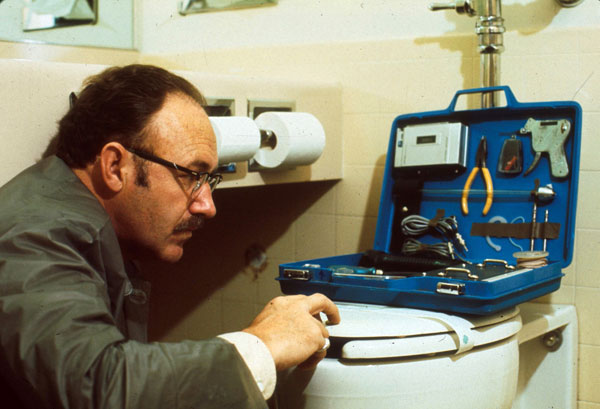
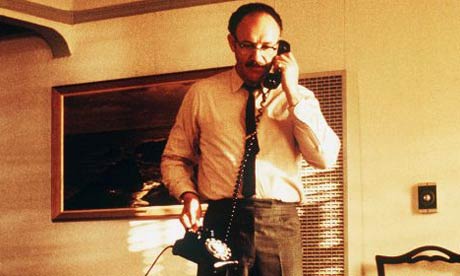
This was part of a series of reviews of the ASUW Film series back in the '70's. Except for some punctuation, I haven't changed anything from the way it was presented, giving the snarky, clueless kid I was back in the '70's a break. Any stray thoughts and updates I've included with the inevitable asterisked post-scripts. "The Conversation" (Francis Ford Coppola, 1975) Harry Caul (Gene Hackman) is an electronics expert dealing in surveillance. His latest assignment is to record a conversation between two very innocent young people in the park. It's a routine assignment, one that Harry handles with a perfectionist's care. But after he has the raw tape—after he has clarified it and re-channeled it—he hears a whispered fear that these two kids may get killed by Harry's employer. Old haunts plague Harry—past assignments he has carried out that led to his victim's deaths. And so he goes to confession to confess what may be a future sin. Confession—where one's private actions that are considered to be sins are revealed to a priest in order to free the sinner of guilt. But this too, is a surveillance—an invasion of one's privacy—ritualized in the name of religion. Surveillance is a part of our lives, then. And privacy is an illusion.
That scene in the confessional is about as close as Francis Ford Coppola comes to really dealing with surveillance in his film, "The Conversation." Despite what many critics have said, Coppola makes no judgements on this subject. Surveillance is simply there as a device to be used for the movie. It's neither good nor bad. It's there to provide Coppola with a means of getting into a rather shallow appearances-are-deceiving mystery story—it's a very weak imitation of Antonioni's "Blowup." When Harry Caul is caught in a surveillance trap ala his own devising, are we supposed to feel some satisfaction in this? Just because he's getting screwed, like he screwed all the others? Is surveillance justified in retribution, in other words? No. How can we take satisfaction in that? For surveillance — the ripping open of one's privacy — is being used, and nothing, really, not even revenge should make us condone it.
Awright, already, W______is it a good movie?
Okay, okay. Yeah, it's a good movie. It's...entertaining, in a shock-lull-shock-lull sort of way. Coppola has made a good movie, despite my reservations as to his morality on the subject. It's an o-k script—a little spare at times—with a lot of loose ends, and his direction is always assured. Gene Hackman manages to flesh out Harry Caul enough to make him an interesting person to watch for the couple of hours we do. And there is fine supporting acting from Allen Garfield, John Cazale (the weak brother, Fredo, in "The Godfather"), Frederic Forrest, Cindy Williams (she's good, despite the fact that she's totally mis-cast) and Robert Duvall (who is on for a very short time and doesn't receive a credit). But, the one thing that is technically outstanding is the sound of the film, produced by the work of its chief editor Walter Murch. Murch also worked on "The Godfathers" for Coppola, and creating what he terms "sound montages" for George Lucas' "THX-1138" and "American Graffiti." His talents with editing and sound mixing are outstanding,and hopefully Murch will, himself, be directing his own films.
Broadcast on KCMU-FM on January 27-28th, 1976
Murch would, indeed, direct one film (so far)—"Return to Oz," in 1985—and it tanked. His intention was to make a genuine adaptation of one of L. Frank Baum's "Oz" books, rather than what the public was expecting—a sequel to the 1939 classic "The Wizard of Oz." And his heart-felt, but scary, recreation of Baum's world didn't click with audiences. One would be sad if Murch didn't then personally supervise the entire post-production process of about one film per year. Films like "Julia," "The Godfather: Part III," "Romeo Is Bleeding," "The Unbearable Lightness of Being," "Ghost," "The English Patient," "First Knight," "The Talented Mr. Ripley," "K-19: The Widowmaker," "Cold Mountain," "Jarhead," and Francis Coppola's latest films. Busy guy. Eclectic talent.
This movie has dogged me my entire career, because it was assumed that, because Harry Caul could electronically filter out steel drums from the background of a murmured recording enough for you to hear what the people were saying that any sound facility could do it, too. No. Not really, you can't. You can tune, you can attenuate, you can try reversing the polarity of a channel to eliminate shared sounds on both channels of a stereo recording, but steel drums? That's a good one. They call that "Movie Magic."
But the kid is right...this is warmed-over "Blowup" without the illusion of film-making, or illusion of illusion that makes that film so compelling. At least it's better than cold, left-over "Blow-Up" like Brian De Palma's "Blow OUT" (in that, film recordist John Travolta must piece together a Chappaquidick-like incident from his sound-recordings and pictures taken from a "Zapruder"-like film--it doesn't pass the incredulity test). And Coppola has to resort to a "cheat"—he changes the actual recording, the one element in the movie that has to be set in stone, to come up with his conclusions. One could make a case...blah blah blah, the fact is, interpretation or not, he planted a card in the deck.
It is, though, a really good paranoid thriller of the type that seemed to be born of the post-Watergate era. And Hackman's insulated Caul is another example of how that actor can take an under-written part (deliberately, I should say--Caul doesn't talk much on purpose) and make him a living, breathing human being you can recognize and, despite his many failings, sympathize with. There is one actor I didn't mention because I didn't really know who he was...yet. He'd made a living doing parts on television, and done a small role in "American Graffiti," but after this film he was about to quit acting and go back to carpentry when a role in a sci-fi movie by Coppola's pal George Lucas changed things for him. Harrison Ford has a small role as "The Director's" menacing assistant.
Oh...the reason I made such a big deal of the confessional scene? I used that to start off the recorded version of this review.
In 1995, "The Conversation" was chosen to be a part of the National Film Registry by the Library of Congress seeing it as "culturally, historically, or aesthetically significant."




Thursday, January 8, 2009
Olde Review: The Seventh Seal
 This was part of a series of reviews of the ASUW Film series back in the '70's. Except for some punctuation, I haven't changed anything from the way it was presented, giving the snarky, clueless kid I was back in the '70's a break. Any stray thoughts and updates I've included with the inevitable asterisked post-scripts.
"The Seventh Seal" aka "Det Sjunde inseglet" (Ingmar Bergman, 1957)
An odd combination of films await those in 130 Kane this Saturday night: Ingmar Bergman's "The Seventh Seal" and Ken Russell's "The Devils."
For those of you whose only experience with Ingmar Bergman is his wildly splintered and heavy film "Persona" from last quarter's ASUW series, "The Seventh Seal" will seem to be made by another man. At this time, Bergman wasn't so experimental, so strange. He was, as he is now, alive and vibrant with the charm of film-making and his '50's films ("The Magician," "Wild Strawberries," "Through a Glass Darkly") although dealing with "heavy" subjects of God and Death and self still possessed a lightness in the telling, a lightness that carried over from his beginnings in films and was lost in the dark broodings of his late '50's and '60's films. There was a time for comedy, and time for deep-think in the space of the best Ingmar Bergman films.
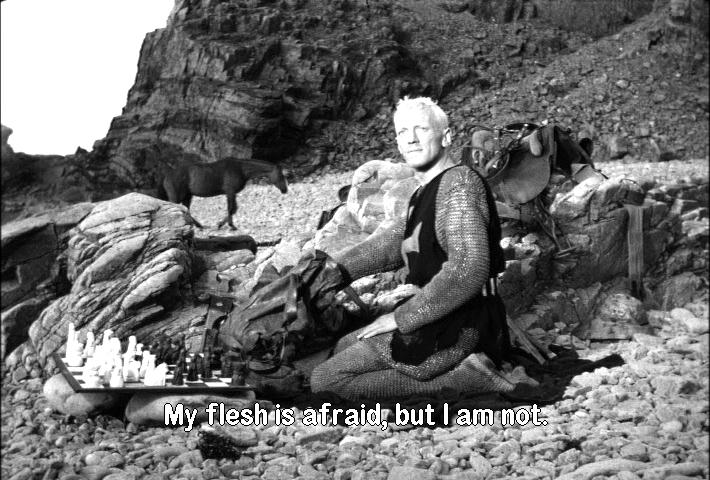
There are many characters in "The Seventh Seal," but at the film's hub are two. The most important is The Knight, who is played Max von Sydow, the supreme brooding actor. The Knight is home from the religious wars where the quest for God has been fruitless—where the point of the quest, after the year's ox-killing has been lost. But the quest for God continues. It has to. God can't be in the war, but can he be found outside amidst plague, witch-burnings and ignorance?
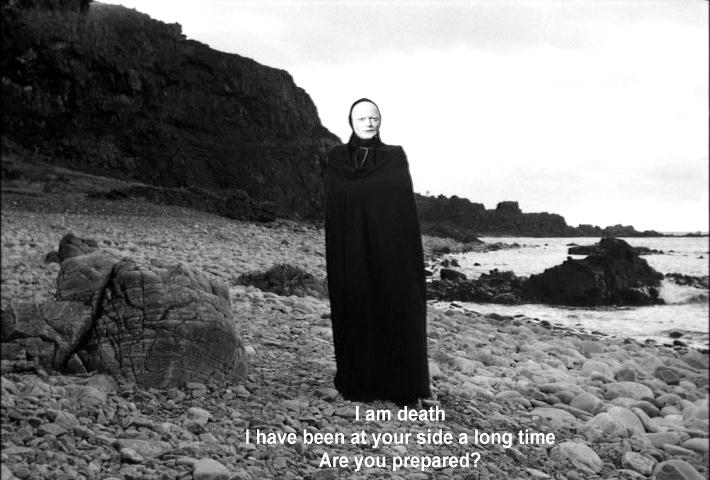
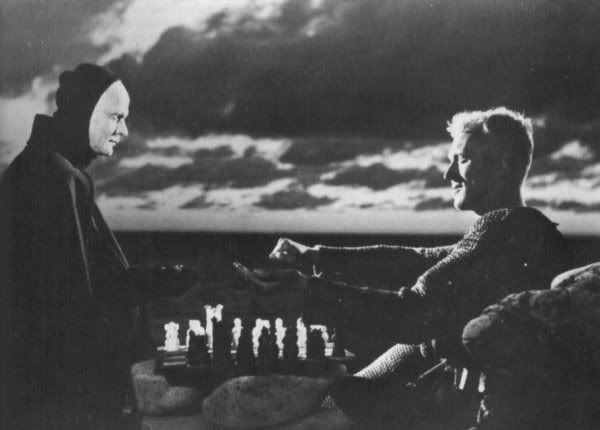
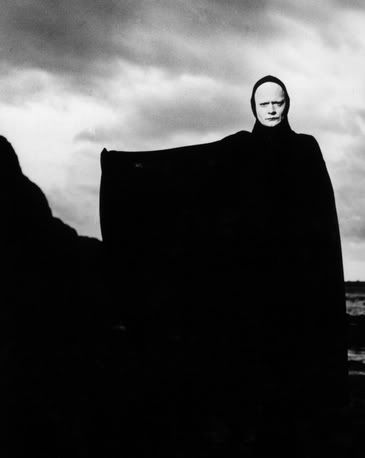
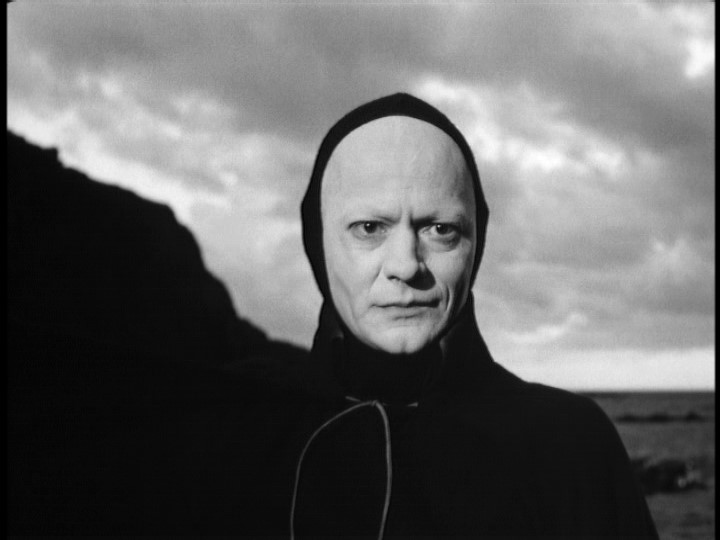
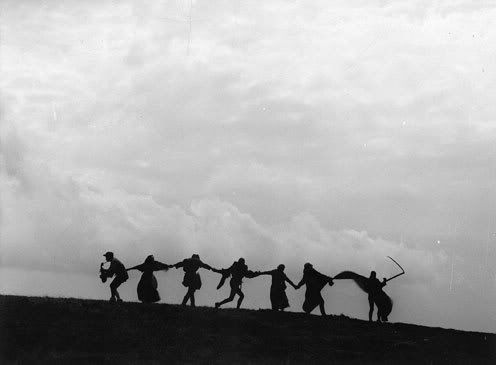
The answers are hard to come by, and even harder to come by while being pursued by another hold-over from the wars, the second most important character being Death. Death pursues the Knight and they engage in continuing battles of wits and of chess. The two opponents are only the hub of the story. There are others: the Knight's man-servant whose musings are concerned more with life that what is beyond; a troupe of actors; a wood-cutter and his adulterous wife. Bergman combines them all in a film that wheels between light and heavy in tone, but always excellent in quality.
Broadcast on KCMU-FM on January 8th, 1976 (thirty-three years ago today)
Sounds like I ran out of time there at the end--I usually only had two or three minutes per film to talk. So, I didn't even mention the stark black-and-white photography that has become so iconic, along with Bergman's simple personification of Death--an actor dressed entirely in a black cassock, with just his face appearing...in sharp contrast. And the image of The Knight playing chess with Death has been copied, parodied, purloined and done...well, to death. In "Bill and Ted's Bogus Journey," they played "Battleship."
It sounds bleak, and it is—it is the Plague-Years, after all. But the film ends with a touch of hope and sacrifice, that even after all the Knight has seen—and not seen in the form of God—he can still cling to ideals. Typing this out, it occurs to me that the film we're reviewing tomorrow has a lot in common with Bergman's masterpiece.


Thursday, December 11, 2008
Olde Review: Fires on the Plain
 "Fires on the Plains" aka "Nobi" (Kon Ichikawa, 1959) Kon Ichikawa's "Fires on the Plain" is not so gentle as "Forbidden Games" — it is something that pretty much has to be endured. It deals with the final days of World War II and the ravaged Japanese Army—disorganized, suffering heavy losses, and losing its humanity. The conditions under which they fight are unbearable: disease is rampant, there is no food and no loyalty and no real reason to keep fighting but to survive. Ichikawa focuses on one soldier who, too, is trying to survive, but survive as a moral being, for he is already doomed by tuberculosis.
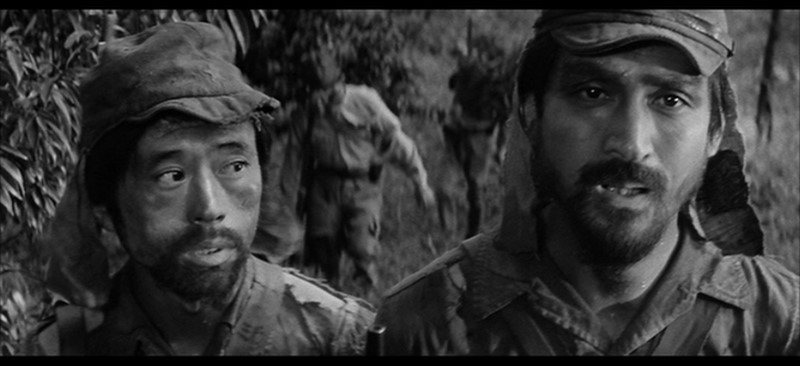


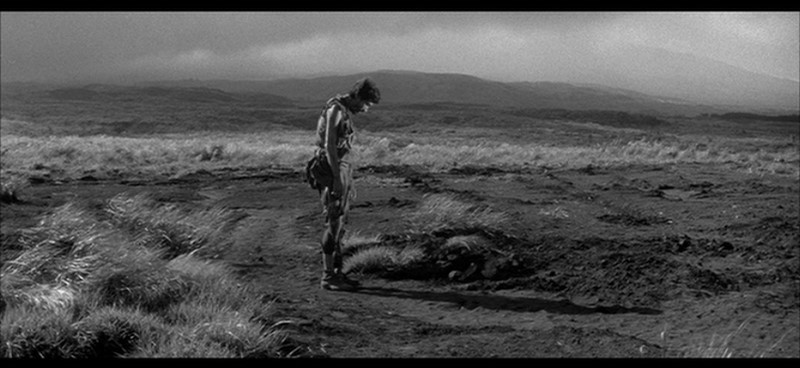
On his trek through the war-zone, the atrocities he sees become greater, the desperation he sees heightens until there are no sides. The war becomes one to survive, each on his own against everyone else. There is no meaning to the war, and also, no meaning to life for all morality, if it can exist in war, is lost. The ending of "Fires" is horribly shocking and if your are in no mood, or cannot take such strong stuff, I would advise you to avoid seeing the film. The total effect is somewhat devastating and probably "Fires on the Plain" is the most excruciating indictment of war and the effect on the men caught up in it.

It is interesting to set this film up against Ichikawa's beautiful "The Burmese Harp," which looks at the same section of the war for the Japanese. But one gets the impression that, for Ichikawa, "The Burmese Harp" didn't express enough of the outrage he felt for war. "The Burmese Harp" looks positively sublime next to "Fires on the Plain," and even though they touch on the same themes, the two films could not be more different. Just looking at stills from "Fire" is a bit grueling, but this review whets my apetite to see it again, especially in light of another, similar film, Clint Eastwood's "Letters from Iwo Jima," and in the light of encountering "The Burmese Harp" and appreciating its artistry.
As I tended to do, I truncated these reviews as they were the final ones for the quarter, and I wanted to make room for closing thoughts:
"Forbidden Games" and "Fires on the Plain" are the last films in the Fall ASUW Film Series, and so, too, this is my last movie review. At this point, KCMU is in a state of flux so I have no idea whether I will be back next quarterwith the Winter ASUW Film reviews, or whether we will have film reviews at all. It's pretty much up in the air right now. I would like to see things continue. I have had fun doing them: seeing new films that I might have missed, allowing myself to express my raves and my gripes about them. The toughest thing about writing them is to distill what you want to say about a film into five minutes, two and a half minutes, or even one minute; time is always the biggest enemy in radio work and that proved to be the case not only writing in writing them, but in producing them, as well. I felt that something else had to be included besides my droning on—at least music, maybe an actuality now and then—and that was time-consuming. A few times my reviews would be late (once it just never went on) and again, time—my time—will be the biggest consideration of whether they will continue. But whatever the fate of the reviews next quarter, the films will continue. And this is the line-up for Winter Quarter....
...I would like to thank the DJ's on the air for even playing the damn things: Tim Hunter, Don Zwicker, Steve Flume, John Windus, and Abby Goldman. I would like to thank Diane Jotautus of the Audio-Visual department who put up with me all these weeks, for letting me see the films, and I'd like to thank Rajeeve Gupta of the Film Showings Committee for giving me the opportuntiy. Lastly, I'd like to thank you, for these reviews do no good unless someone is out there listening. And so, that's the Last Movie Review Show.
I felt compelled to say all that because 1) I felt a great deal of responsibility for these things, and 2) I had enough ego to think anybody gave a rip. I still have trouble compressing my thoughts into a cogent, pithy review that manages to touch on all the issues a film brings up. But, I've also learned that there's just so much of this stuff a person can tolerate (and how long has this one gone one?) The comment about my droning on is on-the-beam—back then, I didn't know how to speak on the radio,it was all just a flat monotone in desperate need of some character. The names I remember fondly. Tim Hunter went on to a successful career as "the funny one" on a morning DJ team locally, John Windus ended up working in radio in the Portland area. Everyone else...long-lost, though I still remember them in my mind's eye. I remember after a while I started calling Abby, Abby "Gold-person" as a joke, which she picked up and used on the air. Diane Jotautus was great supervisor—I worked for her in the A-V Department, and gave it up to concentrate my time doing radio—and more often than not, would watch the films with me to break up the monotony of the office-work. It was also a quick way to check the prints that were showing.
And I did do the Winter series. Some of them have already appeared, but the remaining ones from the quarter will appear on the weeks they were delivered, or thereabouts, 32 years ago.
That's a lot of time spent in the dark.
Wednesday, December 10, 2008
Olde Review: Forbidden Games
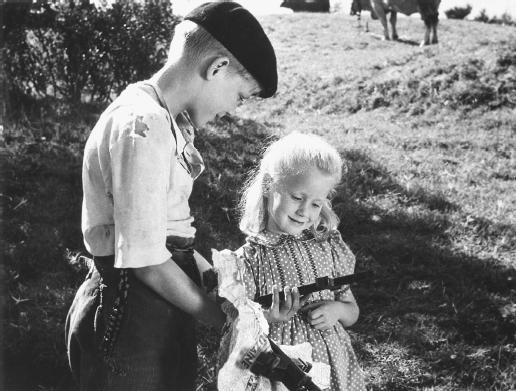
 "Forbidden Games" aka "Jeux Interdits" (René Clément, 1952) is a story of children in the midst of World War II. And for an anti-war film, there is very little war to be seen—at the beginning, a few strafing planes that rip through a line of fleeing Parisiennes, that leaves the young female protagonist an orphan. But the bloodshed is kept to a minimum, for the war is important only in a roundabout way; it's the two children in this story, and the family that surrounds them that are important. "Forbidden Games" is a film that is rich in allegory, but also rich in humor, and rich in a sort of melancholy attitude to the tarnished innocence of the children and the petty arguments of their elders. It's a film that, because of its nature, will lose something of its message, if you don't come across it yourself. So, suffice it to say that you will be left thinking about it, and thanking for it, for quite some time.



Broadcast on KCMU-FM on December 6th and 7th, 1976
Well, that's about as generic a review as one can write...and still have seen the film. That the saddest thing in the film is the kids' shortened childhood, and their melancholy embracing of the responsibilities of adulthood and attitude to death makes it that rare war film that deals exclusively with collateral damage and the effects of the anonymous warfare ripping apart the lives of others. The little girl, Brigitte Fossey, who was five when this was filmed, went on to have a long career in films--you probably saw her in "Cinema Paradiso."
Saturday, November 22, 2008
Olde Review: Midnight Cowboy
"Midnight Cowboy" (John Schlesinger, 1969) "Midnight Cowboy" is
 a film that has been vastly over-rated over the years. So has its director, John Schlesinger. I haven't seen one film of his that has been consistent—content-wise, or quality. Admittedly, Schlesinger does do some great things in his films. but never for long, and that goes for "Far from the Madding Crowd," "Darling," his marathon sequence in "Visions of Eight," and especially last year's "The Day of the Locust." Schlesinger couldn't even pull off a simple thriller like "Marathon Man" without laying it over with unnecessary cross-cutting and lead-balloon pretensions.
The problem? Schlesinger is a cold director and this coldness of attitude combined with a certain heavy-handedness in technique bring movement, but not life, to the subject matter. Add to this Schlesinger's off-and-on fascination with grotesques—as in "Midnight Cowboy"—and the situation is nearly impossible.
"Midnight Cowboy" begins well enough, with a rather multi-layered shot of an empty drive-in movie screen overlapped by the sound of thundering hooves. But not from the screen. From a nearby corral. Joe Buck is leaving the farm to go to New York; putting himself out to stud, so to speak. And Joe Buck's bus-trip to New York is very enjoyable with the exception of some coy flashbacks. But once the Big Apple has been reached, Schlesinger begins to feel the need to be...satirical. And his satire has all the subtlety of a brick through a window, as opposed to the subtlety of "The Sound of Trumpets."

Jon Voight gives a fine performance. Dustin Hoffman is all right (but his limp keeps changing, and Schlesinger keeps drawing attention to it!) But, above all, the best thing about "Midnight Cowboy" is the music for the film by John Barry, whose scores include those for the James Bond films and "Born Free." His music provided the best satire, the most feeling, and the best humor in the film. One of these days, I'm going to have to do a tribute to him.

Broadcast on KCMU-FM December 5th and 6th, 1976
That last bit referred to film score tributes, basically three minutes in length that I did for the station. Barry's still alive. His last score being for the Michael Apted film "Enigma." He didn't do the whole film, but he supervised the music, picking and producing the songs, and writing bits and pieces of score that worked gang-busters in the film.
Frequently, when typing up these elderly reviews from a kid I can't remember being, I've always resisted the urge to change them here. Or wished I could go back in time to tell this little twerp what exactly is wrong with his opinion, and I felt that urge this time when I started reading the review. After all, Schlesinger settled down and did some good things later in his career, and "Midnight Cowboy" remains to this day the only X-rated film to win the Best Picture Oscar, and it's still considered a "classic."
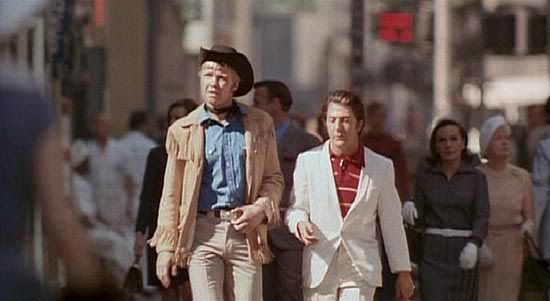
But have you sat through it lately? I mean, sat through all of it? It's a mess, jobbing about from one bit to another, and all those parts that are endlessly played on clip shows—"I'm walkin' heyah!," the final bus ride, Joe Buck's walk through the crowded streets of New York, including satire alert-satire alert the guy who's been assaulted (presumably) lying in the street and everybody's walkin' to the tune of "Everybody's Talkin'" (written by Fred Neil, sung by Nilsson) and....that's about it—are the parts that people remember. Maybe, just maybe, people have a better opinion of the film because they're expected to. It's a counter-culture classic, after all, like "Easy Rider" (and we all know what a masterpiece that is!) Reading through this review, I went from "You're being too harsh" to "Yeah, point taken." The things that bug me about "Midnight Cowboy" are the same things that bugged me then, and it had to do with direction, inconsistency, and just the gosh-awful look of some of those sequences. It's like Schlesinger took Mike Nichols' bag of tricks from "The Graduate" and decided to use them poorly. I'm surprised it won Best Picture, actually.


What was nominated for Best Picture that year? "Anne of the Thousand Days," "Butch Cassidy and the Sundance Kid," "Hello, Dolly," and "Z."
.............well, maybe I'm not surprised (though "Z" is a good film).