Showing posts with label Joseph L. Mankiewicz. Show all posts

Thursday, October 3, 2013

Suddenly, Last Summer

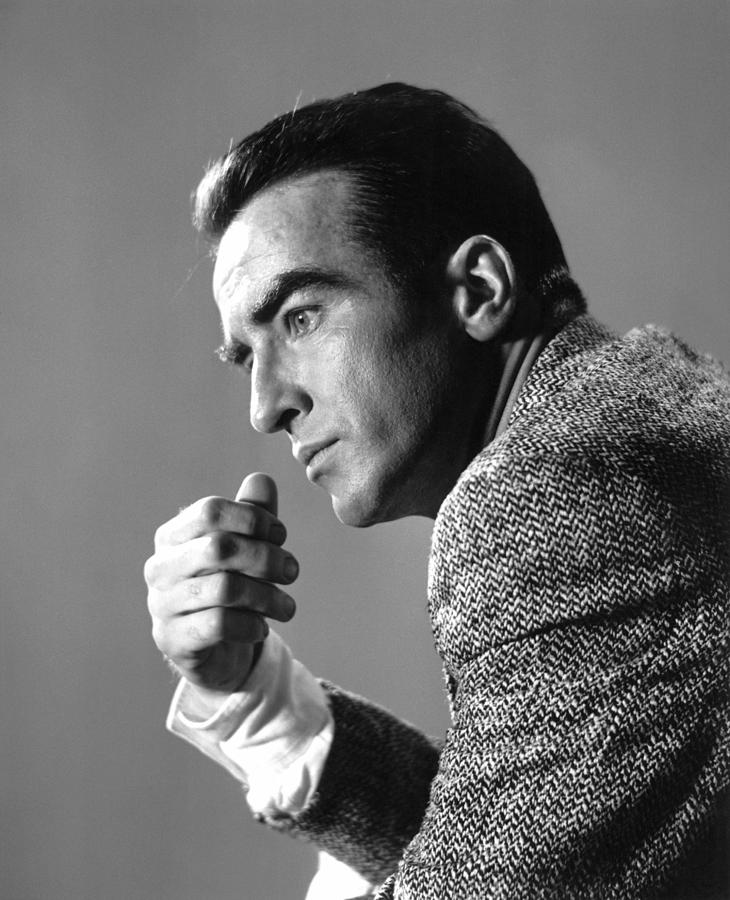
Suddenly, Last Summer (Joseph L. Mankiewicz, 1957) Tawdry gothic-noir that was so compromised by concessions to the moral powers-that-be that nobody associated with its production ended up liking it, not the original author of the play, Tennessee Williams, not his co-screenwriter Gore Vidal, nor the director Joe Mankiewicz.  Pity, as its an example of how Mankiewicz could juice up material directorially in a truly unsettling way when given the chance.  And he had a great cast in Katherine Hepburn, Montgomery Clift (even in the semi-drug-addled condition he was in), Elizabeth Taylor and Mercedes McCambridge.

What's missing is the person everyone talks about—the late Sebastian Venable, (poet and narcissist) who died (suddenly) last summer, ostensibly of a heart attack, as the whispers state, but has nothing to do with the truth, which is damaging enough that his doting mother Violet (Hepburn) will do anything to keep it secret, even if it means lobotomizing her niece Catherine Holt (Taylor) who witnessed his death and has blanked it from her memory. Mother Violet entreats the local psychiatric hospital and its brilliant lobotomist Dr. Cukrowicz (Clift) to see if Catherine is a suitable case for treatment, with the promise of a large endowment if she can be "cured."  "Cured" of the memory stuck in her head, and if not cured, silenced, whether institutionally or medically.


But what those memories are of that led to Sebastian's death "suddenly, last Summer" are only implied for the first 3/4 of the movie.  In the first couple of movements battle lines are drawn as Cukrowicz first gets Vi's version of things (as he investigates why she wants to donate so much money to his institute), then, once questions are raised, tries to coax it out of the mostly comatose Catherine without success.  The gist of it is that Catherine, at Sebastian's request, had replaced his mother as his travelling companion on his world-travelling jaunts from which he would produce his yearly published book of poems.  That Summer, in the town of Cabeza De Lobo, Sebastian died, leaving no book and no issue.


Except for Catherine.  The play's third scene is the explanation in the drawing room scene if this were a detective novel, where Catherine, under the influence of sodium pentathol reveals all (from her point of view), and Mankiewicz goes to directorial town (his point of view) in a weird silent flashback that threatens to crowd out Taylor from the frame, and that veers wildly from realism to German expressionism to surrealism within the course of its run, containing some of the most bizarre imagery just outside the horror realm (or Salvadore Dali's dream sequence from Spellbound).


To tell you what it all means ruins the ending, except that the movie itself doesn't come right out and say anything, owing to the tenor of the times (meaning you couldn't be) and to the so-called community standards that this particular era of film-making was challenging.  This was before ratings systems—G, PG-13, M, R, X and NC-17—but there was The Legion of Decency, over-run by the Catholic Church, that crossed itself, said five "Hail Mary's" and then banned your movie from being advertised.  You couldn't talk about homosexuality, procurement, prostitution, drug use, pedophilia, and cannibalism except in closeted code, and the "Truth Serum" sequence obfuscates with what's going on to the point of obtuseness.  Williams wasn't entirely guilt-free of this; he was just as capable of pulling the shade over a naked light-bulb or turning pleurosis into "blue roses"—he made an art of it.  But here, the mother-love perversity at the heart of so many of his plays runs on the hysterical side, and try as he might Mankiewicz can't make more of the empty book of poems than he can. All he can do is try and push Hepburn over the brink of sanity, after she's been doing wheelies near the edge the entire movie (Vivien Leigh nearly played the part; can you imagine?)

How far we have come since then—except, of course, for the cannibalism part (unless you were voted to the House of Representatives in 2010).

P.S. there's an excellent breakdown of the film, courtesy of The Last Drive-In, that did an excellent job of pulling screen-caps-two of which I cribbed above.

Liz Taylor glamour shot draped over the rail of an asylum


Friday, February 27, 2009

Olde Review: All About Eve

This was part of a series of reviews of the ASUW Film series back in the '70's. Except for some punctuation, I haven't changed anything from the way it was presented, giving the snarky, clueless kid I was back in the '70's a break. Any stray thoughts and updates I've included with the inevitable asterisked post-scripts.

This is a companion piece to "Sunset Boulevard."

"All About Eve" (Joseph L. Mankiewicz 1950) "All About Eve" is not unlike "Sunset Boulevard." It deals with the lust for glamour in show business—in this case, the theater in New York, not the neighborhoods of studios in Hollywood. It, too, was made in 1950, its female characters, for the most part, actresses, are...uh, abnormal. And it, too, is biting, but places its knives-in-the-back in a ci-vi-lized manner, and twists it...delicately...not with Wilder's carving techniques.

What we have is
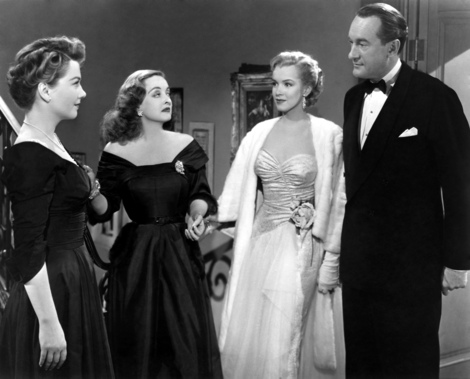
Bette Davis as Margot Channing, a spoiled child-actress, now on the shady side of 40, but still playing ingenue roles. What we have is Anne Baxter as Eve Harrington, a young ingenue who gazes adoringly at her idol, Margo Channing. What we have is Addison DeWitt (played by George Sanders as drily as a total-vermouth martini), the chief stiletto of the critical press, but you've also got Gary Merrill, Celeste Holm, Thelma Ritter, (and, in a very brief role, Marilyn Monroe) in a highly literate script which gives almost everyone some role they can sink, or cut, their acting teeth on, in a story that has "everything but the blood-hounds snapping at their rear end" (and, in a way, that happens, too.)

You see, we meet all these people as
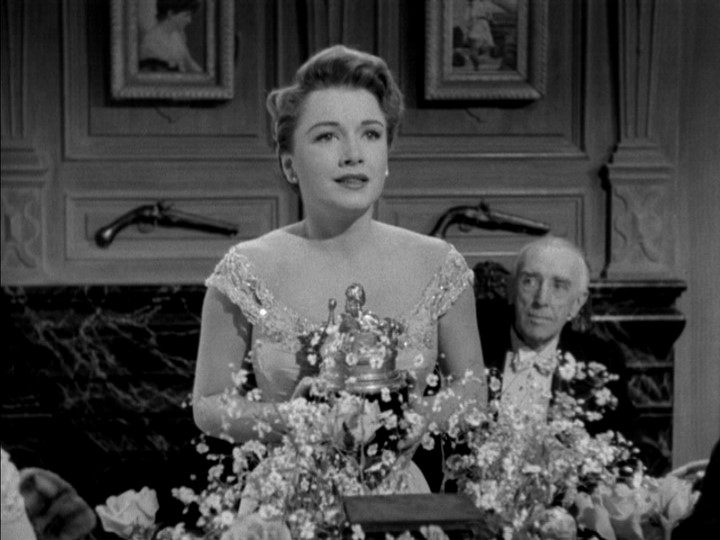
Eve is receiving the Sarah Siddon Award for Best Stage Performance of the Year. A joyous occasion for everyone, right? The very young actress gets a big break—everyone's happy, right?

No, the principal characters are either looking embarrassed, wonderingly perplexed, mad, or just cold to the event. It's flashback time to see why such a double-reaction to the prestigious theater event. And in a "Citizen Kane-switch," one flashback is narrated in turn by several people. And we are through this told "
All About Eve"...but also Margo, Addison, everybody. Everybody's soul is laid bare through the dialogue and the quirks and pops of the performances of the cast. It's a thoroughly entertaining two and a half hours, and its light cynicism will take of the staleness of "Sunset Boulevard" out of your mouth. It will do that, but will hardly make hopeful young starlets complacent.

Broadcast on KCMU-FM on February 3-4th, 1976

I still love this movie and I find it invaluable as a source for great lines. Go ahead. Go to the IMDB listing for "All About Eve" (all you have to do is click on the name at the head of the review*) and go to "Memorable Quotes." There's at least a couple pages of them. All smart, literate and bitchy. I used one in January 2009, as a sub-head for the blog-title (Addison DeWitt's non-self-deprecating "While you're waiting you can read my column. It'll make the minutes fly like hours." Only he could say that about himself--everybody else would be cut down for a remark like that, sort of like only Nixon being able to go to China.) Another favorite of mine is in this olde review: "Wow. Everything but the blood-hounds snappin' at her rear-end" as expressed by the inimitable Thelma Ritter. There's one involving Marilyn Monroe's hungry starlet, Miss Casswell, as she enters a theater-party. She scans the room looking at the producers: "Why do they all look like unhappy rabbits?" DeWitt leans in and confides: "...because they are." Smart. Literate. Bitchy.

And curiously old-fashioned. One doesn't get too far in that list before it comes to the Margo Channing monologue about the value of her life—a speech that always made me uncomfortable: "Funny business, a woman's career - the things you drop on your way up the ladder so you can move faster. You forget you'll need them again when you get back to being a woman. That's one career all females have in common, whether we like it or not: being a woman. Sooner or later, we've got to work at it, no matter how many other careers we've had or wanted. And in the last analysis, nothing's any good unless you can look up just before dinner or turn around in bed, and there he is. Without that, you're not a woman. You're something with a French provincial office or a book full of clippings, but you're not a woman. Slow curtain, the end."

Oh, really! Pretty prosaic for a smart script. Even though this was written in the late 1940's, it still rankles a bit unless you're, say, Anita Bryant.
There's also the way Addison DeWitt and Eve Harrington come across as asexual monsters for whom career is everything and a "normal" lifestyle is to be shunned and mocked.** Being a careerist is a bad thing in "All About Eve." Chasing after love, whether you're good at it or not is the holiest of holies. As I said, this was written in the 40's. One of my favorite quotes from 2008 is Richard Dreyfuss' one about being directed by Oliver Stone in "W.": "You can be a liberal and still be a fascist." Just as you can be smart, literate, and bitchy, and still come across like a schoolma'rm.

"All About Eve" was one of the first films to be made part of The National Film Registry.

It has a "100% Rating" on the Rotten Tomatoes site. Can't do better than that.

* That would be the start. It's an old habit of mine to think interms of "reels." The "head" is the start, and the "tail" is the finish, or the part that tucked into the reel's hub.

** The wikipedia article on "All About Eve" suggests that Addison and Eve are gay, thus making their aberrant behavior a result of their sexuality. "Okay, but whatever you do, don't tell Chuck."

Wednesday, November 14, 2007

"Oh, Wasted 'Sleuth'"

"In Olden Days a Glimpse of Stocking Was Looked On as Something Shocking, now I suppose....Anything Goes"

"Sleuth" started out as a hit play by Anthony Shaffer. It was inevitable that a movie would be made of it, and in 1972, a spit-and-polished version of "Sleuth" hit the screen. Shaffer wrote the screen-play, and it was directed with a rich panache by Joseph L. Mankiewicz (who knew a thing or three about theatricality) and the cast could not be improved--top-lined by Sir Laurence Olivier as mystery writer Andrew Wyke, and Michael Caine as the London hair-dresser Milo Tindle, currently having an affair with Wyke's wife. Mankiewicz's film is devilish fun, a clash between The Old World and The Terminally Hip with the battleground being Wyke's gadget and gee-gaw filled Manor House (designed by Ken Adam). Add to it John Addison's frothy hapsichord score and however dark the film becomes (and Mankiewicz gives it a creepily saw-toothed edge), it is never less than fun to watch, especially seeing Olivier energetically dashing through each scene, precisely mimicking accents and dialects--a brilliant murderous man-child forever playing games and Caine keeping up, trotting warily behind. At the time, that theatricality and staging made everything seem a trifle--a little bon-bon for the rinse-set. But over time, one can't help admiring the energy brought to the fore by Mank and Olivier, defying age and frailty to knock another one out of the park. And Shaffer's play is filled with all sorts of opportunity to...play. It stands as definitive...a champion documentation of the play.

Good Authors too Who Once Knew Better Words, Now Only use Four Letter Words Writing Prose, Anything Goes.

It must have seemed such a good idea to re-do it. With Caine old enough to play the Wyke role, and who else but Jude Law as Tindle, making it "The Battle of the Alfies" (and if you think this is coincidence, a couple of lines makes it obvious it was uppermost in the film-maker's minds). Then, to adapt (at one point Wyke says, cheekily, "You know what the word 'adapt' means, don't you?"), the great Harold Pinter, and to direct, Kenneth Branagh, both men who can mine rich veins out of depleted quarry. And the result? "Sleuth" is still there in skeletal form--it's still Wyke vs. Tindle, but only one line of the original remains*--it's been completely stripped. The fussy old school mysteries Wyke wrote are gone, replaced by "crime novels" that regularly turn up on British telly, exemplified by sweating policemen grilling suspects. Milo's now an actor, who does hair, does the occasional chauffeur job. He plays "killers...sex-maniacs, perverts mostly." Not only is the dialog stripped down to essentials ( and in nice....short little...bursts), so is the attitude. Any veneer of civility from the play has been scraped away, starting in the first moments with the chilly pause before a hand-shake when the two men first meet. No, they start off scrapping and spitting at each other right from "Hello" using all manner of Anglo-Saxon terms for each other, mutual contempt hurled in both directions. Which tends to throw the rest of the play on shaky ground. I suppose the makers didn't think Caine could pull off a stuffy, fusty Brit, and made it two working-class toipes throwing knives between their two sets of blue eyes. It takes the class warfare sub-text completely out of the center of the thing, leaving it all to ring just a bit hollow. The play pretty much runs its course, but the Second Act is considerably shortened, and the Third Act, if you will, is dragged on and on (despite all this, new-"Sleuth" lasts 86 minutes--the first was 2 hr, 18 m-- but seems longer) All this is staged in a hi-tech sterile interior (Wyke had nothing to do with it, he claims which seems...odd). And although there's a lot of bantering and word-play, sometimes annoyingly non-sequitir, it's just NO fun at all. Not a jot. At the end of the original, there is the satisfying finish with two simultaneous wails, along with mocking laughter. Then a curtain comes down. Here, nothing. Silence. Not even the impulse to applaud.

"Sleuth" (1972) is a strong matinee.

"Sleuth" (2007) is a waste of time.

* "The shortest way to a man's heart is humiliation."