Showing posts with label 1972. Show all posts

Friday, June 29, 2012

Fat City

Fat City (John Huston, 1972) Fat City got a lot of positive critical attention when it came out in '72 and one sees why.  It must have been surprising for a lot of critics that, after a couple of movies (The Kremlin Letter, Sinful Davey, A Walk with Love and Death) that seemed to be desperate to reach a youth market or cater to the looser restrictions on subject matter, that the veteran director could still pull off a gritty down-on-your-heels story and make something new out of it—the old dog still had some tricks up his sleeve, and could do a change-up of genre and tone and come up with something as impressive as the young turks starting to enter the field, like Friedkin and Coppola.  

But it shouldn't have surprised anybody.  Huston was a gambler by trade and by hobby, and was never afraid of taking on different approaches to telling a story.  Sure, he could take a mis-step here and there, especially when he tried to do somthing "of the times," rather than in his own perenneal classicism.  It was always story for Huston, and he was never afraid to take things in complex directions.


Fat City is a tale of two boxers—Tully (Stacy Keach) and Ernie (Jeff Bridges) one on the way up and one on the way down, but the only difference between the two, career-wise, is in the timing.  Ernie is in the early rounds of the bout, all pupptish energy and vigor.  Keach's Tully is in the later stages of the fight, battered, bruised, and tired, having known defeat and the ocassional victory, always just out of reach of a right jab.  When we first encounter them, Ernie has yet to have his first professional fight.  Tully is a couple years out of the ring, barely subsisting.  He's scarred over, but that hardening of tissue, mostly keeps the sense-memory of past victories ringing in his head.  Both mean are trying to get into the ring, one with no way of knowing what will come when he's in it, and the other all too aware of the toll it will take...but, anything is better than his current situation.  As it's said in The Shawshank Redemption, you either gotta get busy living or get busy dying.  In this case, living is fighting.  And for the older pugilist, there's still some fighting to be done, rounds to go before he sleeps.

Huston has had many great male performances under his direction, from such as Bogart, Gable, Clift, Brando, Connery, Finney, but I don't think I've ever seen a better performance in one of Huston's films than Stacy Keach in this.* In whatever you've seen him in, nothing prepares you for the internalized pain that Keach conveys in every aspect of his performance. And there's one moment that will stay with me for the rest of my life. During the fight-centerpiece of the film, when Tully makes his comeback, he's knocked to the canvas, but never counted out. He spends an interminable nine seconds on his knees and elbows, head hanging—and there's a moment, a long moment, when you wonder if he's going to get up—if he even wants to get up. Then, he rolls up into a rickety stance to complete the last few seconds of the round. The fighters retreat to their corners and Keach sprawls on his stool, as the cut-men treat a bleeding gash over his left eye.

Huston stays on Keach's face, and there is no expression on it—none.  So, you go to his eyes, which are dead, betraying no light and no spark.  There may be nothing going on in his mind except the most primal reptile instincts to survive; his head is a black hole, nothing leaves, and there may be nothing to leave.  He's a shell, hollow and broken.  That look will show up again in the film, as a final note, lacking in grace, the soundtrack empty, giving a brief glimpse of death, a living one, yes, but a death that still haunts.


Keach in Huston's Fat City
* Everybody is good in this, but one should also note Susan Tyrrell's feisty, free-wheeling performance of a drunk bar-fly that is on par with Keach's and  feels so real you want to throw up your hands and give up.

Friday, March 25, 2011

Solaris (1972)

Solaris, aka Солярис (Andrey Tarkovskiy, 1972) Solaris has often been called "The Russian 2001," presumably because its pace has been deemed similar to Kubrick's Space Odyssey, in that it ignores dramatic pacing in favor of environmental naturalness.

Well, it isn't true, of course. For me, Kubrick's movie moves like a bat out of Hell—it just doesn't engage in the dramatic short-hand that we've become accustomed to in movies: Entrance/Declarative Sentence/Oppositive Expansion/Response (and can we do that faster, please?).

And while it is true that neither does Tarkovsky's Solaris, the Russian director moves his film at a glacial pace, with little interest in "moving things along," engaging in a visual obtuseness that communicates metaphorically rather than directly—which takes time. And while Kubrick has a whole Universe to play around with (and let's include Space/Time in that), Tarkovsky keeps us to two places (with an extended travelogue through Japan's futuristic—in 1972—highway system, standing in for The Future: the dacha of Astronaut/Psychiatrist Kris Kelvin (
Donatas Banionis) and the scientific research station floating above the water-planet Solaris.

Earth fears that the station has become an Orbiting Dutchman, its crew beset by an unexplained madness, because of the reports of returned Astronaut Henri Berton (
Vladislav Dvorzhetsky). After talking to Berton (and saying good-bye to his elderly father who will prbably not be alive by the time he returns) Kelvin goes to the ship and finds it in a shambles, with one crew-man dead, and the other two deranged, seeing visions that he has glimpses of, as well.  Meanwhile, down below, the waters of Solaris are churning.


Kelvin wakes up after a fitful sleep to find his wife in bed with him.  His wife (Natalya Bondarchuk).  His late wife.  His late wife, due to suicide many years before.  The confrontation of such a finality with its apparent re-emergence as reality convinces Kevlin that Solaris, the planet, is working on him, sucking his thoughts and using them against him.  He fights back, luring his wife into a launch vehicle and sending her...somewhere, anywhere but here.  A pointless extreme gesture, as she comes back, a new version, to haunt him again, more complete, with neuroses and suicidal tendencies intact.  You can't fight The Old Feelings, especially when they're being used against you.  Especially when they're yourself...out of your control.

The style and pace...and just plain "WTF-factor"...do recall the Star-Gate and human-cage sequences of 2001, in that they disorient in such a way as to leave you a bit adrift and dis-associated with what is happening on-screen ("I can't trust what I'm seeing because I don't know what's going on"—mirroring Kelvin's predicament).  This weightlessness of the mind makes Solaris a tough slog, but that it keeps bringing up questions long after its viewing, places it in the same Heaven as Kubrick's "Shaggy God Story" (as critic John Simon dubbed it), and although Solaris may not be "The Ultimate Trip," it might be "The Ultimate Head-Trip."


Saturday, June 19, 2010

Avanti!

"Avanti!" (Billy Wilder, 1972) Based on a play by Samuel A. Taylor (who wrote "Vertigo" and "Sabrina"), "Avanti!" has been updated to the Nixon 70's by Billy Wilder and I.A.L. Diamond, as a slightly smutty comedy of manners, where a business-stiff, Wendell Armbruster, Jr. (Wilder muse Jack Lemmon) travels to Ischia, Italy to identify and claim the body of his father (Wendell Armbruster, Sr.).  Turns out the son is stiffer than the dead father.  He is shocked...shocked!...to find that dear old Dad, who supposedly went to Ischia for the therapeutic baths, was carrying on an torrid affair with a British mistress.  This produces a prolonged hissy-fit—Lemmon excelled at these—where everything and everyone seems to be in a conspiracy to make claiming his father's body an unpleasant experience.  The idea!

It's a clever idea: Armbruster is such a stifled, constipated American that he can't think of any way but his way in which to do things.  And he's in Italy...heck, he's in Europe...which operates on a different clock, and respects things that Americans dismiss nowadays.  Like Sundays.

And people.

What a "backwards" place.

Before long, you hate everything American, and want to take an extended vacation...anywhere but here.  And there's only so much one can take.  For gung-ho Americans, it's an extended dig at the Motherland, and for self-loathing liberals, it's preaching to the choir.  Either way, it's not an awful lot of fun to watch. 

There has always been this quality to the later Wilder films—even "The Apartment" has it to an extent—a superior attitude that hammers points home far beyond the level of the wood, a decidedly cruel streak given to the characters not yet clued in to their own cluelessness.  No empathy.  No affection for the character.  A decided lack of charm imprinted on the character(and this from Taylor and Wilder?*) And if I can carry the carpentry metaphor a little further, it makes what could have been an elegant finish look pretty banged up.

What saves the film—besides the forward progress of the story and the character of Armbruster—are the performances of Clive Revill as the flusterily accomodating concierge of The Grand Hotel Excelsior, and by Juliet Mills, who plays the mistress' daughter, who has also made the journey to claim her mother's body.

You already know what happens, even before you see the film.  And that may be why audiences didn't go to see it.  That, and it takes so long to get there.  You may have some spark of affection for a retch, but you may not give them too much time, either.

The reason Wilder did this one?  Producer-agent Charles Feldman saw it as a play (it ran 28 performances) and bought it for Wilder to make.  Feldman, who'd made the disasterous 1967 James Bond spoof "Casino Royale," passed away soon after, and Wilder, perhaps out of loyalty and affection for the man who'd given him "The Seven Year Itch" years earlier, saw it through to the screen.  If only saw more of that grace and affection could have made it into the movie it inspired.

* In retrospect, those same charm-less qualities are given to Linus Larabee in "Sabrina" and the distraught "Scottie" Ferguson in "Vertigo."  At points, they are hateful characters, displaying attitudes that challenge an audience.  

Saturday, February 6, 2010

Silent Running

"Silent Running" (Douglas Trumbull, 1972) I'd been planning to look at this movie for a long time now, but the release of "Moon" put me in mind of it again, the two films sharing a melancholy feel for the isolated man in space, both of whom are dirt-farmers of their own kind.

"
Silent Running" postulates a world so over-populated that the planet becomes overrun with cities, the flora (and some fauna) rocketed into space until such a time that the Earth can find space for them again.

Questions immediately come up: no room for vegetation? Where does the planet get its oxygen? It's phyto-plankton? It seems that if you take vegetation out of the equation that the food pyramid will pretty much collapse in on itself, and with it, the human population who are subsisting on what...space food sticks? Soylent green?

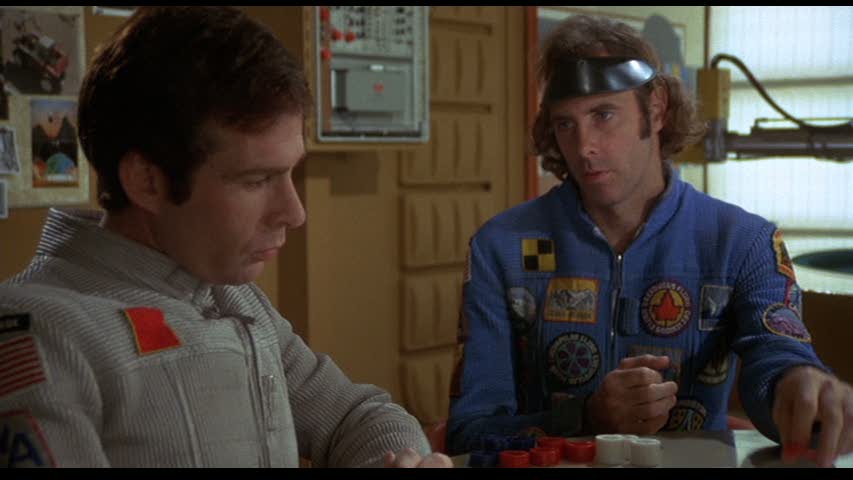
None of this matters to the four caretakers (Cliff Potts, Ron Rifkin, Jesse Vint and Bruce Dern), three of whom could care less, and Astronaut Freeman Lowell (Dern)being the one for whom the Mission is a sacred trust. Needless to say, they don't get along, Lowell's sole companions being the nursery-bots tending to the plants' daily needs.

Things go to seed, when word comes up from Mission Control that Earth doesn't give a rip anymore—budget cuts or some such—
so they should jettison the space-green-houses, blow 'em up, and return home. Rather than commit planticide, Lowell chooses, instead to go all-PETA and decide that his fellow agro-nauts' best function would be as fertlizer. A bit extreme, maybe, but we are talking about Bruce Dern here. And, to hide his crimes, he sends the ship into a collision course with Saturn's rings to try and convince Mission Control the ship will be destroyed. However, pesky-persistent techies that they are, NASA manages to find him, and Lowell must come up with a way of saving the plants and allaying any suspicions.

Douglas Trumbull did some of the FX work on "2001: A Space Odyssey," creating 3-D forced perspective lunar landscapes and perfecting the "slit-scan" technique—a frame-by-frame animated geometric horizon that made up the bulk of the "Star-gate" sequence near the film's end. "Silent Running" was his first feature, and he maintained a healthy career as director ("Brainstorm"), special effects guru ("Close Encounters of the Third Kind," "Blade Runner"), pioneer with film formats (his "Showscan" became a staple at world's fairs displaying huge 70mm films at a reality-approaching 60 frames per second, and designer of thrill rides (for the Luxor and Universal Tours).

In "Silent Running," Trumbull managed to make an ecological low budget sci-fi film, with illusion work that rivalled "
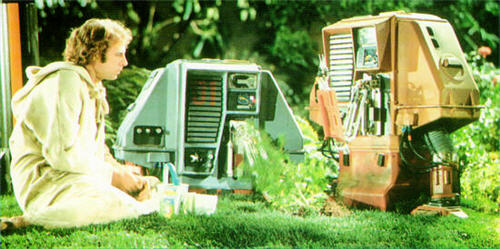
2001"—he even managed to make a realistic looking Saturn, something that wasn't possible years before with the Kubrick film. His robots were strange little non-humanoids forms that suggested walking amplifiers, and the story (and Dern's acting) makes them sympathetic little synth's. The ships designed for "Silent Running" were subsequently used for stock footage for years in such shows as "Battlestar Galactica" and Trumbull's considerable work served to influence the look and techniques of "Star Wars."*

Not the greatest of films, but not through lack of trying, as director, star and art team stretch their budget impressively and play it for all the drama it's worth. But the story is a little skimpy, the protagonist a bit bi-polar, and the conclusion not exactly rousing. A good study in movie-making, if not necessarily story-telling.


* Specifically, the look of R2-D2, and the flotsam scattering separations (emulating real NASA footage) that are in both movies. Trumbull's squat little helper-bots were performed with the help of double amputees in plastiform shells walking on their hands. The effect is totally convincing, and he avoids the cliche of the humanoid robots.

Saturday, November 14, 2009

1776

"1776" (Peter H. Hunt, 1972) Reasons To Hate Musicals #1776 (Collect them all!) To hear this tell the story, the 2nd Continental Congress was split on breaking off from England, so, in a series of half-step measures, John Adams, Benjamin Franklin and Thomas Jefferson endeavor to draft a document stating their goals and intentions, having the Congress vote on it and sign it, and it happens on July 4th, 1776.

Okay. They actually voted on independence on July 2nd, not July 4th. They signed the Dec. of I. in August. They did NOT vote on the document FIRST and THEN declare their independence. The Southern senators did NOT walk out over a slavery clause in the Declaration (they didn't walk out at all), and
Martha Jefferson did NOT make a conjugal visit to her husband Thomas (Ken Howard) in Philadelphia, while he writing it for the simple fact that she was stricken with complications from a miscarriage. Congressman Dickinson was the one with the unpopular opinion—that being not to revolt against England—not John Adams. Congressman James Wilson did not cast the deciding vote, nor was he yet a judge (nor was he non-committal about independence). Jefferson did not release his slaves, nor did Benjamin Franklin belong to an abolitionist society (until after the war).

Other than that, it's "perfectly" accurate.

But as Franklin (
Howard Da Silva) says to Adams (William Daniels) at one point, "Don't worry, John. The history books will sort it all out."

They damned well better. If
a Broadway musical can't hold true to George Bernard Shaw's "Pygmalion," it's self-evident they wouldn't to the events of the Philadelphia Congress' vote for independence from England. But if a musical's purpose is to show us the process of sausage being made, it would be nice if it hewed to the actual facts of the manufacturing of sausage.

One shudders to think there might be someone who believes that this presentation reflects how the matters were actually resolved because nothing could be further from the truth, and as if getting the facts wrong weren't enough, there is an air of needlessly cute lasciviousness throughout the whole thing. Blame that on Peter Stone's book. Yeah, the Founding Fathers had their quirks (or they wouldn't be fathers), but I doubt they were as coy in their coylessness, as they are here.

Some of the songs are powerful: the anti-war "Mama, Look Sharp;" the sarcastic rebuke of high minded Northern hypocrisy, "Molasses to Rum," (which, frankly makes you uncomfortable and want to leave the room—and you're merely watching the thing, rather than, say actually transporting slaves). But, some of them are just excuses to romp and show the statues and paintings in the rotunda as silly high-steppers. Drinkers, sure. Slave-owners, damned right. Petty men, sure. But not small-minded, thank you very much. And not egregiously single-minded and goofy as Richard Henry Lee (
Ron Holgate) is portrayed in "The Lee's of Old Virginia." The low point may be "He Plays the Violin" sung by Martha Jefferson (a dubbed Blythe Danner), which, after a night of connubial bliss, sounds like a dirty metaphor for forming "a more perfect Union" (nudge, nudge). Even without the consideration of the emotional and physical pain the real Mrs. Jefferson was enduring at the actual time, being confronted with such a display, I think Jefferson would have viewed it a salacious affront, tightened his jaw-muscles accordingly, and, lost for words for the first time in his life, merely handed over—at full arm's stretch, not having a ten-foot pole—a copy of his "Jefferson Bible,"* after being strongly tempted to thrash you with it.

I guess finally what I object to in the whole flummery is a musical phoniness that pervades the whole thing, right down to the clapboard sets and the processional set-pieces, to the peacock finery of the costumes and the strutting of the performers. And the music and lyrics tend to dumb them down to types—uni-dimensional men with one categorizable "opinion," that informs their entire purpose. It may have been the goal of the creators to not treat the Congress as cardboard figures, but they hardly expanded them to recognizable humans beings but merely to dramatic conveniences. There's nothing like a revolution now and then, but not everything needs to be choreographed, set to music, or photographed with falsley festive swooping cranes.

"1776" enjoys the distinction of being the first musical to benefit from a sitting president's line-item veto. Producer
Jack L. Warner (whose last production this was) showed it to then-President Richard Nixon, who objected to one of the numbers and coerced Warner to have it cut. Here is that number (showing ample evidence of the clunkiness and smugness of this film); "Cool, Considerate Men."


* Jefferson's personal editing of the Bible, which he did as an exercise, takes out the stories, the improbable and the scientifically unprovable—leaving, basically, the teachings of Jesus Christ. No miracles. No flood. No rising from the dead. A practical, moral and irrefutable Bible.

Saturday, April 18, 2009

The Great Northfield Minnesota Raid

"The Great Northfield, Minnesota Raid" (Philip Kaufman, 1972) Genre-busting western (following two years after the similarly revisionist "Little Big Man") by Philip Kaufman back in his wild indie days about the splintering of the Younger-James Gang, due to their most notorious crime, the theft of Northfield's First National Bank, "the biggest bank west of the Mississippi." Starring Cliff Robertson and produced by Robertson's production company, the film was obviously massaged as a vehicle for Robertson, if not for the fact that Robert Duvall makes the most of the weirder, more psychotic role of Jesse James, cutting through his scenes like a murderously sharp scythe through prairie wheat. By comparison, Robertson has the more central, but goonier role of Cole Younger—distractedly visionary outlaw cursed with an eye toward "wonderments" and other bright objects that tended to throw him off-task.

The world is on the cusp of change—one of those "wonderments" is a steam-powered organ that proves to be both a blessing and a curse to the Younger-James Gang's ability to fight authority, rob banks, and line their pockets in the process. Jesse can't be bothered with "wonderments;" they get in the way of his "visions" for their exploits, which come upon him in nearly incomprehensible rants. Cole, however, always wonders how the outskirts of the Industrial Revolution can make their burgling business a little easier (he sports a brine-soaked leather vest to protect him from bullets).* Pretty soon, they'll move from banks to trains and the stakes will get that much higher. But for the moment, their targets are stationary, and their tactics not unknown to today's white-collar criminals.**

That it was also the beginning of the end for the gang, with Northfield's populace turning on the bandits during the course of the prolonged robbery, ending their "Robin Hood" reputations, and leaving a couple of the gang dead in the street, shot by civilians. The romance with the criminals would go on (so long as they were dead and not stealing town-folks' money anymore) in fictional pulps (and Cole Younger would survive and go on the lecture circuit...yes, really), but the West changed around them as so many of these "sunset" Westerns of the 70's were showing, making them legends...and you have to past your prime (or dead) to be that. Kaufman
's take on it is intermittently fun, long on ideas, but short on entertainment.

* Jesse could be seen as the evangelical, and Cole the scientific , world-views. No wonder they broke up. Jesse died 2 1/2 weeks before Charles Darwin died.

** Before the raid, they prime the pump by encouraging stories of the bank's safety, driving up deposits to ensure they make away with a huge haul. They could work for Enron!

Tuesday, January 13, 2009

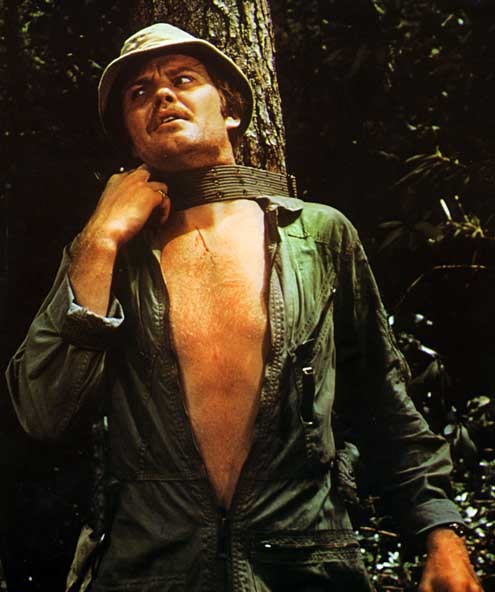
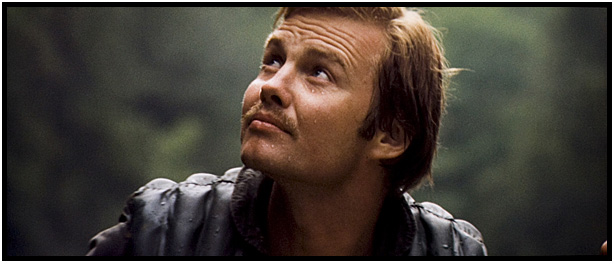
Deliverance

"Deliverance" (John Boorman, 1972) Let me start with an anecdote. I have a dog who's feisty as all get-out. There's not too much he's afraid of, other than missing a meal, and he can be quite aggressive in protecting his perceived territory. My wife and I took him camping, which he enjoyed immensely. That is, until it came time to sleep in the tent. At that point, the dog was quite agitated, especially because he could see through the mesh to the outside world. He kept looking at us as if we were insane: "Sleep? Out here? There's nothing but some fabric to protect us! Are you crazy?" He didn't sleep all night, dutifully looking around to make sure everything was safe, especially his idiot-masters who thought a tent in the wilderness was the same as a house.

I tell that story only because the dog realized something only a non-biped would realize--Nature is cruel. Cruel in tooth and claw, as they say. But "human" nature's got it beat ten ways from Sunday.

And so "
Deliverance," from the novel by poet James Dickey that I was quite fond of back in the day. At the time it appeared in theaters I was worried about its adaptation because the simple story, of four city-boys who take on the adventure of canoeing a river about to be dammed out of existence, could have been a crude film. But, instead, under the austere direction of John Boorman, it's themes of ecology and fool-hardiness, vain-gloriousness and finding strength where none was expected are enhanced and made into an almost mystical experience by the film-maker.

Boorman accentuates the danger of the surroundings by avoiding clearings and staging so many scenes in the middle of forests,
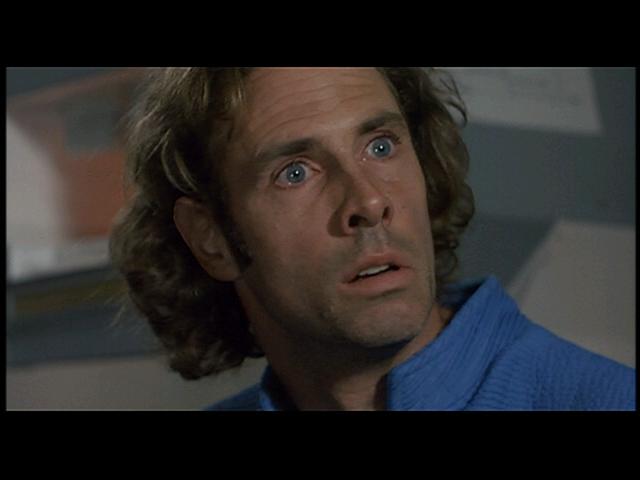
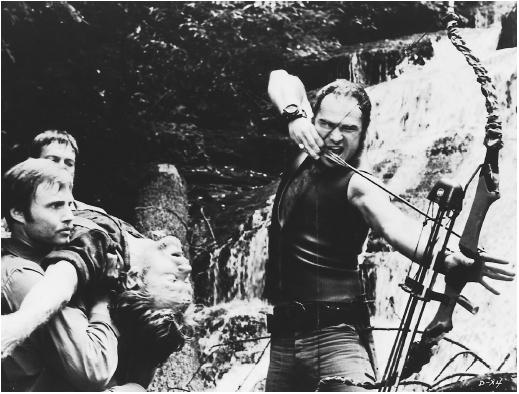
with a restless camera that shifts perspective around trees, moving the formations of them around, to the point where you think you can see things in the patterns of the woods. And he presents tangible, visceral horrors not present in the book-- a mountain man newly killed falling forward into the crotch of a small tree and remaining upright; macho Lewis Medlock (Burt Reynolds) pulling an arrow out of the breast-bone of a backwoods attacker ("Where'd the fletches go..." I thought when the act was done); the exaggerated horror of the men's injuries--the broken thigh-bone that pierces Lewis' leg (Reynolds does an incredible job undercutting his character's uber-stage-manliness with some of the most blood-curdling whimpering I've ever heard), the dislocated shoulder of Drew Ballinger (Ronny Cox) that has the man cradling his own head, sitting, weirdly on a rock out-crop, and Ed Gentry (Jon Voight) cutting an arrow out of his side to prepare for a final show-down below a sky that simmers in a yellow exposure-pushed sky. We won't even talk about Ned Beatty.

If there is a weak performance in the film it's author Dickey as the seething Sheriff who's just a little too-unsubtle in his suggestions. Voight, Beatty (his first film) and Cox do great work, and forgoing insurance, did their own rafting stunts. But Reynolds is terrific in his role, totally dominating the first half of the film, and, though out of action for the rest of the movie, still makes an impression. Hollywood may have a problem with him (doesn't take them...or himself...too seriously, perhaps?) but it would be nice to acknowledge that he can give gifted performances when gifted with good scripts.


In the latest pick, The Library of Congress chose "Deliverance" as one of the significant films to be added to the Film Registry.

Saturday, October 11, 2008

The Day of the Dolphin

"The Day of the Dolphin" (Mike Nichols, 1972) After a series of films in which each one is a bit of an accomplishment in things artistic, cultural and societal ("Who's Afraid of Virgina Woolf?," "The Graduate," "Catch-22," "Carnal Knowledge") Mike Nichols lightened up on the weltschmerz--slightly--to present a relatively frothy entertainment, but in a downbeat kind of way. Robert Merle's best-seller was a thick book that delved more into the philosophical and moral issues of teaching dolphins to express themselves in English. But that probably wouldn't do for the movies, so Buck Henry devised a cloak-and-dagger story about operatives training the mammals to blow up the President...something subtle like that.

The implications of ESL for dolphins takes a back-seat for conspiracy and makes one wonder why one would waste such a top-heavy cast of
George C. Scott, Trish VanDevere, Paul Sorvino, Edward Herrmann, and Fritz Weaver and talking dolphins on just another spy movie. But waste it, they do.
*

Despite Scott's presence (and he's operating on relatively low gear here), the stars are the dolphins, named "Alpha" and "Beta" (or, as they squeak, "Fa" and Bee") In fact, every audience I saw this film with cooed audibly when the first dolphin popped out of the water and breathed "Pah!" in a baby voice at Scott. Like the rudimentary language signed by chimps, the dolphins' grasp of concepts is basic--they know "love," "Ma," "Pa," "Ball," and "Not"--that last one covering a lot of ground from negativity to death.

It all feels a bit gooey and icky, and when Nichols and Henry crank up the melodrama in the final act, one has a tough time taking it with any of the gravity of, say, a "Lassie" movie, probably not what the director intended, making it all for "not."

I do remember one interesting story from the time of the film, from an interview with Nichols at the time the film was made. It has nothing to do with the movie, but is more of a backstage story about the making of it. Nichols found that no matter how ell-trained the dolphins were, they were not the most disciplined of performers. Oh, they understood what they had to do, they just didn't really feel like doing it. They were constantly blowing takes, goofing around, playing--probably stealing donuts from the craft-services table--until tempers got short, and then, they'd do everything on cue--not unlike
Peter Bogdanovich's story about directing Tatum O'Neal.

Anyway, on the last day of filming, on the last take the plan was to release the dolphins back into the wild. The crew gets ready. The dolphins swim out and perform their bit perfectly--it's a "Take." Then, as if knowing they weren't needed anymore, they simply left and swam out to sea. "We're outta here." They just swam away. It left Nichols wondering at the creatures he'd been working with, and wondering if he'd done right by them.**

Maybe they decided to quit "The Biz" before the movie was released.

There's a lot of talent behind it, though--production design by
Richard Sylbert, cinematography from William A. Fraker and a too-good score by Georges Delerue. But it was all for "Not."

When one considers the possibilities, "The Day of the Dolphin" was a day wasted.


* The New Yorker's Pauline Kael suggested that if all Nichols and Henry could come up with for a movie was talking dolphins, they should probably retire from movies. Kael was on the right idea, but off the mark (as she could be)--if all Nichols and Henry could come up with for talking dolphins was a plot to blow up the President--even if it was Nixon--then they should have probably made another movie.

**I will always remember a PBS special on dolphins, hosted by Robin Williams. His first encounter with dolphins in open water, he was enthusiastic to bond, and reached out to one of them, only to get thumped by the other, protective dolphin. He went to a research institute where dolphin behavior was studied, and as he was walking around the tank with a rep, a dolphin poked his head out of the water and watched Williams, who went into "perform" mode and became quite manic, which delighted the dolphin. The scene went on for some time, with Williams and the dolphin playing at each other on a basic level, Williams running from one part of the tank to the other, the dolphin following--the two spinning in place, both fascinated with their play-mate. Finally, Williams was told "we're going to another location," and regretfully left, leaving the dolphin leaning its head out of the tank watching him leave, practically love-sick at his new "friend."

Thursday, May 29, 2008

Olde Review: Bad Company

This was part of a series of reviews of the ASUW Film series back in the '70's. Except for some punctuation, I haven't changed anything from the way it was presented, giving the kid I was back in the '70's a break. Any stray thoughts and updates I've included with the inevitable asterisked post-scripts.


"Bad Company" (Robert Benton, 1972) "Bad Company" is a wonderful movie. It is wise, it is funny as hell, and it combines death and terror in its comedy. Everyone I know who has seen it has extolled it as a minor masterpiece.

Why, then, wasn't it popular?

Why wasn't it seen by many people?

Well, its stars, although fine actors giving perfect performances weren't "names"--Barry Brown, Jeff Bridges (this film was made soon after he completed "The Last Picture Show"), John Savage (now on TV),* Jerry Houser (who was an acting dynamo in "The Summer of '42"), Geoffrey Lewis (the rabbitty Western character actor), and David Huddleston (an all-too-ignored character actor). Gordon Willis, the brilliant photographer of "The Godfather" and "Klute" photographed it. And Harvey Schmidt's piano music seems almost a part of the image.

Why didn't it make money? Because it was a modest little production with good ideas and had no Dino deLaurentiis shelling out $24 million on publicity and gimmicks.**

No, the only things "Bad Company" had were great unsung performances, an unpretentious direction, and a good story. It is at the time of the Civil War, and a bunch of lads get together to rob, and steal...and survive. They are already outlaws for have refused induction into the military. Drew Dixon decides that it would be best for him to hitch onto a wagon train to the westward territories that are still wild and, more important, are not States of the Union. He falls in with some "rough types" led by Bert Rumsey, and, like Benton-Newman's "Bonnie and Clyde," their subsequent partnership results in laughter and death. It was rough out there in the Old West. In the less-than-accomplished hands of one of its own screenwriters, "Bad Company" became the best adaptation of one of their scripts, better than "Bonnie and Clyde." "Bad Company" will appear first on the program. Go early and don't miss anything.

And incidentally, Benton and Newman's new movie with Lily Tomlin and Art Carney will be out fairly soon thanks to producer Robert Altman who saw something special in their extra-special little movie and gave them a second film four years after their auspicious debut.***

This was broadcast on KCMU-FM on January 20th, 1977

* Not sure what this is referring to, although the IMDB has him appearing in a show called "Gibbsville" around the time of this review. Savage would appear shortly in "The Deer Hunter."

** Not sure what this means, but I suspect I was making a slam at the new Dino-produced version of "King Kong." Dino opened it despite my protests.

*** That would be "The Late Show" which didn't do very well at the box-office as I recall, although Benton would use the old private-eye theme of that film in other movies. And weep no tears for Benton-Newman: they went on to write the first two "Superman" movies. Benton made "Kramer vs. Kramer," won the Oscar, and made one of my favorite films "Places in the Heart." He's still directing and writing.

As of this writing, "Bad Company" (1972) has not been released on DVD. More's the pity, as I'd like to re-acquaint myself with this one. You can buy it on VHS, however.
Since the movie opened, a rock band took the name (inspired by this very movie), and two other films using that title have been released--the latest being a lousy Anthony Hopkins-Chris Rock spy comedy directed by Joel Schumacher. It is available on DVD.

Good news. "Bad Company" (1972) IS available on DVD--in a stripped-down presentation from Paramount Home Video from 2002. Here is the link to it on Amazon.com.

Thursday, May 22, 2008

Olde Review: Private Parts

The following was part of a series reviewing the ASUW film series at the University of Washington that were broadcast on KCMU-FM in 1976--I found the old scripts and thought it might be interesting to post them here--with no editorial alteration. I have no doubt that my attitude to some of these films has changed over the years--ageing does that--but to just erase my opinions from back then and tack on my new-found objections would do a disservice to the reviewer who was just a "stinky kid" back then. It'd be like --I don't know--talking over a movie or something!

"Private Parts" (Paul Bartel, 1972) * You thought "Rocky Horror" was tacky? Leave before "Private Parts." Not that it's bad. It's just...trashy. Rather well-made trash at that. It was directed by Paul Bartel, before he went on to make "Death Race 2000," which was also trash. Bartel has talent, he really does. His shots are well-composed, the color composition is great--right now it's a little hard to tell whether he'll go legit and become another Brian DePalma, or will continue with filming lousy stories well and become another Russ Meyer.

"Private Parts" has a badly-acted beginning and a cruddy ending (complete with a Tennessee Williams-style capper). But in between those you keep watching this film (so help me) just to see what the hell will come up next. What trashy, wierd, kinky thing will come up next.

Sweet young thing Cheryl (Ayn Ruyman), kicked out of her apartment, takes up with her wierd (not that "wierd") Aunt Martha (Lucille Benson) at the King Edward Hotel, which seems to have a monopoly on odd tennants. There's this wierd (note that "wierd") photographer named George (John Ventantonio) who, believe it or not, is even sleazier than Oliver Reed is.

Cheryl is into poking into other people's business. george is into all sorts of fetishes and things, and, let's face it, they're made for each other. Just like the sweet young couple in "Rocky Horror...," Cheryl is forever changed by the King Edward.

This movie may not be your cup of tea. It's kind of strong, content-wise, and there are a couple of acts of ultra-violence in which Bartel rubs our collective noses.

But one thing: See it, so that when you see Brian DePalma's wierd but intelligently made "Sisters," you may look upon it as "Citizen Kane" compared to "Private Parts."
-------------------------------------------------------------------------------------------------


*Not the Howard Stern "Private Parts," but Paul Bartel's (Eating Raoul, Death Race 2000) first film.


You know? I don't remember a single frame from this film. Must have purged it from my memory banks. Oh, well. Strange to see I had such a fixation on Brian DePalma in those days (this was years before "The Bonfire of the Vanities.")

Wednesday, November 14, 2007

"Oh, Wasted 'Sleuth'"

"In Olden Days a Glimpse of Stocking Was Looked On as Something Shocking, now I suppose....Anything Goes"

"Sleuth" started out as a hit play by Anthony Shaffer. It was inevitable that a movie would be made of it, and in 1972, a spit-and-polished version of "Sleuth" hit the screen. Shaffer wrote the screen-play, and it was directed with a rich panache by Joseph L. Mankiewicz (who knew a thing or three about theatricality) and the cast could not be improved--top-lined by Sir Laurence Olivier as mystery writer Andrew Wyke, and Michael Caine as the London hair-dresser Milo Tindle, currently having an affair with Wyke's wife. Mankiewicz's film is devilish fun, a clash between The Old World and The Terminally Hip with the battleground being Wyke's gadget and gee-gaw filled Manor House (designed by Ken Adam). Add to it John Addison's frothy hapsichord score and however dark the film becomes (and Mankiewicz gives it a creepily saw-toothed edge), it is never less than fun to watch, especially seeing Olivier energetically dashing through each scene, precisely mimicking accents and dialects--a brilliant murderous man-child forever playing games and Caine keeping up, trotting warily behind. At the time, that theatricality and staging made everything seem a trifle--a little bon-bon for the rinse-set. But over time, one can't help admiring the energy brought to the fore by Mank and Olivier, defying age and frailty to knock another one out of the park. And Shaffer's play is filled with all sorts of opportunity to...play. It stands as definitive...a champion documentation of the play.

Good Authors too Who Once Knew Better Words, Now Only use Four Letter Words Writing Prose, Anything Goes.

It must have seemed such a good idea to re-do it. With Caine old enough to play the Wyke role, and who else but Jude Law as Tindle, making it "The Battle of the Alfies" (and if you think this is coincidence, a couple of lines makes it obvious it was uppermost in the film-maker's minds). Then, to adapt (at one point Wyke says, cheekily, "You know what the word 'adapt' means, don't you?"), the great Harold Pinter, and to direct, Kenneth Branagh, both men who can mine rich veins out of depleted quarry. And the result? "Sleuth" is still there in skeletal form--it's still Wyke vs. Tindle, but only one line of the original remains*--it's been completely stripped. The fussy old school mysteries Wyke wrote are gone, replaced by "crime novels" that regularly turn up on British telly, exemplified by sweating policemen grilling suspects. Milo's now an actor, who does hair, does the occasional chauffeur job. He plays "killers...sex-maniacs, perverts mostly." Not only is the dialog stripped down to essentials ( and in nice....short little...bursts), so is the attitude. Any veneer of civility from the play has been scraped away, starting in the first moments with the chilly pause before a hand-shake when the two men first meet. No, they start off scrapping and spitting at each other right from "Hello" using all manner of Anglo-Saxon terms for each other, mutual contempt hurled in both directions. Which tends to throw the rest of the play on shaky ground. I suppose the makers didn't think Caine could pull off a stuffy, fusty Brit, and made it two working-class toipes throwing knives between their two sets of blue eyes. It takes the class warfare sub-text completely out of the center of the thing, leaving it all to ring just a bit hollow. The play pretty much runs its course, but the Second Act is considerably shortened, and the Third Act, if you will, is dragged on and on (despite all this, new-"Sleuth" lasts 86 minutes--the first was 2 hr, 18 m-- but seems longer) All this is staged in a hi-tech sterile interior (Wyke had nothing to do with it, he claims which seems...odd). And although there's a lot of bantering and word-play, sometimes annoyingly non-sequitir, it's just NO fun at all. Not a jot. At the end of the original, there is the satisfying finish with two simultaneous wails, along with mocking laughter. Then a curtain comes down. Here, nothing. Silence. Not even the impulse to applaud.

"Sleuth" (1972) is a strong matinee.

"Sleuth" (2007) is a waste of time.

* "The shortest way to a man's heart is humiliation."