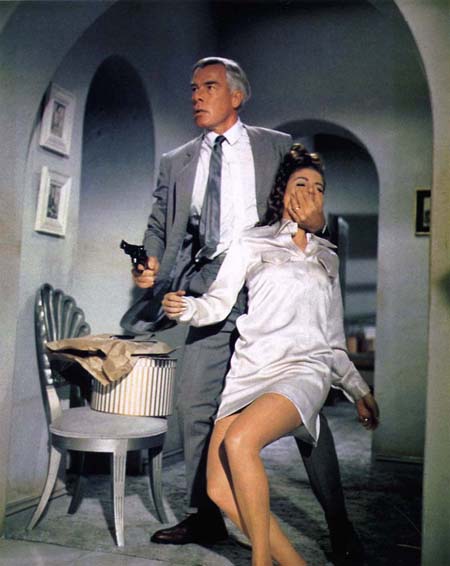
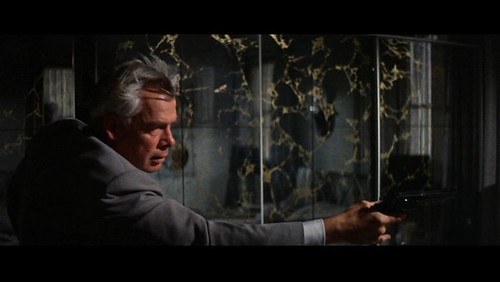
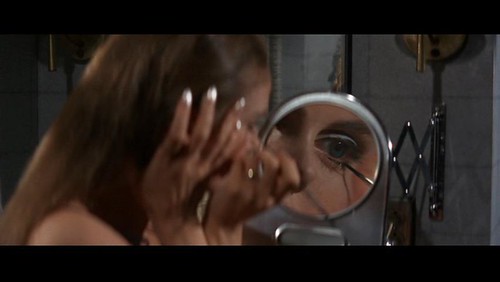
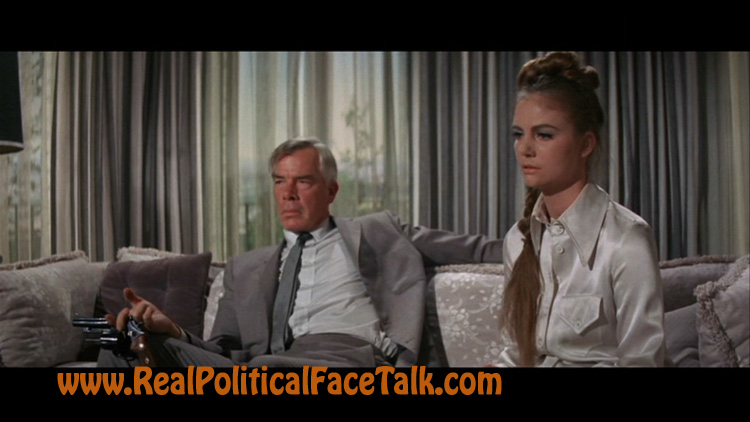
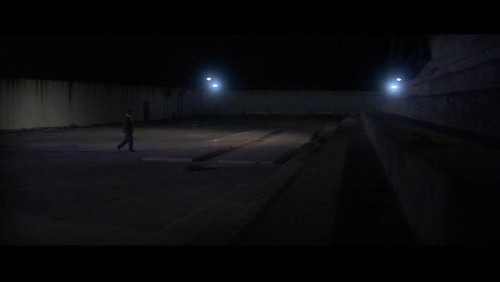
 "Point Blank" (John Boorman, 1967) Obtuse, non-committal, over-stylized noir that still makes you shake your head and say, "Nice to see somebody do something like this." Because Boorman in his psychedelic take on film noir tropes manages to shake loose a lot of the dust you don't see piled up in the dark. And makes a statement about why there might have been such a cultural tumult in that era.
Where the punks and thugs and Mr. Big's in 40's-50's noir were lousy with personality, here they're face-less, charmless non-entities as bland and blank as the glass facades they hide behind. The only thing that makes them human is that they bleed, and that's where our hero strides in.
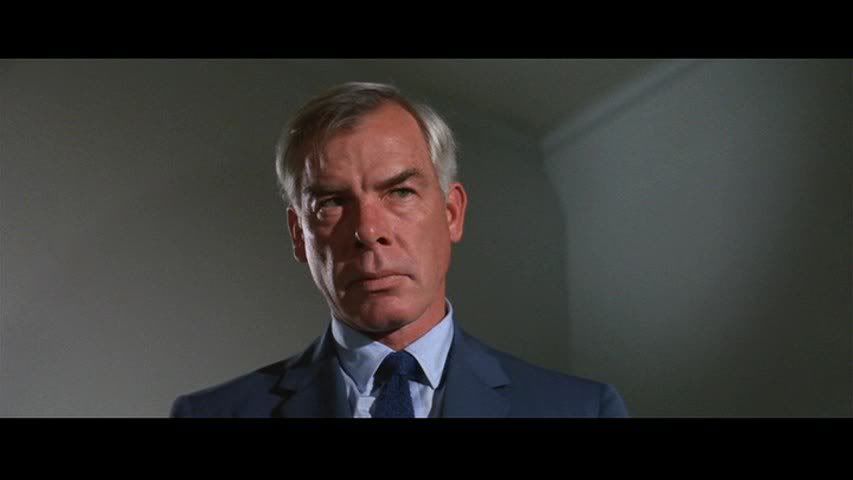
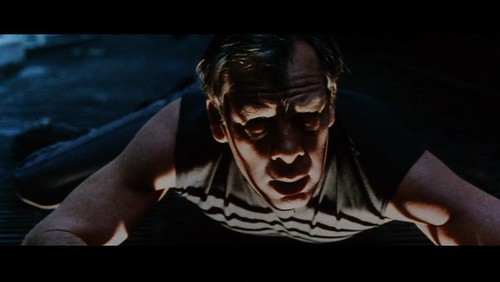
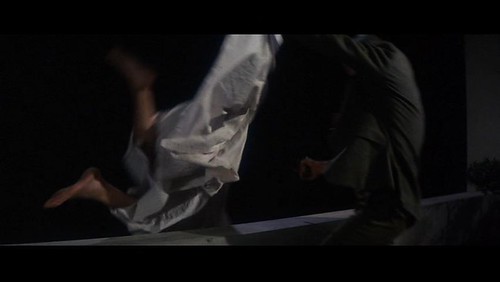
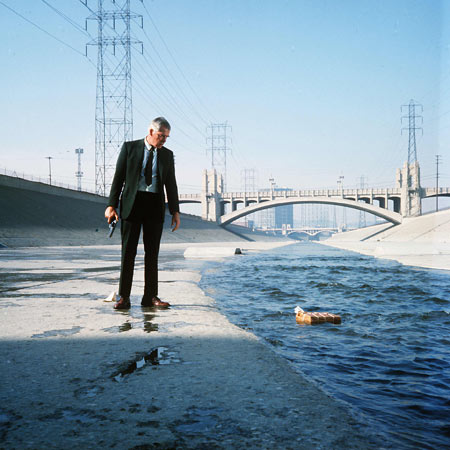
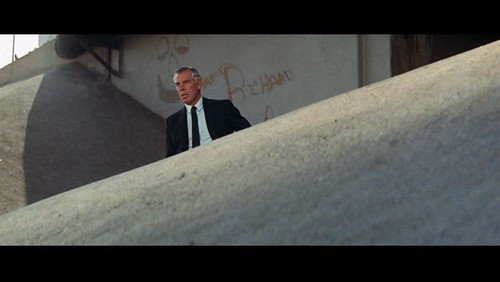
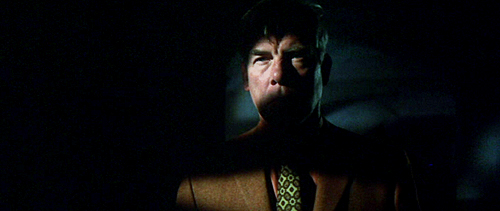
There's always gotta be something a little bit different about a noir hero, if only that there's a silver lining in his dark cloud. But the anti-hero of "Point Blank" is unlike any who've come before him. Walker (Lee Marvin) is the only name he goes by, even his no-good cheating wife (Sharon Acker) calls him that, and the one thing people say about him is they thought he was dead. Expressionless and seemingly impervious to pain,* he just could be, having been set up, cheated and shot—point blank—by his old pal Mace Reece (John Vernon in his film debut) during a drop-robbery at the abandoned Alcatraz prison, his walking with heavy tread the only thing keeping him corporeal. That and the need for vengeance. He's helped along the way by a shadowy presence (Keenan Wynn) whose non-specific organization "helps" Walker with his task. Not that Walker needs much help—usually he's the wrench in the works, insinuating his way into being noticed, making some vague threats and watching over (literally over) the mark's demise. Throw a bug in his sister-in-law's ear (Angie Dickinson), or a slimey underling (Michael Strong), wind them up and set them off on their little missions and sure enough, somebody will wind up dead.
So, what's going on here? Most noirs are mysteries, but there are no answers being requested here, just revenge. The only mystery has to do with the vast clockwork set in motion. Why the shreds of particulars and the over-abundance of style?** Is Walker an Avenging Angel and Wynn his Heavenly Host? Whenever Walker shows up to plant his plans the subjects are usually indulging in one of the Seven Deadlies: lust, sloth, greed, gluttony...
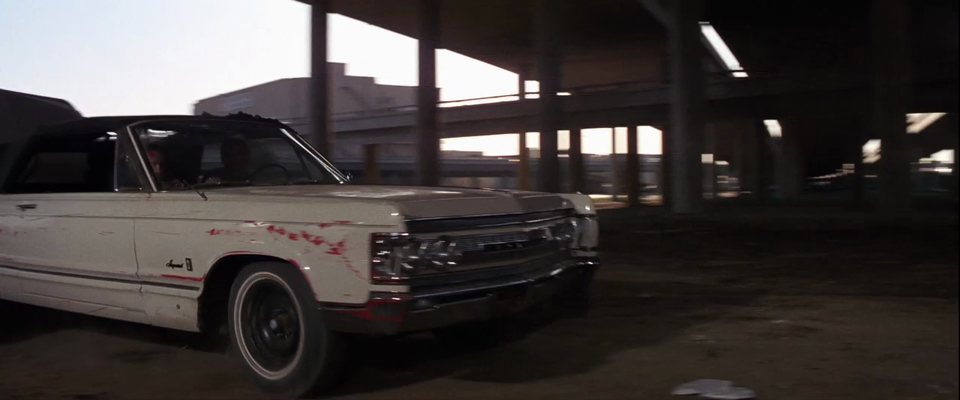
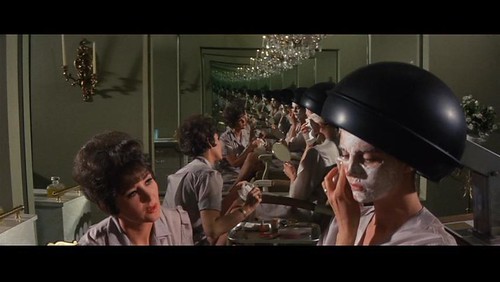
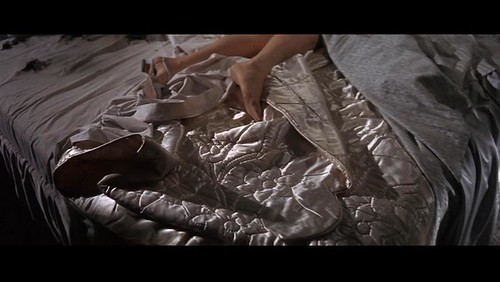
And visually, the film is a series of forced perspectives, Boorman shooting down long corridors and mirrored surfaces into black-centered tunnels and corners to unfathomable vanishing points leading inexorably to...where? Walker's path, mostly. We're locked onto Walker's perspective, however unreliable it may be. Rooms change. Bodies come and go, flashing back and forward. Events happen and then seem to vanish, leaving an empty space, a blank slate, like they've been scoured...purged. Is Boorman using the trangular form of the Renaissance painters and standing it on its ear, giving it inexorable depth. Speculation of this type is a long walk from the movie's source, Donald E. Westlake's "The Hunter." But, such is the influence of Boorman and screenwriters Alexander Jacobs, David Newhouse, and Rafe Newhouse, that one can't help go there, so impenetrable and full of questions is this movie.
Like being lost in the dark
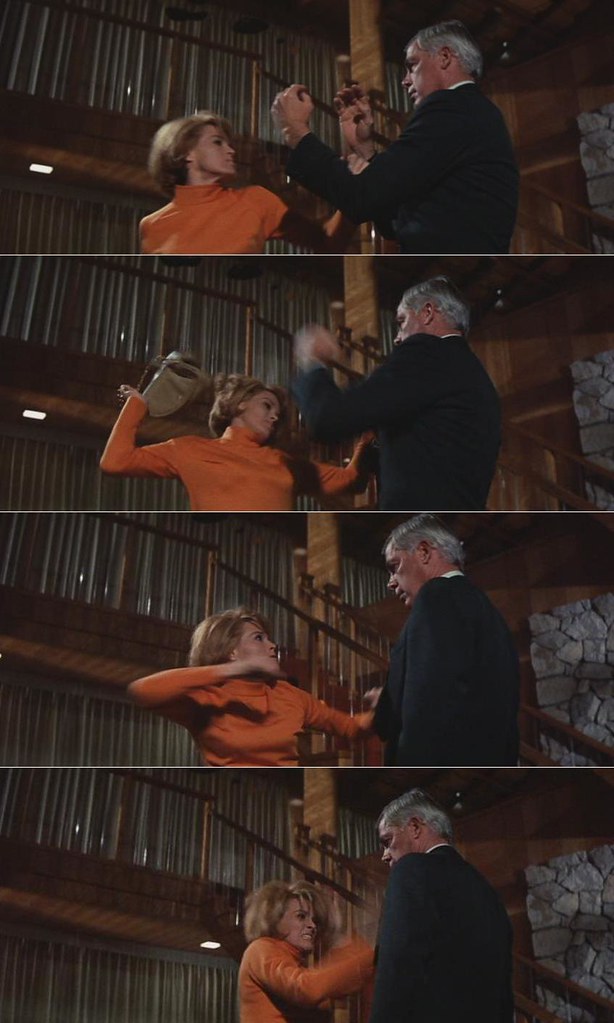
* At one point, Dickinson wails on him, not holding back, thumping his chest, slapping him, hard and clobbering him in the face with her metal-rimmed purse. He (and Marvin) just takes it. Later, she clobbers him with a pool cue, and it just makes him amorous.
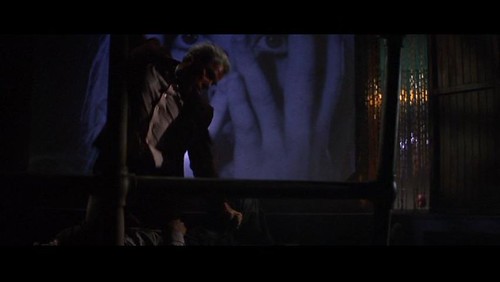
** In a nightclub called "The Movie House," over a screaming rhythm and blues song without words, Walker beats up a couple of thugs, the slide projection in the background showing a pretty actress reacting in distress. A little obvious, that, but fun.
Wednesday, April 29, 2009
Point Blank










Tuesday, January 13, 2009
Deliverance
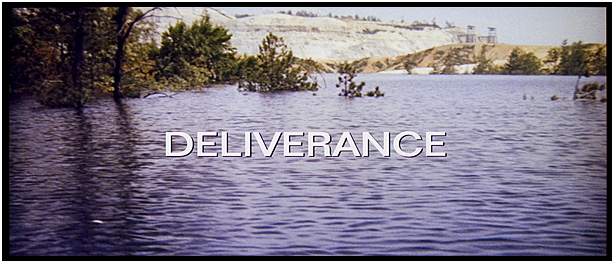
"Deliverance" (John Boorman, 1972) Let me start with an anecdote. I have a dog who's feisty as all get-out. There's not too much he's afraid of, other than missing a meal, and he can be quite aggressive in protecting his perceived territory. My wife and I took him camping, which he enjoyed immensely. That is, until it came time to sleep in the tent. At that point, the dog was quite agitated, especially because he could see through the mesh to the outside world. He kept looking at us as if we were insane: "Sleep? Out here? There's nothing but some fabric to protect us! Are you crazy?" He didn't sleep all night, dutifully looking around to make sure everything was safe, especially his idiot-masters who thought a tent in the wilderness was the same as a house.
I tell that story only because the dog realized something only a non-biped would realize--Nature is cruel. Cruel in tooth and claw, as they say. But "human" nature's got it beat ten ways from Sunday.
And so "Deliverance," from the novel by poet James Dickey that I was quite fond of back in the day. At the time it appeared in theaters I was worried about its adaptation because the simple story, of four city-boys who take on the adventure of canoeing a river about to be dammed out of existence, could have been a crude film. But, instead, under the austere direction of John Boorman, it's themes of ecology and fool-hardiness, vain-gloriousness and finding strength where none was expected are enhanced and made into an almost mystical experience by the film-maker.
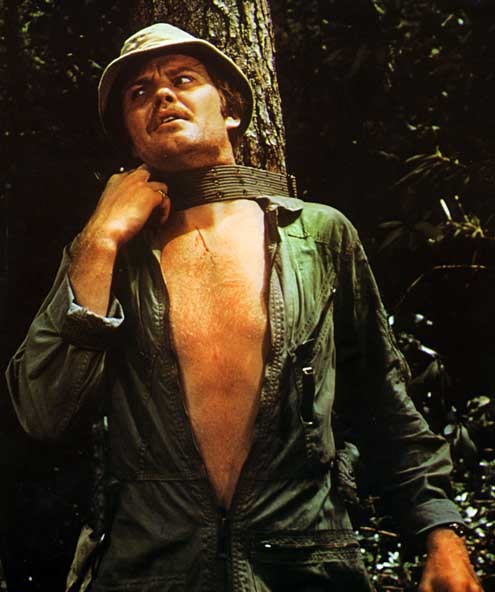
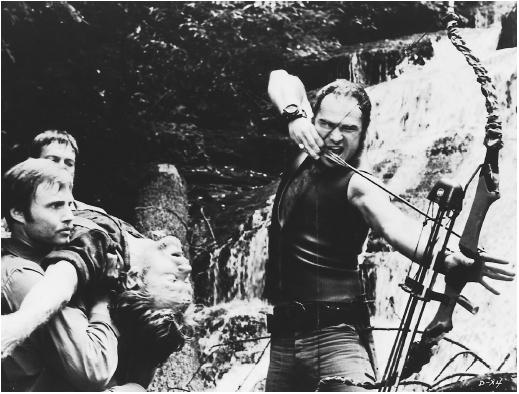
Boorman accentuates the danger of the surroundings by avoiding clearings and staging so many scenes in the middle of forests, with a restless camera that shifts perspective around trees, moving the formations of them around, to the point where you think you can see things in the patterns of the woods. And he presents tangible, visceral horrors not present in the book-- a mountain man newly killed falling forward into the crotch of a small tree and remaining upright; macho Lewis Medlock (Burt Reynolds) pulling an arrow out of the breast-bone of a backwoods attacker ("Where'd the fletches go..." I thought when the act was done); the exaggerated horror of the men's injuries--the broken thigh-bone that pierces Lewis' leg (Reynolds does an incredible job undercutting his character's uber-stage-manliness with some of the most blood-curdling whimpering I've ever heard), the dislocated shoulder of Drew Ballinger (Ronny Cox) that has the man cradling his own head, sitting, weirdly on a rock out-crop, and Ed Gentry (Jon Voight) cutting an arrow out of his side to prepare for a final show-down below a sky that simmers in a yellow exposure-pushed sky. We won't even talk about Ned Beatty.
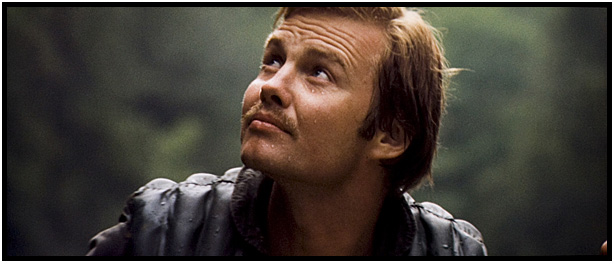
If there is a weak performance in the film it's author Dickey as the seething Sheriff who's just a little too-unsubtle in his suggestions. Voight, Beatty (his first film) and Cox do great work, and forgoing insurance, did their own rafting stunts. But Reynolds is terrific in his role, totally dominating the first half of the film, and, though out of action for the rest of the movie, still makes an impression. Hollywood may have a problem with him (doesn't take them...or himself...too seriously, perhaps?) but it would be nice to acknowledge that he can give gifted performances when gifted with good scripts.
In the latest pick, The Library of Congress chose "Deliverance" as one of the significant films to be added to the Film Registry.








Tuesday, August 5, 2008
Olde Review: Zardoz
This Saturday's ASUW films in 130 Kane are John Boorman's "Zardoz" and Brian DePalma's "The Phantom of the Paradise"

"Zardoz" (John Boorman, 1974)

"Zardoz speaks to you, his chosen ones:
You have been raised up from brutality, to kill the brutals who multiply and are legion. To this end, Zardoz, your God, gave you the gift of the gun"
Ooooo-kay! That little snippet from "Zardoz's" soundtrack* is a perfect example of what is right, and what is wrong with the film.
What we see during that resounding speech is a huge stone god-head floating over lush grass-lands while chanting subjects on horseback an on foot gaze, entranced by it. And it's a beautiful shot--nicely framed, beautifully photographed--even the special effect in the shot is nearly invisible. The sound is nice. The music, mostly the second movement of Beethoven's seventh symphony, is perfectly suited to this movie.

But the words emanating from that nicely modulated voice are really silly.
And so, in a nut-shell, there is "Zardoz"--due to the great abilities of its director John Boorman, whose previous film was "Deliverance" ** (and who is currently working on "The Heretic: Exorcist Part II"),*** it is a beautiful film to look at and listen to, but it is ultimately a very silly movie.
Maybe the script isn't too important. It is possible to ignore it when Boorman is communicating mood through his magnificent images and stately music. It is in the moments of pure image and music that "Zardoz" achieves the kind of epic stature that Boorman obviously wanted. And it is fun while the inspiration lasts, which is about half-way through it. It's about this time that the audience will wonder how in hell the damned thing is going to end. It's obvious by seeing the ending that Boorman wondered himself, and couldn't come up with anything other than a cop-out. Well, all I can say is enjoy what you see--it's quite fantastic. Try to ignore the plot.
And once and for all, maybe you should re-appraise your view of Sean Connery as an actor. It is "Zardoz" that slowly eased him out of the James Bond stereotype he had been mired in for so long, and into his current stream of swashbuckling roles, and in the very difficult role of Zed, the pivotal role of the film, Connery is nothing short of perfect. And so, "Zardoz" is a mixed bag of fine acting, the beautiful image and the hackneyed script.
Broadcast on KCMU-FM on November 5th and 6th, 1975
Um.....maybe the beautiful image. It's hard to say that Connery was doing stellar work running around in thigh-high boots and a red diaper (see below), spouting inane dialog, albeit opposite Charlotte Rampling. Truth of the matter is "Zardoz" is what Boorman made when he wasn't allowed to make "The Lord of the Rings," and Connery played Zed after Burt Reynolds, who was cast, (wisely) bowed out. "Zardoz" is just a stoopid, pretentious fantasy wanna-be, that keeps you guessing about where all this stuff came from--and when it's revealed to be an extremely simplistic (silly) conceit, you want to walk out. It all ends with one of those teen-pleasing Riots Against Authority that were popular "in the day," and sort of sputters to an ending of sorts. It's just a bad, bad film.
So was "The Heretic." Incredibly, someone gave Boorman money to make another film, and though it veers awfully close to the same sort of sophomoric kookiness of it predecessors, his film of "Excalibur" was a stylistic triumph for the director. It's a good thing, too. John Boorman is a fine director, when he has good material (which he can write, as well).
Connery was just coming into his own as his own actor away from 007, with good work in "Murder on the Orient Express," and "The Wind and the Lion." His best work was still ahead. "The Man Who Would be King" would open five weeks after this review was written.
* These reviews were accompanied by sound-clips or music from each of the films. This one started with that pretentious quote. FCC rules kept me from continuing it. Wanna read it? (Well, don't say I didn't warn ya...) "The gun is good. The penis is evil. The penis shoots seeds, and makes new life to poison the Earth with a plague of men, as once it was, but the gun shoots death, and purifies the Earth of the filth of brutals. Go forth . . . and kill!"
** Need to do a review of "Deliverance" one of these days. That is a great film.
*** Well, we won't bring that one up, only to say that Boorman got much better about the subject matter of his films.
 Okay--Connery didn't want to play "Gandalf" because
he didn't understand "The Lord of the Rings"--but he understood this??