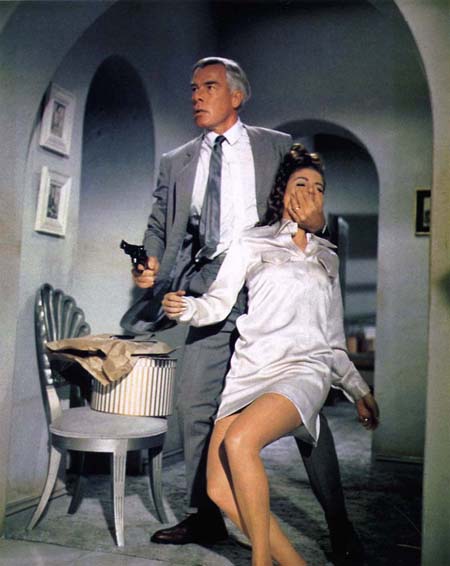
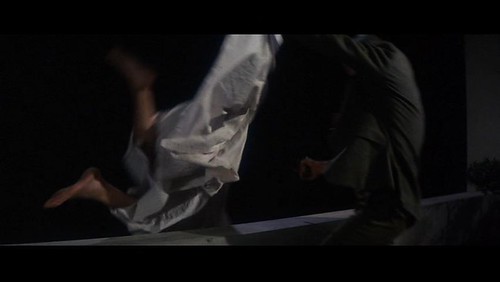
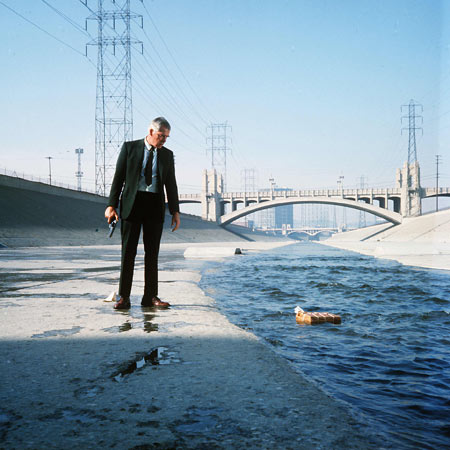
 "Point Blank" (John Boorman, 1967) Obtuse, non-committal, over-stylized noir that still makes you shake your head and say, "Nice to see somebody do something like this." Because Boorman in his psychedelic take on film noir tropes manages to shake loose a lot of the dust you don't see piled up in the dark. And makes a statement about why there might have been such a cultural tumult in that era.
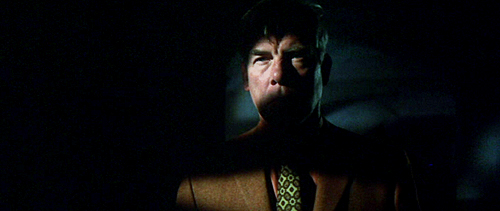
Where the punks and thugs and Mr. Big's in 40's-50's noir were lousy with personality, here they're face-less, charmless non-entities as bland and blank as the glass facades they hide behind. The only thing that makes them human is that they bleed, and that's where our hero strides in.
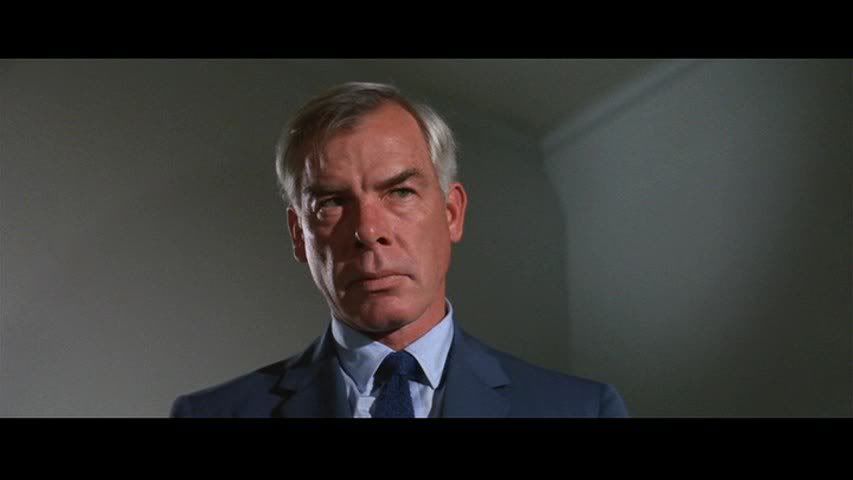
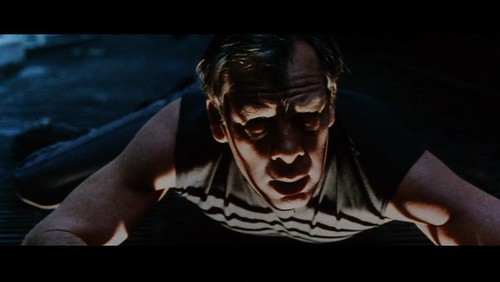
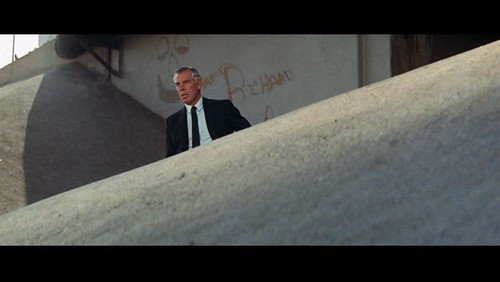
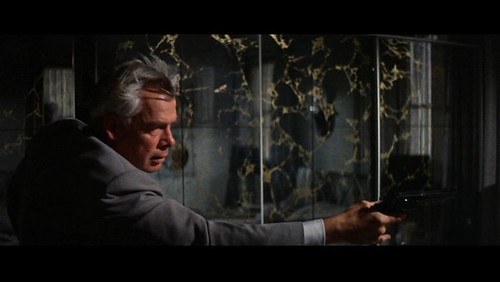
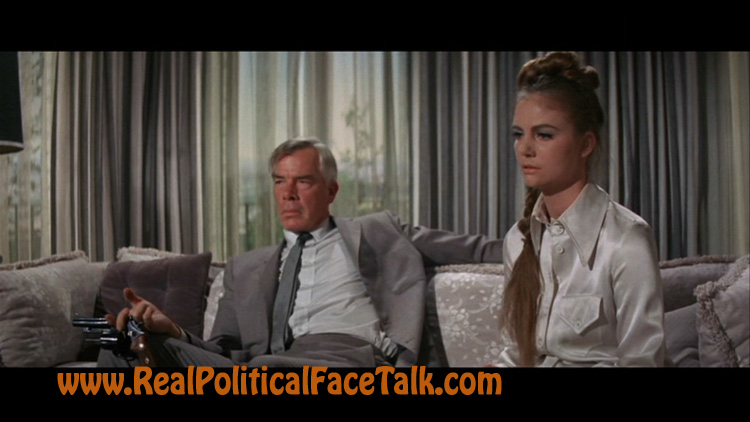
There's always gotta be something a little bit different about a noir hero, if only that there's a silver lining in his dark cloud. But the anti-hero of "Point Blank" is unlike any who've come before him. Walker (Lee Marvin) is the only name he goes by, even his no-good cheating wife (Sharon Acker) calls him that, and the one thing people say about him is they thought he was dead. Expressionless and seemingly impervious to pain,* he just could be, having been set up, cheated and shot—point blank—by his old pal Mace Reece (John Vernon in his film debut) during a drop-robbery at the abandoned Alcatraz prison, his walking with heavy tread the only thing keeping him corporeal. That and the need for vengeance. He's helped along the way by a shadowy presence (Keenan Wynn) whose non-specific organization "helps" Walker with his task. Not that Walker needs much help—usually he's the wrench in the works, insinuating his way into being noticed, making some vague threats and watching over (literally over) the mark's demise. Throw a bug in his sister-in-law's ear (Angie Dickinson), or a slimey underling (Michael Strong), wind them up and set them off on their little missions and sure enough, somebody will wind up dead.
So, what's going on here? Most noirs are mysteries, but there are no answers being requested here, just revenge. The only mystery has to do with the vast clockwork set in motion. Why the shreds of particulars and the over-abundance of style?** Is Walker an Avenging Angel and Wynn his Heavenly Host? Whenever Walker shows up to plant his plans the subjects are usually indulging in one of the Seven Deadlies: lust, sloth, greed, gluttony...
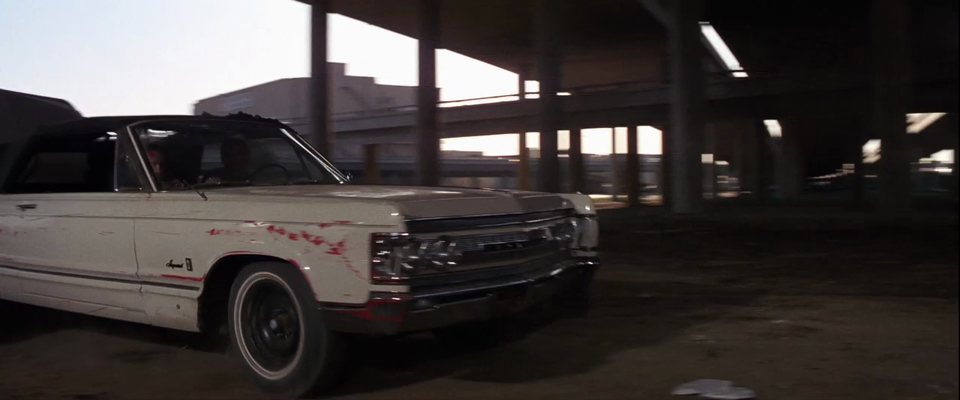
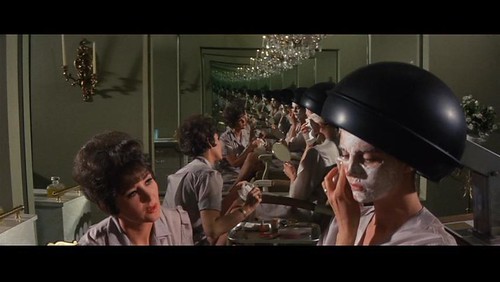
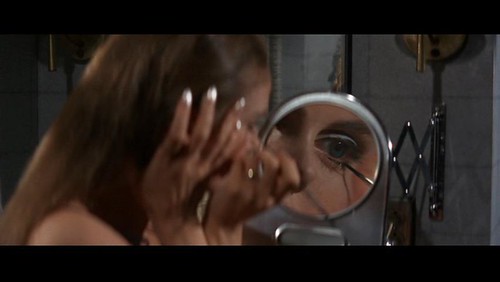
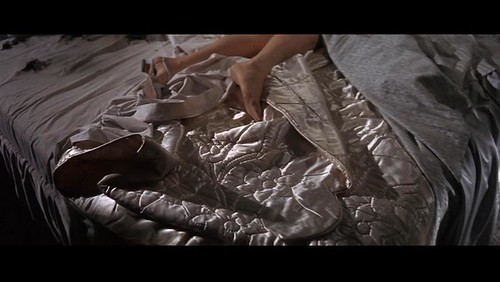
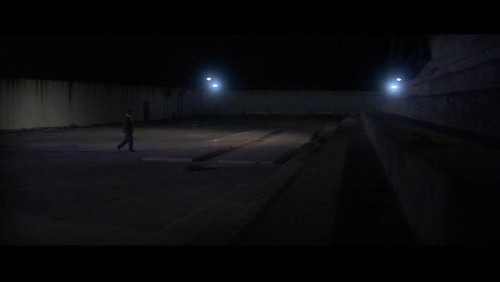
And visually, the film is a series of forced perspectives, Boorman shooting down long corridors and mirrored surfaces into black-centered tunnels and corners to unfathomable vanishing points leading inexorably to...where? Walker's path, mostly. We're locked onto Walker's perspective, however unreliable it may be. Rooms change. Bodies come and go, flashing back and forward. Events happen and then seem to vanish, leaving an empty space, a blank slate, like they've been scoured...purged. Is Boorman using the trangular form of the Renaissance painters and standing it on its ear, giving it inexorable depth. Speculation of this type is a long walk from the movie's source, Donald E. Westlake's "The Hunter." But, such is the influence of Boorman and screenwriters Alexander Jacobs, David Newhouse, and Rafe Newhouse, that one can't help go there, so impenetrable and full of questions is this movie.
Like being lost in the dark
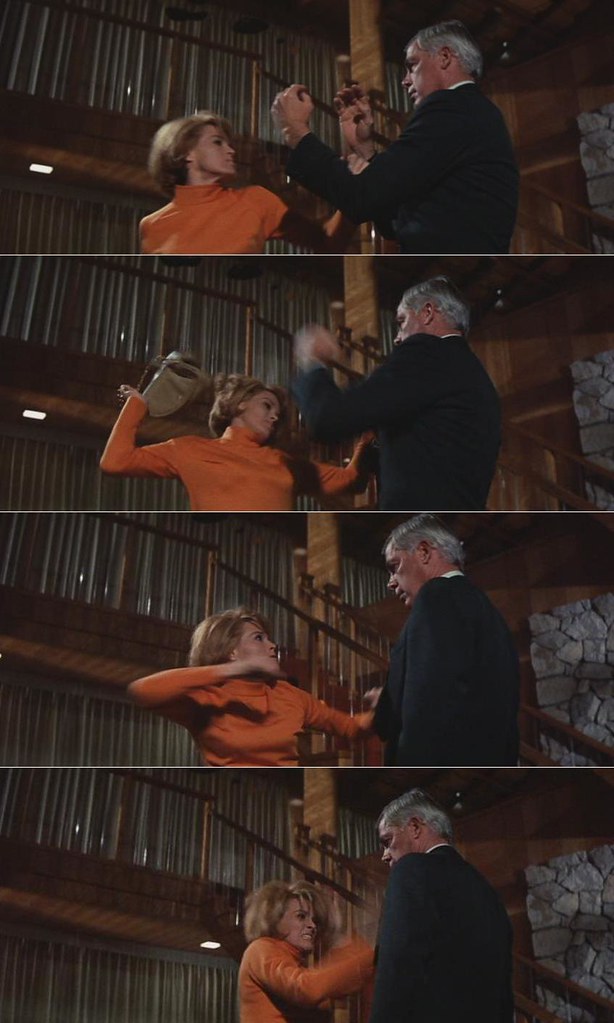
* At one point, Dickinson wails on him, not holding back, thumping his chest, slapping him, hard and clobbering him in the face with her metal-rimmed purse. He (and Marvin) just takes it. Later, she clobbers him with a pool cue, and it just makes him amorous.
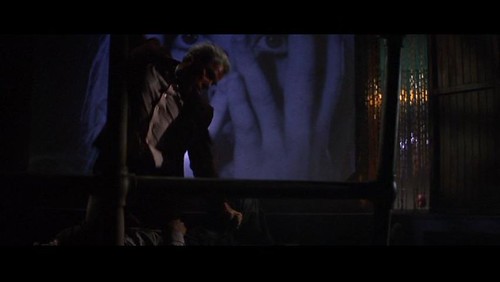
** In a nightclub called "The Movie House," over a screaming rhythm and blues song without words, Walker beats up a couple of thugs, the slide projection in the background showing a pretty actress reacting in distress. A little obvious, that, but fun.
Showing posts with label Angie Dickinson. Show all posts
Showing posts with label Angie Dickinson. Show all posts
Wednesday, April 29, 2009
Point Blank










Monday, September 1, 2008
Rio Bravo
"Rio Bravo" (Howard Hawks, 1959)  Rollicking pop-western that might be, along with "Only Angels Have Wings," the quintessential Howard Hawks movie. It's a drama with comedy. And if it was a mystery starring Humphrey Bogart, it would be acclaimed for its dexterous story-telling and depth of technique.
But because it's a "John Wayne Western," it gets no respect, or retrospective. But who says life is fair? Certainly not a man hung with a moniker like John T. Chance.
The story goes that both John Wayne and Howard Hawks hated "High Noon," but for differing reasons: Wayne, because it was a veiled slam at McCarthy and Hawks because of its basic story structure. Hawks found it appalling that Sheriff Will Kane (Gary Cooper) would ask for volunteers in his fight against the Miller boys. "It's his responsibility. Let him handle it," was Hawks' reasoning. "If he can't, he shouldn't have the badge."
It's a sound argument, and Hawks makes it the cornerstone for the beginning of "Rio Bravo." Sheriff Chance (John Wayne) has a member of the Burdette gang (Claude Akins) jailed for murder, waiting for the Marshall to get to town. For help, he has his coot-ish old deputy "Stumpy" (Walter Brennan, sans teeth) and a former deputy named "Dude" (Dean Martin), who suffers from the shakes and dry heaves during an imposed drying out spell.
"That all you got?" says wagon-master Pat Wheeler (Ward Bond), not really asking.
"That's what I got," says Chance.
Chance refuses all offers of aid from the townspeople; the guys he's got are at least deputized. They won't get in the way like "well-meaning amateurs." And the one guy from Wheeler's party he'd like to have help--Ricky Nelson's "Colorado" (or as first, Wayne, then everybody pronounces it, "Colorada")--won't. It's the kid's good sense not to get involved with the fight that impresses Chance the most.
And this is why I prefer "Rio Bravo" to an ideology-based western trying to make societal points, like "High Noon:" "Rio Bravo" is practical. All the protagonists have to do is wait out the Burdettes, who are always thinking up ways to breach the jail. There are also other concerns--Dude's alcoholism and self-esteem issues. Then there's "the girl," "Feathers" by name (Angie Dickinson), and she's a boiled-down bad good girl in the best "plays-with-boys" tradition of Hawks women. her exchanges with a flummoxed and humiliated Wayne are some of the best examples of Hawks' "three-corner" line of dialog in the director's canon (and despite the screen credits of Jules Furthman and Leigh Brackett--look at her resume some time--it was Hawks who wrote the dialog).
There are joys aplenty in the details of "Rio Bravo," if one is looking for them. For example:
--The opening: A wordless mini-movie that establishes a lot of relationships with no one exchanging a word. "Dude's" alcoholism and his willingness to humiliate himself for a drink, countered by Chance's concern and disgust all told visually. Hawks shoots films the old traditional way of studio films--mid-shots of the participants centered at eye-level. But for the introduction of Wayne that rule is violated, with an up-angle shot of the Sheriff, shaking his head, from "Dude's" floor-perspective. It's just the first of many strong scenes featuring Martin, recently split from the Martin and Lewis duo, and determined to make it as an actor/singer in his own right.
--Despite the seemingly simplistic storyline, the film is rich in sub-text. For example, watch the oft-used Hawks device of cigarettes--who needs one, who offers, who lights--as an indicator of relationships and charity. Hawks did this in several films, but the tobacco flies fast and loose in "Rio Bravo."
--Half the fun of watching "Rio Bravo" is watching the other actors' reactions in scenes. A couple of favorites: Watch Wayne as "Colorada" confronts a fancy-vested gambler who might be cheating at cards.* Wayne's weapon of choice throughout the film is a carbine; he rarely doesn't have it in his hands. During this scene, he holds it lightly in his right hand. When "Fancy-Vest" reaches for a weapon, "Colorada" beats him to the draw. But, off to the side, Wayne has reacted by bringing his rifle to bear, then, once he sees the kid has the situation under control, continues the arc of the rifle to cradle it in his arms, as if that was his intention all along.
--At one point, "Dude" tries to keep information away from Chance, but has his subterfuge spoiled by "Colorada" walking up and blurting it out, while Martin seethes in the background.
--Music is an important component in Hawks' work. At one point, there is a sing-along between Martin, Nelson, and, improbably, Brennan. It might seem a hokey moment, but it means something. before this scene, the three were squabbling. Now, they're harmonizing as a unit, collaborating and getting out of each others' way. It's Hawks' way of showing barriers have been broken and a cohesive unit has been formed, something that was done in "Bringing Up Baby," "Only Angels Have Wings," "To Have and Have Not," and countless others. (See that scene below)
"Rio Bravo" is a rich movie-experience, deeply rewarding, and demanding repeated screenings to catch all the details--not a hardship, as it's also fun. It's a distillation, summing-up and expansion of the elements that made Howard Hawks such a unique film-maker, and gifted story-teller.
 Rollicking pop-western that might be, along with "Only Angels Have Wings," the quintessential Howard Hawks movie. It's a drama with comedy. And if it was a mystery starring Humphrey Bogart, it would be acclaimed for its dexterous story-telling and depth of technique.
But because it's a "John Wayne Western," it gets no respect, or retrospective. But who says life is fair? Certainly not a man hung with a moniker like John T. Chance.
The story goes that both John Wayne and Howard Hawks hated "High Noon," but for differing reasons: Wayne, because it was a veiled slam at McCarthy and Hawks because of its basic story structure. Hawks found it appalling that Sheriff Will Kane (Gary Cooper) would ask for volunteers in his fight against the Miller boys. "It's his responsibility. Let him handle it," was Hawks' reasoning. "If he can't, he shouldn't have the badge."
It's a sound argument, and Hawks makes it the cornerstone for the beginning of "Rio Bravo." Sheriff Chance (John Wayne) has a member of the Burdette gang (Claude Akins) jailed for murder, waiting for the Marshall to get to town. For help, he has his coot-ish old deputy "Stumpy" (Walter Brennan, sans teeth) and a former deputy named "Dude" (Dean Martin), who suffers from the shakes and dry heaves during an imposed drying out spell.
"That all you got?" says wagon-master Pat Wheeler (Ward Bond), not really asking.
"That's what I got," says Chance.
Chance refuses all offers of aid from the townspeople; the guys he's got are at least deputized. They won't get in the way like "well-meaning amateurs." And the one guy from Wheeler's party he'd like to have help--Ricky Nelson's "Colorado" (or as first, Wayne, then everybody pronounces it, "Colorada")--won't. It's the kid's good sense not to get involved with the fight that impresses Chance the most.
And this is why I prefer "Rio Bravo" to an ideology-based western trying to make societal points, like "High Noon:" "Rio Bravo" is practical. All the protagonists have to do is wait out the Burdettes, who are always thinking up ways to breach the jail. There are also other concerns--Dude's alcoholism and self-esteem issues. Then there's "the girl," "Feathers" by name (Angie Dickinson), and she's a boiled-down bad good girl in the best "plays-with-boys" tradition of Hawks women. her exchanges with a flummoxed and humiliated Wayne are some of the best examples of Hawks' "three-corner" line of dialog in the director's canon (and despite the screen credits of Jules Furthman and Leigh Brackett--look at her resume some time--it was Hawks who wrote the dialog).
There are joys aplenty in the details of "Rio Bravo," if one is looking for them. For example:
--The opening: A wordless mini-movie that establishes a lot of relationships with no one exchanging a word. "Dude's" alcoholism and his willingness to humiliate himself for a drink, countered by Chance's concern and disgust all told visually. Hawks shoots films the old traditional way of studio films--mid-shots of the participants centered at eye-level. But for the introduction of Wayne that rule is violated, with an up-angle shot of the Sheriff, shaking his head, from "Dude's" floor-perspective. It's just the first of many strong scenes featuring Martin, recently split from the Martin and Lewis duo, and determined to make it as an actor/singer in his own right.
--Despite the seemingly simplistic storyline, the film is rich in sub-text. For example, watch the oft-used Hawks device of cigarettes--who needs one, who offers, who lights--as an indicator of relationships and charity. Hawks did this in several films, but the tobacco flies fast and loose in "Rio Bravo."
--Half the fun of watching "Rio Bravo" is watching the other actors' reactions in scenes. A couple of favorites: Watch Wayne as "Colorada" confronts a fancy-vested gambler who might be cheating at cards.* Wayne's weapon of choice throughout the film is a carbine; he rarely doesn't have it in his hands. During this scene, he holds it lightly in his right hand. When "Fancy-Vest" reaches for a weapon, "Colorada" beats him to the draw. But, off to the side, Wayne has reacted by bringing his rifle to bear, then, once he sees the kid has the situation under control, continues the arc of the rifle to cradle it in his arms, as if that was his intention all along.
--At one point, "Dude" tries to keep information away from Chance, but has his subterfuge spoiled by "Colorada" walking up and blurting it out, while Martin seethes in the background.
--Music is an important component in Hawks' work. At one point, there is a sing-along between Martin, Nelson, and, improbably, Brennan. It might seem a hokey moment, but it means something. before this scene, the three were squabbling. Now, they're harmonizing as a unit, collaborating and getting out of each others' way. It's Hawks' way of showing barriers have been broken and a cohesive unit has been formed, something that was done in "Bringing Up Baby," "Only Angels Have Wings," "To Have and Have Not," and countless others. (See that scene below)
"Rio Bravo" is a rich movie-experience, deeply rewarding, and demanding repeated screenings to catch all the details--not a hardship, as it's also fun. It's a distillation, summing-up and expansion of the elements that made Howard Hawks such a unique film-maker, and gifted story-teller.
Can't we all just sing-along?
Harmonizing indicates cohesiveness in "Rio Bravo"
* start watching at @2:50 in the embedded clip.
Subscribe to:
Posts (Atom)