Saturday, February 2, 2013
The Anderson Tapes
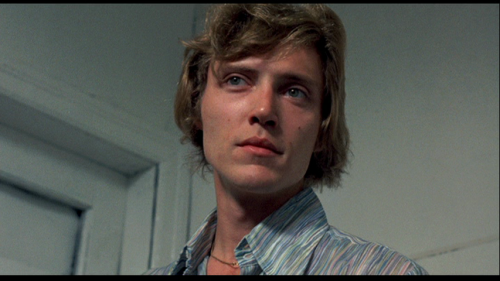
The Anderson Tapes, however, was a different creature, entirely. An extended heist film, in which Connery, Martin Balsam, and (introducing) Christopher Walken participate in what must be the slowest caper in history, the casing of a luxury apartment building in New York City. Connery plays Duke Anderson, a con just released from a ten year stretch in prison, who can't wait to do another score. The inspiration is his girlfriend Ingrid (Dyan Cannon), a high-end call-girl, who has been set up in a luxury apartment by another man.
But, things have changed in the ten years since Anderson was free. Unbeknownst to him, he is under constant surveillance by three different agencies: Ingrid's apartment is bugged by a private detective hired by her "keeper;" the FBI is tracking Black activists, whose headquarters is at a flop where the thieves meet; the IRS is phone-tapping the Mafia Boss (Alan King), who is funding the heist; and the Bureau of Narcotics is keeping tabs on one of the group's members. All of these groups are keeping a running record of the planning of the break-in...but none of them are coordinated or sharing information, and the surveillance work is so concentrated on their individual subjects, that nothing is put together to prevent it from happening. It's hard to determine exactly what is being decried here—that our privacies are being invaded to such an extent, or that this intelligence isn't being cross-referenced to prevent actual crimes and is...dumb. One gets the impression that there is no stance being taken, rather it's to present A Big Irony, that undercuts how events play out, eventually. But, that was Lumet's specialty—he frequently spaced his flat-out movie drama assignmnents with "Ironies," (as opposed to "Comedies") that, their point having been made half-way through the movie, wear out their welcome by the often dissatisfying end of the tale. Everybody looks a little stupid here: the agencies, for their tunnel-vision, the crooks for their own utter lack of surveillance as the crime goes about, and the NYPD, whose very elaborate storming of the apartment complex is literally over-the-top.
Lumet was not the best director for comedy as he had a tendency to sledge-hammer things—like Martin Balsam's mincing interior decorator/antiques smuggler (yeah, yeah, "it was the times," I suppose), but there are some joys to be had, besides Connery doing something different and Walken's debut: appearances by Max Showalter, Margaret Hamilton (her last role), and "crazy old lady" Judith Lowry, as well as Ralph Meeker and SNL pioneer Garrett Morris as Gotham police.
Lumet would hit his stride later in the decade (with the sure editorial hand of Dede Allen), but this one is only moderately successful.
Saturday, May 5, 2012
The Avengers
The Avengers (Jeremiah Chechik, 1998) "Mrs. Peel, we're needed..." in a much better movie.I know, not what you expected, but, then, neither was this movie to me. "The Avengers" were a proven property, a memory (fond) of my youth, especially when it was on American television, during the height of the "Bond craze" of the 1960's. It started out in its early "video" days as a fairly straight-ahead detective procedural with Patrick Macnee as John Steed, who worked with Dr. David Keel (Ian Hendry), then Venus Smith (Julie Stevens), then Cathy Gale (Honor Blackman). The shows became increasingly bolder, cheekier and more in the spy realm, reaching its zenith during the "Emma Peel" years, when Diana Rigg played Steed's partner. By that time, the show was practically a comedy, with odd off-kilter conspiracies, sci-fi and fantasy elements. Most folks tuned in for the repartee, as the plots became fairly disposable; Steed and Emma became the focus of the show, he of the fusty suits and bowler hat, she of the catsuits and judo fights. It was fun, disposable, and a joy to watch.
The movie version gets one out of the three. The blunders begin by miscasting Ralph Fiennes as Steed and Uma Thurman as Peel. Fiennes fares slightly better, but he plays Steed as withdrawn and a bit docile, whereas the Steed of the series was a proud extrovert. Ms. Thurman's Mrs. Peel is everything the series' Rigg wasn't—pale, inexpressive and...American. As if to overcompensate for the lack of joie de vivre in the leads, the movie goes overboard with elements of goofiness in a plot about robotic clones, Teddy bear conspiracists, mechanical bees, and a plot to—dare I say it?—rule the world...by controlling...the weather?
Sean Connery had been saying for years that he'd wanted to play a Bond villain, but knew those producers would never go for it—or pay the salary he wanted. This is the movie where he gets to, and his August DeWynter, is played hammily and with much brio. He gets the best lines and looks like he's having fun. Fiennes looks miserable most of the time, and Thurman is mostly unreadable. There's also an interesting supporting cast, largely wasted, featuring Jim Broadbent, Fiona Shaw, John Wood, Eddie Izzard, Eileen Atkins, and a cameo by MacNee...who plays a character who's invisible. He's the lucky one in the cast.
The script—by Don McPherson—is a mess, and Jeremiah Chechik (who made National Lampoon's Christmas Vacation and Benny & Joon) tries to bring some style to it at the sacrifice of pace and, after the film was slashed from two hours to 90 minutes following a disasterous preview, coherence. It's one of the few movies where I walked out with a feeling of contempt for the whole rotten show.
![]() |
| "No, really, have you read this script?" MacNee and Rigg as "The Avengers" |
Thursday, August 25, 2011
Time Bandits
Time Bandits (Terry Gilliam, 1981) As a filmmaker, Terry Gilliam grew up on Time Bandits, while still maintaining the childish sense of fun and menace that permeated his work before and during the Monty Python days. It's a work of pure imagination, a circus-y freak show that just might kill you, where time is the scene of the crime, and even God and Satan are susceptible to the charms of a precocious little boy and a voracious team of avaricious little people. One's tempted to say it's Gilliam's version of "Snow White" or a flipped version of "The Wizard of Oz," but that would be taking the piss and anarchy out of it.
11 year old Kevin (Craig Warnock) is fascinated with Ancient Greece, which some parents might find a sign of a curious intellect but inspires nothing but neglect in his parents. One night, the wardrobe in his bedroom is shattered by a horse-bound knight who bursts through it and gallops down a forest road that has suddenly appeared—clearly something is amiss in the space-time continuum! The next night, Kevin wants to go to bed early, but instead of a knight-errant, he's visited by a crush of six thieving "little people." They're demoted employees of The Supreme Being (voiced by Tony Jay, but will appear later as a doddering Ralph Richardson)—seems their previous job of designing trees and bushes was sub-par and they're now tasked with fixing rends in the fabric of space-time. But, being particularly (how should we say?) "entrepreneurial" they've seen that their map of black holes can take them to other Earth-eras, from which they can pillage whatever they can carry in a necessarily brief time. "Necessarily" because they're being pursued by extremes of Good and Evil (aren't we all?), with TSB wanting his map back and the personification of Evil (David Warner, clearly relishing the role) coveting the map, so that he can fix TSB's mistakes and make the Universe more to his liking.
Gilliam's film then hops and darts and falls into an episodic structure, where the diminutive fugitives "crash" various eras, including Sherwood Forest in the era of Robin Hood (John Cleese, doing a hilarious version of Prince Charles), a campaign of Napoleon Bonaparte's (a nearly incomprehensible Ian Holm), who is obsessed with puppet shows (because they're smaller than him), the HMS Titanic (served "neat"), and, to Kevin's delight, Ancient Greece, where he befriends King Agamemnon (Sean Connery*), who is first seen battling a Minotaur.
Most of it works and works hilariously, even when Gilliam veers into the surreal...and the budgetarily spare. Still, the low-tech miracles Guillam pulls off with limited resources (5 mil' financed by George Harrison's Handmade Films) are awe-inspiring, not only for their realization on film, but also for the sheer visual splendor—and squalor—Gilliam's considerable imagination envisioned (and still does). It's an amazing spectacle, and if the film stutters a bit pace-wise (especially during the Napoleon segment), the delights to the eye tend to gloss over any story-telling problems. Gilliam's eye would become bolder and his subject matter richer, but Time Bandits was the transition-point between a sketch-comedian/animator and a true film-maker and visionary.
![]() |
| What all the fuss is about |
* The script read: "The warrior took off his helmet, revealing someone that looks exactly like Sean Connery, or an actor of equal but cheaper stature." Gilliam was shocked that not only had Connery read the script, he wanted the part, and even suggested a disconcerting cameo at the end.
Friday, August 28, 2009
The Russia House
"The Russia House" (Fred Schepisi, 1990) "Nowadays, you have to think like a hero merely to behave like a decent human being!" Barley Scott Blair (Sean Connery), barely getting-by book publisher, deep in his cups at a Russian Book Fair, seals his fate with those words. He soon finds himself wanted by both British Intelligence and the Russians, both looking for a hero in a final End Game in the Cold War in John le Carré's indictment of spies who don't have the sense to come in from the cold.
Scott Blair is a hapless go-between for secrets, dispensed by a radical Russian scientist code-named "Dante"* (Klaus Maria Brandauer) who is willing to betray his country for The Good Fight for World Peace. He's enlisted his lover Katya (Michelle Pfeiffer) to contact Blair—the one man "Dante" trusts to smuggle his journals into the West for the purpose of publishing them. But "The Russia House," that wing of the Intelligence Service looking East, gets wind of it first and enlists Barley in an effort to learn as much about Russian nuclear capabilities as they can. Soon, he's wired for sound, followed by surveillance by the Brits (working with U.S. Intelligence) and embarks for a Russia about to collapse in Sovier dis-Union. He's starting to fall himself—for Katya—but, constantly monitored and miked, he'll have to resort to whispering sweet nothings in her ear. It couldn't be more appropriate.
It's a master-stroke to get Connery to play this non-spy in John le Carré's literary world of "anti-Bond's." His long association with 007 is cast aside as he approaches the role bearded, curley-haired and gray, crotchety...and vulnerable, set upon by the author's tweedy grey men smug in their patriotism but lacking in honor. Tom Stoppard's screenplay takes a few bends out le Carré's labyrinthine plot, but none of the complications in the ethics and politics of strange bedfellows in matters of the State and the heart. The production is top-notch, filmed in Portugal and the Soviet Union, with an eye-popping cast of character actors supporting the Connery, Pfeiffer, Brandauer troika. On the British side are James Fox, Michael Kitchen, Ian McNeice, and...Ken Russell! The Americans are Roy Scheider, J.T. Walsh, and John Mahoney, all salamander-cool and not to be trusted.
But the best part of "The Russia House" is the sub-text, which is all le Carré's. Distrustful of his brethren in the spy-hood, the author has always been able to forecast a new sin for them to exploit or fall prey to, and David Cornwell (le Carré's nom de réalité) could see the upcoming glasnost and perestroika and see the forsty battles continue unthawed. Nothing worse or nosier than a spy with nothing to do and not know it. So he looked forward and looked to the past and compared and contrasted.
Remember this, if you must: a bitter cad who sticks his neck out for nobody, a committed idealogue fighting impossible odds, and the woman who is caught in between them. It's "Casablanca." But the milieu is wrong. Where the 1945 film is about choosing "the cause" and "the good fight" in a "mixed up, crazy world," in the world of "The Russia House," lives are being lost in a quest for worthless secrets...worthless because the other side already has them. The only thing to be gained in the cat-and-mouse games being played are the budgets being authorized for the cat and the mouse. In such a compromised clime, the problems of two little people amount to much more than a hill of beans, they are a world-entire of pledges to be kept and sanctity to be upheld. They are the only ideals left amidst the corruption. In such a world, the fundamental things no longer apply. And by basing his story on that timeless tale of love and sacrifice, le Carré throws into stark relief the world of today and that world. Of a "mature, grown-up love" held against a world playing games...no matter what the future brings, as time goes by.
* In the book, he was, more appropriately, "Goethe"—the man who wrote about making deals with the devil, rather than about his territory.
Wednesday, May 13, 2009
Anytime Movies Reloaded: Goldfinger
It's Spring-Break for me. Times are busy. The Summer Movie Season is already begun (and I'll be writing about the new ones) and the Film Festivals are grinding away like creaky mills separating wheat from chaff. It's as good a time as any to re-boot a feature I started years ago, when it was suggested I do a "Top Ten" List.
I don't like those: they're rather arbitrary; they pit films against each other, and there's always one or two that should be on the list that aren't because something better shoved it down the trash-bin.
So, I came up with this: "Anytime" Movies.
Anytime Movies are the movies I can watch anytime, anywhere. If I see a second of it, I can identify it. If it shows up on television, my attention is focused on it until the conclusion. Sometimes it’s the direction, sometimes it’s the writing, sometimes it’s the acting, sometimes it’s just the idea behind it, but these are the movies I can watch again and again (and again!) and never tire of them. There are ten (kinda). They're not in any particular order, but the #1 movie IS the #1 movie.
I’m an unrepentant James Bond fan.
Yes, the movies are sexist and exploitive--frozen in the hardened amber of 60’s attitudes and prejudices.
They’re filled with mink-lined sadism, clueless Brit' snobbery and snarky humor only drunken Frat' boys laugh at.
I love it. And “Goldfinger” (1964) is the epitome of it all.
Call it a “guilty pleasure” if you must and place it at the end of this list, but homage must be paid and credit given.
There may be better films in the series (that would be its predecessor, the slightly more sober “From Russia With Love”- and I have warm spots in my heart for OHMSS, the nasty/silly “Diamonds Are Forever,” and “The Living Daylights.”) Certainly there are more elaborate and flashy ones, where you walk out talking about the sets (and not much else).
But “Goldfinger” has it all, managing to take a middling Fleming thriller (even though Anthony Burgess listed it in his “99 Novels: The Best in English Since 1939 ” as representative of the Bond series) and improve on it—a rarity in the films. The screenplay (by series veteran Richard Maibaum and utility closer Paul Dehn) is an efficient series of traps and foreshadow-dropping gold nuggets of information that pay off later in the story: Bond’s improvised electrocution of an assailant in a seemingly-unrelated pre-titles sequence sets us up with information for another situation later, as does a casual conversation about discharging firearms in a pressurized airplane cabin (since disproved by the “Mythbusters”) Maibaum and Dehn toss out a group of characters early (and fittingly) to streamline the Big Set-Piece—Goldfinger’s raid on Ft. Knox—and go Fleming one better; instead of the unworkable book idea of physically stealing the gold, the screenwriters just devise a way to irradiate it, making it unexploitable, crashing the U.S. economy while increasing the worth of the villain’s holdings. Neat. They also update the book’s nasty “Perils of Pauline” sequence with a circular saw by strapping Bond to a slab of gold being bisected by the recently-developed laser beam.
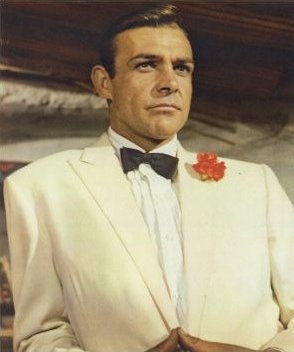
Maibaum excelled at plot and structure, but it was Dehn, a radicalized gay writer who had worked as a propaganda instructor at the OSS "Camp X" during WWII, who tossed in the more cheeky touches. There’s a cool re-appraisal of Bond as a hero in this film. He’s basically kicked between situations beyond his control, something which irked star Sean Connery who saw Bond as an active investigator. Connery was also miffed at some Bond set-ups—the seagull disguise at the very beginning of the film, although he did embrace Bond stripping off a wet-suit to reveal a white linen tuxedo jacket, which he wears to a seedy South-of-the-Border bar (The “cluelessly-overdressed Bond” joke would be done to death in the films until Timothy Dalton put an end to it --although Pierce Brosnan still had his Bond pathologically straighten his tie, even underwater).
His third time out, Connery is finally casual with Bond while tossing in odd little bits of business to suggest that Bond is inches away from being clobbered on a regular basis. The villains are memorable, and the women have defined personalities (for once) with Shirley Eaton’s “golden girl” displaying as much aggressive sexuality as Bond (Eaton, and Gert Frobe, as Goldfinger, had their vocal parts dubbed by other actors). Of course, there's also the gadgetry: the "homer," the lethal bowler hat, the hi-tech exoticism of the laser beam. And then, there’s the car.
John Barry’s score is the blaring frosting on the cake: repeating chimes announcing the presence of the villain or anything having to do with gold; sinuous strings, compounding like snakes, creep during the laser beam sequence and Goldfinger’s signature theme blats out in brass clusters. And although other artists’ Bond songs have topped the charts, no one’s topped its theme song (with lyrics by Leslie Bricusse and Anthony Newley) for brio and outrageousness. No one has ever “belted” a song like Shirley Bassey does this.
It also has my two favorite lines from any Bond film. The first, adapted from Fleming:
This is gold, Mr. Bond. All my life I’ve been in love with its color, its brilliance, its divine heaviness.
And from Maibaum and Dehn, a line so good, it’s amazing no thriller had used it yet:
Bond: Do you expect me to talk?
Goldfinger: No, Mr. Bond, I expect you to DIE!
They’ve just finished filming the latest James Bond film—which is based on Fleming’s first Bond novel “Casino Royale” but due to rights issues has been out of the grasp of the longtime Bond producers. The new Bond is an odd choice—Daniel Craig, who suggests (when he’s “on”) a British Steve McQueen. He has been bad in some films (“Lara Croft: Tomb Raider” and “Road to Perdition”) where he barely registers, but he CAN be the thing your eyes gravitate to, as in Spielberg’s “Munich” or the British TV version of “Copenhagen” (Craig played Heisenberg), or his signature film “Layer Cake.” He may be a bit different, but he can’t be THAT different. After all, every film has ended with “James Bond will Return.” It’s a bit like saying “Meet the new Bond. Same as the old Bond.”
2009 Update: "Casino Royale" managed that rare thing: besting its source—which is saying something because that first Bond novel is damned good. And Daniel Craig did a terrific turn as a Bond who is brutal and brutalized; for once the film continuity involved watching the healing of Bond's scars. The action may have been gritty, but the producers also tossed in a healthy dose of glamour, and revisited old haunts—the Aston Martin DB5, the Bahamas, Bond in a long-sleeved black polo shirt as well as a tailored three piece business suit, and an iconic "emerging-from-the-sea" shot, although this time performed by Craig. The script by Wade and Purvis (with a dialogue tune-up by Paul Haggis) was smart and snappy—and as convoluted as one can get for a script about a poker game. And the acting was several bars ahead of most of the films in the series. It's truly the best all-around Bond movie since "Goldfinger." Good show.
The next Craig Bond flick had less plot, more action and stumbled with the hiring of director Marc Forster who tried to make a more mature film while proving that he was incompetent at action sequences (Note to self: if you're going to "improve" things, first get the basics down).
Goldfinger
Bonus: Edge of Darkness
Friday, November 28, 2008
The Man Who Would Be King
"The Man Who Would Be King" (John Huston, 1975) The obsessive quest. The lust for riches and the good life it will bring. The realization that the journey may be more important than the rewards. Laughter.
Two ne'er-do-wells cross into unknown territory for riches and are undone by their own greed and discord.
John Huston made this story before--a couple times, in fact. The closest might be "The Treasure of the Sierra Madre," which "The Man Who Would Be King" resembles. But it could also be "The Maltese Falcon," from the villains' perspective. Both films deal with wealth evading their questers' grasp, and both end with some laughter.* In "The Man Who Would Be King," that laughter comes earlier, and provides the miracle that leads the adventurers to achieving their hearts' desires. And gaining wisdom.
Although in each film someone always has to take "the fall."
The story is by Rudyard Kipling, and story-teller Huston provides the conceit that might have led to the writing of the tale, as Kipling is featured prominently in the film, portrayed with genial bonhomie and a writer's intrigued fascination at the train-wreck-sure-to-happen by Christopher Plummer. The story, of two confidence men/ex-British militiamen--Daniel Dravot (Sean Connery) and P.T. "Peachey" Carnahan (Michael Caine)--who brave the impossible journey through the Himalayas to find the fabled city of Kafiristan to set themselves up as "kings" held echoes of themes featured prominently throughout the work of John Huston. When he realized his dream of making this film, he was nearly 70 and suffering from emphysema, but the travel and the foreign locations did not dim his enthusiasm at such an age. He said it was one of his favorite shoots in his long-storied career. And one of the easiest.
And it was all due to the casting.
Huston had wanted to make the film in the 50's with Clark Gable as Danny and Humphrey Bogart as Peachey then later with Burt Lancaster and Kirk Douglas, then Paul Newman and Robert Redford.
It was Newman who suggested Connery and Caine. The two old friends had never worked together before and seized on the opportunity. Evenings during filming the two would go over the next day's scenes and work out little bits of well-coordinated business that would indicate the relationship between the two con-men, like old vaudevillians who had shared many a stage...and those routines would delight the wolfish Huston when presented with the ideas the next morning.
One wonders what Huston would have made of the film earlier in his career with those teams of actors. Lighter, perhaps. More comedy. Maybe not so hard on the message of the exploitation of conquered nations. But, with Connery and Caine there is a maturity as these two "soldiers for fortune" go about their business robbing the various "-istan's" "three ways from Sunday."
Would it have ended as it does now, with the grisly but apt ending, and the story-teller becoming so engaged in the telling of the tale, that he is no longer a part of it? Would it have resonated so?
In the end, the point is so moot as to be laughable in itself. "The Man Who Would Be King" is a classic motion picture of any era--a dream project from a master director who had thirty years to perfect it, many chances to get it right, and, unlike his protagonists, the grace and wisdom to appreciate the luck he'd been given and let it live on its own when it was in his grasp.
Not even emphysema could have stopped his laughter at that.
* "The Asphalt Jungle" also has a similar ending...but its low-level crooks do not possess the self-knowledge--or the grace--to laugh at the Cosmic Joke played at their expense.
Thursday, August 7, 2008
Olde Review: The Wind and the Lion
"The Wind and the Lion" (John Milius, 1975)
I avoid seeing films twice unless I really, really love the flm (due to a lack of funds).* When I saw "The Wind and the Lion" the first time, it was as if I was seeing two movies at time. The dialog was really wretched ("Mulai--that's a nice name"), but at the same time the photography, direction and editing were all fabulous. It was a film that had "sweep" (I assume that when a film has "sweep," the camera tends to move along a field, up a wall, through a street, "sweep" through the visual plane of the camera. Oh, but does this movie do that!) "The Wind and the Lion" just swells with movement of all kinds--inside the frame and the frame outside itself. John Milius is a director I don't tend to think much of. I wasn't too fond of his "Dillinger" film, some good things, but not wholly satisfying. But his direction in 'Wind & Lion" is just marvelous. Some of the shots combined with Jerry Goldsmith's score** are just chillingly beautiful: The trucking shot along a line of berbers silhouetted against a sunset;
A diagonally rising crane-shot that drifts over a dune as an entire army of berbers move down a road while a dark, cloudy sky presses down on the whole scene;
After the Raisuli (Sean Connery) has killed off the final horseman at the leper colony (that was the impression I got anyway) Milius cuts to a stunning shot of Eden Pedecaris (Candice Bergen) watching behind a net in the right foreground, while against a low sun on the ocean-tide, the Raisuli slows his horse and the now-riderless horse of his opponent still charges across the screen;
Theodore Roosevelt (Brian Keith) and "his" bear towering over him, as he reads the "Wind and the Lion" letter.
The second time around, my appreciation of the Milius direction grew. It was what I concentrated on throughout and because of it, the dialog that I was uneasy about went down easer and (My God!) some of that dialog was downright poetic. Roosevelt's speech about the bear as the U.S, symbol, his getting on his desk and growling at the camera for the Smithsonian--things that made me squirm in my seat before--I enjoyed this time around.
This movie is flawed to be sure. Some of the writing is still bad. There are inaccuracies in technique and in history. *** The fellow I went to see it with thought there were too many "riding-in-the desert" shots for his taste, but not for mine. And I heartily enjoyed myself and the film.

I still enjoy it (now that I own it) and all qualms that I had about it are gone, and a lot of the things that I found a bit over-dramatic are things that I now dearly love about it. I neglected to mention the huge contribution that cinematographer Billy Williams brings to this movie, as he carried out some of the beautifully outlandish shots Milius came up with. I wish he was allowed to make more films (he's certainly been allowed to doctor scripts most of his career, and Turner gives him a mini-series or TV movie to do once in awhile). His is a singular voice in Hollywood, and he's smart with what he does on film. Who knows, maybe they'll let him re-boot the new "Ahnold-less" Conan film series, as he did the first one. One would wish.
* This was 1975. It would be another five years before the video-tape boom that allowed folks to watch films in their own home, and even own media of that film. Seems like such a long time ago. Now, if one likes a film, one can buy it, and watch it as many times as they want. That's a great convenience--but it tends to make people cluster to stuff they like, rather than explore and take a chance on a new film.
** An aside from this review here: "Goldsmith just happens to be one of my favorite film scorers. I snap up one of his albums as soon as it appears in the racks, and seldom am I ever disappointed with what I hear. However, one of Goldsmith's pieces doesn't seem to mesh correctly with the visuals--the Raisuli's initial ride on a horse gone hay-wire." Um--that was the point, I think.
*** For instance, an incident like this DID take place during the Roosevelt administration. Ion Pedecaris WAS kidnapped by the Raisuli, in 1904. Ion was male. I'm sure it matters to history buffs, but changing Pedecaris to a woman raises the stakes of the story, and provides a whiff of romance and exoticism. Without "The Wind and The Lion" that incident would have been lost in the sands of time.
Tuesday, August 5, 2008
Olde Review: Zardoz
This Saturday's ASUW films in 130 Kane are John Boorman's "Zardoz" and Brian DePalma's "The Phantom of the Paradise"
"Zardoz" (John Boorman, 1974)
"Zardoz speaks to you, his chosen ones:
You have been raised up from brutality, to kill the brutals who multiply and are legion. To this end, Zardoz, your God, gave you the gift of the gun"
Ooooo-kay! That little snippet from "Zardoz's" soundtrack* is a perfect example of what is right, and what is wrong with the film.
What we see during that resounding speech is a huge stone god-head floating over lush grass-lands while chanting subjects on horseback an on foot gaze, entranced by it. And it's a beautiful shot--nicely framed, beautifully photographed--even the special effect in the shot is nearly invisible. The sound is nice. The music, mostly the second movement of Beethoven's seventh symphony, is perfectly suited to this movie.
But the words emanating from that nicely modulated voice are really silly.
And so, in a nut-shell, there is "Zardoz"--due to the great abilities of its director John Boorman, whose previous film was "Deliverance" ** (and who is currently working on "The Heretic: Exorcist Part II"),*** it is a beautiful film to look at and listen to, but it is ultimately a very silly movie.
Maybe the script isn't too important. It is possible to ignore it when Boorman is communicating mood through his magnificent images and stately music. It is in the moments of pure image and music that "Zardoz" achieves the kind of epic stature that Boorman obviously wanted. And it is fun while the inspiration lasts, which is about half-way through it. It's about this time that the audience will wonder how in hell the damned thing is going to end. It's obvious by seeing the ending that Boorman wondered himself, and couldn't come up with anything other than a cop-out. Well, all I can say is enjoy what you see--it's quite fantastic. Try to ignore the plot.
And once and for all, maybe you should re-appraise your view of Sean Connery as an actor. It is "Zardoz" that slowly eased him out of the James Bond stereotype he had been mired in for so long, and into his current stream of swashbuckling roles, and in the very difficult role of Zed, the pivotal role of the film, Connery is nothing short of perfect. And so, "Zardoz" is a mixed bag of fine acting, the beautiful image and the hackneyed script.
Broadcast on KCMU-FM on November 5th and 6th, 1975
Um.....maybe the beautiful image. It's hard to say that Connery was doing stellar work running around in thigh-high boots and a red diaper (see below), spouting inane dialog, albeit opposite Charlotte Rampling. Truth of the matter is "Zardoz" is what Boorman made when he wasn't allowed to make "The Lord of the Rings," and Connery played Zed after Burt Reynolds, who was cast, (wisely) bowed out. "Zardoz" is just a stoopid, pretentious fantasy wanna-be, that keeps you guessing about where all this stuff came from--and when it's revealed to be an extremely simplistic (silly) conceit, you want to walk out. It all ends with one of those teen-pleasing Riots Against Authority that were popular "in the day," and sort of sputters to an ending of sorts. It's just a bad, bad film.
So was "The Heretic." Incredibly, someone gave Boorman money to make another film, and though it veers awfully close to the same sort of sophomoric kookiness of it predecessors, his film of "Excalibur" was a stylistic triumph for the director. It's a good thing, too. John Boorman is a fine director, when he has good material (which he can write, as well).
Connery was just coming into his own as his own actor away from 007, with good work in "Murder on the Orient Express," and "The Wind and the Lion." His best work was still ahead. "The Man Who Would be King" would open five weeks after this review was written.
* These reviews were accompanied by sound-clips or music from each of the films. This one started with that pretentious quote. FCC rules kept me from continuing it. Wanna read it? (Well, don't say I didn't warn ya...) "The gun is good. The penis is evil. The penis shoots seeds, and makes new life to poison the Earth with a plague of men, as once it was, but the gun shoots death, and purifies the Earth of the filth of brutals. Go forth . . . and kill!"
** Need to do a review of "Deliverance" one of these days. That is a great film.
*** Well, we won't bring that one up, only to say that Boorman got much better about the subject matter of his films.
Okay--Connery didn't want to play "Gandalf" becausehe didn't understand "The Lord of the Rings"--but he understood this??
Friday, May 2, 2008
The Hunt for Red October
fans of Alec Baldwin in the LNTAM household, so every so often it's nice to go back and see "serious actor" Baldwin before he stretched his comic chops. "The Hunt for Red October" was a dry-as-a-bone Tom Clancy novel based on a long-rumored incident involving a Russian nuclear submarine accident that Clancy turned into a cat-and-mouse game between a defecting Russian sub commander, and the American and Russian fleets in the North Atlantic. The action was sometimes intriguing, but the characters were non-existent, right down to the motivations of Captain Ramius, and the novel's Clancy stand-in-hero Jack Ryan.Produce Mace Neufeld (who must have the patience of a saint given his long-term relationship with Clancy) turned it into a first-class film of intrigue top-heavy with male actors (by my count the only females are two stewardesses, Gates --Star Trek's "Dr. Crusher"--McFadden as Mrs. Ryan, and the kid who plays Ryan's daughter). So, here's the run-down: Baldwin, Sam Neill, James Earl Jones, Scott Glenn, Courtney Vance (making the most of a geat part), Richard Jordan, Joss Ackland, Stellan Skarsgard, Peter Firth, Jeffrey Jones, Tim Curry, Fred Thompson, plus comedian Rick Ducommun and I swear I see Michael Biehn in the helicopter scene. And as the man everybody talks about, Sean Connery as the Scottish-accented Lithuaninan Comdr. Ramius.
It all works, as a spy/adventure story, as a detective story, a military exercise, and a submarine movie...and a character piece. Nobody comes out and says anything about their feelings but actions define the characters, and with all the sub-time, there's a lot of celluloid of people standing around talking..and for the most part it's good functional talk that propels the movie along. Plus, you'll come away with a gloss of submarine tactics, of sonar capacities, the strategies of "arming" torpedoes, and a healthy respect for difficulties of landing a jet-aircraft on a carrier during bad weather.* Respect also for Baldwin, who managed to make a human being out of the cypher of Jack Ryan through the force of his own personality--his Ryan is something of a geek, like Ben Affleck's later interpretation--and proved himself an adept for actor imitations (nice skewering of Thompson and Connery there, Alec) Plus, a crisp snap to the brim for suggesting and making good on the overhead shot of Ryan cutting his tether from a helicopter to gain entry to an American sub during a violent storm, and looking UP at the camera to make sure we all know it's him doing the stunt.
There was minimal CGI involved--and in fact, due to budget constraints, the filming of the underwater scenes were as low-tech as you could get--model shots of subs were laid-over underwater landscapes filmed in a dry warehouse filled with smoke. Crude particle and wave generation was all that was needed to complete the image. But it's indicative of the back-to-basics approach to "The Hunt for Red October"--an old-fashioned sea-hunt that satisfies.
* But my favorite moment in the movie is a brilliant stroke--the smooth transition in dialog from Russian to English as Firth's Political Officer reads a passage from a bible owned by Ramius' wife: the camera moves in on Firth reading the passage--Revelation 16:16-17--(in Russian) and stops on one commonly-pronounced word--"Armageddon"--and when the camera begins to pull back, he continues...in English. It's a neat trick, perfectly strategized and played.
Sunday, February 3, 2008
Missed It By That Much: Robin and Marian
though they could have been if only a few elements were changed.

"Robin and Marian" (Columbia/Tri-Star) 1976
Director: Richard Lester
Screenplay: James Goldman
On paper, it looks perfect. The author of "The Lion In Winter" jumping a few years ahead in the story to tell of the end of Richard the Lionheart's bloody Crusades, and the return of Robin Hood and the loyal Little John to Sherwood Forest, where they find a lot has changed. Directing would be Richard Lester, who had returned to A-list prominence with his extraordinary staging of "The Three Musketeers"/"The Four Musketeers." He was becoming the "go-to" guy for period dramas, finding ways to bring a mature light-heartedness to any dreary point in history (or more appropriately, he would ignore Hollywood sound-stage pretense and show historical periods a bit more accurately--for example, his fly-filled Rome in the otherwise schtick-filled "A Funny Thing Happened On the Way to the Forum"). In the years since, his successes had been spotty: "Juggernaut," his all-star take on the disaster film, sank at the box-office (never mind--watch it!), as did his dream-project "Royal Flash" bringing his "Musketeers" adaptor George MacDonald Fraser's character to the big screen.
But "Robin and Marian" had that Goldman script (unfortunately, Goldman's other produced screenplay "They Might Be Giants," although good for naming rock bands, also failed at the box-office despite the star-power of a post-"Patton" George C. Scott and Joanne Woodward) and a dream-cast. Goldman wanted Nicol Williamson as Robin and maybe Sean Connery as Little John. Lester got them, but reversed the roles, which Goldman had to admit, worked. Robert Shaw would re-unite with his "From Russia With Love" co-star (and golfing partner) as the Sheriff of Nottingham. Richard Harris would play King Richard, Denholm Elliott and Ronnie Barker (of "The Two Ronnies") would be Merry Men. Ian Holm would appear as the weasley King John. But, with the role of Maid Marian, they hit the mother-lode: after nearly a decade off the screen, producer Ray Stark coaxed Audrey Hepburn to play the older, wiser lost love of Robin Hood.Filming was done in Spain (Lester's old haunt from "Musketeers" and "A Funny Thing Happened On the Way to the Forum") and completed quickly--Lester's a "one-take" kind of director which always appealed to Connery.
Then things started to go wrong.
The script by Goldman is charming, but often relies, as did "The Lion in Winter" on piquant anachronisms--the kind of "Isn't that funny? They talk like we do!" approach to historical drama that can be a bit cloying. "You never wrote!" complains Maid Marian at one point in the script about Robin Hood's many years away. "I don't know how!" says Robin in perplexed reply.
But there are some nice things--the over-all
theme of living past your prime or need, combined with Robin's nostalgia for the old days and his childish belief that he can make things right again on all fronts. There are some nice little cliche-bashings. I remember a couple of cut-away shots of Nicol Williamson's Little John looking pained at Robin and Marian expressing affection for each other, and thinking, "Oh Lord, they're going to make Little John gay!" which I thought was a pretty cheap way to bring in relevance to the story. But it proves to be a clever gambit. Later in the film when Marian goes to John and begs him to keep Robin out of battle, she makes the same assumption. "You've always been jealous of me! But you had him all those years!" Williamson beautifully underplays this scene "Yer Rob's lady," he mumbles. "What?" she cries. "If ye'd been mine, I'd never've left." and Williamson chucks the apple he was eating into the night where it arcs and disappears. Nice set-up. Nice turn. As is the ending, recreating the myth of Robin firing one last arrow through the window, telling John to bury Marian and he where it lands. In Lester's last shot, it never falls to earth.The charm of the script no doubt appealed to Hepburn--she has a speech at the end that most actresses would kill for, though, practically. it slows the film to a crawl at a critical time. There are publicity pictures of Lester and Connery showing her around the set, but Hepburn, given Lester's directorial approach of "You act, I'll shoot" might have been a bit put off by his quick approach and lack of hand-holding.
She made complaints about some of the gristlier aspects to Lester's cut, particularly to his opening the film with a shot of ripe fruit, and ending it, with
the fruit rotting in the sun. This is a brilliant way to express an aspect of the story--that Robin, and Marian too, have overstayed their usefulness. And the film is gritty. The staging of an opening scene in a burned-out desert fortress feels more like everybody's waiting for Godot rather than King Richard. And Lester keeps his own anachronisms well-chosen, for example Robin Hood's morning routine--waking up in the forest, stretching, brushing his teeth with a fir branch, and reaching for a good ball-scratch until he sees Marian waking up--Connery's hopping attempt to be nonchalant is priceless. And the violence is rough stuff. People die very badly
in the film despite the chain-mail and armor, and the wounds they suffer are played up. Lester seemed determined to counter-act any chirpiness in the film by bringing it down to Earth. Maybe this upset Hepburn.But for whatever reason, producer Ray Stark chose to take control. Initially, Lester employed Michel Legrand, his composer for the "Musketeers" films, to write a period-appropriate score, which was met with much approval, though it wasn't tuneful or romantic in any way. Stark, hearing the score, and not having control over much else, replaced it with a quickly put-together score by John Barry, who'd worked with Lester before and whose James Bond scores for Connery were well-known. He also won an Oscar for the music for Goldman's "The Lion in Winter." Barry's a wonderful composer, but the main-stay of his score is a bucolic love theme that frequently bounces over the scenes and makes them too sweet for a film about
the passing of youth and the end of days. It's sounds like it would be more appropriate for a film about otters frolicing than "Robin and Marian." Perhaps Stark thought would be enough to soothe the blue-haired ladies going to see Audrey Hepburn's first film in a decade. Given her rather cute performance, maybe it would have been a good idea to re-cast her, too. Perhaps she took the role as a chance to get another Oscar (she won in 1954 for "Roman Holiday"--Katherine Hepburn won for her starring role in "The Lion in Winter"). She didn't get it. Nor did the blue-hairs show up. The film was not a major hit at the box office.I've never heard the Legrand score, but considering the amazing job that he did scoring "The Three Musketeers" for Lester, the two might have done something very interesting for this film. But we'll never know. "Robin and Marian" is locked in a bizarre nether-world where it's at once too sweet, but also stark and unsentimental. Lester could make misconcieved films, but his approach to counter-point Goldman's sentimentality in a world of hardship was a good one. One would have liked to have seen that version of the film.