Showing posts with label Alec Baldwin. Show all posts

Thursday, August 29, 2013

Blue Jasmine

Depending on the Kindness (Enabling) of Strangers
or
Being Entitled to Your Opinion

Blue Moon/You saw me standing alone/
Without a dream in my heart/Without a love of my own/
Blue Moon/You know just what I was there for/
You heard me saying a prayer for/Someone I really could care for/
And then there suddenly appeared before me/

The only one my arms will hold/
I heard somebody whisper please adore me/
And when I looked to the Moon it turned to gold
Blue Moon/Now I'm no longer alone
Without a dream in my heart/Without a love of my own


Woody Allen's 21st century version of Tennessee Williams' "A Streetcar Named Desire," Blue Jasmine, is a contemporary version of the play's tragedy in an unsympathetic post-Bernie Madoff/Wall Street Bail-Out world, turning it into a moralistic comedy.  It may seem a little misogynistic to be so mocking to someone as Williams' Blanche DuBois who has suffered a cataclysm, but when the someone is as cluelessly entitled and myopic as Allen's Jasmine (nee Jeanette) Francis (Cate Blanchett), there is a very real glee to see them get their, as the term is used in The Magnificent Ambersons, "comeuppance."

It's a brilliant conceit, combining Allen's love for classic literature and forms, tossing his own hang-dog spin onto it, while, for once, being refreshingly contemporary—something Allen hasn't really done of late, as he's had a depressive's obsession with the past for the past couple of decades (no matter how fresh the cast may be).

Allen starts his film (after the standard black background with white credits backed this time by '30's depression era rhythm and blues) with an (unusual for him) CGI shot of a jet approaching the camera, sailing by and moving away.  Jasmine Francis ("I fell in love with the 'Jasmine.' 'Jeanette' has no panache") is on that jet flying from New York to San Francisco to move in with her sister Ginger (Sally Hawkins—her second film for Allen) for a fresh start after losing everything in her life.  They're both adopted and couldn't be more different (As Sally says "She got the good genes."); Jeanette is all high cheek-bones and au couture, while Sally is low class and all teeth, surrounded by Guido's and roughnecks. Jasmine has suffered a reversal of fortune as her husband Hal (Alec Baldwin) has been caught wheeling and dealing in real estate schemes, ending up in prison, and committing suicide.  Her extended visit delays Ginger's boyfriend Chili (Bobby Cannavale) moving in with her and her two kids by Augie (Andrew Dice Clay), he ex-husband.  There's a bit of a sandpaper quality to Ginger and Jasmine's relationship; when Ginger and Augie were married, they lost a lottery nest-egg investing in one of Hal's "get-rich-quick" investment schemes, something Jasmine forgets when she drama-queens over her own plight, and dismisses entirely when confronted with it.


Jasmine (Blanchett) and Ginger (Hawkins)
So it rankles when Jasmine pulls a Mrs. Madoff and claims victim-hood about the money she's lost. Jasmine has no plans, no prospects, and there are hints of a nervous breakdown after she was found wandering the streets talking to herself.  Now, she's popping Xanax with a vodka chaser and barely keeping ahead of anxiety attacks and comatose fugue states as she barrels through the lower echelons of San Francisco, trying to latch onto opportunities.

She decides to go back to school, learning computers so she can go "into" interior design, taking a job at a dentist's (Michael Stuhlbarg)—for which she is totally ill-suited (anything with the words "customer" and "service" in any combination would be)—to fund the courses.  In the meantime, from her lowly status, she lords it over the family and friends she finds beneath her.  That meaning everyone.


The flip-side to this is that people still find her attractive, as she puts up a great, if shallow, front, speaking of her glory days—which segue into flashbacks of her privileged happy life, only to find that once the flashback has ended, that she's still carrying on the conversation inside the flashback, and whoever she was talking through previously has left.*  It's a clever use of flashback as psychosis, a clever, nearly invisible off-shoot of the film-star (played by Jeff Daniels) stepping out of the film in The Purple Rose of Cairo. Where Allen has been living in the past the last few films, Jasmine is doing the same thing, to her detriment, as, whether in flashback or real life, it comes back to haunt her and take her away from the present and any future she might aspire to.

It's a return to near perfect form without the tricks and conceits that Allen used (during his "earlier, funny" films) and nicely merges the bi-polar extremes of comedy and tragedy that the more mature filmmaker in Allen has aspired to.  It also feels less fussy and musty than the after-taste some of the lesser Allen films have left of late.  After a lifetime of making good films, some classic and some merely pedantic, and eschewing his earlier stylistic tricks, one wonders if, at the age of 78, Allen's best films might still be ahead of him and that's an exciting prospect.


Blue Jasmine is a Full-Price Ticket.


Jasmine in her "fugue" state


* It's a bit like the Larry David monologues-to-the-camera in Whatever Works, only there's no child around to ask "Who's that man talking to, Mommy?"

Thursday, July 19, 2012

To Rome with Love

Around the World in Woody's Malaise
or
The Ozymandius Melancholia Gambit ("Turbulence!  My Favorite!")

Far be it for me to suggest that Woody Allen might actually be comfortable in his own skin as a storyteller. but when it has come time for him to do his own "Roman Holiday" film, To Rome With Love, there's not a hint of Fellini in it (Been there, done that—specifically, way back in 1980, when he made his Stardust Memories in tribute to the great Italian film-maker).  Truth to tell, his latest has more in common with the Italian "anthology" films of the 1960's, where directors would tackle similar themes in short personal films.
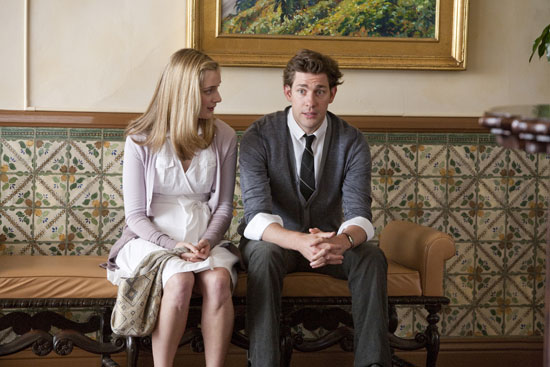
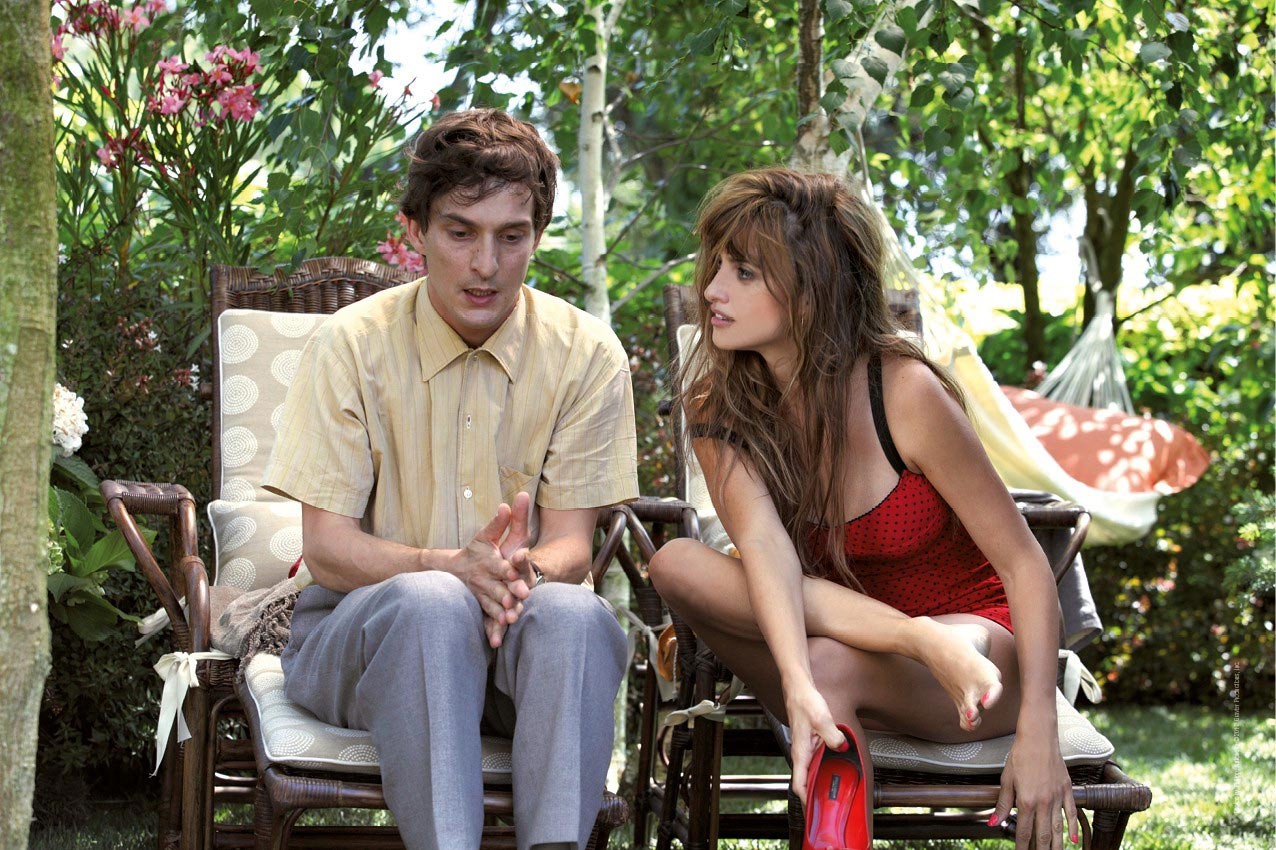
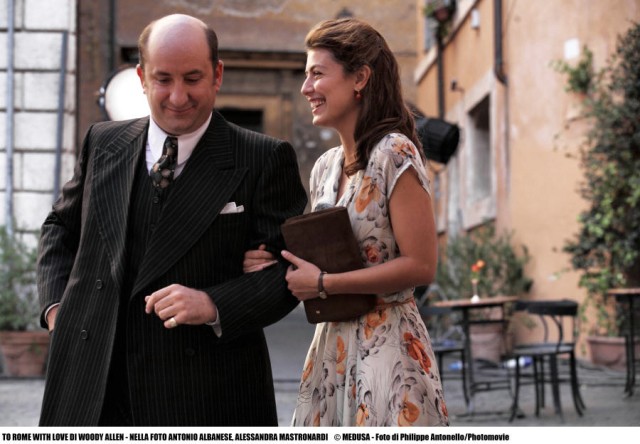
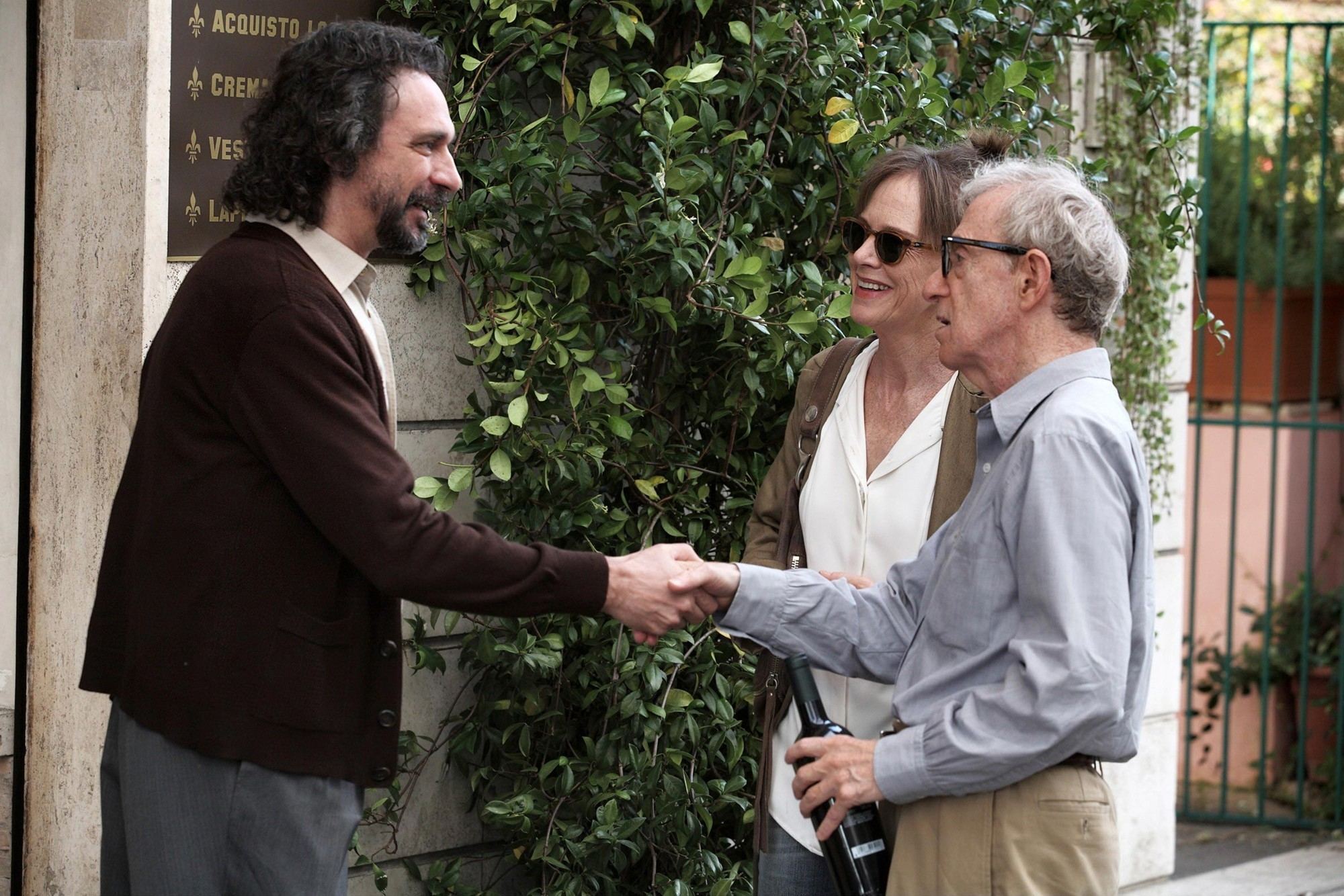
To Rome With Love has four interlocking fantasias about love and personal dissatisfaction: in the first, a young married couple (Alessandro Tiberi and Alessandra Mastronardi) come to Rome, where he is to be introduced to his new work situation—eager to make a good impression, the wife goes shopping and ends up getting lost and involved with an Italian film-star, and hubby, thanks to a case of mistaken identity, must go to his functions in the company of a pre-arranged hooker (Penelope Cruz); the second involves two architects, one seasoned (Alec Baldwin), the other just starting out (Jesse Eisenberg) who become each other's fantasy figures (of a sorts) when the young architect, already attached to Sally (Greta Gerwig), falls for her best friend Monica (Ellen Page), a self-involved, if fascinating, actress; the third involves a "normal member of the middle class" in Rome (Roberto Benigni) who suddenly becomes "famous for being famous," and is pursued and interviewed by an indiscriminate paparazzi; the fourth involves a former classical music executive (Allen), who discovers a great opera singer (Fabio Armiliato) in the family of his potential son-in-law..with conditions.

The setting is Italian, but the themes are pure "Allen-town."  Each of the characters get a brief glimpse of "life on the other side," gingerly placing their toes where the grass is greener, and find it wanting, but themselves enriched from the experience, survived without harm or consequences paid.   Baldwin's architect gets to play devil's advocate (much the same way as Bogart did in Play It Again, Sam) with a realist's wisdom, as opposed to a romantic's fool-hardiness—a good cure for his nostalgia.  The Italian couple experience romantic fantasies before settling down to domestic bliss, not older but wiser.
Benigni's civil-functionary briefly enjoys cultural significance, with all the invasiveness and dissection of minutiae, before returning to anonymity and the value of a private life, and Allen's retiree gets to witness a fulfillment of his dreams by providing a channel for another, and, having achieved it, returning to his normal life.

Any of these stories could be set anywhere.  Rome provides a nice catalyst for these quick short pieces that summarize the Allen world-view: "Life is terrible, but it beats the alternative."  And it's buttressed by the standard "Volare"...which mean "to fly."  

Happy landings.


To Rome With Love is a fine Matinee. 


Friday, January 29, 2010

It's Complicated

"Karma is the Ultimate Bitch in this One"
or,
If You Can't Stand the Hot-Flash, Get Out of the Kitchen.


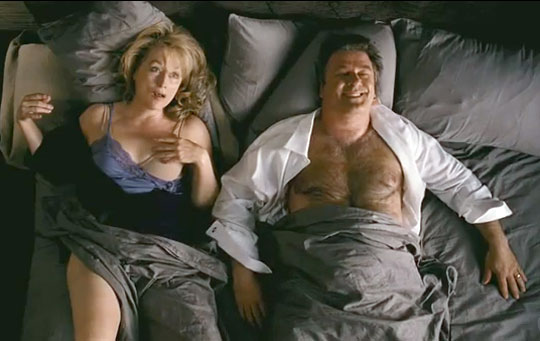
It's refreshing to see a movie about a mature couple of advanced age—mine—dealing with post break-up issues. I just wish they weren't being so immature while doing it.

Jane Adler (
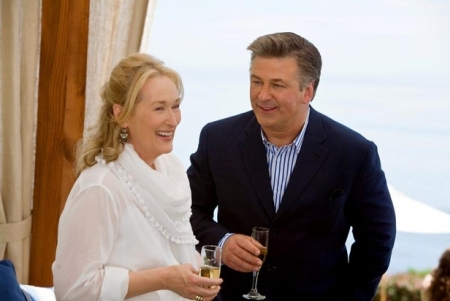
Meryl Streep) is reaching a transition point in her life—approaching "empty nester" age: her oldest daughter Lauren (Caitlin Fitzgerald) is engaged to Harley (John Krasinski), middle daughter Gabby (Zoe Kazan) is moving out of the house, and youngest, Luke (Hunter Parrish) is graduating from college. Her ex-husband Jake (Alec Baldwin) is now married to young "Ms. thang" Agness (Lake Bell), with an inherited son (from her last affair), Pedro (Emjay Anthony). She has decided that she's going to expand her nest...er, house so she can have "the kitchen she's always dreamed of;" she runs a salonish bakery, and she can cook (second movie this year—"Julie & Julia" from Nora Ephron, this one from Nancy Meyers, both of whom seem to be trying to keep Streep in the kitchen).

Youngest son's graduation pulls the whole family together in New York, with Jake "flying solo" due to family illness. Once there, the two old marrieds hook up, and once Jane is tanked, there occurs a "once more for old times' sake" canoodling that leaves him satisfied and her vomiting.

Most guys would take that as a sign, but not Jake. Soon, he's spending too much time at Jane's, telling his ex-wife that his wife doesn't understand him, and while it may seem like sweet revenge for Jane, she's also creeped out by it, so much so that she won't tell the kids, and allows it to interfere with a budding romance with her architect (Steve Martin). Now, maybe I've been watching too many "Nature" shows on elephants lately, but I could have used David Attenborough to explain this mating ritual to me.

Maybe it's that Martin and Baldwin are playing the roles the other should have taken:
Martin's love interest is a deferential, shell-shocked divorcee with a manner that reminded me of Charlie Ruggles, and Baldwin's in full pursed lips obnoxious priss mode (without the "30 Rock" irony) that makes his character not so much funny as alarming. And Streep, consummate pro that she is, works the material for all its worth, fluttering and kvelling and kvetching, making Jane seem two pastries shy of a brunch. There are times when there seems to be some acknowledgment of time—Jane is constantly fanning herself, as if caught in a hot-flash, but the next instant she's giggling like "Juno."

The one guy who seems to be doing something interesting is John Krasinski,
as the not-yet husband who finds he's baby-sitting his future in-laws, and is the only one who seems to rise above the material to be doing something interesting—interesting and funny. As the only fully-informed character in the cast, he manages to convey the screwball nature of the situation, acting as the surrogate audience, eyes widening with each embarrassing compromise. He makes Meyers the director—with her sledge-hammer reaction shots and uneven pacing seem far more successful than she is.

"It's Complicated" is simply a Rental.

Friday, May 2, 2008

The Hunt for Red October

"The Hunt for Red October" (John McTiernan, 1989) We're big fans of Alec Baldwin in the LNTAM household, so every so often it's nice to go back and see "serious actor" Baldwin before he stretched his comic chops. "The Hunt for Red October" was a dry-as-a-bone Tom Clancy novel based on a long-rumored incident involving a Russian nuclear submarine accident that Clancy turned into a cat-and-mouse game between a defecting Russian sub commander, and the American and Russian fleets in the North Atlantic. The action was sometimes intriguing, but the characters were non-existent, right down to the motivations of Captain Ramius, and the novel's Clancy stand-in-hero Jack Ryan.
Produce
Mace Neufeld (who must have the patience of a saint given his long-term relationship with Clancy) turned it into a first-class film of intrigue top-heavy with male actors (by my count the only females are two stewardesses, Gates
--Star Trek's "Dr. Crusher"--McFadden as Mrs. Ryan, and the kid who plays Ryan's daughter). So, here's the run-down: Baldwin, Sam Neill, James Earl Jones, Scott Glenn, Courtney Vance (making the most of a geat part), Richard Jordan, Joss Ackland, Stellan Skarsgard, Peter Firth, Jeffrey Jones, Tim Curry, Fred Thompson, plus comedian Rick Ducommun and I swear I see Michael Biehn in the helicopter scene. And as the man everybody talks about, Sean Connery as the Scottish-accented Lithuaninan Comdr. Ramius.


It all works, as a spy/adventure story, as a detective story, a military exercise, and a submarine movie...and a character piece. Nobody comes out and says anything about their feelings but actions define the characters, and with all the sub-time, there's a lot of celluloid of people standing around talking..and for the most part it's good functional talk that propels the movie along. Plus, you'll come away with a gloss of submarine tactics, of sonar capacities, the strategies of "arming" torpedoes, and a healthy respect for difficulties of landing a jet-aircraft on a carrier during bad weather.* Respect also for Baldwin, who managed to make a human being out of the cypher of Jack Ryan through the force of his own personality--his Ryan is something of a geek, like Ben Affleck's later interpretation--and proved himself an adept for actor imitations (nice skewering of Thompson and Connery there, Alec) Plus, a crisp snap to the brim for suggesting and making good on the overhead shot of Ryan cutting his tether from a helicopter to gain entry to an American sub during a violent storm, and looking UP at the camera to make sure we all know it's him doing the stunt.


There was minimal CGI involved--and in fact, due to budget constraints, the filming of the underwater scenes were as low-tech as you could get--model shots of subs were laid-over underwater landscapes filmed in a dry warehouse filled with smoke. Crude particle and wave generation was all that was needed to complete the image. But it's indicative of the back-to-basics approach to "The Hunt for Red October"--an old-fashioned sea-hunt that satisfies.


* But my favorite moment in the movie is a brilliant stroke--the smooth transition in dialog from Russian to English as Firth's Political Officer reads a passage from a bible owned by Ramius' wife: the camera moves in on Firth reading the passage--Revelation 16:16-17--(in Russian) and stops on one commonly-pronounced word--"Armageddon"--and when the camera begins to pull back, he continues...in English. It's a neat trick, perfectly strategized and played.