Showing posts with label Woody Allen. Show all posts

Thursday, August 29, 2013

Blue Jasmine

Depending on the Kindness (Enabling) of Strangers
or
Being Entitled to Your Opinion

Blue Moon/You saw me standing alone/
Without a dream in my heart/Without a love of my own/
Blue Moon/You know just what I was there for/
You heard me saying a prayer for/Someone I really could care for/
And then there suddenly appeared before me/

The only one my arms will hold/
I heard somebody whisper please adore me/
And when I looked to the Moon it turned to gold
Blue Moon/Now I'm no longer alone
Without a dream in my heart/Without a love of my own


Woody Allen's 21st century version of Tennessee Williams' "A Streetcar Named Desire," Blue Jasmine, is a contemporary version of the play's tragedy in an unsympathetic post-Bernie Madoff/Wall Street Bail-Out world, turning it into a moralistic comedy.  It may seem a little misogynistic to be so mocking to someone as Williams' Blanche DuBois who has suffered a cataclysm, but when the someone is as cluelessly entitled and myopic as Allen's Jasmine (nee Jeanette) Francis (Cate Blanchett), there is a very real glee to see them get their, as the term is used in The Magnificent Ambersons, "comeuppance."

It's a brilliant conceit, combining Allen's love for classic literature and forms, tossing his own hang-dog spin onto it, while, for once, being refreshingly contemporary—something Allen hasn't really done of late, as he's had a depressive's obsession with the past for the past couple of decades (no matter how fresh the cast may be).

Allen starts his film (after the standard black background with white credits backed this time by '30's depression era rhythm and blues) with an (unusual for him) CGI shot of a jet approaching the camera, sailing by and moving away.  Jasmine Francis ("I fell in love with the 'Jasmine.' 'Jeanette' has no panache") is on that jet flying from New York to San Francisco to move in with her sister Ginger (Sally Hawkins—her second film for Allen) for a fresh start after losing everything in her life.  They're both adopted and couldn't be more different (As Sally says "She got the good genes."); Jeanette is all high cheek-bones and au couture, while Sally is low class and all teeth, surrounded by Guido's and roughnecks. Jasmine has suffered a reversal of fortune as her husband Hal (Alec Baldwin) has been caught wheeling and dealing in real estate schemes, ending up in prison, and committing suicide.  Her extended visit delays Ginger's boyfriend Chili (Bobby Cannavale) moving in with her and her two kids by Augie (Andrew Dice Clay), he ex-husband.  There's a bit of a sandpaper quality to Ginger and Jasmine's relationship; when Ginger and Augie were married, they lost a lottery nest-egg investing in one of Hal's "get-rich-quick" investment schemes, something Jasmine forgets when she drama-queens over her own plight, and dismisses entirely when confronted with it.


Jasmine (Blanchett) and Ginger (Hawkins)
So it rankles when Jasmine pulls a Mrs. Madoff and claims victim-hood about the money she's lost. Jasmine has no plans, no prospects, and there are hints of a nervous breakdown after she was found wandering the streets talking to herself.  Now, she's popping Xanax with a vodka chaser and barely keeping ahead of anxiety attacks and comatose fugue states as she barrels through the lower echelons of San Francisco, trying to latch onto opportunities.

She decides to go back to school, learning computers so she can go "into" interior design, taking a job at a dentist's (Michael Stuhlbarg)—for which she is totally ill-suited (anything with the words "customer" and "service" in any combination would be)—to fund the courses.  In the meantime, from her lowly status, she lords it over the family and friends she finds beneath her.  That meaning everyone.


The flip-side to this is that people still find her attractive, as she puts up a great, if shallow, front, speaking of her glory days—which segue into flashbacks of her privileged happy life, only to find that once the flashback has ended, that she's still carrying on the conversation inside the flashback, and whoever she was talking through previously has left.*  It's a clever use of flashback as psychosis, a clever, nearly invisible off-shoot of the film-star (played by Jeff Daniels) stepping out of the film in The Purple Rose of Cairo. Where Allen has been living in the past the last few films, Jasmine is doing the same thing, to her detriment, as, whether in flashback or real life, it comes back to haunt her and take her away from the present and any future she might aspire to.

It's a return to near perfect form without the tricks and conceits that Allen used (during his "earlier, funny" films) and nicely merges the bi-polar extremes of comedy and tragedy that the more mature filmmaker in Allen has aspired to.  It also feels less fussy and musty than the after-taste some of the lesser Allen films have left of late.  After a lifetime of making good films, some classic and some merely pedantic, and eschewing his earlier stylistic tricks, one wonders if, at the age of 78, Allen's best films might still be ahead of him and that's an exciting prospect.


Blue Jasmine is a Full-Price Ticket.


Jasmine in her "fugue" state


* It's a bit like the Larry David monologues-to-the-camera in Whatever Works, only there's no child around to ask "Who's that man talking to, Mommy?"

Saturday, October 20, 2012

Shadows and Fog

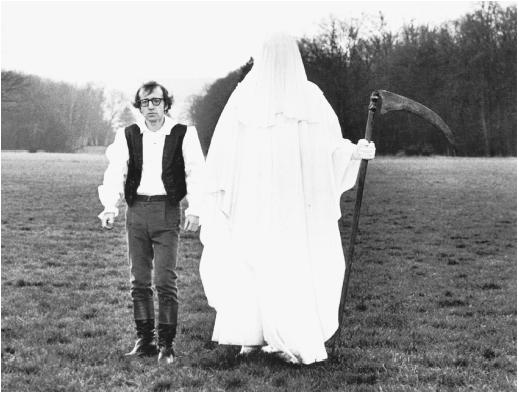
Shadows and Fog (Woody Allen, 1991) When Woody Allen makes a film in the style of Ingmar Bergman (Interiors), it's done in deadly earnest.  But, when he takes on German Expressionism, entering the angular world of Lang, Murnau, with a para-nod towards Kafka, it's a comedy.  Not quite sure why; maybe he has an affinity towards one stylization and the other he just finds phony, but the different approaches are like, well, day and night.  Allen explored that theme—taking the same story and interpreting it as either comedy or tragedy—in Melinda and Melinda, a bit of a mis-fire—but one suspects that the Nordic tradition he buys completely, and completely dismisses the German (God knows why).

Here, the visual is pure dread, but the subject matter is a mixed bag of precision and vagueness, comedy and darkness.  Allen plays Kleinman, a passive-aggressive bookkeeper, who is recruited in the middle of the night by a vigilante mob (including David Ogden Stiers and James Rebhorn) to roam the streets looking for a serial strangler.  Being a professional coward, and only dealing well with facts and figures in black-and-white, Kleinman is ill-suited for the activity and begs off, inviting suspicion from the group.  When there is speculation that maybe he won't do his duty as a citizen because he might be the strangler, Kleinman caves.

On his dark journey through the city streets (the largest set ever built in New York's Kaufman-Astoria Studios, making this Allen's most expensive film), he runs across an all-star cavalcade of slothful potential victims: a philosophy student (John Cusack) with a weakness for prostitutes (among them Lily Tomlin and Jodie Foster, madamed by Kathy Bates), a circus love-triangle tangentially related (with John Malkovich, Mia Farrow and Madonna) and the town coroner (Donald Pleasence), who has a purely scientific interest in the killer.*

Kleinman soon realizes that life simply doesn't add up, that a little slippage occurs, especially when it comes to illusion and reality (in the form of a very handy and practical magician named Armstead, played by Kenneth Mars).  The film struggles with the dichotomy throughout, as highly contrasted as the black and white photography, never truly meshing, and finally ends, as many of Allen's weaker films—and one of Allen's strongest ones (Hannah and Her Sisters)—do, with a Deus ex Machina** that buttons everything up inexplicably, leaving no questions but a lot of raised eyebrows.

Which is fine for the purposes of the film, but it's hardly what you'd find in an example of German Expressionism, where the punishment fits the crime...and where things really are in black and white.  


* Yes, the film is top-heavy with fine actors (and Madonna), but if you look in the darkened nooks and crannies of the film you'll also find Fred Gwynne, William H. Macy, John C. Reilly, Josef Sommer, Wallace Shawn, Kate Nelligan, Kurtwood Smith and Philip Bosco.  Was this film cast or filmed at a SAG convention?

** Here's a question:  It's a Woody Allen film; Can there be a Deus Ex Machina if there's no Deus?

Thursday, July 19, 2012

To Rome with Love

Around the World in Woody's Malaise
or
The Ozymandius Melancholia Gambit ("Turbulence!  My Favorite!")

Far be it for me to suggest that Woody Allen might actually be comfortable in his own skin as a storyteller. but when it has come time for him to do his own "Roman Holiday" film, To Rome With Love, there's not a hint of Fellini in it (Been there, done that—specifically, way back in 1980, when he made his Stardust Memories in tribute to the great Italian film-maker).  Truth to tell, his latest has more in common with the Italian "anthology" films of the 1960's, where directors would tackle similar themes in short personal films.

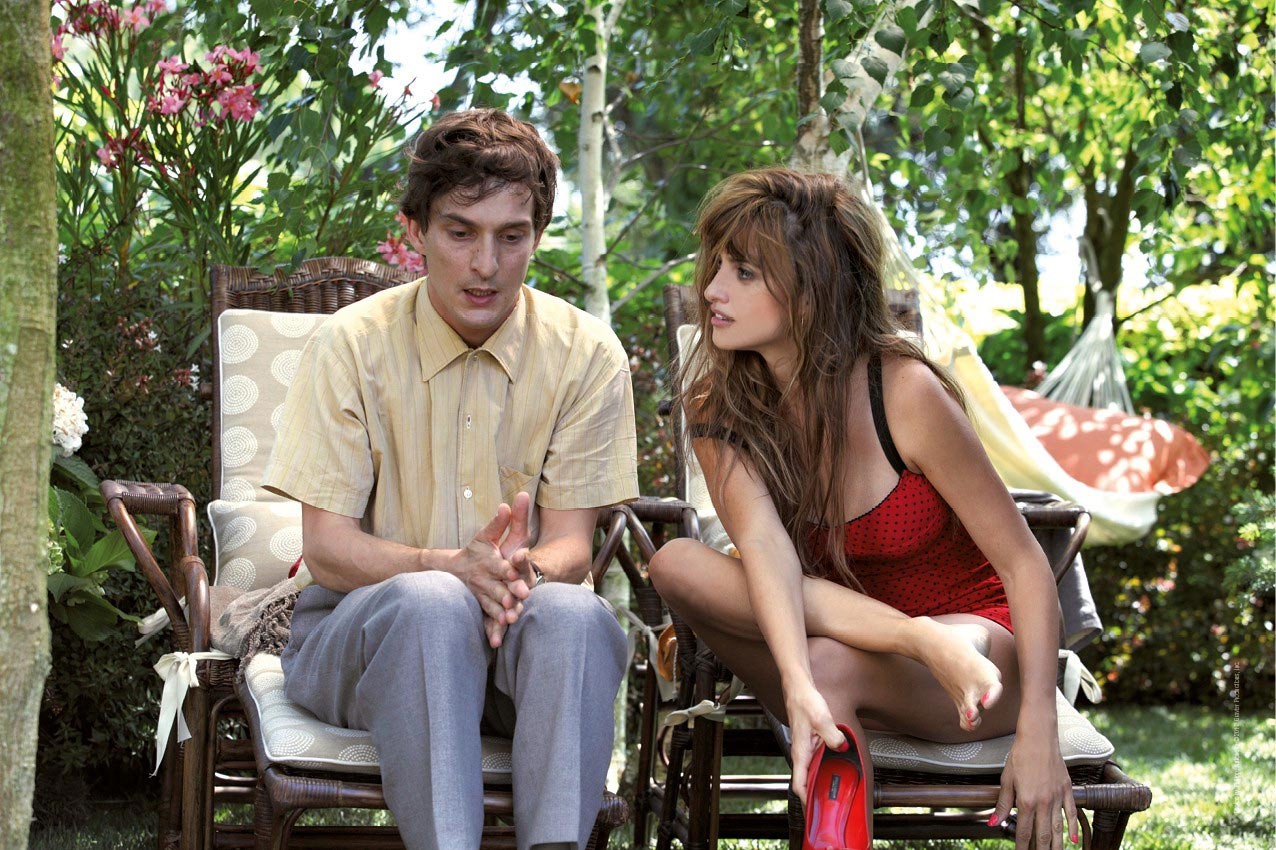
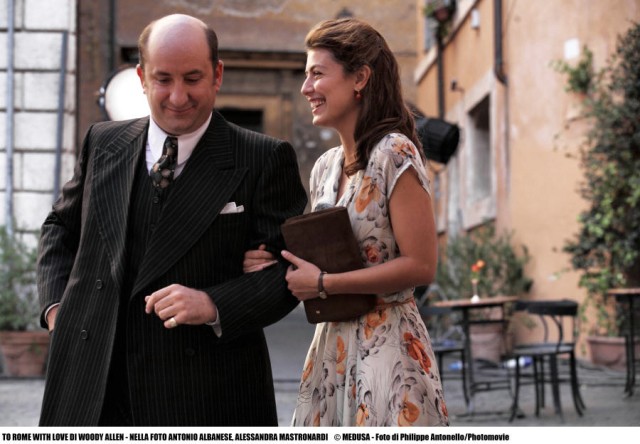
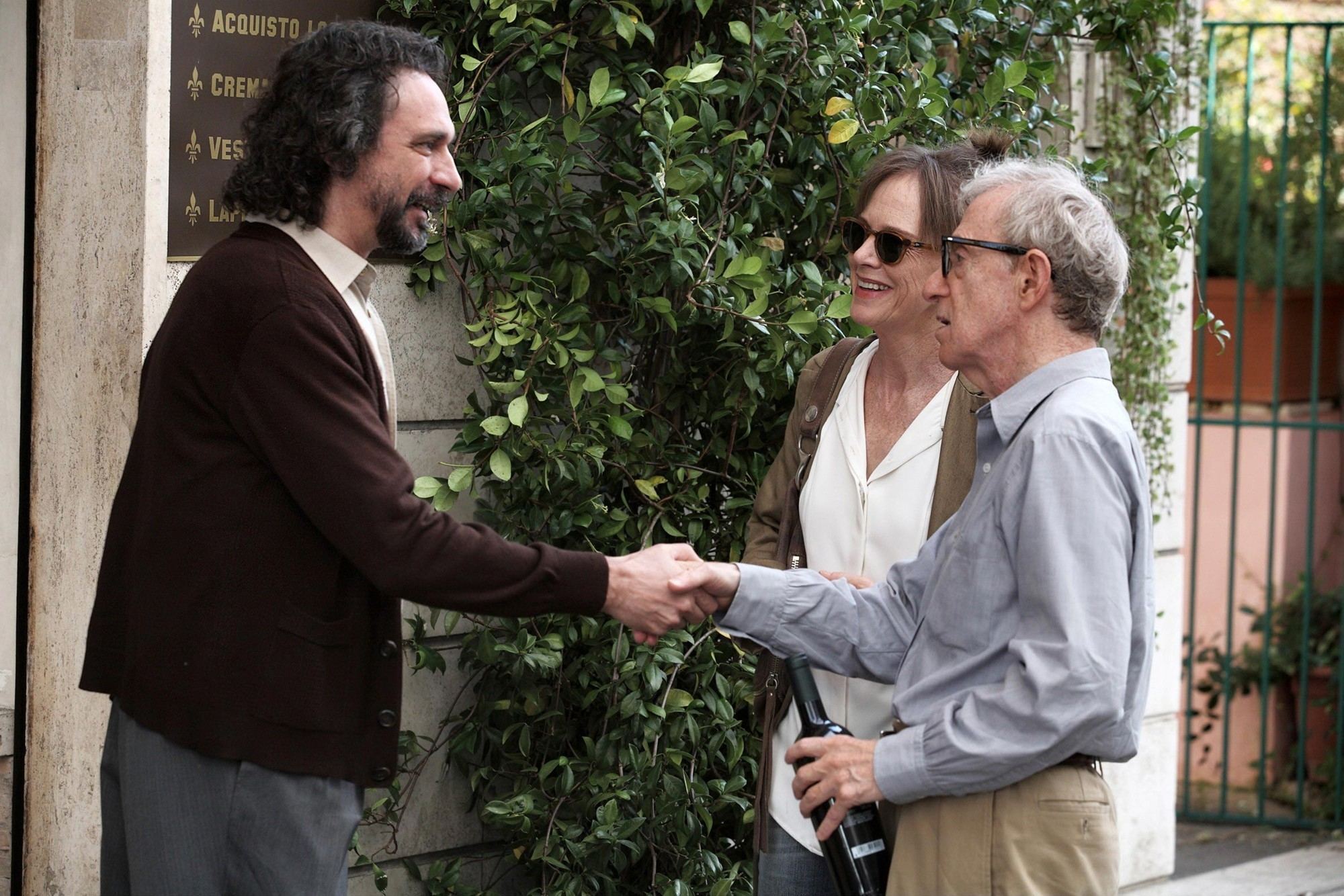
To Rome With Love has four interlocking fantasias about love and personal dissatisfaction: in the first, a young married couple (Alessandro Tiberi and Alessandra Mastronardi) come to Rome, where he is to be introduced to his new work situation—eager to make a good impression, the wife goes shopping and ends up getting lost and involved with an Italian film-star, and hubby, thanks to a case of mistaken identity, must go to his functions in the company of a pre-arranged hooker (Penelope Cruz); the second involves two architects, one seasoned (Alec Baldwin), the other just starting out (Jesse Eisenberg) who become each other's fantasy figures (of a sorts) when the young architect, already attached to Sally (Greta Gerwig), falls for her best friend Monica (Ellen Page), a self-involved, if fascinating, actress; the third involves a "normal member of the middle class" in Rome (Roberto Benigni) who suddenly becomes "famous for being famous," and is pursued and interviewed by an indiscriminate paparazzi; the fourth involves a former classical music executive (Allen), who discovers a great opera singer (Fabio Armiliato) in the family of his potential son-in-law..with conditions.

The setting is Italian, but the themes are pure "Allen-town."  Each of the characters get a brief glimpse of "life on the other side," gingerly placing their toes where the grass is greener, and find it wanting, but themselves enriched from the experience, survived without harm or consequences paid.   Baldwin's architect gets to play devil's advocate (much the same way as Bogart did in Play It Again, Sam) with a realist's wisdom, as opposed to a romantic's fool-hardiness—a good cure for his nostalgia.  The Italian couple experience romantic fantasies before settling down to domestic bliss, not older but wiser.
Benigni's civil-functionary briefly enjoys cultural significance, with all the invasiveness and dissection of minutiae, before returning to anonymity and the value of a private life, and Allen's retiree gets to witness a fulfillment of his dreams by providing a channel for another, and, having achieved it, returning to his normal life.

Any of these stories could be set anywhere.  Rome provides a nice catalyst for these quick short pieces that summarize the Allen world-view: "Life is terrible, but it beats the alternative."  And it's buttressed by the standard "Volare"...which mean "to fly."  

Happy landings.


To Rome With Love is a fine Matinee. 


Thursday, June 9, 2011

Midnight in Paris

"Gertrude Stein Punched Me in the Mouth"
or
"L'époque est toujours plus belle de l'autre côté du pont Einstein-Rosen"

 "A Twenties Memory" by Woody Allen
Copyright © 1966-1971 by Woody Allen


I've been waiting for Woody Allen to make this film since before he asked to Play It Again, Sam (or even What's Up, Tiger Lily?). 

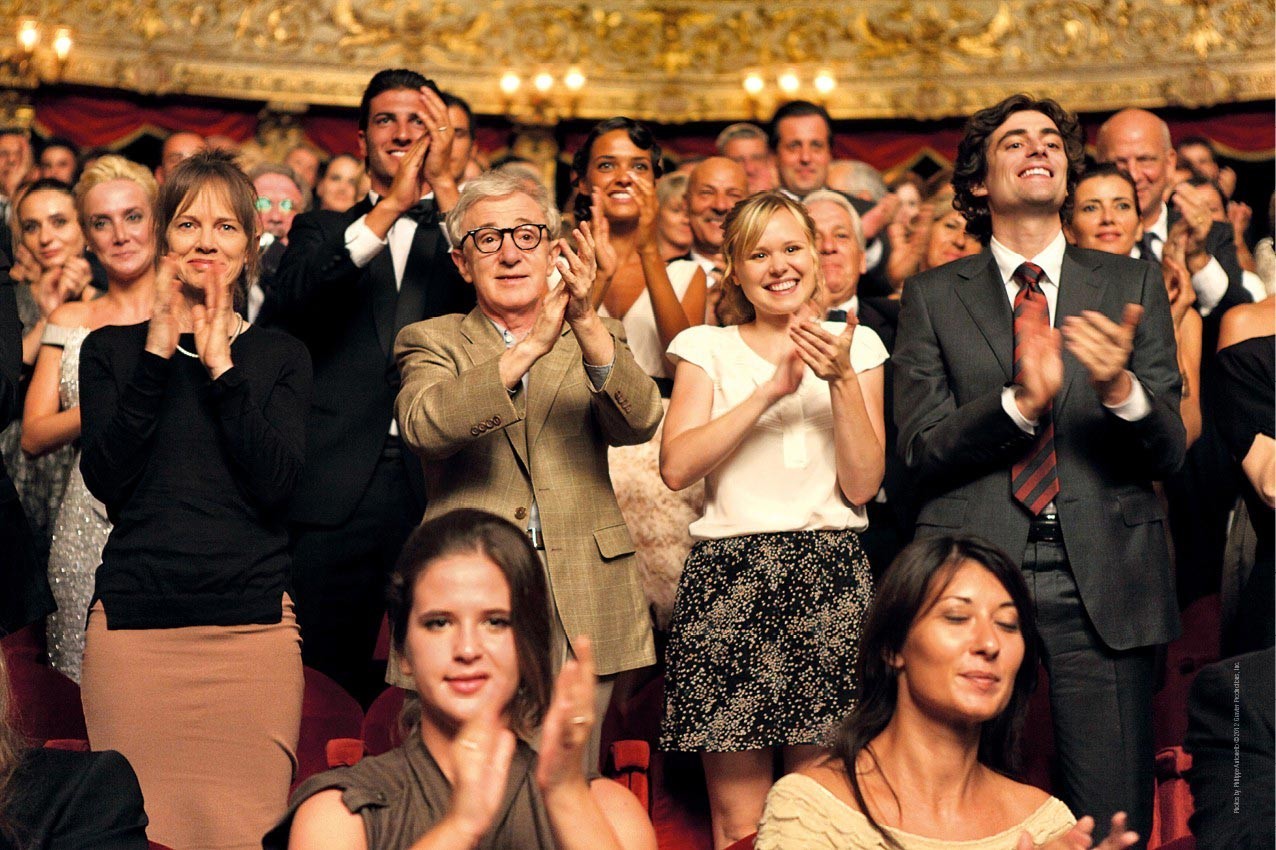
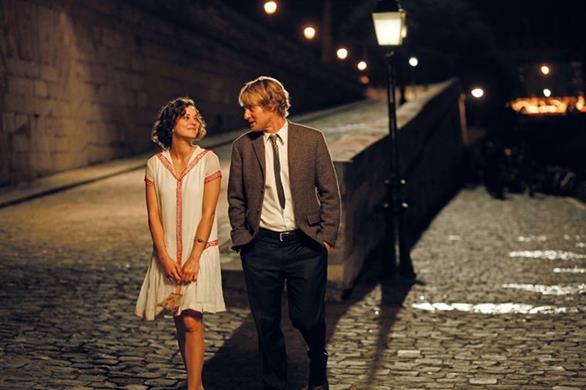
Based on a routine from his stand-up days,* which he later expanded for a piece in "The New Yorker" (see above), Midnight in Paris follows Gil (Owen Wilson) a self-absorbed, neurotically anxious writer of Hollywood fluff ("Wonderful, but forgettable...sounds like something I wrote"), who is obsessed with death,** as he travels to Paris from Pasadena with fiancee Inez (Rachel McAdams, but it could just as well have been Elizabeth Banks) and her conservative family. Gil is working on a novel, long in the gestation, and is distracted by the vapid shallowness that he is about to marry into.  Paris is shops, restaurants, museums and snootiness, and to escape the jejeune de vivre, he takes a late-night walk through the streets of Paris and is approached by a vintage taxi.  Entering the cab for Gil is a magical moment for him, on the same plane-breaking as when Tom Baxter (or is it Gil Shepherd) walks off the screen in The Purple Rose of Cairo.  He is instantly transported to 1920's Paris and becomes lost in "The Lost Generation"  (without the benefit of having survived World War I), meeting Cole Porter (Yves Heck), Ernest Hemingway (Corey Stoll), Zelda (Alison Pill) and Scott Fitzgerald (Tom Hiddleston), all the heroes of his favorite literary era and time, 1920's.  He's enchanted...and as his novel is about the time...inspired.  He goes back to Inez, gob-smacked, unable to explain where he's been all night, but "alibi's" his adventures as a dream (as they are, certainly in the aspirational sense).  He tries to bring Inez to the party, but the magic doesn't work—she's as unthrilled with Gil's stories as he is with her wine-tasting adventures with acquaintance Paul (Michael Sheen). 

She leaves.  And the taxi arrives, bearing Gil and Hemingway to the apartment of Gertrude Stein (Kathy Bates) and Alice B. Toklas (Thérèse Bourou-Rubinsztein), who are playing judgemental hosts to Pablo Picasso (Marcial Di Fonzo Bo) and his enchanting mistress Adriana (Marion Cotillard).  Gil gives his novel to Stein and Hemingway to critique, but he is drawn to Adriana, making her way through the 20's as best she can.

So, the two planes of existence for Gil are set up: his modern-day drudgery on the cusp of a marriage of inconvenience; and his fantasy past, where his dreams are reality and reality can make dreamsYou know where this is going.

It doesn't matter, though.  This is a "feel-good" Woody Allen picture—the kind people like—where the messages are still telegraphed the way they are in "obvious" Allen movies, the coincidences just a little too convenient, but so full of incident, grace and nuance (and quite a bit of humor) that it goes down well (as Allen groused throughout Stardust Memories, audiences "like his earlier, funnier [movies]").  That Gil is such a sunny presence in the past (and as played by Wilson, he has a guileless charm that doesn't sacrifice intelligence—he's the way you'd imagine Jimmy Stewart would play Woody Allen), even his kvetching is charming and not harsh.  It doesn't matter that you be a history buff and "get" all the references,*** (and we meet Luis Bunuel, Man Ray, Salvadore Dali [Adrien Brody], and on a side-trip, Toulouse Lautrec, Gaugin and Degas).  Of course, Gil is enchanted; he is an era when his heroes are still at the stage he is, becoming themselves, with their best work still ahead of them.  His age of magic is their everyday life.  The interesting lesson of the film (and what makes it special and wise) is that knife cuts both ways.  The "lesson" is both sour and sweet, but not hope-crushing—a little bit of salt in the creamy fluff.

And no, nobody punches Gil in the nose—but you can't help noticing that Wilson's is a little broken.

"Midnight in Paris" is an enchanting Matinee.


I mentioned before that I was in Europe. It's not the first time that I was in Europe, I was in Europe many years ago with Ernest Hemingway. Hemingway had just written his first novel, and Gertrude Stein and I read it, and we said that is was a good novel, but not a great one, and that it needed some work, but it could be a fine book. And we laughed over it. Hemingway punched me in the mouth.

That winter Picasso lived on the Rue d'Barque, and he had just painted a picture of a naked dental hygenist in the middle of the Gobi Desert. Gertrude Stein said it was a good picture, but not a great one, and I said it could be a fine picture. We laughed over it and Hemingway punched me in the mouth.

Francis Scott and Zelda Fitzgerald came home from their wild New Years Eve party. It was April. Scott had just written "Great Expectations," and Gertrude Stein and I read it, and we said it was a good book, but there was no need to have written it, 'cause Charles Dickens had already written it. We laughed over it, and Hemingway punched me in the mouth.

That winter we went to Spain to see Manolete fight, and he was... looked to be eighteen, and Gertrude Stein said no, he was nineteen, but that he only looked eighteen, and I said sometimes a boy of eighteen will look nineteen, whereas other times a nineteen year old can easily look eighteen. That's the way it is with a true Spaniard. We laughed over that and Gertrude Stein punched me in the mouth.


** Yes, this is the Woody Allen character.  His films never fall too far from the analyst's couch.

*** I certainly didn't—I had to do some referencing for the line: "That was Djuna Barnes (I was dancing with)?  No wonder she wanted to lead."

Tuesday, November 2, 2010

You Will Meet a Talk Dark Stranger

"Man Makes Plans. God Laughs."
or
"The 'Thing Without Feathers' Turns Out to be My Nephew."

With a title like You Will Meet a Tall Dark Stranger, you know this won't be one of Woody Allen's autobiographical tales.  The Woodman never strays too far from All Things Woody, his characters usually being scrambled aspects of himself, with one character being a direct comic stand-in.  The likes of Kenneth Branagh, Mia Farrow, John Cusack, Larry David and Edward Norton have all been past dopple-neuroti-gangers for the writer-director.  Rarely has there been a film of his without one.

This is one of those rare films, although one could say this tangled web of London residents could all be aspects of Allen's personality, with the closest being (maybe) Anthony Hopkins' Senior Fool.  One needs a play-book to keep everybody in this rondeau straight, although they are all in each others' orbits.  Start with Hopkins' Alfie—married to Helena (Gemma Jones), parents of Sally (Naomi Watts), wife of Roy (Josh Brolin).  Alfie, going through his "middle-age crazy" period, divorces Helena, sending her to a faux psychic (Pauline Collins) in her grief.  This all upsets Sally, who's trying to make ends meet working for a gallery owner, Greg (Antonio Banderas) while her husband is becoming frayed trying to write a follow-up to his previous publishing success.  Basically, everyone's in the weeds, and it's not long before everybody decides that somebody else's grass in better than their own.  Soon Da is marrying a call-girl/"actress" (Lucy Punch), Roy is pursuing a neighbor he keeps oggling through his window (Freida Pinto), and Sally starts to have feelings for her boss, as her feelings for Roy start to wane.

Allen starts and ends the movie with Leon Redbone warbling "When You Wish Upon a Star," and begins with Helena visiting a psychic, making one think that instead of a rating designation ("R," btw), it should have a sign saying "Abandon All Hope, Ye Who Sit in the Auditorium."  That he equates spiritualism as just a more rigorous form of "hoping against hope" (when the two are merely con-games with different sources—second-hand or internal) is dispiriting, and though it's a continuation of his life-view—"full of loneliness, and misery, and suffering, and unhappiness, and it's all over much too quickly"—there isn't the shrugging whimsey that serves as a warming punch-line this time.

For it may be true, as Emily Dickinson says, that "Hope is a thing without feathers" (and Allen's screwball lateral to that is the second title for this review), and "if wishes were horses, beggars would ride," I tend to take the more optimistic view.  Yes, there will always be poor (because Jesus tells me so) without a nagging destiny, that's no reason that, even though their feet are perpetually on the ground, they shouldn't be reaching for the stars.

Because there will always be stars, too, even if we don't see them, and even if we're not looking for them.  It's why I keep looking up at them.  It's why Woody Allen keeps making movies. 

Maybe his next one will be better.  I hope. 

You Will Meet a Tall Dark Stranger is a Rental. 

Friday, July 10, 2009

Whatever Works

"And Sometimes, Finally, a Cliche is the Best Way to Make a Point"
or
"Mommy, That Man is Talking to Himself" ("Come Along, Justin")


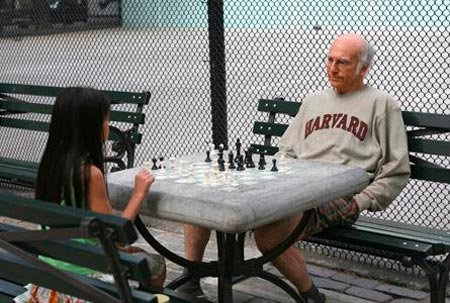
Boris Yellnikov (Larry David) is a genius. A misanthropic genius, to be sure, but a genius; he's only too happy to tell you that he almost won a Nobel Prize for his work in quantum mechanics, specializing in string theory. He's also only too happy to tell you that you're sub-normal, a microbe!, an inchworm!, a potzer!, a troglodyte!, a mouth-breather!—and in fact, at a couple points during the film he turns to the audience and turns on them...us...to tell us what he thinks of us. A lot of movies choose to insult its audience these days (sometimes directly, sometimes by what the makers think they can get away with), but Yellnikov has the courtesy of treating anyone who chooses to listen to him the same disparaging way. He has a lot of views about quantum theory, the Heisenberg Principle, but never mentions the Konigsbergian Bubble Theory, in which the world is essentially a sub-set of forty individuals restricted to a single geographical point, 15 of whom have speaking parts.

"Whatever Works" is a return to
Woody Allen's World, and its story of a young girl turning the heart of a beast is familiar ground, coming across as a "Woody's Greatest Hits" film—you'll find bits of "Annie Hall," "Manhattan," and particularly "Hannah and Her Sisters" with its scenes of turmoil in the marriage between intellectual Frederick (Max von Sydow) and sensitive former-student Lee (Barbara Hershey). And "Whatever's" Melodie St. Ann Celestine (Evan Rachel Wood) is the latest in a long string of naive young waifs
portrayed by Diane Keaton, Mariel Hemingway, Mia Farrow, Mira Sorvino, Samantha Morton, Juliette Lewis, and Scarlett Johansson. One could make some excuse about Allen returning to themes he explored earlier in order to form a more perfect coalescence of his ethos and it would be as pretentious as it sounds. Allen says that "Whatever Works" is an early screenplay he wrote in the 70's with the intention of it starring Zero Mostel. When Mostel died, Allen shelved it. So, the truth is Allen has been cherry-picking from this script for years to make some of his earlier, better pictures.

Although this is one stretch of New York City pavement worn a bit thin, there is something unique about it. One thing you can count on in Allen's movies is his autobiographical characters,
the passive aggressive smart-asses played by Allen or a surrogate (past stand-in Woody's have been Mia Farrow, Mary Beth Hurt, Kenneth Branagh, John Cusack and Edward Norton). But Yelnikoff isn't passive at all, and David plays him as he does much of his work...at 110%. This should get tiring, but it doesn't, and that's a very tricky thing to pull off. Mostel could do it, with his razor's edge timing and comic flailing, but David doesn't have his gifts as an actor. David merely sends off "vibes" that he could actually be this self-absorbed (he did create "Seinfeld," after all), and as with George Costanza, the entertainment value is in watching the train wreck. He's the reason to see "Whatever Works" (and his character is of the opinion that's the main motivation of the audience).

So, if you're going to go, go already, but understand that you'll see a lot of the same themes that have come before: of the chameleon nature of personality due to environment, of universal impermanence and the embracing of it, that it's a long, long way from May to December, and that it's not such a stretch for a physicist to move on from string theory, and pursue post-doctorate work on the ties that bind.

"Whatever Works" is a Rental (Better yet, rent "Hannah and her Sisters!")

Tuesday, March 10, 2009

Match Point

"Match Point" (Woody Allen, 2005) The box office was good for "Match Point," Allen's first hit in years, and one wonders why. The film is accomplished and assured, simple in execution but morally complex, one of those little Woody Allen morality puzzles that update the classics (in this case, "Crime and Punishment," as well as any number of "bad-boy makes good" novels, where all you need is a compromised conscience to make it in the world). The BBC put in money, so the locations are in Great Britain (it's good to get out of New York once in awhile). The actors are young and skew to a lower movie-going demographic (although except for Scarlett Johansson, the actors are not box-office draws)--but there are no "tunes" on the soundtrack, merely ironically chosen opera extracts sung by Caruso (complete with vinyl surface noise).

Allen considers it one of his best films.

Despite the accents and strange new territory, it's undeniably Allen-town with its chilly empty spaces pointedly deliberately composed, its couples colliding and splintering, an act of insanity out of the blue, and a late touch of magic that chills.

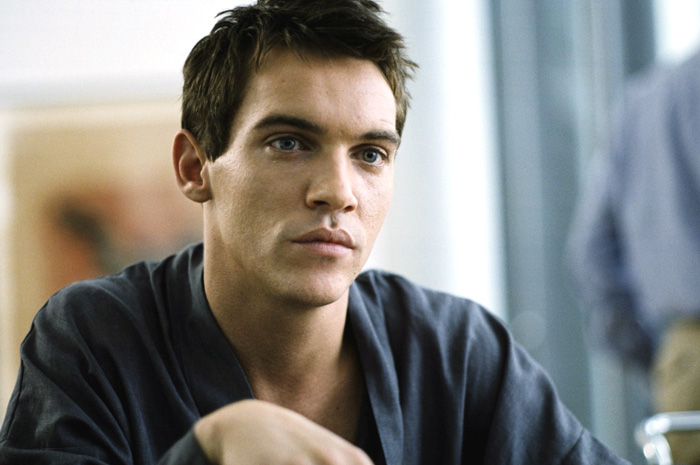
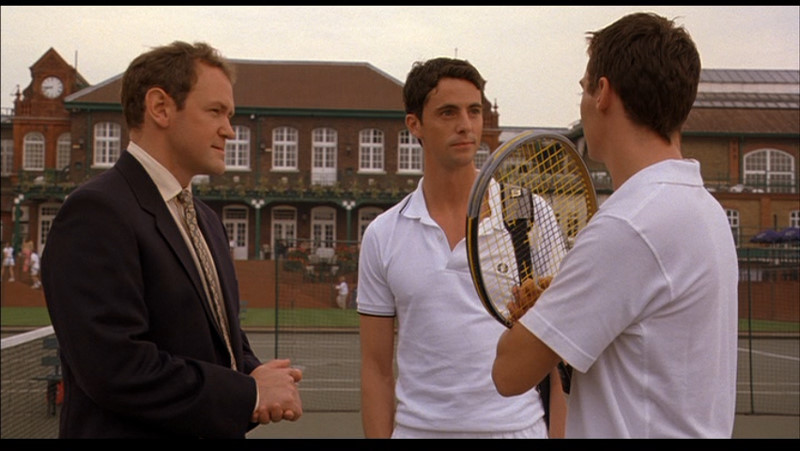
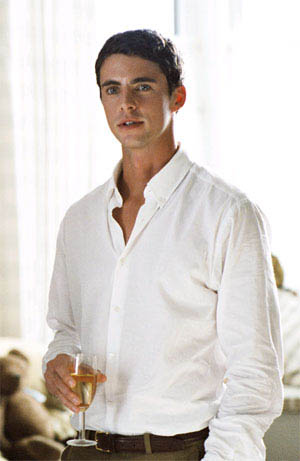
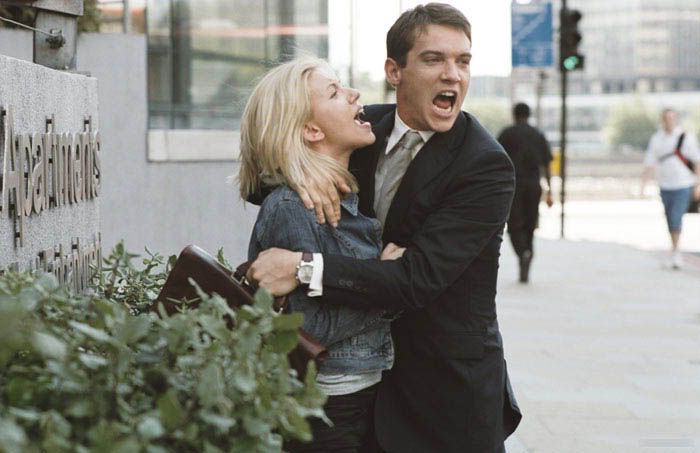
But it's one of those Allen movies where the literary seams show, his long empty corridors reverberating with the classics of the past informing his movie, with some of the echoes coming from his old Brooklyn haunts; I kept thinking that Chris Wilton, the slippery tennis pro (the only thing that's true about him is, surprisingly, he is a tennis pro!) reminded me of Leonard Zelig, the "human chameleon," who, in his insecurity, would conform to whatever group he was with, even physically changing to accomplish it. But more than the literary seams show. Jonathan Rhys Meyers, who plays Wilton, isn't a fast enough actor to make his sudden shifts of tone and snap-excuses sound credible; there needs to be an ad-libbed looseness to his answers, rather than the studied RADA responses Meyers provides. The rest of the cast play their parts as required: Brian Cox (always good), as Wilton's chief enabler; Matthew Goode (interesting to see him in this role after "Watchmen"--in this part, he's much snappier playing a member of the effete elite); Emily Mortimer, thanklessly perfect in a thankless role; Scarlett Johansson as the Victim of Fate, smart enough to know herself, but not know her role in the world.


So, what's different? Why this Woody Allen movie doing well, when the previous ones hadn't? Allen had been, piece by piece, removing the musty-Woody-Allen-tropes from his movies to no effect at the box office. What made this one different?

Then, it hit me.


There's no "Woody Allen" character in it. No stand-in's with comically stuttering neuroses. No "fools" that make a point. No sad clowns in the corner. This time, Woody Allen is behind the camera. For good.

Tuesday, December 2, 2008

Everyone Says I Love You

"Everyone Says I Love You" (Woody Allen, 1996) First off, the title of Woody Allen's attempted musical should read "Everyone...Says I Love You" because the meter is essential. It comes from the song that takes a large junk of time-spanning narrative from the Marx Brothers comedy "Horse Feathers." That haunting and addicting song by Bert Kalmar and Harry Ruby** stays in the mind a long time. And the songs Allen employs, a mix of 20's/ 30's standards ("Makin' Whoopee," "My Baby Just Cares For Me") drop the narrative to a dead stop in a way that the musicals being emulated never did.* The musical pieces feel like an interruption rather than an extension of the story, or a poetic expression of the character's thoughts, though brief attempts are made to do so. The song that works best is the first one ("Just You, Just Me") that starts without warning, out of Allen's standard white-on-black opening credits (in silence). Then Boom! We're singing...actually Edward Norton is singing in a gentle, reedy pleasant voice. Norton comes off best, genuinely attempting to "sell" the song and sentiment (and it's fun to see a joyful Norton--early in his career--galumphing out of the way of dancers, and doing a better version of the Woody Allen stammering switch-backs than the director can manage***). Everyone--save Drew Barrymore--sang their own songs, and they do pretty well, though Julia Roberts is very off-key, and Tim Roth, playing a recently paroled con, sings inconsistently sweetly. The biggest disappointment is Allen's number sung in a barely-there voice. His song is not so much plaintive, as shy and non-committal...and wrong.

The plot is as slim as anything Allen's done: a series of brief encounters with the engagement of Holden Spence (Norton) and Skylar Dandridge (Barrymore) at its hub. But Allen undercuts the effervescence of the musical format by basing the main story on the efficacy of inspired love, or love-at-first-sight. Love is an illusion he says, just like breaking into song with a full orchestra backing you up in a movie. Great. It's a bit like being inspired to song by reading The Wall Street Journal. The cast is the usual first-rate one: Alan Alda, Goldie Hawn, Lukas Haas, a young Natalie Portman and Billy Crudup, Julia Roberts, Gaby Hoffmann, and Tim Roth

Besides that opening plunge into musical-land, the charm of it all is only sporadically amusing, if warm-hearted--Allen, during instrumental portions of the songs, intercuts beautifully shot (by
Carlo Di Palma) landscapes ala Fox musicals. But, there seems a long, dry spell before further joys, and, as it does so often in Allen's films, the best is saved for last--a dance between Hawn and Allen by the river Seine, which nearly matches in grace what Astaire and Rogers achieved by mixing dance and story through the use of movie-magic--the one kind of magic Allen does believe in. Although the two are far, far less capable dancers, Allen compensates by putting Hawn on a wire-rig, and she, seemingly effortlessly, floats high into the air with a natural gracefulness, and alights to earth as if weightless. It is pulled off with such suddenness and beauty that one is caught off-guard, and stunned, like that sudden drop into song at the film's beginning. It's one of the most charming...and surreal moments in the body of Allen's work. ****

*But the elephantine musicals of the 60's and 70's--that's another story.

**
Groucho: Everyone says I love you
but just what they say it for I never knew
it’s just inviting trouble for the poor sucker who
says I love you

Take a pair of rabbits who
get stuck on each other and begin to woo
and pretty soon you’ll find a million more rabbits who
say I love you

When the lion gets feeling frisky and begins to roar
there’s another lion who knows just what he’s roaring for

Everything that ever grew
the goose and the gander and the gosling too
the duck upon the water when he feels that way too
says quack quack quack

Chico: Everyone says I love you
the great big mosquito when-a-he sting you
the fly when he get stuck on the fly paper too
says I love you

Every time the cow says moo
she’s a-make the bull-a very happy too
and the rooster when he holler cock-a-doodle-doodle-doo
says I love you

Christopher Columbo he write the queen of Spain a very nice a-little note
and he’s a-write I love you, babee and then he get himself a great a-big a-boat
he’s a wise-a-guy

What do you think Columbo do
when he’s a-come here in 1492?
he said to Pocahontas achi vachi vachi voo
that means you little son of a gun, I love you

Zeppo: Everyone says I love you
the cop on the corner and the burglar too
the preacher in the pulpit and the man in the pew
says I love you

Every one, no matter who
the folks over eighty and the kid of two
the captain and the sailor and the rest of the crew
says I love you

There are only eight little letters in this phrase you’ll find
but they mean a lot more than all the other words combined

Everywhere the whole world through
the king in the palace and the peasant too
the tiger in the jungle and the monk in the zoo
says I love you


***

****

Tuesday, September 9, 2008

Vicky Christina Barcelona

"Juan is the Loneliest Number That You'll Ever Do"
or
"To Javier and Javier Not"

"Vicky Christina Barcelona" (Woody Allen, 2008) The latest film in what will, no doubt, be called Woody Allen's "Scarlett" period, "Vicky Christina Barcelona" was shot almost totally in Spain, and benefits from the change of location. It's a large part of what drives the plot and the two women who vacation in Spain for different purposes.

Vicky (Christina Hall) is studying Catalan architecture (particularly Gaudi), and spends the time in Spain as a prelude to getting married to staid, reliable Doug (Chris Messina). Christina (Scarlett Johansson) has just written and directed an 18 minute film starring herself, and broken up with the latest in a series of men in impetuous affairs. She has no business in Spain, but goes to spend time with Vicky and get away. Vicky values the safe and dependable. Christina is searching, "certain only of what she doesn't want," as explained by a ubiquitous Narrator (Christopher Welch), whose constant comments make the film feel less a visual experience than a story with pictures.
While in Spain, the two women are approached by darkly handsome artist Juan Antonio (Javier Bardem) who offers to fly the women to the town of Oviedo for the weekend to view the Gaudi works, drink wine, and make love. Vicky thinks Juan is a creep. Christina is intrigued, but both women end up going, Vicky to protect her impetuous friend.

Juan is soulful, attentive, but it is obvious he is in love with his ex-wife Maria Elena (
Penelope Cruz), despite the fact a) they couldn't make it work, and b) she stabbed him in a rage. ("Oh, that..." she says dismissively when it's brought up)
Things get complicated, but never enough for the Narrator to be lost for words or explanations, and when Maria Elena shows up again in Juan Antonio's life, the movie turns, at equal turns poetic, and dangerous. Despite the mannered ways that Allen's films can frequently turn out, this group of actors is particularly well-suited to working outside of Allen's tic's and rhythms. The closest any of the characters come to the Allen neurotic persona (a staple in Allen's films, either played by Allen or a stand-in) is Vicky, but she's much more sure of herself, if not her situation.

Bardem is sadly, relaxed in the film, but Penelope Cruz is a force of nature, this generation's Sophia Loren. After being stuck in some unmemorable films with some straight-jacketed performances, the last few years and films have displayed a bravura presence, and she runs a gamut of emotions in this one to full effect. It's a tough role to pull off--she's held up as an icon until she appears, and when she shows up later in the film, arriving bedraggled from the hospital after a suicide attempt, Cruz more than fills the bill, with her extremes of behavior never seeming contrived or phony. And Johansson has rarely been better represented on-screen--one close-up in particular of Christina listening to Juan Antonio explaining his love for his ex-wife fairly burns on the screen with resentment.

It may ultimately prove to be a minor Allen film, but as a change of pace and an expansion of style it couldn't be more successful.

"Vicky Christina Barcelona" is a matinee.


Wednesday, July 23, 2008

Olde Review: Love and Death

This was part of a series of reviews of the ASUW Film series back in the '70's. Except for some punctuation, I haven't changed anything from the way it was presented, giving the kid I was back in the '70's a break. Any stray thoughts and updates I've included with the inevitable asterisked post-scripts.


"Love and Death" (Woody Allen, 1975) Let no one get the idea that I don't like Woody Allen. I really do. There was a time in my life that I was completely absorbed in the Allen "persona." For a time I was even writing term papers in his style (luckily I was a freshman and no one knew the difference). But even though I like Allen a great deal, it doesn't prevent me from not being too enthralled with "Love and Death," for there are too many times when Allen forgets that he is making a moving picture, and does a monologue much like the ones he did in his old night-club days. Indeed, there are times, when "Love and Death" becomes merely an illustrated version of his writings in "Getting Even" and "Without Feathers." *

The best
Allen movie is still "Play it Again, Sam" which, coincidentally, is being broadcast by CBS Friday night). Allen wrote it, based on his hit stage play, but Herbert Ross directed it. And one of the reasons that it is more successful is because the Allen "schlemiel" character is rooted to the present time. In "Love and Death," the movie takes place at the time of the Napoleonic Wars and the jokes come easily...too easily. All Allen has to do is put together an anachronistic scene--very easy to do and he still gets the yoks! (Cheerleaders on the battleground, indeed!**) "Play it Again, Sam" and its current scene forced Allen to come up with genuine funnies, not anachronistic ploys. "Sleeper" was successful because it worked with our knowledge of the present with our ignorance of the future. "Love and Death" is less so because it worked our knowledge of the present against our knowledge of the past. The two don't work together.***

Broadcast November 4th and 5th, 1976

"Love and Death" would prove to be the last of what Allen cheekily labeled "his earlier, funny ones" in "
Stadust Memories." At the time this review was written, Allen was polishing the edit of what was at that time called "Anhedonia," which would become the Best Picture Oscar-winning "
Annie Hall," and Allen would never go back to making his anachronistic "easy-laughs" kind of film, and started taking the craft a lot more seriously. "Love and Death" was Allen's "Long Goodbye" to that style of film-making.

Actually, "Love and Death" was his transition film, a bridge between those two styles--for example, his classically framed "lions-roar" that he ripped from
Eisenstein's "Potemkin." His camera set-ups began to take on the spare look of an Ingmar Bergman film (he also took the Death figure from "The Seventh Seal"). The script was a mess--an amalgram of Dostoevsky, Chekhov, Tolstoy and "Sleeper," but it was funny stuff, and a lot less episodic than "Bananas," or "Everything You Wanted to Know about Sex****" One dismisses the craft of comedy in film at one's own peril, because there are enough well-shot comedies that can't eke out a laugh to save their box-office lives. If one is looking at the photography more than enjoying the jokes is that anhedonia?

So, I was wrong here, but not as wrong as I would be (for that, see tomorrow), and Allen would leave the blandly Ross-directed "Play it Again, Sam" (which is a bit offensive now with its "rape" jokes) behind, with such classics as "
Annie Hall," Manhattan," Hannah and Her Sisters," and "Crimes and Misdemeanors," and a lot of gems along the way. Every economically-made five or six films or so, Allen will make a great film. That's a fine batting average in the Biz.

* These are collections of Allen's essays for "The New Yorker."

** I guess I forgot the scene where the hot-dog vendor is yelling "Red Hots!" on the battle-field.

***Crap! Of course, they can work together!