Showing posts with label Jodie Foster. Show all posts

Tuesday, September 3, 2013

Elysium

Zero Tolerance for Citizens
or
Spinning That Ol' Wheel of Fortune

I expect nearly everybody was looking forward to Neill Blomkomp's next film, after the gooey splash District 9 made.  His new one, Elysium, has the same kind of life-lesson—"what have you done for someone else lately?" and how one's perspective changes when you walk around in someone else's downtrodden shoes.  

The approach is slightly different, though, even if the futuristic milieu is still glum.  In this future, the current economic climate hasn't changed, only the locations have.  Earth, after years of neglect, is one big slum, there is no distinction between urban and rural anymore, the green spaces are dead, and there is a space-age version of urban flight—the "one percenters" have moved on up to an orbiting oasis called Elysiumand it is, as in Greek Myth, the isle of the Fortunate, a paradise, with estates and luxury homes perched inside it's rotating ring. It's the ultimate gated community.  A large star in the sky, it is out of reach but never out of the sight or the minds of the stragglers of Earth who hope to get there by fortune or by smuggling themselves by shuttles, which Elysium's defensive perimeter either discourages or destroys.


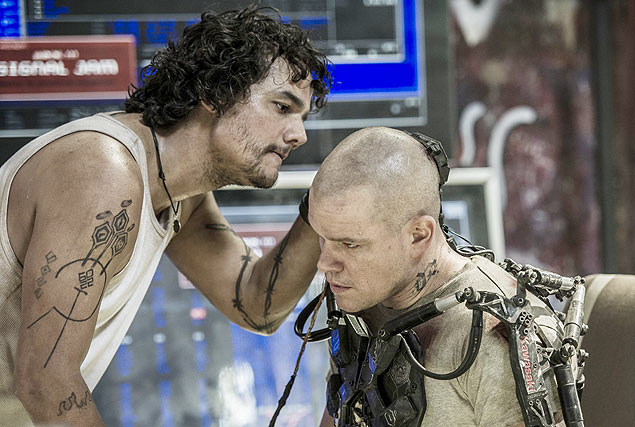
The parallels to today's refugee and immigrant desperation is baldly presented, and obvious to anyone whose world-view isn't in spec-fic but down here on Earth, much as apartheid was morphed into xenophobia in D-9. Add to that that the penthouse in space also seems to have access to the ultimate in universal health-care, a medi-bed that scans you and...simply cures you (it seems).  Other than those fanciful details, everything's played a little straighter, no doubt because you have big stars like Matt Damon and Jodie Foster, rather than just Sharlto Copley (although he's here too, bless him), so the financial risks are slightly more, so they make the stakes in the film a little higher, too.  Higher in that the government (naturally) is up there in Elysium, in the form of President Patel, who has a rather prickly defense secretary (Foster, channelling Angela Lansbury from The Manchurian Candidate), who has a unique sense of how to protect The Ring, supplementing the force of robot-police with soldiers of fortune, like a particularly nasty one named Kruger (Copley), who would probably kill for a hobby if he wasn't being paid for it.


Down on Earth, it's dog-eat-dog, and former car-thief Max Da Costa (Damon) is trying to go straight, working towards the dream of going to Elysium by working in one of the factories mass-producing the robo-cops that keep the populace under their teflon thumbs.  But an industrial accident leaves Da Costa dying, with only five days to live.  His only chance is to somehow get up to Elysium and one of those miracle-med-things, so, with a few super-drugs pumping through his system, he signs up to do some dirty work for a former employer, which involves stealing industrial secrets—which just happen to be Elysium's security codes—that will unlock the station's defenses and allow a mass exodus from Earth to Elysium.


Da Costa allows himself to be merged with a powerful exo-skeleton and neural-net to download the codes, then, once there—well, let's just say things get personal, as these things are wont to do, but not selfish, as that flies against the "hero" sense that movies must have, so there has to be some deflection of need for Da Costa to some other....blah-blah-blah.  Face it, the exo-skeleton could be a crucifix motif, so Da Costa has to do some sacrificing because...well, that's the way they do it in movies these days.  There can't be any motivation of "self" because apparently that would make you as "bad" as the Elysium-buyers.  So, ultimately, Da Costa has to do all the fighting and scraping for somebody else, and, as per usual, it's an acquaintance's sick child.  Again.


And that's the main thing that makes Elysium less than thrilling: for all the "neat" visuals, for the interesting "take" on today's events, for all the good intentions and the perversions of such, it feels like every other sci-fi Christ allegory and leaves you feeling a little hollow while its trying to make you feel noble and unselfish while watching it.  Well, I've seen that before, and I thought the intention of sci-fi was to show you something different.  It is a noble effort, but ultimately, it suffers from story-sameness, and recycled ideas from the cookie-cutter school of script-writing.  It's too bad because Elysium has a lot going for it.


Elysium is a Rental. 


Gotta say that Elysium has some pretty cool concepts for its pleasure-wheel

Saturday, October 20, 2012

Shadows and Fog

Shadows and Fog (Woody Allen, 1991) When Woody Allen makes a film in the style of Ingmar Bergman (Interiors), it's done in deadly earnest.  But, when he takes on German Expressionism, entering the angular world of Lang, Murnau, with a para-nod towards Kafka, it's a comedy.  Not quite sure why; maybe he has an affinity towards one stylization and the other he just finds phony, but the different approaches are like, well, day and night.  Allen explored that theme—taking the same story and interpreting it as either comedy or tragedy—in Melinda and Melinda, a bit of a mis-fire—but one suspects that the Nordic tradition he buys completely, and completely dismisses the German (God knows why).

Here, the visual is pure dread, but the subject matter is a mixed bag of precision and vagueness, comedy and darkness.  Allen plays Kleinman, a passive-aggressive bookkeeper, who is recruited in the middle of the night by a vigilante mob (including David Ogden Stiers and James Rebhorn) to roam the streets looking for a serial strangler.  Being a professional coward, and only dealing well with facts and figures in black-and-white, Kleinman is ill-suited for the activity and begs off, inviting suspicion from the group.  When there is speculation that maybe he won't do his duty as a citizen because he might be the strangler, Kleinman caves.

On his dark journey through the city streets (the largest set ever built in New York's Kaufman-Astoria Studios, making this Allen's most expensive film), he runs across an all-star cavalcade of slothful potential victims: a philosophy student (John Cusack) with a weakness for prostitutes (among them Lily Tomlin and Jodie Foster, madamed by Kathy Bates), a circus love-triangle tangentially related (with John Malkovich, Mia Farrow and Madonna) and the town coroner (Donald Pleasence), who has a purely scientific interest in the killer.*

Kleinman soon realizes that life simply doesn't add up, that a little slippage occurs, especially when it comes to illusion and reality (in the form of a very handy and practical magician named Armstead, played by Kenneth Mars).  The film struggles with the dichotomy throughout, as highly contrasted as the black and white photography, never truly meshing, and finally ends, as many of Allen's weaker films—and one of Allen's strongest ones (Hannah and Her Sisters)—do, with a Deus ex Machina** that buttons everything up inexplicably, leaving no questions but a lot of raised eyebrows.

Which is fine for the purposes of the film, but it's hardly what you'd find in an example of German Expressionism, where the punishment fits the crime...and where things really are in black and white.  


* Yes, the film is top-heavy with fine actors (and Madonna), but if you look in the darkened nooks and crannies of the film you'll also find Fred Gwynne, William H. Macy, John C. Reilly, Josef Sommer, Wallace Shawn, Kate Nelligan, Kurtwood Smith and Philip Bosco.  Was this film cast or filmed at a SAG convention?

** Here's a question:  It's a Woody Allen film; Can there be a Deus Ex Machina if there's no Deus?

Saturday, January 28, 2012

Carnage

Get a Room!
or
Who's Afraid of Nibbles the Hamster?

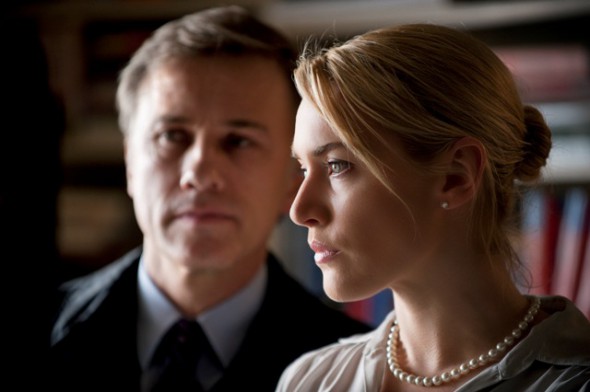
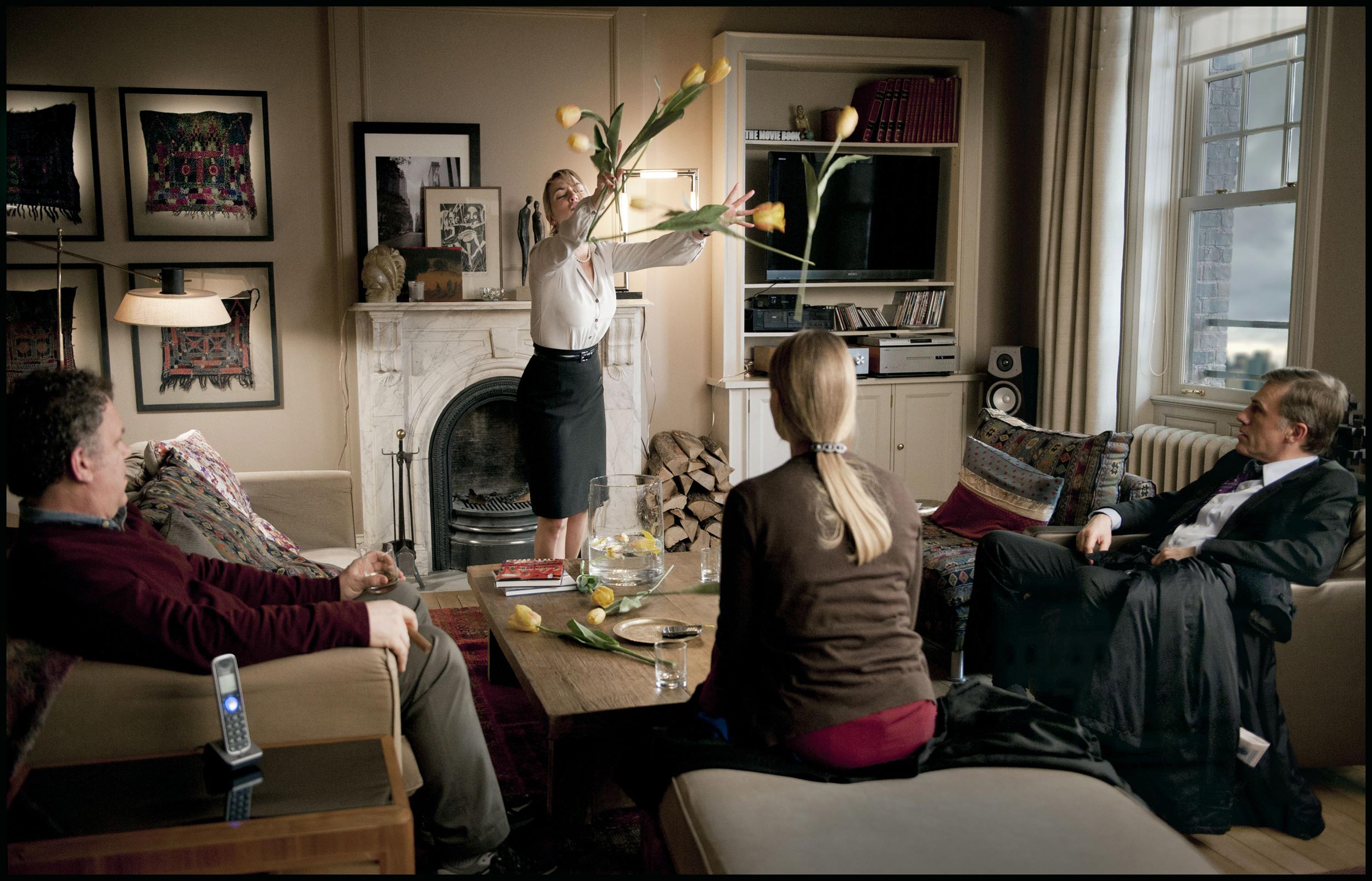
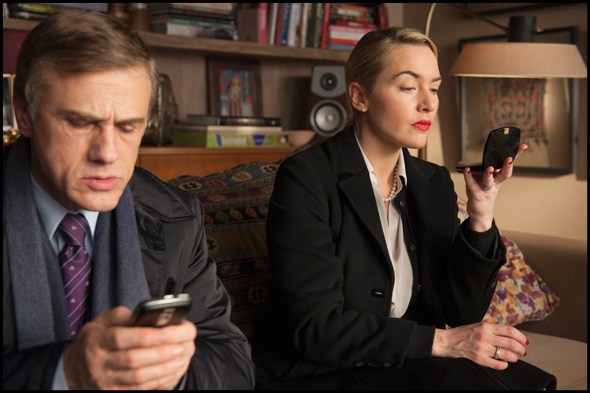
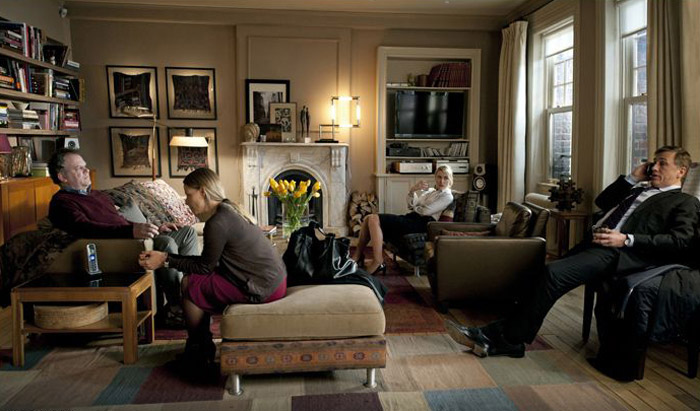
A schoolyard brawl between two kids escalates into a meeting between the parents that only proves the kids are amateurs at it in Roman Polanski's new film Carnage, based on the play by Yasmina Reza.  The meet-and-greet takes place at the New York apartment of Penelope and Michael Longstreet (Jodie Foster, John C. Reilly)— he's in hardware sales and she's an arts afficianado and rights activist, writing a book about African genocide—with Alan and Nancy Cowen (Christoph Waltz, Kate Winslet)—he's in lawyery and she frets.  It all starts well enough: cobbler is served and coffee offered, everyone's uncomfortable and on their best behavior.  But the niceties don't last any longer than the cobbler.  Penelope starts getting self-righteous, Michael, overly conciliatory, while Alan loses his laser-like focus from a series of interrupting cell-calls that from a client with a wonder-drug for high blood pressure that may have all sorts of side effects.

Then, Nancy...well, things go down-hill fast after Nancy...

It's basically a one-joke black-comedy that isn't remotely funny (the anti-punch-line comes at the end) turned up to 11 by an all-star cast and a director confined to a minimal set and probably going a little bit insane day by day.  Bear in mind that Polanski was probably giggling and encouraging extremism all through shooting, but all these terrific actors have their moments of masonry mastication—Foster coming off the worst, and Winslet the best, with Reilly and Waltz being alternately obnoxious and snaky.  Fairly soon, lines are drawn in tasteful carpets and there's a constant tying and untying of boundaries and bonds, that fall along lines of sex, politics and whatever the last subject talked about was. 

There are histrionics galore, and while there are no real baring of souls, there are all sorts of baring of inhibitions and not in the fun way.  These people seem to have absolutely no sense of decorum or restraint or any illusions that their opinions might not be the most pertinent to the proceedings.  It's all out there, vomited at projectile force and with no dolby/no squelch.  That would appear to be the comedy of it, but unfortunately it comes off a little forced and a little unrealistic.  It doesn't matter how set in their ways and high-strung these people are, at some point there is going to be re-assessment and back-pedaling, even if the trajectory is straight down-hill.

Not in this self-contained universe.  There is no tentativeness here, no sticking the toes in to test the waters, everybody belly-flops into the pool from the high-minded-board.  Even "Who's Afraid of Virginia Woolf?" is subtle by comparison, although there are some nice behavioral touches, like Penelope raising her level of discussion to an obviously uncomfortable volume to drown out Alan's phone-call.  Common sense is forgotten along with the kids argument and everything degenrates to a tag-team grudge match between and among the couples.

Ultimately, it's a bad night out that you want to forget about in the morning.

Carnage is a Rental.

Friday, May 13, 2011

The Beaver

"Ignoring the 800 Pound Gorilla in the Room"
or
"Uh-uh, Honey.  Talk to the Hand"

Jodie Foster's new film, The Beaver, was always going to have an uphill battle finding an audience when it was released.  First, it's about mental illness, but atypically for Hollywood, it's not a comedy.  Second, it stars Mel Gibson (in a good...actually heroic...performance), so any review is going to feel obligated to slide in some mention of the "800 pound gorilla in the room."* Both detract from the film itself which has a difficult enough time staying focused on its issues, but at least has enough moxie to try and do something a little different—without tugging too hard on the obvious heart-strings.

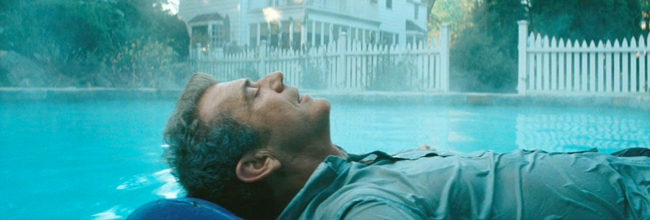
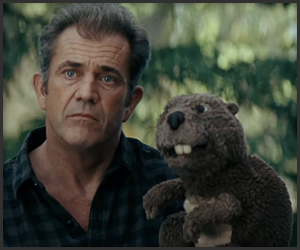
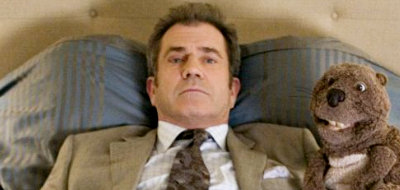
Gibson plays Walter Black, an executive of the Jerry Co. toy company, who, following The Peter Principle, was given the CEO position that he wasn't really qualified for, over a female executive (the always wonderful Cherry Jones).  He runs Jerry Co. into a few quarters of red-ink lethargy (although the brick-and-mortar doesn't come tumbling down) and has a complete mental breakdown...slowwwwly Not wanting to get out of bed in the morning, reduced to monosyllabic answers and avoiding any interaction, Walter is so clinically depressed that, finding a ragged beaver puppet in a dumpster, he starts using it as a surrogate to speak through and at.  Walter goes away.  And everybody has to address "The Beaver" (who talks in a gruff Cockney, sounding a bit like Gibson's co-star in Edge of Darkness, Ray Winstone).  The situation is explained to new recruits with an intro card:


"Hello, the person who handed you this card is under the care of a prescription puppet designed to help create a psychological distance between himself and the negative aspects of his personality. Please treat him as you normally would but address yourself to the puppet.
Thank you."

Thank YOU.  The thing is, "The Beaver's" not a better person than Walter, he's just chirpy and aggressive.  Walter can go away and "hide" in his limbowhile "The Beaver" does all the P.R. work, chortling and being cute, while Walter fails to commit.  Walter thinks that Beaver is a tourniquet on his arm, staunching the bleeding, but all he's applied is a band-aid...cover up the problem until it goes away.  "The Beaver" is the "manic" while Walter remains the "depressive" and the puppet is just another room where he can hide, pouring all his effort into the surrogate, while ignoring the real problem.

Sidebar:  Let's talk about depression.  Full disclosure—I have suffered from depression in the past, but, just like fools, I don't "suffer" it now.**  The instinct is to run away and hide and do nothing, lest you fail and make things worse.  But, action is the best cure for it—to ac-cent-u-ate the positive and e-li-mi-nate the negative.  It's "better than nothing," which is what depression inspires...a lonely, isolating cage of nothing.  It's always better "to be" than "not to be."

But, that's hard to convey in a movie (and be entertaining about it, anyway).  "The Beaver" has a brother-in-mind from movies-past, and that would be Harvey.  For all its twee charm, great lines and James Stewart whimsey, Harvey is a film about mental illness—Elwood P. Dowd has suffered a breakdown from the death of his wife and has replaced her companionship with a "pooka" taking the form of a six-foot-three-and-half-inch ('lets get the facts right") juicer of a rabbit.  The conceit of the play is to say that we're all crazy..."After this he'll be a perfectly normal human being. And you know what stinkers they are!"...and reassures us through stage-craft that we're just as nuts when we see doors opening and closing by themselves, indicating Harvey's presence.  The charm of it, played for comedy, disguises the pain at the heart and soul of the play; I once saw a performance of it at the Seattle Repertory Theater where Dowd (Elwood P.) was a melancholic, sad, mournful, and that version of the play has always stuck with me, despite the weird shift in tone.  

The Beaver (the film) has that same problem of tone.  There are moments of lightness...more irony than humor***...but, ultimately, it's a sad affair, however ludicrous and "wacky" it might seem in the overview.  And, Black's conflicts with his family, particularly his son (Anton Yelchin), who views his father's condition with contempt and fear...that he might go down the same path.  He's a student who charges a fee to write papers for less-gifted class-mates because he has a knack for writing "in other people's voices," and his efforts writing a valedictory speech for a school hottie (Jennifer Lawrence—she's terrific, and a tough little actor) makes up a parallel story to his father's struggles.  Foster plays Black's wife, and the best thing she brings to the role is a tentative panic behind the eyes in trying to keep her family together

Gibson's eyes, however, haunt.  They perfectly convey the radiating hurt (without overdoing it by going into mawkishness)...and the consuming deadness as he retreats.  This is some of his best work in years, especially considering he's having to play two characters at once, the puppet and the puppet-master, while simultaneously keeping it unclear which is which.  Foster, as director, maintains a discrete presence, but has one big pay-off by ommission; by filming Black and his symbiot constantly in two-shot, she maximizes the dread one feels when "The Beaver" is alone in the frame—quite the directorial coup, actually.  That conflict builds as the story goes along, cautioning that if you're going to have a surrogate speaking for you, choose one with less prominent teeth. 

This is good, disturbing stuff.  And an interesting approach by all concerned to a nicely buttoned-up screenplay that dots the "i's" (without putting little smiley faces on them) and double-crosses the tease, and dares to question the idea of "self" and losing it.  Some might find it depressing. 

But it made me smile.

The Beaver is a Matinee.


* If you wanna know about it (or if you've been living under a rock for the last few months), just "Google" Mel Gibson."  I'm sure you'll find out what's going on quickly.


** Yeah, yeah, I know. "TMI."  But, hey, I write, I analyze.  It's what I do.  It's why I'm here—on more than one occasion I've been told "Couldn't you just ENJOY the movie for what it is?"  Some other Yojimbo can do that.  It's not me.  I'm critical with movies as I'm critical with myself—I aspire to something more in what I do and I expect it of anybody who sticks their neck out onto the creative chopping block.  It's common among writers, actors...and, I am sure, puppeteers and ventriloquists, whom I've been fascinated with since I was a kid.  All take on other persona's in their craft—something the movie makes clear—and more than a little analysis—self- and otherwise—goes into that.  I wouldn't have it any other way.


*** I can only think, with horror, what this would have been like if, as was once the case, Jim Carrey or Steve Carell had played it, instead of Gibson, who looked the situation square in the eye and played it for truth, rather than laughs.

Wednesday, June 30, 2010

The Silence of the Lambs

The Silence of the Lambs  (Jonathan Demme, 1994) "I will NOT go see a movie like THAT!"

My client was adamant. I knew what he meant. I was repulsed by the idea, myself. After all, it was based on a novel by
Thomas Harris, the most ghoulish and cruelest of thriller writers. I'd read "Black Sunday" and it had an image I wish I could sand-paper out of my mind. I'd read "Red Dragon" (and seen it's Michael Mann movie adaptation, Manhunter), but I hadn't read "The Silence of the Lambs." After "Red Dragon" I swore off his novels. Harris went places I just didn't want to go...ever...not even in a pulp entertainment.

But the "buzz" about
The Silence of the Lambs was so good, I had to go. My wife didn't want to see it ("UH-uh"). But a female colleague heard I was going (and her husband was "in no way" going to see it), so we agreed to meet up at the theater—almost like a dare—and satisfy our morbid personalities.

See, I'd seen
Manhunter (starring pre-"CSI" William Petersen and Joan Allen), and the most intriguing thing about it was the introduction of a character named Dr. Hannibal Lecter* (played in Manhunter by Brian Cox). Lecter was an über-villain, like Dr. Mabuse. An insane genius psychiatrist, far more twisted than his clients, and he seemed unstoppable, uncontainable. Indeed, he was portrayed as a criminal so dangerous, he was kept in an impenetrable transparent cage of perspex. Cox played him agitated, and as a cannibal, he perpetually chewed gum, as if to satisfy a craving (or to keep his jaw strong).


A study in contrasts: Brian Cox (left) and Anthony Hopkins (below) as their respective Lecters


Anthony Hopkins famously played him in The Silence of the Lambs as an unblinking, supremely confident being of stillness.  When we first see him (after an extended build-up talking about how dangerous he is), the camera slides him into view—and he's already waiting for us.  That's a bravura move (done in silence, purely visually, pure cinema) in collaboration between Hopkins and director Jonathan Demme (who has never been so "to-the-bone" instinctual in his set-ups).  Our first sight of Hopkins is a shock; he's not doing anything. Nor does he have to.  In a dungeon-cage with a tranparent front (not bars, as they're too penetrable, but more like a zoo for observation), he still is in control of the situation and knows it, and his "laser-like intellect" has already begun profiling his prey, FBI Agent Clarice Starling (a bird's name, indicative of small, tremulous life), played by a subtly vibrating Jodie Foster (who's brilliant).


This is a horror movie.  And the best horror movies don't just scare us.  They touch a nerve, grab on tight and slither up into our brains and take root, never leaving us.  They know what scares us, right down to the DNA in our collective alligator brains, and individually to our unbidden (but specially created) nightmares.  And like Jaws, The Silence of the Lambs serves up one of the special horrors to our conqueror species:  fear of being eaten...consumed.  It's not just the dying and the reduction to meat, but it's taking away ourselves, our "souls," our specialness and uniqueness (like Gene Hackman's Sheriff in Unforgiven blurting down the echoing cave of a gun-barrel: "I was building a HOUSE!"). "Deserves got nothing to do with it."

And that's a horror.  A true horror.  A viscerally twisting fear of humankind, that we don't matter, everything that we are, that we do, can't hold off Death.  Any Death.  Every "snuff" makes us just dust in the wind.  And everything we are amounts to nothing.  "Tell her to paint an inch thick.  To this favour, she must come."

"Make her laugh at that."

Sure, it's a horror movie.  But becoming carrion is one thing.  This is about skin-suits. Bad enough to be turned into a meal, yes.  But apparel? 

Yeee-EEE-eee!

So, that's the reason so many people might NOT want to go see The Silence of the Lambs.  What is there, of such value, to see it?  To face your fears and walk into the darkened theater to face these horrors?


There is a subtle sub-text in the film and a not-so-subtle-visual one.  One of the travails of Agent Starling is to go through her rigorous FBI training, the obstacles, the paths, includes making her way through a traditional world (and institutuion) of men.  She is often under-estimated (except by, of all people, Lecter, who is intrigued and challenged by her: "People will say we're in love" is his witty reversal on it) and must point out to the officious males she's dealing with (and it is dealing) that they are treating her in a subordinate manner ("You know, we get a lot of detectives here, but I must say I can't ever remember one as attractive."), even though she calls everyone—her superior Jack Crawford (Scott Glenn), Lecter, even the serial killer she's seeking (the terrific Ted Levine, whose brave work in this film should never be unacknowledged in any review) "sir."  


Foster's Starling is a victim, too, although she won't succumb to victimization.  She fights it.  And she fights the battle for the women whose lives have been lost through the pathological extension of that subjugation, and, with her work, might be saved.  Reduction of the human being is the tough theme that runs through The Silence of the Lambs, and it is perpetrated by serial killers and officials alike, anyone who assumes more authority than they are due.  Or more superiority than they deserve.  We all covet that to some degree.  Look in the mirror.

What looks back?


"The eyes are the window to the Soul" they say (although it's difficult to trace who originally said it).  And director Demme makes sure we see them, both eyes and souls.  Frequently, even in conversations, he will photograph the actors looking straight on, their eyes on a direct axis with the center of the camera lens (and thus, the audience).  A lot of directors do that (Spike Lee and Woody Allen, for instances), but more often than not, those uses are to have the characters speak directly to the audience, breaking the fourth wall between player and played.  Not Demme (and this is what makes Silence unique).  Whole conversations happen, with the actors looking out at us, as if we are the ones having the conversation—we connect with them, those flickering phantoms on the screen, making them more than casual phantoms, the ones we merely observe as if they were any passer-by on the street.  We look into those windows, see the Souls (even those of the Soulless) and immediately those beings have value and worth, not just victims of our gaze, but true intimates, more than the mere shells that envelop their spirits.

And this is what separates The Silence of the Lambs from the many serial-killer/slasher movies that stalk through the genre—separates it a full 180° from the other films, in fact.  So many of those use the POV subjective shot of the killer observing and hunting its prey (and Demme uses it, too, in the nerve-jangling final confrontation between Starling and "Buffalo" Bill).  So many used it, in fact, that it became a cliché of the type, putting us in the uncomfortable position of seeing the world through the victimizer's vision, rather than the victim's—the hunter's, rather than the hunted's—accompanied by the rasping inhuman breath of the coveting, rather than the pleadings of the coveted.  "The Silence of the Lambs" breathes new life into the form, elevating the victim, the genre...and us.  It gives value to the human being, and in so doing, raises itself up, as well.

---------------------------------------------------

"So," the client began tentatively. "I went to go see Silence of the Lambs... 

"And?" I offered. "Wha'd ya think?"

He blurted. "Ya know, that was a REALLY GOOD movie."

Yes, it is.  Still is. Repulsive, still, certainly. But a great movie.


And it still has the distinction of being the only horror movie to win the Best Picture Oscar, and, even rarer, to win the Big Five categories (Best Picture, Director, Actor, Actress, Screenplay), all deservedly so.


* In Mann's film, he's Hannibal Lecktor, a more oral-associated mad scientist name.

Friday, November 7, 2008

Contact

"Contact" (Robert Zemeckis, 1997)

"There are only two ways to live your life. One is as though nothing is a miracle. The other is as though everything is a miracle."

In one of his later books,* Arthur C. Clarke tells the story of mankind's first encounter with an alien construct -- a galaxy-spanning robot "starglider" scout passing by our solar system on its way to "God knows what?" Communication is established, transmissions fly fast and furious, and then someone asks "Do you know God?" The probe does its best not to perform a NOMAD version of a spit-take, and its dismissal of the concept** eliminates religion from the Earth in (as Douglas Adams described it) "a puff of logic."

"
Contact" is a scaled-back version of the Carl Sagan novel about humankind's First Contact: we get a series of blips from Deep Space via The Very Large Array*** and translate them to create a means of meeting. The focus of the film is an agnostic SETI scientist named Elanor Arroway (Jodie Foster) who is a brilliant scientist, but a lousy politician. She struggles with the question of Faith throughout the movie to her detriment and comes away from the experience questioning, but filled with belief.

Religion and Science do not sit in the same pew, but to possess a sense of wonder implies some kind of faith. When he asked what he thought about while waiting to be launched into orbit,
John Glenn replied, "I just sat there thinking that every part and instrument was contracted to the lowest bidder."

You have to believe in some-thing. Arroway is confronted by a crisis of Faith and finds out what it's like to be on the recieving end of a bunch of
Doubting Thomas's. And the entire movie becomes a reverse of its galaxy-spanning opening shot**** (reminscent of "The Powers of Ten"), as we start from Earth orbit with a cacophony of broadcast data, and as we accelerate away past the speed of light, we catch up with the transmissions we have sent out in space throughout the 20th century until we reach the extent of our influence and the Universe goes quiet. We roam through star-clusters and birthing star-systems amidst nebulae, until we reach the goal--the eyes of a child, Ellie Arroway's eyes, specifically. Those eyes will dim in wonder and with worry when Jodie Foster takes over the role (from young Jena Malone). But, in space, when confronted with the sheer splendor of the Universe, Zemeckis will morph Foster's face into Malone's as she stammers "So beautiful. No words. They should have sent a poet."

Perhaps they already did. For
at film's end, as we leave Arroway to ponder her journey of Belief and the Mystery of Faith, she picks up a palm-full of New Mexico sand, and sees a pattern that she has seen before.

To see a world in a grain of sand,
And a heaven in a wild flower,
Hold infinity in the palm of your hand,
And eternity in an hour.

William Blake "Auguries of Innocence"


* "The Fountains of Paradise" ©1979

** "2069 June 08 GMT 1537. Message 6943. Sequence 2. Starglider to Earth:"

"The hypothesis you refer to as God, thought not disprovable by logic alone, is unnecessary for the following reason."

"If you assume that the universe can be quote explained unquote as the creation of an entity known as God, he must obviously be of a higher degree of organization than his product. Thus you have more than doubled the size of the original problem, and have taken the first step on a diverging infinite regress. William of Ockham pointed out as recently as your fourteenth century that entities should not be multiplied unnecessarily. I cannot therefore understand why this debate continues."

*** When dealing with landscapes cosmic, it always helps to capitalize...a lot.

****


Wednesday, November 14, 2007

Shoot 'Em Up/The Brave One

"Guns Don't Kill People....But It Sure Does Help!"

"The Angriest Man in the World," Mr. Smith is sitting on a street bench in a squalid part of town. He's inrtoduced with a Leone-style close-up of only his eyes. Then, cut to his face. It's Clive Owen in full wide-eyed coma look. He brings a carrot up to his face and loudly crunches into it.

What's Up, Doc?

Well, it's certainly not anybody's IQ.

Next, a very pregnant woman runs past him (shot none too elegantly), followed by a speeding car that noisily and gratuitously slams into another car, trapping the driver. He gets out the passenger door, spewing paper and fast-food bags and garbage out of his car onto the street.

There..right there...maybe two minutes into the film is the only amusing idea in the whole movie. And it was only amusing to me because it reminded me of my car.

But that's it--the only thing I enjoyed in the entire film, no help from director Michael Davis. In the sums-it-up "Shoot 'Em Up," Clive Owen's "Mr. Smith" finds himself charged with protecting a baby, just like "Children of Men," but without all that boring social commentary and stuff. With the help of a lactating prostitute (Monica Belluci, shot through a vaseline-greased lens, and utilizing the time-honored 60's-style "Bad Italian Actress" technique), Smith and child evade Mr. Hertz (a bug-eyed Paul Giamatti, reminding me that it was only a few years ago that he starred in stuff "Big, Fat Liar") who has an infinite number of disposable goons, with an infinite number of bullets that seem predisposed to not hit anything, while Smith's gun hits something (usually lethally) every time.

"Shoot 'Em Up" tries to align itself with the Warner Bros. cartoons of Bugs and Elmer but has not the wit, the style or the precise timing (Giamatti starts the movie with a Merrie Melodies lisp, but inexplicably drops it a few minutes in). I was really hoping that at some point Owen would hit him in the face with a frying pan, so we'd see Mr. Hertz's face flatten out, but no such luck. And, of course, after every set-piece or innovative killing technique (Smith kills with a carrot--twice) there are the inevitable one-liners that haven't been so eye-rollingly bad since Roger Moore was James Bond, with all the sophistication of the chat-room droolings of pre-teens. After a simultaneous shoot-out and screw where both participants reach their ...climax, Owen turns to the camera and in his best Terminator-in-Chief drone says, "That's what I call shooting your wad." But then there's "Eat Your Vegetables.." (after a carrot-killing), "That's what I call a hand-job," and the immortal "Fuck you, you fuckin' fuckers!" That kind of lummoxy aside reached its satiric punch-line with the antics of "McBain" on "The Simpsons," but it gives me hope that someday I can get just such a writing job. At the end, Belluci looks at Owen and says "What took you so long?" I half expected the lame-ass line that ended Robert Altman's "The Player:" "Traffic was a bitch."

According to this flick, there's nothing worse than "a pussy with a gun." I dunno, how about "a pussy with a movie camera but without an original idea in his head, a lick of talent, or the smarts God gave a radish?" Yeah. That's worse. A lot worse.

"Shoot "em Up" is a complete Waste of Time.
-----------------------------------------------------------------------------
Oof. Talk about your awkward segues.

"The Angriest Woman in the World" Erica Bain by the end of "The Brave One" is in the same mode: "Who's the Bitch now?" she screams as she mows down one of the men who beat her into a coma, killed her fiancee...and stole her dog. Not only does she get her revenge, but she gets her dog back (oh...spoiler alert!), so everything's all right, right?

Never mind that for the preceding two hours--that feel like four--she's bided her time by capping the asses of whatever scum of the earth crossed her path. At least she's an equal opportunity vigilante: one group's Latino, another is black, and three separate white guys--bonus points for the rich one.

Were I John Hinckley, I'd stay in prison.

The critical rags are calling this "Dirty Harriet,"* but that's all wrong. Its the daughter of "Death Wish," the Charles Bronson viscerally charged revenge-actioner with the same formula and practically the same resolution--except with a gun rather than the earlier film's non-cinematic plea-bargaining. Erica is a radio-journalist--well, an audio-documentarian, whose love affair (and experience) with New York extends as far as her ear-buds, spinning chatty little stories about the "myth" of old New York, and what gentrification is taking away. Tellingly, one of the first things we see her doing is recording her own foot-steps as she walks the city streets. From there, she goes to her little iso-booths and spins her valentines to "the safest big city in the world" (except it's missing a couple of buildings downtown, and not to gentrification). After the attack, she's even more isolating, and butches up her wardrobe, symbolically shedding her skin to become a new person that she doesn't know or understand. Oh, and there's that shooting-people-in-subways thing. "Inside you is a stranger," she narrates to herself. "Why don't my hands shake? Why doesn't anyone stop me?" Pretty soon she's doing it not because she's threatened, but because she can, and in a perverse cat-and-mouse game strikes up a friendship with detective Terrence Howard, who is feeling increasingly powerless to stop the newly-empowered vigilante messing up his mean streets. I came away thinking "never give Terry Gross a gun."

Of all people, Neil Jordan ("The Crying Game," "Interview with a Vampire") directs this,** and his way of showing fear and Erica's world out of whack is with slowly tilting shots with a steadicam (with its gyroscope knocked out), which made me think we were heading for the Penguin's dastardly bird-themed lair. It's a little tough to take this stuff seriously when it reminds you of the old "Batman" show. About the only pleasure in the film is the beyond-cynical banter of Howard and his partner investigating the crime scenes (My favorites: "Guy had a rap sheet longer than my dick" "No priors?" and "Any idea what killed him?" "Could be the fall--could be the crowbar stuck in his head--I'm thinkin' 70/30, maybe 50/50"). And a tiny scene with a police desk-clerk who routinely mantras "I know how difficult it can be, but if you will be patient and have a seat an officer will be down shortly to help you." It makes the same point about institutional disinterest in 20 seconds that it takes the whole of "In the Valley of Elah" to make.

And the acting. Even with this type of material, Foster takes it right down to her marrow, until she no longer looks like the same person. There is a terrific scene of her and Howard in a diner not talking about what they're talking about while "You Don't Know Me" echoes over the PA that's very well done.

Wish it were in another movie.

"The Brave One" is a cable-flick.

* "Dirty Harry," the police-as-vigilante movie was co-written by Rita Fink.

** Yes, but Joel Silver produces. That might be the answer.