Showing posts with label Robert Zemeckis. Show all posts

Friday, May 20, 2011

Back to the Future, Part II

 Back to the Future, Part II (Robert Zemeckis, 1989) The BTTF series always left me a little cold. Sure, it was fun (in a slap-dash hap-hazard kind of way)*, and it made Michael J. Fox a movie star, breaking out from his "Family Ties" TV-role. But, I've always found the two films on either side a bit rote: BTTF I was the clever story where Marty McFly (Fox) goes back in time and saves the future marriage of his parents (Lea Thompson, Crispin Glover), which he, by his very presence in the past, is in danger of never making happen, and BTTF III is a completely superfluous entry with a retro-science-fiction Western theme that merely rectified the cliff-hangers left over from BTTF II.

Most folks consider Part II to be the superfluous one—a time-bridge to Part III—as it starts with a way-stop to the year 2015 where Marty watches in horror as he must come to terms with the loser-family he will sire. Then, because of a scripted mishap in that future which nullifies his efforts in 1955, it turns into a virtual remake of the first film wherein the Marty of 24 hours later (let's call him Marty+1) must weave his way back through the circumstances of the first movie without interfering with the past or changing its future. The goal is the same—save Mom and Dad's marriage so Marty can be born...in order to save the marriage again, like a Moebius loop made out of film. And it may feel like a re-tread—even lazy film-making—but for me, Back to the Future Part II is what the entire series should have been like.


It is also a stunning commentary on the derivative nature of sequels at a point when the trend was in its full cloning bloom. All sequels, with only a couple of select choices, are derivative—by hoping to create the same success at the box-office, the film-makers will follow the same formula, only make it bigger. Back to the Future, Part II fits the mold to a recycled "T"—it IS the same movie, but from a different angle, with the lead character re-experiencing it, and trying to set it right—again—24 hours in the future.


Due to some re-casting (Elisabeth Shue for Claudia Wells**), parts of the first film were re-filmed to keep things continuity-square.***  But there are whole sections of Part II that are mirror-images of Part I, and as you can tell by the video below, some of the same shots—especially the ones with Crispin Glover—are re-used, as Marty+1 negotiates through Part I, while avoiding any of the participants (and, one can imagine, Part I's camera crew), trying to re-re-establish the McFly romance.

But, there is one moment in Part II, that has always made my brain hurt while simultaneously making me bust out laughing and making my eyes bug out from the sheer absurd audacity of it—when outside the gymnasium Biff (the terrible Thomas F. Wilson) confronts Marty+1, at just the moment that Marty (from Part I) bursts through the gym doors, thereby knocking out M+1, thus complicating things further.

Sure, one moment does not a good movie make.  However, that exquisite bending of time and space for a comedic end has such cosmic and karmic implications that it put me in mind of the some of the filmic leaps (and falls) of the late, great Buster Keaton.  Keaton created such intricate film illusions that played with reality in its parallel universe of movies, that I think this collision (literally) of the day older and wiser Marty, by the frenetic yet-to-succeed younger version of himself would have made Buster smile.

Except he never smiled.


The moment when Marty hits Marty+1 is at 03:51


* One issue that's always grated me, though, is the apparent time anomaly that inspires Chuck Berry to write "Johnny B. Goode."  Look, mess with time all you want.  But, DON'T mess with the Rock!

** Ms. Wells was replaced, not for any aesthetic film reasons, but because she was not available; she wanted to be with her Mother, who had been diagnosed with cancer.

*** Because the Back to the Future films were produced by Steven Spielberg, and not by George Lucas, Ms. Wells has not been digitally replaced by Shue.  I think that's nice.

Thursday, November 12, 2009

A Christmal Carol (2009)

"God Bless Us, Every Mega-Pixel"

Everyone has a favorite "Christmas Carol" (or I should say, "version" of "A Christmas Carol").* A novella, it is the perfect length for adaptation to movie (with some padding) or television special (with some commercials). And being as it's in the Public Domain, anybody can adapt it without paying any money to Mr. Dickens (who probably haunts the producers, every one!). Hence the title: "Disney's 'A Christmas Carol.'"tm **

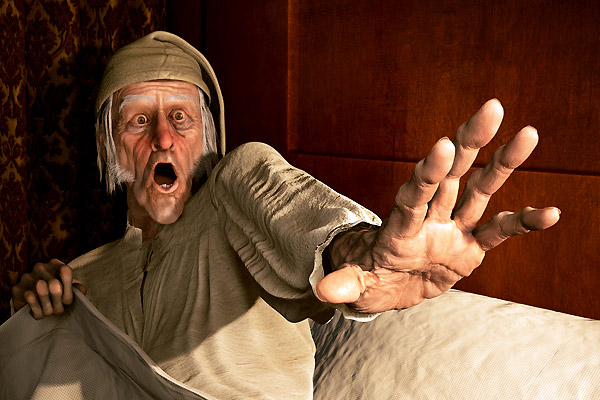
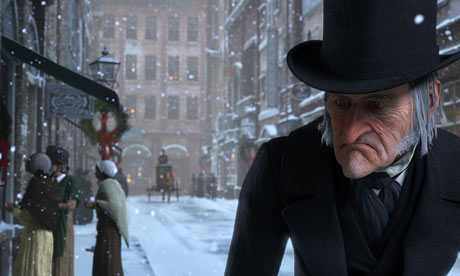
Disney may own it, but it's Robert Zemeckis and Jim Carrey's "A Christmas Carol," and it stands up against even beloved ghosts of "Christmas Carols" past. Face it. There are so many, that presentation is the main criterion to base a judgement, like "Hamlet." And format has a lot to do with what drives Zemeckis' version. Skip the 3-D aspect for a moment. This motion capture-CG "take" does some very interesting things with the story (adapted within a farthing of Dickens' original by Zemeckis himself) that are only possible with animation—the ghosts being integral to the story.

"A Christmas Carol" is a ghost story. The ghosts and their tours of Scrooge's life past, present and future must be enough to slap Scrooge giddy,
make him "scared straight," turn his perspective from "profit" to "a common good."

In other words, it must turn him from
a "cool, conservative man" to a "bleeding heart liberal."***

You have to have really scary ghosts to do that. Really scary ghosts. Any half-steps and Scrooge would be a "champagne liberal," and what good are they?

In this version,
Carrey not only plays "Scrooge" (through Zemeckis' ever-improving "motion-capture" technique) but also the three Ghosts: a cooing Irish flame for the past, a roaring Scottish present, and a funereally silent Future. Each has their own presentation of their visions, Past whisking Scrooge to his old haunts, Present turning Scrooge's sitting room into a camera obscura to spy the current Christmas, flinging Scrooge to a stage street to present Want and Ignorance, two feral spirits—the one growing up violent behind prison bars, the other morphing into a hooker and into a straight-jacketed mad-woman. And Future, in a neat touch, forms itself from Scrooge's own shadow.

There emerges during the sequence a chase as Scrooge is pursued by his own nightmarish funeral cortege pulled by two red-eyed horses, a bit that old Walt would have been proud of. It soon deteriorates into a demonstration of 3-D (which Zemeckis and Pixar are already masters of—the previews of
James Cameron's "Avatar" shows a few problems) as bedlam as a mouse-sized Scrooge must scramble through the sewers to escape a terrible fate. One could live without it, as well as the "snuffing" episode of Christmas Past were the sequence not a vivid demonstration of just how well Zemeckis uses the technology to bring a life-like edge to the movie. And that's where this "Christmas Carol" truly makes its mark.

Where this version of "A Christmas Carol" is unique is that this marks the occasion when "motion capture" CG "got the faces right." Zemeckis' previous experiment in this realm, "
Beowulf," had an odd, plasticene feel to it, mouths didn't crinkle correctly in speech, faces wobbled in perspective. Not here. Carrey is a broad actor, to be sure. But he's also an actor of simultaneous quicksilver subtleties, and this film captures it all. It's one thing to flit the camera perspective through snow-storms and sail through the chains of a scale, falling chestnuts, and the "eye" of a wreath (all done in the film's credits), but it's quite another artistic thing to capture the look of pleased instant love on young Ebeneezer's face when he first meets his beloved Belle (Robin Wright Penn), or to show the pleading terror and remorse when a ghostly Scrooge comes "face-to-face" with a mourning Bob Cratchit (a perfect Gary Oldman). Keep your dizzying flights of fancy 3-D. It's in those moments of intricate expression when "Disney's 'A Christmas Carol'" truly soars.

"Disney's 'A Christmas Carol'" is a Full-Price Ticket.****

* Well, since you asked, I have my own favorites—usually the ones that are a bit scarier in their psychic psychological warfare on Scrooge. I like the "Alastair Sim" version often sighted as a favorite, and love the "George C. Scott" version for television from 1984 (he's scarier at the end than at the beginning!), but my favorite—and this is probably a case of "Mom's Apple Pie Syndrome"—is "Mr. Magoo's Christmas Carol," which, even though it is a musical, even though it is a cartoon and even though Scrooge is Jim Backus, still manages to pack an emotional wallop, more than any "live" version I've seen, including this version.

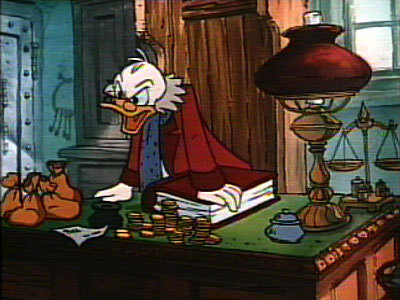
** They've already done a version with Mickey Mouse: "Mickey's Christmas Carol" (1983). Scrooge McDuck played Scrooge. Natch.

*** I have to bring this up: a couple years ago one of the Zucker bros. directed a conservative version of "A Christmas Carol," but it took the Christmas out of it—I guess it's "An X-mas Carol," then,...talk about your "Wars on the Holidays"(sic)—called "An American Carol" in which a Michael Moore type (played by Chris Farley's brother—more popularly known as "Chris Farley's brother") is shown the Ghosts of America Past, Present, and Future in order to "scare" him into being more conservative—frankly the Bush II Administration had the opposite effect on me. Not to paint with too large a brush, but conservative political humor tends to be so ham-fisted and structurally unsound that it can't even see its own hypocritical ironies.

**** And a spendy one at that. Ticket prices are higher for 3-D presentations. I have some trepidations about saying it—this site being all about "value" and all—but I thought it was worth it. My opinion, merely.

Friday, November 7, 2008

Contact

"Contact" (Robert Zemeckis, 1997)

"There are only two ways to live your life. One is as though nothing is a miracle. The other is as though everything is a miracle."

In one of his later books,* Arthur C. Clarke tells the story of mankind's first encounter with an alien construct -- a galaxy-spanning robot "starglider" scout passing by our solar system on its way to "God knows what?" Communication is established, transmissions fly fast and furious, and then someone asks "Do you know God?" The probe does its best not to perform a NOMAD version of a spit-take, and its dismissal of the concept** eliminates religion from the Earth in (as Douglas Adams described it) "a puff of logic."

"
Contact" is a scaled-back version of the Carl Sagan novel about humankind's First Contact: we get a series of blips from Deep Space via The Very Large Array*** and translate them to create a means of meeting. The focus of the film is an agnostic SETI scientist named Elanor Arroway (Jodie Foster) who is a brilliant scientist, but a lousy politician. She struggles with the question of Faith throughout the movie to her detriment and comes away from the experience questioning, but filled with belief.

Religion and Science do not sit in the same pew, but to possess a sense of wonder implies some kind of faith. When he asked what he thought about while waiting to be launched into orbit,
John Glenn replied, "I just sat there thinking that every part and instrument was contracted to the lowest bidder."

You have to believe in some-thing. Arroway is confronted by a crisis of Faith and finds out what it's like to be on the recieving end of a bunch of
Doubting Thomas's. And the entire movie becomes a reverse of its galaxy-spanning opening shot**** (reminscent of "The Powers of Ten"), as we start from Earth orbit with a cacophony of broadcast data, and as we accelerate away past the speed of light, we catch up with the transmissions we have sent out in space throughout the 20th century until we reach the extent of our influence and the Universe goes quiet. We roam through star-clusters and birthing star-systems amidst nebulae, until we reach the goal--the eyes of a child, Ellie Arroway's eyes, specifically. Those eyes will dim in wonder and with worry when Jodie Foster takes over the role (from young Jena Malone). But, in space, when confronted with the sheer splendor of the Universe, Zemeckis will morph Foster's face into Malone's as she stammers "So beautiful. No words. They should have sent a poet."

Perhaps they already did. For
at film's end, as we leave Arroway to ponder her journey of Belief and the Mystery of Faith, she picks up a palm-full of New Mexico sand, and sees a pattern that she has seen before.

To see a world in a grain of sand,
And a heaven in a wild flower,
Hold infinity in the palm of your hand,
And eternity in an hour.

William Blake "Auguries of Innocence"


* "The Fountains of Paradise" ©1979

** "2069 June 08 GMT 1537. Message 6943. Sequence 2. Starglider to Earth:"

"The hypothesis you refer to as God, thought not disprovable by logic alone, is unnecessary for the following reason."

"If you assume that the universe can be quote explained unquote as the creation of an entity known as God, he must obviously be of a higher degree of organization than his product. Thus you have more than doubled the size of the original problem, and have taken the first step on a diverging infinite regress. William of Ockham pointed out as recently as your fourteenth century that entities should not be multiplied unnecessarily. I cannot therefore understand why this debate continues."

*** When dealing with landscapes cosmic, it always helps to capitalize...a lot.

****


Monday, November 26, 2007

Beowulf

Getting Pixelated at the Mead Hall

"Beowulf" tells the age-old story about the hero who rides into town to defeat a inhuman beast, then its mother, and finally, late in life, a fearsome dragon which proves to be his final battle. Robert Zemeckis directs from a screenplay by Neil Gaiman ("Sandman," "Stardust") and Roger Avary ("Pulp Fiction").

First off, the screenplay by Gaiman and Avary takes a few liberties with the old text, making Beowulf something of a blow-hard, the struggle of Beowulf and Grendel's mother a different kind of tussle, and that fateful dragon becomes the issue of that liaison, just as Grendel is the product of an earlier assignation between Grendel's mother and Hrothgar. That ties it all very neatly together, and sets up a nice little "sins of the father" echo.

It also neatly dispels one of the problems I always had with the story (I first read it in a Scholastic Book Club edition) was that Beowulf maims Grendel, tearing off his arm, then marches off to dispatch Grendel's mother. Having done so, he marches back to the Mead Hall bearing the head of Grendel. Grendel? What about Mom? Since he's taking souvenirs, why doesn't he bring back her head? I mean he cut it off, did he lose it somewhere? Struck me as a bit of a disconnect, it did, and I went on with the story vaguely distracted by that point.

So Gaiman and Avary, citing that Beowulf is boastful, supposes that Beowulf didn't kill Grendel's Mom, but was seduced by her instead, thus the only trophy he could bring back, save for a "loathsome" disease, would be Grendel's head, and he just says he killed her. And that child is the dragon that King Beowulf fights to their mutual destruction.* As I said, tidy.

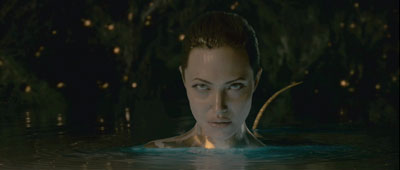
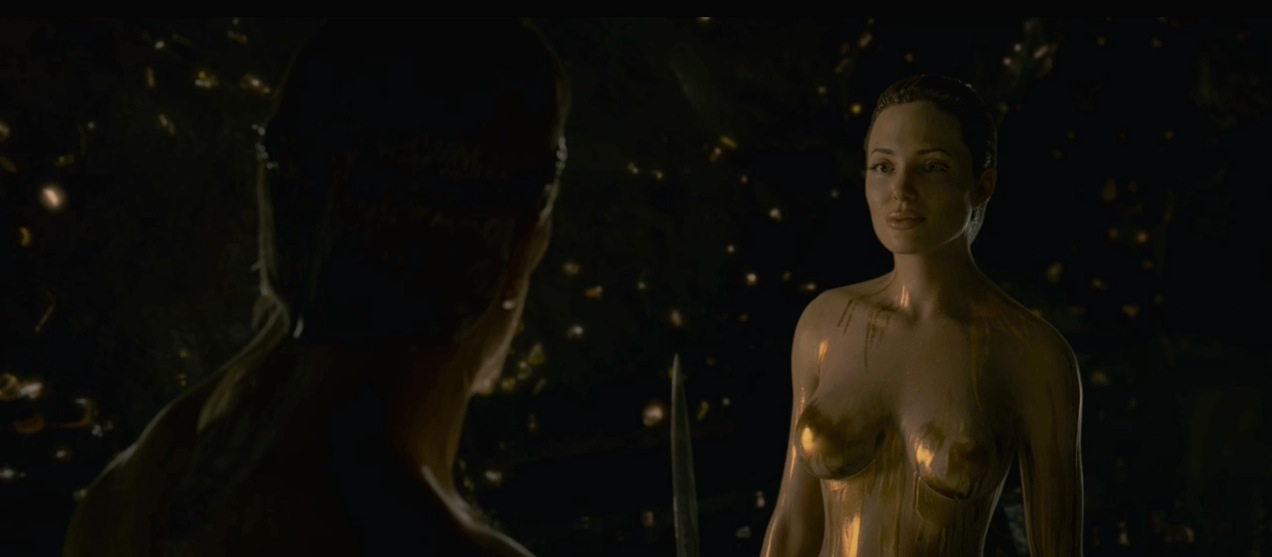
This is Zemeckis' second big motion-capture film after "The Polar Express," the "beloved" children's story made slightly creepy because all the characters look like those artists models, with resemblances of people plastered on them. One wishes to say that it's a "revolution" and all, but I'm still unimpressed, despite the thousand of person-hours involved to produce it. The landscapes and inanimate objects look great, but the people still have a clumsy way of walking and expressing themselves that takes you right out of the moment. The eyes seem all wrong, and the animation of the mouths when talking looks pinched and unconvincing, as if every character has had a few rounds of plastic surgery--the women in this are all unlined and Barbie-doll-ish. The characters played by Hopkins, Malkovich, Wright-Penn and Jolie all resemble the actors, which is also a bit of a distraction--they've done a lot of work to get Jolie "just so," but despite that there are instances where it looks like Jolie morphing into Jennifer Garner. ** But Ray Winstone, and Brendan Gleeson look like totally original characters that make them a bit more accesible. Generally, everything looks wonderful in dim-light scenes, but in the glare of daylight, the illusion falls apart.

A few other things bother, like the fight where Beowulf vows to fight Grendel naked (just to keep things even), and we are presented with object after object getting in the way of proving it. It was a running joke in "Austin Powers" and "The Simpsons Movie," but here, it's done completely straight-faced--which makes it all the more funny. The presentation of Angelina Jolie as Grendel's Mother makes the seductress role a little easier to see, but when she approaches Beowulf in all her "might-as-well-be-nakedness," there is a shot of her feet, which are cloven--but have spiked heels. Claws, yes. But spiked heels? Did Grendel's mother get the image to present herself from "Victoria's Secret?"*** Then, there's the problem that I'm seeing in more CGI movies--the "we're under a tough deadline, so let's make everything move really fast, so we don't have to do a lot of detail work" that shows up in such things as "Spiderman 3" and this film. Propulsive? Yes. Distinguishable? Not a bit. But it's easier to do a complex sequence if your make everything kind of a "smear." Finally, there's Crispin Glover as Grendel--one of those handful of roles you could say that Glover was BORN to play, but even here he's bizarrely strange--his words undecipherable, and his performance turned to "11." Like a lot of things in the film, it may produce unintended fits of giggling.

Also, this may be an animation film, but there is no way that a kid should go to this. There's a lot of gooey, icky violence, disturbing images, and nudge, nudge jokes that will have them in therapy within a week. Also, I didn't see the 3-D presentation of it--a lot of pointy things get stuck in your face in both versions--but I've been told the 3-D effects are, indeed, staggering and probably the most successful 3-D process yet produced.

I know a lot of things will stay with me--particularly the way Ray Winstone says: "Moi Nime is Baya-woof! An' Oi've cahm to kill yo' monstah"


"Beowulf" is a rental, by crom!

* I'd cite some sort of "Spoiler Alert" here, but as it's the oldest manuscript in "British" literature, and was written around 1100 AD, you've had plenty of time to read it by now!!

** A trick not beyond Zemeckis, who in the space-warp segment of "Contact," morphed Jodie Foster's face with Jena Malone's, the actress who played the character as a child.

*** Want to know what's really wierd? You go to the web-site that has the Beowulf translation on it, and there are two google ads: one for "Olde English" and the other for "sexy pics" of Angelina Jolie. One has to wonder whether the film-makers have done more harm than good.