Showing posts with label Christopher Lloyd. Show all posts

Friday, October 25, 2013

The Addams Family

First, came the macabre series of Charles Addams one-panel cartoons in The New Yorker (where the ghoulish family were only periodic characters).

Then came the TV series—the characters' names provided by Addams himself.


A quarter century later, given the trend to recycle old television into new movies, The Addams Family came to the big screen.


The Addams Family (Barry Sonnenfeld, 1991) The first directing job by cinematographer Barry Sonnenfeld, who came out of a short, boisterous career that started in the Coen Brothers/Sam Raimi early years of hyper-activity, something that he has maintained throughout his own films. Sonnenfeld's movies careen between dead-pan humor and break-neck agitation—you could see it in some of his camera moves for the Coen's and you can certainly see it in the pell-mell caroming of the first big-screen version of The Addams Family.  The casting is truly inspired and may, in fact, be perfect, with Anjelica Huston as Morticia, Raul Julia as Gomez, Chris Lloyd as Fester, and Carel Struyken as Lurch.*  

But the breakout performance is by 11 year old Christina Ricci as daughter Wednesday, who manages to make her lines all laughers with a bland expression and a direct unironic reading of her lines.  She found the secret to making the script work, because it isn't very good, (a collaboration between Beetlejuice author Larry Wilson and Edward Scissorhands scripter Caroline Thompson) not doing anything really unique with the characters, basically amping up the character traits of the TV versions while creating a plot in which Uncle Fester has been missing for 25 years (presumably lost in the Bermuda Triangle).  Gomez's crooked accountant (played by Dan Hedaya) attempts to bring an impostor in to take over the Addams fortune.  For awhile, it looks like the plan succeeds, but it doesn't, and it's soon revealed that the impostor really IS Fester, and blah, blah, blah. 


One of the jokes that works-Pugsley's collection of "Stop" signs

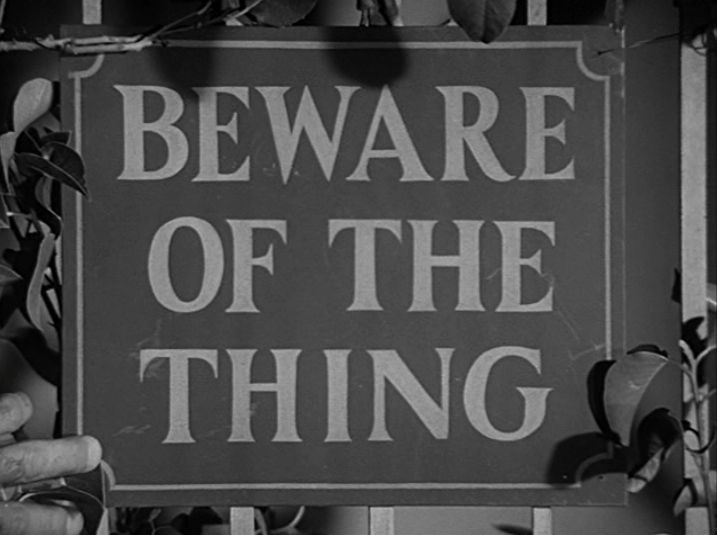
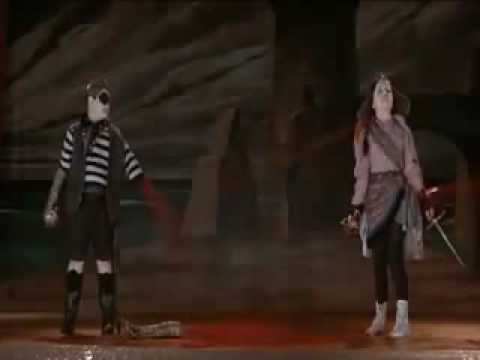
Sonnenfeld ramps up the film for all it's worth, making a lot—in fact, too much—of the character of "Thing," the disembodied hand-servant to the Addams, but the only time the film gets lively is when children Pugsley and Wednesday are forced to participate in a school version of "Hamlet" which involves a sword-fight that they make look decidedly real.  Sonnenfeld had the help of two legendary craftspeople Owen Roizman (who shot The French Connection and The Exorcist**) and master editor Dede Allen (who edited Bonnie and Clyde, Slaughterhouse-Five and Reds), but even played well, the material is stale, and was a major disappointment.  When it was announced that a sequel was being prepared, one could only think "...why?"


One of the Addams cartoons used in the film—this one
before the credits!  Frankly the film could have used
more of this and less of what they did use, which was
watered down sit-com material.


Addams Family Values (Barry Sonnenfeld, 1993) As much of a fan as I was of the "Addams" television show—I liked them, far more than the bland television families usually presented—I didn't even go see Addams Family Values in the theater (I was working—a lot).  

Big mistake.  Sonnenfeld was back, having completed a slightly tamer Michael J. Fox comedy in the interim.  Dede Allen was gone.  Owen Roizman was replaced by Don Peterman (who'd DP'd Star Trek IV, Splash, and Flashdance) and Ken Adam, legendary Art Director came on-board.


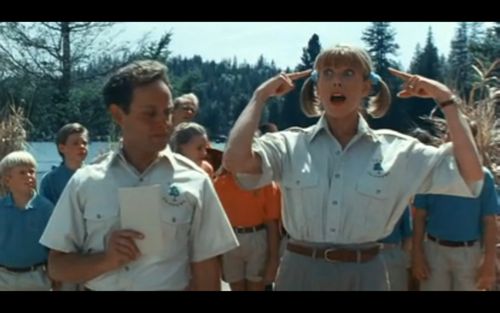
But the most important element was the script...written by Paul Rudnick*** with what must have been a poison pen from an inkwell filled with snark and maliciousness.  It is an extraordinarily funny movie, despite an unpromising premise: the Addams welcome a new child to the family, a boy, Pubert (the original name Charles Addams gave to Pugsley, rejected by the network censors). This creates enormous tension in the family, as Pugsley and Wednesday exhibit jealously and make many plans to kill the child, who manages to thwart their every efforts.  Concerned, Morticia and Gomez hire a series of nannies for the kids, all of whom are frightened away by the children, except for Debbie Jilinsky (Joan Cusack, never funnier), who attracts the attentions of Uncle Fester.  When the children become suspicious of her behavior, she convinces Gomez and Morticia to send them to Camp Chippewa, run by the extraordinarily wasp-y and perky Gary and Becky Granger (Peter McNichol and Christine Baranski), who make no secret of their disgust with these "weird" children who don't fit in.


Indoctrination in Addams Family Values


Now, that is truly creepy.  And funny.  The "Camp Chippewa" segments are the best of the film's sub-plots, indicating that if someone wants to do another film with the Addamses they need to 1) get them out of the house and 2) hire Rudnick (This iteration's Gomez, Raul Julia, sadly, passed away a year after Addams Family Values was released).  But, the entire film has more zest, more life (or what passes for it, given the subjects) and genuinely twisted humor than the original exhumation.****  It's always a pleasure to run into on the tube, no matter at which point one comes in.  


* I love doing this if only to share finds: like Carel Struyken's 360 photography site, which you can find here.

** Roizman left the production after a month.  Sonnenfeld ended up finishing the film himself.

*** Rudnick did some dialogue touch-up on the first film.

**** I've spared a lot of the quotable lines (they're peppered all over the Inter-spider-web anyway), but one little joke I love is the lighting of Mortiicia in Values-taking the "Kirk-lighting effect" used a little in the first film, and in the second, bending lightwaves backwards in order to achieve the same effect in every. single. shot.

Finally, this is my favorite Charles Addams cartoon....


Friday, May 20, 2011

Back to the Future, Part II

 Back to the Future, Part II (Robert Zemeckis, 1989) The BTTF series always left me a little cold. Sure, it was fun (in a slap-dash hap-hazard kind of way)*, and it made Michael J. Fox a movie star, breaking out from his "Family Ties" TV-role. But, I've always found the two films on either side a bit rote: BTTF I was the clever story where Marty McFly (Fox) goes back in time and saves the future marriage of his parents (Lea Thompson, Crispin Glover), which he, by his very presence in the past, is in danger of never making happen, and BTTF III is a completely superfluous entry with a retro-science-fiction Western theme that merely rectified the cliff-hangers left over from BTTF II.

Most folks consider Part II to be the superfluous one—a time-bridge to Part III—as it starts with a way-stop to the year 2015 where Marty watches in horror as he must come to terms with the loser-family he will sire. Then, because of a scripted mishap in that future which nullifies his efforts in 1955, it turns into a virtual remake of the first film wherein the Marty of 24 hours later (let's call him Marty+1) must weave his way back through the circumstances of the first movie without interfering with the past or changing its future. The goal is the same—save Mom and Dad's marriage so Marty can be born...in order to save the marriage again, like a Moebius loop made out of film. And it may feel like a re-tread—even lazy film-making—but for me, Back to the Future Part II is what the entire series should have been like.


It is also a stunning commentary on the derivative nature of sequels at a point when the trend was in its full cloning bloom. All sequels, with only a couple of select choices, are derivative—by hoping to create the same success at the box-office, the film-makers will follow the same formula, only make it bigger. Back to the Future, Part II fits the mold to a recycled "T"—it IS the same movie, but from a different angle, with the lead character re-experiencing it, and trying to set it right—again—24 hours in the future.


Due to some re-casting (Elisabeth Shue for Claudia Wells**), parts of the first film were re-filmed to keep things continuity-square.***  But there are whole sections of Part II that are mirror-images of Part I, and as you can tell by the video below, some of the same shots—especially the ones with Crispin Glover—are re-used, as Marty+1 negotiates through Part I, while avoiding any of the participants (and, one can imagine, Part I's camera crew), trying to re-re-establish the McFly romance.

But, there is one moment in Part II, that has always made my brain hurt while simultaneously making me bust out laughing and making my eyes bug out from the sheer absurd audacity of it—when outside the gymnasium Biff (the terrible Thomas F. Wilson) confronts Marty+1, at just the moment that Marty (from Part I) bursts through the gym doors, thereby knocking out M+1, thus complicating things further.

Sure, one moment does not a good movie make.  However, that exquisite bending of time and space for a comedic end has such cosmic and karmic implications that it put me in mind of the some of the filmic leaps (and falls) of the late, great Buster Keaton.  Keaton created such intricate film illusions that played with reality in its parallel universe of movies, that I think this collision (literally) of the day older and wiser Marty, by the frenetic yet-to-succeed younger version of himself would have made Buster smile.

Except he never smiled.


The moment when Marty hits Marty+1 is at 03:51


* One issue that's always grated me, though, is the apparent time anomaly that inspires Chuck Berry to write "Johnny B. Goode."  Look, mess with time all you want.  But, DON'T mess with the Rock!

** Ms. Wells was replaced, not for any aesthetic film reasons, but because she was not available; she wanted to be with her Mother, who had been diagnosed with cancer.

*** Because the Back to the Future films were produced by Steven Spielberg, and not by George Lucas, Ms. Wells has not been digitally replaced by Shue.  I think that's nice.

Friday, May 16, 2008

The Adventures of Buckaroo Banzai: Across the 8th Dimension


"The Adventures of Buckaroo Banzai", (Richter, 1984) One person's cult movie is another person's rotten tomato. Score one for the Solanum lycopersicum. though if you are a fashion-freak, you may enjoy it as an 80's period-piece. It might also solve the mystery of Peter Weller's career. (Buckaroo Banzai). The plot is both generic and nonsensical - our eponymous hero has to save the earth from a band of aliens - but it is really no more than a vehicle for the campy dialog that must have sounded really funny at the run-through. Admittedly, there are some great lines now and then but the whole experience is too tortuous to go through more than once.