Showing posts with label Anjelica Huston. Show all posts

Friday, October 25, 2013

The Addams Family

First, came the macabre series of Charles Addams one-panel cartoons in The New Yorker (where the ghoulish family were only periodic characters).

Then came the TV series—the characters' names provided by Addams himself.


A quarter century later, given the trend to recycle old television into new movies, The Addams Family came to the big screen.


The Addams Family (Barry Sonnenfeld, 1991) The first directing job by cinematographer Barry Sonnenfeld, who came out of a short, boisterous career that started in the Coen Brothers/Sam Raimi early years of hyper-activity, something that he has maintained throughout his own films. Sonnenfeld's movies careen between dead-pan humor and break-neck agitation—you could see it in some of his camera moves for the Coen's and you can certainly see it in the pell-mell caroming of the first big-screen version of The Addams Family.  The casting is truly inspired and may, in fact, be perfect, with Anjelica Huston as Morticia, Raul Julia as Gomez, Chris Lloyd as Fester, and Carel Struyken as Lurch.*  

But the breakout performance is by 11 year old Christina Ricci as daughter Wednesday, who manages to make her lines all laughers with a bland expression and a direct unironic reading of her lines.  She found the secret to making the script work, because it isn't very good, (a collaboration between Beetlejuice author Larry Wilson and Edward Scissorhands scripter Caroline Thompson) not doing anything really unique with the characters, basically amping up the character traits of the TV versions while creating a plot in which Uncle Fester has been missing for 25 years (presumably lost in the Bermuda Triangle).  Gomez's crooked accountant (played by Dan Hedaya) attempts to bring an impostor in to take over the Addams fortune.  For awhile, it looks like the plan succeeds, but it doesn't, and it's soon revealed that the impostor really IS Fester, and blah, blah, blah. 


One of the jokes that works-Pugsley's collection of "Stop" signs

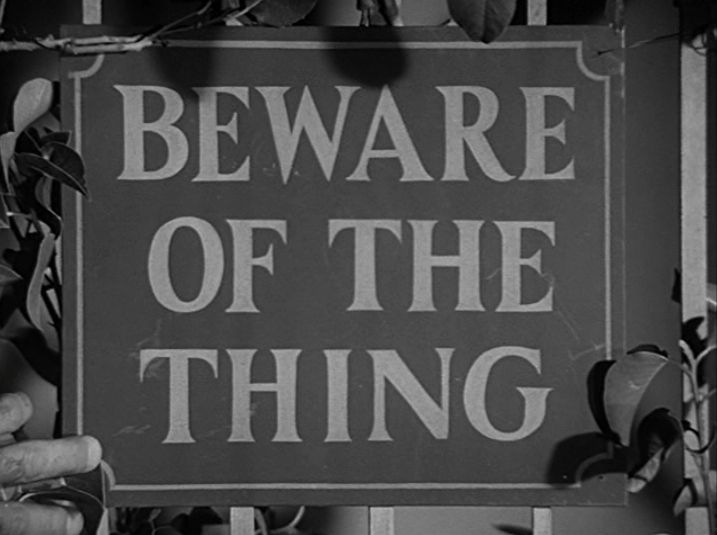
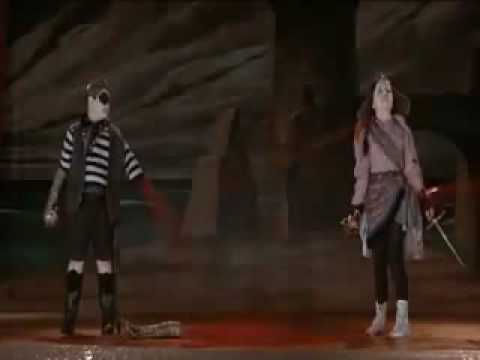
Sonnenfeld ramps up the film for all it's worth, making a lot—in fact, too much—of the character of "Thing," the disembodied hand-servant to the Addams, but the only time the film gets lively is when children Pugsley and Wednesday are forced to participate in a school version of "Hamlet" which involves a sword-fight that they make look decidedly real.  Sonnenfeld had the help of two legendary craftspeople Owen Roizman (who shot The French Connection and The Exorcist**) and master editor Dede Allen (who edited Bonnie and Clyde, Slaughterhouse-Five and Reds), but even played well, the material is stale, and was a major disappointment.  When it was announced that a sequel was being prepared, one could only think "...why?"


One of the Addams cartoons used in the film—this one
before the credits!  Frankly the film could have used
more of this and less of what they did use, which was
watered down sit-com material.


Addams Family Values (Barry Sonnenfeld, 1993) As much of a fan as I was of the "Addams" television show—I liked them, far more than the bland television families usually presented—I didn't even go see Addams Family Values in the theater (I was working—a lot).  

Big mistake.  Sonnenfeld was back, having completed a slightly tamer Michael J. Fox comedy in the interim.  Dede Allen was gone.  Owen Roizman was replaced by Don Peterman (who'd DP'd Star Trek IV, Splash, and Flashdance) and Ken Adam, legendary Art Director came on-board.


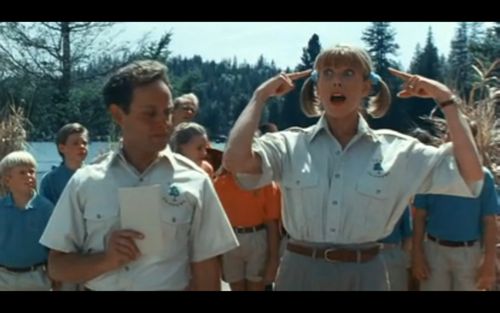
But the most important element was the script...written by Paul Rudnick*** with what must have been a poison pen from an inkwell filled with snark and maliciousness.  It is an extraordinarily funny movie, despite an unpromising premise: the Addams welcome a new child to the family, a boy, Pubert (the original name Charles Addams gave to Pugsley, rejected by the network censors). This creates enormous tension in the family, as Pugsley and Wednesday exhibit jealously and make many plans to kill the child, who manages to thwart their every efforts.  Concerned, Morticia and Gomez hire a series of nannies for the kids, all of whom are frightened away by the children, except for Debbie Jilinsky (Joan Cusack, never funnier), who attracts the attentions of Uncle Fester.  When the children become suspicious of her behavior, she convinces Gomez and Morticia to send them to Camp Chippewa, run by the extraordinarily wasp-y and perky Gary and Becky Granger (Peter McNichol and Christine Baranski), who make no secret of their disgust with these "weird" children who don't fit in.


Indoctrination in Addams Family Values


Now, that is truly creepy.  And funny.  The "Camp Chippewa" segments are the best of the film's sub-plots, indicating that if someone wants to do another film with the Addamses they need to 1) get them out of the house and 2) hire Rudnick (This iteration's Gomez, Raul Julia, sadly, passed away a year after Addams Family Values was released).  But, the entire film has more zest, more life (or what passes for it, given the subjects) and genuinely twisted humor than the original exhumation.****  It's always a pleasure to run into on the tube, no matter at which point one comes in.  


* I love doing this if only to share finds: like Carel Struyken's 360 photography site, which you can find here.

** Roizman left the production after a month.  Sonnenfeld ended up finishing the film himself.

*** Rudnick did some dialogue touch-up on the first film.

**** I've spared a lot of the quotable lines (they're peppered all over the Inter-spider-web anyway), but one little joke I love is the lighting of Mortiicia in Values-taking the "Kirk-lighting effect" used a little in the first film, and in the second, bending lightwaves backwards in order to achieve the same effect in every. single. shot.

Finally, this is my favorite Charles Addams cartoon....


Wednesday, June 29, 2011

The Dead


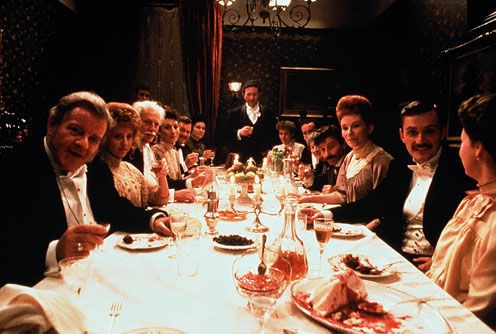
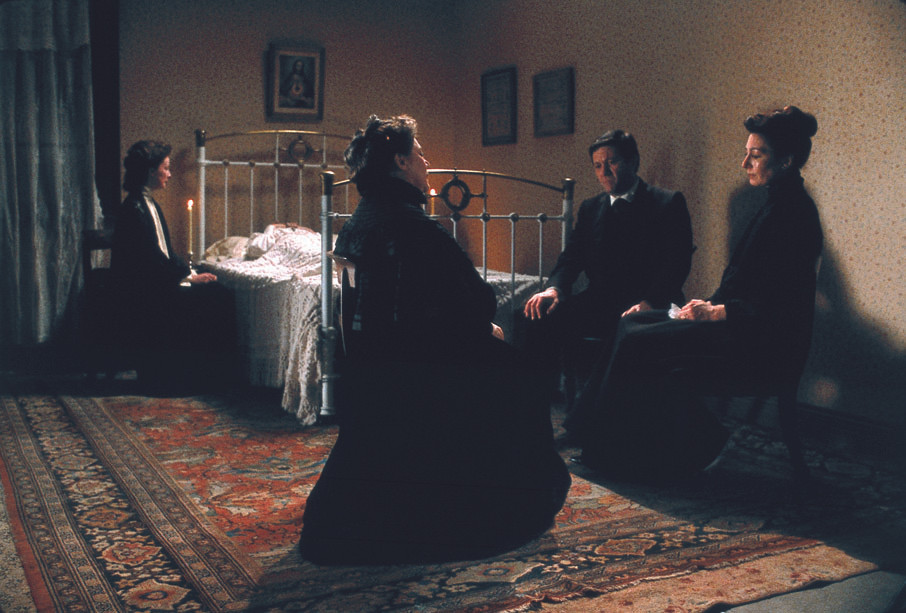
The Dead (John Huston, 1987) An annual Epiphany dinner held by the Morkan sisters (Helena Carroll, Cathleen Delany) creates an epiphany for their nephew, Gabriel (Donal McCann) and his wife Gretta (Anjelica Huston) in the legendary director's last film, a film every bit as strong as his first (The Maltese Falcon way back in 1941) and in many ways far, far more subtle.

You look back on the accomplishments of Huston's career—the classics like Falcon, The Treasure of the Sierra Madre, The African Queen, The Man Who Would Be King, the grandiose films of the '50's, his WWII documentaries, and "unfilmable" projects like Moby Dick, The Bible: In the Beginning..., Reflections in a Golden Eye, Wise Blood and Under the Volcano, and the occasional mis-step like Beat the Devil, Casino Royale, The Life and Times of Judge Roy Bean, Phobia, or The MacKintosh Man*—to "go out" on this simple, elegant adaptation of one of his favorite authors' (James Joyce) short stories, working with his kids (Tony wrote the screenplay, Anjelica stars and in many ways is the "center" of the film), set in the land he loved—Ireland—where he lived and filmed for so many years.  An insatiable gambler on- and off-set, this one he was "all in" and left the table a winner.

Tough project, too.  Most of it set in one room, a large part around a dinner table, with fine singing (and in one case, not—but the guests are graceful in their praise—and the director moves away from the elderly actress singing, having trouble with lip-syncing the dubbed song, and charitably meanders to another room, dwelling on the cherished collections of that character's rich life, instead).  Huston was in frail health, directing from a wheelchair using a monitor in another room to keep the sound of his by-now always required air compressor from the filming.

Graceful is the word for The Dead, and despite the title, it only periodically succumbs to Irish melancholy.  It centers around a celebration, after all, a once-a-year special ocassion in which, who knows, it may be the last time some of the group might be there.  Best to keep the spirits up, the praise high, and the liquor slightly rationed.  And there aren't any small parts here, if the lines are unevenly distributed, there are bits of business, reaction shots, ensemble acting and quite a bit of dancing to keep things busy.

I just wish (selfishly) the host had stuck around to throw another party.


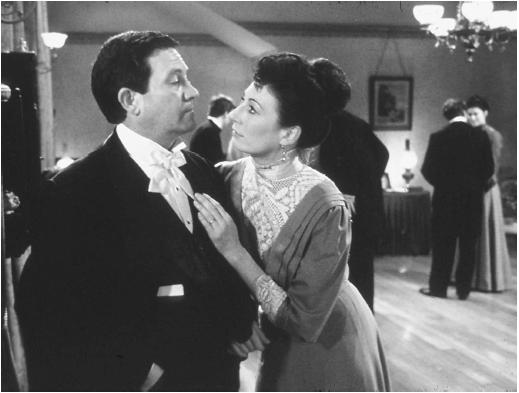
There is a lot of love in this shot, displayed on-screen and off


* Just imagine if his last film was Annie—which, in itself, was a weird untypical chancey project for him to take on!

Tuesday, October 7, 2008

Choke

"Know Thyself"* or "The Running Gag"

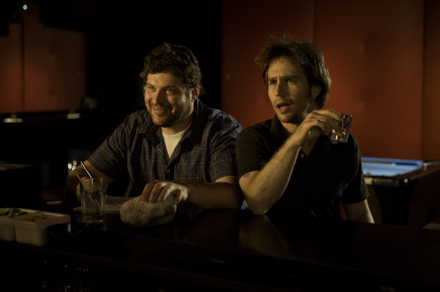
Vincent Mancini (Sam Rockwell) is conflicted, stymied, blocked, obstructed and stone-walled.

He is not, however, impotent.


He's a sex addict. He's half-heartedly going to a support group for sex mania. And whole-heartedly failing to commit...to the group's four-step program, or any serious relationship. In fact, every time he goes to one of the meetings he ends up taking a step or two back. Understandable, as the group is full of sex maniacs!

He works as
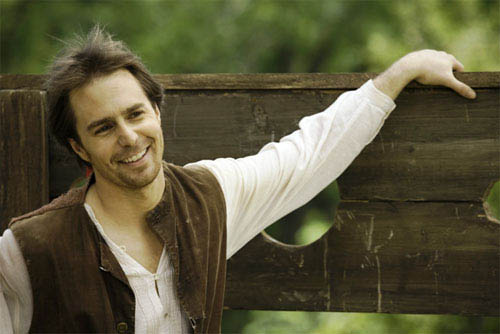
a tour-guide at a historical reconstruction of a Revolutionary-period village ("I am the back-bone of Colonial America" he intones to the camera, as if he was reciting narration from "Fight Club"--the marketing for the film features that film's title in slightly smaller type than its own). There, he fantasizes about ripping the bodices off of every female employee. He wants to know them in the biblical sense, if not know them in the intimate sense.


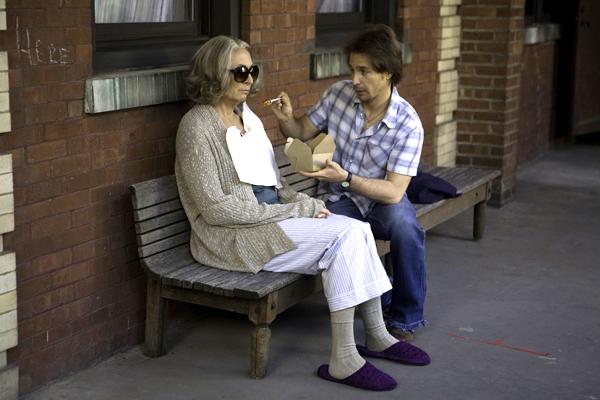
His mother (Anjelica Huston) is in a permanent care facility suffering from dementia, not from Alzheimer's, but from repeated and systematic drug use. She now only recognizes Vincent as one of a series of dead lawyers she once knew, which is fine, except that Vincent wants to know more about his past--specifically who his father is--and that knowledge is slowly fading from memory. Vincent is desperate to know that he has some DNA not related to his addled mother's.

His life is so abnormal, that he craves the normal even if he wouldn't recognize it if he was hit in the head with it. As a child he was jerked from foster-home to foster-home, always rescued by Mom, for a series of runs-to-the-border interrupted by arrest and another foster home. The only love he has known is when his mother saved him from choking on a corn-dog using the Heimlich maneuver. Now, he goes from restaurant to restaurant purposefully choking on food, in the hope that someone will rescue him. And give him some money out of sympathy to keep Mom in that facility.

The story so strains to be unconventionally amusing that it is crushingly disappointing to have it become so...conventional in its resolution and the embracing of the good and the normal as the panacea for all ills. "
Choke" plays by the old bait and switch of the Hollywood system under the Hays Code. Lure the audience in with scandal, titillation and promises of lurid behavior, then turn it into a homily about the right, true path. "Choke" becomes the sort of sanctimony-in-wolf's-clothing that you would find in such films as "Peyton Place," "Sex and the Single Girl," or any horny teen sex-comedy, combined with the basic trope of psychological films where all one's neuroses are cured with a sudden remembrance of that one key event that unlocks all the symptoms, and you have the basic dull curve that "Choke" slides into. Everything falls like a house of cards once the underlying truth is revealed.**

One should expect more from the author of "Fight Club," but it's not his fault. Blame writer-director Clark Gregg for this one. He's taken all the thorns off of Palahniuk's outline and exposed the basic tawdriness of his novel to the light of day and making it shrivel like a vampire.***

The only thing to recommend this film is Rockwell and Huston, who manage to breathe life into their characters--they're the best written in the screenplay. Sensitive viewers should be aware of the pervasive language, and sexual situations, which are not glamorized in the least.

"Choke" is a the very cheapest and sleaziest of rentals.

* Inscribed at the Temple of Apollo at Delphi. John Huston used it in the prologue for his film "Freud: The Secret Passion," as the basic tenet of psychology. In the context of "Choke," I find it a rather useful and funny reference.

**As in the other Palahniuk adaptation. It's interesting, the whole "falling house of cards" metaphor for the psychological scale falling from one's eyes can be applied (quite literally) to "Fight Club" as well, and it's just as much an oversimplification of the process as "Choke," or for that matter, "Freud," or "Spellbound." It did clue me into the conclusion that "Fight Club" is a completely mentally-contained movie--that is, it's all happening in the main character's head. All of it. Or it doesn't make any sense. If that is the intention, my respect for the film just doubled. Maybe the scales fell from my eyes.


*** One more thing: Gregg joins the group of actor-creators not content to stay behind the camera of their films, ala M. Might Shyamalan, Mike Binder, and Kenneth Lonergan. The likes of Costner and Harris and Gibson act and direct because the producers cut their losses on actors' "special projects" by keeping their legitimate box-office draws up-front. There's no financial reasons that Shyamalan or Lonergan or Gregg should be splitting their attentions acting, and writing-directing. Hitchcock made cameos in his films initially to fill in crowd scenes, then it came to be expected--a running gag lasting throughout his career. Here the "Hitchcock moments" are merely self-serving.