First, came the macabre series of Charles Addams one-panel cartoons in The New Yorker (where the ghoulish family were only periodic characters).

Then came the TV series—the characters' names provided by Addams himself.
A quarter century later, given the trend to recycle old television into new movies, The Addams Family came to the big screen.

 But the breakout performance is by 11 year old Christina Ricci as daughter Wednesday, who manages to make her lines all laughers with a bland expression and a direct unironic reading of her lines. She found the secret to making the script work, because it isn't very good, (a collaboration between Beetlejuice author Larry Wilson and Edward Scissorhands scripter Caroline Thompson) not doing anything really unique with the characters, basically amping up the character traits of the TV versions while creating a plot in which Uncle Fester has been missing for 25 years (presumably lost in the Bermuda Triangle). Gomez's crooked accountant (played by Dan Hedaya) attempts to bring an impostor in to take over the Addams fortune. For awhile, it looks like the plan succeeds, but it doesn't, and it's soon revealed that the impostor really IS Fester, and blah, blah, blah.
  |
| One of the jokes that works-Pugsley's collection of "Stop" signs |

 |
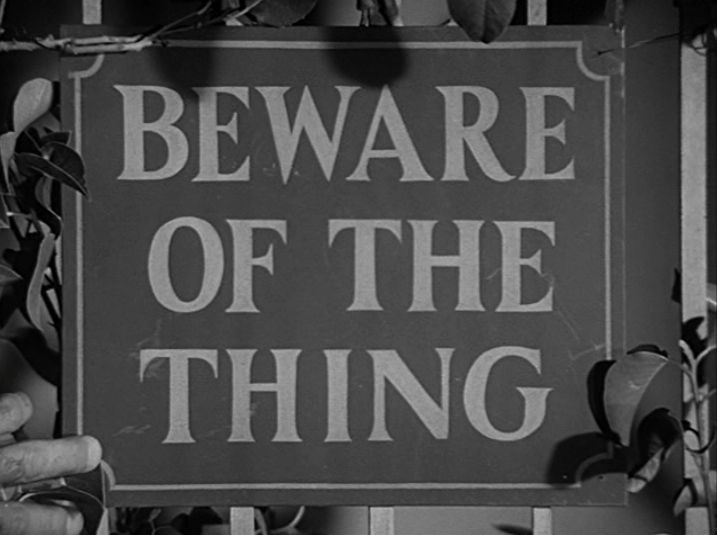
| One of the Addams cartoons used in the film—this one before the credits! Frankly the film could have used more of this and less of what they did use, which was watered down sit-com material. |

Big mistake. Sonnenfeld was back, having completed a slightly tamer Michael J. Fox comedy in the interim. Dede Allen was gone. Owen Roizman was replaced by Don Peterman (who'd DP'd Star Trek IV, Splash, and Flashdance) and Ken Adam, legendary Art Director came on-board.
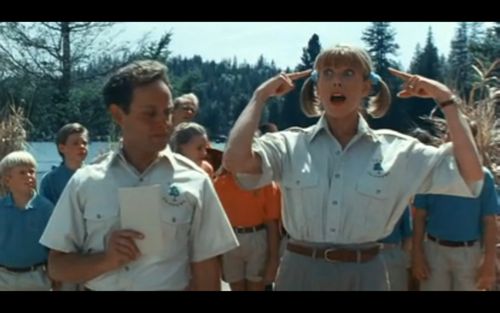
But the most important element was the script...written by Paul Rudnick*** with what must have been a poison pen from an inkwell filled with snark and maliciousness. It is an extraordinarily funny movie, despite an unpromising premise: the Addams welcome a new child to the family, a boy, Pubert (the original name Charles Addams gave to Pugsley, rejected by the network censors). This creates enormous tension in the family, as Pugsley and Wednesday exhibit jealously and make many plans to kill the child, who manages to thwart their every efforts. Concerned, Morticia and Gomez hire a series of nannies for the kids, all of whom are frightened away by the children, except for Debbie Jilinsky (Joan Cusack, never funnier), who attracts the attentions of Uncle Fester. When the children become suspicious of her behavior, she convinces Gomez and Morticia to send them to Camp Chippewa, run by the extraordinarily wasp-y and perky Gary and Becky Granger (Peter McNichol and Christine Baranski), who make no secret of their disgust with these "weird" children who don't fit in.
Indoctrination in Addams Family Values
Now, that is truly creepy. And funny. The "Camp Chippewa" segments are the best of the film's sub-plots, indicating that if someone wants to do another film with the Addamses they need to 1) get them out of the house and 2) hire Rudnick (This iteration's Gomez, Raul Julia, sadly, passed away a year after Addams Family Values was released). But, the entire film has more zest, more life (or what passes for it, given the subjects) and genuinely twisted humor than the original exhumation.**** It's always a pleasure to run into on the tube, no matter at which point one comes in.

* I love doing this if only to share finds: like Carel Struyken's 360 photography site, which you can find here.
** Roizman left the production after a month. Sonnenfeld ended up finishing the film himself.
*** Rudnick did some dialogue touch-up on the first film.
**** I've spared a lot of the quotable lines (they're peppered all over the Inter-spider-web anyway), but one little joke I love is the lighting of Mortiicia in Values-taking the "Kirk-lighting effect" used a little in the first film, and in the second, bending lightwaves backwards in order to achieve the same effect in every. single. shot.
*** Rudnick did some dialogue touch-up on the first film.
**** I've spared a lot of the quotable lines (they're peppered all over the Inter-spider-web anyway), but one little joke I love is the lighting of Mortiicia in Values-taking the "Kirk-lighting effect" used a little in the first film, and in the second, bending lightwaves backwards in order to achieve the same effect in every. single. shot.
Finally, this is my favorite Charles Addams cartoon....