Showing posts with label C. Show all posts

Friday, November 15, 2013

The Counselor (2013)

Couples Therapy
or
How to Get a Head in Business

The Counselor is not "The Worst Movie Ever Made" (as some would have it) nor should such a withering condemnation (from a critic? *pfft*) warrant it any sort of pity-praise to escalate it above what it deserves.  Pity is the last thing on the mind of The Counselor.

What it is is the first original screenplay by Cormac McCarthy—he also exec-produced—and directed, with a lavish budget for just about everything, including dirt, by Ridley Scott, who one should now probably call a "stylist," rather than a director. Everything looks great.  But, again, one wonders if Scott read the script beyond descriptions.  


Like so much of McCarthy's work, it is dark and gritty and nihilistic—in a hopeful, moral kind of way; in other words, it's a story or very bad people doing very bad things from the point of view of a person who is tsk-ing in the background.  Perfect director for this would have been Martin Scorsese.  But, it's Ridley Scott who, given his past, seems to have a lot of sympathy for the devil (Blade Runner, Legend, Hannibal, Matchstick Men, American Gangster, Prometheus), indeed, in his last movie, the hero was, once again, a synthetic human being with its own sense of ethics.  That synth was played, rather brilliantly, by Michael Fassbender, which is why he's the titular lead.


The thing about novelists doing screenplays and writing for the movies is they're slumming, unless they see themselves as legitimate film-makers (see the Coen Brothers or John Sayles).  Maybe McCarthy couldn't flesh out his characters for the novel form.  Maybe he wanted to see what a film-maker wanted to do with a work he wasn't happy with and see what the collaborative process would produce.  Maybe he wanted to make some money.  But, for whatever reason, McCarthy chose to do this as a film, and not a fully thought out novel.


"...red in tooth and claw"
Maybe he just didn't like it.  It's extraordinarily simplistic—The Counselor spends the first half warning its protagonist "Don't do this" and casually mentioning ways in which people can be killed, usually involving decapitation ("it's just business").  Once he's "locked in," it spends the second half eliminating most of the cast in precisely the ways that have been described in the first half.  It answers the question that is contained in a couple iof questions in that first half—"Why am I telling you this?"  Obviously, so we can anticipate it being used later and knowing what's happening.  In other words, literally, the first half of The Counselor is a prolonged "you just don't get it, do you?" speech.  The second half, he gets it (I'd warn about spoilers here, but everything is telegraphed fairly early on, even "the surprise" puppet-master of the thing).

One interesting aspect of The Counselor is the cast...or, at least, the cast as it once was.  Fassbender was always going to be in it, evidently, but the others were going to be real-life couples Brad Pitt and Angelina Jolie and Javier Bardem and Penélope Cruz, but slightly scrambled so that Bardem and Jolie would be a couple and Fassbender and Cruz would be paired.  At some point, Jolie dropped out and Cameron Diaz was cast in her role.  She's as fine as everybody else in the cast, but the dialog is difficult for swallow.  Take for example, this:


I suspect that we are ill-formed for the path we have chosen. Ill-formed and ill-prepared. We would like to draw a veil over all the blood and terror that have brought us to this place. It is our faintness of heart that would close our eyes to all of that, but in so doing it makes of it our destiny... But nothing is crueler than a coward, and the slaughter to come is probably beyond our imagining.
I remember a scene from the Elia Kazan film of The Last Tycoon where movie mogul Monroe Stahr in a fit of pique exits a screening saying "'And I, you...' nobody TALKS like that."  Everybody talks like that in The Counselor, everybody's vocabulary is up to snuff, and everybody has the time to ponder and philosophize.  But what their philosophy centers around is Nature, "red in tooth and claw."  But Nature doesn't have the time to think about what it is doing, except strategically.  If there is a slaughter to come for the human race, the meek won't inherit the Earth, but evidently the pretentious will. 

Everybody talks a good game in The Counselor, but it makes a bad movie.

The Counselor is a Cable-Watcher. 

Friday, November 1, 2013

Post Hallowe'en Special: Get Off the Lawn, You "Damned" Kids!

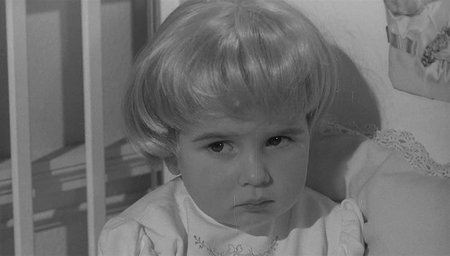
Village of the Damned (Wolfe Rilla, 1960)  Based on the John Wyndham sci-fi novel "The Midwich Cukoos," adapted by Stirling Silliphant and director Rilla, Village of the Damned* is a curious mixture of sci-fi and horror—a combination of pulp sensibilities, but with a strange sub-text that could be taken as religious, mystical, or invasive, and then has the audacity to not answer any of the questions and leave you hanging as the suppositions swirl through your head.  Both it and its sequel are fascinating things to watch, but each in their different way.

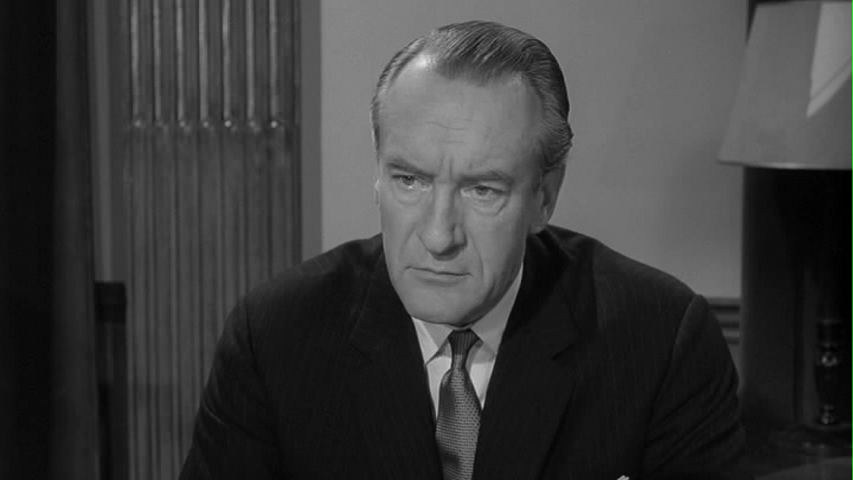
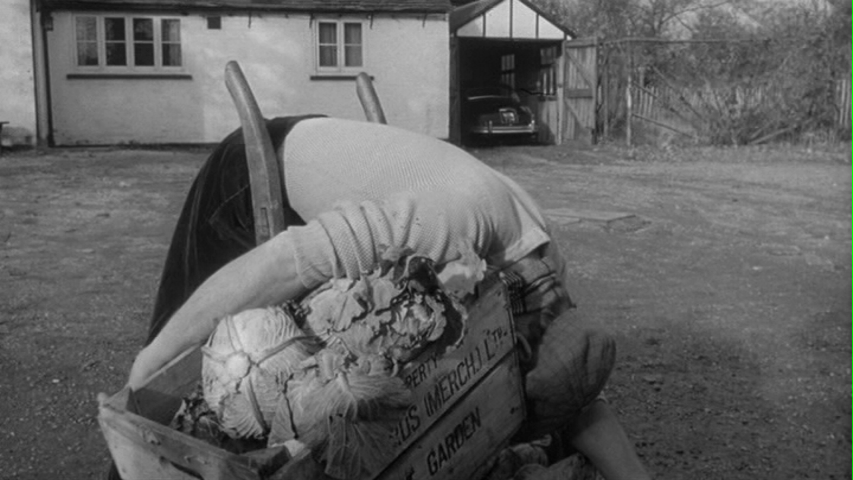
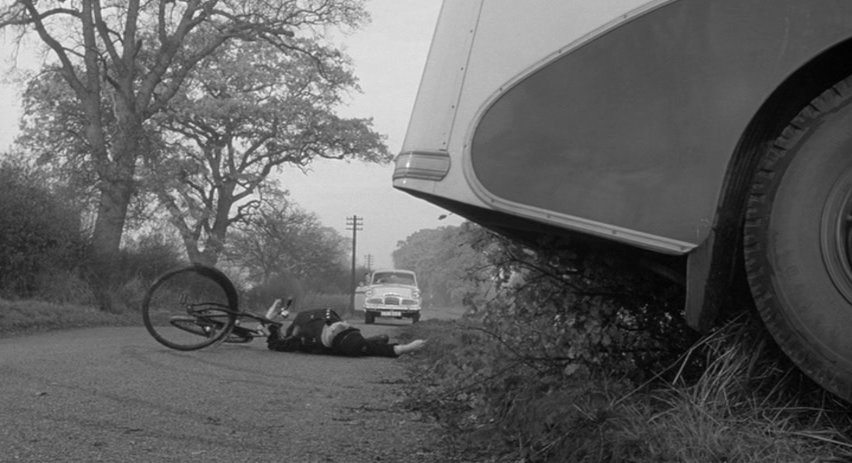
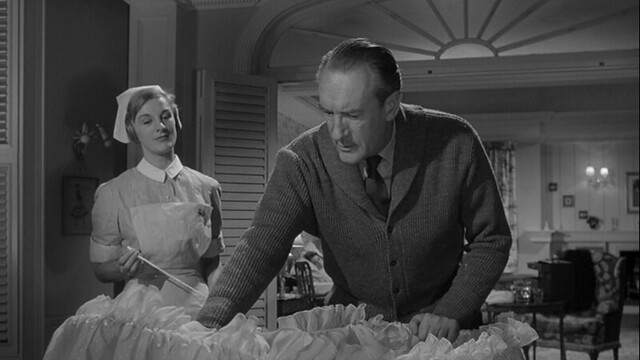
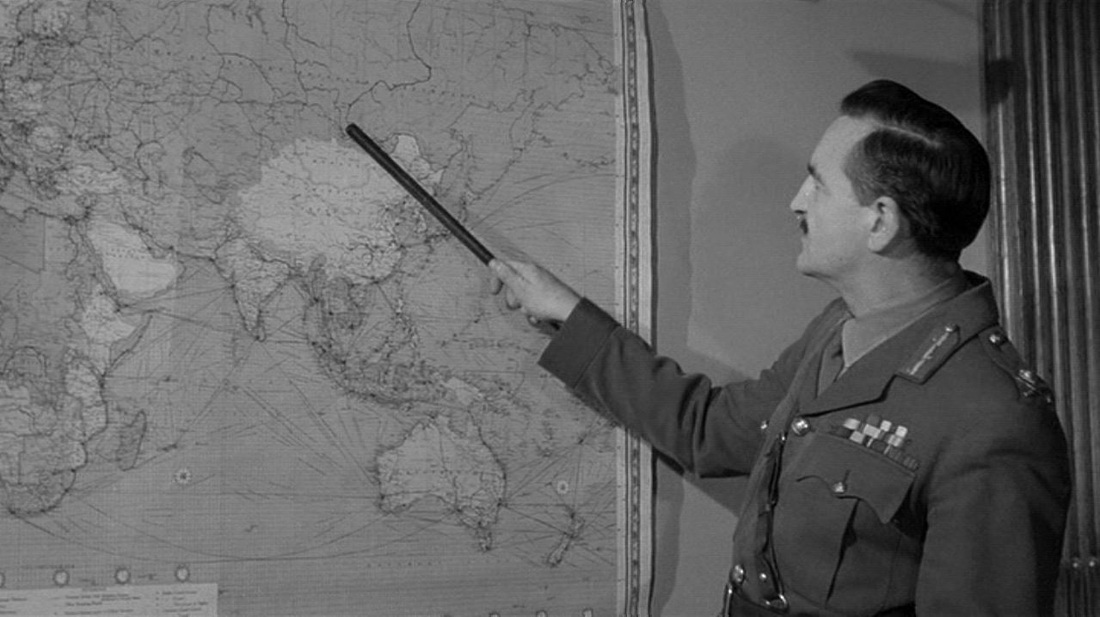
In the town of Midwich, professor Gordon Zellaby (George Sanders) is making a call to his brother-in-law Alan Bernard (Michael Gwynn) when all of a sudden, he falls unconscious.  So does the family dog.  Bernard is alarmed at this and can't raise anyone in town, so he investigates and being in the military he doesn't do it subtly.  What he finds is that everyone within a few mile radius of city center is unconscious...or will become unconscious (even taking preventative measures like gas-masks) if they enter within that "zone"—aeroplanes flying overhead will have their pilots drop off, the planes crashing.  


It's a mystery.  Why this town?  Why this effect?  But, two hours later, everyone awakens, mystified.  They felt a cold sensation before they dropped, but that was it.  The disturbance is forgotten.


Until two months later, when it's determined that every woman "of child-bearing years" in Midwich is pregnant.  For Zellaby and his wife (Barbara Shelley), it's a miracle though it's a little late in life for him.  But, for the unmarried women in town, and for the women with husbands away, it's not only embarrassing, it has to be some bizarre mistake...and when it's confirmed it makes things uncomfortable, socially.  For awhile they're stigmatized, but before long (and with the doctor's confirmation) it's determined that all the women are pregnant...and they don't how.


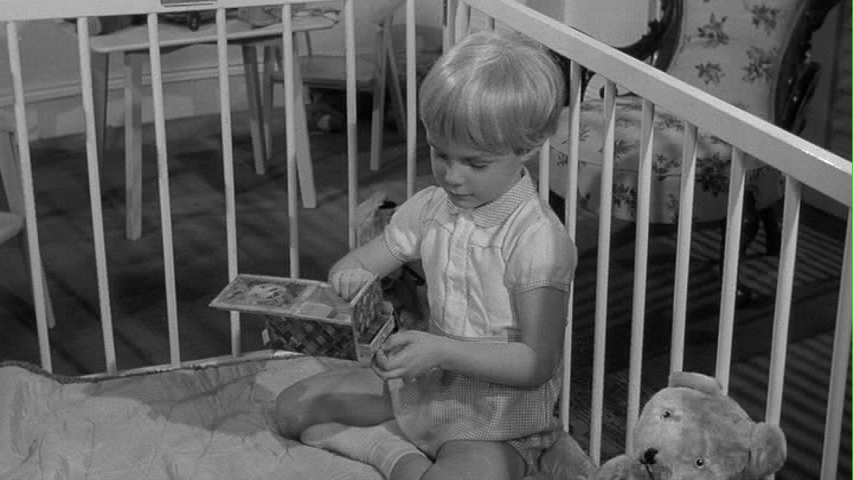
Out of this mass-immaculate conception, the village is seriously creeped out, but the children appear to be normal, if gestating at an accelerated rate.  And all are born on the same night, all premature by normal standards, but all around ten pounds, all with white shocks of hair and something "weird" about their eyes, totally black.  The kids grow quickly and they learn quickly, being able to figure out chinese puzzle boxes while still toddlers.  Give it to one, and then another, sight unseen, will be able to figure it out, as if by telepathy or shared mental faculties.

And...if things don't go their way, they can influence the thoughts and actions of others, an act apparent when their eyes begin to glow white.  The children, as they grow older and become more sophisticated, become even odder—walking as a group by themselves, dressing themselves, speaking in a tone, sophisticated and cold.
**

What to do about them...and who "is" them, anyway?  No one has any answers, but reports around the world suggest Midwich isn't the only village on Earth to experience this.  Some of the places have murdered the children. One isolated village in Russia is trying to instruct the children to the best they can.  What is the answer: to eradicate, or to exploit? 

The military doesn't want to do anything subtle, but Zellaby, with doubts as to their origin, staves off their eradication by seeing if he can teach them in their own segregated school (naturally).  The trouble is, the children don't want to do anything subtle, either, and these kids are of a mind to stop the problem of bullying by any means necessary.


This is a great film, which doesn't shirk societal issues at the same time it doesn't pin down exactly what the hell is going on here.  The fact is the kids are here and dealing must begin.  But how, never mind why.  Plus, it's a genuine horror-fest, making one web-site's list of "10 movies pregnant women should never watch." Apt.  And one curious anomaly about the film is that the strange glowing eyes that signal some heavy brain-work on the part of the children (and figures in the denouement) is only seen in American prints of the film.  Interesting, as they seem to appear in the British posters for the film.

But, those curiosities aside, it's well-worth seeing, and pondering...

One further note, young Martin Stephens who gives such a calmly mature performance as little David Zellaby in this (and The Innocents) left acting while still a child and became an architect.  Yes, he has a web-site.


°° °° °° °° °° °° °° °° °° °° °° °° °° °° °° °° °° °° °° °° °° °° °° °° °° 


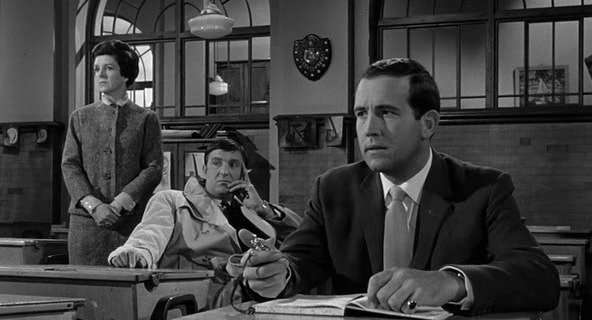
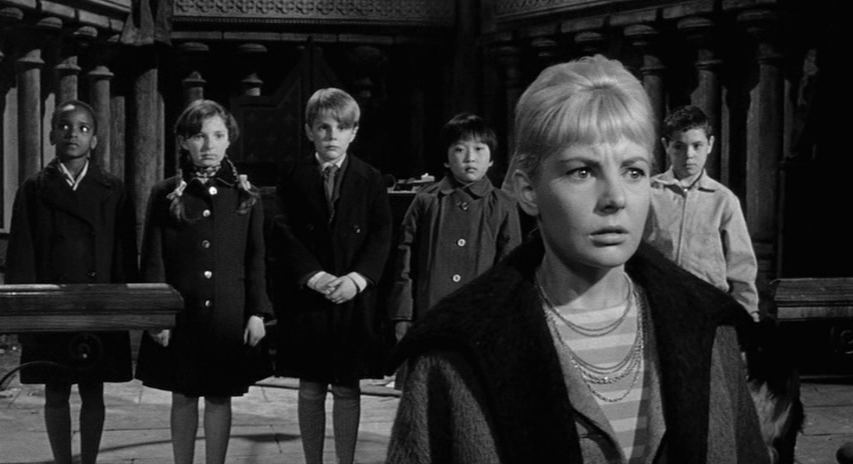
Children of the Damned (Anton M. Leader, 1964) If Village of the Damned leaves things unexplained, Children of the Damned just complicates the issue, rather than coming up with any concrete answers. The six titular children have the same powers and intellect, but not the same attributes.  None of them has the tell-tale white hair or the slightly high browline as the first crop of kids.  And there's only one child from Britain; the others, flown in by the UN, come from Russia, China, India, America, and Nigeria and their abilities are only discovered by a UNESCO survey on child development.  The lead investigators in England, psychiatrist Tom Llewelynn (Ian Hendry) and geneticist Dr. David Neville (Alan Badel, laconically ironic) are looking into the why's and wherefore's of young Paul Looren (Clive Powell), a child of extraordinary learning skills that are frankly off their charts.  A visit to his single mother only ends with her tossing them out and their disbelief in her claiming she was never "touched by a man."

Llewelynn and Neville make an odd duck duo,*** the shrink earnest and straightforward and the geneticist cracking wise with every line.  Their investigations come up with no reason why these kids have these abilities, they just do, and when Britain's Secret Service tries to take control of young Paul, he sets up a distraction and scampers, seeking out the other five children and taking up residence in an abandoned church, with Paul's aunt (Barbara Ferris) as hostage/mouthpiece.  The various embassies want each of their children back to exploit them, weaponizing them, in effect.  Llewlynn is thunderstruck by the idiocy of that: "As soon as one of them knows your plan, then the others will know it."  So much for Cold War secrets.


Neville and Llewelynn, U.N. observers...observing

Still the various countries want their kids back, and the kids want nothing of it, attacking from their stronghold in the church, devizing a broadcasting "thingie" using the church's pipe-organ to incapacitate anyone attempting to remove them, leaving their attackers dead or "wishing they were."


Children of the Damned is slightly diminished from its original, but on its own is one of those great science fiction films of limited scope and budget that still manages to evoke the sense of a much larger concept, despite narrowing down what the children "are," while giving the film a sense of cautionary tragedy that the first film doesn't have.  Less a horror film than a story of sociological and political paranoia, Children of the Damned features good performances and an efficiently crackling script (by John Briley—he would go on to write Cry Freedom and Gandhi) and manages to stand on its own terms, apart from the first film, as an entertaining, if very unsettling film.


...and what they're observing.


°° °° °° °° °° °° °° °° °° °° °° °° °° °° °° °° °° °° °° °° °° °° °° °° °° 


Village of the Damned (John Carpenter, 1995) This updated version of the original follows the same plot structure of the first, with less emphasis on the mysterious circumstances that cause the "immaculate" pregnancies in the town of "Midwich, California," less stigma—it is the '90's, after all, there's even the subject, given the circumstances, of aborting the children—and more emphasis on the children and the violence they mete out on the town.  In color, and sporting a good cast of stars (with Christopher Reeve—his last role before his crippling accident—Linda Kozlowski—she of the "Crocodile Dundee" series—Michael Paré, Mark Hamill and Kristie Alley), these kids are more pointedly accusatory, speak in archly threatening whispers,**** and action-oriented, and unusually vicious in the way they have their victims destroy themselves—impaled on a broom, blinding an eye-doctor, having one of the parents driving into a propane tank (rather than a brick wall), another perform an autopsy on herself, and the botched military intervention in another country alluded to in the first film is dutifully played out with all the blood-bags the budget can allow—and Carpenter doesn't cut away as the original did.  There's no implication here, which (as it usually is) isn't as powerful as leaving your audience's squirming imagination to do the dirty work.  


Christopher Reeve's doctor hates talking to kids.

On the plus side, it's less of a man's world this time out on both sides: the chief investigator of the phenomenon is a woman (Alley, whose a bit cavalier in her dealing with the kids) and the leader of the children is one of the little girls, Mara (Lindsey Haun) daughter of Reeve's local physician and his wife (Karen Kahn).  This time out, the children pair off, boy-girl, with one of the children (Tom Dekker) left partnerless because one of the children is stillborn, and, as a result, being the only one to develop any empathy at all.  The other kids are little monsters who, when forced to go up against an adult with any will at all, will have the pinwheels in their glowing eyes go from green to red to white, then, just to stack the deck against them further, their faces glow red into a demon's visage.

In other words, what was subtle and thought-provoking in the first film doesn't have the same effect in this one.  And the reason is you're being beaten over the head with it, and rather pointlessly.  There's no ambiguity here.  There's no mystery.  It's just a simple formula: strange is bad=kill it. Carpenter can be a good film-maker and stylist—he wrote the playbook on the post-Hitchcock slasher film (which may not be much of a recommendation—until you compare it with his imitators).  Maybe this was just a case of studio expectations for meeting a carnage quotient.  But whatever it is, the 1995 remake of the Village of the Damned takes all the fun...and the seriousness out of the story.

And that's a "Damned" shame.


* There is another film done by the Hammer group, and directed by American director Joseph Losey, starring McDonald Carey and Oliver Reed called (depending on which version you see) These are the Damned or The Damned, and are unrelated to this film series, although it does involve children, with special qualities.

** It was odd watching it this time around, as the children, particularly Martin Stephens, reminded me of no one so much as Sheldon Cooper, Jim Parson's character on "The Big Bang Theory."  Sorry, DR. Sheldon Cooper.

*** And no, I don't think they're gay, even if they do share a flat in London (separate rooms, mind you).  Both are on assignment from Unesco in London.

**** Unfortunately, the kids' performances are melodramatically threatening, a bit like Patty McCormick in The Bad Seed.

Friday, October 25, 2013

Carrie (2013)

To Carrie Out the Lord's Vengeance
or 
"Mama, Don't Ruin it!"

I've been working on a review of Brian De Palma's latest film Passion the last couple of weeks (still working out how I feel about it—on a superficial enjoyment level it doesn't succeed very well, but if you appreciate craft and detail there is a lot to digest, and it makes you realize that a lot of older directors go through that shift where the details are more important than the Big Picture) and was watching an interview with De Palma* about the film (which I'll include again when I get around to finishing it) and at one point the subject of Kimberly Pierce making a new version of Carrie was broached.  

"We're friends", he said of Pierce, who made Boys Don't Cry and Stop-Loss. "I've seen some stuff and it looks good."  But the more telling comment from the talk is when someone brings up Piper Laurie (who played mother Margaret White in his version) and De Palma remarks: "Piper thought we were making a comedy."

As well she might have.  Stephen King's "Carrie" is a hoot to read (you can do so—textually—here), but it isn't if you take it too seriously.  Which is odd. King cackles and galumphs through his writing, something he also did when he took to acting and directing his films.  Which is why the best King adaptations have a surreal sense of giddy humor about them—they have to be a little over-the-edge, dangling their feet in the muddy waters of madness to be really, really good.  It's why George Romero made good King adaptations. And Kubrick (despite King's protestations).  And Carpenter.  And Reiner.  And De Palma.  But, if you get all solemn and reverential about them, they fall flat as pancakes.


Pierce gets precipitously close to that edge, but doesn't tumble over it.  She includes a couple of things that De Palma, and the screenwriter of both versions—and the musical version—Lawrence D. Cohen, left out of King's book, which are the opening scene of Carrie's birth (the harrowing circumstances alluded to in the first chapter) and a sub-plot involving Sue Snell.  Quite a few things are better—the kids...look like kids, not twenty-somethings from television sit-com's posing as teens.  The good of that is that the performances are more awkward and more vulnerable.  The downside is that they are all dewy lumps that don't have a lot of distinctiveness to them, so one is caught for a second wondering "which one is this, again?"  I mock the ages of the older Carrie cast-members, but they had the experience and chops (from those sit-coms, presumably) to make their characters known as soon as they entered a shot.  The 2013 kids are...awkward...looking like they're ready for a direction-cue in the middle of a take.  For example, as pretty and competent as Gabriella Wilde is (she plays this version's Sue Snell, the "remorseful" girl played first by Amy Irving), most of the time she's blandly waiting for her next line with a concerned furrow and not much else behind it.


One essential thing (given the times, making this Carrie somewhat relevant) is the inclusion of the evil genie of new media into the mix.  Every kid here has a cell-phone.  Every kid is documenting their lives like would-be film-makers (and Pierce throws in random samples of such stuff for bridging sequences, showing "normal" high school activity). But, the most innovative use of it comes when Carrie has a "period" in school that isn't scheduled and the girls in her high school gym class viciously taunt her, there's the added inevitability that some goonish lout will whip out their I-phone (usually banned from bathrooms for this very reason) to record the event.  At that point, the truly bad-bad girl of Kris Hargenson (a brunetted Portia Doubleday here, future Mrs. de Palma Nancy Allen then) decides to go one step further, post it on YouTube, and it's then that punishment is meted out to the class. For Kris, this is unfair—she doesn't want to be an out-cast as she sees Carrie is and lashes out, digging herself deeper and deeper into detention, punishment and malicious revenge—and that video is used to twist the knife during the horrific prom sequence.  It raises the stink of public media being thrown into the mix of private bullying and how it has escalated the trauma of humiliation by bringing mob mentality into the pecking order, empowering the mean-spirited far beyond their reach, and narrowing the victim of options for safe zones that might bring light (and perspective) to their situation.  At that point, humiliation becomes torture and isolation becomes impenetrable.


As I said, if you take this stuff too seriously, it becomes no fun at all.  And while Pierce's heart is in the right place, standing up for the repressed outcast and removing the puerile nudity of De Palma's version, she also goes a bit too far, making things less horror-ific, and more disturbingly real.  For example, taking the loony ecstasy that Laurie brought to her fundamentalist (no fun; all mental) mother—Julianne Moore's version is seriously deranged, scratching herself to bleeding at the slightest provocation—and making Moretz's Carrie a very active revenge-seeker (where Spacek's interpretation was all evil-eye and mannequin-stiff, Moretz directs the carnage like a magician), the changes make her much less sympathetic as a character.  Even though both movies show Carrie "learning her craft" by checking out resources in the library (I thought schools were banning books right and left—heck, they even ban "Carrie!"), the new Carrie seems to have more control than Spacek's, whose bursts of revenge felt like an id monster that would combust things with a look.  This one concocts tortures and lingers over them like a cat playing with a mouse.  Hey, control is great, but at what point does the tortured become the torturer?  At what point do we lose sympathy for her and see her as just another maniac terrorizing a school?  At what point does that earnestness work against the intent?


So.  Good attempt.  Maybe even worth the effort.  But, at some point, this new Carrie manages to undermine the reason it was generated in the first place—to give us a really good scare.  Perhaps real life events have just caught up and overwhelmed the perspective of seeing entertainment in this, or, to make debating points, the filmmakers just eked out some of that entertainment value.  But, I remember leaving the first Carrie feeling sympathy for the devil, seeing it as a tragedy.  This time, it seemed everything was a natural consequence of tinkering with forces beyond one's control, especially if self-control is in short supply.  There was no catharsis, and at that point, Carrie just stands for nothing, a nihilistic bloody mess. 

Carrie is a Rental.


*


Friday, October 18, 2013

Captain Philips

Shakin' the Cam/Rockin' the Boat
or
"Everything's Going to Be Okay"

Paul Greengrass, who has succeeded in bringing a visceral documentary feel to even his fiction films (The Bourne Supremacy/Ultimatum, The Green Zone) is back in "Based on a True Story" territory with Captain Phillips, which is about the 2009 cargo ship taken over by Somali pirates, which, in the course of events, resulted in its titular captain being taken hostage for ransom.

Currently, some of the crew of the hijacked cargo ship are in the midst of a multi-million dollar lawsuit with the Maersk line over the events and "in the press" are disparaging the movie's events and the character of Phillips ("anonymously" for legal reasons—as most heroes would do it) now that the movie is released.  Their peril was stopped hours after it began.  At that point, their safety was assured and the drama stopped. Phillips was stuck in a lifeboat with the pirates for a few days more, and faced an untenable situation that only seemed to worsen as the hours went on.*

Anyway, a lot of bad-mouthing about Phillips being portrayed as a hero in this situation.  He's not (although the resulting PR feeding-frenzy-makers like to bandy the word "hero" about at the slightest positive act).  He's a victim, more passive than aggressive, trying to survive the situation as much as possible. That much is clear.  Earlier this week, we'd did a review about truth and fiction and the compromises film-makers make to save time, money and confusion.  We're not willing to go over the same territory twice in one week.

So, how's the movie?


Quite good, in that edge-of-your-seat uneasiness way. The drama—and melodrama—comes from the "unknown" factors and the "wild card" desperation of the pirates themselves (they're portrayed as excitable, drug-addled** child-men with no other options), simmering at the boiling-popint that only intensifies when the scene shifts from the vast cargo ship to the tiny lifeboat that Phillips and the hijackers occupy for the next few days, while the ship's crewmen, the shipping company, and the Navy get their respective acts together. Those expecting a quick-cutting flying fistifest ala "Bourne" are going to slunk away with pouty-mouths—there ain't that much action here, and when the film gets really good, there's no room for any.  No, most of the movie is a waiting game, everybody waiting for an opportunity to make a killing, one way or another.  And if something doesn't go anybody's way, there's an escalation of a few seconds until things calm down, then there's a lag where we're waiting for something to go wrong again, and it does...so that the film is an emotional roller-coaster ride for the audience (other than the evidence that Capt. Rich Phillips has his picture all over the place seeming very much alive).


So much of the film depends on the presence of Hanks in the starring role; we spend the most time with him and the actors portraying the Somali's, who have the same sense of menace throughout (although some pains are made to make sure that Barkhad Abdi's ring-leader, Muse, is set apart from the others—the others come down to "the driver," "the injured kid," and "the wild-eyed crazy one").  

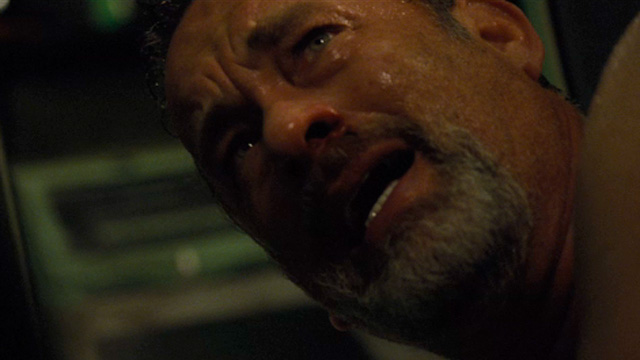
It recalls a story about the marketing of Apollo 13, which originally had a poster of the perilous situation—the spacecraft leaking oxygen going around the dark side of the Moon—but fearing for their investment, the producers opted for one that had Tom Hanks front and center in a claustrophobic layout.  The reason for this being that audiences might not care for the situation depicted in the earlier poster, but if there's a poster where Tom Hanks is worried that he's in trouble, that might bring a sympathetic audience in, hoping that the popular actor would attract a crowd.  And so the actor-specific poster (despite an all-star cast) was substituted. One wonders if it might be the same reason that Executive Producer Kevin Spacey is not portraying Phillips; maybe folks wouldn't worry about Spacey so much, but Hanks' every-man persona might make a monetary difference at the box office.  In any case, Hanks does a fairly good job at maintaining a veneer of calm while an undercurrent of panic roils through him.  But where he really shines—to the point where it's amazing to see—is the way he projects the character's shock at the end of the film, and one has to applaud Hanks for displaying a total break-down without once making us recall his crying for a volleyball.*** Despite his reputation as a male version of America's sweetheart, he is a good enough actor to still surprise and move, over one's objections.

Captain Phillips is a Matinee.


* My first question to those union sailors would be "If Phillips died, would you still be pursuing the lawsuit?" They're damned if they would, and damned if they wouldn't.

** In the film, they're constantly chewing khat.

*** That would be his loony-toons turn in Cast Away.  If I had a nickel...

Wednesday, June 12, 2013

Clash By Night

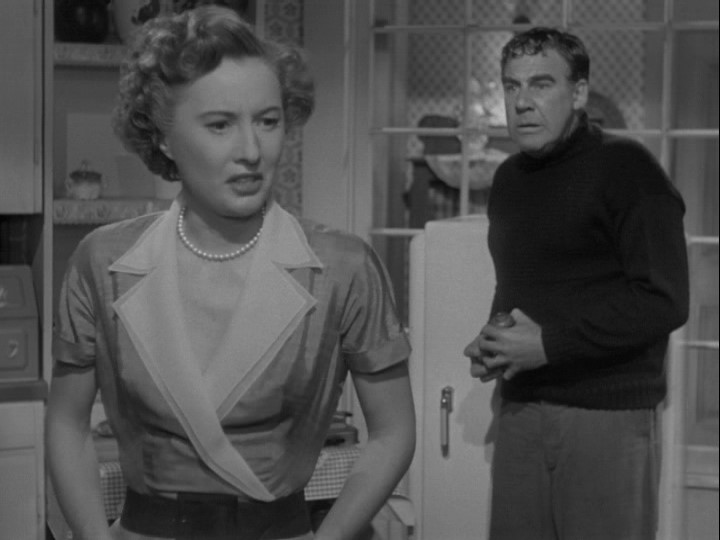
Clash By Night (Fritz Lang, 1952) Interesting. Fritz Lang directing Barbara Stanwyck, Paul Douglas, Robert Ryan and Marilyn Monroe in an adaptation of a play by Clifford Odets (produced on stage by Billy Rose!).  Talk about clashes.  The events take place in a fishing town and Lang gets a lot of mileage with shots of Nature—seals, gulls and a violently crashing surf—drawing parallels between the various top-feeders trying to take advantage of the spoils of the fishing fleet's daily labors.  They're scavengers of opportunities and Lang keeps the beasts on land and sea in the same universe, making a more direct and poetic pictorial comment on the squalid life in town than any amount of purple Odets prose can provide.

Mae Doyle (Stanwyck) comes back to Monterey, after years on the road, to move back into the family house with her brother (Keith Andes).  "Home is where you come when you run out of other places," she snarls.  But her purpose is not to settle down so much as to lick wounds.  Her search for a better, easier life than working in a cannery (like Monroe's Peggy) or marrying a fisherman and raising kids has proven a bitter disappointment.  She slinks back into town ("Home is where you go when you run out of places") and word gets 'round that Joe's sister's back, which attracts the attention of Jerry D'Amato (Douglas), a bachelor-fisherman living with his widowed father (Silvio Minciotti) and sleazy Uncle Vince (J. Carroll Naish).  Mae and Jerry start seeing each other, but she rejects any advances he makes, telling him he doesn't even know her, "what kind of animal I am.  Do I have fangs?  Do I purr?"  


He takes her to meet his friend Earl (Robert Ryan), whom Jerry describes as "in the movie business;" He runs the projector at the local bijou.  Earl's one piece of work.  A sour drinker, married to a vaudeville dancer, he'll tell you all about what's wrong with women to your date.  "Take any six of them.  Throw them up in the air.  The one who sticks to the ceiling, I like."*  Mae is repulsed, but Jerry is still loyal to Earl, even though he'll talk bad about his friend behind his back.  "Jerry's the salt of the Earth—but he's not the right seasoning for you." (Ugh. Odets) Again, Mae's reaction to Earl is to be repulsed, which sends her right into the arms of Jerry, and any previous objections she had to marrying him are suddenly forgotten.  Before long, they're hitched and have a daughter, which is upsetting to Jerry's opportunistic Uncle Vince, who will never put up with anything that interrupts his mooching lifestyle.  Jerry ends up throwing him out.

But, Mae is still restless, and complications ensue that tie back to life in the animal kingdom, and the charm of aggressive males.  Because the movie then starts to take place solely at night, there are those that will call this a "film noir," the genre most commonly associated with gangsters, surly private eyes, never-spoken-of family secrets, and the evil impulses of men.   Got the last one right, as the worst of people gets the better of others.  But, the film noir genre is less prominent than the soap opera one, and it doesn't help that the material is sometimes eye-rollingly colorful.  Still, the cast is uniformly excellent, and Lang's hand is sure, and makes puts everything in the proper perspective.


* This is one of the problems I have with Odets as a writer: that sentiment must mean something—at least to Odets—but it makes no sense to the rest of humanity, which is supposed to be his audience.  I suppose it means that Earl doesn't like any woman; there's a better way to say it, I'm sure.  But then I don't like Odets much—take any six of his works.  Throw them up in the air.  The one that sticks to reality, I like.

Wednesday, October 10, 2012

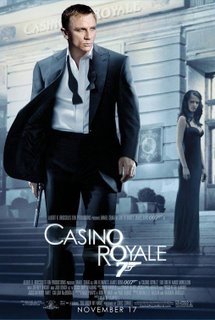
Casino Royale (2006) Revisited

Breaking Bonds

Is it that good?
Short answer: yes.
Is he that good?
Yeah. He's the best thing about it. There are other good things as well, but let's look at Bond 6.0.


Not conventionally handsome, not the Arrow-shirt version of Bond, Craig has a multi-planed face that's great to watch whether it's jammed up against a shattered bathroom mirror considering just how much pressure it's going to take to strangle an assailant* or, half-a-movie later in another bathroom mirror, clearly satisfied with himself in a newly-tailored tuxedo jacket. His acting choices are subtle, nicely measured. His atypical look is just one of the many breaks from the past in a series that has not only embraced clichés, but luxuriated in them, and would even occasionally ham-string a promising entry to accommodate them (quite opposite from the early intentions of the producing team, which was to go against the grain of conventional thrillers--something not to far afield from Fleming's literary intentions--and surpass them, and in that regard, Casino Royale is the first film since Goldfinger to actually improve on its source.) The films are, after all, about Bond, so you'd better have somebody interesting in the lead, and Craig's Bond, his face becoming criss-crossed with scars as the movie progresses, makes you care just how much of a toll the mission is taking on him, both physically and psychologically. When was the last time anybody gave a damn about James Bond's soul in the movies?

In this "reboot" the clichés are dusted off, their origins shown and exposed for the good ideas they once were. The stunts and longish action sequences are still there, but they're used, at their best, to expose character.** There are gadgets, but nothing you couldn't find in catalogs this Christmas (technology has long since caught up to Bond with cell-phones, GPS tracking and personal defibrillators). "The James Bond Theme" is merely hinted at in the body of the film and in the "Secret Agent Man"-ish title song*** (growled by home-boy Chris Cornell), and saved for the end with a fully formed (for good and ill) Bond.

As good as Craig is, he's matched by his co-stars. Mads Mikkelson as LeChiffre has a nice, oily quality to him, and certainly projects the most danger to Bond since Robert Shaw's Red Grant (in From Russia With Love), The only cast member retained (so far) from the Brosnan films is Dame Judi Dench, whose "M" is finally given the authoritative role over Bond that Bernard Lee once had, rather than seeming like Bond's subordinate.

And the Bond-"girls?" Well, there is Ivana Milicevic, who's there mostly for decoration. But Caterina Murino certainly can act, and brings a nice world-weary resignation to the role as a terrorist's wife out for some revenge. But the revelation here is Eva Green, who's Vesper Lynd manages to flesh out the cypher that Fleming created. A mystery in the book, Green conveys a genuine human being, and her scenes with Craig are some of the best written exchanges (and are cracklingly well delivered) in the series, and includes one heart-breaker of a scene, after a brutal fight in a stairwell. It's so moving and so well-done that it's surprising to see it in a Bond movie.

And that's the thing: there has always been a great deal of disparity between what constitutes a "Good James Bond Movie" and a genuinely "Good Movie." And this is a "Good Movie"...which happens to have James Bond in it...that can stand as a fine drama, AS WELL AS holding its own in the adventure/action aisle. I didn't cringe at a performance or roll my eyes at a joke once and if there was one thing I was dissatisfied with it might be the small amount of screen-time given to Jeffrey Wright...and maybe tweak the ending a bit. Credit the writers (regulars Purvis and Wade and the ubiquitous Paul Haggis), the director (Martin Campbell, who did "Edge of Darkness") and super-editor Stuart Baird. This is going to be a fun one to watch slowed down on DVD. Oh, and "Cubby" Broccoli's kids, who followed up one of the most profitable movies in the series (the loud, obnoxious video-gamer Die Another Day) with this one, that challenged, re-wrote, and kept the edge of Fleming's writing, when the temptation might have been to cash in on what worked before with just more of the same. 

Talk about gambling...

Casino Royale (2006) is a Full-Price Ticket to be chased by a large tumbler of Scotch and a warm, comforting shower

The View from 2012:  It still holds up, and if there are three great Bond films, Casino Royale would be firmly there, hovering near, if not holding, the top spot.  Craig has proven to be a boon to the series, raising the bar, advising, bringing in top-drawer talent, and raising the entire series' image in the larger movie community.  One might even consider him indispensable (but that idea has been disproven before), which is a far cry from the derision that was tossed out when his choice was first announced.


* Oh, did I say "strangled?" There's a lot of very brutal violence in this movie (not just card-playing in tuxedos) that managed to skirt by with an inexplicable PG-13 rating, including a scene where Bond is stripped naked, tied to a seat-less chair, and has his testicles beaten with a very heavy, very gnarly knotted rope--a scene that should send any 13 year old boy running for the bathroom. This is not the clean "one-shot/no-blood" violence of past Bonds. Here the violence is fast, painfully brutish and bloody. Be warned.

** There is a wonderful moment when Bond has just (barely) foiled an attempt at industrial espionage, where he cocks his head, exhausted, at the untouched target and quietly marvels at what he's done.

*** The title sequence is also unique--gone are the writhing go-go girls--but it should delight anyone who grew up with the imaginative main titles of many a 60's spy series.

Wednesday, September 12, 2012

Sleepwalk With Me

"Okay's Kind of a Strong Word"
or
"Yeah...No...Yeah..."

The best thing on radio, for many years now, is "This American Life," ("from WBEZ, Chicago") Ira Glass' free-form hour of people telling stories revolving around one theme, with variations. sometimes truth, sometimes fiction, sometimes "found sound" (as the original intention of the show was).   It has vaulted many of its contributors into the literary limelight, like David Sedaris, Sarah Vowell, John Hodgman, David Rakoff, Dan Savage, and Jon Ronson.  For a brief time, Showtime bankrolled a television version of it, which caused some format grief ("will it work in TV, and if it does, will the radio version go away...like Dragnet?") but after two seasons Glass wanted a furlough back to its audio roots—no pictures, please.  There've already been a couple movies made from certain segments, two being Steve Soderbergh's The Informant! and Unaccompanied Minors.  Both started out as first-person narratives of the TAL variety and expanded, quite handily, into movie form and length.  It can work, if the story has enough heft and resonance to it, and complication.  In fact, TAL is made for movie grist, the grain being so different from "normal."

Sleepwalk With Me was born from "This American Life" and a particularly charming comedian named Mike Birbiglia and is based on his stand-up routine, which became a Broadway one-man show, which became a best-selling book and first aired on TAL in 2008.  Birbiglia's story of suffering from a sleepwalking disease, especially when stressed, and the consequences of it just as his comedy career was taking off made for compelling radio.  Birbiglia is honest, self-deprecating, and just a little vulnerable.  And one expected the film version to be a variation of the one-man show/stand-up routine.  

But what works in the hot medium of audio does not in the cold medium of the visual.  Perhaps Birbiglia is not a compelling personality when doing his work, and his strength lies in the "better-heard-than-seen" arena.  Whatever the reason, when he and co-writer Ira Glass decided to expand his career to a new medium, they decided to dramatize the whole bit, as if it were fictional, Birbiglia directed, with a competent crew of actors (I knew he wasn't playing it straight when James Rebhorn and Carol Kane showed up as his parents), and a "talk-to-the-camera"-while-driving narration that links everything together (which kinda, sorta "plays" but only produces one laugh-line, after a particularly surprising incident:  "I KNOW!  I'm in the future, also!" he shock-shouts to the audience).  As a film, it's all over the map, strictly scripted, then ad-libbed, staying on-track, then completely spinning off into a tangent. Birbiglia is also a little scattered as an actor.  Specializing in a brand of comedy that depends on dead-pan cutting down and reduction, it's a little subtle for out-and-out comedy—sometimes a sentence will go by before you realize "oh, that's supposed to be funny," especially when you're not hanging only on words for your information.  Birbiglia is an odd performer, too, resembling Tom Hanks a bit, all forehead and weak chin, he's a tentative line-reader, and frequently a contrary one, often saying two different things one after the other.  The whole thing comes off as weak Woody Allen, and what seemed to work very well as a narrative, comes off as merely "okay" on-screen.


It's disappointing, but also fascinating to see why the magic doesn't work this time out.

Sleepwalk With Me is a Rental.