Showing posts with label 1960. Show all posts

Friday, November 1, 2013

Post Hallowe'en Special: Get Off the Lawn, You "Damned" Kids!

Village of the Damned (Wolfe Rilla, 1960)  Based on the John Wyndham sci-fi novel "The Midwich Cukoos," adapted by Stirling Silliphant and director Rilla, Village of the Damned* is a curious mixture of sci-fi and horror—a combination of pulp sensibilities, but with a strange sub-text that could be taken as religious, mystical, or invasive, and then has the audacity to not answer any of the questions and leave you hanging as the suppositions swirl through your head.  Both it and its sequel are fascinating things to watch, but each in their different way.

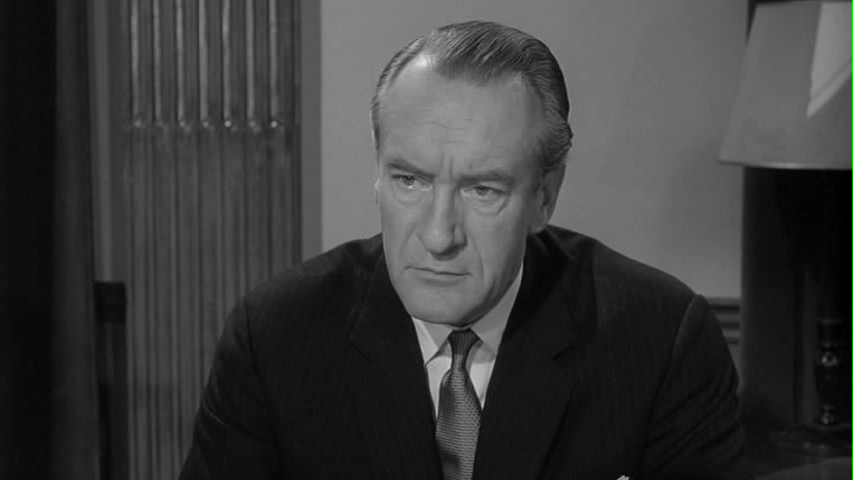
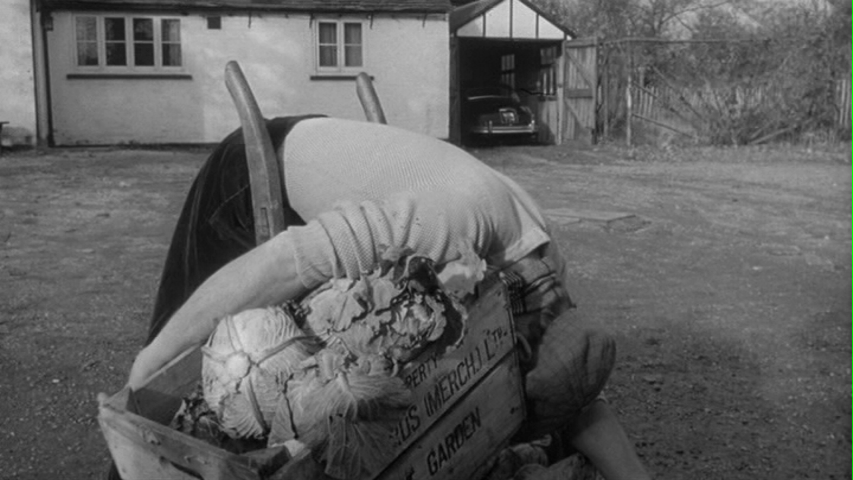
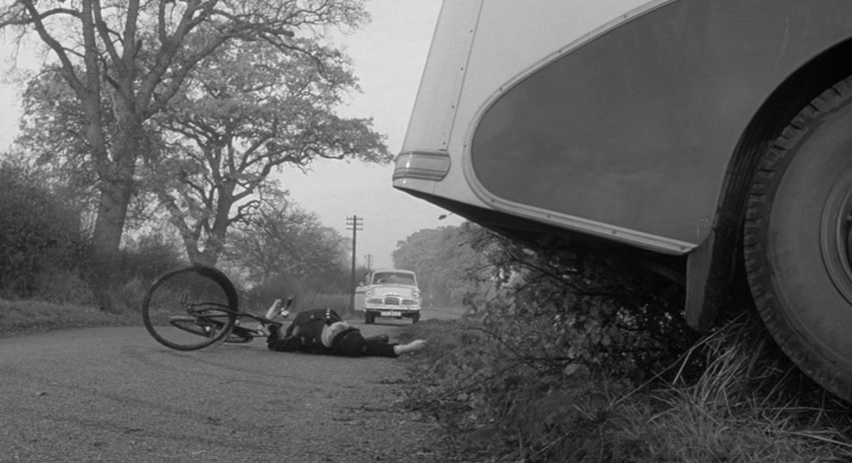
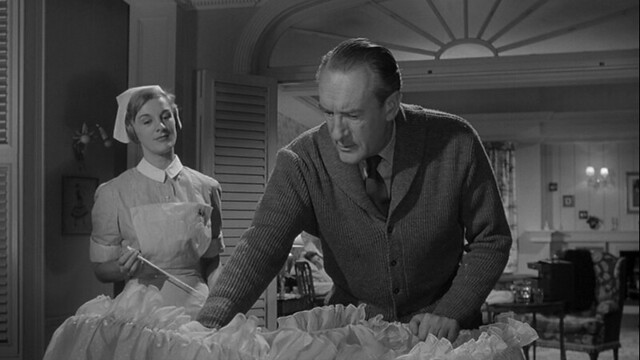
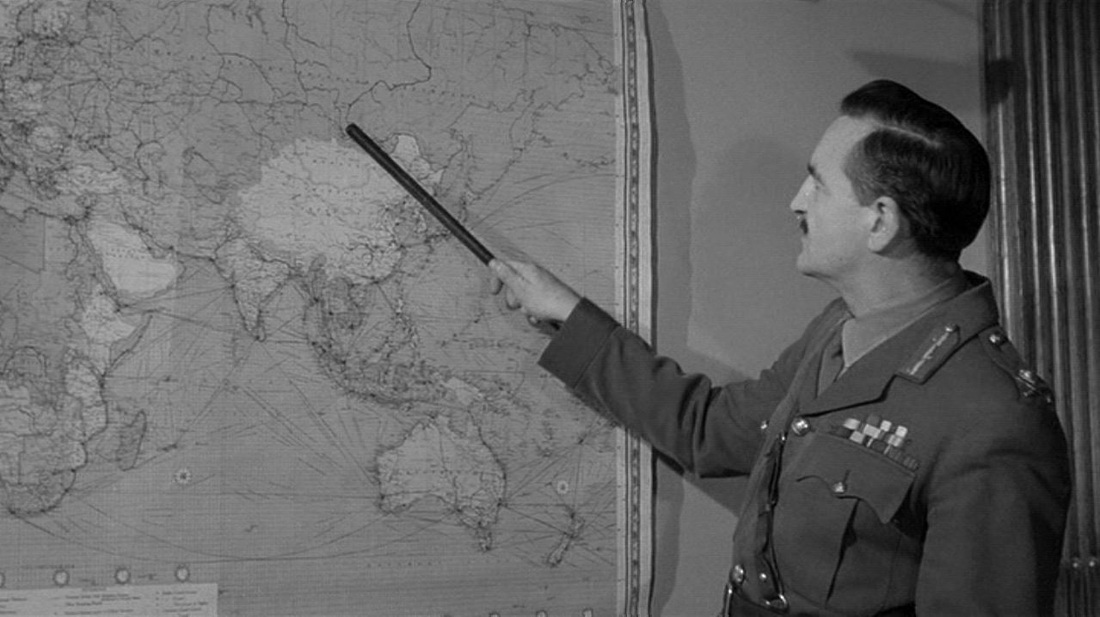
In the town of Midwich, professor Gordon Zellaby (George Sanders) is making a call to his brother-in-law Alan Bernard (Michael Gwynn) when all of a sudden, he falls unconscious.  So does the family dog.  Bernard is alarmed at this and can't raise anyone in town, so he investigates and being in the military he doesn't do it subtly.  What he finds is that everyone within a few mile radius of city center is unconscious...or will become unconscious (even taking preventative measures like gas-masks) if they enter within that "zone"—aeroplanes flying overhead will have their pilots drop off, the planes crashing.  


It's a mystery.  Why this town?  Why this effect?  But, two hours later, everyone awakens, mystified.  They felt a cold sensation before they dropped, but that was it.  The disturbance is forgotten.


Until two months later, when it's determined that every woman "of child-bearing years" in Midwich is pregnant.  For Zellaby and his wife (Barbara Shelley), it's a miracle though it's a little late in life for him.  But, for the unmarried women in town, and for the women with husbands away, it's not only embarrassing, it has to be some bizarre mistake...and when it's confirmed it makes things uncomfortable, socially.  For awhile they're stigmatized, but before long (and with the doctor's confirmation) it's determined that all the women are pregnant...and they don't how.


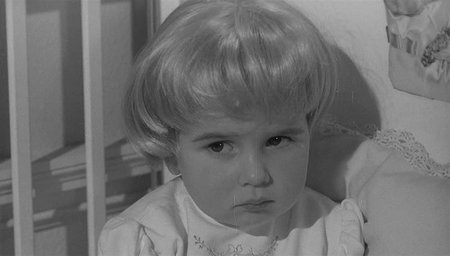
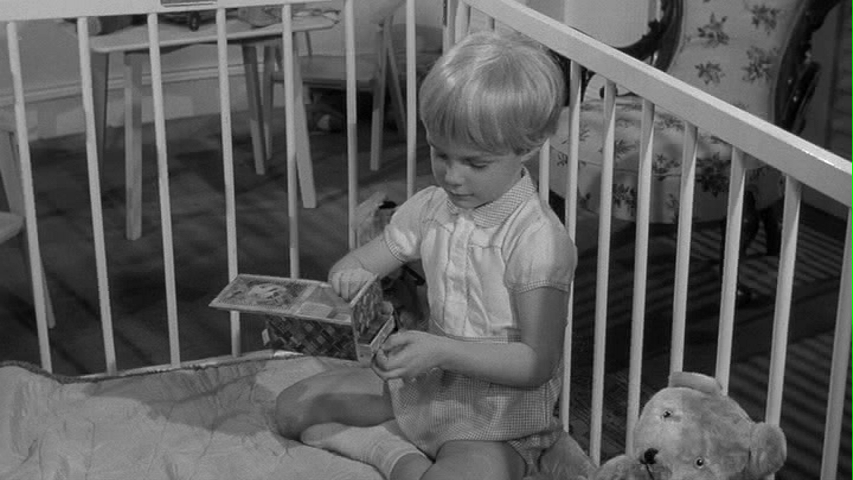
Out of this mass-immaculate conception, the village is seriously creeped out, but the children appear to be normal, if gestating at an accelerated rate.  And all are born on the same night, all premature by normal standards, but all around ten pounds, all with white shocks of hair and something "weird" about their eyes, totally black.  The kids grow quickly and they learn quickly, being able to figure out chinese puzzle boxes while still toddlers.  Give it to one, and then another, sight unseen, will be able to figure it out, as if by telepathy or shared mental faculties.

And...if things don't go their way, they can influence the thoughts and actions of others, an act apparent when their eyes begin to glow white.  The children, as they grow older and become more sophisticated, become even odder—walking as a group by themselves, dressing themselves, speaking in a tone, sophisticated and cold.
**

What to do about them...and who "is" them, anyway?  No one has any answers, but reports around the world suggest Midwich isn't the only village on Earth to experience this.  Some of the places have murdered the children. One isolated village in Russia is trying to instruct the children to the best they can.  What is the answer: to eradicate, or to exploit? 

The military doesn't want to do anything subtle, but Zellaby, with doubts as to their origin, staves off their eradication by seeing if he can teach them in their own segregated school (naturally).  The trouble is, the children don't want to do anything subtle, either, and these kids are of a mind to stop the problem of bullying by any means necessary.


This is a great film, which doesn't shirk societal issues at the same time it doesn't pin down exactly what the hell is going on here.  The fact is the kids are here and dealing must begin.  But how, never mind why.  Plus, it's a genuine horror-fest, making one web-site's list of "10 movies pregnant women should never watch." Apt.  And one curious anomaly about the film is that the strange glowing eyes that signal some heavy brain-work on the part of the children (and figures in the denouement) is only seen in American prints of the film.  Interesting, as they seem to appear in the British posters for the film.

But, those curiosities aside, it's well-worth seeing, and pondering...

One further note, young Martin Stephens who gives such a calmly mature performance as little David Zellaby in this (and The Innocents) left acting while still a child and became an architect.  Yes, he has a web-site.


°° °° °° °° °° °° °° °° °° °° °° °° °° °° °° °° °° °° °° °° °° °° °° °° °° 


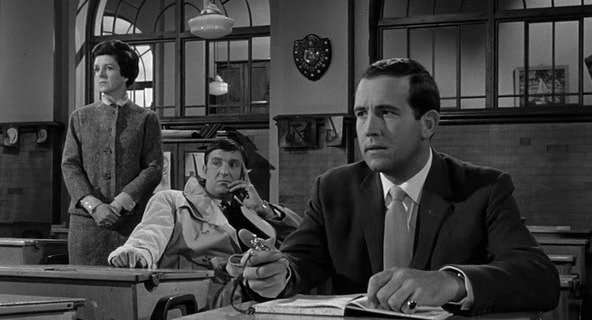
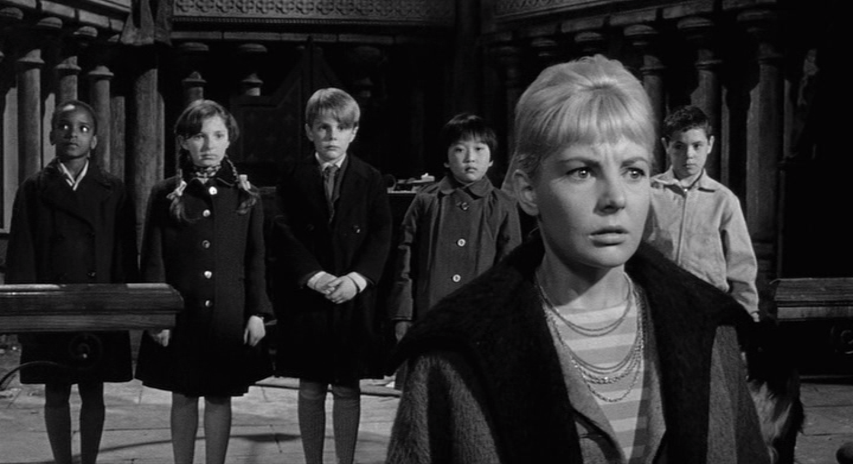
Children of the Damned (Anton M. Leader, 1964) If Village of the Damned leaves things unexplained, Children of the Damned just complicates the issue, rather than coming up with any concrete answers. The six titular children have the same powers and intellect, but not the same attributes.  None of them has the tell-tale white hair or the slightly high browline as the first crop of kids.  And there's only one child from Britain; the others, flown in by the UN, come from Russia, China, India, America, and Nigeria and their abilities are only discovered by a UNESCO survey on child development.  The lead investigators in England, psychiatrist Tom Llewelynn (Ian Hendry) and geneticist Dr. David Neville (Alan Badel, laconically ironic) are looking into the why's and wherefore's of young Paul Looren (Clive Powell), a child of extraordinary learning skills that are frankly off their charts.  A visit to his single mother only ends with her tossing them out and their disbelief in her claiming she was never "touched by a man."

Llewelynn and Neville make an odd duck duo,*** the shrink earnest and straightforward and the geneticist cracking wise with every line.  Their investigations come up with no reason why these kids have these abilities, they just do, and when Britain's Secret Service tries to take control of young Paul, he sets up a distraction and scampers, seeking out the other five children and taking up residence in an abandoned church, with Paul's aunt (Barbara Ferris) as hostage/mouthpiece.  The various embassies want each of their children back to exploit them, weaponizing them, in effect.  Llewlynn is thunderstruck by the idiocy of that: "As soon as one of them knows your plan, then the others will know it."  So much for Cold War secrets.


Neville and Llewelynn, U.N. observers...observing

Still the various countries want their kids back, and the kids want nothing of it, attacking from their stronghold in the church, devizing a broadcasting "thingie" using the church's pipe-organ to incapacitate anyone attempting to remove them, leaving their attackers dead or "wishing they were."


Children of the Damned is slightly diminished from its original, but on its own is one of those great science fiction films of limited scope and budget that still manages to evoke the sense of a much larger concept, despite narrowing down what the children "are," while giving the film a sense of cautionary tragedy that the first film doesn't have.  Less a horror film than a story of sociological and political paranoia, Children of the Damned features good performances and an efficiently crackling script (by John Briley—he would go on to write Cry Freedom and Gandhi) and manages to stand on its own terms, apart from the first film, as an entertaining, if very unsettling film.


...and what they're observing.


°° °° °° °° °° °° °° °° °° °° °° °° °° °° °° °° °° °° °° °° °° °° °° °° °° 


Village of the Damned (John Carpenter, 1995) This updated version of the original follows the same plot structure of the first, with less emphasis on the mysterious circumstances that cause the "immaculate" pregnancies in the town of "Midwich, California," less stigma—it is the '90's, after all, there's even the subject, given the circumstances, of aborting the children—and more emphasis on the children and the violence they mete out on the town.  In color, and sporting a good cast of stars (with Christopher Reeve—his last role before his crippling accident—Linda Kozlowski—she of the "Crocodile Dundee" series—Michael Paré, Mark Hamill and Kristie Alley), these kids are more pointedly accusatory, speak in archly threatening whispers,**** and action-oriented, and unusually vicious in the way they have their victims destroy themselves—impaled on a broom, blinding an eye-doctor, having one of the parents driving into a propane tank (rather than a brick wall), another perform an autopsy on herself, and the botched military intervention in another country alluded to in the first film is dutifully played out with all the blood-bags the budget can allow—and Carpenter doesn't cut away as the original did.  There's no implication here, which (as it usually is) isn't as powerful as leaving your audience's squirming imagination to do the dirty work.  


Christopher Reeve's doctor hates talking to kids.

On the plus side, it's less of a man's world this time out on both sides: the chief investigator of the phenomenon is a woman (Alley, whose a bit cavalier in her dealing with the kids) and the leader of the children is one of the little girls, Mara (Lindsey Haun) daughter of Reeve's local physician and his wife (Karen Kahn).  This time out, the children pair off, boy-girl, with one of the children (Tom Dekker) left partnerless because one of the children is stillborn, and, as a result, being the only one to develop any empathy at all.  The other kids are little monsters who, when forced to go up against an adult with any will at all, will have the pinwheels in their glowing eyes go from green to red to white, then, just to stack the deck against them further, their faces glow red into a demon's visage.

In other words, what was subtle and thought-provoking in the first film doesn't have the same effect in this one.  And the reason is you're being beaten over the head with it, and rather pointlessly.  There's no ambiguity here.  There's no mystery.  It's just a simple formula: strange is bad=kill it. Carpenter can be a good film-maker and stylist—he wrote the playbook on the post-Hitchcock slasher film (which may not be much of a recommendation—until you compare it with his imitators).  Maybe this was just a case of studio expectations for meeting a carnage quotient.  But whatever it is, the 1995 remake of the Village of the Damned takes all the fun...and the seriousness out of the story.

And that's a "Damned" shame.


* There is another film done by the Hammer group, and directed by American director Joseph Losey, starring McDonald Carey and Oliver Reed called (depending on which version you see) These are the Damned or The Damned, and are unrelated to this film series, although it does involve children, with special qualities.

** It was odd watching it this time around, as the children, particularly Martin Stephens, reminded me of no one so much as Sheldon Cooper, Jim Parson's character on "The Big Bang Theory."  Sorry, DR. Sheldon Cooper.

*** And no, I don't think they're gay, even if they do share a flat in London (separate rooms, mind you).  Both are on assignment from Unesco in London.

**** Unfortunately, the kids' performances are melodramatically threatening, a bit like Patty McCormick in The Bad Seed.

Tuesday, September 25, 2012

The Entertainer (1960)

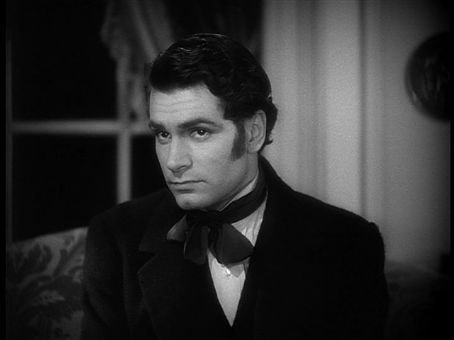
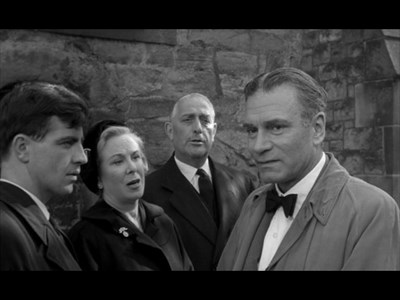
The Entertainer (Tony Richardson, 1960) One thing about Laurence Olivier, he was an actor for all genres.  Yes, he was primarily known as a stage and film Shakespearean, probably the greatest, but he also did light comedies, thrillers, period dramas, horror films, the occasional cheese-fest...everything...including the kitchen sink.  Kitchen sink dramas, that is. 

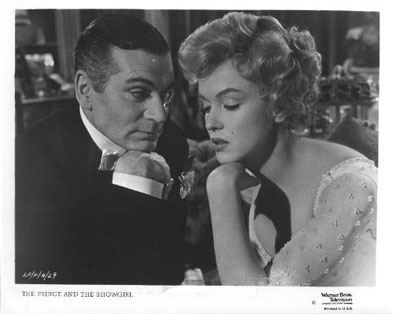
In My Week With Marilyn—the fictionalized telling of the filming of The Prince and the ShowgirlKenneth Branagh's Olivier announces he's done with directing (after his on-set tussles with Monroe and finding out she's incandescent on-screen, anyway, despite his direction) and is going back to the stage to do a John Osbourne piece.  That would be "The Entertainer," the play on which this film is based.  On stage, it vacillated between life on-stage for Archie Rice (Olivier), and at home, where...well, he's never really OFF-stage, a needy vaudevillian with an alcoholic second wife (Brenda De Banzie), three kids (Albert Finney, Alan Bates, and Joan Plowright—who would become the last Lady Olivier), and a slightly more talented, but no more wiser live-in Da (Roger Livesey).

For now, Archie is scraping by, as star/producer of a boardwalk diversion at a seaside holiday camp, in the perfect venue—an old, faded theater, where the air is as stale as his material.  His day is only vital in the afternoons and early evenings in the bustling chaos of on-stage and backstage.  The rest is the drummest of hums—wife in her cups, son off to war in the Suez, youngest son helping Dad in the dive, and daughter teaches art to a bunch of barely interested teddy-boys and girls.  She goes to the seaside, seeking out Father, looking for some form of stability before settling into a perfunctory marriage.

She should have gone somewhere else.  Archie is only accessible on-stage, and when off, he's trying to hustle another season, another venue, another donor, another prospective starlet.  Life just isn't good enough for him if a limelight isn't on him and the money's starting to run out to pay the electric bill. Much was made of the play as a comment for the fading empiricism of Great Britain, as personified by the propped-up jolly-good Archie, for whom the show must go on, despite not having any juice in it for years, surviving with a heavy layer of rouge and grease-paint to give the long-distance impression of vitality and youth, blithely ignoring the march of time and pasting it over with the false grin of performance, no matter how desperate it may come across.

Richardson's film opens the play up, puts instance on Archie's transgressions on-screen instead of just being talked about and blubbered over, and Olivier sticks out like a sore thumb—rightly so—apart from the rest of the cast.  Where Livesey is old-school formal and the kids are new-broom casual, Olivier sticks to his guns with a theatrical performance which feels appropriately, desperately false, which benefits the film while also making the character of Archie a complete outsider, a role he no doubt relishes.  There's only one star in this "revue," everybody else is a bit player.

For Olivier, it must have fulfilled some need—to slum, maybe, or to reach out to the new material being generated by Osbourne, Richardson and others in the new school of British rebellion.  Maybe, after his long string of kings, princes and noblemen, he wanted to explore the has-been's and ignoble men, to cultivate portraits of characters of a more stratified than rarefied stripe.  There's also an element that Olivier might have been familiar with—the performer's ennui, bordering on contempt for his audience.  At this stage in his career, Archie is performing for himself—the money's not great, the material stale, and any creative collaboration is non-existent—the most intimate relationship he has is with his make-up mirror and even that is betraying him.  Olivier is not above showing bitterness—he was particularly adept at tartly spitting out the ironic put-down in the guise of civility.  And he was acknowledging his age (he was a very old Hamlet in his film of it) and the potential for failure, by portraying it, challenging it, mocking it, waving a red cape at it, maybe exorcising it.  It was a brave interesting role for Britain's leading thespian.


Olivier as Archie Rice: "The Roar of the Greasepaint"


Wednesday, August 26, 2009

Rocco and His Brothers

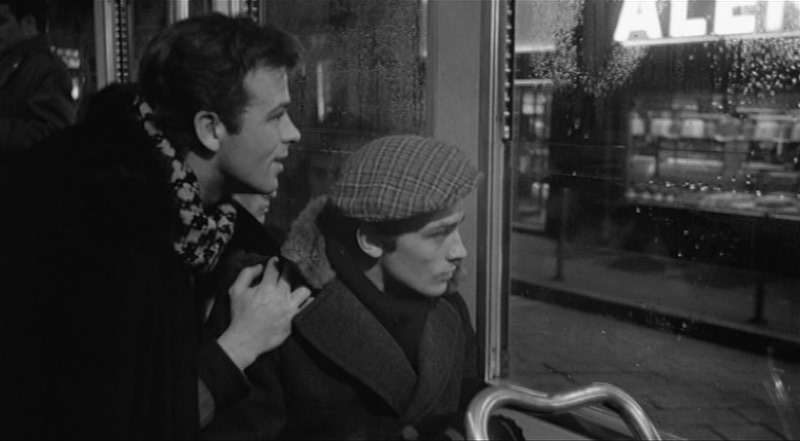
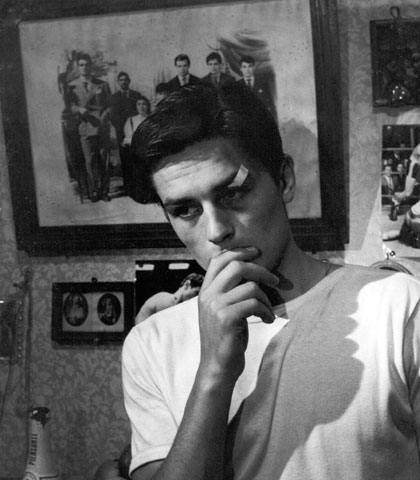
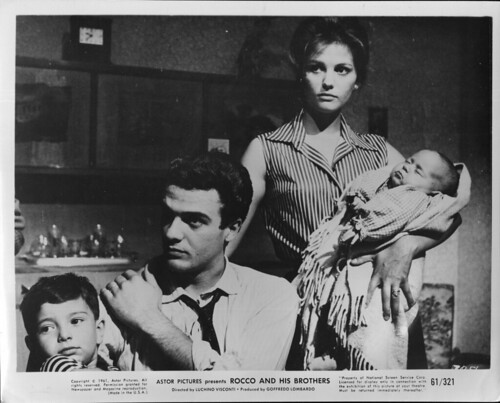
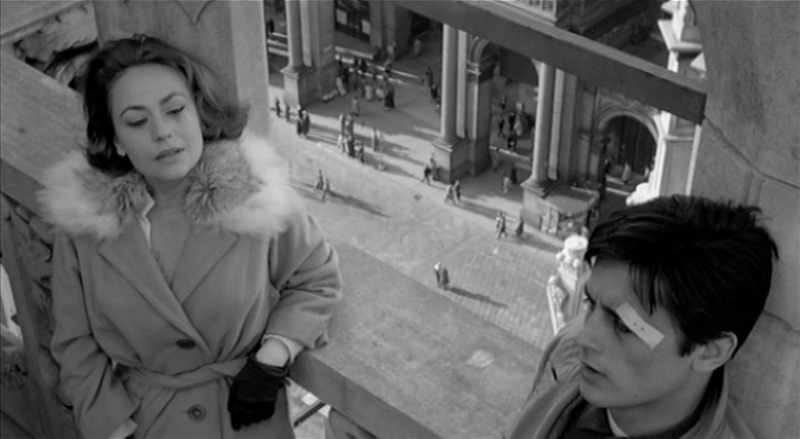
"Rocco and His Brothers" aka "Rocco e i suo fratelli" (Luchino Visconti, 1960) The Parondi family moves up to Northern Italy from the country and they find simultaneous success and tragedy in the city. It's the immigrant's story: they move to make a better life and the choices they make are wholly determined by their conditions. The widow Parondi (Katina Paxinou) moves her brood to Milano, where eldest son Vincenzo (Spiros Focás) is guest of honor at an engagement party for his intended, Ginetta (Claudia Cardinale). The family swoops in and North/South prejudices erupt and break up the party. The worst news for Vincenzo is, as eldest, he has to provide for them and arranges a short term rental that he plans to break the lease on, so they can be kicked out and depend on government housing. From there, the brothers must find work and make a life for themselves.

But it's tough to be a saint in the city. The film is divided into chapters for each brother, starting with
Vincenzo, then the mercurial Simone (Renato Salvatori), good-hearted Rocco (Alain Delon), practical Ciro (Max Cartier) and the innocent Luca (Rocco Vidolazzi) who looks up to them all. Simone and Rocco take the fast money way out, going into the traditional immigrant sportboxing—and its underworld of shady characters, Ciro gets an auto-workers job, while Vince ignores his mother's objections, marries Ginetta and moves out. Each brother, in turn, finds their escape from family, even Rocco whose mission seems to be to keep the family intact. The brothers are wholly unprepared for the city and their separate ways of dealing leads to internal conflict and strife, with the women in their lives often being the ones chewed up in their machinations.

It's not just the 3-hour length and terrific
Nino Rota score that suggest it, but you look at Visconti's direction of "Rocco and His Brothers" and you see the playbook Francis Ford Coppola used for "The Godfather:" the half-lit sets, the faces emerging from darkness, the "communal" shots where a lot happens in long takes of activity, the simultaneous staging of triumph and tragedy, and the bursts of violence communicated with a minute pre-echo of dread. That "Rocco" matches so many of "The Godfather's" themes—the passing of old traditions in modern times, the splintering of the family, the immigrant's plight, and the futility of good intentions—one can see how film-buff Coppola was inspired to make a silk purse out of Mario Puzo's best-selling sow's ear.

Thursday, August 13, 2009

The Apartment

"The Apartment" (Billy Wilder, 1960) I went to a party the other night and a friend upbraided me, saying "Irony is so passé!"

Gosh, I hope not. That'd mean I can't enjoy
Billy Wilder films anymore.

Wilder came to Hollywood as a writer* and had great success with and "
Ninotchka" "Ball of Fire" and graduated to directing with "The Major and the Minor" and "Double Indemnity." Talk about a valedictorian. With the start of his directing career, Wilder concentrated on dramas with a biting humor (winning a Best Director Oscar in the process**), but with the failure of "Ace in the Hole" in 1951 shifted his course slightly to make more comedies with dramatic overtones, the most acclaimed being "The Apartment," one of the many collaborations between Wilder and actor Jack Lemmon.***

"
The Apartment" tells the story of C.C. "Bud" Baxter (Lemmon), working for a major insurance company as one of the many drones stranded behind desk and adding machinethe mammoth working pool set, a miracle of forced perspective looks like it covers several city blocks and feels like you should pack a lunch just to cross it. Crossing it is uppermost in Baxter's calculating skull. And to that end, he uses everything at his disposal, including lending his apartment as a love-nest for the married executives to pursue...outside interests. That apartment should have a revolving door on it, as Baxter must keep a scheduler as well as a well-stocked liquor cabinet. The arrangement helps him get ahead and the personal recommendations brings him to the peaked attention of the company's personnel director Mr. Sheldrake (Fred MacMurray****) who has need of the Apartment himself.

Baxter is climbing the ladder now, but it's one of the elevator operators, Miss Francine Kubelik (
Shirley MacLaine) that gets a rise out of him. They start a flirty relationship that Kubelik is a little cool to pursue, seeing as she is on a downward spiral in a relationship with Sheldrake. For Baxter, it will become a case of clashing ambitions.

The situation drips with irony: an insurance company, where the exec's juggle statistics and mistresses with no moral compasses. And the hierarchy of executive structure is paralleled to the status of folks in their private lives: the mistresses are treated with contempt if they begin to interfere with the home turf.
And Baxter is literally left out in the cold every night, as the executives hedonistically burn through relationships that Baxter doesn't have the roots to start. It's only when a crisis occurs that Baxter begins to grow a conscience over the moral compromises he's making and providing.

The crisis sparks something Baxter's superiors (in everything but morals) never slow down enough to experience—a caring relationship, centered around (ironically) Kubelik in Baxter's bed. Schedules get shuffled, promises broken, and complications loom that the usually organized Baxter can barely manage all in an effort to create a recuperating stillness in a hectic personal life that comes crashing into his business-life. Conscientiousness ensues.

It seems like a fairy-tale today with current rubber-board rooms of the business-world filled with sociopaths. But, at the tale end of the 50's and the concerns of the world moving away from our boys in khaki to the boys in grey-flannel, it was a cautionary tale. Revolutions of all sorts in the '60's and plagues, both sexual and financial, in the 70's have made the film seem...one shudders at the word... "quaint."

But, that doesn't affect its wit, its insight, its charm, or high entertainment quotient. As a film it's a perfectly built comedic construction, a bon-bon exquisitely made and wrapped, with just a hint of bitterness at its core. And in the running gag that permeates the conversation of the film, it delivers its bellyful of laughs with no disconnect to the head, on its way to the heart, intellectually-wise.


* Wilder liked to tell the story of escaping Nazi Germany, entering the United States through Mexico. When asked his occupation by the immigration official, Wilder tremulously answered, "I write movies." The Fed looked him up and down, then said "Write good ones" and stamped his papers.

** For the "The Lost Weekend," Ray Milland won the Oscar for Best Actor for that film.

*** Those being "Some Like It Hot" (1959), "The Apartment" (1960), "Irma la Douce" (1963), "The Fortune Cookie" (1966), "Avanti!" (1972), "The Front Page" (1974), "Buddy Buddy" (1981).

**** I had MacMurray's daughter for a client once, and I had to tell her, "Ya know, your dad could play terrific bastards!" She fairly sparkled, and thanked me.

Thursday, November 13, 2008

Never On Sunday

"Never On Sunday" aka "Pote tin Kyriaki" (Ποτέ την Κυριακή) (Jules Dassin, 1960) A truly odd film, but obviously a labor of love for the expatriate blacklisted writer-director who made a new life and career for himself in Greece. If the movie wasn't so openly good-hearted, one would almost think Jules Dassin was thumbing his nose at his detractors in Hollywood by showing off his newly-adopted country and tackling subject matter that the movie capitol wouldn't touch, and do so in such a light-hearted manner. Cecil B. DeMille would have simmered, if he hadn't been dead for a year.

Never On Sunday" tells the story of a touristing American intellectual and Greek scholar (named Homer, naturally), scribbling away in his notebook about the customs and way of life in modern Greece. His first night, his ebullient inquisitiveness gets him into a barroom brawl; the shiner he receives he'll keep throughout the movie. That Dassin casts himself in the role parallels his own joy of discovering the care-free life in Europe,* and by casting his wife, Melina Mercouri, as the effervescent prostitute Ilya, he was able to give her a show-piece that introduced her to the rest of the world.** And the charming score by Manos Hatzidakis topped popular music charts

Part travelogue, part home movie, part character study, "Never On Sunday" would prove to be Dassin's greatest hit, and showed off the gifted director's ability to economically make an audience-grabbing film without having to resort to the pot-boiler crime dramas he had specialized in previously. And the tricks he learned to shoot a film anonymously making "
The Naked City" allowed extensive location work, which inspired a tourism boom that still exists today.

It's a wise little film, too, as tourist Homer falls in love with the land of his expertise, and with Ilya, but finds that his academic's view of Greece doesn't fit the reality. And Ilya? He spends a lot of his time trying to rescue her from her life of prostitution, only to find that she doesn't want to be rescued. As with
other learned men who find their Shangri-La, Homer regretfully leaves, tossing away his notes on the philosophy of Greece, and looking abck as he sails away from the idyllic life he's not ready to embrace. Just as Homer tosses away his travel notebook at the end of the film, Dassin was able to put aside the past, and create a new life in his adapted Greece, and the fiery actress who would become his Muse, activist partner and lifelong companion.

* Dassin, in a 2004 interview included on the "Naked City" DVD tells the story of why he cast himself in the film--no money in the budget for a star. Once the film was completed, Dassin had conversations with an interested Jack Lemmon, and convinced the producers to give him more money to re-shoot his scenes if, having seen the film, Lemmon agreed to participate. Dassin screened the film for him, and Lemmon's comments damned with faint praise--he said Dassin was so awful in the role that he was actually charming, and told Dassin he didn't need to re-shoot. End of story. When the subject of his performance came up in the Q & A, Dassin put his head in his hands and said "Oy!"

** Mercouri won the Best Actress award at the Cannes Film Festival that year, and was nominated for the Best Actress Oscar. She had been nominated at Cannes before, as Dassin was nominated that year for Best Director for "Rififi." He won. She lost. Spying her later, nursing her disappointment he went up to her and said "An award's just an award, it doesn't take away from the work," to which she replied "Screw you! You won!!" "It was love at first sight," said Dassin.

Thursday, September 4, 2008

The Magnificent Seven

"The Magnificent Seven" (John Sturges, 1960) Sturges' remake of Kurosawa's "Seven Samurai" as a Western with cowboys (more accurately gun-slingers) is a rousing crowd-pleaser (while maintianing the original's resigned tone) not only due to Kurosawa's indestructible original tale, but also the charismatic cluster of stars vying for screen-time with "The King" himself, Yul Brynner.* Steve McQueen, coming off the "Wanted: Dead or Alive" series was particularly shameless about trying to grab the spotlight from Brynner. "It doesn't bother me," the older actor would tell the director. "All I have to do is take off my hat."

This time it's a Mexican village being annually robbed by bandito's led by
Eli Wallach that cause a trio of farmers to go searching for "gun-fighters" to take on the bandits. One by one, the odd troupe are assembled including up-and-coming stars McQueen, Charles Bronson, Robert Vaughn, James Coburn, Brad Dexter and Horst Bucholz,** all down on their luck and taking on the job until something better comes along. Momentum is kept up by some sharp writing, but also by a rousing Copland-esque score by Elmer Bernstein*** that manages to goose the action up several notches from how it's paced on screen.

The transition (and translation) from Japan to Mexico is flawless, and just as the Samurai have their distinct characteristics, so, too, do the gunfighters--only Horst Bucholz, given an outlandish billing in retrospect, fails to rise to the potential of the others. The genius of the film is Kurosawa's, but this Americanized version still has its own unique charms, enough to make "The Magnificent 7" a huge success in its own right. A few years later, the same tack was used to create a westernized version of Kurosawa's "
Yojimbo,"**** and launched the "Spaghetti Western" and the career of its chief architect, Sergio Leone.


* Brynner cut such a fine figure as a gunslinger (despite his Russian heritage) that he came back for the sequel "The Return of the Seven," and was the emblematic robot shootist in "Westworld" and its sequel "Futureworld."

** The closest I could come to finding a movie that had so many future stars (and Brad Dexter) in it is Francis Coppola's "The Outsiders.

*** Bernstein's theme became known as "The Marlboro Theme" because it was used as the background music for that brand's (now extinct) cigarette commercials. The prolific Bernstein (no relation to Leonard) only won one Oscar for his music--for the musical score to "Thoroughly Modern Millie."

**** That would be "A Fistful of Dollars," starring Clint Eastwood.


Sunday, February 3, 2008

The Innocents

"The Innocents" (Jack Clayton, 1960) One of the truly great horror movies ever made, though without a drop of blood in sight. Jack Clayton's film of William Archibald's play (based on Henry James' "The Turn of the Screw"), with a polish by Truman Capote, and a final coat of lacquer by John Mortimer, is a creepily finessed horror story/psychological thriller depending on your point-of-view. Miss Giddens is given her first governessing job by "The Uncle," a cold bon-vivant, who wants her to "handle everything" and "leave me alone." Arriving at the country estate, she finds a world alive with life...and some dead stuff, too. Isolated and buttoned-up (minister's daughter) she starts to suspect that her little charges are more than they seem to be, finally convinced that they are in the thrall of the dead care-takers previously employed. Deborah Kerr treads a fine line between gentility and hysteria, and Michael Redgrave, appearing briefly, is the coldest of rakes. The stars of the film, though, are little Martin Stephens and Pamela Franklin, she, vibrating like a thing possessed (well...) and he, all-stillness and eyes that are fathoms deep. There has rarely been two kids as quietly malevolent as these two. Then, too, are the presences of Peter Wyngarde (Britain's epitome of the degrading satyr) and Clytie Jessop, as the figments of Quint and Jessel, who have gone before. The image of Jessop, standing ethereally among the reeds of a lake still is one of the singularly creepy images in all of cinema for me. Freddie Francis did the outstanding cinematography, and A.G. Ambler and John Cox, who provided the outstanding sounds evocative of things both natural and not. Talk about the road to Hell paved with good intentions...