Showing posts with label Eli Wallach. Show all posts

Friday, February 4, 2011

Baby Doll

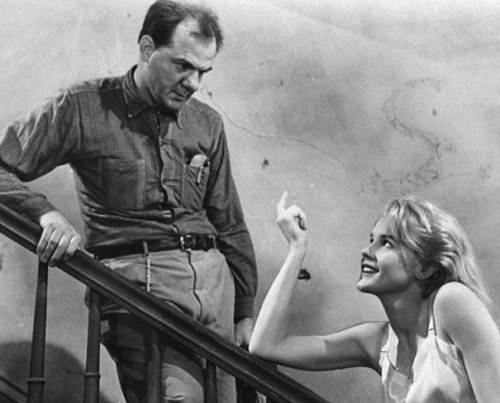
Baby Doll (Elia Kazan, 1956) On December 16, 1956, the Catholic Church's Cardinal John Spellman denounced this film in his sermon as "grievously offensive to Christian standards of decency."  Calling the film "revolting" and "morally repellent," he extended his reach with a Power Grab, declaring "In solicitude for the welfare of souls entrusted to my care and the welfare of my country, I exhort Catholic people to refrain from patronizing this film under pain of sin."

In order to drum up business he might have said, "If you see it, say two Hail Mary's and call me in the morning."  Ironically, he probably ended up driving up attendance for the film, whose worst sin was bad timing, but more questionable booking decisions have been made during the Christmas season.

A week later, Time Magazine, in its review of it led off with this line: "Baby Doll (Newtown; Warner) is just possibly the dirtiest American-made motion picture that has ever been legally exhibited." Then, in the same paragraph, goes into double-Time-speak stating "Baby Doll is an almost puritanically moral, work of art."  Thanks for the clarification.

Well, lightning bolts notwithstanding—and all the participants in Baby Doll led nice, long lives—it can be seen with the perspective of time (rather than "Time") that Spellman just had a bee in his biretta, using his bully pulpit (emphasis on the "bull") to pass Holy Judgment on a film he probably didn't see, or, if he had, mis-read.  Suggestive, yes.  Baby Doll is very suggestive, in the style of Italian comedies coming out at the time, where everything is implied, but nothing is seen, portrayed or shown.  What happens off-screen (or off-frame) is in the prurient mind of the beholder, and if such is the case His Eminence probably should have broken out the birch branches and started flailing.


Tennessee Williams' original screenplay features Karl Malden as Archie Lee Meighan, a Southern gentleman of Benoit Mississippi who's fit to be fried.  Archie Lee gets no respect, y'all, not from the town, not from his employees, and not from his child-bride Baby Doll (Carroll Baker), on the cusp of her twentieth birthday, a significant event for the couple.  Baby Doll has moved from father-figure to father-figure, agreeing to her father on his death-bed to marry the middle-aged cotton-gin owner, who might be able to provide for her.  Part of the bargain is that Archie Lee would buy her a fabulous mansion, the biggest in Benoit (although it is in disrepair), and wait until her 20th to consummate their marriage.  This leaves Archie Lee is a peripatetic state of frustration.

But, the tamped fires at home aren't his only reason for agitation—his cotton-gin business is failing, due to the conglomerate cotton-gin run by Silva Vaccaro (Eli Wallach) doing big business downtown.  In a fit of pique, Archie Lee burns down the demon gin, leaving him open to negotiate a deal to do the work.  But Vaccaro has other things in mind.  He suspects Meighan as the arsonist, and so he hangs back from the mill, in an effort to gain information from the rather vapid Baby Doll, who is very susceptible to falling for Vaccaro's tricks.

Suggestiveness ensues.  But also hilarity.  It is, after all is said and done (rather than implied and imagined), a comedy—a Williams "Southern"—like a Western, a story about the civilizing of an uncivilized situation, where the brutes are dispatched and the naive gain some wisdom, balancing the scales to Williams' own vision of the charming, graceful South he knew and wanted to recreate.

And the part that everyone was hung up about—the scene on the swing between Baker and Wallach that Kazan shot in tight close-up?   Seems the fact that you couldn't see the hands of the players was extremely questionable and prurient to outraged viewers.  The documentary included with the film has the answer: Kazan shot the scene in close-up, so you couldn't see the very large heaters keeping the actors warm on that supposedly very hot day shot in the cold temperatures of Benoit.  One more example of the mystical power of film—and why what isn't in the frame is just as important as what is.


Friday, March 12, 2010

The Ghost Writer

"Brilliant...in a Horrible Kind of Way"


From the first jolting burst of rain on the soundtrack to the last exquisitely planned-out shot (and indeed to the thudding end of Alexandre Desplat's Herrmannesque score), Roman Polanski's film of The Ghost Writer is one of the most intricately mapped out paranoid-thrillers since the heady post-Watergate days when they were in vogue. But, more than those austere films of plots, counter-plots and figures in shadows, this film has wit, wisdom and a sorcerer's command of the English language. In fact, it feels more like a Hitchcock film than any of Polanski's other thrillers.

And that's due to the precision of the writing—as it should be, since the film is about writing and word-choice and the differences between truth and artifice. Co-scenarists
Robert Harris (who wrote the movie source "The Ghost") and Polanski, set up an intricate puzzle to be solved, ala Hitchcock, that is both visually compelling and haunting.
For those of us who live in the Pacific Northwest, it's a familiar story: a ferry pulls into dock, and the off-load of vehicles is stopped by one lone vehicle with no one behind the wheel. Already, there's a story there with several possible outcomes. Did the driver forget he had his car and walked off the ferry? Are they still on the boat, say, in the bathroom?

Or did they fall overboard? Or, for that, were they pushed?
A simple story line—common, really—but it creates the question: where did the driver go? And for a movie it's a natural, because it can be presented in purely visual terms.
Turns out the missing man was a writer—a ghost-writer, specifically, named Mike McAra, and, within days, he's found washed-up on shore with an extremely high blood-alcohol content. McAra, at the time, had been working anonymously on the memoirs of the once popular former
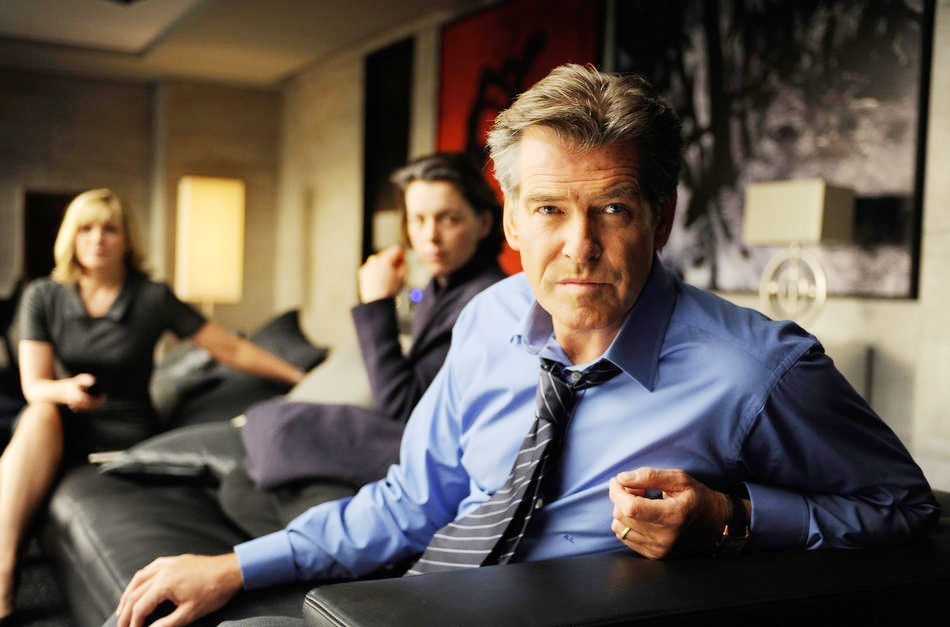
Prime Minister Adam Lang (Pierce Brosnan, never better
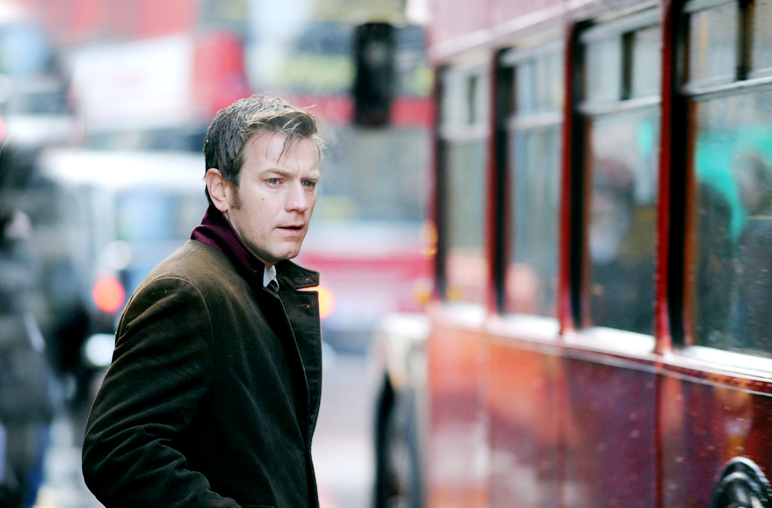
*) A new ghost-writer is hired (Ewan McGregor), and is given access to the top-secret manuscript (and the former PM) only by traveling to the high-security compound owned by the publishers to which Lang and his small staff have retreated to work on the book. The new ghost (he is never named, as he wouldn't be on the book) is de-briefed, patted down, scanned, searched and only then is he allowed to read the draft, which is under lock and key and never to leave its present sequestered location.
To his horror, he finds the book a snoozer—he doesn't like political memoirs, anyway—and he's determined to beat it into some kind of readable shape, given a time-limit of only four weeks.
The compound he's staying at on Martha's Vineyard is a concrete nightmare that looks more suited to one of the villains Brosnan battled in the Bond series—high-tech-gadgeted, and constantly surveilled. The minimal staff includes Lang's assistant from the No. 10 days,
Amelia Bly (a smart, sharp Kim Cattrall), and overseen by Lang's wife Ruth (the wonderful Olivia Williams from Rushmore and An Education). Soon, complications set in and the building goes into crisis mode as it is revealed that Lang, in his dealings with the U.S. on the war on terror, was involved in the kidnapping and torture of terror-suspects, and may be brought up on charges as a war criminal by the International Criminal Court.
Suddenly, the compound is in a state of siege
and that memoir becomes a hot topic: The publisher (Jim Belushi, unrecognizable and nicely brusk) wants the book in two weeks before the headlines get cold, Lang leaves to go on an image-building trip to Washington, the press is bombarding the compound ("the pack is on the move" as Amelia puts it), protesters chant outside the gate, and The Ghost is left there with a few mysteries to unravel. Both he and Lang are nicely metaphored by the compound's gardener trying to keep the dead grass he's just raked into a wheelbarrow on a blustery day.
Leave the exposition at that. But it calls to mind past Polanski films of protagonists walking in the foot-prints of people who have come before, and in danger of losing their own identity to them—not that hard for The Ghost, as he has no identity in the film (
Lang merely calls him "man," because he has no head for names).
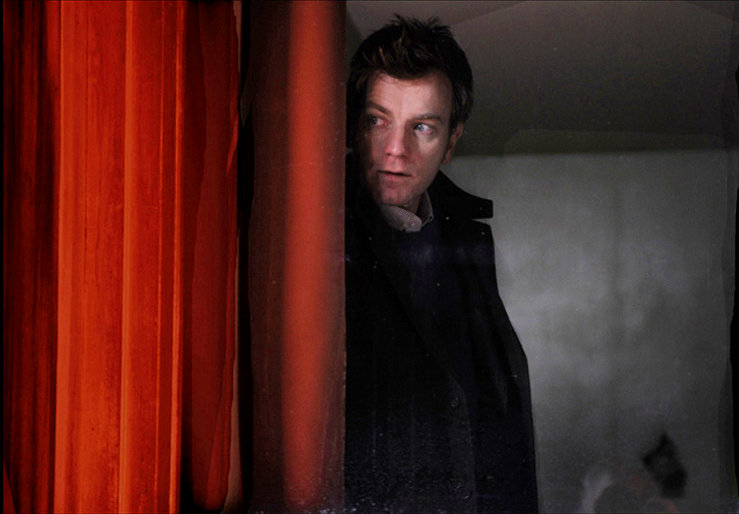
There are twists and turns, but where it is enticing is the way Polanski mines the material for suspense and humor. No detail goes unused—not the security, not the weather, not the language, not the technology, not the sound. Small glances through slitted curtains may be significant, as are muffled conversations in the next room, or the insistence by a staff-member to use a car on the island, rather than the bicycle. It COULD be innocent. He really MIGHT be concerned about the weather. But, then again...
Then, again. Along with the paranoia are moments of perverse comedy where The Ghost's stealth make him stick out like a sore thumb, or just makes things more difficult for himself. Aware of his position as a replacement, he soon finds himself retracing his predecessor's steps, having to both live up to the trusted writer's reputation, but also to do right by him to find out what happened.
If he can escape the same fate.
The performer's are uniformly excellent:
McGregor is a perfect protagonist, veering between deer-in-the-headlights and the wily hubris of the Man Who Knows Too Much, Brosnan and his character share a theater background, and the actor allows the arrogance and The Act of being a politician look believable in equal measure. Olivia Williams is by turns steel and rubber in her role, and Cattrall is efficiently perfect—you suspect her immediately. There are also nice turns by Timothy Hutton, Eli Wallach and the ubiquitous Tom Wilkinson, and by Robert Pugh as one of Lang's political rivals.
But it's Polanski's show—he's the Puppet-Master, the audience-conductor like Sir Alfred, and effective enough that you leave the theater with a heightened sense of awareness, looking around corners, at things out-of-place, that the world is a more dangerous place.

And the most deliciously perverse irony is that Polanski had to complete the film in the place that informed the sensibility and interests of the young Hitchcock's film career: a prison cell.
**

* Despite his hard-scrabble up-bringing Brosnan has always been better at playing effete characters. It's why his James Bond was something of a bore—Brosnan seems more suited to knocking someone out with a nerve-pinch than a karate chop.

** "I must have been about four or five years old. My father sent me to the police station with a note. The chief of police read it and locked me in a cell for five or ten minutes, saying "This is what we do to naughty boys." Hitchcock/Truffaut p. 17

Thursday, September 4, 2008

The Magnificent Seven

"The Magnificent Seven" (John Sturges, 1960) Sturges' remake of Kurosawa's "Seven Samurai" as a Western with cowboys (more accurately gun-slingers) is a rousing crowd-pleaser (while maintianing the original's resigned tone) not only due to Kurosawa's indestructible original tale, but also the charismatic cluster of stars vying for screen-time with "The King" himself, Yul Brynner.* Steve McQueen, coming off the "Wanted: Dead or Alive" series was particularly shameless about trying to grab the spotlight from Brynner. "It doesn't bother me," the older actor would tell the director. "All I have to do is take off my hat."

This time it's a Mexican village being annually robbed by bandito's led by
Eli Wallach that cause a trio of farmers to go searching for "gun-fighters" to take on the bandits. One by one, the odd troupe are assembled including up-and-coming stars McQueen, Charles Bronson, Robert Vaughn, James Coburn, Brad Dexter and Horst Bucholz,** all down on their luck and taking on the job until something better comes along. Momentum is kept up by some sharp writing, but also by a rousing Copland-esque score by Elmer Bernstein*** that manages to goose the action up several notches from how it's paced on screen.

The transition (and translation) from Japan to Mexico is flawless, and just as the Samurai have their distinct characteristics, so, too, do the gunfighters--only Horst Bucholz, given an outlandish billing in retrospect, fails to rise to the potential of the others. The genius of the film is Kurosawa's, but this Americanized version still has its own unique charms, enough to make "The Magnificent 7" a huge success in its own right. A few years later, the same tack was used to create a westernized version of Kurosawa's "
Yojimbo,"**** and launched the "Spaghetti Western" and the career of its chief architect, Sergio Leone.


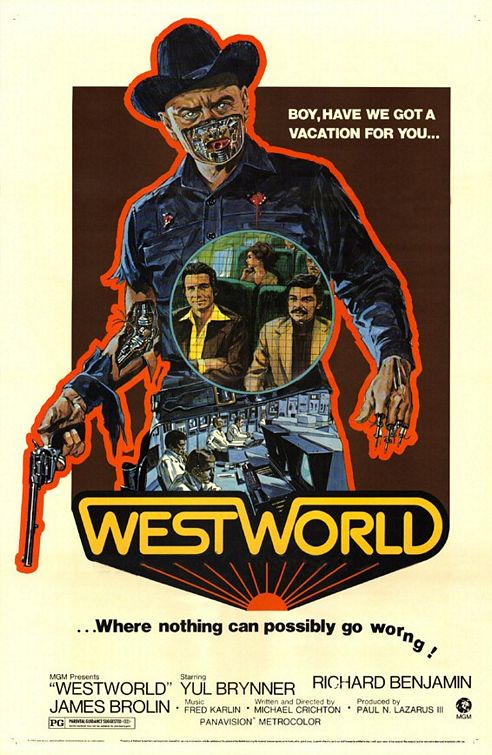
* Brynner cut such a fine figure as a gunslinger (despite his Russian heritage) that he came back for the sequel "The Return of the Seven," and was the emblematic robot shootist in "Westworld" and its sequel "Futureworld."

** The closest I could come to finding a movie that had so many future stars (and Brad Dexter) in it is Francis Coppola's "The Outsiders.

*** Bernstein's theme became known as "The Marlboro Theme" because it was used as the background music for that brand's (now extinct) cigarette commercials. The prolific Bernstein (no relation to Leonard) only won one Oscar for his music--for the musical score to "Thoroughly Modern Millie."

**** That would be "A Fistful of Dollars," starring Clint Eastwood.