Showing posts with label Roman Polanski. Show all posts

Saturday, January 28, 2012

Carnage

Get a Room!
or
Who's Afraid of Nibbles the Hamster?

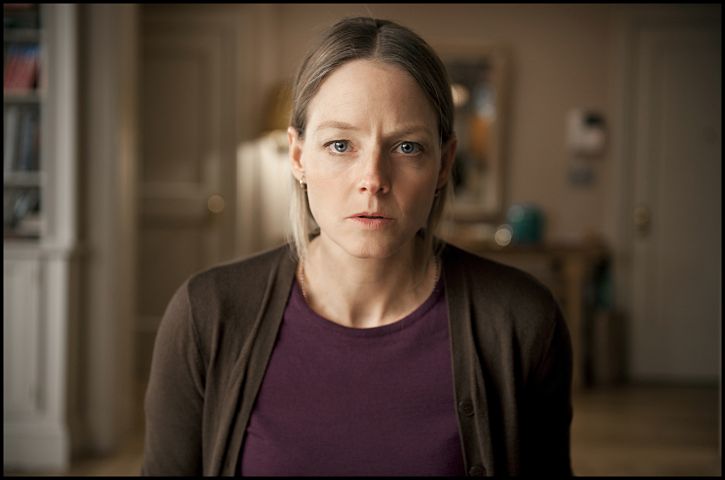
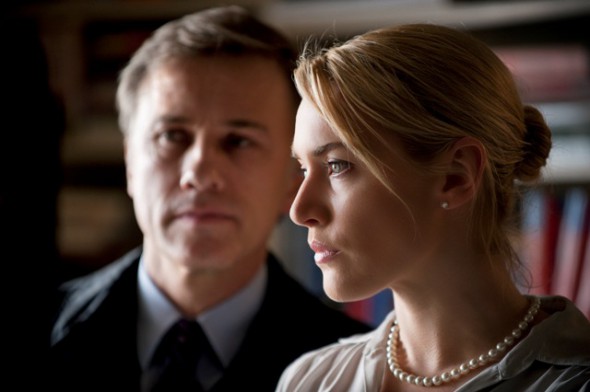
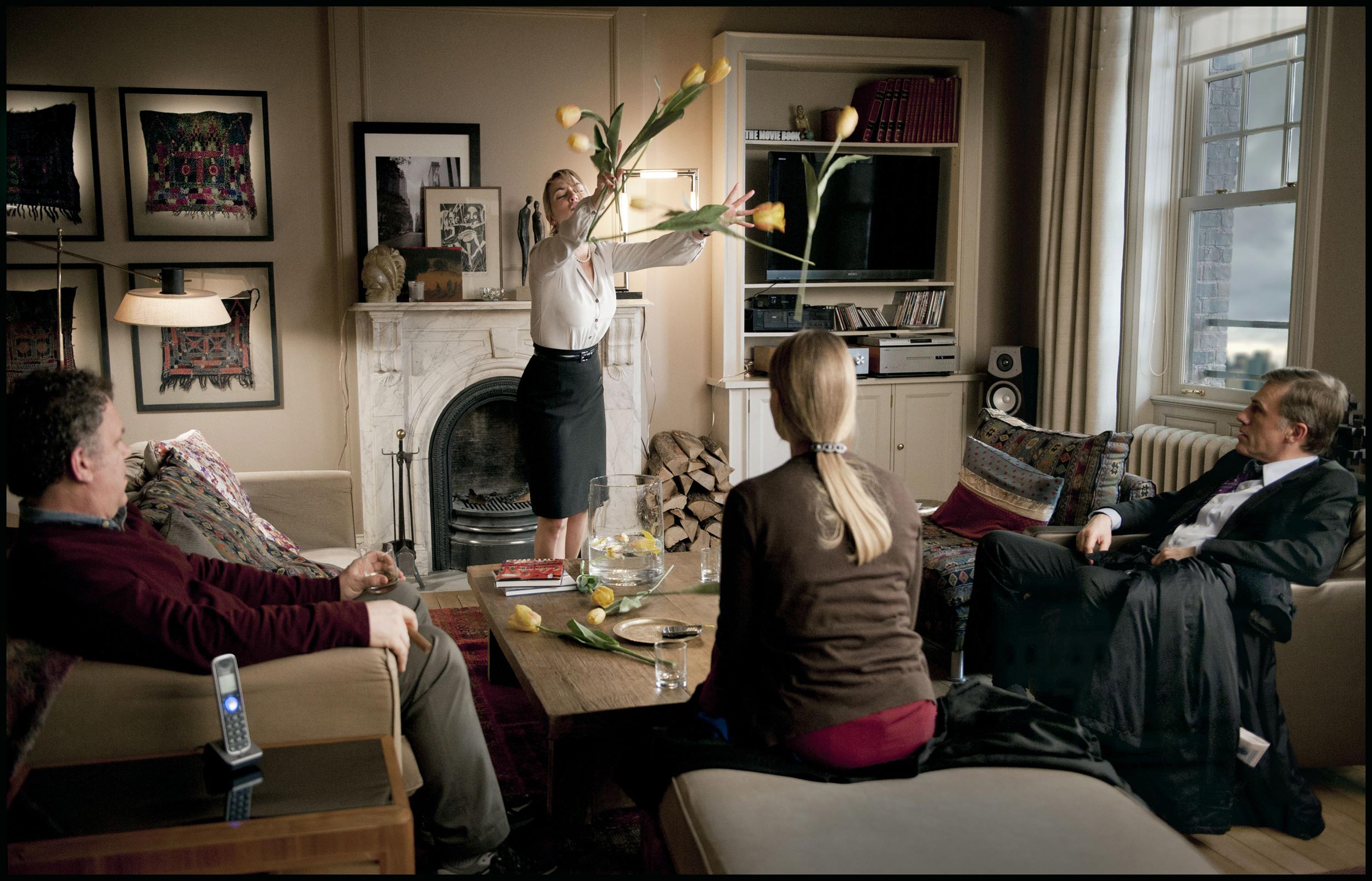
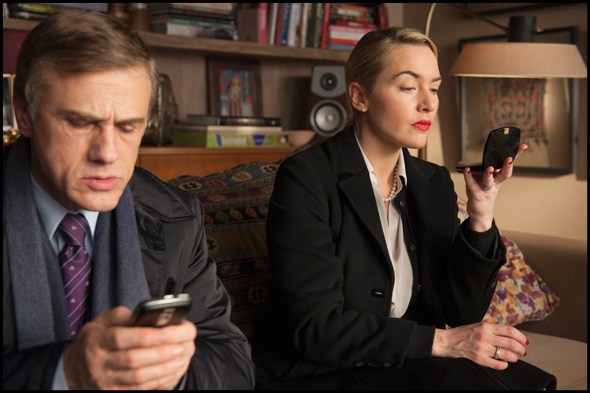
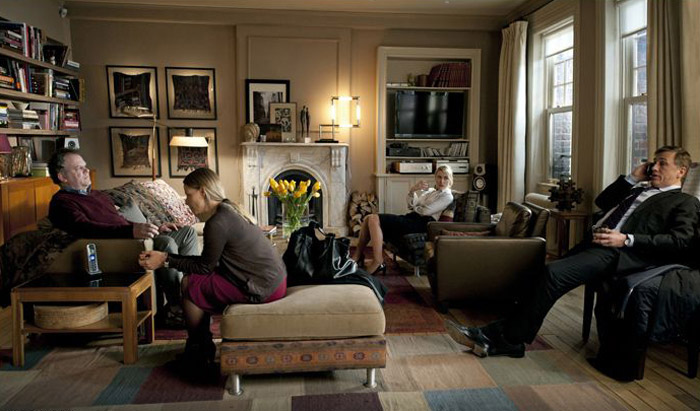
A schoolyard brawl between two kids escalates into a meeting between the parents that only proves the kids are amateurs at it in Roman Polanski's new film Carnage, based on the play by Yasmina Reza.  The meet-and-greet takes place at the New York apartment of Penelope and Michael Longstreet (Jodie Foster, John C. Reilly)— he's in hardware sales and she's an arts afficianado and rights activist, writing a book about African genocide—with Alan and Nancy Cowen (Christoph Waltz, Kate Winslet)—he's in lawyery and she frets.  It all starts well enough: cobbler is served and coffee offered, everyone's uncomfortable and on their best behavior.  But the niceties don't last any longer than the cobbler.  Penelope starts getting self-righteous, Michael, overly conciliatory, while Alan loses his laser-like focus from a series of interrupting cell-calls that from a client with a wonder-drug for high blood pressure that may have all sorts of side effects.

Then, Nancy...well, things go down-hill fast after Nancy...

It's basically a one-joke black-comedy that isn't remotely funny (the anti-punch-line comes at the end) turned up to 11 by an all-star cast and a director confined to a minimal set and probably going a little bit insane day by day.  Bear in mind that Polanski was probably giggling and encouraging extremism all through shooting, but all these terrific actors have their moments of masonry mastication—Foster coming off the worst, and Winslet the best, with Reilly and Waltz being alternately obnoxious and snaky.  Fairly soon, lines are drawn in tasteful carpets and there's a constant tying and untying of boundaries and bonds, that fall along lines of sex, politics and whatever the last subject talked about was. 

There are histrionics galore, and while there are no real baring of souls, there are all sorts of baring of inhibitions and not in the fun way.  These people seem to have absolutely no sense of decorum or restraint or any illusions that their opinions might not be the most pertinent to the proceedings.  It's all out there, vomited at projectile force and with no dolby/no squelch.  That would appear to be the comedy of it, but unfortunately it comes off a little forced and a little unrealistic.  It doesn't matter how set in their ways and high-strung these people are, at some point there is going to be re-assessment and back-pedaling, even if the trajectory is straight down-hill.

Not in this self-contained universe.  There is no tentativeness here, no sticking the toes in to test the waters, everybody belly-flops into the pool from the high-minded-board.  Even "Who's Afraid of Virginia Woolf?" is subtle by comparison, although there are some nice behavioral touches, like Penelope raising her level of discussion to an obviously uncomfortable volume to drown out Alan's phone-call.  Common sense is forgotten along with the kids argument and everything degenrates to a tag-team grudge match between and among the couples.

Ultimately, it's a bad night out that you want to forget about in the morning.

Carnage is a Rental.

Friday, March 12, 2010

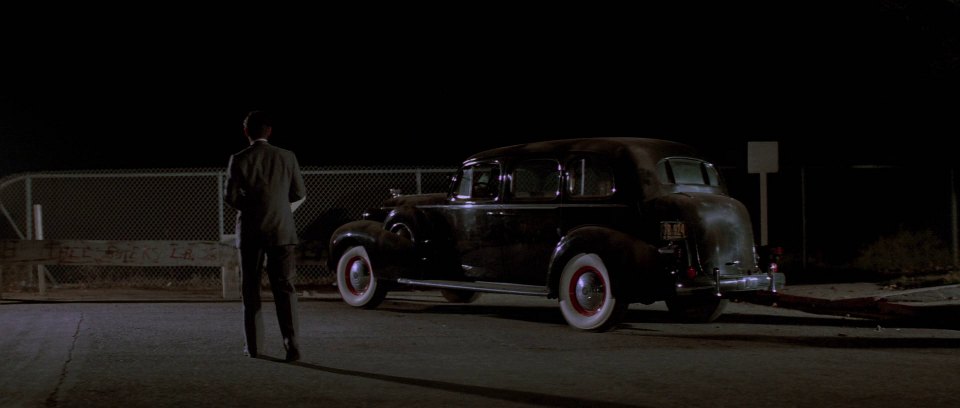
The Ghost Writer

"Brilliant...in a Horrible Kind of Way"


From the first jolting burst of rain on the soundtrack to the last exquisitely planned-out shot (and indeed to the thudding end of Alexandre Desplat's Herrmannesque score), Roman Polanski's film of The Ghost Writer is one of the most intricately mapped out paranoid-thrillers since the heady post-Watergate days when they were in vogue. But, more than those austere films of plots, counter-plots and figures in shadows, this film has wit, wisdom and a sorcerer's command of the English language. In fact, it feels more like a Hitchcock film than any of Polanski's other thrillers.

And that's due to the precision of the writing—as it should be, since the film is about writing and word-choice and the differences between truth and artifice. Co-scenarists
Robert Harris (who wrote the movie source "The Ghost") and Polanski, set up an intricate puzzle to be solved, ala Hitchcock, that is both visually compelling and haunting.
For those of us who live in the Pacific Northwest, it's a familiar story: a ferry pulls into dock, and the off-load of vehicles is stopped by one lone vehicle with no one behind the wheel. Already, there's a story there with several possible outcomes. Did the driver forget he had his car and walked off the ferry? Are they still on the boat, say, in the bathroom?

Or did they fall overboard? Or, for that, were they pushed?
A simple story line—common, really—but it creates the question: where did the driver go? And for a movie it's a natural, because it can be presented in purely visual terms.
Turns out the missing man was a writer—a ghost-writer, specifically, named Mike McAra, and, within days, he's found washed-up on shore with an extremely high blood-alcohol content. McAra, at the time, had been working anonymously on the memoirs of the once popular former
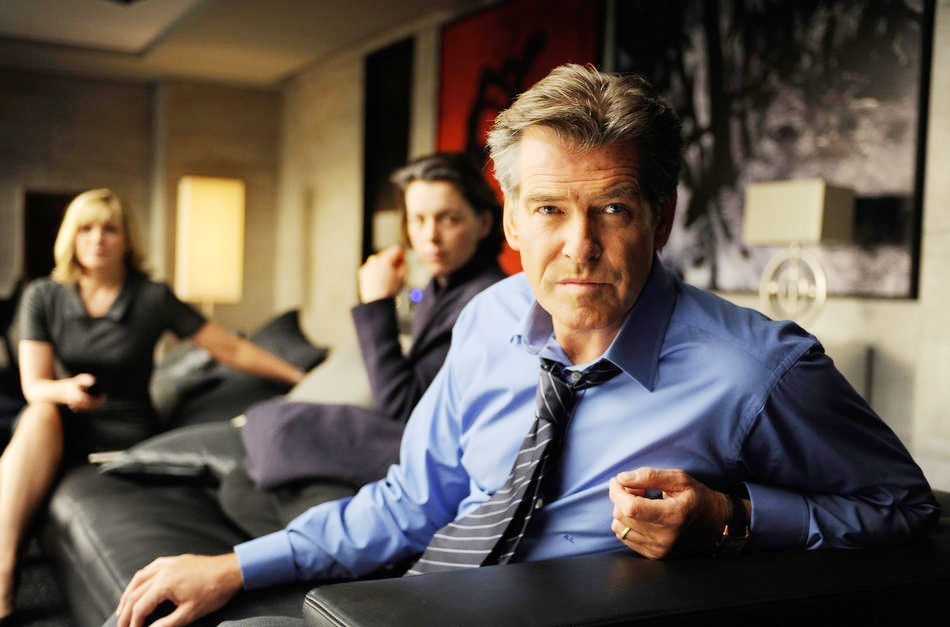
Prime Minister Adam Lang (Pierce Brosnan, never better
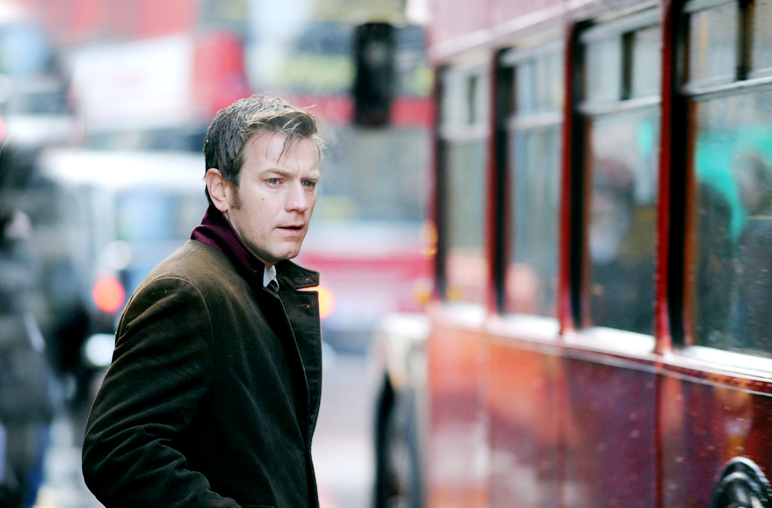
*) A new ghost-writer is hired (Ewan McGregor), and is given access to the top-secret manuscript (and the former PM) only by traveling to the high-security compound owned by the publishers to which Lang and his small staff have retreated to work on the book. The new ghost (he is never named, as he wouldn't be on the book) is de-briefed, patted down, scanned, searched and only then is he allowed to read the draft, which is under lock and key and never to leave its present sequestered location.
To his horror, he finds the book a snoozer—he doesn't like political memoirs, anyway—and he's determined to beat it into some kind of readable shape, given a time-limit of only four weeks.
The compound he's staying at on Martha's Vineyard is a concrete nightmare that looks more suited to one of the villains Brosnan battled in the Bond series—high-tech-gadgeted, and constantly surveilled. The minimal staff includes Lang's assistant from the No. 10 days,
Amelia Bly (a smart, sharp Kim Cattrall), and overseen by Lang's wife Ruth (the wonderful Olivia Williams from Rushmore and An Education). Soon, complications set in and the building goes into crisis mode as it is revealed that Lang, in his dealings with the U.S. on the war on terror, was involved in the kidnapping and torture of terror-suspects, and may be brought up on charges as a war criminal by the International Criminal Court.
Suddenly, the compound is in a state of siege
and that memoir becomes a hot topic: The publisher (Jim Belushi, unrecognizable and nicely brusk) wants the book in two weeks before the headlines get cold, Lang leaves to go on an image-building trip to Washington, the press is bombarding the compound ("the pack is on the move" as Amelia puts it), protesters chant outside the gate, and The Ghost is left there with a few mysteries to unravel. Both he and Lang are nicely metaphored by the compound's gardener trying to keep the dead grass he's just raked into a wheelbarrow on a blustery day.
Leave the exposition at that. But it calls to mind past Polanski films of protagonists walking in the foot-prints of people who have come before, and in danger of losing their own identity to them—not that hard for The Ghost, as he has no identity in the film (
Lang merely calls him "man," because he has no head for names).
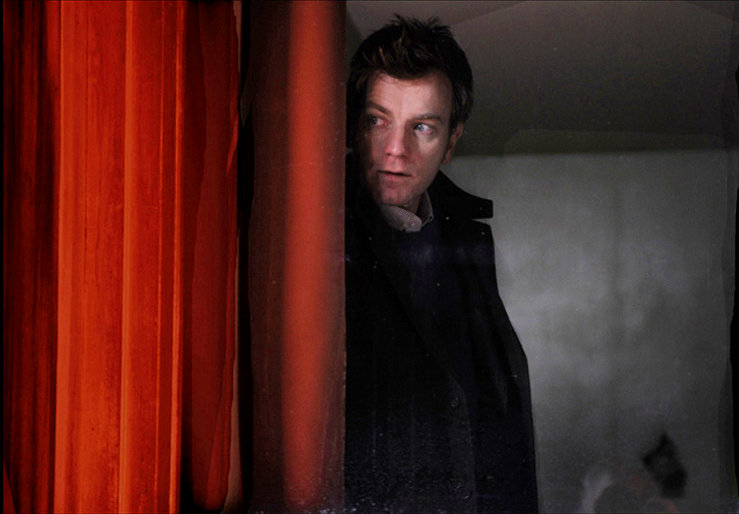
There are twists and turns, but where it is enticing is the way Polanski mines the material for suspense and humor. No detail goes unused—not the security, not the weather, not the language, not the technology, not the sound. Small glances through slitted curtains may be significant, as are muffled conversations in the next room, or the insistence by a staff-member to use a car on the island, rather than the bicycle. It COULD be innocent. He really MIGHT be concerned about the weather. But, then again...
Then, again. Along with the paranoia are moments of perverse comedy where The Ghost's stealth make him stick out like a sore thumb, or just makes things more difficult for himself. Aware of his position as a replacement, he soon finds himself retracing his predecessor's steps, having to both live up to the trusted writer's reputation, but also to do right by him to find out what happened.
If he can escape the same fate.
The performer's are uniformly excellent:
McGregor is a perfect protagonist, veering between deer-in-the-headlights and the wily hubris of the Man Who Knows Too Much, Brosnan and his character share a theater background, and the actor allows the arrogance and The Act of being a politician look believable in equal measure. Olivia Williams is by turns steel and rubber in her role, and Cattrall is efficiently perfect—you suspect her immediately. There are also nice turns by Timothy Hutton, Eli Wallach and the ubiquitous Tom Wilkinson, and by Robert Pugh as one of Lang's political rivals.
But it's Polanski's show—he's the Puppet-Master, the audience-conductor like Sir Alfred, and effective enough that you leave the theater with a heightened sense of awareness, looking around corners, at things out-of-place, that the world is a more dangerous place.

And the most deliciously perverse irony is that Polanski had to complete the film in the place that informed the sensibility and interests of the young Hitchcock's film career: a prison cell.
**

* Despite his hard-scrabble up-bringing Brosnan has always been better at playing effete characters. It's why his James Bond was something of a bore—Brosnan seems more suited to knocking someone out with a nerve-pinch than a karate chop.

** "I must have been about four or five years old. My father sent me to the police station with a note. The chief of police read it and locked me in a cell for five or ten minutes, saying "This is what we do to naughty boys." Hitchcock/Truffaut p. 17

Wednesday, June 17, 2009

Roman Polanski: Wanted and Desired

"Roman Polanski: Wanted and Desired" (Marina Zenovich, 2008) A few weeks ago, a friend professed a love for the film "Powder," and I told him, "You and I should talk." He's a big believer in holding folks accountable for their actions and not seeking out the work of those he finds abhorrent. So, I told him about "Powder's" director (for Disney!) being convicted of child molestation, and that "Powder" was something of a personal apologia for the director being "different." This creeped my friend out and I felt bad, and tempered my argument by saying that "I like a lot of Roman Polanski's films and he's a child rapist."

Not...technically—that is, legally on the record—true.
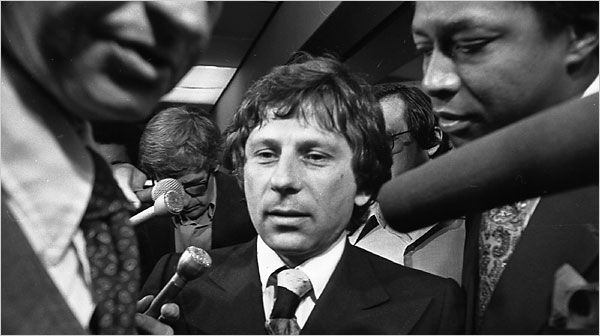
Polanski was convicted in 1978 of liquoring up and having sex with a 13 year old girl that he was photographing for some European magazine. He was marely convicted of "unlawful intercourse." Before then, he had had an affair with 15 year old Nastassja Kinski (who subsequently starred in his film "Tess")—the only difference being that he had carried on that affair in Europe.

Now, along comes this film that prods into Polanski's private life—his parents died in concentration camps, his dark sensibilities (which he claims developed from seeing Disney's "
Snow White," which I can believe), his doomed marriage to Sharon Tate and her subsequent murder by the Manson Family and the lurid fascination and idle (and unsubstantiated) speculation of the Press (not just the Hollywood Press) of the Polanski's supposed complicity in what was a series of random murders (The Fifth Estate loves a good conspiracy theory—on the West Coast, but, sadly, not so much on the East).

Polanski's arrest and trial was another chance for the Press to whack at scabbed-over wounds, and right out of the gate,
they descended like locusts.

Both the prosecutor of the case and Polanski's defense attorney have argued that he was railroaded by a publicity-seeking judge (also with an eye toward the young ladies), and the victim successfully sued Polanski in civil court and has come out publicly (and in this documentary) saying that it was a chance she took for publicity and an acting career in the twisted morass of Hollywood. She has publicly forgiven Polanski. She's grown up and one gets the sense from her world-weary tone that she wishes the rest of the World would, too.

So, Polanski can come back at any time (the only thorn in the proceedings is that the judge now handling the case wants it televised, which is a deal-breaker for the director. Given the evidence of the paparazzi feeding frenzy that constantly dominates the documentary, one sees why (that, and I'm sure Polanski wants to be able to direct that last act). The documentary makes no bones about Polanski's actions, it doesn't argue that Polanski did it, nor does it condemn him for it. It's agenda is to examine whether,
given the evidential footage of the media circus that the proceedings became, and the interviews of court officials and the obvious culpability of a compromised judge who enjoyed the limelight, Polanski's sentencing phase would have been fair and impartial, as Polanski's doubts about it led to his fleeing the country. It would be nice if the judge being accused were alive to defend himself, but he died in 1994.

For all the questions that the documentary brings up, the one that is never asked reveals the filmmaker's bias towards Hollywood's (as well as America's) unquestioning feeling of superiority—the question isn't why doesn't he come back.

The question is why would he ever want to.

Tuesday, May 19, 2009

Anytime Movies Reloaded: Chinatown

It's Spring-Break for me. Times are busy. The Summer Movie Season is already begun (and I'll be writing about the new ones) and the Film Festivals are grinding away like creaky mills separating wheat from chaff. It's as good a time as any to re-boot a feature I started years ago, when it was suggested I do a "Top Ten" List.

I don't like those: they're rather arbitrary; they pit films against each other, and there's always one or two that should be on the list that aren't because something better shoved it down the trash-bin.

So, I came up with this: "Anytime" Movies.

Anytime Movies are the movies I can watch anytime, anywhere. If I see a second of it, I can identify it. If it shows up on television, my attention is focused on it until the conclusion. Sometimes it’s the direction, sometimes it’s the writing, sometimes it’s the acting, sometimes it’s just the idea behind it, but these are the movies I can watch again and again (and again!) and never tire of them. There are ten (kinda). They're not in any particular order, but the #1 movie IS the #1 movie.

This is the one of the “Anytime Movies” that falls into the category of “Lost Causes and the Futility of Good Intentions,” but lest anyone think these films are depressing, they’re not.

Well, okay, this one is.


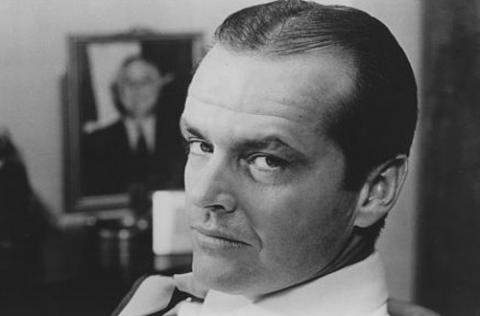
It’s also perfect. Given the nature of the trio of men who oversaw its creation—screenwriter Robert Towne, director Roman Polanski, and producer Robert Evans—the thing could have self-destructed like a fragment grenade. And, in fact, the planned trilogy of films featuring detective JJ “Jake” Gittes investigating three big California crimes (water, land, and nuclear) stopped after the personality clashes that derailed the first attempt at filming “The Two Jakes.” Polanski couldn’t set foot on American soil due to rape charges, and Evans (who was producing and co-starring) and Towne (writing and directing) clashed on the set. The combination of expanded roles and ego following the first film’s success shut down production, and it was only the efforts of star Jack Nicholson, who took over directing, that allowed the film to be made. They say that great films need a miracle – Chinatown had it, but “The Two Jakes” didn’t have a prayer.

“Middle of a drought and the water commissioner drown. Only in L.A., huh?”

Based loosely on the construction of the William Mulholland designed aqueduct, and the real estate swindles it engendered, “Chinatown” starts out as a mystery even more steeped in the locale of L.A. than Chandler’s Marlowe stories. Here, the very city is a part of the crime and corruption is steeped in its soil and water. Water is the heart of “Chinatown.” Its ebbs and flows are constantly monitored –the original object of investigation is the city’s head of the Department of Water and Power who then becomes the victim of a grisly murder. Water is never too far from the surface of the story. Even Jerry Goldsmith’s shimmering score suggests water in its low harp trills, and the sighing of, yes, water phones.

“Chinatown” gets all its details right—the language, the costumes
Richard Sylbert’s period work is amazing, and a perfect cast makes the most of Robert Towne’s wise-acre dialog. A perfect cast? Right down to the smallest part. There’s a favorite moment of mine when Gittes, after badgering the secretary of the new head of Water and Power, is distracted by an odd squeaking noise. He, of course, has to investigate, and opens the outside door on the two work-men who are scraping the dead man’s name off the door. The one guy looks irritated—the other guy smiles, nods, and as the door is closing shakes his head ruefully—“Happens every time.” It’s a tiny little moment that feels so authentic, so much more than a mere movie might provide, it provides a moment of truth in a continuous string of truths.

But, that is a moment you can appreciate as it happens. “Chinatown” lives on in the memory. After the mystery is solved, moments come back, as the pieces come together and the journey to the conclusion coalesces. They haunt. On repeat viewings, “Chinatown” is a treasure trove of call-backs and foreshadowing’s.* Little things, like the odd cadence of a name, mispronunciations that can be traced back, a birth-mark—lead you downstream to a resolution that you should, in retrospect, have seen all along. Like Gittes, its only at the end that you get the full story. Of course, like him, you follow the most obvious things that seem out of place or arouse suspicions. ** But the world is a more complicated place and long after the film is finished does it strike you that the two most suspicious people while watching the film are actually the most decent and altruistic ones acting with the best of intentions. Of course, in this world they come to a bad end.


“Do you know how long I've been in this business?”

And here’s where that mix of personalities comes in. Towne’s screenplay is very grey—Jake Gittes at the beginning of the film—the very beginning—gets angry and abusive with his moaning client, Curly (In the film, there’s only an impatient irritation). Later dialog casts a sympathetic spin on water magnate Noah Cross. The original screenplay ends with, if not a happy ending, then a triumphant one. Evans loved the screenplay (though he didn’t quite get it), but in one of those odd bursts of inspiration that sustained him throughout an eccentric career as a producer, decided that the film needed a European sensibility, and so, brought in Polanski, who had left the country and Los Angeles following the murder of his wife Sharon Tate by the Manson family. His perverse take on the city and the material focused it, and made a stronger delineation between good that is good and evil that is truly evil—and provided the ending that doomed those most in need of rescuing. “Chinatown” ends in shock, and with a sense of tragic inevitability. That Jake, in a moment of selfishness and hubris, sets up a series of events that ends up completely bollixing up his good intentions, completes a circle and a character arc that had been percolating below the surface the entire time. He ends up ignoring the lessons he learned in Chinatown (the district, not the film), and paying the same consequences. The final words are ironic--“Forget it, Jake. It’s Chinatown.” Forgetting isn’t his problem. Remembering is. Towne would hammer the point home with the last line of “The Two Jakes”—“Kitty! You never get over it.”

But by that time it wasn’t necessary to say.
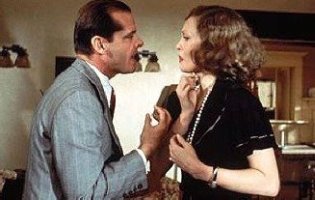

Jake wants the truth.
He can't handle the truth.

* On my most recent viewing, I noticed a moment that shocked me. After Jake and Evelyn flee a scene in her car amidst a hail of gunfire, the superbly coiffed Evelyn touches her left eye—as if she has something in it. Whether it was Polanski’s or Dunaway’s choice, it’s a brilliantly sick one.

** Towne’s screenplay is so fully formed that, unlike Chandler’s Marlowe stories, a first person narrative isn’t necessary. We are always aware of what Gittes is doing, and thanks to Nicholson’s performance, what he’s thinking.

Chinatown
Mr. Smith Goes to Washington
American Graffiti
To Kill a Mockingbird
Goldfinger
Bonus: Edge of Darkness

Wednesday, August 27, 2008

Olde Review: MacBeth (1971)

This was part of a series of reviews of the ASUW Film series back in the '70's. Except for some punctuation, I haven't changed anything from the way it was presented, giving the kid I was back in the '70's a bit of a break. Any stray thoughts and updates I've included with the inevitable asterisked post-scripts.

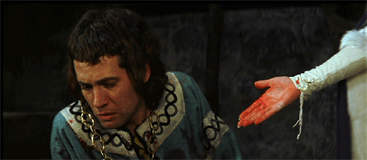
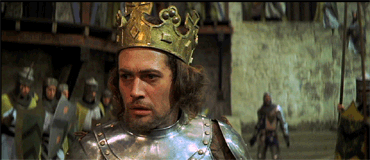
"MacBeth" (Roman Polanski, 1971) (Peter Brook's) "King Lear" is brutal, and so, too, is Roman Polanski's "MacBeth," probably excessively so. There is much graphic carnage in "MacBeth," and I would recommend that if you are disturbed by such substance that you think twice before going. But it is healthy to keep in mind that "MacBeth" is a play filled with violence. All Shakespeare's tragedies are; one need only to leaf through the last acts of them to prove itself out.

But there is much to praise in Polanski's version; it is a fuller version of the play it is based on than "King Lear." Peter Brook cut out a voluminous amount of Shakespeare's original prose. The cinematography and Polanski's camera placements are all very assured, and very fine in detail.* The acting of Jon Finch and Francesca Annis as MacBeth and his Lady are fine for what Polanski's interpretation is. But it is my view that MacBeth should be older (and) probably less crude than is Finch's portrayal; an older man could speak the "out, out brief candle" speech with more of a knowing world-weariness than the young MacBeth here could manage.**


Both these films are hard (and) tough with a gritty interpretation.*** The beauties of Shakespeare--his words--are still there to be enjoyed and marveled over, but the madness, the savagery, and the evil inherent in those words are presented with such ferocity, that one's view of the words on the page will be forever altered. Those sensitive enough to see the beauty of the words may not be able to stand up to what is graphically presented within them.


Broadcast on KCMU-FM November 18th and 19th, 1975.

* I was smirking at that sentence, thinking: "What would an unassured shot look like?" and immediately came up with an answer: shaky-cam!
** But one should also remember this film was in production soon after Franco Zeffirelli's hit film of "Romeo and Juliet," which did something radical--actually portray R & J as being still in their late teens, rather than, say, Liz and Dick. The tragedy is a bit more keenly felt when it's kids' lives that are being cut short so soon. Plus, to have the cast young and attractive might bring in audiences (it didn't). The film was a "Hugh M. Hefner Production" financed with "Playboy" money, so there's another reason for young attractive people in the leads. But, I always imagine "MacBeth" as a brute, not very political, and passed over to advancement because of it. Fatally ambitious, MacBeth enters into an arrangement with the witches ro ascend to the throne. It plays a bit better for me if MacBeth is older, and a bit desperate to achieve his life's ambitions (and his wife's) at last.

*** This review is a companion piece to yesterday's review of Peter Brook's King Lear.

Wednesday, August 13, 2008

Olde Review: Chinatown

This was part of a series of reviews of the ASUW Film series back in the '70's. Except for some punctuation, I haven't changed anything from the way it was presented, giving the kid I was back in the '70's a bit of a break. Any stray thoughts and updates I've included with the inevitable asterisked post-scripts.

"Chinatown" (Roman Polanski, 1974)

Gittes: Hello Claude. Where'dja get the midget?
Midget: Yer a nosey fellow, kitty-kat, huh? Ya know what happens to nosey fellas, huh? No? Wanna guess? Huh? No? (slices Gittes' nose). Next time you lose the whole thing. Cut it off and feed it to my goldfish. Understand? Understand?!
Mulvehill: Tell 'im you understand, Gittes.
Gittes: I unnerstand!

As opposed to the whimsy of "The Third Man," "Chinatown" is a film of deadly earnest, a perfect example of what is termed "film noir"-which means, in melodramatic terms "when the streets are dark with something more than night," usually the feeling of purveying evil. That is certainly there in "Chinatown," although it would be hard to pin that evil on the influence of the film's all-encompassing villain, or the influence of its director, Roman Polanski, who incidentally played that strangely accented "midget" with a knife you heard in that tape segment.* Polanski shaped this film into a first-rate thriller, even more, into the best film coming out of a major studio in 1974, deserving of every Oscar that "The Godfather Part II" won that year.** As with most of these films, each and every performance is perfectly played from the starring performances of Jack Nicholson, Faye Dunaway, John Huston and John Hillerman, down to a lowly sign painter.***

Chinatown--a section of Los Angeles inhabited mostly by Asian-Americans due to a suppression of their people.

Chinatown--the former beat of two L.A. patrolmen, J.J. Gittes and Lou Escobar; a beat they think in "bad luck" for "you can't always tell what's going on."

Chinatown--the symbol of all evil to Jake Gittes, private detective, for it reminds him of his own tragic failures.

Jake Gittes is hired by a Mrs. Mul'-wray to investigate her "philandering" husband. But as Jake investigates, he realizes that Mr. Mul-wray' is not what he seems, Mrs. Mul'-wray is not what she seems, and Jake finds himself investigating a larger scandal, one encompassing city-wide fraud and personal tragedy. Jake knows all the moves he is supposed to make while investigating--tailing, picking up clues, following them to the next step--and the whole way, he thinks he has the whole case going smoothly. But he doesn't. It is much too big for him to stop. He ignores those little details that he, and we, only can remember later. And Jake Gittes, when the case is over, relives a tragic part of his past, and can only take consolation in the caring words of an associate--"Forget it, Jake. It's Chinatown."

The ending of "Chinatown" is a complete reversal of what the film had, supposedly, been leading up to. It will undoubtedly shock and disappoint you. Some critics have said it is ill-considered and "tacked on." But it isn't. It is perfect for the film that Roman Polanski made, and it makes the experience of viewing "Chinatown" that much more resonant.


Broadcast on KCMU-FM November 11th and 12th, 1975.

Some revisions should be made to this (if I were making revisions). I was being too much of a "nanny" critic, telling people how they should feel. And I kind of blew any surprise that ending SHOULD have by telling an audience to expect it.


And "Chinatown" isn't "the symbol of all evil" for Gittes. That's giving him too much thought of the place. It's just a place to be avoided. Bad luck. Fool me once, shame on you. Fool me twice--

And Walsh's words to Gittes aren't "caring," he says it because there's nothing more to say. "Get over it. What'd you expect?"

I've written about "Chinatown" more extensively
here. But there's more to say. Reading a nearly final script by Towne of this film tells you that Polanski brought more sense of moral rage to the film (interesting, for Polanski). Evil is evil. Good is good. I've always "gotten" the sense that Hollis Mulwray is not only a good man, but practically a saint. There are things implied in Polanski's direction that point even further in that thought. But, in Towne's screenplay, more sympathy is ascribed to the villain. He is not pure evil as the film would have him appear. He is merely weak, and anything can happen in a moment of weakness. Evelyn Mulwray is also less of a victim in that screenplay, though her actions are seen to be a trifle hysterical. There are no easy answers in Towne's early screenplay. Things are not black and white, merely shades of gray. And given Polanski's history--the concentration camps, and his wife, Sharon Tate's grisly murder at the hands of the Manson gang, and his own past films, one would see why he'd tilt it to the side of the devils.

In 1991, "Chinatown" became a part of the National Film Registry.


* Yeah--you don't get the taped segment. Sorry. The transcript will have to do. I've always loved the way Nicholson drawled out "Hello, Claude. Where'dja git the midgit?" It runs a close second to my favorite Nicholson line, from "Five Easy Pieces:" "Don't tell me 'bout the GOOD life, Eldon, 'cuz it makes me PUKE!"

** Although "The Godfather, Part II" also deserved every Oscar it won. Except maybe score. And I don't think that's hyperbole saying the best film coming out of a major studio that year. That's also due to its Executive Producer, the extremely savvy producer Robert Evans. Say what you will about Evans, but under his stewardship, Paramount could not be topped as the dominant movie studio in Hollywood. Look at 'em now, folks.

*** Actually, "Chinatown" is one of the few films where every performance is perfect. And that sign painter--it's one of my favorite bits in movies, because it rings so true. The guy's watching his assistant scrape the name off a door, and that scrape gets detective Gittes to investigate, opening the door. The painters look up at Gittes, who realizing what it is, shuts the door...and AS IT'S CLOSING, the guy in charge replaces his nodding greeting with a rueful shake of his head "Happens every time." Of course it does. But it's the sort of detail "Chinatown" is full of, as so few movies are.

Thursday, July 10, 2008

Olde Review: Rosemary's Baby

This was part of a series of reviews of the ASUW Film series back in the '70's. Except for some punctuation, I haven't changed anything from the way it was presented, giving the kid I was back in the '70's a break. Any stray thoughts and updates I've included with the inevitable asterisked post-scripts.

This Saturday's ASUW films in 130 Kane are Roman Polanski's "Rosemary's Baby," and Robert Wise's "The Haunting."

"Rosemary's Baby" (Roman Polanski, 1968) "Rosemary's Baby" opens with this theme:* it's a lullaby, sung charmingly off-key by Mia Farrow, its star, but underscored with even more off-key, sometimes baleful accompaniment. And as this lullaby oozes out on the soundtrack, the image we see is of a line of New York apartments--not an unusual opening shot for the beginning of a movie, in fact, it's pretty much of a cliche. And so is the opening situation--two young newly-weds-in-love house-shopping. We've seen it hundreds of times. It's an everyday occurrence. The apartment is lovely, the couple buys it, and everything is quite normal. Until a new-found friend of Rosemary's commits suicide, and Rosemary's relationship with her eccentric neighbors turns rather familial, and a bizarre fate befalls the fellow who got her husband's job. Now, that it looks like success for them, they decide it's time to have a kid...and see, there's this chocolate mousse...

Well, I don't have to go any further for I'm sure the legend of "Rosemary's Baby" has preceded it. But what separates "Rosemary" from other gothics is the perverse outlook of its director, Roman Polanski. Yes, everything's normal, and it is that very normalcy that makes the intrusion of Demonic Forces so doubly terrifying. One can accept odd happenings on a dark and stormy night on a cliff-top castle, but on a sunny day in a New York apartment complex?** It makes the horror so much more palpable to be surrounded by normalcy for it increases the possibility of something happening to you. And thus, Polanski places threats in such "normally" innocent and reassuring things as a chocolate mousse, or Ralph Bellamy (who had hawked aspirins for years on the tube) playing a "witch" doctor, if you'll excuse the pun. It's an unorthodox approach to the Gothic Horror Story...at least it was in 1968, when it was released, and to paraphrase an ad for Polanski's latest film, "The Tenant," "No one does it to you like Roman Polanski."***--not William Friedkin in "The Exorcist," or Richard Donner in "The Omen." Polanski's "Rosemary's Baby" is head and shoulders...and horns, above them.

Still true, but, my God, after Polanski's conviction of child-rape, that's one hell of a movie tag-line on "The Tenant!" Polanski's arrest, trial and conviction would come later two years after that film was released, but it sure is the ultimate sick joke.
As for "Rosemary's Baby," it still takes the prize as the best "Devil Walks Amongst Us" movie, and it's no small part due to Polanski's sick sense of humor--Orson Welles referred to him as "one of those morbid boys"--and his way of mixing the mundane and the sacrilegious. The most entertaining part of "Rosemary" are the elderly and uncomfortable neighbors--the legacies of the Bramford Hotel, and the best of them is sprightly Ruth Gordon, who won an Oscar for her role. It resurrected Gordon's career, and she went on to star in a long list of films in her twilight years.

Broadcast on KCMU-FM on October 22 and 23, 1976


* Yeah, there's nothing wrong with your computer--there is no song. I usually backed my radio-reviews with an appropriate piece of music, and for this one, I used the actual theme on the soundtrack.

** Ironically enough it's the high-end and rather exclusive Dakota building, standing in for the "Bramford." John Lennon would be shot in front of the Dakota a decade later.

*** EEE-Yikes!

Tuesday, January 22, 2008

The Pianist

"The Pianist" (Roman Polanski, 2002): I've been avoiding this like the plague, because when you get home the last thing you want to see is a "holocaust" movie. But since our current Net-flicks choices are "The Pianist" or "The Constant Gardener," its a bit easier to choose which of the two depressions you want to take on. We went with "Pianist," and I regret putting it off. Yes, it's about the Warsaw Ghetto. But it's also a terrific adventure/survival movie about a man used to the rarefied world of the arts being forced to make life and death choices in order to survive. That its a true story (about pianist Władysław Szpilman) makes it even more remarkable and a testament to one's will to live. But its also one of Roman Polanski's best films--a straight ahead artful telling of the tale without blandishments or Polanski's usual tendency to throw in some frivolous garbage that devalues the piece. Adrien Brody is simply amazing in it (but "Man Alone" movies tend to bring out the best in actors--anyone remember Dr. Hang S. Noor in "The Killing Fields?"), slowly losing the detached look in his eyes as his situation worsens and worsens. One can't help but flash on current events and how a populace can be fooled into thinking "But they wouldn't dare...." Give someone enough power, and they'll dare anything. With enough power, who's going to stop them? Well worth seeing so don't be scared by it.

Monday, January 14, 2008

Chinatown

This is the first of “Anytime Movies” that falls into the category of “Lost Causes and the Futility of Good Intentions,” but lest anyone think these films are depressing, they’re not.

Well, okay, this one is.


It’s also perfect. Given the nature of the trio of men who oversaw its creation—screenwriter
Robert Towne, director Roman Polanski, and producer Robert Evans—the thing could have self-destructed like a fragment grenade. And, in fact, the planned trilogy of films featuring detective JJ “Jake” Gittes investigating three big California crimes (water, land, and nuclear) stopped after the personality clashes that derailed the first attempt at filming “The Two Jakes.” Polanski couldn’t set foot on American soil due to rape charges, and Evans (who was producing and co-starring) and Towne (writing and directing) clashed on the set. The combination of expanded roles and ego following the first film’s success shut down production, and it was only the efforts of star Jack Nicholson, who took over directing, that allowed the film to be made. They say that great films need a miracle – “Chinatown” had it, but “The Two Jakes” didn’t have a prayer.

“Middle of a drought and the water commissioner drown. Only in L.A., huh?”

Based loosely on the construction of the
William Mulholland designed aqueduct, and the real estate swindles it engendered, “Chinatown” starts out as a mystery even more steeped in the locale of L.A. than Chandler’s Marlowe stories. Here, the very city is a part of the crime and corruption is steeped in its soil and water. Water is the heart of “Chinatown.” Its ebbs and flows are constantly monitored –the original object of investigation is the city’s head of the Department of Water and Power who then becomes the victim of a grisly murder. Water is never too far from the surface of the story. Even Jerry Goldsmith’s shimmering score suggests water in its low harp trills, and the sighing of, yes, water phones.

“Chinatown” gets all its details right—the language, the costumes—
Richard Sylbert’s period work is amazing, and a perfect cast makes the most of Robert Towne’s wise-acre dialog. A perfect cast? Right down to the smallest part. There’s a favorite moment of mine when Gittes, after badgering the secretary of the new head of Water and Power, is distracted by an odd squeaking noise. He, of course, has to investigate, and opens the outside door on the two work-men who are scraping the dead man’s name off the door. The one guy looks irritated—the other guy smiles, nods, and as the door is closing shakes his head ruefully—“Happens every time.” It’s a tiny little moment that feels so authentic, so much more than a mere movie might provide, it provides a moment of truth in a continuous string of truths.

But, that is a moment you can appreciate as it happens. “Chinatown” lives on in the memory. After the mystery is solved, moments come back, as the pieces come together and the journey to the conclusion coalesces. They haunt. On repeat viewings, “Chinatown” is a treasure trove of call-backs and foreshadowing’s.* Little things, like the odd cadence of a name, mispronunciations that can be traced back, a birth-mark—lead you downstream to a resolution that you should, in retrospect, have seen all along. Like Gittes, its only at the end that you get the full story. Of course, like him, you follow the most obvious things that seem out of place or arouse suspicions. ** But the world is a more complicated place and long after the film is finished does it strike you that the two most suspicious people while watching the film are actually the most decent and altruistic ones acting with the best of intentions. Of course, in this world they come to a bad end.


“Do you know how long I've been in this business?”

And here’s where that mix of personalities comes in. Towne’s screenplay is very grey—Jake Gittes at the beginning of the film—the very beginning—gets angry and abusive with his moaning client, Curly (In the film, there’s only an impatient irritation). Later dialog casts a sympathetic spin on water magnate Noah Cross. The original screenplay ends with, if not a happy ending, then a triumphant one. Evans loved the screenplay (though he didn’t quite get it), but in one of those odd bursts of inspiration that sustained him throughout an eccentric career as a producer, decided that the film needed a European sensibility, and so, brought in Polanski, who had left the country and Los Angeles following the murder of his wife Sharon Tate by the Manson family. His perverse take on the city and the material focused it, and made a stronger delineation between good that is good and evil that is truly evil—and provided the ending that doomed those most in need of rescuing. “Chinatown” ends in shock, and with a sense of tragic inevitability. That Jake, in a moment of selfishness and hubris, sets up a series of events that ends up completely bollixing up his good intentions, completes a circle and a character arc that had been percolating below the surface the entire time. He ends up ignoring the lessons he learned in Chinatown (the district, not the film), and paying the same consequences. The final words are ironic--“Forget it, Jake. It’s Chinatown.” Forgetting isn’t his problem. Remembering is. Towne would hammer the point home with the last line of “The Two Jakes”—“Kitty! You never get over it.”

But by that time it wasn’t necessary to say.


Jake wants the truth.
He can't handle the truth.


* On my most recent viewing, I noticed a moment that shocked me. After Jake and Evelyn flee a scene in her car amidst a hail of gunfire, the superbly coiffed Evelyn touches her left eye—as if she has something in it. Whether it was Polanski’s or Dunaway’s choice, it’s a brilliantly sick one.

** Towne’s screenplay is so fully formed that, unlike Chandler’s Marlowe stories, a first person narrative isn’t necessary. We are always aware of what Gittes is doing, and thanks to Nicholson’s performance, what he’s thinking.


Anytime Movies are movies I can watch anytime, anywhere. If I see a second of it, I can identify it. If it shows up on television, my attention is focused on it until the conclusion. Sometimes it's the direction, sometimes it's the writing, sometimes it's the acting, sometimes it's just the idea behind it, but these are the movies I can watch again and again and never tire of them. There are ten. This is Number 7.


IV: -Only Angels Have Wings

V: The Searchers

VII: Chinatown
VIII: American Graffiti


X: Goldfinger