Showing posts with label Ewan McGregor. Show all posts

Tuesday, January 29, 2013

The Impossible

Disaster Relief
or
The Tides That Bind

It truly is an amazing story, fully befitting the title The Impossible.  The heart-and earth-rending circumstances surrounding the 2004 tsunami are the stuff of nightmares.

The Bennett family* is spending Christmas 2004 in Thailand.  They're Australians living in Japan: she's a wife/mother/home-maker for now, a doctor by trade; he's a something or other, attached to his phone and worried about losing his job.  The kids are twelve, seven, and five, respectively with the oldest, Lucas, a bit of a pre-teen jerk to everybody—little brothers and parents—and has a bad case of the surlies with a lot of growing up to do.

Thailand at Christmastime 2004 is the perfect time to do it.  Their seaside resort is pristine, perfect.  They spend Christmas lightly bickering, worrying, and considering the future.  Man plans.  God laughs.

What they can't anticipate is the earthquake that rocks Southeast Asia, or the resulting wall of water that comes crashing through the resort, pushing everything out of its path, slamming everything up-shore, sucking it back to the ocean and then, hammering them again, turning the tidelands into a raging river in both directions, scattering everything in random paths.


That includes the Bennetts. When Mom Maria rises above the wall of water, battered and bleeding, she sees Lucas being carried away to the ocean.  The two desperately risk safety and stability to connect and stay within reach, despite being tossed about like so much silt.  When the waters subside they scrabble in bare feet amid the carnage of uprooted vegetation, rubble and broken bodies.  Maria's leg is torn apart, flesh ripped from bone.  A makeshift tourniquet keeps her together, and Lucas becomes parent, keeping her focused through her shock and finding high ground and supervising her trip to a triage center, a hospital drastically ill-equipped to deal with the wreckage of such a catastrophe.  What has become of the rest of the family is anybody's guess, but that is for another time, if they can spare it from just surviving.

Director Juan Antonio Bayona (in the credits, he's "J.A. Bayona") manages to keep the focus micro, while presenting a macro canvas.  That in itself is an amazing accomplishment, but he has an amazing talent for making things personal and visceral, the scenes of the struggle swept up in the ocean waves is tough to watch, and the inundation of the victims in the tsunami's path, as experienced by Maria is a surreal nightmare of images, that convey panic and horror simultaneously. The details of everything, especially the personal crises of the peripheral victims is in plain view, as much a part of the story as the Bennett's struggles.  Their crisis is central, but the individuals' own efforts in providing help to other survivors is reflected by the help they get back.  It's a story of one family, but the efforts of all the survivors, native and tourist, to help each other through the overwhelming havoc is knitted throughout the story in an overall arc that is inspiring, and something of a tonic in this movie season.

The Impossible is a Full-Price Ticket.

Watts, McGregor and The Impossible Belon family

* Much has been made of the fact that the Belon's (who are Latinos) are being played by Anglo actors,  something that is much pooh-poohed by Maria Belon.  But, one has to ask: why did a production, headed by Spanish-speaking artists, make such a decision, other than for "sellability?"  I only bring this up, as there is a pattern here, what with the similarly anglicized Argo.  Are Latinos not allowed to be featured in movies because it might hurt the box office (I say this while ruefully noting that a Latino actor and black actor are "inserted" into the all-white Gangster Squad—if one is to be accurate one way, shouldn't one the other—and yet I thought Mackie and Pena were a nice touch, and they're always welcome to see). Yes, as Maria Belon says, the story is "universal"—it has more to do with family than what race that family is.

Thursday, July 26, 2012

Genre/Gender-Bending with Mr. Soderbergh

Haywire (Steve Soderbergh, 2011) Fairly standard actioner about a wet-ops unit for hire, and one particular freelancer who's beginning to suspect harmful links between gigs, directed by Soderbergh (written by past collaborator Lem Dobbs), with some unusual qualities of note.  For one, the director stages his fights like they were dance sequences from an M-G-M musical—full-frame/full-figure (but without the Lion Studio's "stage" angle on the axis of the central figures).  There are no tight shots, tight editing, it's all composed of mis-en-scene, rather than montage, just an angle/reverse angle one-two parrying between perspectives.  It's tough, athletic, and the only real reason to cut away is if something goes wrong—a fluffed punch, or bad timing that creates a lull in the fight or a disconnect with "reality."  There's no "lull" between hits because the way the altercations are staged you never see the connections, and there's no simulation of connection, because they're composed mostly of gymnastics, wrestling and fast action—the opposite of The Bourne Identity style of rapid cutting and implication of "hits." Soderbergh does something different with this style, while accomplishing the same intensity of the edit-dependent fisticuffs of the last few years.  The most critical part, however, is who's doing the fighting, and that's where Haywire is really different and utterly dependent on its athletic lead.
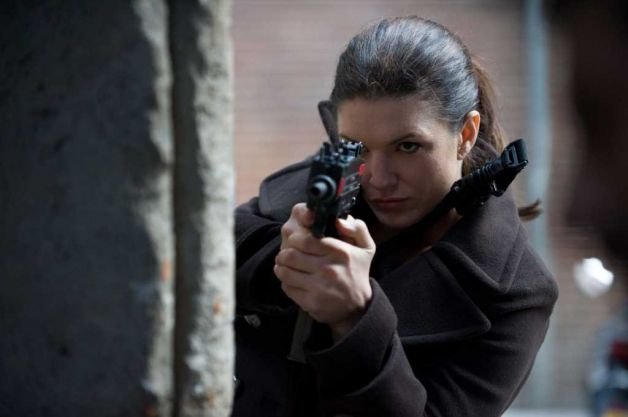
Gina Carano, mixed martial artist—and frequent participant in "American Gladiator"—plays Mallory Kane, and she is disciplined enough to pull off the fight sequences with a savage speed.  Any actress can train to look convincing, but Carano has the moves down for her character who is supposed to be a berserker weapon of mass-destruction, so there's rarely a cut-away or an insert shot to betray the use of stunt-doubles.  There aren't any.  So, Soderbergh (who also shot the film) keeps his camera out of the way and keeps everything and everybody in frame as best he can.  We've seen women in fights before—fights with men (Tarantino loves to do that)—but it's slightly unnerving to see these, knowing full well that everything was done in-camera, with few editing tricks.  The speed makes it a bit more visual—there's no 1/4 second adjustment/orientation lag between cuts—and more upsetting initially, but one does, as the fighting continues for minutes unabated, used to it (except for the question of what kind of make-up she uses to hide the bruising).

Because Carano is largely unknown except for her MMA career—she's fine in her dramatic scenes, just not great (but then, have I ever complained about Jet Li or Jason Statham's acting?)—the cast is a little top-heavy with big-name victims...Ewan McGregor, Michael Douglas, Channing Tatum, Michael Fassbender (the latter doing a fine riff on Bond coolness—of course, he gets his ass kicked in the film's best fight), Bill Paxton and Antonio Banderas.  Nobody is required to do anything beyond displaying detached coolness.  But the internal logic is there, so at least this one is a better example for the experiment than, say, Salt.


The girl breaks bones and furniture.


Welcome to the Crazy Club!
or
The Moon's Just a Cheap Shot Away


And what's good for the goose...

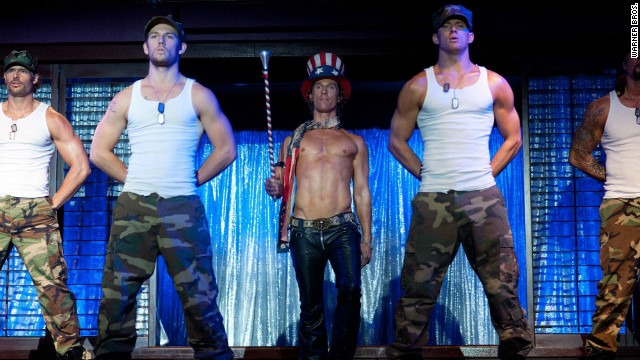
Soderbergh's next film after Haywire (if we don't count his second-unit work for The Hunger Games), also goes against the grain in the traditional genre/gender roles that we come to expect in movies—a dance/backstage drama movie, but with male leads.  Magic Mike is Flashdance with testosterone, the only thing missing is the "if you give up your dreams, you die" line.  Here, the basic dream is moving out of Tampa, Florida...to a bigger venue, or a better life.   The clutch of male strippers each have their own motivations—mostly money—and for them, the gig is a better alternative than slogging through a 9 to 5 job, wearing a tie.  So, at night, they dance, flirt, tease, and as club owner Dallas (Matthew McConaughey) "pry the cash out of their purses."

We're introduced to the skin-trade by Adam (Alex Pettyfer) irresponsible brother of Brooke (Cody Horn), who makes a good enough living for him to sponge off by having a steady job dealing with medical claims.  At a construction job that he's ill-equipped for, he runs into Mike Lane (Channing Tatum), who, despite seeing Adam as a loser, takes him under his wing, giving him a job as a "gopher" for the Xquisite dance club, where Mike, he finds to his surprise, is a featured dancer.  Well, you know how these backstage stories go: one of the performers can't go on-stage—he's passed out from a growth hormone overdose, and so Adam must make his stripper debut.  Dallas and Mike watch from the wings and simultaneously offer an opinion: "Can't dance worth shit." "But..that..can..be..taught," replies Dallas.

Wish the rest of it could be.  It'd save us all a bunch of time.  Mike's the hero of the tale, the veteran, "the guy most-together," but Adam is the neophyte and must go through the unfulfilling one-nighters, the drug problems, the crack-ho relationship, the debts to the hood-pushers, the spiral down to the bottom.  Mike just goes home to a brewsky and a night of uncrinkling his Benjamins on the edge of his self-designed furnishings (the establishment of such a business is his dream).  He's the cleverest of the bunch—Tatum developed the story based on his own experiences dancing in Tampa, so naturally he's the cleverest—and he's the most romantic of the bunch, mooning over a past-patron (Olivia Munn*) and very interested in Adam's sister.  He probably stays around being The Kid's Obi-Wan just to keep her in the picture, because there's only so many times you can say "You don't want that in your life, bro'" before it gets tiresome.

It does, but it could be a lot worse.  It could be "Showboys," and in outline form it resembles it, but it avoids the smarmy camp quality of that film by having a sense of humor about itself** and what it is (and what it doesn't aspire to, which is anything with an overt message) and it stresses the economic times that drop the unskilled (but ripped) into such night-work (day-jobs being rather scarce, especially when you party until 4 am) without having any pretensions about suffering for your art.  And the performances are fine, especially Tatum and McConaughey, who clearly relishes playing an out-and-out bad-boy with no shame.  But, all the men throw themselves into the roles of buck-a-throw sex-objects, with a brio and swagger that's fun to watch—as long as nobody takes it for anything more.  

It's the old "show-biz is a rough road, kids" movie, but with a "y" chromosome in the script of its DNA, a morality tale with enough immorality to make it worth watching.  And it's a healthy thing for Soderbergh (or anybody) to be turning the tables on these themes with their built-in sexism—even if the tables have some dancing on them.

Magic Mike is an immodestly modest Rental.


The boys break rules (but not twenties)


* Interesting role for her.  She plays a woman who plays with Mike like a boy-toy for jollies, but he finds, much to his dismay, that she does not consider him someone to bring home to meet Mom and Dad.  Dude...(if I can use the language of the film) Why do you think you never went over to her place??  As they might say in Showgirls "Denial's not just a river in Egypt, honey..."

** Reviews and synopses are saying it's a comedy-drama, though.  No.  No, it's not.  It's a light drama (with sprinkles of heaviness) and some clever writing here and there.  Maybe that hyphenate was there to attract the ladies (as if all the beef-cake and pretty boys wasn't enough).

Tuesday, April 10, 2012

Salmon Fishing in the Yemen

Swimming Upstream
or
The Fish, The River, and The Games We Play

You look at the title and already the questions start. Salmon Fishing in the Yemen?  What's up with that?  It sounds quixotic—salmon fishing in a desert environment.  Impossible.  Useless.  Theoretically possible, certainly.  "Like a manned mission to Mars is theoretical," says Professor Alfred Jones (Ewan McGregor), but not very practical.  But a rep agency has a sheikh client (Amr Waked) who wants to do it.  It will generate a lot of things: money into the coffers of the fisheries and wildlife people; publicity for the P.M. (as orchestrated by Patricia Maxwell, played with a vibrating steeliness by Kristin Scott Thomas); electricity for the sheikh's kingdom.  So it has its practical side—it gets bureaucrats functioning, people working, so who cares about the feasibility, even if its a crap-shoot (or more properly, a carp-shoot).  Like fishing.

Even Jones, the functionary put in charge of the project, needs some luring to wrap his mind around the project.  "I have a standing with the scientific community—a reputation!"  "A mortgage.." counters his wife in a practical marriage.  He thinks everyone spear-heading the project needs a net.  And his demands start to loom large, asking the sheikh's representative, Harriet Chetwode-Talbot (Emily Blunt) to get the engineers who designed the Three Gorges Dam in China to do the blue-printing and then "get two of those big Russian transports—Antonovs?—One for the fish and another for all the money we'll need."

He gets the engineers (which impresses), but a little research and a talk with the sheikh and a tour of the building site gets Jones hooked and convinces him that it just might work—a blind cast, to be sure, but he's made a lot of those.  And like angling, it takes a lot of patience.  As his benefactor says, you've got to have faith.  Any faith will do.  Even if it's the faith one has putting your hook in the water.

Not unlike the faith you have to have going into any Lasse Hallström movie. He burst onto the international film scene with My Life as a Dog (a film I still haven't waded through, despite sitting on my desk for a month) and he became Miramax's "go-to" guy for prestige pictures for "blue-hairs"—a director of such discriminating taste, that one could actually accuse him of avoiding the subject, so as not to offend.*  The effect can either be good or bad, and I approach a Hallström chronicle with caution.  For every The Shipping News, there's a Once Around.  Every What's Eating Gilbert Grape is matched by An Unfinished Life.  Something to Talk About isn't, really, and Chocolat feels a bit hollow.  "Yeah, it was fine," you say when it was over, "but..."  Not exactly thrilling.  Tamped down.  Safe.  Unexceptional.  The story gets told, but it doesn't move the senses or the emotions.  The movie gets made, gets seen, but disappears from the mind like spun sugar in water.  But every few movies, the elements jell.

Salmon Fishing in the Yemen is one of his better efforts, but is still very restrained, though the elements of terrorist drama that pop up tend to disrupt the generally genial tone of the thing.  And like a fine day of fishing, it all comes down to the casting.  McGregor is terrific here, lilting accent intact, and feeling more genuine than he has since The Ghost Writer.  Blunt is given a bit more emotion than she's been allowed her last few movies, and Waked is a sage, calm presence.  And as far as the movie goes, one is charmed with the conceit of the film as a love metaphor—of taking a flyer in relationships, and committing to something beyond yourself, even if the odds are long and the obstacles high. But, ultimately, it's in one's nature to swim upstream, to rise above, because it is our nature.

Salmon Fishing in the Yemen is a Matinee.


* I always remember conservative commentators talking about what a fine film The Cider House Rules was—because it was about an abortion doctor who established an orphanage for "unwanteds"—most probably because they hadn't seen it, for if they had they might not have had such high praise for a film dealing with child and sexual abuse and incest.


Friday, July 29, 2011

Beginners


Is "For Real" "The Opposite of Free?"

Nobody "knows" anything.  We stumble through life, individually, doing the best we can or will. Millions have preceded us.  Millions (hopefully) will follow us, but we're all blazing a trail, learning as we go.  We are all Beginners, and only cable news pundits and politicians act like they have the answers.  Liars.

The life of Oliver (Ewan McGregor, lightly scruffy) is much like that of director Mike Mills*—graphic designer, cartoonist, sweetly depressed, mother dead, father (Christopher Plummer) comes out of the closet afterwards at the age of 75, and remains gay in both senses of the term, until his death of cancer a few years later.  It takes awhile for Oliver to process—the movie takes place mostly in flashback so the movie does make him live a bit in the past.  And self-analysis is very much a priority for him, perhaps too much.  He can inventory what things were like at the time of all the events of his life.  Take him to a costume party, naturally, he goes as Freud.  Walk into his home, you get the Grand Tour...even the Jack Russell terrier, Arthur, that he inherits from his Dad gets one.  It's all part of the dialog he has with the dog (who looks at him and thinks—via sub-titles—"I only have a vocabulary of 150 words.  I can't talk."), and becomes a constantly needy companion.  He now looks at his present through a prism of the past, but, as with driving a car, you can't go forward very well if you're only looking through the rear-view mirror.

At that previously mentioned costume party (Freud, remember...with dog in tow), he meets Anna, played by dark-eyed blond Mélanie Laurent (who also can't talk—laryngitis). meets her cute, and they develop a relationship that's friendly, warm...and quiet.  But, his melancholy keeps getting in the way, and they go through stages of happy/sad/happy/sad, all of which is confusing to the dog (who keeps asking "Are we married yet?")

It's nice.  It's sweet.  It's puzzling.  Beginners is about growing up and learning, and taking chances despite all that.  It's about coming out of grief and the shadow of your parents (and your own origins) and moving forward.  Personally, I found myself identifying with the dog.  Beginners is a fine little wallow, but I really wanted to go for a walk.

Beginners is a Rental.

* Director of Thumbsucker, married partner of Miranda July, whose film Me and You and Everyone We Know some hail as a masterpiece and I find frustratingly precious, although I'm looking forward to seeing her new one.

Friday, January 28, 2011

I Love You, Phillip Morris

"The Many Lives and One Life-Term of  Steven Russell"
or
"Hold me, Kiss me, Make me Write Bad Checks..."

I can see why Jim Carrey wanted to do this, although the box-office returns might not be up to the block-busting weekend standards his films are used to.  The writing team of Glenn Ficarra and John Requa (who also directed) had previously written one of the most ribald Christmas movies ever made—Bad Santa (they also wrote the first Cats & Dogs, but let's not stray there).  For anyone who doesn't like Christmas movies, Bad Santa was a tonic, a mean-spirited slash & burn of every sentiment and cliche associated with the Holiday. It's so black-hearted that, to this day, it is tough for me to watch a Christmas movie now with any sort of innocence, so caustic and toxic is that movie.  That it ended up with a jaded heart of gold somewhere amidst the bloody gristle was an astonishing accomplishment, and made me anticipate what they might foist on the innocent audience next. 

Their latest, I Love You, Phillip Morris, has the proverbial "something to offend everybody."  And it is relentless in its attempt to shock.  That the story is, essentially, true (and chronicled in the book "I Love you, Phillip Morris: A True Story of Life, Love and Prison Breaks" by Steve McVicker, about the mis-adventures of Steven Jay Russell) only proves the adage that truth is stranger than fiction.  Especially when the truth involves a lot of fiction.  The writer-director team only have to find punch-lines in the various scenes in order to push it into the comedy realm.  Absurdism rules.  Love will do that to you.

The film begins with Steve Russell (Carrey) flat-lining in a hospital bed, his life passing before his eyes, and thus, too, through the projector aperture.  His normal life turned upside-down when he learns that he's adopted, he starts living his life as a non-person, as one who doesn't exist.  But, existing with a 163 I.Q. means you have a lot of time on your hands to think things up to do.  It's a bit like the wondrous aspect of Groundhog Day—what would you do with the time you have if every day had a "Reset" button at the end?  Steve Russell has his own "Reset" button, and just one life to live, so he spends it as a completely self-absorbed unit, grabbing at the possibilities of life by any means necessary, including lying, cheating and stealing.  A complete sociopath, the only thing limiting him is what he hasn't learned to get away with yetHe starts as an ordinary family man, becoming a policeman, a church organist and living a lie.  Then a near-fatal car-crash at a crossroads snaps him into an epiphany: he's going to live the life he's always wanted out in the open, as long as how he does so, stays in the background.  He openly leads a gay lifestyle, leaving his wife and child, bankrolling everything through frauds of one type or another, until it all lands him in prison.  

Then, the real fun begins.

For the secret of Steven Russell is to find the weak links in society's infrastructure and take advantage of them.  In prison, he meets and falls in love with Phillip Morris (Ewan McGregor), who might uncharitably be called a 'weak link"—as he "sees the good in everybody," and for Russell, that's finding his soul-mate, easy to admire and easy to be false to.  

So much lying, deception, robbing, stealing, impersonation and chicanery goes on in this film that, finally, it is a bit numbing.   By the time Russell pulls off his biggest deception (and it's a doozy, not only in the difficulty of pulling it off, but in the harm that it can inflict), nothing surprises...or shocks.  So much time has been spent in the red-line of your sensibilities, that your meter emerges pretty much pegged.  It's going to take a lot of time looking at puppies in order to Brillo the sourness out of your skull. 

Except...I Love You, Phillip Morris is kind of sweet.  Despite being a lying sack, Steven Russell is a pretty devoted guy, going to extremes for those he loves, and...yes...even dying for them.  It's horrifying.  But, its heart is in the right place.  Ficarra/Requa can be counted on to find the silver linings in the dark clouds, as well as peeing in the punch-bowl.  Every scene has a 90° swerve on what its about—sweet to sour, darkness to light.  One of my favorite scenes has Phillip bribing a cell-neighbor to play "Chances Are" (Johnny Mathis, natch')—because the thug has the only cassette player—so that he and Steven can dance and snuggle in the cell they share.  We watch as they dance slowly in silhouette, the song warbling through the cell-block until the guards yell "lights out" and start screaming at the thug to turn off the music, which he refuses to do.  Pretty soon, there's a small riot outside the cell as the guards run in enmasse, beating and tasering the yelling music-provider,  merely heard in the background, as we focus on Steven and Phillip lost in their dance and each other—the world has gone away.

Nice.  Creepy and violently funny, but nice.  And smart.  And tells you all you need to know about Steven and Phillip's devotion.  The film-makers got their act down, but the yin and yang of extremes don't help Carrey and MacGregor, who struggle to maintain a consistent tone in their characters scene-to-scene.  At times, Carrey is so arch you wonder how anyone could be conned by this cartoon character, and MacGregor veers from teeth-jarringly sweet to pathetically whiney.  But, when the comedy turns to drama, the two seem to snap into place to make it work...as a real scene, which tends to nullify the comedy that has gone before.  It's a tightrope-walk to be sure, but there's an awful lot of nervous-making swaying going on.

I don't say this very often, but this is one of those movies you worry about recommending because there is so much material that could give frail audiences "the vapors," but if you steel yourself—maybe get a speeding ticket on the way to the theater, pay your taxes that day—you might have a darkly good time.

I Love You, Phillip Morris is a Matinee. 


The Real Steven Russell (I think)


Friday, March 12, 2010

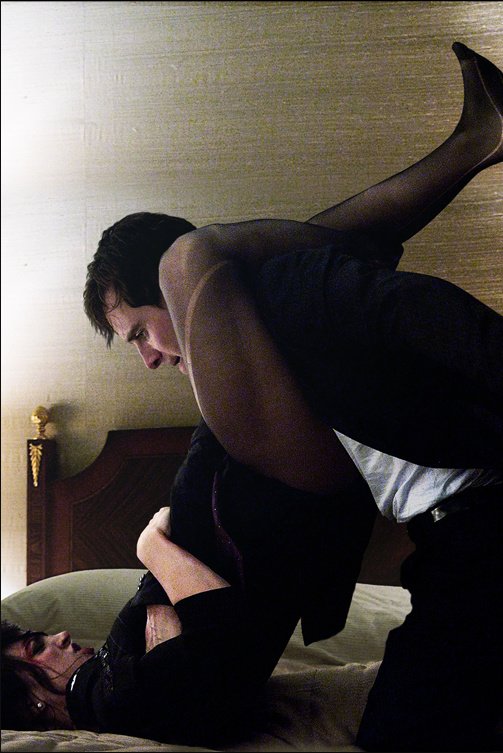
The Ghost Writer

"Brilliant...in a Horrible Kind of Way"


From the first jolting burst of rain on the soundtrack to the last exquisitely planned-out shot (and indeed to the thudding end of Alexandre Desplat's Herrmannesque score), Roman Polanski's film of The Ghost Writer is one of the most intricately mapped out paranoid-thrillers since the heady post-Watergate days when they were in vogue. But, more than those austere films of plots, counter-plots and figures in shadows, this film has wit, wisdom and a sorcerer's command of the English language. In fact, it feels more like a Hitchcock film than any of Polanski's other thrillers.

And that's due to the precision of the writing—as it should be, since the film is about writing and word-choice and the differences between truth and artifice. Co-scenarists
Robert Harris (who wrote the movie source "The Ghost") and Polanski, set up an intricate puzzle to be solved, ala Hitchcock, that is both visually compelling and haunting.
For those of us who live in the Pacific Northwest, it's a familiar story: a ferry pulls into dock, and the off-load of vehicles is stopped by one lone vehicle with no one behind the wheel. Already, there's a story there with several possible outcomes. Did the driver forget he had his car and walked off the ferry? Are they still on the boat, say, in the bathroom?

Or did they fall overboard? Or, for that, were they pushed?
A simple story line—common, really—but it creates the question: where did the driver go? And for a movie it's a natural, because it can be presented in purely visual terms.
Turns out the missing man was a writer—a ghost-writer, specifically, named Mike McAra, and, within days, he's found washed-up on shore with an extremely high blood-alcohol content. McAra, at the time, had been working anonymously on the memoirs of the once popular former
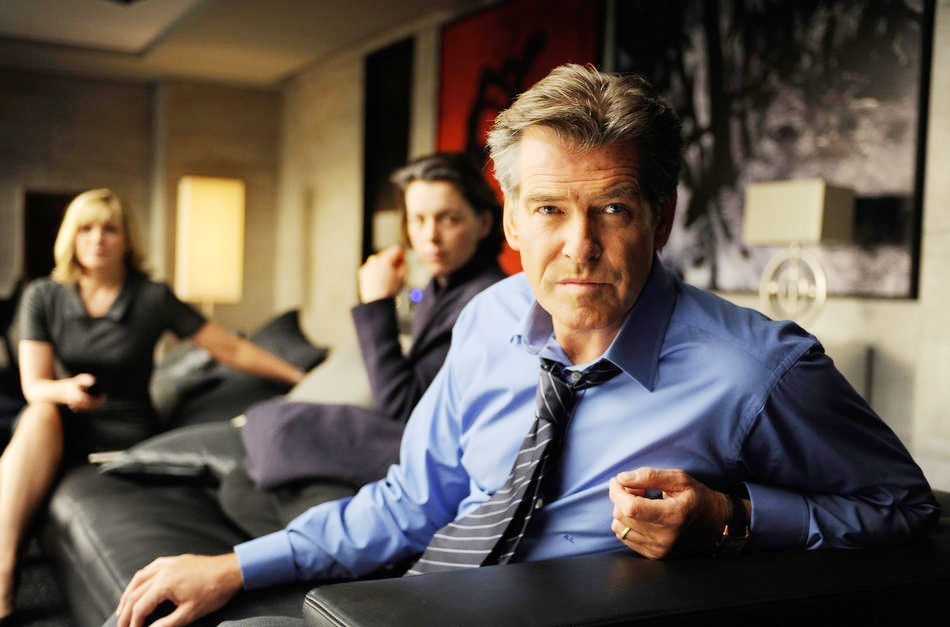
Prime Minister Adam Lang (Pierce Brosnan, never better
*) A new ghost-writer is hired (Ewan McGregor), and is given access to the top-secret manuscript (and the former PM) only by traveling to the high-security compound owned by the publishers to which Lang and his small staff have retreated to work on the book. The new ghost (he is never named, as he wouldn't be on the book) is de-briefed, patted down, scanned, searched and only then is he allowed to read the draft, which is under lock and key and never to leave its present sequestered location.
To his horror, he finds the book a snoozer—he doesn't like political memoirs, anyway—and he's determined to beat it into some kind of readable shape, given a time-limit of only four weeks.
The compound he's staying at on Martha's Vineyard is a concrete nightmare that looks more suited to one of the villains Brosnan battled in the Bond series—high-tech-gadgeted, and constantly surveilled. The minimal staff includes Lang's assistant from the No. 10 days,
Amelia Bly (a smart, sharp Kim Cattrall), and overseen by Lang's wife Ruth (the wonderful Olivia Williams from Rushmore and An Education). Soon, complications set in and the building goes into crisis mode as it is revealed that Lang, in his dealings with the U.S. on the war on terror, was involved in the kidnapping and torture of terror-suspects, and may be brought up on charges as a war criminal by the International Criminal Court.
Suddenly, the compound is in a state of siege
and that memoir becomes a hot topic: The publisher (Jim Belushi, unrecognizable and nicely brusk) wants the book in two weeks before the headlines get cold, Lang leaves to go on an image-building trip to Washington, the press is bombarding the compound ("the pack is on the move" as Amelia puts it), protesters chant outside the gate, and The Ghost is left there with a few mysteries to unravel. Both he and Lang are nicely metaphored by the compound's gardener trying to keep the dead grass he's just raked into a wheelbarrow on a blustery day.
Leave the exposition at that. But it calls to mind past Polanski films of protagonists walking in the foot-prints of people who have come before, and in danger of losing their own identity to them—not that hard for The Ghost, as he has no identity in the film (
Lang merely calls him "man," because he has no head for names).
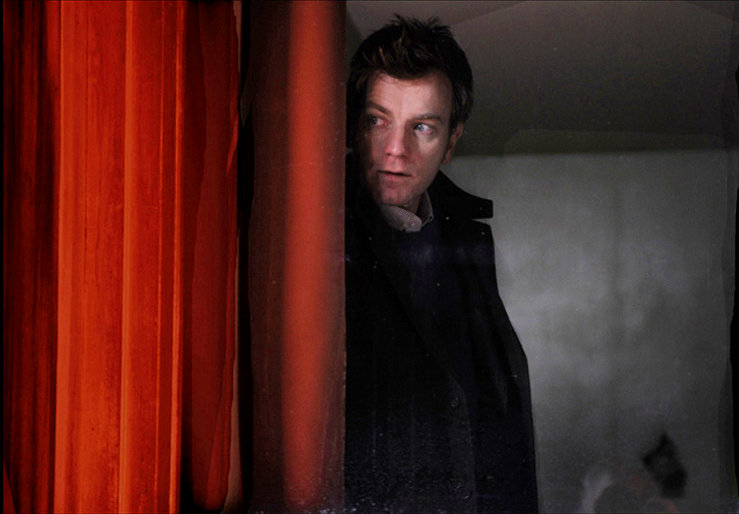
There are twists and turns, but where it is enticing is the way Polanski mines the material for suspense and humor. No detail goes unused—not the security, not the weather, not the language, not the technology, not the sound. Small glances through slitted curtains may be significant, as are muffled conversations in the next room, or the insistence by a staff-member to use a car on the island, rather than the bicycle. It COULD be innocent. He really MIGHT be concerned about the weather. But, then again...
Then, again. Along with the paranoia are moments of perverse comedy where The Ghost's stealth make him stick out like a sore thumb, or just makes things more difficult for himself. Aware of his position as a replacement, he soon finds himself retracing his predecessor's steps, having to both live up to the trusted writer's reputation, but also to do right by him to find out what happened.
If he can escape the same fate.
The performer's are uniformly excellent:
McGregor is a perfect protagonist, veering between deer-in-the-headlights and the wily hubris of the Man Who Knows Too Much, Brosnan and his character share a theater background, and the actor allows the arrogance and The Act of being a politician look believable in equal measure. Olivia Williams is by turns steel and rubber in her role, and Cattrall is efficiently perfect—you suspect her immediately. There are also nice turns by Timothy Hutton, Eli Wallach and the ubiquitous Tom Wilkinson, and by Robert Pugh as one of Lang's political rivals.
But it's Polanski's show—he's the Puppet-Master, the audience-conductor like Sir Alfred, and effective enough that you leave the theater with a heightened sense of awareness, looking around corners, at things out-of-place, that the world is a more dangerous place.

And the most deliciously perverse irony is that Polanski had to complete the film in the place that informed the sensibility and interests of the young Hitchcock's film career: a prison cell.
**

* Despite his hard-scrabble up-bringing Brosnan has always been better at playing effete characters. It's why his James Bond was something of a bore—Brosnan seems more suited to knocking someone out with a nerve-pinch than a karate chop.

** "I must have been about four or five years old. My father sent me to the police station with a note. The chief of police read it and locked me in a cell for five or ten minutes, saying "This is what we do to naughty boys." Hitchcock/Truffaut p. 17