Showing posts with label Olivia Williams. Show all posts

Friday, December 14, 2012

Anna Karenina (2012)

Artificial Intelligence
or
Anna! Karenina! The! Musical!

Tolstoy's "Anna Karenina" is considered by many the greatest novel ever written, and has been adapted so many times (two of them starring Greta Garbo!), one is tempted to name any version "The Last Remake of Anna Karenina."  So, the task for director Joe Wright and scripter Tom Stoppard must have seemed daunting, or as one of Zsa Zsa Gabor's later husbands stated it: "You know what you have to do, you just have to find a way of making it interesting."

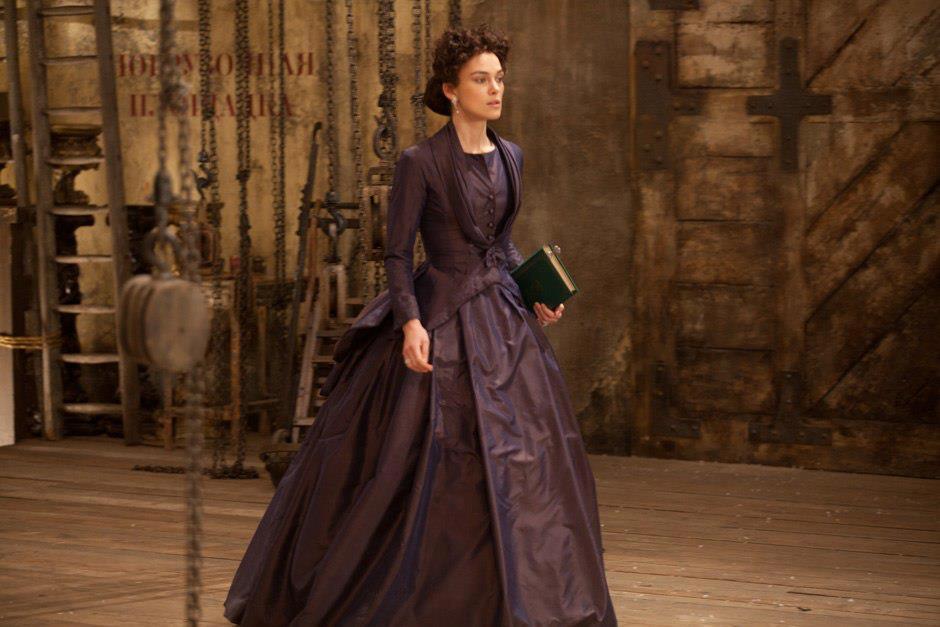
Well, this one is interesting, alright.  And it hues closely to Tolstoy's novel in the way that a CliffsNotes Edition sticks close.  All the plot points are there, the characters whittled down to their bare essences, or eliminated altogether, and breezily delivered in a theatrical manner, save some significant exceptions.  Truth is, Wright makes this version of Anna Karenina the way Baz Luhrmann would, as a grand, operatic experience staged in an extraordinarily choreographed with the emphasis on the "arch" (as in "playfully and affectedly roguish") in Proscenium Arch.
  

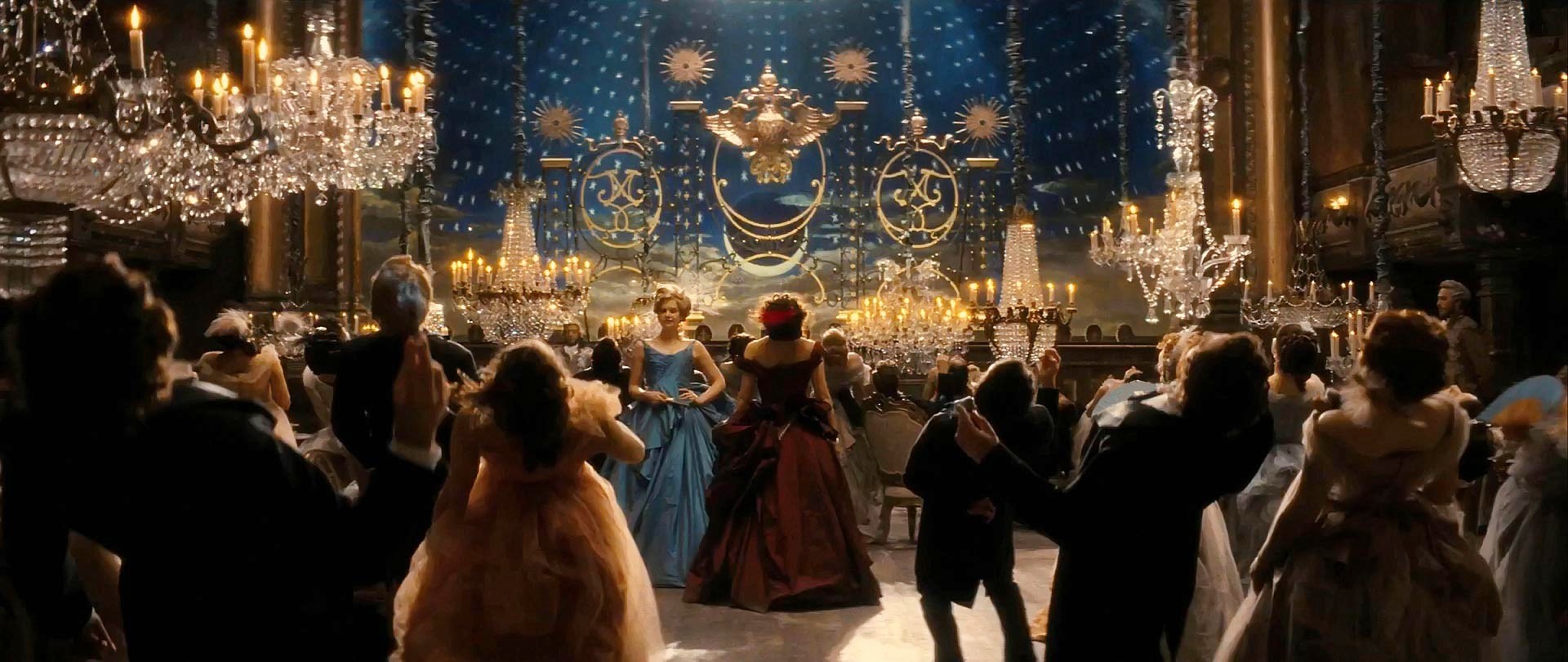
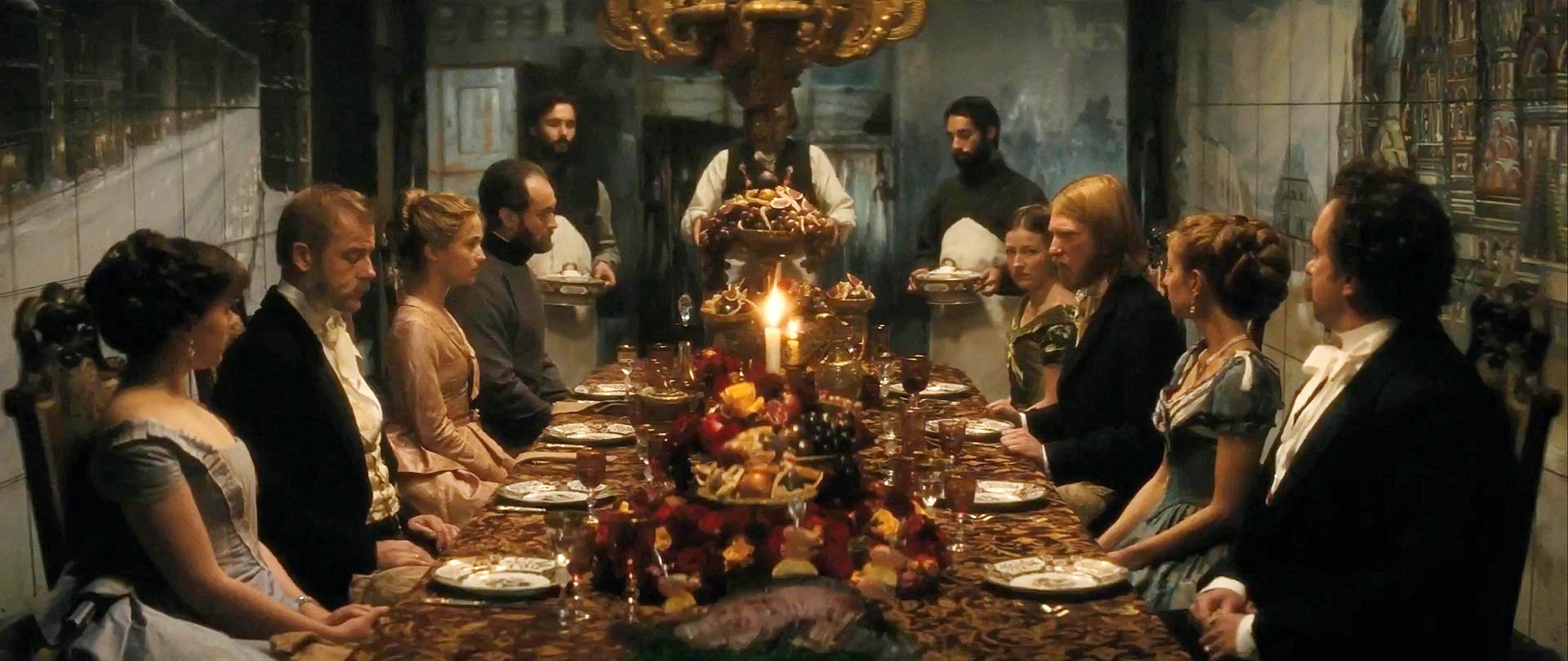
Jim Emerson had a fascinating article (based around Skyfall) on his "Scanners" blog on the difference between a "theatrical" film and a theatrical film and its use of space as defined by the limitations of the frame and a stage directors' tendency to reflect that frame with its own limitations resembling the dimensions of a stage.  Wright fully embraces that concept and goes further; for the main story of the hoi-polloi and their social and political gamesmanship, all of the action takes place within the false spaces of a theater (at times even using the rafters as locations for traditional street-scenes): train and carriage scenes are decidedly set-bound with no effort made to reflect a "real" world outside the windows; transitions are made "in-camera" without editing, so a very stagy and choreographed bureaucratic work set-up with synchronized rubbing stamping (set to Dario Marianelli's interesting score) segues to a restaurant scene by merely having the "extras" trade in their black business suits for waiter-whites; a formal society ball is not an intricate commingling of dancers that Wright so effectively engineered in Pride and Prejudice, but is an elaborate ballet, where the participants barely touch and their hand movements are intricately swanning in nothing that approaches a traditional dance (at times, to keep track of the principals, the foreground dancers in our field of vision "freeze" to better make out the focus of our attention).  Like Francis Ford Coppola's set-bound version of Bram Stoker's Dracula, It's all very elaborate, "stagey," false, and at times clever but, a lot of the time, merely "showy," like a musical with no libretto, something to separate this "Anna" from the more realistic, even if filmed in-studio, versions.  

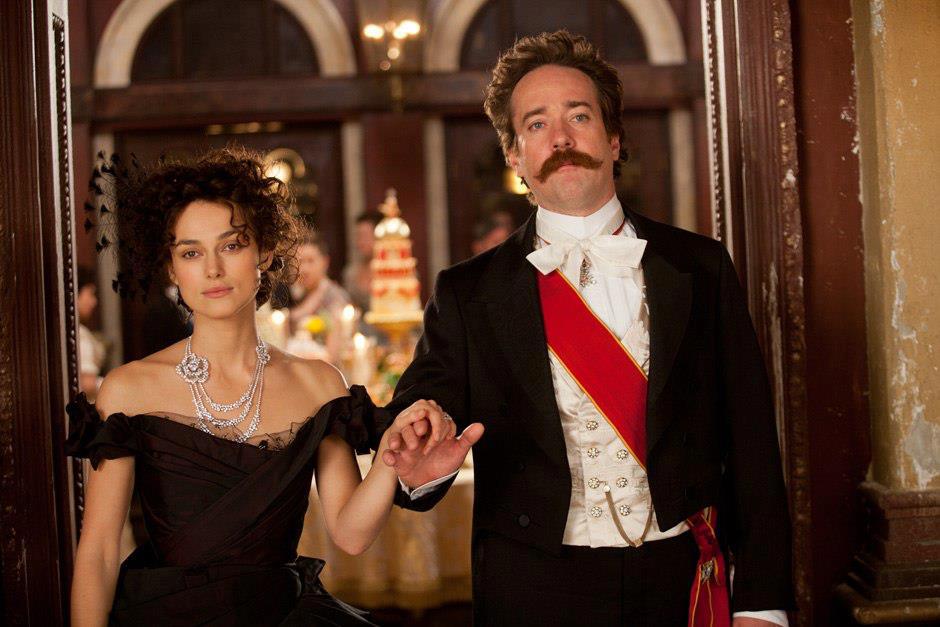
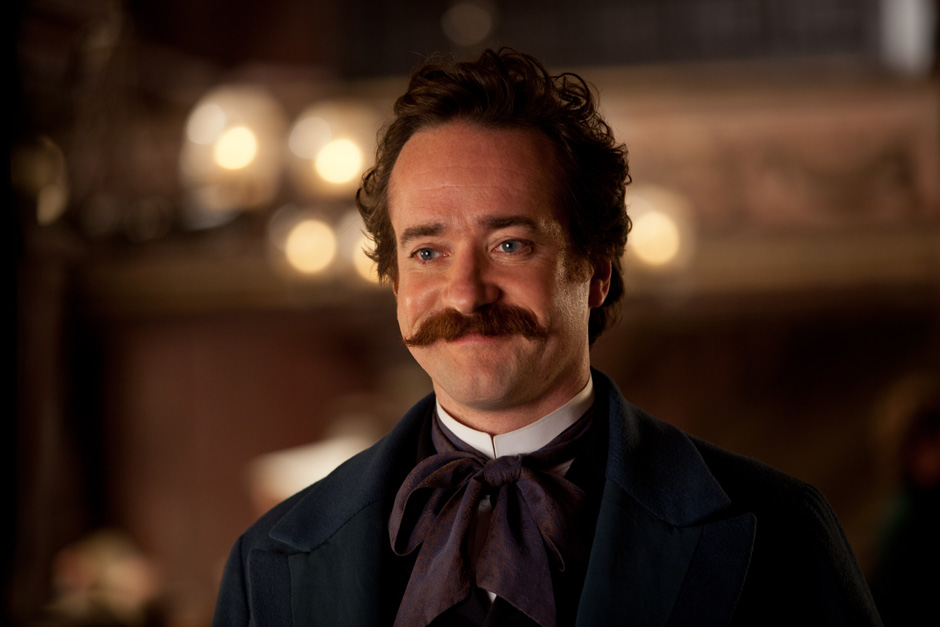
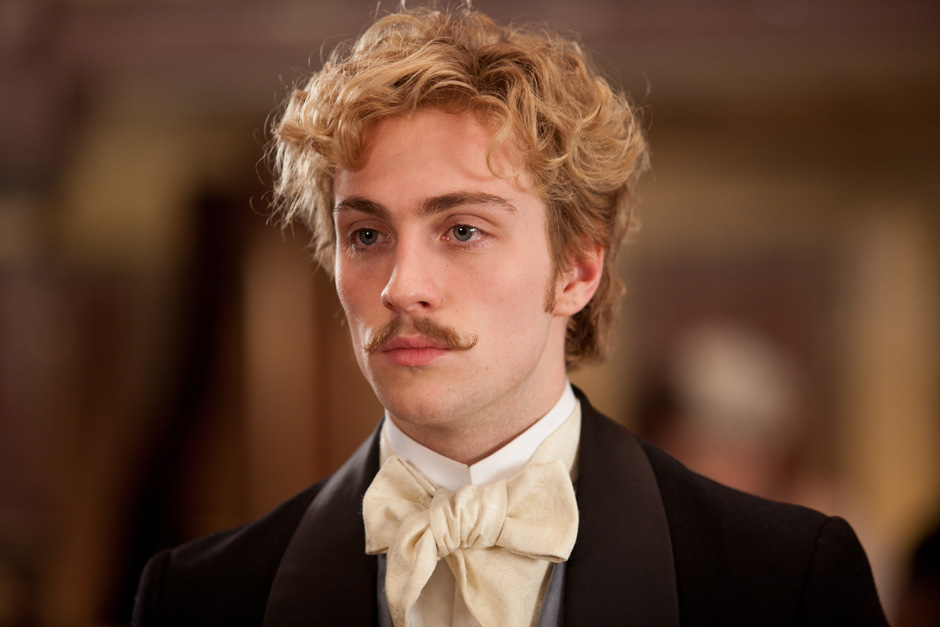
The performances run that way, too.  Keira Knightley is an exasperating Anna, conflicted but fatally committed to fully expressing whatever is on the surface of her heart.  Her P & P co-star, Matthew McFadyen is a burlesque cousin Oblonsky, fatuously showy in a way that reminds of Kevin Kline performing a burlesque role.  Jude Law—not one of my favorite performers—here is exceptional as Anna's cuckolded husband, and is so restrained and non-theatrical, that it sets him apart from almost every other performer, isolating him, and is a good short-hand way of showing why Anna might be dissatisfied with him.  Olivia Williams has a small part as the Countess Vronsky, whose son (Aaron Taylor-Johnson) is the very florid object of fascination for Anna.

Anna (Keira Knightley) runs from Vronsky at the Ball
and experiences a little fore-lightening from an approaching train.

It's dangerous in a Joe Wright theater.

But, almost the entire film is deliriously fascinated with the artificial that it undercuts the very real passion and consequences of actions of the people in the film, reducing them to "players" as opposed to human beings.  I say "almost" because Wright does change things up to "open up" the segments featuring Levin (Domhnall Gleeson) and Kitty (Alicia Vikander), who already have their disappointing encounter with Vronsky and move on.  When they reunite, their segments are set in a real world of sky, clouds and fields befitting the couple who exemplify wisdom, forbearance and patience.  Wright puts them in our world, relegating the others to an artificial world that is essentially stage-managed (even at the end with a coda of Karenin and the remains of his family, it is contained in the stage-world that Wright has chosen to house his film.

It's different, even interesting in an oddly disrespectful manner, as the flightiness of the bourgeoisie and their concerns are merely shadow-play and window-dressing—it is true to an extent—but by pushing the metaphor so aggressively, it undercuts any feeling one has for the players in the majority of the film itself, and reveals itself as resembling the tut-tutting of the hypocrites who turn against Anna.  I'm not sure that Tolstoy had that intention (even strained through Stoppard), and this film might have benefited  from a less facile presentation that required less stage-craft and something more resembling (I don't know) empathy?


Anna Karenina is a Cable-Watcher.


Friday, March 12, 2010

The Ghost Writer

"Brilliant...in a Horrible Kind of Way"


From the first jolting burst of rain on the soundtrack to the last exquisitely planned-out shot (and indeed to the thudding end of Alexandre Desplat's Herrmannesque score), Roman Polanski's film of The Ghost Writer is one of the most intricately mapped out paranoid-thrillers since the heady post-Watergate days when they were in vogue. But, more than those austere films of plots, counter-plots and figures in shadows, this film has wit, wisdom and a sorcerer's command of the English language. In fact, it feels more like a Hitchcock film than any of Polanski's other thrillers.

And that's due to the precision of the writing—as it should be, since the film is about writing and word-choice and the differences between truth and artifice. Co-scenarists
Robert Harris (who wrote the movie source "The Ghost") and Polanski, set up an intricate puzzle to be solved, ala Hitchcock, that is both visually compelling and haunting.
For those of us who live in the Pacific Northwest, it's a familiar story: a ferry pulls into dock, and the off-load of vehicles is stopped by one lone vehicle with no one behind the wheel. Already, there's a story there with several possible outcomes. Did the driver forget he had his car and walked off the ferry? Are they still on the boat, say, in the bathroom?

Or did they fall overboard? Or, for that, were they pushed?
A simple story line—common, really—but it creates the question: where did the driver go? And for a movie it's a natural, because it can be presented in purely visual terms.
Turns out the missing man was a writer—a ghost-writer, specifically, named Mike McAra, and, within days, he's found washed-up on shore with an extremely high blood-alcohol content. McAra, at the time, had been working anonymously on the memoirs of the once popular former
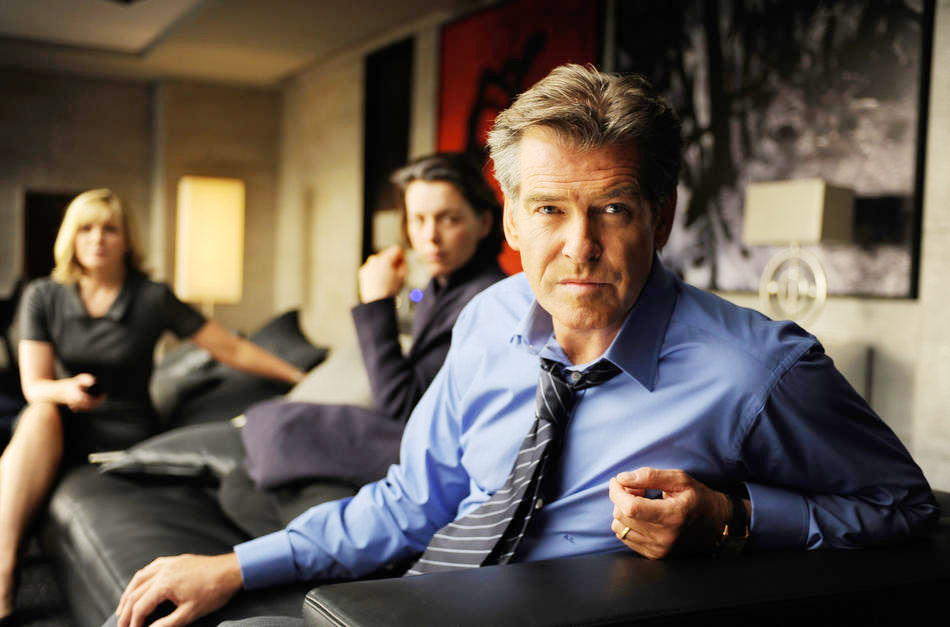
Prime Minister Adam Lang (Pierce Brosnan, never better
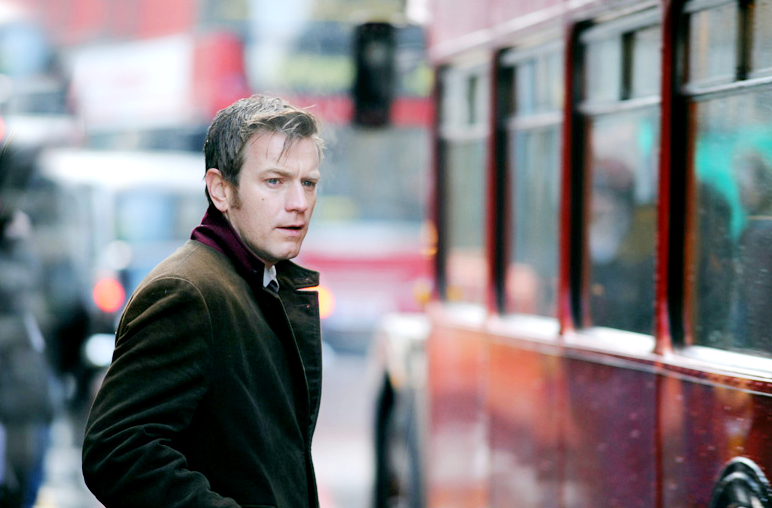
*) A new ghost-writer is hired (Ewan McGregor), and is given access to the top-secret manuscript (and the former PM) only by traveling to the high-security compound owned by the publishers to which Lang and his small staff have retreated to work on the book. The new ghost (he is never named, as he wouldn't be on the book) is de-briefed, patted down, scanned, searched and only then is he allowed to read the draft, which is under lock and key and never to leave its present sequestered location.
To his horror, he finds the book a snoozer—he doesn't like political memoirs, anyway—and he's determined to beat it into some kind of readable shape, given a time-limit of only four weeks.
The compound he's staying at on Martha's Vineyard is a concrete nightmare that looks more suited to one of the villains Brosnan battled in the Bond series—high-tech-gadgeted, and constantly surveilled. The minimal staff includes Lang's assistant from the No. 10 days,
Amelia Bly (a smart, sharp Kim Cattrall), and overseen by Lang's wife Ruth (the wonderful Olivia Williams from Rushmore and An Education). Soon, complications set in and the building goes into crisis mode as it is revealed that Lang, in his dealings with the U.S. on the war on terror, was involved in the kidnapping and torture of terror-suspects, and may be brought up on charges as a war criminal by the International Criminal Court.
Suddenly, the compound is in a state of siege
and that memoir becomes a hot topic: The publisher (Jim Belushi, unrecognizable and nicely brusk) wants the book in two weeks before the headlines get cold, Lang leaves to go on an image-building trip to Washington, the press is bombarding the compound ("the pack is on the move" as Amelia puts it), protesters chant outside the gate, and The Ghost is left there with a few mysteries to unravel. Both he and Lang are nicely metaphored by the compound's gardener trying to keep the dead grass he's just raked into a wheelbarrow on a blustery day.
Leave the exposition at that. But it calls to mind past Polanski films of protagonists walking in the foot-prints of people who have come before, and in danger of losing their own identity to them—not that hard for The Ghost, as he has no identity in the film (
Lang merely calls him "man," because he has no head for names).
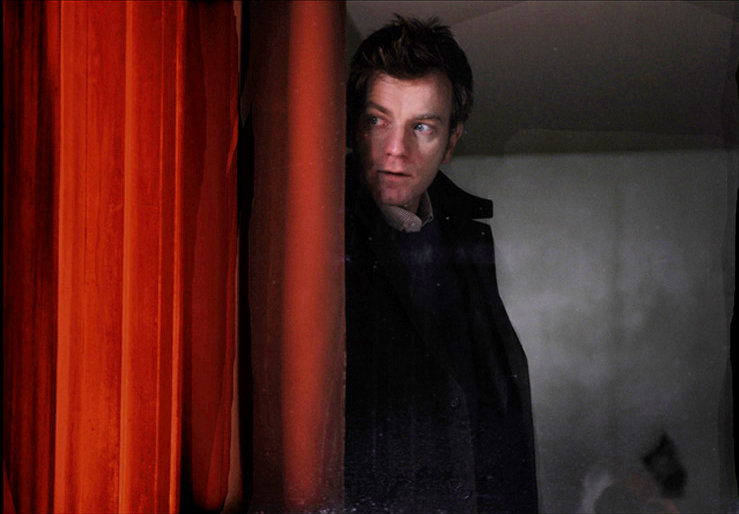
There are twists and turns, but where it is enticing is the way Polanski mines the material for suspense and humor. No detail goes unused—not the security, not the weather, not the language, not the technology, not the sound. Small glances through slitted curtains may be significant, as are muffled conversations in the next room, or the insistence by a staff-member to use a car on the island, rather than the bicycle. It COULD be innocent. He really MIGHT be concerned about the weather. But, then again...
Then, again. Along with the paranoia are moments of perverse comedy where The Ghost's stealth make him stick out like a sore thumb, or just makes things more difficult for himself. Aware of his position as a replacement, he soon finds himself retracing his predecessor's steps, having to both live up to the trusted writer's reputation, but also to do right by him to find out what happened.
If he can escape the same fate.
The performer's are uniformly excellent:
McGregor is a perfect protagonist, veering between deer-in-the-headlights and the wily hubris of the Man Who Knows Too Much, Brosnan and his character share a theater background, and the actor allows the arrogance and The Act of being a politician look believable in equal measure. Olivia Williams is by turns steel and rubber in her role, and Cattrall is efficiently perfect—you suspect her immediately. There are also nice turns by Timothy Hutton, Eli Wallach and the ubiquitous Tom Wilkinson, and by Robert Pugh as one of Lang's political rivals.
But it's Polanski's show—he's the Puppet-Master, the audience-conductor like Sir Alfred, and effective enough that you leave the theater with a heightened sense of awareness, looking around corners, at things out-of-place, that the world is a more dangerous place.

And the most deliciously perverse irony is that Polanski had to complete the film in the place that informed the sensibility and interests of the young Hitchcock's film career: a prison cell.
**

* Despite his hard-scrabble up-bringing Brosnan has always been better at playing effete characters. It's why his James Bond was something of a bore—Brosnan seems more suited to knocking someone out with a nerve-pinch than a karate chop.

** "I must have been about four or five years old. My father sent me to the police station with a note. The chief of police read it and locked me in a cell for five or ten minutes, saying "This is what we do to naughty boys." Hitchcock/Truffaut p. 17