Showing posts with label Kelly MacDonald. Show all posts

Friday, December 14, 2012

Anna Karenina (2012)

Artificial Intelligence
or
Anna! Karenina! The! Musical!

Tolstoy's "Anna Karenina" is considered by many the greatest novel ever written, and has been adapted so many times (two of them starring Greta Garbo!), one is tempted to name any version "The Last Remake of Anna Karenina."  So, the task for director Joe Wright and scripter Tom Stoppard must have seemed daunting, or as one of Zsa Zsa Gabor's later husbands stated it: "You know what you have to do, you just have to find a way of making it interesting."

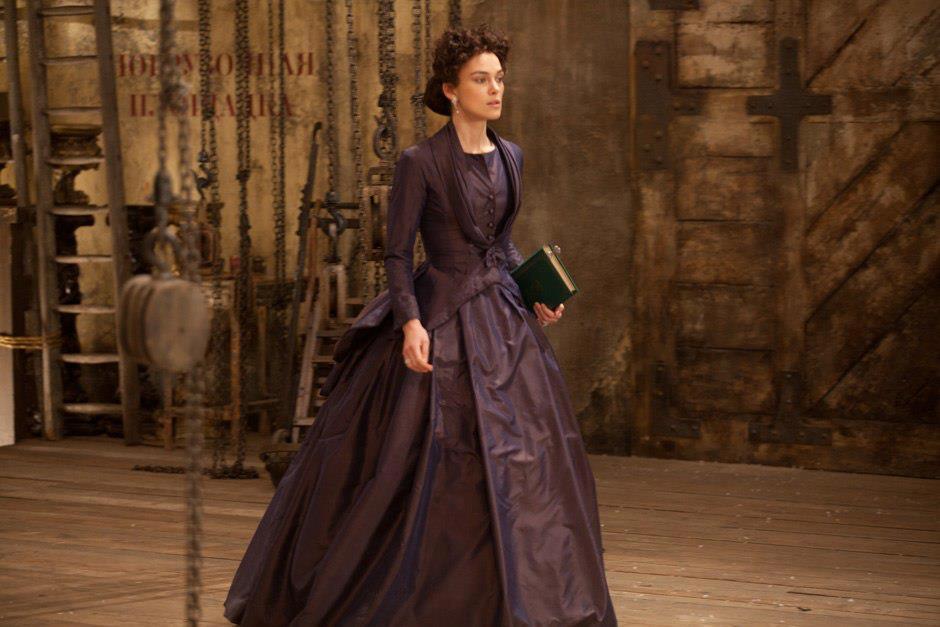
Well, this one is interesting, alright.  And it hues closely to Tolstoy's novel in the way that a CliffsNotes Edition sticks close.  All the plot points are there, the characters whittled down to their bare essences, or eliminated altogether, and breezily delivered in a theatrical manner, save some significant exceptions.  Truth is, Wright makes this version of Anna Karenina the way Baz Luhrmann would, as a grand, operatic experience staged in an extraordinarily choreographed with the emphasis on the "arch" (as in "playfully and affectedly roguish") in Proscenium Arch.
  

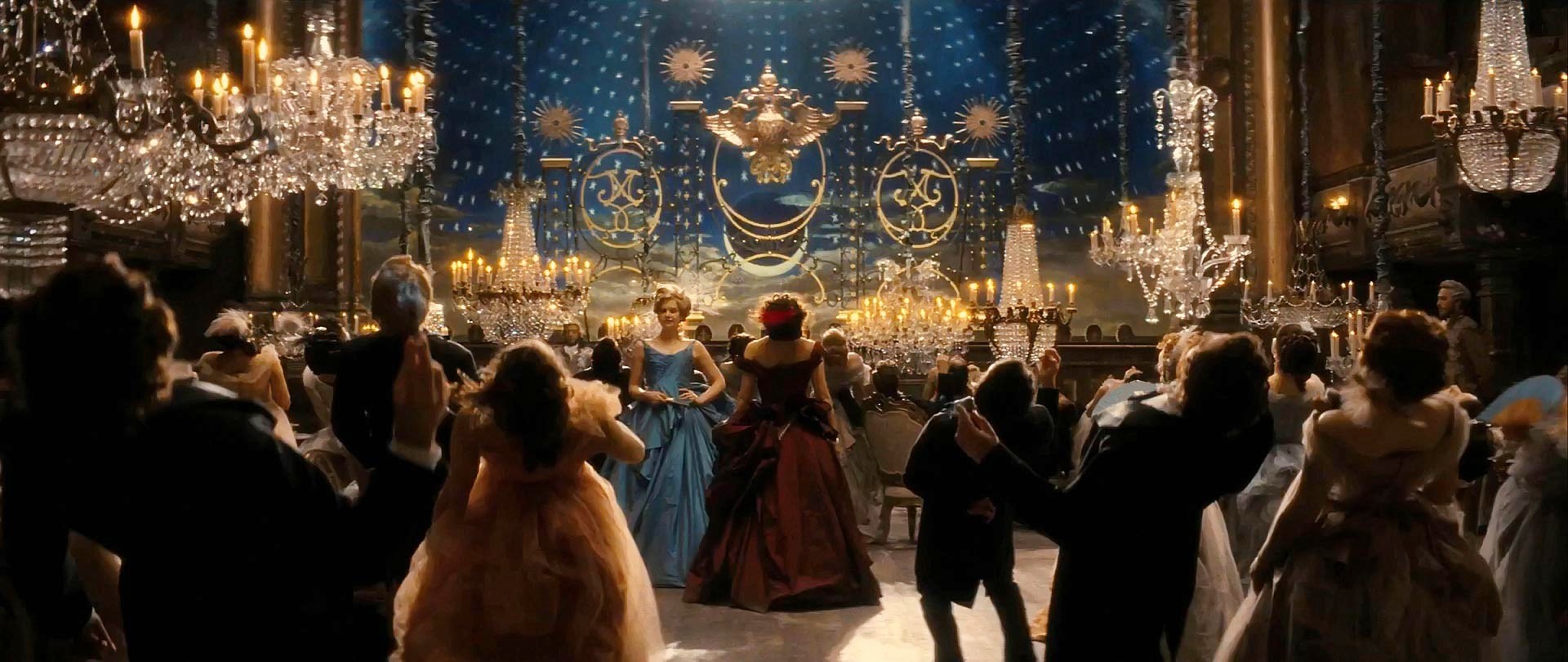
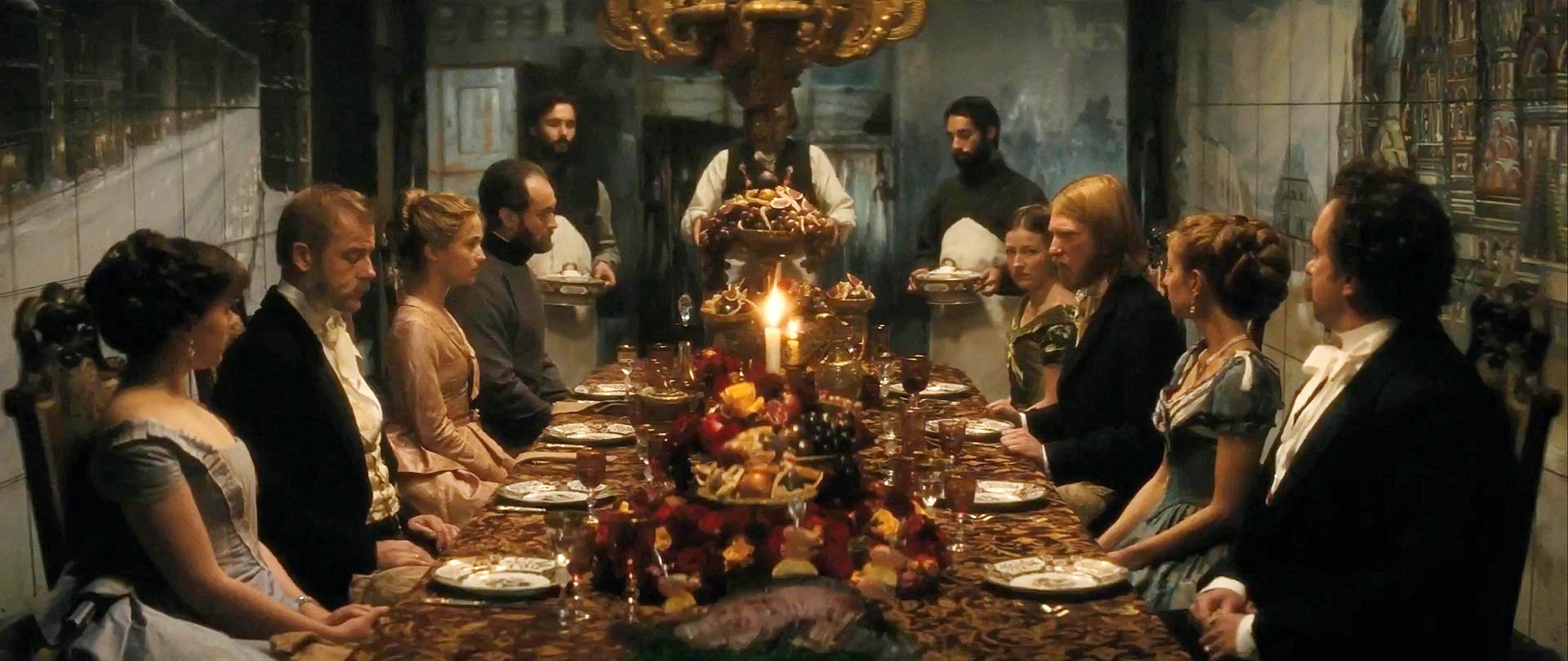
Jim Emerson had a fascinating article (based around Skyfall) on his "Scanners" blog on the difference between a "theatrical" film and a theatrical film and its use of space as defined by the limitations of the frame and a stage directors' tendency to reflect that frame with its own limitations resembling the dimensions of a stage.  Wright fully embraces that concept and goes further; for the main story of the hoi-polloi and their social and political gamesmanship, all of the action takes place within the false spaces of a theater (at times even using the rafters as locations for traditional street-scenes): train and carriage scenes are decidedly set-bound with no effort made to reflect a "real" world outside the windows; transitions are made "in-camera" without editing, so a very stagy and choreographed bureaucratic work set-up with synchronized rubbing stamping (set to Dario Marianelli's interesting score) segues to a restaurant scene by merely having the "extras" trade in their black business suits for waiter-whites; a formal society ball is not an intricate commingling of dancers that Wright so effectively engineered in Pride and Prejudice, but is an elaborate ballet, where the participants barely touch and their hand movements are intricately swanning in nothing that approaches a traditional dance (at times, to keep track of the principals, the foreground dancers in our field of vision "freeze" to better make out the focus of our attention).  Like Francis Ford Coppola's set-bound version of Bram Stoker's Dracula, It's all very elaborate, "stagey," false, and at times clever but, a lot of the time, merely "showy," like a musical with no libretto, something to separate this "Anna" from the more realistic, even if filmed in-studio, versions.  

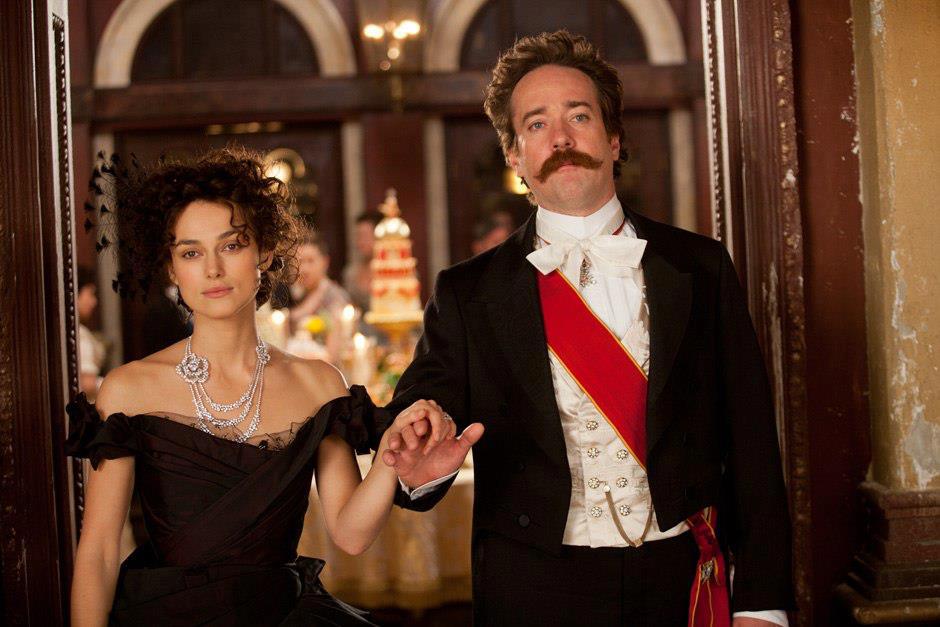
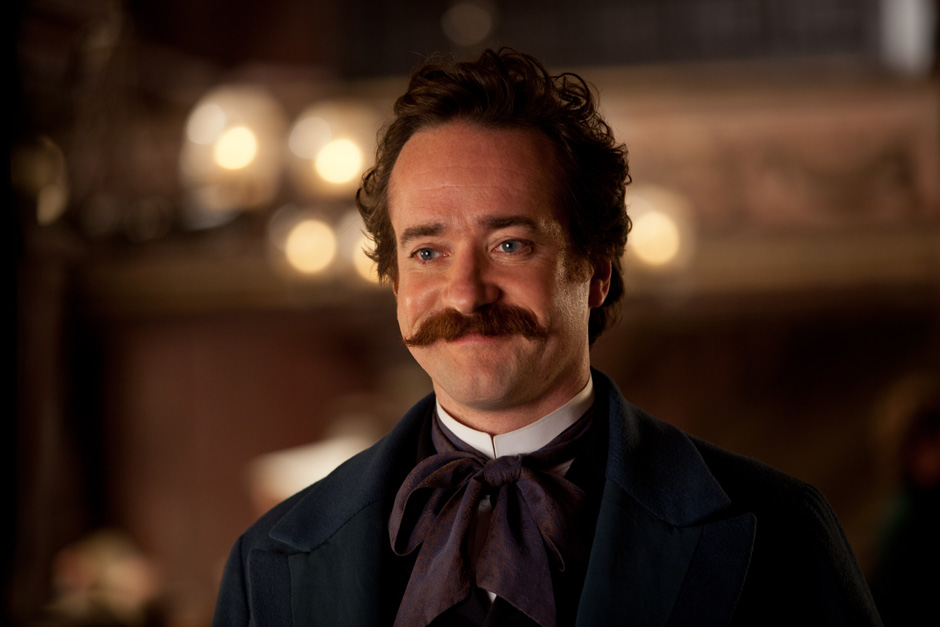
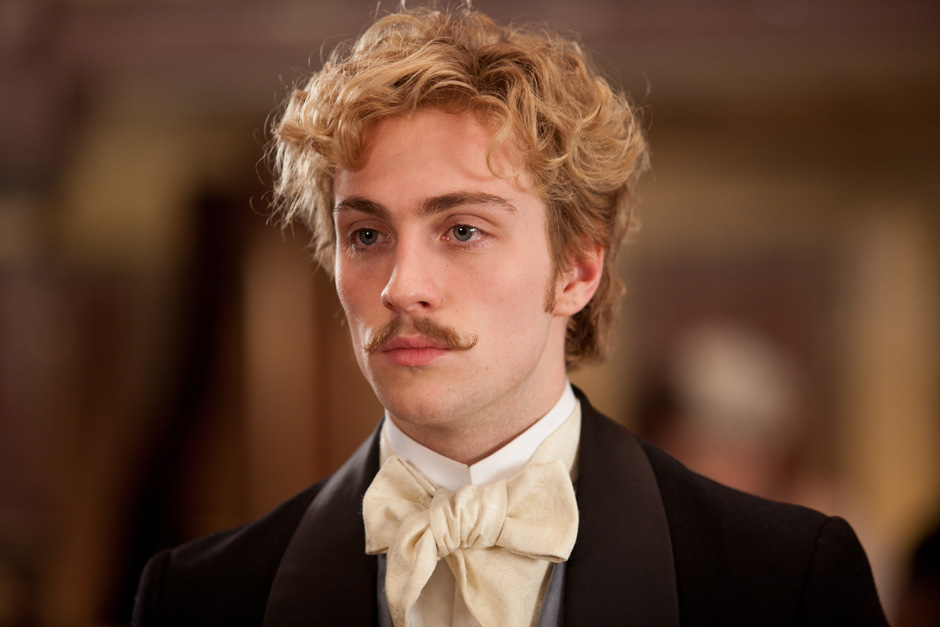
The performances run that way, too.  Keira Knightley is an exasperating Anna, conflicted but fatally committed to fully expressing whatever is on the surface of her heart.  Her P & P co-star, Matthew McFadyen is a burlesque cousin Oblonsky, fatuously showy in a way that reminds of Kevin Kline performing a burlesque role.  Jude Law—not one of my favorite performers—here is exceptional as Anna's cuckolded husband, and is so restrained and non-theatrical, that it sets him apart from almost every other performer, isolating him, and is a good short-hand way of showing why Anna might be dissatisfied with him.  Olivia Williams has a small part as the Countess Vronsky, whose son (Aaron Taylor-Johnson) is the very florid object of fascination for Anna.

Anna (Keira Knightley) runs from Vronsky at the Ball
and experiences a little fore-lightening from an approaching train.

It's dangerous in a Joe Wright theater.

But, almost the entire film is deliriously fascinated with the artificial that it undercuts the very real passion and consequences of actions of the people in the film, reducing them to "players" as opposed to human beings.  I say "almost" because Wright does change things up to "open up" the segments featuring Levin (Domhnall Gleeson) and Kitty (Alicia Vikander), who already have their disappointing encounter with Vronsky and move on.  When they reunite, their segments are set in a real world of sky, clouds and fields befitting the couple who exemplify wisdom, forbearance and patience.  Wright puts them in our world, relegating the others to an artificial world that is essentially stage-managed (even at the end with a coda of Karenin and the remains of his family, it is contained in the stage-world that Wright has chosen to house his film.

It's different, even interesting in an oddly disrespectful manner, as the flightiness of the bourgeoisie and their concerns are merely shadow-play and window-dressing—it is true to an extent—but by pushing the metaphor so aggressively, it undercuts any feeling one has for the players in the majority of the film itself, and reveals itself as resembling the tut-tutting of the hypocrites who turn against Anna.  I'm not sure that Tolstoy had that intention (even strained through Stoppard), and this film might have benefited  from a less facile presentation that required less stage-craft and something more resembling (I don't know) empathy?


Anna Karenina is a Cable-Watcher.


Thursday, June 28, 2012

Brave

We All Have Our Bear to Cross
or
"A Princess Strives for Perfection"

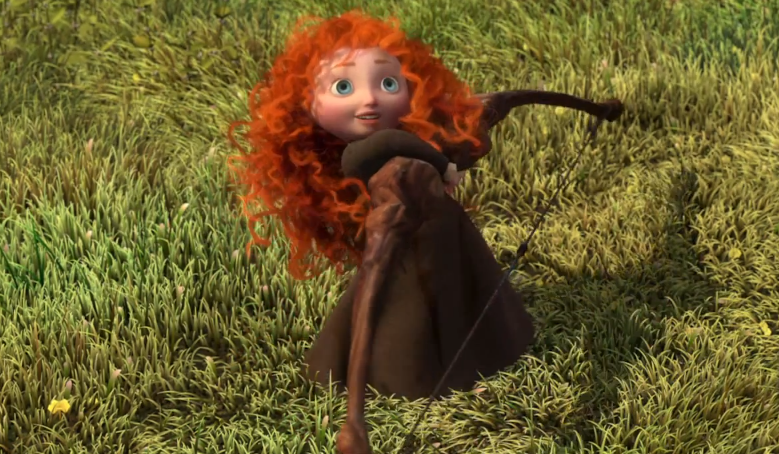
They used to have a lot of trouble with hair in the early days of digital crafting.  For instance, you remember the monkeys from Jumanji—the hair was short and matted and plasticene looking ("Not good enough, Sonny Jim").

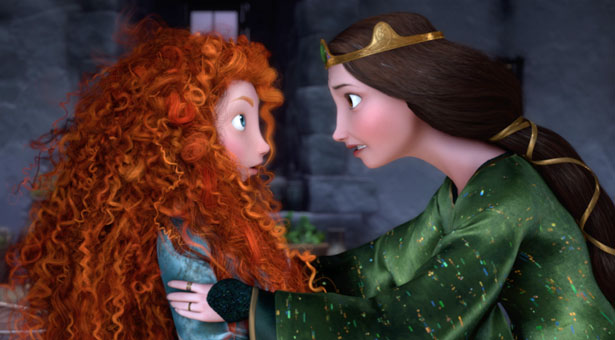
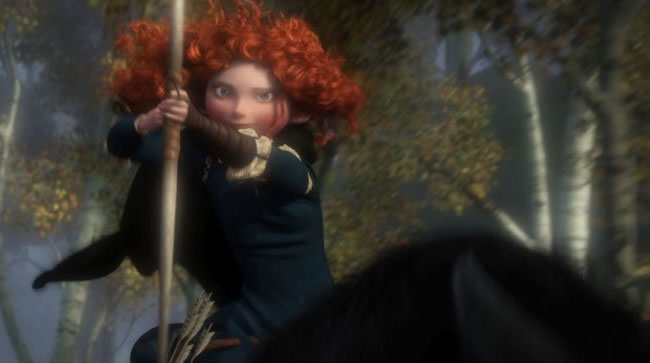
Things have come a long way; Princess Merida (voiced by Kelly Macdonald) in Brave has an unruly hedge of red hair, of all different textures and tensile strength, thatched together, the odd curlicue strands floating, like the representatives of an unruly spirit.  The one girl in the royal Scottish family of Lord Fergus (Billy Connelly) and Lady Elinor (Emma Thompson), she is being groomed, quite radically by Elinor, to be the perfect little princess, a prim and proper consort to one of the sons of the other clans (led by voice actors Robbie Coltrane, Craig Ferguson, and Kevin McKidd)—losers all.  Trouble is, Merida is very much a product of her parents.  The first born, she takes off a lot from her Lord-father, who when we first encounter the family, gives his daughter a bow for her birthday.  A wild shot sends an arrow deep into the forest where Merida has her first encounter with will'o-the-wisps, which her Mother tells her can lead her to her Fate.  As if Merida wants to be led anywhere.  As she grows, she'd much rather take off with her steed Angus, firing arrows at a full gallop on an archery course of her own devising, going on adventures that her potential suitors might blanch at.

But, when forced to play the role imposed on her, Merida becomes defiant, setting in motion a series of events that will prove disasterous to her clam, politically and personally.

To reveal any more would be spoiling the surprises along the way, which are heart-felt, potentially extremely tragic, and ironic all at the same time.  It's a grim fairy tale, conceived by original director Brenda Chapman (Pixar's first female director, although she was let go in the middle of production over "creative differences.")

There are a lot of "first's" here: it's Pixar's first "period" film; their first with a female protagonist, believe it or not (and this has a strong one to start off with, with feminist leanings, and mother-daughter issues); their first "princess" film and their first "fairy tale" of sorts, although it's not based on any story I'm aware of, treading new ground, although the touchstones along the way have all the familiarity of ages-old myth.

And Pixar has re-written their software codes to make a truly complex-looking film.  It's not just the hair, but also the verdant forests, rough-hewn roads, castles, and water effects all have a photo-realism quality, while the cartoon-proportioned people have a fastidiously eclectic design and a malleability of expression far beyond what Pixar's animators have been able to accomplish before.  There are no short-cuts here, but only the pushing of the artistic envelope (and that includes the 3-D effects which looks seamless and flawless with no speed-artifacting) that has been the standard for every production out of this studio.

At the showing I attended there was a technical glitch with the projectors that delayed the film somewhat (pfft...so I missed a couple of previews), and one of the patrons remarked out-loud how much the theater might compensate for the delay.  It left me wondering what sort of compensation is needed besides a great film, flawlessly done. 

Brave is preceded by a magical short, La Luna.  And stay 'til the end as there's a nice little coda.

Brave is a Full-Price Ticket.


Tuesday, June 30, 2009

The Merry Gentleman

"Fat Man Doesn't Want to be Fat—Still Eats the Fries"

Kate Frazier (Kelly Macdonald) has escaped an abusive relationship from her policeman-husband (Bobby Cannavale), and is now hiding out in another town, anonymous, working, and giving varying excuses for the "shiner" she's sporting. She doesn't want to get involved, but ends up fighting off questions and the advances from all sorts of flawed men. That includes the police detective (Tom Bastounes, who will go far, I'll bet) investigating the "jumper" that Kate saved the same night that a man in her office building was killed by a sharp-shooter across the street.

What she doesn't know and the detective suspects is that they were one and the same man. Tom Logan (
Michael Keaton) is a tailor by day, but freelances as a hitman in Chicago. He's good at both jobs, but only one of them makes him suicidal. And in one of the neat touches of the screenplay, Kate and Tom have this odd habit of saving each other's lives.

Actors want to direct. But not all actors can. For every vain-glorious exercise of star-clout, there are the actors—like Redford, Gibson, even Ben Affleck—who surprise you and make you realize that they probably should have always been behind the camera.

Add Michael Keaton to the list. The duality that he's displayed on-screen—at least the conflict between the comedic and the dangerous—is just as potent in "The Merry Gentleman," his directorial debut.
Spare, austere, almost seeming like a British mystery, Keaton lures you with a tightly static camera that lulls you until it starts to move, as it does rarely. Keaton the director is extremely generous with his actors, holding back his own performance—it's all in his eyes—, deepening the mystery, while providing great showcases for the rest of the cast—all of whom feel they walked in on the set from their day-jobs being those people. Kelly MacDonald (the Scottish actress who played Josh Brolin's wife in "No Country for Old Men") has the most prominent role, trying to maintain a happy face on her own double life, trying to avoid past mistakes and failing miserably, something she has in common with most of the characters in the film. It's an incredibly assured directing debut (of a good screenplay by Ron Lazzeretti), with only a couple stumbles on ancillary characters where things aren't as tight—and that's because Keaton didn't go for a close-up. He was shooting for the movies, not for TV. That's the kind of mistake I'll take.


"The Merry Gentleman" is an interesting little movie—it feels like it's been told before (hitman finds he has feelings)—but never in so subtle or so clever a way. It's well worth seeing. And I'm looking forward to Keaton's next directing job.

"The Merry Gentleman" is a Matinee