Showing posts with label Emma Thompson. Show all posts

Tuesday, December 31, 2013

Saving Mr. Banks

"Just Because It's Fiction Doesn't Make it a Lie"*
or
"Cavorting, Twinkling, and Prancing to a Happy Ending Like a Kamikaze"

Mary Poppins was a bitch.  That's been my joke for a long time, especially given the reputation that Disney's film of Mary Poppins (this year voted to the National Film Registry) has of being just as sugar-gooey as cotton candy in an Orange County heat wave.  It isn't.  And I've gotten several startled looks from adults who then see the film and, yes, they do see that aspect of it, despite the step-in-timing chimney-sweeps, the dancing penguins, and the moments of larkiness. It's not all a jolly 'oliday with Mary. In the end, it's a little bittersweet, and she ascends into a Peter Ellenshaw matte painting of London that isn't dabbled in sunlight, but is a melancholy smearing of smoke and darkening skies.

That's probably due more to Travers' own stipulations to the Disney crew than to anything.  Disney could be dark—dinosaurs died and there was "Night on Bald Mountain" in Fantasia, Pinocchio had its moments jack-assery and Monstro swallowing, Bambi's mother died, and 101 Dalmations almost got skinned—and provided moments of terror and threat in its films, as long as everything turned out all right as the final song paraded people up the aisles. But, Mary Poppins would have been a slightly different movie if it hadn't been for Travers' nannying the scripters and Disney with her chalk-lines drawn in the sand.  For that, we should be grateful.


Maybe less so for Saving Mr. Banks, the Disneyfication of the Disneyfication of "Mary Poppins."  It's "based on a true story," which means (as Blake Edwards coined the phrase) it's "true except for a lie or two," and in the western parlance of John Ford, "when the truth becomes legend, print the legend."  They couldn't have made this movie without Disney and "the Disney version," so, obviously the filmmakers are going to take a charitable stand on the studio's side of things (for example, Richard Sherman, who's played by Jason Schwartzman in the film, says that, rather than, as in the film, taking a personal approach when Travers came to work with the film-makers, Disney took off for Palm Springs and didn't come back until she left).  But, the more you find out about P.L. Travers (her nom de plume), the more you realize that they're taking the edges off her, as well.  Travers was a fantasist, and her largest work was the construction of her life, ever-changing, malleable, inconsistent and to her specifications as the mood and the myth suited her. "Mary Poppins" suited her just fine, and her demands for what was and was not acceptable are well documented in the many scripts versions filled with the word "No" in the margins, and the audio tape of the back-and-forth's between her and the scripters and song-writing team (which she insisted on, and which is played as coda over the end-credits).  Emma Thompson, who listened to them all in her preparation for the role, called her "vile."**


"Two artists at the height of their powers-like two gorillas fighting:"*** 
A study in contrasts between Disney (Hanks) and Travers (Thompson)
Fascinating, complicated, but vile in the instance.  And understandable in her concerns for what she considered "family," and that is where the film is at its most charitable and lovely.  Where Saving Mr. Banks shines is in the film's presentation of Travers' carefully hidden back-story, of her growing up in Australia to a charming, but erratic alcoholic father (played by Colin Farrell...think about that, Colin Farrell in a Disney movie), a frail mother (Ruth Wilson), and a precariousness to the family that, until her father is demoted from his bank managership, she had not previously known existed.  The movie goes back and forth between the disappointing assaults on her stipulations at Disney and her memories, some of which inspired the work she fights so egregiously to defend.  Meanwhile, Disney (Tom Hanks, who pushes "folksy" mighty hard to play a role almost too familiar to play), with theme parks to build and other movies in the pipeline, is left vexed and perplexed that the "Disney magic" isn't working at all well on "Pamela."

How could it?  I remember one writer describing the movie adaptation business for one of his works as "holding the coat for the man who's assaulting your child."  Disdainful of animation and films in general and Disney's work in particular, the movie's Travers reluctantly comes to Hollywood, where she is inundated by welcoming gifts in the form of "all things Mickey" in her hotel room to the point where she feels under siege. Any pleasantries are seen with suspicion for agendas, hidden.  And for the Disney dwarves, the task is mining anthracite because they're playing to a vision of Travers from her books, but not from her history and will always come up short until they know the origin story...which she'll never tell.  

The process, by which the movie-makers back-and-forth to keep the starched corners of the character, and the tone from being perpetually giddy, would be long and tedious to sit in a movie, and so compromises have to be made. Let's just say things didn't happen the way they happen in the movie—there was no meeting of the minds and no sharing of histories; Disney was a businessman and entrepreneur who knew a good thing when his daughters saw it and Travers wanted to keep her house.  Battles were chosen; compromises were made...in Mary Poppins and Saving Mr. Banks.  That same give and take, that same grace under fire, to produce the best work regardless of the truth, permeates both films in their way.  The truth is just one more hurdle to a good story.

So, one can gripe—although Thompson is the very definition of "practically perfect in every way" here and should cause no consternation—but if one does, they're being a little bit intransigent and dealing with their own "issues," reflecting, again, the issues of the film.  It's a film that ultimately charms.  Anyone immune to it can, as everyone on both sides of the conundrum seemed to agree, "go fly a kite."

Saving Mr. Banks is a Matinee.  I'm not so sure I'd take the kids.


Julie Andrews, Uncle Walt, and Dr. Travers on best behavior

* P.L. Travers

** In one of those perfect symmetry moments, Thompson, in her satiric acceptance speech winning the Golden Globe for her adaptation of Jane Austen's "Sense and Sensibility" imagined Austen's own disregard for her just-awarded work: "P.S. Managed to avoid the hoiden, Emily Thompkinson, who has purloined my creation and added things of her own. Nefarious creature."

*** Thompson, in an interview, describing why she was drawn to the script and the story.  

Thursday, June 28, 2012

Brave

We All Have Our Bear to Cross
or
"A Princess Strives for Perfection"

They used to have a lot of trouble with hair in the early days of digital crafting.  For instance, you remember the monkeys from Jumanji—the hair was short and matted and plasticene looking ("Not good enough, Sonny Jim").

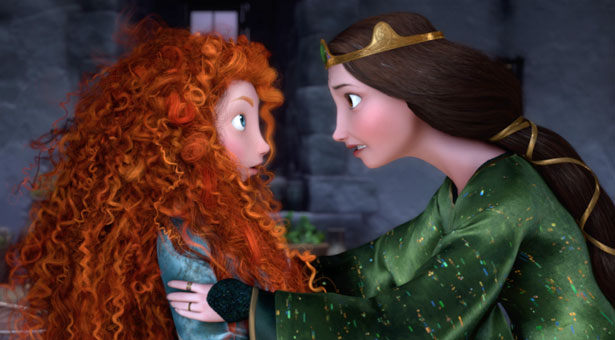
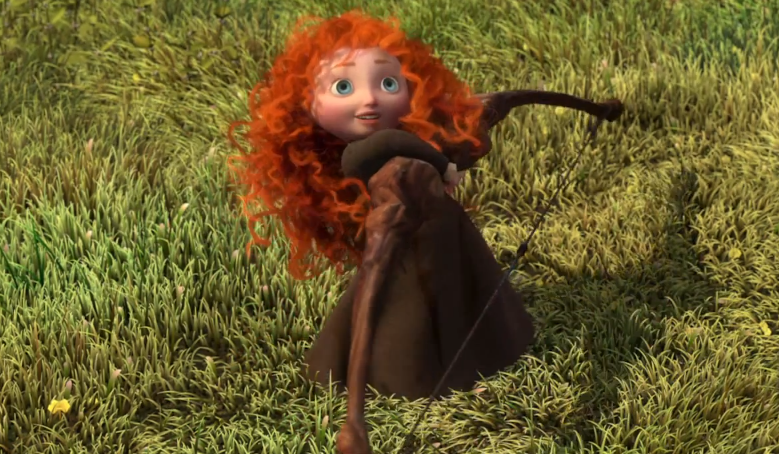
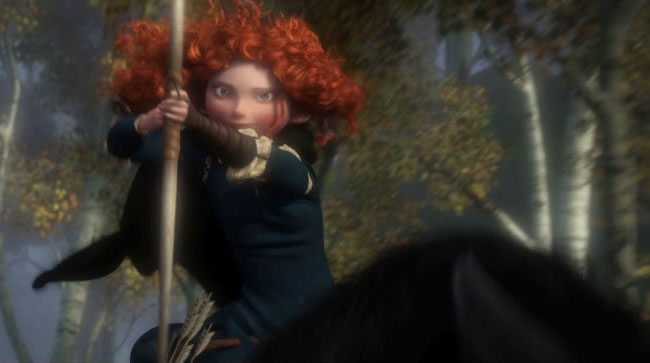
Things have come a long way; Princess Merida (voiced by Kelly Macdonald) in Brave has an unruly hedge of red hair, of all different textures and tensile strength, thatched together, the odd curlicue strands floating, like the representatives of an unruly spirit.  The one girl in the royal Scottish family of Lord Fergus (Billy Connelly) and Lady Elinor (Emma Thompson), she is being groomed, quite radically by Elinor, to be the perfect little princess, a prim and proper consort to one of the sons of the other clans (led by voice actors Robbie Coltrane, Craig Ferguson, and Kevin McKidd)—losers all.  Trouble is, Merida is very much a product of her parents.  The first born, she takes off a lot from her Lord-father, who when we first encounter the family, gives his daughter a bow for her birthday.  A wild shot sends an arrow deep into the forest where Merida has her first encounter with will'o-the-wisps, which her Mother tells her can lead her to her Fate.  As if Merida wants to be led anywhere.  As she grows, she'd much rather take off with her steed Angus, firing arrows at a full gallop on an archery course of her own devising, going on adventures that her potential suitors might blanch at.

But, when forced to play the role imposed on her, Merida becomes defiant, setting in motion a series of events that will prove disasterous to her clam, politically and personally.

To reveal any more would be spoiling the surprises along the way, which are heart-felt, potentially extremely tragic, and ironic all at the same time.  It's a grim fairy tale, conceived by original director Brenda Chapman (Pixar's first female director, although she was let go in the middle of production over "creative differences.")

There are a lot of "first's" here: it's Pixar's first "period" film; their first with a female protagonist, believe it or not (and this has a strong one to start off with, with feminist leanings, and mother-daughter issues); their first "princess" film and their first "fairy tale" of sorts, although it's not based on any story I'm aware of, treading new ground, although the touchstones along the way have all the familiarity of ages-old myth.

And Pixar has re-written their software codes to make a truly complex-looking film.  It's not just the hair, but also the verdant forests, rough-hewn roads, castles, and water effects all have a photo-realism quality, while the cartoon-proportioned people have a fastidiously eclectic design and a malleability of expression far beyond what Pixar's animators have been able to accomplish before.  There are no short-cuts here, but only the pushing of the artistic envelope (and that includes the 3-D effects which looks seamless and flawless with no speed-artifacting) that has been the standard for every production out of this studio.

At the showing I attended there was a technical glitch with the projectors that delayed the film somewhat (pfft...so I missed a couple of previews), and one of the patrons remarked out-loud how much the theater might compensate for the delay.  It left me wondering what sort of compensation is needed besides a great film, flawlessly done. 

Brave is preceded by a magical short, La Luna.  And stay 'til the end as there's a nice little coda.

Brave is a Full-Price Ticket.


Wednesday, May 30, 2012

Men in Black III

Time Wounds All Heels
or
"Don't Ask Questions You Don't Want to Know the Answer To..."

The third "Men in Black" film had to go somewhere else but up.  The first two films were variations on the "illegal alien" theme about a government organization that monitored the activities of extraterrestrials in the world and specifically New York City, and revolved around alien invasions and the containment of said aliens. And when you've seen one alien invasion directed by Barry Sonenfeld, you've seen them all, and hyper-kinetically at thatAnd once it's been established that "aliens can be anywhere" the joke runs a bit dry pretty quickly, especially when the sub-species can contain pug-dogs and large cockroaches.  The second film tried to expand on those concepts and felt a bit thin in the process, concentrating a bit too much on the secondary characters rather than the basic plot and the character interactions.

So, where does Men in Black III go from there?  

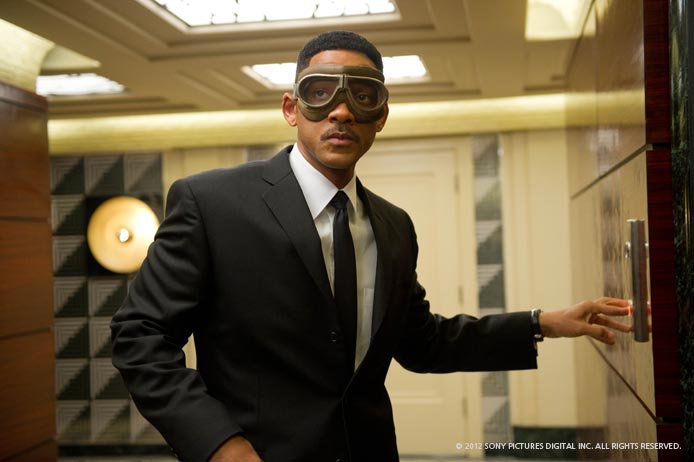
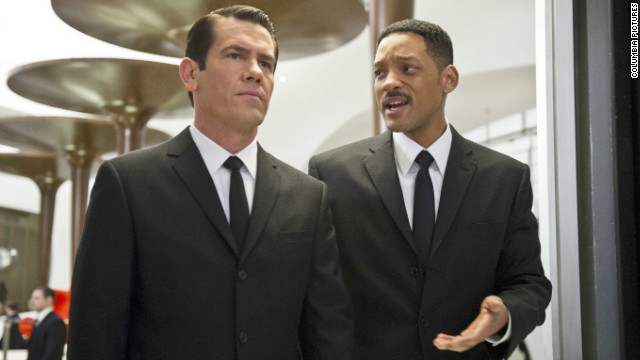
One of the nice aspects of the series has been its ability to still think outside the box, while expanding the horizons of just what that box might contain, be it variations of scale and dimension, even if only in afterthought.  With the infinite reaches of space seemingly exhausted, the group (based, supposedly on an idea by Will Smith) has the series going back in time.  Naturally.  It ostensibly revolves around an Earth-takeover plot by another alien (one must ask at some point "why always us?"), "Boris the Animal" (who seems based on the DC Comics "Hell's Angel in Space" Lobo and is played with growly gutteral responses by Jemaine Clement from "Flight of the Conchords") who escapes from his maximum (and we mean maximum) security prison to find the man who sent him there 40 years ago—Agent K (Tommy Lee Jones).  When he's unable to kill him here, the Boglodite finds another means to do so, and Agent J (Smith) wakes up the next morning, the only one with any memories of K past July, 1969.  Agent K has been killed by Boris in the past, and J must journey back to try and save him.*

Once back there, J negotiates his way through a 1960's era way of doing things.  Everything's a little less high-tech (a little less), but the MIB Agency is still there, as is the much younger Agent K (Josh Brolin, doing a bang-on interpretation of Jones) and J must solve the puzzle of saving the Earth (of course), while keeping K safe.  The past sequences are greatMen in Black has exploited the "fish-out-of-water" angle perpetually—and new corners are being thrown out the whole time (My favorite being a brief glimpse of a "Barbarella"-type being escorted around MIB, and although Smith is a bit too "Red Bull" throughout the entire movie, check out his understated reaction to some Black Panthers).  Great cast, too.  Rip Torn is gone, but David Rasche plays him in the past, Emma Thompson is on hand as the new MIB head, Will Arnett makes a brief appearance as does Bill Hader.  Toss in the chameleon-like Michael Stuhlbarg as an alien able to read multiple time-lines and there's always someone to deflect the eye, or hand things off from Smith.

But, the best thing about this "Men-in-Black" installment is resonance.  The other two were fine, the first better than the second just for its novelty, but had a shelf-life of three minutes.  Part of it is Sonenfeld's way of comically undercutting any meaning to the thing, by changing perspective—"you think you got a handle on it yet? Well, let me throw THIS at you!"  The whole "the Universe is so big and cosmic that there's no way you can understand it because there's so many mysteries, so nothing is real" concept, which is the backbone of the series (and the source for most of its humor) leaves one with a feeling of "meh"--nothing matters in a vast uncaring, unfathomable Universe.  Not here.  The cold of Space has nothing to do with the leavening of Time, and, in this case, the franchise plays it straight, without a wink, a nod, a reveal, or a goo-spraying splat.  For once, something really means something in the "Men in Black" Universe, and that venturing into uncharted territory makes the third time the charm.

Men in Black III is a Matinee.  (Not really necessary to see it in III-D)


* I'm not saying anything here that isn't revealed in the trailer.


Saturday, January 8, 2011

Last Chance Harvey

 Last Chance Harvey (Joel Hopkins, 2008) Amiable, genial little semi-romantic semi-comedy with a fine casting of plucky players trying to make more of it than it is.

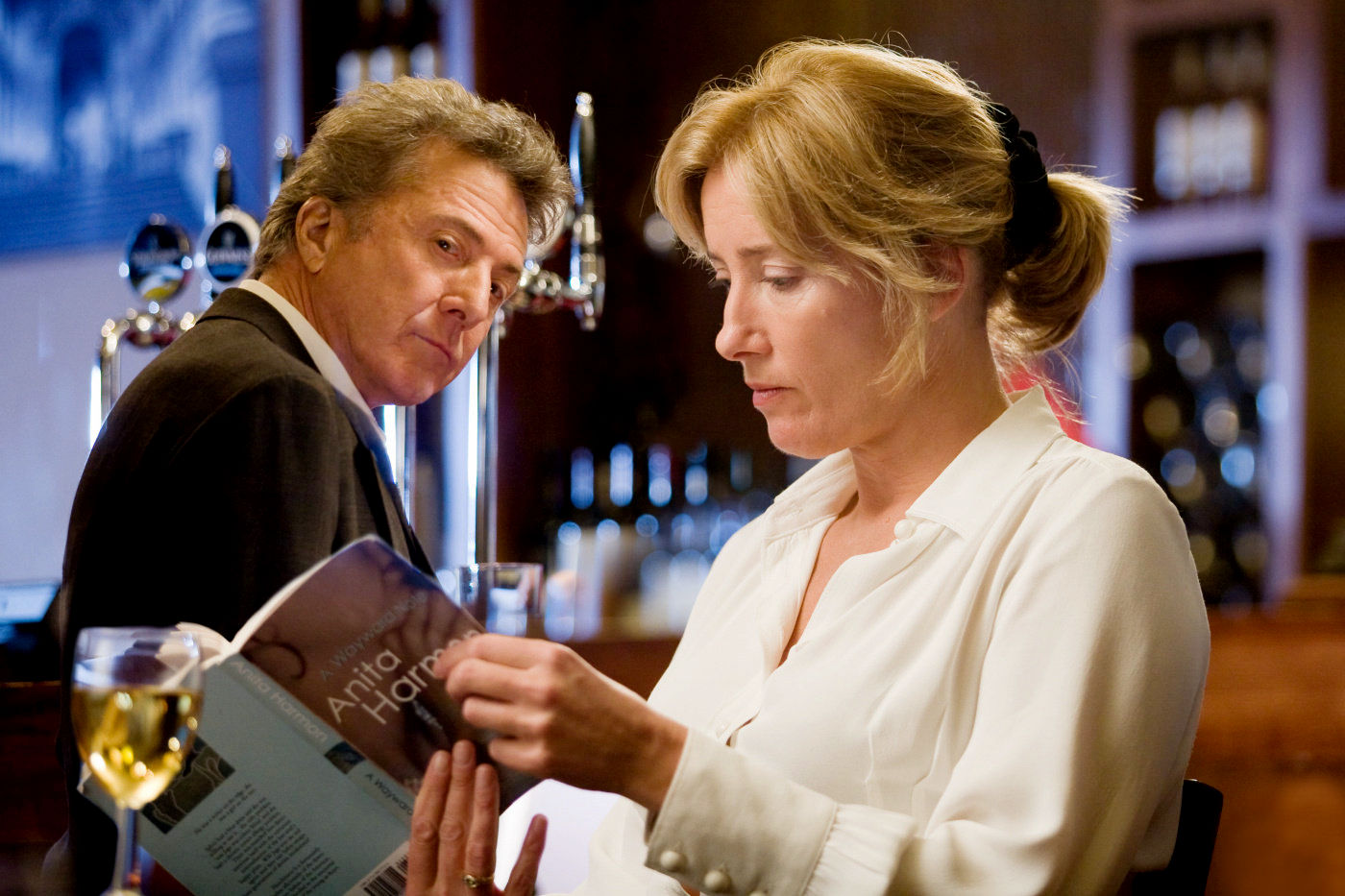
Harvey Shine (Dustin Hoffman) writes commercial jingles, but he's always wanted to be a jazz pianist.  He's about to write yet another inoccuous ear-worm, but he's on his way to London for his daughter's wedding.  He's told, rather cruelly by his boss (Richard Schiff) to take his time, enjoy himself...because he won't have a job when he gets back.

Hey...Mazel tov!

Add to that, his estrangement from his family, his awkwardness with social situations, and that dear daughter wants her step-dad (James Brolin) to give her away, Shine is having a verty bad time.  Determined to skip the reception and head home, he finds his flight delayed with a long layover.  Only thing to do is hit the bar, and once there, he has a strained conversation with Kate Walker (Emma Thompson, always exactly right), an airline worker he previously had blown off.

She wouldn't be there if a connection didn't happen...not back to the U.S., but between them...and as I said it's amiable and genial and you probably already know where it is heading.  There is a complication or two of the An Affair to Remember variety—don't worry, no one gets hit by a bus—and we get to witness what may be the longest wedding reception in history.  The slight storyline is fleshed out with Kate's eccentric mother (the wonderful Eileen Atkins) wo thinks that there's a Rear Window-style murderer living next door.  Hilarity ensues.

Still, you could do worse than this one to kill a little time, especially with such a good cast.


Saturday, March 15, 2008

Love, Actually

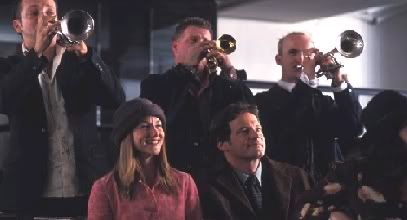
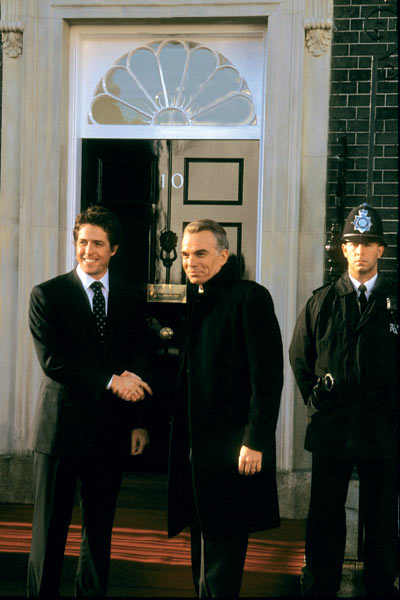
"Love Actually" (Richard Curtis, 2005) Curtis went from being the author of "Blackadder" and "Mr. Bean" to something of a Master of Chick-Movies after "Four Weddings and a Funeral" and "Notting Hill." "Love Actually" was his stretching of his formula to "Babel"/"Crash"-like proportions. It's just "La Ronde" but with more coincidences and slop-over of story that the result is soon you cease to care who knows who. As such, its tough to make a precise calculation of how many stories there are. There's the guy (Colin Firth) who after a break-up goes to Provence and falls in love with his Portugese housekeeper. He knows the couple who meet "cute" as lighting stand-ins for a porno film. There's the recent widower (Liam Neeson) whose son has a secret. He's friends with the wife (Emma Thompson) of an ad exec (Alan Rickman) and she happens to be the sister of the new Prime Minister (Hugh Grant) who has a crush on one of his staff, who happens to live next door to the secretary in love with the ad exec, whose employee (Laura Linney) has a not-so-secret crush on another ad-person, and that leaves out newleyweds Keira Knightly and Chiwetel Olojiofor, whose best man has a crush on...and on and on...England seems like a mighty small island, and everyone wants to get into everybody's else's knickers, literally or figuratively. It's surrounded by the story of a faded--make that acid-washed--rock-star (Bill Nighy, brilliant) staggering somewhere between Robert Palmer and Keith Richard, who has recorded a crappy Christmas version of "Love is All Around Me," which, for some reason, catches on. Plus, there are cameos by Billy Bob Thorton, Claudia Schiffer, Rowan Atkinson--basically anyone who wasn't needed on the sets of "The Lord of the Rings" or the "Harry Potter" films. The stories are happy, sad, contrived, bittersweet, tragic and occasionally prurient with quite a bit of gratudity. Neeson is as loose as he's ever been in a movie (he has the best line), matching Grant for light-comedy skills, Linney is charming and has the best laugh-out-loud moment, and its great to see Rickman and Thompson together again. It's a pleasant diversion, smartly written with the various stories achieving varying degrees of success.