Showing posts with label Josh Brolin. Show all posts

Thursday, January 24, 2013

Gangster Squad

Manifest Density
or
The War for the Soul of Los Angeles (such as it is)

Ruben Fleischer's third film (after the very good Zombieland and the excremental 30 Minutes or Less) is Gangster Squad, a Hollywoodized version of the efforts by the LAPD to take down the efforts of Mickey Cohen, the lieutenant of Bugsy Siegel's Jewish mafia, who took over Siegel's interests when the mob kingpin was murdered in 1947.

If one is looking for a history lesson, one should look elsewhere.  This is a glamorized, fictionalized version of the events set in some art-deco post-war version of Los Angeles that doesn't seem to have existed anywhere except the Warner Brothers gangster films and Brian de Palma's The Untouchables, to which this film owes a great debt.  The gangsters all wear dark clothes with long coats (the better to identify them) and are all greasy and ugly, while the police are all good-looking guys in nice suits who bend the rules a bit (with the possible exception of Chief Parker, played with a gruff somnambulance by Nick Nolte, who headed up the similar "Hat Squad" in Lee Tamahori's Mulholland Falls).*

It all feels very false, from how the gangsters rarely hit anything despite the thousands of rounds shot from tommy guns, and the Gangster Squad "hit" ratio usually fares better.  The Squad (hand-picked by the leader's wife, played by Mireille Anos, for being rough-necks and not promotion-headed top-of-their-classers) consists of boss John O'Mara (who did exist, but did not run the unit) as played by Josh Brolin, Jerry Wooters (played by Ryan Gosling), Max Kennard (Robert Patrick)—a sharpshooter, Conway Keeler (Giovanni Ribisi) a surveillance/electronics expert, as well as two PC members for the 21st century audience—Anthony Mackie (so good in The Adjustment Bureau) and Michael Peña.   Their target is Mickey Cohen (Sean Penn in a make-up that makes him look like he walked out of Warren Beatty's Dick Tracy), who's reputation is movie-inflated to make him seem like he's an empire-building Al Capone, rather than the cheap hood with star connections he ultimately was.

Fleischer is more interested in flash than being true to the source.  His fights are surprisingly well-staged, one shot per flying fist, but not Bourne-edited so one can easily follow it—an early fight in an elevator borrows heavily from a similar scene in a James Bond movie but actually goes places the 007 film merely used for suspense.  Once in awhile, he'll go for a Matrix-y slo-sloo-slooo-mo effect (rather than a fleeting Peckinpah image) just to make a point of something, like cartridges flying out of a machine gun, or a Christmas ornament exploding due to gunfire, but it's just slowing things down as opposed to telling a story.  Brolin's fine, nuanced even, but Gosling's McQueen-ish hipster act is wearing a little thin, and the chemistry exhibited between he and Emma Stone from Crazy, Stupid Love is completely missing here.  Mackie, Peña, and Patrick are far more engaging probably because they don't fit the established mold. 

It's entertaining, to a certain extent, but one gets the feeling, after patterns have been set that bring to mind other films, that one is being sold a bill of goods, and we are.  

The real-life Cohen was convicted of tax evasion (not murder) in 1950, serving four years.  Upon his release, he established several businesses (the ones portrayed in the film) and was again convicted of tax evasion in 1961 and released (again) in 1972.  Cohen died in his sleep in 1976.


Gangster Squad is a Rental.


The real Mickey Cohen, photographed in 1950
The real "Gangster Squad"


* Amusingly, his driver is Officer Darryl Gates (played by Josh Pence) who would be Chief from 1978 to 1992.

Wednesday, May 30, 2012

Men in Black III

Time Wounds All Heels
or
"Don't Ask Questions You Don't Want to Know the Answer To..."

The third "Men in Black" film had to go somewhere else but up.  The first two films were variations on the "illegal alien" theme about a government organization that monitored the activities of extraterrestrials in the world and specifically New York City, and revolved around alien invasions and the containment of said aliens. And when you've seen one alien invasion directed by Barry Sonenfeld, you've seen them all, and hyper-kinetically at thatAnd once it's been established that "aliens can be anywhere" the joke runs a bit dry pretty quickly, especially when the sub-species can contain pug-dogs and large cockroaches.  The second film tried to expand on those concepts and felt a bit thin in the process, concentrating a bit too much on the secondary characters rather than the basic plot and the character interactions.

So, where does Men in Black III go from there?  

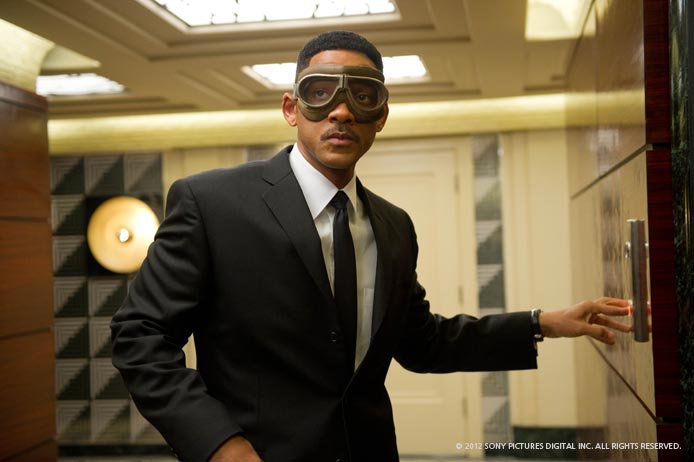
One of the nice aspects of the series has been its ability to still think outside the box, while expanding the horizons of just what that box might contain, be it variations of scale and dimension, even if only in afterthought.  With the infinite reaches of space seemingly exhausted, the group (based, supposedly on an idea by Will Smith) has the series going back in time.  Naturally.  It ostensibly revolves around an Earth-takeover plot by another alien (one must ask at some point "why always us?"), "Boris the Animal" (who seems based on the DC Comics "Hell's Angel in Space" Lobo and is played with growly gutteral responses by Jemaine Clement from "Flight of the Conchords") who escapes from his maximum (and we mean maximum) security prison to find the man who sent him there 40 years ago—Agent K (Tommy Lee Jones).  When he's unable to kill him here, the Boglodite finds another means to do so, and Agent J (Smith) wakes up the next morning, the only one with any memories of K past July, 1969.  Agent K has been killed by Boris in the past, and J must journey back to try and save him.*

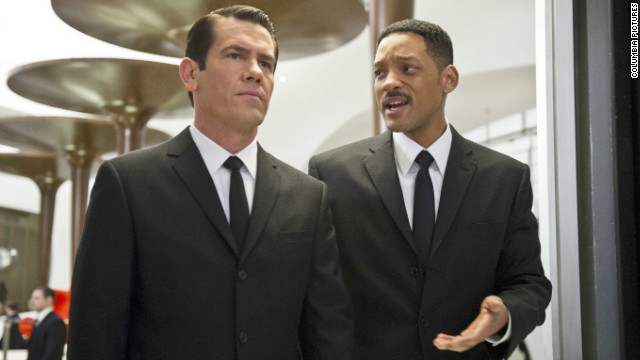
Once back there, J negotiates his way through a 1960's era way of doing things.  Everything's a little less high-tech (a little less), but the MIB Agency is still there, as is the much younger Agent K (Josh Brolin, doing a bang-on interpretation of Jones) and J must solve the puzzle of saving the Earth (of course), while keeping K safe.  The past sequences are greatMen in Black has exploited the "fish-out-of-water" angle perpetually—and new corners are being thrown out the whole time (My favorite being a brief glimpse of a "Barbarella"-type being escorted around MIB, and although Smith is a bit too "Red Bull" throughout the entire movie, check out his understated reaction to some Black Panthers).  Great cast, too.  Rip Torn is gone, but David Rasche plays him in the past, Emma Thompson is on hand as the new MIB head, Will Arnett makes a brief appearance as does Bill Hader.  Toss in the chameleon-like Michael Stuhlbarg as an alien able to read multiple time-lines and there's always someone to deflect the eye, or hand things off from Smith.

But, the best thing about this "Men-in-Black" installment is resonance.  The other two were fine, the first better than the second just for its novelty, but had a shelf-life of three minutes.  Part of it is Sonenfeld's way of comically undercutting any meaning to the thing, by changing perspective—"you think you got a handle on it yet? Well, let me throw THIS at you!"  The whole "the Universe is so big and cosmic that there's no way you can understand it because there's so many mysteries, so nothing is real" concept, which is the backbone of the series (and the source for most of its humor) leaves one with a feeling of "meh"--nothing matters in a vast uncaring, unfathomable Universe.  Not here.  The cold of Space has nothing to do with the leavening of Time, and, in this case, the franchise plays it straight, without a wink, a nod, a reveal, or a goo-spraying splat.  For once, something really means something in the "Men in Black" Universe, and that venturing into uncharted territory makes the third time the charm.

Men in Black III is a Matinee.  (Not really necessary to see it in III-D)


* I'm not saying anything here that isn't revealed in the trailer.


Friday, December 24, 2010

True Grit (2010)

"Revenge in a Minor Key"

or
"Hoo-raw'd by a Little Girl"


Someone had to save "True Grit" and that the Coen Brothers are in charge of posse is reason to be appreciative.  After their rather opaque film A Serious Man tanked seriously at the box-office (I thought it was last year's best movie), they needed a more accessible property to bring in audiences, and the well-known property (whether by book or previous film) is a good match.

Sure, I love the original 1969 version.  But, over time legend has overcome its considerable gifts, overshadowing the story, as John Wayne's performance overshadowed the movie.  True Grit (1969) is an adventure story, where the book is a post-modern comic drubbing of Old West myths.  The first film has a lot of those myths intact, those being the myths from Hollywood's westerns, including such at-the-end-of-an-era things as Strother Martin, Jeff Corey, Hank Worden, the opening song, Elmer Bernstein's  Copland-with-brass score, clean streets and available light.  The first True Grit is a sun-dappled western romp more pretty than gritty, with Kim Darby (good as she is) having to play young rather than the character, and Glen Campbell (out of his depth) as the Texas Ranger LaBoeuf.  It's just so clean, and the enterprise at its core so self-congratulatory that the point of the book gets a bit swamped in the process. 

The Coens take True Grit back to its roots.  Keeping in Mattie Ross' arch narration, and casting 14 year old Hailee Steinfeld as the young protagonist is a shift that greatly improves this adaptationSteinfeld is just severe enough, and, as opposed to the earlier film's Darby, spends her time acting more adult, as opposed to being an older actress acting young.  She's a bit arresting, bossing around Cogburn (Jeff Bridges) and horse-trader Hollister (Dakin Matthews), not having to sell the "young" aspect, but merely rise above it.

Like Steinfeld, the rest of the casting is superb.  Matt Damon's LaBoeuf is still a glory-hound, but of such fool-hardy self-assurance and puffery that you actually feel a bit sorry when it doesn't pan out to his vision.  Josh Brolin does a fine job as Tom Chaney, the initial object of the man-hunt, bigger in myth than he is in real life, and something of a whiner.  And Barry Pepper is nearly unrecognizable as Lucky Ned Pepper (I'm sure, no relation), who reveals a gift for rolling around the stilted dialogue he's been saddled with, and who (bless him) acknowledges in his performance the work of the fine actor who preceded him in the role.*

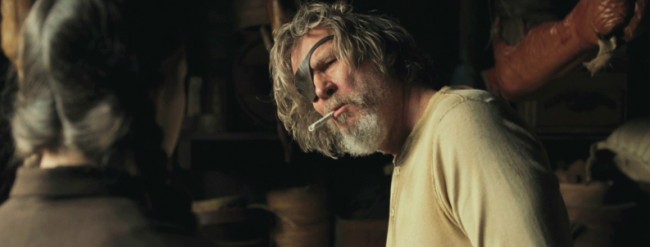
And everyone will be watching Jeff Bridges, because he has small boots to fill—Wayne had little feet—His "Rooster" Cogburn has his eye-patch on the other side (Wayne kept his left eye covered, Bridges his right—that a political statement?), and his deputy Marshall is more dissolute, less jolly, growlier and more willing to admit his infirmities.  His drunk is a bit more dangerous and cantankerous (the Coens keep the corn-dodger shooting match between Cogburn and LaBoeuf), although Bridges always tries to invest some dignity in the stumbling, playing it less for laughs than for character.  The role has little of Wayne's "star" presence, but a nice sunken lived-in quality.  His "Fill your hands, you son-of-a-bitch" is not said as a challenge, but in genuine anger, without Hollywood quotation marks.  He's superb, and by the time he confronts a Choctaw body-snatcher on the hunt, Wayne's version is cheerfully merely remembered.

But, it goes beyond that for the Coens' version.  Their True Grit is steeped in atmosphere, acknowledging racial differences and feeling less like a scout outing on a beautiful spring day.  Confrontations are held in pitch-black night, during snow-flurries, and inclement weatherNature in its beauty played a big part in the appeal of the 60's Grit, here it is nature in its ambivalence—one gut-wrenching scene taking place in the pitch of night under a dwarfing sky of shining stars.  The struggles of the individuals, man and beast, under that canopy are thrown into stark relief with those indifferent points of light.  It haunts, and throw one more sharpening aspect of this version that the previous lacked.

For, after the deeds have been done, this Mattie Ross, confidently bossy 14 year old, is given a sight of the carnage her single-minded quest has left in its wake.  There are moments, under that clear sky, of regret that the first film didn't dare preach, and of the destruction such obstinance can wreak.  A further coda follows the book's conclusion, that such lessons may not keep, under so strict a host.

It's lovely.  It's the book, done in a minor key in an overcast light, not dressed-up and gussied-up, but bittersweet, full of sand, and a lot of grit.

True Grit (2010) is a Full-Price Ticket


* Okay, I can't keep it a secret, it is so delicious: Robert Duvall played Pepper in the first film, and in a key-scene (with Pepper in close-up) giving instructions to stay with Mattie Ross, Pepper gives a two-fingered hand-signal that was a running gesture of Duvall's iconic (and beloved) Augustus McRae in the "Lonesome Dove" mini-series.  That move calls to mind another gesture echo in classic westerns: John Wayne's grabbing his arm in the last shot of The Searchers in a quiet tribute to the habit of another star of John Ford westerns, Harry Carey.  Lovely, and nearly invisible.

Tuesday, November 2, 2010

You Will Meet a Talk Dark Stranger

"Man Makes Plans. God Laughs."
or
"The 'Thing Without Feathers' Turns Out to be My Nephew."

With a title like You Will Meet a Tall Dark Stranger, you know this won't be one of Woody Allen's autobiographical tales.  The Woodman never strays too far from All Things Woody, his characters usually being scrambled aspects of himself, with one character being a direct comic stand-in.  The likes of Kenneth Branagh, Mia Farrow, John Cusack, Larry David and Edward Norton have all been past dopple-neuroti-gangers for the writer-director.  Rarely has there been a film of his without one.

This is one of those rare films, although one could say this tangled web of London residents could all be aspects of Allen's personality, with the closest being (maybe) Anthony Hopkins' Senior Fool.  One needs a play-book to keep everybody in this rondeau straight, although they are all in each others' orbits.  Start with Hopkins' Alfie—married to Helena (Gemma Jones), parents of Sally (Naomi Watts), wife of Roy (Josh Brolin).  Alfie, going through his "middle-age crazy" period, divorces Helena, sending her to a faux psychic (Pauline Collins) in her grief.  This all upsets Sally, who's trying to make ends meet working for a gallery owner, Greg (Antonio Banderas) while her husband is becoming frayed trying to write a follow-up to his previous publishing success.  Basically, everyone's in the weeds, and it's not long before everybody decides that somebody else's grass in better than their own.  Soon Da is marrying a call-girl/"actress" (Lucy Punch), Roy is pursuing a neighbor he keeps oggling through his window (Freida Pinto), and Sally starts to have feelings for her boss, as her feelings for Roy start to wane.

Allen starts and ends the movie with Leon Redbone warbling "When You Wish Upon a Star," and begins with Helena visiting a psychic, making one think that instead of a rating designation ("R," btw), it should have a sign saying "Abandon All Hope, Ye Who Sit in the Auditorium."  That he equates spiritualism as just a more rigorous form of "hoping against hope" (when the two are merely con-games with different sources—second-hand or internal) is dispiriting, and though it's a continuation of his life-view—"full of loneliness, and misery, and suffering, and unhappiness, and it's all over much too quickly"—there isn't the shrugging whimsey that serves as a warming punch-line this time.

For it may be true, as Emily Dickinson says, that "Hope is a thing without feathers" (and Allen's screwball lateral to that is the second title for this review), and "if wishes were horses, beggars would ride," I tend to take the more optimistic view.  Yes, there will always be poor (because Jesus tells me so) without a nagging destiny, that's no reason that, even though their feet are perpetually on the ground, they shouldn't be reaching for the stars.

Because there will always be stars, too, even if we don't see them, and even if we're not looking for them.  It's why I keep looking up at them.  It's why Woody Allen keeps making movies. 

Maybe his next one will be better.  I hope. 

You Will Meet a Tall Dark Stranger is a Rental. 

Saturday, October 2, 2010

Wall Street: Money Never Sleeps

"Greed...(For Lack of a Better Movie)...is Good"

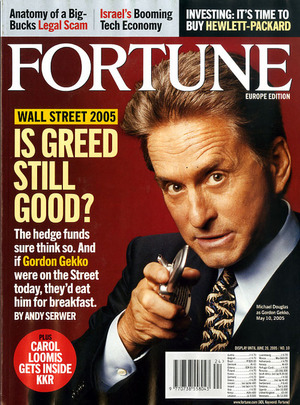
Entering into the third year of the Great Bank Swindle, it was only natural that someone in Hollywood would try and make hay off of it.  Enter Oliver Stone, with a sequel of sorts to his "Wall Street" film of 1987: "Wall Street: Money Never Sleeps" (a rather loopy title, in my eyes).  Wall Street high-roller Gordon Gekko (Michael Douglas) is released from prison to find himself alone, short of cash, and unable to get back into the game—the rules, such as they are, have changed, and prison never looks good on the resumé.

Seven years after Gekko is sprung, young Wall Street investment trader Jake Moore (Shia LaBoeuf) finds himself in the middle of the banking crisis, his company folding and his mentor (Frank Langella) commits suicide as a result.  The rootless Moore is then determined to avenge the death of both his Father Figure and livelihood by taking on the entities that led to his firm's collapse.  It was only a matter of time before he ran into Gekko, on a promotional tour for his new book, describing his life on top and behind bars.  Their stars are due to collide for another reason; is engaged to Gekko's daughter (Carey Mulligan), estranged from her father for his sociopathic wheeling-dealings and the subsequent overdose death of her brother.

Already it starts to feel icky.  Stone's original was, much like his "Platoon," less about their subjects (Vietnam, insider trading) and more about the writer-director's coming to terms with Daddy issues.  His protagonist in both films (played by Charlie Sheen) had to choose between good and bad fathers in both situations (Tom Berenger and Willem Dafoe in the first, and Douglas and Martin Sheen in the second), hovering about his shoulders like angel-demons, prodding him to go one way or the other, making him choose which Father Knows Best.

Everybody has Daddy problems in this one, to the point where that seems to be the only issue concerned.  Oh, there's some touching on of Green Energy and of the Banking conspiracy, but for the most part it is of the characters pin balling between Male Authority Figures, and the Mentor-Protegé thing (right down to Josh Brolin's character's favorite art-piece).  The only thing left is the kinda squeaky relationship between LaBoeuf and Mulligan, with Gecko acting like some Yojimbo playing all sides against each other.  It's a little disappointing to see Douglas' Gekko-monster being soft-pedalled in this manner—like finding out that Darth Vader (another Dark Father figure!) is merely Hayden Christensen in disguise.  Disappointing if one could get a handle on the character at all.  Douglas vacillates between being a tough-as-nails financier with all the answers and vulnerable Fair-Market Father trying to win back his little girl—that transformation gives Douglas and Mulligan a well-played if ultimately hollow scene in which they come to tearful terms.  He has never been better than that scene, and takes chances that recall his father Kirk's fearlessness in hitting for the bleachers.

If only that were true of Oliver Stone.

For the fact of the matter is, despite being one of our more (self-professed)radical film-makers, the once angry young man has made one of the most conventional of movies.  To be fair, he didn't write it, so the personal complications among the characters that one can see coming a mile away are not his fault.  And though he may trick the movie up with visual legerdemain (including a simple use of split-screen that he abandons fairly early on), pervasive songs by David Byrne and Brian Eno (that are banal), and "cuting" it up with several visual and aural "in-jokes," the film couldn't be more "safe," preaching to the choir, and goo-ing the whole thing up in a veneer of soap-scum. 

If one wants to be a truly innovative film-maker, to push the limits of visual story-telling, tell us something we don't already know.

"Wall Street: Money Never Sleeps" is a low-yield Cable-Watcher. 


Tuesday, June 22, 2010

Jonah Hex

"Jonah Bloody Hex...Ah'd Recognize that Half-Cooked Pie-Hole Anywhere."

The title of this post says it all: "Jonah Hex," the movie, is "half-cooked" as in half-baked and a "pie-hole" as in an empty void.

Sad, too.  "Jonah Hex" could have been a lot of savage fun if it were truer to the source—the DC comic book, the last semi-regular western title the publisher produces.

Jonah Hex was a confederate officer, who would not take part in a raid that would only produce civilian casualties, and so, he was the ultimate outlaw, trusted by neither the North or the South, and a bounty hunter, with a particularly nasty streak (not counting the melted-flesh scar adorning his right cheek*).

Hex was in a "funny book," although, he had no "powers and abilities far below those of mortal men," except a deadly accuracy with all things kill-making.  Seems that's not good enough for a four-color movie adaption these days, because the character now has a way to commune in the darker places of the spirit-world, awakening the dead with a touch in order to obtain information.  This hooey is a result of being saved from death by the mumbo-jumbo of the Crow Natives, who salved his wounds (but knew nothing from plastic surgery) and snatched his soul back from the after-life.**  Of course, the wounds were CAUSED by Natives in the comics, but consistency is the hob-goblin of little minds, and the pea-brains who made this one decided to air on the side of political correctness—which "Jonah Hex" never was and never should be.

The best of the "Hex" stories (not counting the ones where he was flung into a post-apocalyptic future, as a "Mad Max"-type) were written by a scribe with with his own twisted streak, Michael Fleischer (although don't call him "crazy" because Harlan Ellison implied it in an interview, and Fleischer sued...and lost).  The last issue he wrote had Hex meeting his end, and then being stuffed and mounted for display and the amusement of anyone who'd fork over two-bits.

He should contact his lawyers, because he might have better luck this time; this one's a PG-13 fiasco that's all-hat and no cattle, that tries to be gritty-tough, but doesn't have the powder to show a kill-shot.  A lot of people get killed, roasted, bludgeoned and chopped, but all discretely off-screen, even while its trying to be as nasty as can be, like a bully that talks tough but runs away from a fight.  And anyone who thinks "The A-Team" was poorly directed (guilty) will be amazed at the cluelessness displayed here by director Jimmy Hayward,*** former animator for Pixar and co-director of the very fine "Horton Hears a Who!"****

It's all shot in a snatch-and-grab style, awkwardly staged, with no time to linger over period detail, then settles into a Leone-like formality (with picturesquely ugly extras) that's to a spaghetti western what Chef Boy-Ar-Dee's "SpaghettiO's" is to fine Italian cuisine.  The Main Title fills in some animated back-story (fine), but then the thing hits the dirt like Hoss' played-out horse, with a tricked up story about a Doomsday Weapon about to be lobbed on Washington by Hex's former commander (who happened to murder his family to boot).  At about the half-way point, it looks like someone had seen "Sherlock Holmes"***** and tried to emulate the steam-punkish style, but—(never thought I'd say this!)—didn't have a clue how to match the precision of Guy Ritchie.

The movie's look changes dramatically whenever Megan Fox is on-screen, but that's not to the good.  Instead of the gritty telephoto look of the rest of the film, she looks like someone spent some precise time lighting her, as she's bathed in golden light with roseate high-lights in her hair—it's the reverse equivalent of smearing vaseline on the lens to hide an actresses' wrinkles—it stands apart from the rest of the film almost to a laughable degree—and for no good reason other than it makes her look damned good.  You can't shine gelled baby-spots on her performance, though, which, unencumbered of any modern girly-girl archness (at which she can be quite smart), is delivered in a flat, lazy drawl (sometimes, as she's inconsistent) and suggested to me that she might be this generation's Raquel Welch...or Jill St. John ("Ya look great, honey, just don't speak, okay?  You, too, Keanu").

It's a mess.  The script's bad (by the makers of the "Crank" movies—seems like a "natural" choice to me!), and only matched by the slip-shod film-making—whoever did it, and it could be a bean-counter at Warner for all I know.  The best parts are in the trailer, as the movie's only 85 minutes long (with credits), you're only missing 83 minutes of garbage.

I sat, during the credits, with my own Hex-like sneer on my face, contemplating just how badly this thing was screwed up, when the name of one of the Executive Producers showed up: Akiva Goldsman.  Of course!  The man who wrote the bad "Batman" scripts, who wrote "Lost In Space," "I Am Legend," "Practical Magic," "I, Robot," won an Oscar for "A Beautiful Mind ("schizophrenia can be fun, kids!!"), and adapted both "The DaVinci Code" and "Angels and Demons," and whose only talent seems to be the ability to "crack" a script by taking anything edgy or complicated and dumbing it down to the level of a kindergartner.  If he were a chef, his specialty would be a liquid, runny oatmeal.  His name has so symbolized terrible work that in my most churlish moments (usually after seeing one of "his" movies) I can only refer to him as "Hackiva."  The man should be barred from having control over anything of literary merit, and  consigned to merely working on "Chipmunk" sequels.  He's been pegged to direct the remake of (appropriately) "The Toxic Avenger."  One hopes that he's a better director than he is a writer/producer, and may prove to be with the bar set so low.  I doubt it.  It's tough to avoid the "Hackiva" hex.

"Jonah Hex" is a Waste of Time.


* Among the many flaws of the movie, the prosthetic creating this effect looks a bit plastic—you don't see it on the poster, of course, in another instance of white-washing the movie—but it does have one funny outcome:  Whenever Jonah goes to a bar, he always has to order a double because half of it goes through the open wound in his cheek.

** And, just to pile on the atmospherics, he also seems to be followed around by flocks of crow familiars, which must make it hard to sneak up on people, although he does from time to time. 

*** Okay, to be fair to Hayward—"Horton" IS a great movie and certainly the best of the recent big screen Seuss adaptations—was replaced by Warner execs by Francis Lawrence ("Constantine," "I Am Legend") during re-shoots, so that may account for the film's inconsistent tone and look. 

**** I first suspected hopelessness when the hilarious Will Arnett showed up...in a completely straight-laced role as a government functionary.  What a waste!

***** Both "Jonah" and "Sherlock" are Warner Brothers movies, so, that's a distinct possibility.

Wednesday, January 14, 2009

Milk

"The Plural of 'Us's' is 'I'"

I had all these cute little headlines to put at the top of this review, reflecting my disappointment with Gus Van Sant's bio-pic of slain San Francisco supervisor Harvey Milk—"Condensed Milk," "2% Milk"—but ultimately it comes down to this: you owe it to yourself to see "The Times of Harvey Milk" the Oscar-winning documentary on Milk and his efforts to fight discrimination. No hidden links: You can watch it on Hulu here: http://www.hulu.com/watch/49577/the-times-of-harvey-milk It'll cost you nothing but 90 minutes of your time with minimal interruptions. "Milk" acknowledges its debt to this film in its final credits. Indeed, you'll see a lot of archive footage shared by both films. And "Milk," a features recreations of footage from this film. The film ends with Sean Penn, as Milk, saying the words that you'll find in the video at the bottom of this review into his tape recorder for the prescient "In the Event of My Death by Assassination" tape he made. But that sentiment was not a private one. And the film does a disservice to Milk making it so.

It also inadvertently plays into stereotypes by suggesting that Milk's assassin Dan White was a closeted gay man instead of the mentally ill person he was. White's angry (and public) resignation during a meeting of the Board of Supervisors is also made private in the film. White's sneaking into the city hall with a loaded weapon to avoid metal detectors is alluded to, but not that White re-loaded his pistol after shooting Mayor Moscone and heading to the Supervisor offices to kill three other board members (Milk was the only one present). That the crimes were deliberate seems incontrovertible. But White was only convicted of manslaughter and released after serving five years in prison.

And one can quibble about Penn's performance as well, making Milk more fey in his mannerisms (Milk had hidden his sexuality in New York for years), and giving him a thick Bronx accent more Harvey Fierstein than Harvey Milk (ironically, Fierstein narrates the "Times" documentary).

Still, ya gotta do what ya gotta do. The original documentary is 25 years old and is probably past its shelf-life. A dramatic re-telling of the tale was probably due (a twin project "The Mayor of Castro Street" has been in the works, first by Oliver Stone and more recently by writer Christopher McQuarrie and Bryan Singer for years, and has for the time being been abandoned) if only to keep reminding people of the toll closeted life inflicted on the gay population. The battle continues to put a familiar face on homosexuality. And if a melodramatic re-telling of a pivotal story is required, so be it.

Van Sant does a fine job of mixed media cutting between vintage footage, newscasts, and recreations. And he gets great work out of his cast, particularly Penn, who's never seemed so relaxed in a role, James Franco (who gets better with each movie) as his first partner in San Francisco, and Emile Hirsch from Penn's "Into the Wild" as one of his youngest recruits.

"Milk" is a Matinee.


Tuesday, November 4, 2008

W.

"Somethin' 'Bout Bein' in the Barrel"

The Writer's Prejudice Up Front : I've never liked George W. Bush. He's the type of guy I'd like to sit down and have a beer with...thrown in his face. I've always considered him woefully unprepared to be President: a rich man's son who aspired downward; a dilletante who'd never had a successful business that his Dad's cronies didn't bail out; an oil-man, who excelled at digging dry holes; the most bald of hypocrites, pious when the microphone's on, but profane when they're off; who believed in sacrifice as long it was somebody else; possessed of the ethics of a snake-oil salesman, he'd made so many promises and held so many I.O.U.'s that putting him in charge of the Treasury was like putting Dracula in charge of the Blood Bank. Or as Maureen Dowd once famously wrote: "He's the guy who would rent a hotel room, and then ask you to the prom." One by one, Bush and his co-conspirators undermined every aspect of American life to the point where his own Administration, which contained so many of them, should be considered its own National Disaster. There isn't penance enough in this world to make up for the harm that this vain-glorious underachiever did. And once he leaves office, he'll go back to the only job he's had success at: Influence-peddling. Writing about him in the past tense is the only pleasure one can take in writing about him.

He is the Shame of our Nation.

Having said that, "So, Mrs. Lincoln...how'd you like the play?"

Oliver Stone is no one's idea of an objective film-maker, if there is such a thing. Once a screenwriter puts pen to paper, they've already started manipulating the movie to their point-of-view, whether it's from the left, right, center or upside-down (Why do you think they're called "directors?"). So, no one should be surprised that Stone has an axe to grind, with "W.".

Stone is a director of heart, but he frequently by-passes his brain when making his points. So, "
Platoon," still his best film, hi-jacks the gritty depiction of grunt jungle-fighting with Stone's own conflicted "Daddy" issues, his "Pvt. Chris Taylor" having to choose between two superiors with different moral ways of engaging the enemy. Lincoln and every fantasist depicting moral choice has put angels and devils on our shoulders. Stone burdens us with His Old Man. That same scenario was transferred to High Finance, with his very next film "Wall Street." I haven't seen every film of Stone's, but most of them are concerned, in some capacity, with paternal conflicts. And because he's a better propagandist than scenarist, most Stone films stop dead whenever we get to each Stone "thesis," invariably a Message being presented by a single character who has center-stage and our undivided attention. "JFK," a dazzling technical exercise of photography and editing, comes positively unglued in its presentation of conflicting conspiracy scenarios for Pres. Kennedy's assassination (Kennedy being another Stone father figure--"Our murdered King," as he's described in the screenplay--completely by-passing any thought that we might, you know, be living in a democracy with a representative government), until Kevin Costner's prosecutor Jim Garrison places in his summation a theory on military-industrial conspiracy behind the Vietnam War--a Stone obsession.* (In "W." Dick Cheney--Richard Dreyfuss clearly enjoys being given the opportunity to play him--stops an Iraq War strategy session to pontificate on securing Middle East interests for oil exploitation for a hundred years). Give the man points for passion, but his movies become such a glut of emotion that the point becomes lost in the gnashing of teeth and the wringing of hands. His bio-pic of "Nixon" was such a slap-dash affair, it seemed like a badly-cast TV-movie gloss-over, skipping from high-light to low-light in time to shoe-horn the next commercial (A weirdly fictional conversation between Chairman Mao and Nixon was Stone's show-stopper there). By the end, with its End-Credits playing over a Mormon Tabernacle Choir-rendition of "Shenandoah," one almost felt some sympathy for the man. Nixon, not Stone.

"
W." (his too-early summation of the second Bush Administration) suffers the same problems. It's a gloss of recent events, interspersed with flash-backs to the wastrel days of the young George W. Bush,** drunk with entitlement and just about anything else he could find. Particular heed is paid to his relationship with "Pappy" George H.W. Bush (James Cromwell, though he seems nothing like Bush the Elder, displays quiet bluster and submerged weakness), in which the good-for-nothing son is particularly eaten up, not by his own failures, but by his father's view of them.

The best part of the film--oddly for Stone--is Bush's conversion to The Faith. Struggling with his alcoholism, determined to become a Public Figure (as private industry success constantly eludes him), he is converted by Pastor Earl Hudd (
Stacy Keach, playing it straight, and doing some of the best work of his long career), introducing Bush to the second "Daddy," the Divine One, slotting this film into the standard Stone scenario. One knew, as soon as Bob Woodward revealed that Bush, prior to the invasion of Iraq, didn't consult his father/former President, but, instead, relied on the advice of a "Higher Father to appeal to," that Stone would obsess on it and exploit it. The film-maker takes the one relationship as far as it will go, creating a fantasy sequence where Bush 41 challenges Bush 43 to fisticuffs, but Stone doesn't have "the stones" to have W. duking it out with his Savior, J.C.


That battle's still to come.

Stone starts "W." with a Sergio Leone close-up of Bush's steely gaze, what impressionist Frank Caliendo says "like he's always got the sun in his eyes." It's another fantasy sequence, where W. acknowledges the cheers of an empty baseball stadium from center-field--what he'll later reveal as "his favorite place on Earth." The movie will end back on those eyes, searching, confused, disoriented--having lost a pop-fly "in the lights." Those distorted lights show up twice more in the movie--in that previously mentioned conversion scene, as well as when a hung-over Bush collapses while jogging. That's it? That's what we get? A half-assed light show? Is Stone saying he's abandoned by God, or that Bush is overwhelmed by his circumstances? The metaphor's too half-baked to communicate as solid concept clearly.

One could look at W.'s story in Shakespearean terms, as a modern day Prince Hal, whoring and wenching in his oats-sewing days to become the Monarch his father couldn't be. The difference is Hal had Falstaff as guide to the back-alleys of Agincourt. George W. Bush is his own King. And his own Fool.

But Oliver Stone is too busy making room for his "Daddy" theories to create a proper condemnation. As with "Nixon," you start to actually sympathize with the man. Any illumination into the man or the effect of his Administration is lost in the lights. To Stone, he is just another Yalie "poor little lamb who has lost his way."

Bah. Bah...and Bah.

"W." is a weak-kneed, squinty-eyed moron of a cable-watcher.


* Any judge would have gaveled the irrelevancy, but Stone's judge was played by the real-life Garrison.

**Josh Brolin does fine work, but the performance feels a bit "one-note," having to nail the too-familiar Bush mannerisms and vocal tendencies.

Monday, April 21, 2008

In the Valley of Elah

There is a good movie here wishing it could be born out of this mess. Tommy Lee Jones is giving it all he's got, portraying a meticulous and persevering war vet trying to uncover the mystery of his son's death. Some nice details build his character... like the way he creases his pants even when he's living out of a motel room; or the way he pumps young soldiers for information by inviting them to share a cigarette or a shot of Jim Beam. The center of the film is a half-hearted attempt at a detective story, with Tommy Lee and Charlize Theron sniffing out a cover up. I say "half-hearted" because the film never fully commits to engaging you in the detective story... instead, it gets distracted. There's an aborted try at a family drama (where TL Jones becomes surrogate daddy for Charlize's kid, which is not only unbelievable, but only lasts for about 2 minutes and is never mentioned again); some limp attempts to address racial prejudice (in which TL Jones again breaks character and beats a man while delivering an ethnic slur); and wasted appearances by fine actors Barry Corbin and Josh Brolin. Their screen time is well-written and compellingly delivered, but fails to contribute to any central thrust of the film. (BTW, I think this must have been filmed around the same time as No Country for Old Men, which might explain how at least three cast members appeared in both films.)

The film hints at fertile territory, but it's all undone by a heavy-handed insistence at creating a "message" film. As such, it reeks of embarrassingly obvious symbolism and propaganda. It's the same sort of failure that plagued Fast Food Nation. Lots of good actors contribute to both films (no doubt they support the respective causes) but nothing cohesive or satisfying comes of it.

I would only recommend In the Valley of Elah for Tommy Lee Jones completists. Otherwise, like me, you'll probably want your two hours back.

Monday, February 25, 2008

No Country For Old Men

Signs and Wonders

Llewelyn Moss is out on the Texas veldt tracking a caribou he shot, following the blood-trail when it is suddenly crossed by another blood-trail. Following it, he finds a drug-deal gone bad--five vehicles, and several dead Latinos, a truck-bed full of cocaine and eventually a satchel filled with stacks of of money, $10,000 to a stack. Fate is good to him.

Anton Chigurh is hunting, too. He needs a vehicle, and as he's driving a stolen police car, he can pull over anyone he chooses. He walks over to the driver side of the car, carrying a gas canister and a nozzle. "Get out of the vehicle," he says. And the driver complies. "Hold still, please, sir," he says, and the driver complies. He points the nozzle at the man's forehead and fires.

Sheriff Ed Tom Bell has been Sheriff of Terrell County since he was 26 years old, and that was a long time ago. You'd think he'd seen everything, but he's beginning to wonder if such a thing is possible. Looking over that drug deal gone bad while horse-back, he surmises the way things went down. "That's very linear, Sheriff," says his deputy. "Age'll flatten a man, Wendell," he not particularly replies.

The first time I'd heard of the Coen Brothers was a Time Magazine review of their first movie "Blood Simple." When it wound up being featured at the Seattle Film Festival I went, expecting great things and their quirky ways of telling a story, like that travelling shot (by future director Barry Sonenfeld) that glided over a bar-top, rising up and over a fallen bar-fly. But what I wasn't expecting was a sequence that is one of my favorite in all of film, and is such an obvious thing to do, I wondered why nobody'd thought of it before. Ray has just murdered his lover's husband and stashed him in the back-seat of his car to take him someplace remote to bury him. But as he drives the long, flat Texas highway at night, the corpse behind him moans and moves. He slams on his brakes, pulls to the side of the road and runs...runs in a panic to get away, into a field. He runs into the dark until he stops, panting in fright and exertion. He stands there, looking back at the car. Now what? He's "safe." He got away. but he's no better off than he was before. He has to go back. And he especially has to go back before another car or truck approach and bathe the scene in light.


He has no idea what he'll find when he goes back there, but back he must go. It's the center of the Big Undecipherable that is the heart of the Coen brothers' movies--when people start to ask "how did I get here? And how do I come out, if I can't go back?" There's no going back to Square One with the Coen's. There is only the going-forward, head up or head bowed.

In its way, "No Country for Old Men" has bits of other Coen movies all over it. The "cat-and-mouse" games of "Blood Simple." The airy philosophy of "O Brother, Where Art Thou?" The sharply written common dialog of all their films. The questioning law officer with philosophical questions of "Fargo," the "what's it all worth" tragedy of "Miller's Crossing," and "Barton Fink." It stands as a good primer for all that is good in their work.

Is it their best work? The "Masterpiece" that it's been touted as? Hard to say. There seems to be a decided effort on their part to NOT make it that, to undercut the impact that the film could have had had they been more direct, hit things on the nose, as they say, rather than leaving things unsaid and perhaps confounding their audience. They've left room for interpretation and controversy, to make one think about the importance of dreams, of Fate and Destiny. One has to review the film that is, not the film that could've been. And "No Country," as is, has some exquisite cinematography (by Roger Deakins--night shooting has never looked more convincing or as beautiful as here), note-perfect performances by just about everybody in the cast, but especially all the leads--not just Tommy Lee Jones, and Javier Bardem and Josh Brolin, but also Tess Harper (where's she been?), Woody Harrelson, Stephen Root, and Barry Corbin.

What makes "No Country for Old Men" different from the other Coen movies is a departure from the insular, claustrophobic worlds they have presented in the past. Before the films never strayed beyond the orbits of the main characters of their films--the surroundings filled with extras were there as filler. But this feels like a fuller world, a complete world, where every character has worth and life seems to be going on beyond the frame. That's new, and it will be interesting to see where this aspect of their film-making will take them.

It is not as fully realized a vision as "Raising Arizona," or "Fargo," or even "The Big Lebowski." It is not as accessible as "O Brother, Where Art Thou?" But it far outshines such experiments in style as "Barton Fink," "The Hudsucker Proxy," "The Man Who Wasn't There," or "Intolerable Cruelty." "No Country for Old Men" is a stellar summing-up of where the Coen's have been, even if it doesn't quite rise above it. But the expanded universe of theirs--the more full world they present here--presages bigger and better films still to come.

"No Country for Old Men" is a full-price ticket.