Showing posts with label Elizabeth Banks. Show all posts

Thursday, December 2, 2010

The Next Three Days

"Thinking Outside the Cell-Block"
or
"It Doesn't Matter What We Believe"

Director Paul Haggis you either love or you hate.  The haters find him manipulative and obvious (I'll buy the second charge, but movies, even documentaries, are—du-uh!—manipulative by their very nature) and will never forgive him for making Crash, which beat out Brokeback Mountain for the Best Picture Oscar.*  The lovers, well, there aren't too many of them outside the movie industry—but Clint Eastwood and the Bond producers love him, and that's good enough for me.

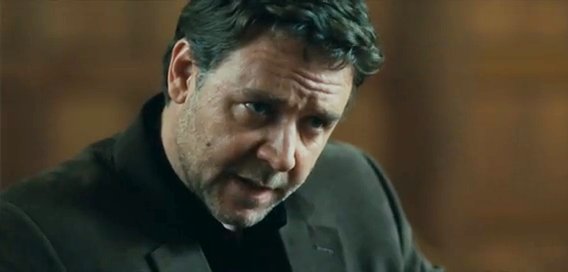
His third film, The Next Three Days, which he wrote and directed,** tells the story of a couple (with child) who are separated, when she (Elizabeth Banks) is arrested, tried and convicted for murder.  Her husband (Russell Crowe), a school teacher, exhausts their finances—selling two homes—and all legal recourses, trying to prove her innocence.  After three years of incarceration, her child doesn't even acknowledge her (having lived half his life without her), and after her last appeal is turned down, she attempts suicide.

Time to think outside the box...the legal system, and the penal system.  The civilized courses have failed...as a matter of course.  It's time to take action, and matters...into one's own hands.

In a way, this is the same movie Haggis has been making all along, his thesis converted into an action plot device more positive in its usage than negative in its omission.  Both Crash and In the Valley of Elah feature protagonists trying to do more than the expected by-the-book (or society) response, to subvert the easy knee-jerk "comfortable" reaction, and (I dunno) think a little deeper.  He seeks the help of a multi-prison escapee (Liam Neeson, in a too-short cameo), who gives him a broad picture of the strategies of going over the wall, and more importantly, staying out.  One of the first things he says may be what's written on the first page of Haggis' screenwriting notebook, as it informs so much of his work: "You have to do a lot of lookin'—things that disrupt the day-to-day routine."  That semi-somnambulent day-to-day routine has been the loam Haggis has toiled in over the years, and in this film, he finds a protagonist who tries to take advantage of it, rather than subvert it.*** 

It's a heist film, basically, with human valuables.  It is also, for a brief time, an "incredible mess" movie as Crowe's John Brennan must—painfully—learn the ropes of the outlaw life (and occasionally be beaten with them).  This pays off later in the film—well, nearly everything pays off later in the film—as the "anything that could go wrong" scenarios start piling up in the film's nerve-rattling desperate finale, and one remembers how those early efforts only served to make matters worse.  The barriers that Brennan must overcome are represented by a filming scheme that places so much of the film behind screens and windows of various opacities—a traditional trope of prison films (it just doesn't happen so much out in the so-called open, as it does in here—Haggis wants us to know there are traps inside and outside prison).

Great cast.  Crowe is nicely casual initially, then gradually turns into the ragged obsessive/compulsive he needs to be, Banks does drama as well as she does comedy (very), and, beyond Neeson, there are nice cameos by Daniel Stern, Olivia Wilde (as a divorcee...really?)...and particularly, Brian Dennehy, who, with the least amount of dialogue, makes the most of his scenes.

There will, no doubt, be an increase in interest in "bump"-keys, and breaking into vehicles with tennis-balls, and Haggis even throws a bone to his critics by purposely leaving a plot-thread frustratingly unresolved.  It's a good film, professionally done, and with enough twists and turns to keep one engaged, while still taking the time—one of the critical elements the film focusses on—to keep things realistic, and not turning the down-to-earth perps into clairvoyant superheroes.  I'd say it was a matinee if the scope reached a bit more, but, as it is...

The Next Three Days is a Rental.  A good one. 


* A decision I've always agreed with: I think Crash was reaching for something to say—especially about the 7-10 split of a city that is Los Angeles, and the casualness of racism as the easy way out.  Brokeback Mountain, although I admired its photography and I thought Heath Ledger had the best cowboy voice in movie history (great work, that—Jake Gyllenhaal, not so much) felt too much like a Joan Crawford movie in reverse-drag.  Mellerdrama at its sawdustiest.

** After Crash and In the Valley of Elah, The Next Three Days is not original—it is based on the French film Pour Elle (Anything for Her, 2008)


*** Even a late-minute extreme act by one of the protagonists is an expression of trying to break out of the routine, to think outside the box (or in this case, the van) and break the lock-step the other is in.

Tuesday, November 4, 2008

W.

"Somethin' 'Bout Bein' in the Barrel"

The Writer's Prejudice Up Front : I've never liked George W. Bush. He's the type of guy I'd like to sit down and have a beer with...thrown in his face. I've always considered him woefully unprepared to be President: a rich man's son who aspired downward; a dilletante who'd never had a successful business that his Dad's cronies didn't bail out; an oil-man, who excelled at digging dry holes; the most bald of hypocrites, pious when the microphone's on, but profane when they're off; who believed in sacrifice as long it was somebody else; possessed of the ethics of a snake-oil salesman, he'd made so many promises and held so many I.O.U.'s that putting him in charge of the Treasury was like putting Dracula in charge of the Blood Bank. Or as Maureen Dowd once famously wrote: "He's the guy who would rent a hotel room, and then ask you to the prom." One by one, Bush and his co-conspirators undermined every aspect of American life to the point where his own Administration, which contained so many of them, should be considered its own National Disaster. There isn't penance enough in this world to make up for the harm that this vain-glorious underachiever did. And once he leaves office, he'll go back to the only job he's had success at: Influence-peddling. Writing about him in the past tense is the only pleasure one can take in writing about him.

He is the Shame of our Nation.

Having said that, "So, Mrs. Lincoln...how'd you like the play?"

Oliver Stone is no one's idea of an objective film-maker, if there is such a thing. Once a screenwriter puts pen to paper, they've already started manipulating the movie to their point-of-view, whether it's from the left, right, center or upside-down (Why do you think they're called "directors?"). So, no one should be surprised that Stone has an axe to grind, with "W.".

Stone is a director of heart, but he frequently by-passes his brain when making his points. So, "
Platoon," still his best film, hi-jacks the gritty depiction of grunt jungle-fighting with Stone's own conflicted "Daddy" issues, his "Pvt. Chris Taylor" having to choose between two superiors with different moral ways of engaging the enemy. Lincoln and every fantasist depicting moral choice has put angels and devils on our shoulders. Stone burdens us with His Old Man. That same scenario was transferred to High Finance, with his very next film "Wall Street." I haven't seen every film of Stone's, but most of them are concerned, in some capacity, with paternal conflicts. And because he's a better propagandist than scenarist, most Stone films stop dead whenever we get to each Stone "thesis," invariably a Message being presented by a single character who has center-stage and our undivided attention. "JFK," a dazzling technical exercise of photography and editing, comes positively unglued in its presentation of conflicting conspiracy scenarios for Pres. Kennedy's assassination (Kennedy being another Stone father figure--"Our murdered King," as he's described in the screenplay--completely by-passing any thought that we might, you know, be living in a democracy with a representative government), until Kevin Costner's prosecutor Jim Garrison places in his summation a theory on military-industrial conspiracy behind the Vietnam War--a Stone obsession.* (In "W." Dick Cheney--Richard Dreyfuss clearly enjoys being given the opportunity to play him--stops an Iraq War strategy session to pontificate on securing Middle East interests for oil exploitation for a hundred years). Give the man points for passion, but his movies become such a glut of emotion that the point becomes lost in the gnashing of teeth and the wringing of hands. His bio-pic of "Nixon" was such a slap-dash affair, it seemed like a badly-cast TV-movie gloss-over, skipping from high-light to low-light in time to shoe-horn the next commercial (A weirdly fictional conversation between Chairman Mao and Nixon was Stone's show-stopper there). By the end, with its End-Credits playing over a Mormon Tabernacle Choir-rendition of "Shenandoah," one almost felt some sympathy for the man. Nixon, not Stone.

"
W." (his too-early summation of the second Bush Administration) suffers the same problems. It's a gloss of recent events, interspersed with flash-backs to the wastrel days of the young George W. Bush,** drunk with entitlement and just about anything else he could find. Particular heed is paid to his relationship with "Pappy" George H.W. Bush (James Cromwell, though he seems nothing like Bush the Elder, displays quiet bluster and submerged weakness), in which the good-for-nothing son is particularly eaten up, not by his own failures, but by his father's view of them.

The best part of the film--oddly for Stone--is Bush's conversion to The Faith. Struggling with his alcoholism, determined to become a Public Figure (as private industry success constantly eludes him), he is converted by Pastor Earl Hudd (
Stacy Keach, playing it straight, and doing some of the best work of his long career), introducing Bush to the second "Daddy," the Divine One, slotting this film into the standard Stone scenario. One knew, as soon as Bob Woodward revealed that Bush, prior to the invasion of Iraq, didn't consult his father/former President, but, instead, relied on the advice of a "Higher Father to appeal to," that Stone would obsess on it and exploit it. The film-maker takes the one relationship as far as it will go, creating a fantasy sequence where Bush 41 challenges Bush 43 to fisticuffs, but Stone doesn't have "the stones" to have W. duking it out with his Savior, J.C.


That battle's still to come.

Stone starts "W." with a Sergio Leone close-up of Bush's steely gaze, what impressionist Frank Caliendo says "like he's always got the sun in his eyes." It's another fantasy sequence, where W. acknowledges the cheers of an empty baseball stadium from center-field--what he'll later reveal as "his favorite place on Earth." The movie will end back on those eyes, searching, confused, disoriented--having lost a pop-fly "in the lights." Those distorted lights show up twice more in the movie--in that previously mentioned conversion scene, as well as when a hung-over Bush collapses while jogging. That's it? That's what we get? A half-assed light show? Is Stone saying he's abandoned by God, or that Bush is overwhelmed by his circumstances? The metaphor's too half-baked to communicate as solid concept clearly.

One could look at W.'s story in Shakespearean terms, as a modern day Prince Hal, whoring and wenching in his oats-sewing days to become the Monarch his father couldn't be. The difference is Hal had Falstaff as guide to the back-alleys of Agincourt. George W. Bush is his own King. And his own Fool.

But Oliver Stone is too busy making room for his "Daddy" theories to create a proper condemnation. As with "Nixon," you start to actually sympathize with the man. Any illumination into the man or the effect of his Administration is lost in the lights. To Stone, he is just another Yalie "poor little lamb who has lost his way."

Bah. Bah...and Bah.

"W." is a weak-kneed, squinty-eyed moron of a cable-watcher.


* Any judge would have gaveled the irrelevancy, but Stone's judge was played by the real-life Garrison.

**Josh Brolin does fine work, but the performance feels a bit "one-note," having to nail the too-familiar Bush mannerisms and vocal tendencies.