Showing posts with label Liam Neeson. Show all posts

Thursday, December 2, 2010

The Next Three Days

"Thinking Outside the Cell-Block"
or
"It Doesn't Matter What We Believe"

Director Paul Haggis you either love or you hate.  The haters find him manipulative and obvious (I'll buy the second charge, but movies, even documentaries, are—du-uh!—manipulative by their very nature) and will never forgive him for making Crash, which beat out Brokeback Mountain for the Best Picture Oscar.*  The lovers, well, there aren't too many of them outside the movie industry—but Clint Eastwood and the Bond producers love him, and that's good enough for me.

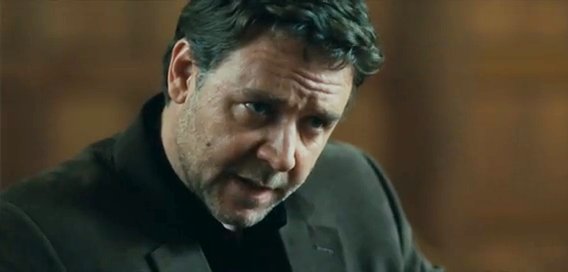
His third film, The Next Three Days, which he wrote and directed,** tells the story of a couple (with child) who are separated, when she (Elizabeth Banks) is arrested, tried and convicted for murder.  Her husband (Russell Crowe), a school teacher, exhausts their finances—selling two homes—and all legal recourses, trying to prove her innocence.  After three years of incarceration, her child doesn't even acknowledge her (having lived half his life without her), and after her last appeal is turned down, she attempts suicide.

Time to think outside the box...the legal system, and the penal system.  The civilized courses have failed...as a matter of course.  It's time to take action, and matters...into one's own hands.

In a way, this is the same movie Haggis has been making all along, his thesis converted into an action plot device more positive in its usage than negative in its omission.  Both Crash and In the Valley of Elah feature protagonists trying to do more than the expected by-the-book (or society) response, to subvert the easy knee-jerk "comfortable" reaction, and (I dunno) think a little deeper.  He seeks the help of a multi-prison escapee (Liam Neeson, in a too-short cameo), who gives him a broad picture of the strategies of going over the wall, and more importantly, staying out.  One of the first things he says may be what's written on the first page of Haggis' screenwriting notebook, as it informs so much of his work: "You have to do a lot of lookin'—things that disrupt the day-to-day routine."  That semi-somnambulent day-to-day routine has been the loam Haggis has toiled in over the years, and in this film, he finds a protagonist who tries to take advantage of it, rather than subvert it.*** 

It's a heist film, basically, with human valuables.  It is also, for a brief time, an "incredible mess" movie as Crowe's John Brennan must—painfully—learn the ropes of the outlaw life (and occasionally be beaten with them).  This pays off later in the film—well, nearly everything pays off later in the film—as the "anything that could go wrong" scenarios start piling up in the film's nerve-rattling desperate finale, and one remembers how those early efforts only served to make matters worse.  The barriers that Brennan must overcome are represented by a filming scheme that places so much of the film behind screens and windows of various opacities—a traditional trope of prison films (it just doesn't happen so much out in the so-called open, as it does in here—Haggis wants us to know there are traps inside and outside prison).

Great cast.  Crowe is nicely casual initially, then gradually turns into the ragged obsessive/compulsive he needs to be, Banks does drama as well as she does comedy (very), and, beyond Neeson, there are nice cameos by Daniel Stern, Olivia Wilde (as a divorcee...really?)...and particularly, Brian Dennehy, who, with the least amount of dialogue, makes the most of his scenes.

There will, no doubt, be an increase in interest in "bump"-keys, and breaking into vehicles with tennis-balls, and Haggis even throws a bone to his critics by purposely leaving a plot-thread frustratingly unresolved.  It's a good film, professionally done, and with enough twists and turns to keep one engaged, while still taking the time—one of the critical elements the film focusses on—to keep things realistic, and not turning the down-to-earth perps into clairvoyant superheroes.  I'd say it was a matinee if the scope reached a bit more, but, as it is...

The Next Three Days is a Rental.  A good one. 


* A decision I've always agreed with: I think Crash was reaching for something to say—especially about the 7-10 split of a city that is Los Angeles, and the casualness of racism as the easy way out.  Brokeback Mountain, although I admired its photography and I thought Heath Ledger had the best cowboy voice in movie history (great work, that—Jake Gyllenhaal, not so much) felt too much like a Joan Crawford movie in reverse-drag.  Mellerdrama at its sawdustiest.

** After Crash and In the Valley of Elah, The Next Three Days is not original—it is based on the French film Pour Elle (Anything for Her, 2008)


*** Even a late-minute extreme act by one of the protagonists is an expression of trying to break out of the routine, to think outside the box (or in this case, the van) and break the lock-step the other is in.

Tuesday, June 15, 2010

The A-Team (2010)

"Because Over-Kill is Underrated, My Friend"


I was never a huge fan of the TV version of "The A-Team," still in syndication around the country.  A male version of "Charlie's Angels," with a for-hire team of whack-job mercenaries (that the producers claimed was inspired by the odd-ball cops of "Hill Street Blues") it was a huge hit until it ran out of steam, cycling through the script-library of adventure shows—a kind of manic, cartoon hybrid of "The Rockford Files" and "Mission: Impossible."


Because the source material was rather poor, the news of a big-screen remake was not the sort that would make one hyper-anticipatory. Just the opposite; "The A-Team" sounded like a B-movie waiting to happen, perhaps even falling lower on the alphabetical scale if the creatives involved were as by-the-playbook as the series runners. 

Happily—giddily—the folks making "The A-Team" knew what worked with the old series and have amped it up to the nth degree, even occasionally throwing a TV-trope into the mix to show you they're not taking this too seriously.  It's not Great Cinema—I don't think I can justify paying big bucks seeing it in a theater—but in its looney-toon action sequences, it approaches the manic intensity of child's play with new toys.

It's a sugar-rush.

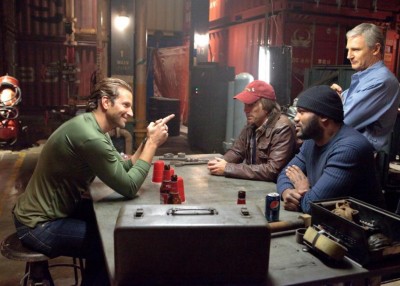
The old "A's" (Peppard, Benedict, T, and Schultz) were Viet-era grunts, but they've been re-boot-camped to the Persian Punch-Out (and Mr. Cheney says to leave the quagmire comparisons at the door, thanks, and he's got a gun).  But they're still the zany merc's they always were, with their complicated strategems, the MacGyver'd weapons, "you-can't-do-that-in-this-vehicle" stunts, and the "pity the fool."  The cast is shake-your-head-til-it-rattles good:  Liam Neeson, haggard and stogified, makes a great Col. "Hannibal" Smith—it's nice to see Neeson in something a little lighter, the man needs a break.  Bradley Cooper's "Face" has a perpetual shit-eating grin, and no dolby/no squelch for chatting people up (he's worked out and takes off his shirt a lot, ladies).  As John Milius said about Arnold Schwarzenegger, if Mr. T didn't exist, they would have to construct one, and they've done that, shoe-horning "Rampage" Jackson into the role.  Sadly, he doesn't have "T's" fire that smoulders during the drama scenes, but when required to turn it up to "11," Jackson comes through.  But, the curdled cream-of-the-corps is Sharlto Copley as "Howling Mad" Murdock.  Fans of the show loved the certified (and certifiable) pilot played by Dwight Schultz (bless 'im), but Copley (who played the harried Afrikanner middle-management hack in "District 9"—and you liked him in that), takes the role in his teeth and shakes it 'til it squeeks, flecks of mad-foam and scrambled accents flying in all directions.  Let this be noted in the ledger—he is going to be big.  He's that good.  He's that funny.  He's that creative, and this is him playing in the minors.  There are at least two "Batman" villains with his name on them.  Sharlto. Copley.  Learn to pronounce it.  You'll be using it a lot.

They could have put anybody else in this movie and it would be fine, but Patrick Wilson has a field-day with his ghost-in-the-CIA-machine, Agent Lynch.  Gerald McRaney (one of those TV-elements I talked about earlier) manages to rise above the material, and Jessica Biel rocks her wardrobe, plays the straight man, and nails the movie's best line (the laughter went for 30 seconds, I clocked it).

High praise.  Brownie points for that.  And the writers weren't lazy,* the special effects crews sloppily crafty—8 of them, but they spent more time on details and in-jokes than they do on photo-realism and I can respect that.  But the direction (by Joe Carnehan—remember when he was "the next big thing" with "Narc?") is a mess.  At one point, there's a heated conversation in a photo-booth between two people and you'd swear there was three.  There are odd shots during the mayhem that don't show much—and were obviously "C"-roll cameras—but are there, anyway.  And more than that, the cutting scheme assumes we're morons, flashing back to scenes we might have missed adjusting our drool-cup in case we missed "the point." 

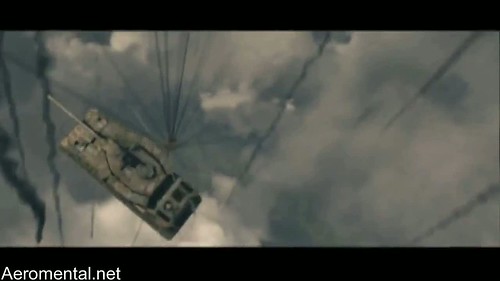
They needn't have bothered.  "The point," such as it is, is to keep sharpening before it gets dull, which the movie threatens to do at several points.  During the "drama," one gets the urge to get a Coke, hit the head, or text-message, until the next hyper-action sequence comes along, like the hysterical tank-bit, or the child's mayhem with a cargo-tanker, comes along.

It's entertaining.  And that's a gift.

But, like a sugar-high, it doesn't last, and makes one antsy for the next supply of "rush."

Isn't there a big-budget "Magnum: P-I" scheduled?


"The A-Team" is a Rental.

* Although you will think they were.  At one point, it will be obvious what is going on, and you will (I have faith in you) go "Wait a minute...that's..."—as every member of the audience I saw it with, did, and felt the need to say it aloud.  I'm going to give the writers credit and say it's another one of the TV-tropes I alluded to earlier—the "obvious switcheroo" that Your Aunt Jessye could figure out.


Saturday, April 17, 2010

Clash of the Titans

"There's a Saga Born Every Minute"
or
"Let's Get Krakken"


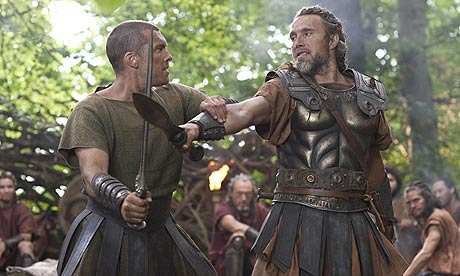
A new version of "Clash of the Titans" has opened—as if one was needed. The 1981 "Clash" is notable as being the last film in the storied career of stop-motion animator Ray Harryhausen,* the puppet-magician, who could trace his work-lineage back to Willis O'Brien, the legendary creator of "King Kong." Talk about "Titans." Those of us (of a certain age) think very kindly on the series of British films based on Myth, spear-headed by Harryhausen. Some of us might even get a little misty when we think of the battles staged frame-by-frame between the cinematic stalwarts and Harryhausen's skeletons and other slithering, skittering creatures.

In the cold light of the critical day, though, one has to admit that, aside from
Harryhausen's work (and some legendary scoring), the movies were a bit stiff dramatically (and not just in the upper-lip department), but they provided adolescent adventure, comely lasses, and were a Colossus' step up from "Hercules" movies.

Even the original "Clash of the Titans," although boasting a cast that contained a pantheon of British thesps on the order of
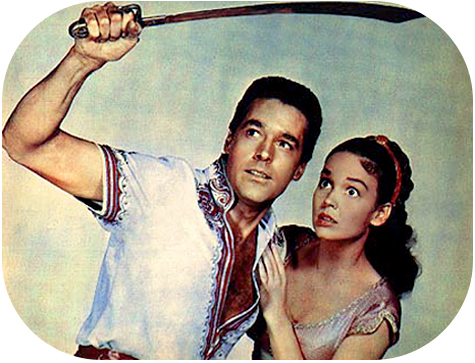
Lord Laurence Olivier, Maggie Smith, Ursula Andress, and Claire Bloom as Olympian Gods, (and Harry Hamlin, Judi Bowker and Burgess Meredith as mere mortals...or demi-gods), only manages to rise above for the camp-nature of the Brit-Theater vets' performances. Desmond Davis' direction is flat, with many vogueing shots of the hero Perseus brandishing his sword with just the right alignment to eclipse the sun, implying its gift-from-gods status. Not very convincing, nor was Judi Bowker as the damsel-in-distress.

This new version has been in development since the success of "
Gladiator," with many re-writers (including an uncredited Lawrence Kasdan) and directors. But it wasn't until French director Louis Leterrier ("The Transporter,""The Incredible Hulk") took it on that the movie emerged from Development Hades.

And it's surprisingly good. Oh, it's not anybody's idea of an inspired film, and there are moments where Letterier lets things fall flat (
the fight with three mystic crones and even the Big Finale fight with the Krakken are staged too frenetically so that important information gets lost in all the flailing). But there's a nifty fight with giant scorpions and a fight with the Medusa are nicely handled. In fact, they reveal a love of the original (and Harryhausen) that's endearing. That scorpion fight is staged among some strewn ruins that suggest Harryhausen's penchant for staging in proscenium-like settings with rubble for the poor flailing hero to appear to be doing something during filming. And even though it's a pixel-fest, there are winking nods to the 1981 version, and even a replication of the old master's stop-motion semi-stuttering movements.

Great cast, too, starting with the appearances of
Pete Postlethwaite and Elizabeth McGovern (where's she been?) as Persus' foster-parents. Liam Neeson plays Zeus (without any of Olivier's archness) and Ralph Fiennes has fun with his snakey performing of Hades. Sam Worthington plays Persus as a bit like a bland Russell Crowe, and Mads Mikkelsen (LeChiffre in "Casino Royale") does fine glowering work as an Argosian soldier who only smiles...once. Chief love interest is no longer Andromeda (played by Alexa Davalos, who's a dead-ringer for a brunette Katherine Heigl), but Io (the increasingly ubiquitous Gemma Arterton), cursed by the gods with immortality and, apparently, the tendency to be a buttinski with an all-knowing smile.

We can analyze this movie until it turns into a block of Quik-crete, but it delivers adventure tickles (one can't really say "thrills"), some nice character bits, and a regard for its original. It's a bit duller in color and flash than the first "Clash," but it does what it does for the most part very well.

Whether we needed another version is another question.

This "Clash of the Titans" was intended to be released "flat," but since "
Avatar" (the last movie Sam Worthington "sorta" performed in) received so much tribute, they hastily converted it to 3-D. There are the de rigeur spinning swords, swords poking at our noses, and—this is new—a skipping gold coin. But, as it wasn't designed for 3-D and it's an after-thought, let's call it "2 1/2 D." That, combined with the fact that most IMAX theaters in this country are not IMAX, and you have a lot of people paying extra money to not see what they think they're seeing—a 3-D movie in IMAX format. The tickets are far costlier, and "Clash of the Titans" was the top of the box-office the last couple of week-ends, so that tells me that there are a lot of people who don't know...and don't care that they're not getting what they think they're getting.

"Clash of the Titans" (2010) is a Rental.

* By the time of of the first "Titans," ILM had begun perfecting the go-motion system—Phil Tippett's way of introducing motion-blur to frame-by-frame filming, best seen in "Dragonslayer."

Friday, April 16, 2010

Chloe

"We Used to Do Everything Together"

Atom Egoyan's "Chloe" (based on the movie "Nathalie...") is a throwback to the '70's, and that cusp of movie-making history before cable began making the sexually-charged obsession films that used to draw folks into the cinemas. Take a theme of Hitchcockian prurience (including a bit of his fashion sense), slime it with some DePalma directness (without the use of power-tools) and spice it with just a pinch of Kubrickian cruelty and that's "Chloe."

Dr. Catherine Stewart* (
Julianne Moore) has a successful practice as a clinical OB/GYN—very clinical. "It's just the contraction of muscles," she informs a patient who's never had an orgasm. "There's nothing mysterious or magical about it."

In any Hitchcock thriller, such expert dismissal clamors for a cum-uppance.

Fact is, she's worried about her marriage to classical music scholar David (
Liam Neeson). There's not a lot of communication in it. For instance, she throws a surprise party for him, which he misses completely, when he fails to catch a shuttle from New York. Smartie, smartie has a party... She's hurt, embarrassed, vulnerable, and suspicious. David's evasiveness and a happened-upon text message lads her to suspect he's having an affair, despite his protestations (well, she can see him flirting with anything in a skirt!). The couple may be talking, but nobody's listening.

A chance encounter with student-aged escort Chloe Sweeney (Amanda Seyfried, all eyes and lips) gives her an idea; she hires the young hooker to flirt with David—just to see what happens (just to confirm what she suspects in her mind). "What's the client's name?" asks the girl. "He's not the client," the doctor orders.

Of course not. That would imply somebody else has control. The situation is about her, willing to tempt fate
to tempt her husband, and make concrete her suspicions. An arranged casual meeting at lunch confirms her fears—David is interested in the girl. Very interested.

This creates a series of triangulations that are liable to hurt somebody with its knife-like edges. The issues become the usual ones in sexual politics:
who's in control, what's the motivation, what's the risk, who has the headache.

This would be a great deal of fun if it was more...fun. For all the frank-talk and
the abundant nudity on the part of Seyfried and Moore, especially in a girl-on-girl love-making sequence—this movie will be remembered only on the pages of "Mr. Skin"—little is left to the imagination. And imagination is what the film is all about...or should be. In her voice-over, young Chloe boasts that she is skilled enough to become "your living, breathing...unflinching dream." It's an example of how the screenplay is clever with its words and quite precise in its usage. But it has no wit. It takes everything so seriously to the point of ludicrousness, and can't even laugh at its own contrary prudishness. It's like a partner more concerned in acting the part in their performance than with the act itself. It's not fun. Kinky for awhile, but not fun.

Some of Hitchcock's naughty sense of humor would be nice, even some of his comic mother issues,
as opposed to the earnestly oppressive ones here, would have been fine. Hell, I wouldn't have minded a power-tool or two—just something a little over the top, or off of it. Something that might make it a shade more ironic, iconic or comic. It shouldn't be such a conscientiously cautionary tale. What fun is that?

Ultimately, "Chloe" is simply cloying. As disappointing and tasking as a bad date.

"Chloe" is a Rental.

* Stewart. Get it?

Tuesday, April 21, 2009

Taken

"Spare the Rod and Spoil the Child"

Writers Luc Besson (Leon the Professional, La Femme Nikita, The Fifth Element) and Robert Mark Kamen ("The Karate Kid" movies, Lethal Weapon 3, the "Transporter" movies) have the formula down:

Half-hour of Set-up
Quick criminal act (under five minutes) with Hero-Vow
3/4 hour or so of Investigation with Random Acts of Carnage
10 minute Final Battle
5 minute Resolution

Stir lightly over a medium heat with 4 cups of adrenaline and a teaspooon of sugar.

Your basic fomulaic action movie.
Besson doesn't even need to direct anymore (He's off trying to conquer the kid-movie market with his "Arthur" films—three of them in the works.)
His stylized action sequences (dubbed by fussy French critics as "Cinéma du look") with slo-mo shots and "Billy Quan" angles have been replaced with zippy-quick sequences with an average shot length of half a second that the second unit can do, with picked-up insert shots of the star later on (there merely has to be a suggestion of the actor in these sequences, which are mostly demolition-derby car chases and on-the-run fire-fights with legions of stunt-men). For this film, "Transporter" cinematographer Pierre Morel directs, but it could be anybody in the production pipeline.

The thread that ties this all together is Ex-CIA merc' Bryan Mills (
Liam Neeson, subbing for Harrison Ford) and his love for his 17 year-old daughter Kim (Maggie Grace from "Lost"). His CIA years doing wet-work ("I was a preventer, not a spy") devastated his family, and now he's making up for lost time by "being there" for his daughter. But old habits die hard. He's called "Mr. Attention-To-Detail:" he meticulously wraps birthday presents, he checks the exits of every room he walks into, he can hot-wire a car (or an informant), and can find the soft tissue on anybody—he favors neck punches, but will go for the kidneys if he wants you to talk.


Against his better judgement, he caves into the tender lip-curling and snarling of his ex-wife (Famke Janssen) and lets his under-age daughter fly to Paris with a friend where (within minutes) she is kidnapped and thrown into a white-slavery ring. Mills (who has provided an international cell-phone with a speed-dial to him), hears the whole thing go down, and with the financial aid of Kim's step-dad (Xander Berkeley, who you can't hate because he took the nuke-plane down in "24" ), and his old contacts in the CIA and the French police, goes to Paris where he proceeds to (as his French contact discretely says) "make a mess." That includes shooting the guy's wife ("It's just a flesh-wound") to get information out of him. And after she made dinner for him and all. Talk about practicing tough love!

One of his CIA buddies tells him he has a ninety-six hour window to find his daughter (In Germany the film is called "96 Hours"), and dang, if that's not precisely correct, ending with a shoot-out in tight quarters on a floating pleasure-boat for a
Nero-like sheikh heading down the river Seine. Brat-atat-Bang-Bang and you're out. Feel-Good coda. Credits. Head for the Exits. The Movie dissolves from your mind.

Liam Neeson's presence and the substitution of sentiment instead of mission, are the only things that distinguish it, but other than that...pfft!

There's a sequel in the works, to which the only logical reponse is: "Why?"

Because this cast-off from France made in 2007 and released in the U.S. a year later was No. 1 at the box office for one weekend, that's why.

"Taken" is charitably a cable-watcher.

I went to see this at "The Big Picture" in Redmond, a fine example of "Cinema du Look" exemplifying style over substance where they sit you in very plush comfy chairs and you have the choice to order alcoholic libations, which, frankly, makes "Taken" a better film than it is. I had a Mac and Jac's, but I'd suggest something stronger for this one: something mind-numbing.

Monday, May 26, 2008

The Chronicles of Narnia: Prince Caspian

The Chronicles of Narnia: Prince Caspian, (Adamson, 2008)

One of the best things about this movie remains what was best about its predecessor (The Lion, the Witch and the Wardrobe) - the four actors* who play the Pevensie children when they are playing children. Even though some of the dialog has been so modernized that you expect them to say things like 'Bite me', they play against and off each other as if they are real-life siblings. Less successful is when they take up their roles as the Kings and Queens of Narnia though we might be able to blame the source material for this. As book four** in the seven-volume saga, PC is another thinly-disguised allegory that desperately needs covering up.

The good news is we get less of the pontificating Aslan (Liam Neeson, voice) in this one, the bad news is that we don't get enough of Queen Jadis, the White Witch (Tilda Swinton). Instead our villains are the Telmarines, portrayed here as a Balkan people (somewhat confusingly, as in the book and here, they are said to be descended from pirates from the South Seas) who fall through a gap between our world and the land of Narnia. They are led by the Lord Protector, Miraz, (Sergio Casttellitto) who having killed his brother, King Caspian IX, is about to do the same for his nephew, also named Caspian (Ben Barnes).

The young prince escapes taking with him a magic horn with which he summons the help of the four Kings and Queens of the ancient realm of Narnia, long since under the thrall of the Telmarines. The horn does indeed summon the four Pevensie children though it is over 1000 years since their rule. Not only that but they come back to Narnia only a year older than their first visit.

Like its predecessor too, at its heart is a battle: here, the confrontation of the vastly superior Telmarine forces and the Narnian army. It does not seem long ago that we were treated to the novelty of CGI-created battle scenes; now, they are beginning to get old very quickly. Note to director: the beaver is better this time but the mouse is far, far too cute even for C.S. Lewis.

*William Moseley (as Peter); Anna Popplewell (as Susan); Skandar Keynes (as Edmund); Georgie Henley (as Lucy)

The Chronicles of Narnia: Prince Caspian is a matinee.


** Prince Caspian was the second of the Narnia books to be published but fourth chronologically. TLTL&TW was the first to be published but the second chronologically. There is still disagreement among readers and publishers as to a 'correct' order to read the books as Lewis did not set out to write a seven-volume series. He has been quoted as agreeing with those that think the books should be read chronologically but there are others who claim that this destroys the narrative sequence of the books.

Sunday, April 27, 2008

Batman Begins


"Batman Begins" (Christopher Nolan, 2005) There is the good Batman and the bad Batman; in Batman Begins we are invited to understand why our superhero (Christian Bale) is the conflicted fellow that he is, and how he transforms himself into the man in the mask, the superhero without super powers, a truly human avenger. Apparently, because this is a Christopher Nolan movie and everything has to be a little more complicated than necessary, it is not only because our hero was traumatized by witnessing his parents' death but also because Bruce, a timid little fellow as a child, grew up with a fear of bats after a nasty experience down a well, said phobia later leading to the family leaving the theater on that fateful night. Because he gets involved with the League of Shadows, ninja vigilantes who apparently have been responsible for cleansing the world of evil since the sack of Rome. See, I told you Nolan was nothing if not complicated. You can almost hear Jagger singing 'Sympathy for the Devil' at one point as Henri Ducard (Liam Neeson) ticks off the number of cities he has laid waste to in the name of justice. In this world where there is a fine and dotted line between good and evil, the League both save Wayne and become his nemeses.

Wayne's first reaction to the death of his parents is to seek vengeance in particular on their killer, an act he is only deprived of by the intervention of the crime boss of the city (Tom Wilkinson) who will, of course, figure in the story later on as will the corrupt chairman of Wayne Enterprises (Rutger Hauer) both of whom working for, you guessed it, for Henri Ducard. Another conflict for Bruce - the money he relies on to fund his crime-fighting comes from the profits of a company working for the bad guys.

The movie's relationship with technology seems off-kilter too - one of the better things about this telling of the tale is seeing the development of the character; Wayne is feeling his way into the role, experimenting with the suit and the iconography. He is aided by Lucius Fox (Morgan Freeman) playing a kind of Q figure as well as by the ever-faithful Alfred (Michael Caine). Yet, in the denouement, it is all so crash bang slick. We see little of the man himself other than jump-cut fight sequences or high-speed chases as he zooms around in his high-tech Hummer-style car that looks more like a bug than a bat.

Did I mention there was a love story too? The young Wayne has a playmate, the daughter of we assume the housekeeper of Wayne Mansion who grows up to be a D.A. (Katie Holmes) - one of the only incorruptibles left in the city. So just in case we don't get the moral dilemma of Bruce Wayne's double identity, she is here to make sure we do. How can he reveal his love and his true identity when he needs to play the role of callous playboy to protect those he loves? Even though it is a refreshing take on the Dark Knight after the Burton/Schumacher franchise, in many ways, Spider-man just did it better.

Monday, April 14, 2008

Kinsey

"Kinsey" (Bill Condon, 2004) Bill Condon's film of the life and work of Alfred Kinsey, whose scientific study of sexuality in America was the literary equivalent of playing "Doctor" in the '50's ("I'll read yours, if you'll read mine") is a cogent little gloss of the subject which still manages to tell an intriguing and controversial story, while addressing something Kinsey and his researches never did--that of morality, and "feelings." Treating sex as a clinical study wasn't so easy a proposition, as Kinsey, his wife, co-workers and the Rockefeller Foundation that funded him, found out. Condon films the movie in a series of boxes--safe little containers to hold the forbidden fruit. It's when Kinsey is outdoors that he feels the most free. Put him in a rotunda, he's in trouble. What started out as a cold and clinical study by his group soon affects the lives of his researchers, and, when the results are published, the rest of the country. Condon (who wrote the screenplay) starts the movie as a training exercise, grilling his survey-takers (Peter Sarsgaard, Timothy Hutton and Chris O'Donnell--great cast, with Liam Neeson and Laura Linney, playing Kinsey and wife, being very fine) on their approach, their manner, and their reactions to answers as a test subject--neatly introducing the back-story. There's one box that Kinsey won't consider--Pandora's--and he and his staff are only too willing to dive into it--experimentally, of course, in the name of Science--only to find the damage that it can cause. The libido and the psyche are two compoletely different things, and the film almost makes a case for restraint in sexual matters, for all the damage it can do. An interesting consideration, that. One wonders how amused Kinsey would be by the irony.

The other thing that's interesting is that when writing a review of the film, there's no way that you can write it without filling it with unintended double entendres (said the Actress to the Bishop).

Saturday, March 15, 2008

Love, Actually

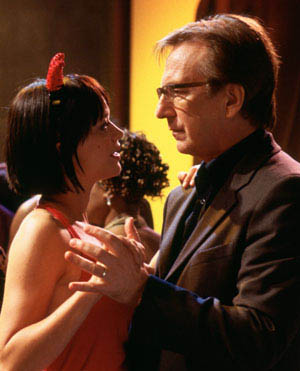
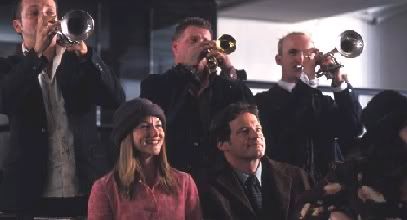
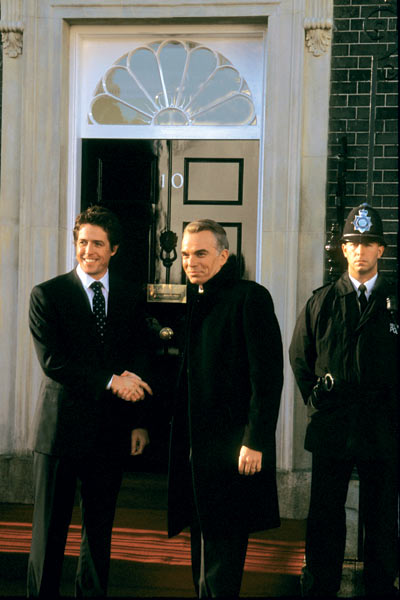
"Love Actually" (Richard Curtis, 2005) Curtis went from being the author of "Blackadder" and "Mr. Bean" to something of a Master of Chick-Movies after "Four Weddings and a Funeral" and "Notting Hill." "Love Actually" was his stretching of his formula to "Babel"/"Crash"-like proportions. It's just "La Ronde" but with more coincidences and slop-over of story that the result is soon you cease to care who knows who. As such, its tough to make a precise calculation of how many stories there are. There's the guy (Colin Firth) who after a break-up goes to Provence and falls in love with his Portugese housekeeper. He knows the couple who meet "cute" as lighting stand-ins for a porno film. There's the recent widower (Liam Neeson) whose son has a secret. He's friends with the wife (Emma Thompson) of an ad exec (Alan Rickman) and she happens to be the sister of the new Prime Minister (Hugh Grant) who has a crush on one of his staff, who happens to live next door to the secretary in love with the ad exec, whose employee (Laura Linney) has a not-so-secret crush on another ad-person, and that leaves out newleyweds Keira Knightly and Chiwetel Olojiofor, whose best man has a crush on...and on and on...England seems like a mighty small island, and everyone wants to get into everybody's else's knickers, literally or figuratively. It's surrounded by the story of a faded--make that acid-washed--rock-star (Bill Nighy, brilliant) staggering somewhere between Robert Palmer and Keith Richard, who has recorded a crappy Christmas version of "Love is All Around Me," which, for some reason, catches on. Plus, there are cameos by Billy Bob Thorton, Claudia Schiffer, Rowan Atkinson--basically anyone who wasn't needed on the sets of "The Lord of the Rings" or the "Harry Potter" films. The stories are happy, sad, contrived, bittersweet, tragic and occasionally prurient with quite a bit of gratudity. Neeson is as loose as he's ever been in a movie (he has the best line), matching Grant for light-comedy skills, Linney is charming and has the best laugh-out-loud moment, and its great to see Rickman and Thompson together again. It's a pleasant diversion, smartly written with the various stories achieving varying degrees of success.

Tuesday, January 22, 2008

The Chronicles of Narnia: The Lion, the Witch and the Wardrobe

The Chronicles of Narnia: The Lion, the Witch and the Wardrobe (Adamson, 2005) Just enough inspiration to be enjoyable. If there wasn't, this would be a stiff "Lord of the Rings" wannabe with children, rather than Orcs. It's a breezy summation of C.S. Lewis' first classic for kids, and though it was sold as a Christian film to gather the flocks who flocked to "The Passion of the Christ," it comes across as less than inspirational. Some fine special effects, it ultimately comes down to a battle movie, which seems odd. Tilda Swinton makes a great evil Queen, and Liam Neeson voices the Lion of the title with the same gravitas he used with Qui-Gon Jinn In "Episode I." That's not necessarily a good thing.

Ultimately, "Narnia" is a good bench-mark for determining how advanced CGI effects are. At this point, it would seem that we're good on polar bears, centaurs, wolves and lions. Not so much with beavers. But as there are seven books in all in Lewis' series, I suppose there's time to get it right.