"Every Picture Tells a Story, Don't It?
or
"Framing the Argument"
Anyone who tries to do something new in films should be applauded, no doubt about it. But one should not come away from the experience calling to mind other films and experiences—then you merely get the sound of one hand clapping. Or the white-noise bustle of a disinterestedly browsing museum-crowd (with which the film begins and ends).
Not that film-maker Lech Majewski didn't try something new. His new film The Mill and the Cross takes as its subject matter Flemish painter Peter Brueghel's painting "The Way to Calvary," and constructs the scenario inside the painting, with the artist (played by Rutger Hauer) and his patron (Michael York) walking through the painting as the artist sketches, puts it all together in his mind and takes it to completion.
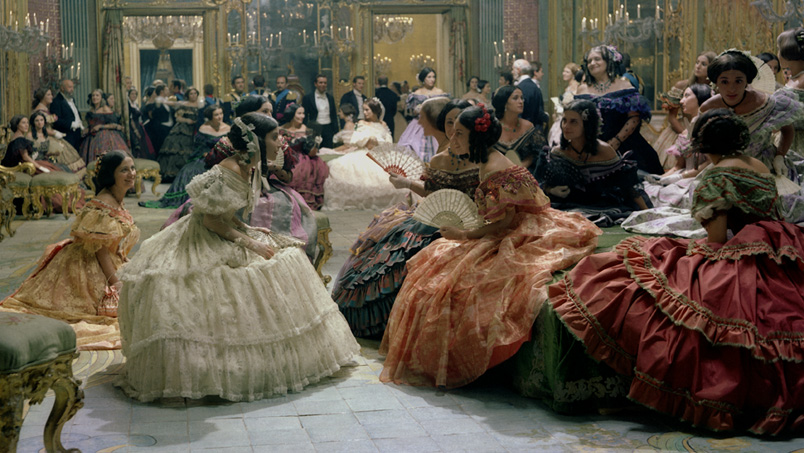
Films are, themselves, like paintings, if you can go with the analogy—both are contained in frames and there is the implied understanding that those frames are the limitations of our vision, that maybe without the frame they might go on to dimensions of breadth or depth and that what we see is the scope of the artists' vision, directing us to what is important, the focal point of the subject matter. Some of the most gorgeous films I've seen, like Barry Lyndon or The Leopard, inspire a wish to merely hang images from them on my wall.
No such thoughts crept to mind during The Mill and the Cross, as ingeniously as Majewski endeavored to bring the many facets of "The Way to Calvary" to life. Rather than having any "life" to it, it feels like a passionless exercise, the characters impenetrable cyphers, meandering around trying to "inspire" the moment of the painting (which holds far more activity than the film seems to want to evoke). All those new ideas are solely in the design and conceptual stage and not in the actual realization of the film. Pretty much limited to sets and blue screen, there is a flatness of tone that sometimes occurs when actors are restricted to surroundings that are uninspiring. And even with the technical wizardry required to pull it off, there is a tendency for the actors to appear visually separated from their backgrounds (as if the lighting were off) in the same way that the blue-screened citizens of Tokyo seemed like they were never in danger of being trampled by Godzilla.
But, it's not only technically that the movie falls...as flat as a canvas. There's a paucity of dialogue for any of the characters, so that their motivations and actions are completely unclear. Things happen, people are tortured, bread is baked, Christ is crucified—then what that's over, everybody gets up and dances away like the fools at the end of The Seventh Seal, but without Death leading the way. It is, after all, only a painting (no one was killed in the making of this picture, all the subjects got up and went home).
Besides The Seventh Seal, The Mill and the Cross also reminded me of a graphic novel that I've long admired, Neil Gaiman's "Signal to Noise,"* in which a dying film-maker decides to make his one last epic, a project that he knows will never be put to celluloid. And so, because it remains in script-form, it will be as close to his original vision without the compromises of budget or time...or collaboration. It is as pure as it can be, only susceptible to the impressions it forms in the reader's mind. In a sense, all the barriers—technical, budgetary and time—that must be overcome from written word to image on film or video are opportunities for compromise that can erode that concept from its inception as inspiration to its final presentation. In attempting to get below the paint of "The Way to Calvary," Majewski, rather than explaining, expanding, and presenting the process of the artist and the "life" of the art only gets further afield of the source in an intellectually safe, shallow interpretation. We get the surface and never the depth of the characters that he presents, and so, The Mill and the Cross is an exercise of adaptation—just as a film-maker adapts the written word (a novel, say, and part of Majewski's source for the film is Michael Francis Gibson's analysis of the painting)—that fails. The only thing unique and laudatory about it is that it attempts to "realize" another medium. But the result—technically savvy but paper-thin—makes it a kindred spirit with so many of the current CGI blockbusters—an art-house version of a "Transformers" movie.
The Mill and the Cross is a Rental (but, frankly, I'd rather go back to Vienna to the Kunsthistorisches Museum and see the original—with my own eyes).
 |
| "The Way to Calvary"—far more interesting than the movie |
* In pre-digital audio terms, "signal to noise" is the ratio of pure program sound to static or interference inherent in the analog medium on which it is imprinted. It is a measure of signal quality, a meter (if you will) for perfection, which Gaiman then ascribed to purity of vision).