Showing posts with label Charlotte Rampling. Show all posts

Saturday, November 26, 2011

The Mill and the Cross

"Every Picture Tells a Story, Don't It?
or
"Framing the Argument"

Anyone who tries to do something new in films should be applauded, no doubt about it.  But one should not come away from the experience calling to mind other films and experiences—then you merely get the sound of one hand clapping.  Or the white-noise bustle of a disinterestedly browsing museum-crowd (with which the film begins and ends).

Not that film-maker Lech Majewski didn't try something new.  His new film The Mill and the Cross takes as its subject matter Flemish painter Peter Brueghel's painting "The Way to Calvary," and constructs the scenario inside the painting, with the artist (played by Rutger Hauer) and his patron (Michael York) walking through the painting as the artist sketches, puts it all together in his mind and takes it to completion.

Films are, themselves, like paintings, if you can go with the analogy—both are contained in frames and there is the implied understanding that those frames are the limitations of our vision, that maybe without the frame they might go on to dimensions of breadth or depth and that what we see is the scope of the artists' vision, directing us to what is important, the focal point of the subject matter.  Some of the most gorgeous films I've seen, like Barry Lyndon or The Leopard, inspire a wish to merely hang images from them on my wall. 

No such thoughts crept to mind during The Mill and the Cross, as ingeniously as Majewski endeavored to bring the many facets of "The Way to Calvary" to life.  Rather than having any "life" to it, it feels like a passionless exercise, the characters impenetrable cyphers, meandering around trying to "inspire" the moment of the painting (which holds far more activity than the film seems to want to evoke).  All those new ideas are solely in the design and conceptual stage and not in the actual realization of the film.  Pretty much limited to sets and blue screen, there is a flatness of tone that sometimes occurs when actors are restricted to surroundings that are uninspiringAnd even with the technical wizardry required to pull it off, there is a tendency for the actors to appear visually separated from their backgrounds (as if the lighting were off) in the same way that the blue-screened citizens of Tokyo seemed like they were never in danger of being trampled by Godzilla.

But, it's not only technically that the movie falls...as flat as a canvas.  There's a paucity of dialogue for any of the characters, so that their motivations and actions are completely unclear.  Things happen, people are tortured, bread is baked, Christ is crucified—then what that's over, everybody gets up and dances away like the fools at the end of The Seventh Seal, but without Death leading the way.  It is, after all, only a painting (no one was killed in the making of this picture, all the subjects got up and went home).

Besides The Seventh Seal, The Mill and the Cross also reminded me of a graphic novel that I've long admired, Neil Gaiman's "Signal to Noise,"* in which a dying film-maker decides to make his one last epic, a project that he knows will never be put to celluloid.  And so, because it remains in script-form, it will be as close to his original vision without the compromises of budget or time...or collaboration.  It is as pure as it can be, only susceptible to the impressions it forms in the reader's mind.  In a sense, all the barriers—technical, budgetary and time—that must be overcome from written word to image on film or video are opportunities for compromise that can erode that concept from its inception as inspiration to its final presentation.  In attempting to get below the paint of "The Way to Calvary," Majewski, rather than explaining, expanding, and presenting the process of the artist and the "life" of the art only gets further afield of the source in an intellectually safe, shallow interpretation.  We get the surface and never the depth of the characters that he presents, and so, The Mill and the Cross is an exercise of adaptation—just as a film-maker adapts the written word (a novel, say, and part of Majewski's source for the film is Michael Francis Gibson's analysis of the painting)—that fails.  The only thing unique and laudatory about it is that it attempts to "realize" another medium.  But the result—technically savvy but paper-thin—makes it a kindred spirit with so many of the current CGI blockbusters—an art-house version of a "Transformers" movie.

The Mill and the Cross is a Rental (but, frankly, I'd rather go back to Vienna to the Kunsthistorisches Museum and see the original—with my own eyes).


"The Way to Calvary"—far more interesting than the movie


* In pre-digital audio terms, "signal to noise" is the ratio of pure program sound to static or interference inherent in the analog medium on which it is imprinted.  It is a measure of signal quality, a meter (if you will) for perfection, which Gaiman then ascribed to purity of vision).

Saturday, August 16, 2008

Olde Review: Farewell, My Lovely

Written Nov. 25, 1975

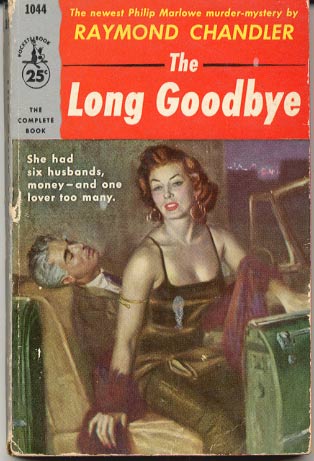
"Farewell, My Lovely" (Dick Richards, 1975) This summer I became acquainted with my first Raymond Chandler novel (I'm a late bloomer). It was an old copy, tattered and falling apart with an honest-to-god-"Genuine Pocket Book" pulp cover on it (barely), of "The Long Goodbye." A lovely thing to read--entertainingly, slickly written. The magic of the gutter just kind of spills out of it.

Now,Howard Hawks made a great Marlowe picture, with Humphrey Bogart, but Bogart naturally talks like Chandler writes(people don't talk like Bogart--his emphases come in the oddest places).* Robert Mitchum talks like ol' Bob Mitchum, and though he'll put in some "Bogartian" inflections of his gravelly voice, there's still a lot of wrong with him.

Dick Richards is not one of my favorite directors. His "Rafferty and the Gold-Dust Twins," though occasionally gratifying was highly episodic, strung together and rather poorly paced (maybe I just don't like "road pictures," but then why did I like "Harry and Tonto" and "Alice Doesn't Live here Anymore?"). His adaptation of "Farewell, My Lovely" doesn't fare to well, either. It's sleazy where it wants to be gritty, and slightly hysterical when it wants to be tough. It's warmed-over Chandler with nothing that can revitalize the plot plagiarized and bastardized by so many rotten tv detective shows.** "Chinatown" had an evil "plot" idea that I've seen before on these same detective shows, yet "Chinatown" burned with Polanski's perversity, so that you didn't care. "Farewell, My Lovely" is beautifully photographed (that title sequence with Los Angeles burned up in yellows and reds blurring on the street is just beautiful--can't tell a book, etc.) But it's just another movie that tried to cash in on another film's appeal and wasted its own potential. "No way has been invented yet to say good-bye to them."

"Farewell, My Lovely" was the second time Chandler's novel had been adapted as an official Philip Marlowe movie. The first was 1944's "Murder, My Sweet" starring singing, dancing Dick Powell (who also played Marlowe in a television adaptation of "The Long Goodbye") Other Marlowe's, besides the best-remembered Bogart, are the Montgomery's, Robert and George, James Garner and Elliott Gould. Philip Carey, Danny Glover and the very fine Powers Boothe played him on tv. Mitchum, 30, even 20 years earlier, would have been a great Marlowe, but in 1975, he was just a bit too old and paunchy to be playing Chandler's L.A. shamus. It's a great cast though, with Charlotte Rampling, Sylvia Miles, John Ireland, Harry Dean Stanton, Anthony Zerbe--even a pre-"Rocky" Sylverster Stallone. And they got the ambience right, with Marlowe's attention being diverted from the case by DiMaggio's hitting streak in 1941--the book was released in 1940, but why quibble? It was still pre-war. They did far better than Michael Winner's version of "The Big Sleep"--set in London in 1978.

And David Shire's trumpet-dominated score could notch comfortably behind any detective story.

* And one can say that people don't talk like Chandler writes!


** And had been used starting as early as 1942, evidently, in a George Sanders B-movie called "The Falcon Takes Over." Chandler's "The High Window" was adapted as "Time To Kill" for the Lloyd Nolan "Michael Shayne, Private Detective" movie series (and again in 1947 as "The Brasher Doubloon").

Tuesday, August 5, 2008

Olde Review: Zardoz

This was part of a series of reviews of the ASUW Film series back in the '70's. Except for some punctuation, I haven't changed anything from the way it was presented, giving the kid I was back in the '70's a bit of a break. Any stray thoughts and updates I've included with the inevitable asterisked post-scripts.

This Saturday's ASUW films in 130 Kane are John Boorman's "Zardoz" and Brian DePalma's "The Phantom of the Paradise"

"Zardoz" (John Boorman, 1974)

"Zardoz speaks to you, his chosen ones:
You have been raised up from brutality, to kill the brutals who multiply and are legion. To this end, Zardoz, your God, gave you the gift of the gun"

Ooooo-kay! That little snippet from "Zardoz's" soundtrack* is a perfect example of what is right, and what is wrong with the film.

What we see during that resounding speech is a huge stone god-head floating over lush grass-lands while chanting subjects on horseback an on foot gaze, entranced by it. And it's a beautiful shot--nicely framed, beautifully photographed--even the special effect in the shot is nearly invisible. The sound is nice. The music, mostly the second movement of Beethoven's seventh symphony, is perfectly suited to this movie.

But the words emanating from that nicely modulated voice are really silly.

And so, in a nut-shell, there is "Zardoz"--due to the great abilities of its director John Boorman, whose previous film was "Deliverance" ** (and who is currently working on "The Heretic: Exorcist Part II"),*** it is a beautiful film to look at and listen to, but it is ultimately a very silly movie.

Maybe the script isn't too important. It is possible to ignore it when Boorman is communicating mood through his magnificent images and stately music. It is in the moments of pure image and music that "Zardoz" achieves the kind of epic stature that Boorman obviously wanted. And it is fun while the inspiration lasts, which is about half-way through it. It's about this time that the audience will wonder how in hell the damned thing is going to end. It's obvious by seeing the ending that Boorman wondered himself, and couldn't come up with anything other than a cop-out. Well, all I can say is enjoy what you see--it's quite fantastic. Try to ignore the plot.

And once and for all, maybe you should re-appraise your view of Sean Connery as an actor. It is "Zardoz" that slowly eased him out of the James Bond stereotype he had been mired in for so long, and into his current stream of swashbuckling roles, and in the very difficult role of Zed, the pivotal role of the film, Connery is nothing short of perfect. And so, "Zardoz" is a mixed bag of fine acting, the beautiful image and the hackneyed script.

Broadcast on KCMU-FM on November 5th and 6th, 1975

Um.....maybe the beautiful image. It's hard to say that Connery was doing stellar work running around in thigh-high boots and a red diaper (see below), spouting inane dialog, albeit opposite Charlotte Rampling. Truth of the matter is "Zardoz" is what Boorman made when he wasn't allowed to make "The Lord of the Rings," and Connery played Zed after Burt Reynolds, who was cast, (wisely) bowed out. "Zardoz" is just a stoopid, pretentious fantasy wanna-be, that keeps you guessing about where all this stuff came from--and when it's revealed to be an extremely simplistic (silly) conceit, you want to walk out. It all ends with one of those teen-pleasing Riots Against Authority that were popular "in the day," and sort of sputters to an ending of sorts. It's just a bad, bad film.

So was "The Heretic." Incredibly, someone gave Boorman money to make another film, and though it veers awfully close to the same sort of sophomoric kookiness of it predecessors, his film of "Excalibur" was a stylistic triumph for the director. It's a good thing, too. John Boorman is a fine director, when he has good material (which he can write, as well).

Connery was just coming into his own as his own actor away from
007, with good work in "Murder on the Orient Express," and "The Wind and the Lion." His best work was still ahead. "The Man Who Would be King" would open five weeks after this review was written.


* These reviews were accompanied by sound-clips or music from each of the films. This one started with that pretentious quote. FCC rules kept me from continuing it. Wanna read it? (Well, don't say I didn't warn ya...) "The gun is good. The penis is evil. The penis shoots seeds, and makes new life to poison the Earth with a plague of men, as once it was, but the gun shoots death, and purifies the Earth of the filth of brutals. Go forth . . . and kill!"

** Need to do a review of "Deliverance" one of these days. That is a great film.

*** Well, we won't bring that one up, only to say that Boorman got much better about the subject matter of his films.


Okay--Connery didn't want to play "Gandalf" because
he didn't understand "The Lord of the Rings"--but he understood this??
Total Film magazine rated Connery's costume at number one of "the dumbest decisions in movie history" in 2004.