Showing posts with label 1975. Show all posts

Saturday, May 1, 2010

Tommy

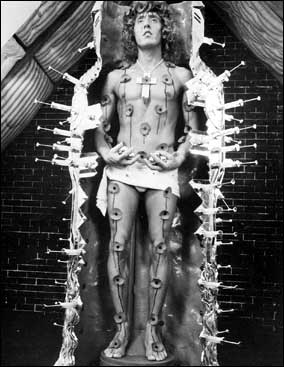
"Tommy" (Ken Russell, 1975) There have been bad rock and roll movies—really bad ones. But the genre seemed to hit its peak during the glitzy, gay disco-days of the 1970's. "The kids"—and Robert Stigwood—were making hits (and lots of money) from movies like "Saturday Night Fever" and "Grease." But even more, the companies putting out the soundtracks filled with movie-hits were making a wind-fall. There was a subsequent crush of rock-movies with double-album soundtracks hitting theaters and stores and amidst that groundswell were such gems as the Barbra Streisand "A Star is Born," "Can't Stop the Music," "Sgt. Pepper's Lonely Hearts Club Band"—starring The Bee Gees and Peter Frampton—but ahead of the pack was this bloated and excessive refutation of all things revolutionary in rock n' roll—"Tommy."

Pete Townsend and The Who's "rock-opera" (though it doesn't follow strict form requirements) barely held together as an album, but it was a fine conceit. And where there's conceit, there is Hollywood.

An excessive film,
during an excessive time in Hollywood. This scattered and episodic movie actually has more in common with the episodic "Broadway Melody" revue films of the 30's and 40's—guest-stars are trotted out (Eric Clapton, Elton John, Tina Turner, Jack Nicholson) for one song, then they are shipped off, never to be seen again.

I don't remember much of "
Tommy" except the excesses (purging does that), but I do remember the frequent use by director Russell of the distorted close-up, how the songs didn't flow into each other but kinda...stopped.

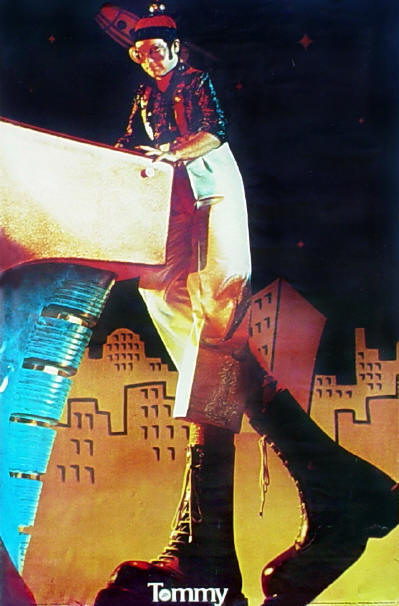
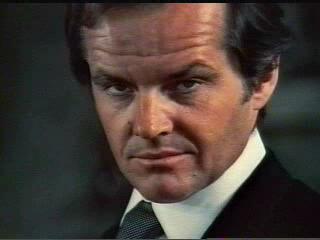
Then started again. Flow was something missing from "Tommy," and replaced by excess. Elton John was the biggest thing in music at the time, but he's just a blip in the film, perched atop stilt-like Doc Martens. Jack Nicholson (substituting for a probably-more-appropriate Christopher Lee) is in B-movie auto-pilot and CANNOT sing. Ann-Margret was inconceivably nominated for an Oscar for her performance in the filmprobably for bravery, Tina Turner was deliriously ferocious (and fidgety) as "The Acid Queen," and the heretical "Eyesight for the Blind" sequence that took place in The Church of Marilyn Monroe. Tasteless, crass, and jaw-droppingly audacious, it is also a very neat commentary on the idolatry of celebrity—a far better one than the movie itself...or Townsend's original...was trying to be. Except for that sequence, the film is a waste of time. An extremely commercial indictment of things commercial.

I suppose it could be due a re-make.

Let's forget it (Better, still).


The "Eyesight for the Blind" sequence (the song by "Sonny Boy Williamson II", performed by The Who, Eric Clapton—quite stoned—and Arthur Brown). Like the movie, it is padded to just go on soooo long and director Ken Russell (and editor Stuart Baird) do what they can to keep things semi-lively. Best thing about the movie.

Thursday, May 7, 2009

Olde Review: A Brief Vacation

This was part of a series of reviews of the ASUW Film series back in the '70's. Except for some punctuation, I haven't changed anything from the way it was presented, giving the snarky, clueless kid I was back in the '70's a break. Any stray thoughts and updates I've included with the inevitable asterisked post-scripts.

This is a companion piece to the review of "The Earrings of Madame De..."

"A Brief Vacation" aka "Una breve vacanza" (Vittorio De Sica, 1973) The late Vittorio DeSica was not only a fine actor, as he displayed in "The Earrings of Madame De..." He was also one of the foremost directors forging a name for himself by helping to pioneer the post-war neo-realist school of Italian Cinema—a type of film that found poetry, not in the cloistered fabrications of the film studio, but out in the streets, favoring location shooting and the light of the sun to tell its simple, human stories.

Fortunately, DeSica never changed his style too much throughout his career, and his last film, in 1973, "A Brief Vacation" has all the strengths of the neo-realist style. Clara (
Florinda Bolkan) is a working class house-wife with a senile mother-in-law, a sick husband, a crud for a brother-in-law, three kids, a machine-like job...and a routine. She's getting old before her time and the pressures of her family, job, and time are causing her to lose her grip and her health. She is sent to Sondolo, a resort up in the mountain, in order to gain back her health. She leaves her utterly useless family behind to spend time away from the city and the pressures. It is a simpler, less rigid life in recuperation, but she finds that she is still needed—by the people of the resort, her fellow in-patients, by her new family.

DeSica excells at showing little details of life, that make his films that much more easier to live in. There is a sequence at a concert that is superb in its content and its sheer choreography.

In a film like this, with one central character, the person who plays that character has a difficult task. But
Florinda Bolkan has the sheer screen presence to carry it off. You can watch her for two hours; she commands the attention. The western films that she has been in ("Royal Flash" and "The Last Valley") both bombed in the U.S. and dragged her superb performances down with them. And so this may be your first chance to see Bolkan and see what acting power she contains.

The last scene in the film—Clara on the train returning to the city in a too-brief cinematic journey, much like a stylized version of a trip from Heaven to a limbo-tunnel (in which she is the only illumination) to a city-hell—is a superb moment of film, the last in a long line of superb moments in the films of Vittorio DeSica. He died soon after making this film, and he could not have foreseen how appropriate the last shot of the film—a city wall fading into blackness—could be such a perfect end to an illustrious career.

Broadcast on KCMU-FM on February 5th-6th, 1976

Some pretty torturous writing there. Also, since I haven't seen all of DeSica's films, I'm wondering how my younger self could make the claim that DeSica never changed his style. That seems unlikely. And I don't remember much about "A Brief Vacation," as it has turned into a faint memory. But, reading this, I'd like to see it again. I'd like to know if the character of Clara, considering she becomes indispensible in both the home and the resort, brings it upon herself, rather merely being taken advantage of. It's an interesting thought, as we very often make our own hells. And it would make her character arc that much more interesting, rather than her being stuck in a situation, then going to Paradise and finding love and happiness that she must forsake to go back. Suppose she's just the type of person who insists on doing things and people fall back into taking a back-seat to her wishes.

I also notice that it's tough to find "A Brief Vacation" (I had to settle for a "Review" poster for the film rather than a theatrical poster that might better illustrate the movie, and I found that one on Ebay!) in a search on the Internet. It might be that it's an Allied Artists release, and AA had some financial problems later on (although it's much easier to find their film, "The Man Who Would Be King").

It goes on the list of "To Be Re-encountered."

Thursday, January 29, 2009

Olde Review: The Lost Honor of Katharina Blum

This was part of a series of reviews of the ASUW Film series back in the '70's. Except for some punctuation, I haven't changed anything from the way it was presented, giving the snarky, clueless kid I was back in the '70's a break. Any stray thoughts and updates I've included with the inevitable asterisked post-scripts.

If you're feeling in the mood for a little paranoia, you might want to sneak a peek at Friday's ASUW films in 130 Kane. They deal with a social problem that touches us all: the destruction of the individual's right to privacy, and the films are "The Lost Honor of Katharina Blum" and "The Conversation."

"The Lost Honor of Katharina Blum" aka "Die Verlorene Ehre der Katharina Blum oder: Wie Gewalt entstehen und wohin sie führen kann"* (Volker Schlöndorff, 1975) This is a German film, first presented to Seattle at the Moore-Egyptian Film Festival** and proved to be the hit of the many films presented there. It states at the outset that the story is based on a true incident, *** which alerts one that what is about to unfold is a very strange story—so strange that if those responsible didn't tell you it was real, you wouldn't believe it.

We begin by following the surveillance of one Ludwig Götten (Jürgen Prochnow) (we are watching the surveilllance for we, the movie-watching audience out there in the dark, are the ultimate voyeurs) Götten knows he is being followed—that he is being watched, but he manages to elude them...almost. During his wandering, he runs into a girl, Kathharina Blum (Angela Winkler) and they spend that night together.

In the morning, Ludwig is gone. The police who had been surveilling him are dumb-founded, and Katharina is their only lead. And so, amid much hoopla and press coverage, Katharina is taken into custody.

"It is the duty of the police to inform the public." Recognize that phrase? It's something of a play on the old stand-by, now cliche, argument of the Press. But with this phrase comes the first hint of what this movie is driving at. The police and their tactics are openly displayed in the opening segment. Once you know it's the police you are perfectly willing to take on the air of self-righteousness and say "These police are fascists, through and through!" But, as the film progresses, you realize that that the actions of the Press are the focus of the film. Indeed, the press are working with the police; each one supplies the other with information they have scraped up. It's a very harsh picture of the Press that is presented, and many may not like it, after all, being an investigative reporter is in "in" profession—they are our latest media heroes. And it dares to question the people's right to know...that is, the people's right to know dirt. "The freedom of the Press can not be taken lightly," says the duplistic D.A. "But the freedome and dignity of mankind can be?" replies Katharina's outraged aunt. Katharina, herself,states that "it is their business to rob people of their honor, or else they wouldn't sell newspapers."

"...Katharina Blum" is very one-sided. Its arguments and its tone in presenting totally immoral reporters, grubbing for headlines may make some think the film is a total harangue. But, for my part, I couldn't help thinking of the
Patty Hearst's, the Gary Gilmore's, the Jimmy Carter's and the endless string of others whose total life-histories (have been) paraded before our eyes for the sake of ratings or our money. I highly recommend this film to everyone. It might make you think twice before you smirk at the people who refuse to be interviewed on "60 Minutes."

Broadcast on KCMU-FM on January 8th, 1976 (thirteen years ago today)

I am shocked! shocked!! to find that the press do things for money! Still, one would like to think of our news-gatherers as doing a public good as opposed to directing the eyes to the ads, but the situation has only gotten worse, not better. In the 33 years since this review was written (33 years this week, in fact) we have seen the death of ex-Princess Diana, killed in a high-speed car-wreck when her somewhat inebriated driver attempted to evade a horde of papparazzi, a young mother committed suicide after being publicly accused of infanticide by braying talking-head Nancy Grace, and Geraldo Rivera's reporting of a rumor of finding all the miners safe in the West Virginia Sago mine disaster only deepened the country's gloom. Generally, the news-mongers have marched towards info-tainment while abrogating their responsibilities for access and "most-favored" status on K Street party lists. And in a scenario that expands the one of the film to national, and potentially international proportions, the Bush Administration fed self-produced "news" stories to local stations, and planted "reporters" (one, a gay prostitute) to salt press conferences and throw the conferencers some soft-balls. "Lost Honor?" One is lucky not to have their bones jellied in the gears of the News-Monster, government-sponsored or no. Jürgen Prochnow became an international star, and Volker Schlöndorff went to a Hollywood career (directing Dustin Hoffman's stage and TV versions of "Death of a Salesman," as well as the film version of "The Handmaid's Tale") and continues to work in Germany.

And "60 Minutes," with a complete turn-over of correspondents, though its been endlessly copied and co-opted, keeps on ticking.

* "The Lost Honor of Katharina Blum, or How Violence Develops and Where It Can Lead."

** Now called The Seattle International Film Festival, now far expanded from just the Egyptian Theater in Seattle.

***Hmm. So did "Fargo."

Friday, November 28, 2008

The Man Who Would Be King

"The Man Who Would Be King" (John Huston, 1975) The obsessive quest. The lust for riches and the good life it will bring. The realization that the journey may be more important than the rewards. Laughter.

Two ne'er-do-wells cross into unknown territory for riches and are undone by their own greed and discord.

John Huston made this story before--a couple times, in fact. The closest might be "The Treasure of the Sierra Madre," which "The Man Who Would Be King" resembles. But it could also be "The Maltese Falcon," from the villains' perspective. Both films deal with wealth evading their questers' grasp, and both end with some laughter.* In "The Man Who Would Be King," that laughter comes earlier, and provides the miracle that leads the adventurers to achieving their hearts' desires. And gaining wisdom.

Although in each film someone always has to take "the fall."

The story is by
Rudyard Kipling, and story-teller Huston provides the conceit that might have led to the writing of
the tale, as Kipling is featured prominently in the film, portrayed with genial bonhomie and a writer's intrigued fascination at the train-wreck-sure-to-happen by Christopher Plummer. The story, of two confidence men/ex-British militiamen--Daniel Dravot (Sean Connery) and P.T. "Peachey" Carnahan (Michael Caine)--who brave the impossible journey through the Himalayas to find the fabled city of Kafiristan to set themselves up as "kings" held echoes of themes featured prominently throughout the work of John Huston. When he realized his dream of making this film, he was nearly 70 and suffering from emphysema, but the travel and the foreign locations did not dim his enthusiasm at such an age. He said it was one of his favorite shoots in his long-storied career. And one of the easiest.

And it was all due to the casting.

Huston had wanted to make the film in the 50's with
Clark Gable as Danny and Humphrey Bogart as Peachey then later with Burt Lancaster and Kirk Douglas, then Paul Newman and Robert Redford.

It was
Newman who suggested Connery and Caine. The two old friends had never worked together before and seized on the opportunity. Evenings during filming the two would go over the next day's scenes and work out little bits of well-coordinated business that would indicate the relationship between the two con-men, like old vaudevillians who had shared many a stage...and those routines would delight the wolfish Huston when presented with the ideas the next morning.

One wonders what Huston would have made of the film earlier in his career with those teams of actors. Lighter, perhaps. More comedy. Maybe not so hard on the message of the exploitation of conquered nations. But, with Connery and Caine there is a maturity as these two "
soldiers for fortune" go about their business robbing the various "-istan's" "three ways from Sunday."

Would it have ended as it does now, with the grisly but apt ending, and the story-teller becoming so engaged in the telling of the tale, that he is no longer a part of it? Would it have resonated so?

In the end, the point is so moot as to be laughable in itself. "The Man Who Would Be King" is a classic motion picture of any era--a dream project from a master director who had thirty years to perfect it, many chances to get it right, and, unlike his protagonists, the grace and wisdom to appreciate the luck he'd been given and let it live on its own when it was in his grasp.

Not even emphysema could have stopped his laughter at that.

* "The Asphalt Jungle" also has a similar ending...but its low-level crooks do not possess the self-knowledge--or the grace--to laugh at the Cosmic Joke played at their expense.

Saturday, October 18, 2008

A Boy and His Dog

"A Boy and His Dog" (L.Q. Jones, 1975) L.Q. Jones is most well-known as a quirky character actor, usually playing rangy, seedy types for the likes of Sam Peckinpah--he was part of Peckinpah's stock company--and Robert Altman--he played the character based on Chet Atkins in Altman's last film, "A Prairie Home Companion."

But in 1975, he also directed a low-budget high-concept picture based on a classic sci-fi story written by
Harlan Ellison. The story, "Blood's a Rover,"* tells the story of a young adult male in a post-apocalyptic world whose only companion is a telepathic dog, or "Rover," named "Blood." Blood sniffs out food and women for Vic to attack, reads minds, and communicates telepathically with "Vic." It's a bizarre story with an odd little twist, and is one of Ellison's best-known tales.

The film Jones made of it is satiric, savage, sassy, and right on the edge of burlesque as Vic (a very young, pre-"Miami Vice" Don Johnson, and his pooch(voiced by Tim McIntire) roam the post-nuclear countryside that bears a passing resemblance to the world of "Mad Max,"** with mutants and squalor. At one point, Vic is lured by one of his female conquests to an underground society of American nostalgists led by Jason Robards, who appear to have stepped right out of the River City, Iowa of "The Music Man,"*** except for the deranged robots, goon squads, and the man-milking machines (the society is sterile). Vic must make a choice between this semblance of civilization and the scorched-earth policies above ground.

Ellison's attitude towards it is rather strange, initially saying that it was a good adaptation, but then turning on it as mysoginistic (especially for its gut-crunching last line). An odd sentiment from the story's creator as that is all reflected in his yarn in the first place. And yet Ellison has gone on and produced sequels to the original story without any attempt to disown the political incorrectness of the original. I guess he felt Jones was too blase about subjects Ellison had second thoughts about. Still, Jones' vision of a post holocaust nuclear society has stayed relevent for decades--as the poster says "it's a future you may live to see!"


* Taken from a line from A.E. Housman's "A Shropshire Lad"

** Jones' post-apocalyptic garage-sale look preceded "Mad Max" by three years, and "The Road Warrior," which it resembles by five years.

***All of these residents are heavily made-up in what I thought at the time was clown make-up, but I realize now is reflective of the look of rosey-cheeked painted-over family portraits. The undergrounders are heavily made-up to compensate for the lack of sun.

Saturday, August 16, 2008

Olde Review: Farewell, My Lovely

Written Nov. 25, 1975

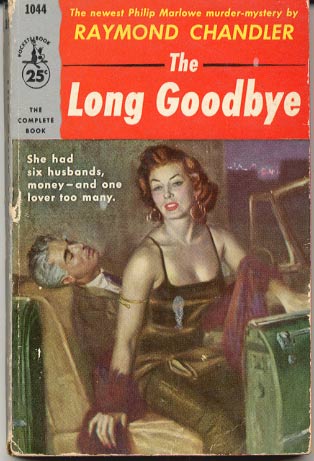
"Farewell, My Lovely" (Dick Richards, 1975) This summer I became acquainted with my first Raymond Chandler novel (I'm a late bloomer). It was an old copy, tattered and falling apart with an honest-to-god-"Genuine Pocket Book" pulp cover on it (barely), of "The Long Goodbye." A lovely thing to read--entertainingly, slickly written. The magic of the gutter just kind of spills out of it.

Now,Howard Hawks made a great Marlowe picture, with Humphrey Bogart, but Bogart naturally talks like Chandler writes(people don't talk like Bogart--his emphases come in the oddest places).* Robert Mitchum talks like ol' Bob Mitchum, and though he'll put in some "Bogartian" inflections of his gravelly voice, there's still a lot of wrong with him.

Dick Richards is not one of my favorite directors. His "Rafferty and the Gold-Dust Twins," though occasionally gratifying was highly episodic, strung together and rather poorly paced (maybe I just don't like "road pictures," but then why did I like "Harry and Tonto" and "Alice Doesn't Live here Anymore?"). His adaptation of "Farewell, My Lovely" doesn't fare to well, either. It's sleazy where it wants to be gritty, and slightly hysterical when it wants to be tough. It's warmed-over Chandler with nothing that can revitalize the plot plagiarized and bastardized by so many rotten tv detective shows.** "Chinatown" had an evil "plot" idea that I've seen before on these same detective shows, yet "Chinatown" burned with Polanski's perversity, so that you didn't care. "Farewell, My Lovely" is beautifully photographed (that title sequence with Los Angeles burned up in yellows and reds blurring on the street is just beautiful--can't tell a book, etc.) But it's just another movie that tried to cash in on another film's appeal and wasted its own potential. "No way has been invented yet to say good-bye to them."

"Farewell, My Lovely" was the second time Chandler's novel had been adapted as an official Philip Marlowe movie. The first was 1944's "Murder, My Sweet" starring singing, dancing Dick Powell (who also played Marlowe in a television adaptation of "The Long Goodbye") Other Marlowe's, besides the best-remembered Bogart, are the Montgomery's, Robert and George, James Garner and Elliott Gould. Philip Carey, Danny Glover and the very fine Powers Boothe played him on tv. Mitchum, 30, even 20 years earlier, would have been a great Marlowe, but in 1975, he was just a bit too old and paunchy to be playing Chandler's L.A. shamus. It's a great cast though, with Charlotte Rampling, Sylvia Miles, John Ireland, Harry Dean Stanton, Anthony Zerbe--even a pre-"Rocky" Sylverster Stallone. And they got the ambience right, with Marlowe's attention being diverted from the case by DiMaggio's hitting streak in 1941--the book was released in 1940, but why quibble? It was still pre-war. They did far better than Michael Winner's version of "The Big Sleep"--set in London in 1978.

And David Shire's trumpet-dominated score could notch comfortably behind any detective story.

* And one can say that people don't talk like Chandler writes!


** And had been used starting as early as 1942, evidently, in a George Sanders B-movie called "The Falcon Takes Over." Chandler's "The High Window" was adapted as "Time To Kill" for the Lloyd Nolan "Michael Shayne, Private Detective" movie series (and again in 1947 as "The Brasher Doubloon").

Saturday, August 9, 2008

Olde Review: The Day of the Locust

Written October 22, 1975

"The Day of the Locust" (John Schlesinger, 1975) I saw "Day of the Locust," after seeing Scorsese's "Alice Doesn't Live Here Anymore" (which was such a personal film) was quite a shock. It is an impersonal film, as impersonal as one can get. Where Scorsese cared for his characters so much that he projected their feelings in the way he used his camera, Schlesinger paints his characters as grotesques. Faye Greener (Karen Black) is a pouty-mouthed, viper-tongued bitch. Her father (Burgess Meredith) is a pathetic wheezer, whose laugh that--like an itching powder--can create laughter is "communicated"--not successfully--by a distorted close-up of Harry's sweating, wrinkled face. Homer Simpson* (Donald Sutherland) is beaten mercilessly in this film, not only by the characters in it, but also by Schlesinger, whose failure in this film shows Simpson, not as an innocent, but a dullard, his brow constantly furrowed, but never thinking, his hands bothering him, but how? Schlesinger can't and won't elaborate, but goes on to show him, as he watches and embraces the trivial in his garden, a tear rolling down his cheek.

We ask "why?," but Schlesinger won't tell us.

Finally, there is Tod Hackett (
William Atherton), of whom we know that he's a set designer, that he lusts after Faye and who pastes a darker vision on his wall of his Hollywood environs--a vision he experiences as Schlesinger goes mad, seemingly, at the end and destroys Los Angeles in a cinematic orgy of attempted message-building with past-faced human beings on the sidewalks. Somehow, this whole sequence could have been done better. Horrible, yes it is, but obscure, as well. An obscurity that Schlesinger pounds into us. An obscurity that Schlesinger mixes with the obvious. It appeared to me to be the cinematic equivalent of vinegar and water.

I remember this film as being one of the more unpleasant experiences going to the movies. I was expecting some simpatico reactions to it as a recent trip to Hollywood seemed like a vacation to Sodom and Gomorrah on Piko and Sepulveda. Instead what the film achieved was a crass braying that passed as wit and a visual style that hit you over the head with obvious fish-eye lens shot to make Schlesinger's gallery of grotesques even more grotesque. I don't mind being a choir-member being preached to, but I don't think I have to buy all the sermon, do I, especially when it's so poorly done?

Plus, one has to be pretty insulated to think that a glimpse of Hell would be a klieg-lighted riot at a movie premiere. Surely there are other areas of the Earth where the worst in humanity occurs on a daily basis. Maybe it isn't so visually arresting...

Anyway, brownie points for a Hollywood film to point out Hollywood excess, even though it's based on a book that came out in '39, when the idea wasn't so self-evident. Swell. If you're that brave, go make something a bit more contemporary.

And the question comes up: if Paramount could fund and promote this little piece of self-excoriation at the height of their movie-churning glory, why hasn't anyone produced "What Makes Sammy Run?" Too political? Too true? Maybe it still stings a bit too much for contemporary Hollywood.

It was, after all, written in 1941--two years after "The Day of the Locust."

* D'oh!

Friday, August 8, 2008

The Three Musketeers/The Four Musketeers

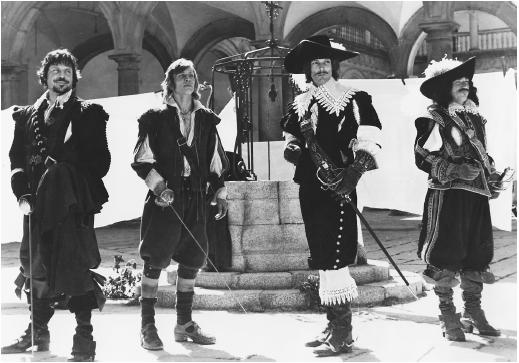
"The Three Musketeers: The Queen's Diamonds"/
"The Four Musketeers: Milady's Revenge"(Richard Lester, 1974/1975)
These rollicking films, originally planned as a two and a half hour epic (no matter what the Producers say!) may just be one of the best adventure films (and adaptations of a classic) ever filmed, balancing the demands of the story, the tenor of the times in which it was made and the idiosyncrasies of its director.

When approached, Lester (who hadn't made a film since "
The Bed Sitting Room" in 1969) wasn't enthused. Then he read the story, and did some research...and heartily agreed. One can see why. For "The Three Musketeers," as Lester and his screen-writer George MacDonald Fraser envisioned it is a story of intrigue in high places carried out by the lackeys and foot-soldiers who live to serve. Forget that the palace-dwellers are either snakes or dullards--they provide an opportunity for income and adventure--two qualities lacking amongst the citizens of France and England, who, at the time are at war. The opportunities for thrills, humor and pointed satire are rich and mined well by the film-makers.


Lester's direction is masterful--simple set-ups and multiple cameras used during the swash-buckling to make sure there's a glimpse of every buckled swash. And those scenes are choreographed as a group participation so that every Musketeer has "business." Lester also worked to makes sure that the fights were inelegant affairs--not balletic, but more like street-fights, with few rules and the use of landscape and surroundings as equal strategies to the sword technique (and every part of the sword is used, as opponents are sometimes conked with ornate handles).

Lester surrounds the royalty with games and idle amusements that have a slight tint of mindless cruelty to them, and that extends to the villains, whose machinations involving the Royals are merely extensions of those games, with regime-toppling consequences.

And the cast! As the musketeers, Oliver Reed as the surly Athos, Richard Chamberlain as the effete Aramis, Frank Finlay as the clownish Porthos, and Michael York as the young and naive D'Artagnan. As the Royals, Jean-Pierre Cassel as the foppish King Louis XIII, Geraldine Chaplin as the frail Queen Anna of Austria, and Simon Ward as the rakish Duke of Buckingham. As the villains, Faye Dunaway as Lady De Winter, Christopher Lee as the villainous Rochefort, and Charlton Heston in one of his best performances as the Machiavellian Cardinal Richelieu. Rounding out the cast are Raquel Welch as the Queen's seamstress, the accident-prone Constance de Bonacieux,* Spike Milligan as her randy husband, and Lester regular, the great Roy Kinnear as D'Artagnan's man-servant, Planchet. A superb cast, rarely equalled.

It's long been contended that the film was supposed to be one movie, but that the Salkind's split it into two to maximize profits. That's the rumor--there is a natural split of the film at the half-way point that feature almost all the actors for a sort-of bow, but it could have been used for an intermission. Certainly, there is less movie in "The Four Musketeers," it being padded with an "up-to-that-point" narrated prologue.

But there are two distinct stories of different tones, the first being the intrigue-filled, but relatively light-hearted "The Queen's Diamonds" story (in which Athos, Aramis and Porthos are wounded, but not killed), and the darker "Milady's Revenge" with its beheadings, extended back-story and several prominent deaths. Where Part 1 is rollicking fun with minimal consequences, the stakes in Part 2 are very high, passions flare, and the sword-play becomes deadly. The humor is darker than the first, too. Despite the same cast and crew,** the two are very different in tone.

Taken together, they have a moralist's sensibility of the costs of frivolity and duplicity; adventure can be fun, but in a poisonous political atmosphere, one adventure's at one's own risk. You can have a good time watching "The Three Musketeers," but the story is incomplete without the paid dues in "The Four Musketeers." Together, they make one of the finest adaptations of a classic novel ever put to film.

* Welch, not the most versatile of actresses, won the Golden Globe for her hilarious performance in "The Three Musketeers" and tearfully told the crowd "I've been waiting for this since "One Million Years B.C.!"

** except for the score composers--Michel Legrand for "The Three Musketeers" and Lalo Schifrin for "The Four Musketeers."

Thursday, August 7, 2008

Olde Review: The Wind and the Lion

Written November 7th, 1975

"The Wind and the Lion" (John Milius, 1975) I avoid seeing films twice unless I really, really love the flm (due to a lack of funds).* When I saw "The Wind and the Lion" the first time, it was as if I was seeing two movies at time. The dialog was really wretched ("Mulai--that's a nice name"), but at the same time the photography, direction and editing were all fabulous. It was a film that had "sweep" (I assume that when a film has "sweep," the camera tends to move along a field, up a wall, through a street, "sweep" through the visual plane of the camera. Oh, but does this movie do that!) "The Wind and the Lion" just swells with movement of all kinds--inside the frame and the frame outside itself.

John Milius is a director I don't tend to think much of. I wasn't too fond of his "Dillinger" film, some good things, but not wholly satisfying. But his direction in 'Wind & Lion" is just marvelous. Some of the shots combined with Jerry Goldsmith's score** are just chillingly beautiful: The trucking shot along a line of berbers silhouetted against a sunset;

A diagonally rising crane-shot that drifts over a dune as an entire army of berbers move down a road while a dark, cloudy sky presses down on the whole scene;

After the Raisuli (Sean Connery) has killed off the final horseman at the leper colony (that was the impression I got anyway) Milius cuts to a stunning shot of Eden Pedecaris (Candice Bergen) watching behind a net in the right foreground, while against a low sun on the ocean-tide, the Raisuli slows his horse and the now-riderless horse of his opponent still charges across the screen;

Theodore Roosevelt (Brian Keith) and "his" bear towering over him, as he reads the "Wind and the Lion" letter.


The second time around, my appreciation of the Milius direction grew. It was what I concentrated on throughout and because of it, the dialog that I was uneasy about went down easer and (My God!) some of that dialog was downright poetic. Roosevelt's speech about the bear as the U.S, symbol, his getting on his desk and growling at the camera for the Smithsonian--things that made me squirm in my seat before--I enjoyed this time around.

This movie is flawed to be sure. Some of the writing is still bad. There are inaccuracies in technique and in history. *** The fellow I went to see it with thought there were too many "riding-in-the desert" shots for his taste, but not for mine. And I heartily enjoyed myself and the film.


I still enjoy it (now that I own it) and all qualms that I had about it are gone, and a lot of the things that I found a bit over-dramatic are things that I now dearly love about it. I neglected to mention the huge contribution that cinematographer Billy Williams brings to this movie, as he carried out some of the beautifully outlandish shots Milius came up with. I wish he was allowed to make more films (he's certainly been allowed to doctor scripts most of his career, and Turner gives him a mini-series or TV movie to do once in awhile). His is a singular voice in Hollywood, and he's smart with what he does on film. Who knows, maybe they'll let him re-boot the new "Ahnold-less" Conan film series, as he did the first one. One would wish.

* This was 1975. It would be another five years before the video-tape boom that allowed folks to watch films in their own home, and even own media of that film. Seems like such a long time ago. Now, if one likes a film, one can buy it, and watch it as many times as they want. That's a great convenience--but it tends to make people cluster to stuff they like, rather than explore and take a chance on a new film.

** An aside from this review here: "Goldsmith just happens to be one of my favorite film scorers. I snap up one of his albums as soon as it appears in the racks, and seldom am I ever disappointed with what I hear. However, one of Goldsmith's pieces doesn't seem to mesh correctly with the visuals--the Raisuli's initial ride on a horse gone hay-wire." Um--that was the point, I think.

*** For instance, an incident like this DID take place during the Roosevelt administration. Ion Pedecaris WAS kidnapped by the Raisuli, in 1904. Ion was male. I'm sure it matters to history buffs, but changing Pedecaris to a woman raises the stakes of the story, and provides a whiff of romance and exoticism. Without "The Wind and The Lion" that incident would have been lost in the sands of time.

Saturday, August 2, 2008

Olde Review: Rooster Cogburn

Written October, 27, 1975

"Rooster Cogburn" (Stuart Millar, 1975) Stopped by the Renton* to see Stuart Millar's "Rooster Cogburn." It was...pleasant. Not particularly exciting, but...pleasant. When I think of all the possibilities of a script involving John Wayne building on an earlier role and Katherine Hepburn....

I can even think of the possibilities of direction within the limitations imposed by the script....


Well, anyway, with the talent showcased there, let's just say the glass could have been cleaned a little better. The "Rooster Cogburn" character is described as "having gone to seed." I must agree. Cogburn is but a shadow of the characterization Wayne created in 1969, and as if to off-set it, Wayne overplays it, especially in the opening sequences, but his efforts come out looking like amateurish mugging.

Hepburn fares much better in her role but then why shouldn't she? She played the same type of character in "The African Queen." The action sequences lack the punch that a more seasoned director like Howard Hawks or Henry Hathaway might've delivered. For example, the shoot-out at the Goodnight mission where a number of Indians and Eula Goodnight's father are murdered by a gang of desperadoes--the scene should have been frightening, a horrible thing to watch, as it must have been to the Hepburn character.. But after a well-used slow zoom into the growing commotion, Millar shows us the massacre from high overhead at least 30 feet away, showing all the action encompassed in the frame, keeping us at a safe and unparticipatory distance.

Another sequence that had great had great potential was the character "Breed's" (
Anthony Zerbe) showdown with Hawk (Richard Jordan), as he is exposed for being a traitor to him. After a very lengthy series of shots between the two characters as Breed hesitates in handing over his gun, Hawk kicks him and he slides down the slope. Then, there's a shot of Breed's hat sliding down the slope (nice try, but it just doesn't work, symbolically or otherwise), and ALL OF A SUDDEN ** there is a shot of Breed falling over a cliff (I remember thinking to myself "Was there a cliff there?" Yes, but we didn't know that until the character fell off it!) There was no suspense in this scene, but there certainly would have been if Millar had told us, somehow, that there was a cliff behind him. We would have been able to think ahead even further than we had when "Hawk" asked to see "Breed's" gun. We would have seen what was coming and squirmed a bit for the character. this way, nothing. A momentary shock and it's over.***

"Rooster Cogburn" is full of missed chances like this, and it really is too bad.

It really was. I remember reading about the trials and tribulations director Millar had with his iconic, and feisty and flinty stars out on location. How they'd do a scene, and not do a re-take if they thought it was good. Wayne wasn't in the best of health, but felt he had to do his own horse-riding in front of Hepburn--the male-pride thing. And though Wayne and Hepburn got along like a house afire, it was just an unpleasant shoot. And Millar was more of a producer than a director. He was 44 when he directed "Rooster Cogburn" but his "legacy" stars treated him like a kid.

It is too bad. This is the only movie that Wayne and Hepburn did together--at this time, she was starting to go the rounds of veteran actors with whom she hadn't sparred before, like Fonda, Wayne, Olivier--and it would have been nice to have a good, decent script instead of this hashed-together combination of "The African Queen" and warmed-over "True Grit." And whatever talents Millar had, he didn't know how to gather enough material to make a film that could be cut together smoothly, or build anything approaching dramatic tension. Sometimes projects are brought together on a whim and star-power, but without the good foundation of a solid script, and a director who can find gold in a coal-mine, it'd be like building a cardboard house on the sea-shore. The whole thing collapses before there's any equity. It usually happens when a screen-couple are re-united after a big hit. Anybody remember John Travolta and Olivia Newton-John's second pairing after "Grease?" Me, neither.****

* The Renton Cinema, demolished in the 80's, is now the AMC Renton Village 8. Same location, though.

** Emphasis, mine.

*** This is the basic "Hitchcock Rule:" A scene is much more exciting if you give the audience more information. If a bomb goes off on a train *BOOM* it's over, a little disorientation and shock and it's done. But tell the audience there's a bomb..show them where it is and what time's it's going to go off...and show all the people who might see it but don't, with the clock ticking down and you have a long period of suspense where people know the situation and are helpless to do anything about it. It's a much more effective scene.

**** Okay, I lied. "Two of a Kind."

Thursday, July 24, 2008

Olde Review: Monty Python and the Holy Grail

This was part of a series of reviews of the ASUW film series back in the '70's. Except for some punctuation, I haven't changed anything from the way it was presented, giving the kid I was back in the '70's a break. Any stray thoughts and updates I've included with the inevitable asterisked post-scripts.

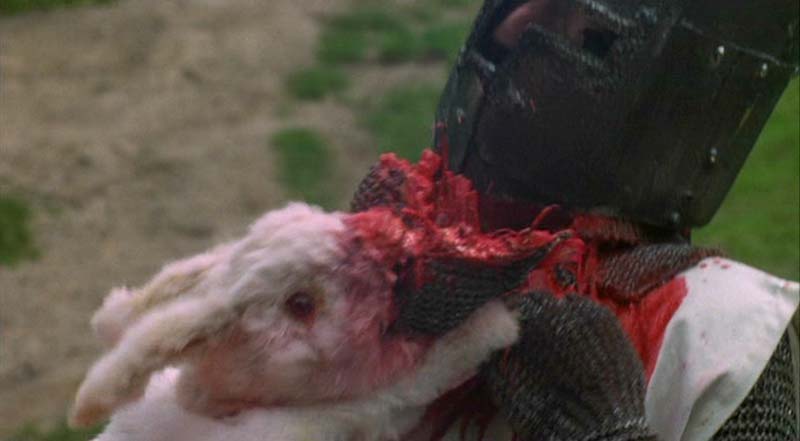
"Monty Python and the Holy Grail"(Terry Gilliam and Terry Jones, 1975) I also like "Monty Python." It is refreshing to turn on the tube and see total anarchy once in awhile. But, there is such a thing as good, disciplined cinema comedy, which places it above well-made home-movies like "Monty Python and the Holy Grail." I mean, these silly gits won't even take the credits seriously, fer chrissakes! It is not wihtout its gory charms (you have to admire people who come up with a blood-thirsty rabbit).

Maybe what I'm griping about is this: It is possible to have good screen comedy and a disciplined film at the same time. It's even possible to have it with anarchic comedy as in Howard Hawks' "Bringing Up Baby." And it is this discipline that is missing in "The New Comedy" as these films are billed*--they are funny, but they are not graceful. They are really quite slip-shod in the way they have been shot and edited.

Really, the only man who is continuing in the tradition of anarchic comedy and good film-making is, of all people, Mel Brooks, but only because he made two gems of recent comedy--"Young Frankenstein" and "Silent Movie." There is still hope for Woody Allen, if he returns to the style of 'Sleeper." There is no hope for Monty Python--they would have to change their comedy style--and it wouldn't really be worth it.

The moral to all this is: It may be funny as Hell, but that don't make it a good movie!

Broadcast on KCMU-FM November 4th and 5th, 1976

Poppycock! The style, or lack of it, in "Holy Grail," is part of the fun. At times epic, and at other times amateurish, it is the unexpected ways that Python (Monty) have of playing with the medium that makes up the charm (and a great deal of the comedy) of the film. Another look at the film (with the stick removed) shows it to be messing with the conventions of the fantasy film and of film in general (love the credits with the Norwegian translations) in fresh ways--and isn't that evidence of style? And while Terry Jones, who directed most of "Grail," has had a somewhat lackluster directing career, Terry Gilliam has had an amazingly rich (if problematic) directing career. Style? He has bags of it!

The writer of this review was hung up on "Filum" as "Aht" and more concerned with adhering to basic rules of "cinemah," rather than working with, without and outside of them to create spontaneous comedy. Sometimes, obeying the rules deprives one of opportunities to expand the discipline to achieve a richer art-form.

As for my better alternatives, the hope for Woody Allen that I spoke of was just around the corner with "Annie Hall," and after his successes, Mel Brooks made the most conventional and laziest of his comedies "The History of the World, Part 1" (after a less-than-inspired spoof of Hitchcock films, "High Anxiety.") The dedication he used to bring the look to the movies I mentioned, went away, and he decided that what he was doing was "good enough." It wasn't. On to Broadway...

*Lest we forget the program was "The Running, Jumping and Standing Still Film," "Love and Death" and this one.


Saturday, July 19, 2008

Olde Review: Hearts of the West

Caution: there is spoilerage ahead!

"Hearts of the West" (Howard Zieff, 1975) You've gotta have some kinda admiration for a movie that starts out with dialog you always think of yelling when a movie starts in a jabbering theater: "Allright, people, settle down, please, please!" And then, when we're all settled we are given a screen-test--the illusion (it's all acted, after all) of a reality (screen-tests are "real" world versions of movie illusion) of an illsuion (the movie-world that we see on screen).

Through it all stumbles Lewis Tater (
Jeff Bridges), but he does it both in 16mm black and white for the screen-test, but also through the 35mm color for the movie-movie that we, the audience, see. Lewis keeps plunging himself through reality and illusion and multiple layers of the two. Lewis is shown to be a writer writing illusions (his western stories), acts them out (which is also an illusion/delusion, but a reality that they are acted out, but that's also an illusion). He is sent a letter from a Nevada correspondence college (reality) to which he goes to attend classes and hang around campus. His brothers are yokking it up as he tells of his plan because they can't adjust so easily as Lewis to crossing between reality and illusion (if they call the college a "ranch" and use all sorts of western jargon, then it has to be able to teach western writing--it's gotta be for real--but the western jargon is idiotic and hype to the brothers).

So Lewis goes to college. It ain't there. The college is an illusion, but not really, it's there in the form of the real post office boxes ticket agent
Dub Taylor points at. The college is an illusion, but it's there in the reality of the boxes. And Taylot talks about it as though it were really there. Tater is thrown out of his funk by a landlady who sets him up for the night. There he can start professing his abilities ("I'm a writer!--also an illusion if you take the words of Howard Pike (Andy Griffith), "You're not a writer 'til somebody tells ya ya are," for reality--but still Tater writes--he is a writer, whatever his talent) and acting out his illusions of battling desperadoes with an imaginary whip. Then, suddenly illusion becomes reality as he must fight and flee flea-bag desperadoes. He "wanders through thedesert, parched and thirsty" turning the reality of his situation into the fantasy of his novels. Who should he wander upon, or who should wander upon him? Real cowboys.

But not real cowboys--movie cowboys. They are, but they are not. Lewis becomes one himself, living out his fantasies on a movie set in anillusion of the West, while (in reality) he is being stalked by the two con-men he has inadvertently robbed. The conflict of reality and illusions abound: Lewis, overcome by his fantasies, going berserk, charging the leading man, extending a "bullet-tearin'-his-gut" death, generally screwing up a scene; the improbably scene where Lewis must pose as a young businessman to get some cash from the bank-notes of the two swindlers at the bank (improbable, but...what is a more interesting situation where a young actor must act a role to gain something, ala
Hitchcock's "Stage-Fright"); Howard pike's "in-the-nick" entrance as he shoots one of the swindlers full of lead--he only shoots imaginary bullets--blanks--which are enough to convince the crook, and us, that he has been shot, especially after Lewis really has been shot (his disbelief that such a thing could really happen exemplified in his "there's a hole in my leg...a round little hole" My God! It isn't pointing your finger and whistling air through your mouth, it's real!), and the final confusion as Tater, led into the ambulance, tells Pike, "What a story this'll be...independent wealth." Reality turned into Fantasy. A complete turn-around from the beginning of the film when Lewis' fantasies became true. Now, the truth will become a story--a fantasy. Lewis' life is now enough to fulfill his need of fantasy and illusion.


Howard Zieff directed "Hearts of the West" very simply and economically, a habit handed over from his commercial-making days. His "Slither," to me, was a vacancy--I can't remember much of it, except that it was paired* with "Scarecrow," which at least has Gene Hackman, Al Pacino and Vilmos Zsigmond going for it. And if i've dwelled too long on Rob Thompson's script a bitt too much (a bit?), it is because I found Zieff's direction of this story a trifle pedestrian. Zieff can direct a fine picture for writers, for he doesn't let his direction get too flashy and hurt the story. That's good if ya got a good story like "Hearts...," but it you've got an "El Goose-egg" like "Slither" his direction can't help.

Written December 1, 1975

I had to re-read this several times (and again, even as I was typing this out), and had trouble following it each time. So rather than re-review the movie, I feel like using this space to review the review. It's all too much "theme-paper" analysis assuming that the reader has already seen the film (and that's not a safe assumption, given this particular film) as opposed to being a good summation/review of the particulars for people who, it is assumed, have not seen it, and are making a decision to do so. For example, I give away far too much of the plot, and, again, as this film is not often seen, or even known about (undeservedly so, I think) that's not a good thing. Not a very good review, and notvery well-written. An "off" day.

So, perhaps a little summary is in order. "Hearts of the West" was a fairly-low budget film written by Seattle-based writer Rob Thompson, who, after a long time seeing B-westerns, wrote a screen-play about the early days of film-making--not too long after the time of the cowboy era, really--and of an aspiring writer who lived and dreamed the Old West, or rather the Old West portrayed in pulp-novels and the silent westerns. It was light-hearted, with some dark spots, and a unique voice that set it apart from most other movies being made at the time.
What I remember of "Hearts of the West" are the performances of Jeff Bridges and Blythe Danner, but especially Andy Griffith (playing a morally ambiguously character after years of squeaky-clean "Mayberry" television work) and more especially Alan Arkin--all riding-cropped egomania as the director. And I remember the bits of dialog--those sited in the review, like "a ROUND little hole," and "You're not a writer 'til someone says you are" (a favorite of mine), but also his screen-test line "This ain't a ca-tillion!" Rob Thompson the script-writer moved from films to television, and from writing to directing, and his quirky brand of each breathed that atypical freshness to such quirky shows as "Northern Exposure," "Ed," "Monk," and "The Book of Daniel."

It's nice to find entertainment outside of the cookie-cutter.

* This was in the day of double-bills (R.I.P.)