Showing posts with label German. Show all posts

Friday, February 18, 2011

The American Friend

The American Friend (Wim Wenders, 1977) of all the "Talented Mr. Ripley's" that emerged from the poison-pen of Patricia Highsmith, there was never one so unusual as this adaptation.  Wim Wenders had been looking for a Highsmith property to adapt, and came up trumps—all the writings of the author of "Strangers on a Train" had been secured for adaptation.  And when the elderly Highsmith met with Wenders, she was suitably impressed to present him with a prize she'd been saving, the galley of the unpublished "Ripley's Game," her third novel in the exploits of Tom Ripley, American A-type (amoral, asexual) sociopath, who's managed through murder, masquerade and machiavellian tactics to make himself a very rich, cultured man in the selling of forged paintings.

There've been many Ripleys: you could say that Robert Walker's Bruno Antony in Hitchcock's adaptation of Strangers... was a good blueprint, but then Alain Delon had played the character in René Clément's Purple Noon, Barry Pepper in Ripley Underground, the almost-respectable adaptation of the first book starred Matt Damon, and John Malkovich portrayed him in the remake of Ripley's Game.  She initially didn't like Dennis Hopper's portrayal of "a cowboy in Hamburg," but she came around.


This was Hopper's first movie after the strung-out (in all meanings of the term) work he'd done as the fried photojournalist in Apocalypse Now, and the contrast couldn't be more striking.  Hopper's Ripley is quiet, almost shy, highly observational—check out the once over he gives Bruno Ganz in the gallery—and highly self-reflexive.


His Ripley seems to believe that a movie is being made about him, and he's constantly recording himself, and taking self-polaroids.  But, in action, his Ripley is fast, savage, uncompromising, and truly scary.


He's matched, step by clumsy step, by Bruno Ganz as the hapless picture framer, Jonathan Zimmermann, who becomes entangled in Ripley's scheme to provide for his family as he's dying. 


Wenders has fun with the film, casting many directors in prominent roles, most notable to American audiences, two experts of the crime film, Nicholas Ray (he portrays Ripley's one-eyed genius of a forger) and Sam Fuller, who plays the snakish gangster at the center of the plot. 


Also of note is the incredible work of director of photography Robby Müller, who manages to make every location suffuse with an unnatural glow of evil.


Ultimately, though, it is a love story.  Whatever Ripley's motivations, his squiring of Zimmermann through a series of plots, murders and misadventures, secures the man a fortunate death.  In the Malkovich Ripley's Game, the character celebrates his accomplishments by luxuriating in a sumptuous concert performance, but The American Friend is much more heart-breaking.  Ripley observes the final act of Zimmermann on a beach, embracing a pier support, a sad, satisfied smile on his face, alone with his triumph.  Simple, poignant, and a glimpse into a monster's heart, it is the one I prefer.


Thursday, February 25, 2010

North Face (2008)

"Die-hard Climbers Die Easier Than You Think"

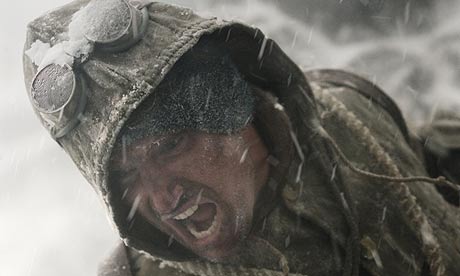
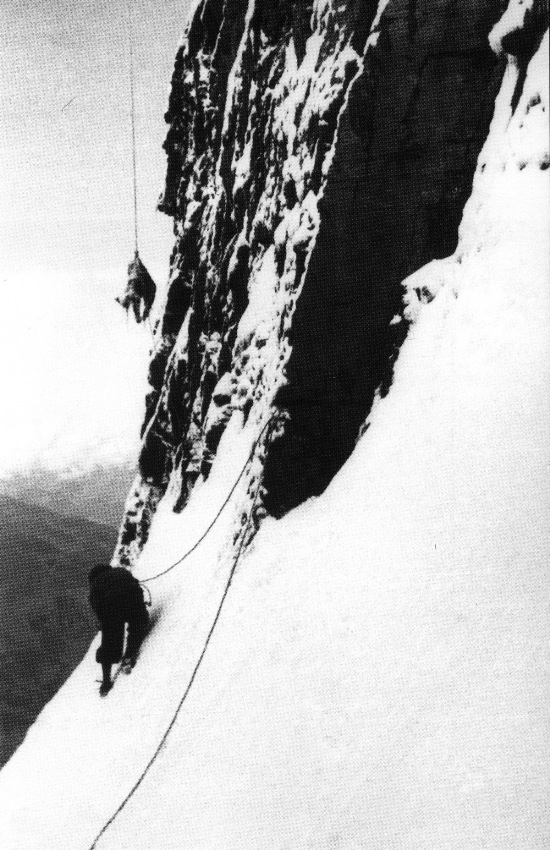
Released in Germany, Switzerland and Austria in 2008 (and only just now making its way to the U.S.), "North Face" (aka "Nordwand") chronicles the 1936 attempt by two teams (one German, one Swiss) to climb the sheer North face of the Eiger ("The Ogre") near Berne, Switzerland. Though the western edge had been summitted since 1858, but the concave bowl on the North slope was considered a particular challenge—"the last problem of the Alps." The deaths of two German climbers in 1935 resulted in a suspension of climbing attempts, but several teams made the trek in 1936 to be the first to attempt that route's first summit.

The film makes it an exercise in politics and career advancement for an assistant at a Berlin publication (
Johanna Wokalek), an amateur alpinist, who persuades her childhood Berchtesgaden chums Toni Kurz (Benno Fürmann) and Andreas Hinterstoisser (Florian Lukas) to make the attempt so that she might cover it for her paper. Kurz is initially reluctant, but his affection for Luise and the challenge of the mountain persuades him to make the attempt in July of 1936. It's watched closely by the German government, as the ascent might make quite a splash for the Nazi Olympics coming up.

The film itself is a marvel,
with the actors doing their own stunts and "really being there" grasping the sides of the mountain. Director Philipp Stölzl creates tense climbing sequences of a type that hasn't been seen before, where every missed opportunity, dropped piece of equipment, and injury is keenly felt in a way that films like "Touching the Void" can't seem to convey. Partially, it's Stölzl's use of time as a factor He doesn't take short-cuts, compress events, and deliberately reminds the audience of the clock and time and daylight passing. His climbers are seen as more altruistic, as well, to the point where one liberty is taken with the story to keep the German boys in a good, audience-identifying light. And there is marked cross-cutting between the struggles on the mountain and the tourists living in the lap of luxury on the ground, while crowding the telescopes to check the climbers' progress.

It's one of the best mountain-climbing films ever made,* with a richly dramatic story keenly conveyed.
That it's, for the most part, true is just frosting.

"North Face" is a Matinee. Dress warm.


* The only down-side is composer Christian Kolonovits' intrusive score which, for some ungodly reason, uses samples of pick-axes for percussion, making you think there are others on the mountain just out of sight. It's distracting and takes away from the drama on the screen.

Tuesday, October 13, 2009

Wings of Desire

"Wings of Desire" aka "Der Himmel über Berlin" (Wim Wenders, 1987)


"I can't see ya, but I know you're here.
I can feel it. I wish I could see your face.
I have so much I want to tell you. I'm a friend.
Compañero."


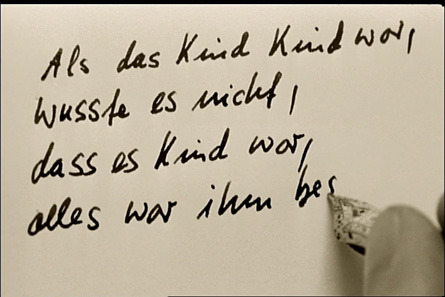
Among the loveliest, most complicated and free-thinking films ever made, Wim Wenders' "Wings of Desire" (he actually prefers that title to the German "The Heavens over Berlin") takes an angel's eye view of humanity shuffling through the everyday. Being angels, their vision is always a dream-like black and white, reminiscent of the look of UFA films. And they conduct their busy-body surveillance unseen, except by young children, other angels and the actor Peter Falkwho can "feel" their presence. Wenders creates a dream-like world for them, passing through walls (and over Berlin Walls), a whispering of voices always in the background as stray thoughts pass their notice—their favorite hang-out being a library, where they watch over the studious and the inquisitive and the poetic, drinking in their new thoughts and understandings. Unlike the people of Berlin,* the Angels are not hemmed in by borders, physical or political, they come and go as they please, giving aid to the afflicted, reflecting joy where they can.

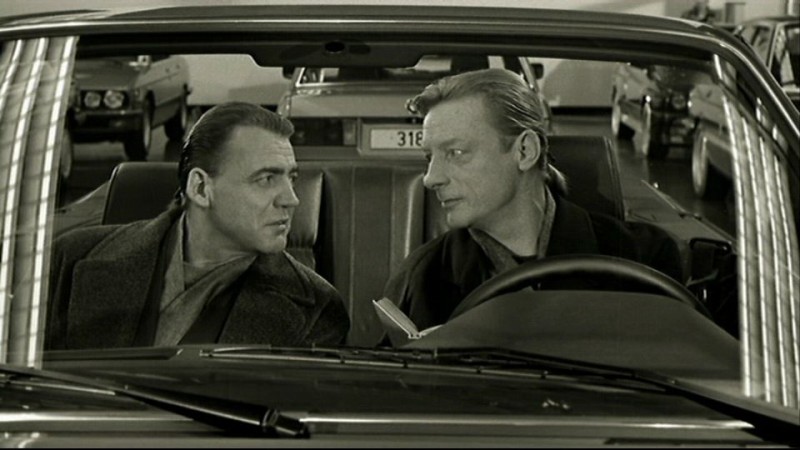
We observe two in particular, Damiel (
Bruno Ganz) and Cassiel (Otto Sander), who compare notes on the new things they've seen during their rounds (while sitting unseen in a convertible in a show-room—they seem to like sitting in vehicles) and express a certain envy over the sensations they've seen in the tangible world. One can see a certain amount of Neil Gaiman's "Sandman" series as inspired by this film, especially in the recitation of the free-form thoughts that spiral through humans' brains. That the script was not set in stone during filming, but was improvised and honed by the writer, director and cast is remarkable given the well of imagery the dialog evokes.

For Damiel, the empathy his rounds evoke and the longing he feels crashes to Earth when he passes a circus and sees trapeze artist Marion (
Solveig Dommartin, who did her own stunts) who also sports wings in her work. Drawn to her, drawn to Falk, he can't resist the urge to experience life as a human and walk among us, and Ganz lights up once experiencing color, taste and touch. For Wenders, the passage from angel to human is not a fall from Grace but a maturation, a risk; it is one thing to give comfort, and quite another to give and to take it. That takes another kind of grace, entirely.


"
Wings of Desire" has a 1993 sequel:
Wenders' "In weiter Ferne, so nah!" ("Faraway, so Close!") and was churned into a bland Americanized remake ("City of Angels" because it's set in Los Angeles) that has none of the lyricism and all of the ginned-up sentimentality mixed with "jeopardy spikes" that come from the Hollywood script-mills.

* I was going to say "Berliners," but why make the same mistake JFK did?

Thursday, January 29, 2009

Olde Review: The Lost Honor of Katharina Blum

This was part of a series of reviews of the ASUW Film series back in the '70's. Except for some punctuation, I haven't changed anything from the way it was presented, giving the snarky, clueless kid I was back in the '70's a break. Any stray thoughts and updates I've included with the inevitable asterisked post-scripts.

If you're feeling in the mood for a little paranoia, you might want to sneak a peek at Friday's ASUW films in 130 Kane. They deal with a social problem that touches us all: the destruction of the individual's right to privacy, and the films are "The Lost Honor of Katharina Blum" and "The Conversation."

"The Lost Honor of Katharina Blum" aka "Die Verlorene Ehre der Katharina Blum oder: Wie Gewalt entstehen und wohin sie führen kann"* (Volker Schlöndorff, 1975) This is a German film, first presented to Seattle at the Moore-Egyptian Film Festival** and proved to be the hit of the many films presented there. It states at the outset that the story is based on a true incident, *** which alerts one that what is about to unfold is a very strange story—so strange that if those responsible didn't tell you it was real, you wouldn't believe it.

We begin by following the surveillance of one Ludwig Götten (Jürgen Prochnow) (we are watching the surveilllance for we, the movie-watching audience out there in the dark, are the ultimate voyeurs) Götten knows he is being followed—that he is being watched, but he manages to elude them...almost. During his wandering, he runs into a girl, Kathharina Blum (Angela Winkler) and they spend that night together.

In the morning, Ludwig is gone. The police who had been surveilling him are dumb-founded, and Katharina is their only lead. And so, amid much hoopla and press coverage, Katharina is taken into custody.

"It is the duty of the police to inform the public." Recognize that phrase? It's something of a play on the old stand-by, now cliche, argument of the Press. But with this phrase comes the first hint of what this movie is driving at. The police and their tactics are openly displayed in the opening segment. Once you know it's the police you are perfectly willing to take on the air of self-righteousness and say "These police are fascists, through and through!" But, as the film progresses, you realize that that the actions of the Press are the focus of the film. Indeed, the press are working with the police; each one supplies the other with information they have scraped up. It's a very harsh picture of the Press that is presented, and many may not like it, after all, being an investigative reporter is in "in" profession—they are our latest media heroes. And it dares to question the people's right to know...that is, the people's right to know dirt. "The freedom of the Press can not be taken lightly," says the duplistic D.A. "But the freedome and dignity of mankind can be?" replies Katharina's outraged aunt. Katharina, herself,states that "it is their business to rob people of their honor, or else they wouldn't sell newspapers."

"...Katharina Blum" is very one-sided. Its arguments and its tone in presenting totally immoral reporters, grubbing for headlines may make some think the film is a total harangue. But, for my part, I couldn't help thinking of the
Patty Hearst's, the Gary Gilmore's, the Jimmy Carter's and the endless string of others whose total life-histories (have been) paraded before our eyes for the sake of ratings or our money. I highly recommend this film to everyone. It might make you think twice before you smirk at the people who refuse to be interviewed on "60 Minutes."

Broadcast on KCMU-FM on January 8th, 1976 (thirteen years ago today)

I am shocked! shocked!! to find that the press do things for money! Still, one would like to think of our news-gatherers as doing a public good as opposed to directing the eyes to the ads, but the situation has only gotten worse, not better. In the 33 years since this review was written (33 years this week, in fact) we have seen the death of ex-Princess Diana, killed in a high-speed car-wreck when her somewhat inebriated driver attempted to evade a horde of papparazzi, a young mother committed suicide after being publicly accused of infanticide by braying talking-head Nancy Grace, and Geraldo Rivera's reporting of a rumor of finding all the miners safe in the West Virginia Sago mine disaster only deepened the country's gloom. Generally, the news-mongers have marched towards info-tainment while abrogating their responsibilities for access and "most-favored" status on K Street party lists. And in a scenario that expands the one of the film to national, and potentially international proportions, the Bush Administration fed self-produced "news" stories to local stations, and planted "reporters" (one, a gay prostitute) to salt press conferences and throw the conferencers some soft-balls. "Lost Honor?" One is lucky not to have their bones jellied in the gears of the News-Monster, government-sponsored or no. Jürgen Prochnow became an international star, and Volker Schlöndorff went to a Hollywood career (directing Dustin Hoffman's stage and TV versions of "Death of a Salesman," as well as the film version of "The Handmaid's Tale") and continues to work in Germany.

And "60 Minutes," with a complete turn-over of correspondents, though its been endlessly copied and co-opted, keeps on ticking.

* "The Lost Honor of Katharina Blum, or How Violence Develops and Where It Can Lead."

** Now called The Seattle International Film Festival, now far expanded from just the Egyptian Theater in Seattle.

***Hmm. So did "Fargo."

Monday, January 14, 2008

The Lives of Others

The Sound of Eaves-dropping and Walls Falling

 
"The Lives of Others" won the Best Foreign Film Oscar over such worthy contenders as "After the Wedding" and "Pan's Labyrinth," so I wanted to see what won out and why. It's the story of an operative in the East German Secret Police who is presented to us as an extremely cold, but very competent interrogator who will over the course of an intense hours-long questioning extract information from "enemies of the state" psychologically. He is approached by the authorities to spy on a playwright who is supposedly sympathetic to the state, and his mistress, who has attracted the attention of a bureaucrat high up in the ministry. The op, named Wiesler (or HGW XX/7) sets up an elaborate net of microphones in the playwright's apartment and begins a 24-hour monitoring for anything that might discredit him. To reveal anything more would be to give away too much information. Suffice it to say that the mission takes an unexpected turn, and in the end everyone is compromised until finally the Wall comes tumbling down and the story becomes something of its own Truth and Reconciliation Commission. Good enough (though not as good as Coppola's "The Conversation"), but "The Lives of Others" does a poor job of pinning down who feels what and when. I couldn't help thinking couldn't be the first scenario of its kind that would lead to similar consequences. But one shouldn't quibble, I guess, when the script is so literate and the performances so subtle that one has to study every line in every actor's face. So, it's a good film. though a flawed one, and for that, I'd rather have seen "Pan's Labyrinth" win.


"The Lives of Others" is a matinee ticket.