Showing posts with label John Huston. Show all posts

Friday, June 29, 2012

Fat City

Fat City (John Huston, 1972) Fat City got a lot of positive critical attention when it came out in '72 and one sees why.  It must have been surprising for a lot of critics that, after a couple of movies (The Kremlin Letter, Sinful Davey, A Walk with Love and Death) that seemed to be desperate to reach a youth market or cater to the looser restrictions on subject matter, that the veteran director could still pull off a gritty down-on-your-heels story and make something new out of it—the old dog still had some tricks up his sleeve, and could do a change-up of genre and tone and come up with something as impressive as the young turks starting to enter the field, like Friedkin and Coppola.  

But it shouldn't have surprised anybody.  Huston was a gambler by trade and by hobby, and was never afraid of taking on different approaches to telling a story.  Sure, he could take a mis-step here and there, especially when he tried to do somthing "of the times," rather than in his own perenneal classicism.  It was always story for Huston, and he was never afraid to take things in complex directions.


Fat City is a tale of two boxers—Tully (Stacy Keach) and Ernie (Jeff Bridges) one on the way up and one on the way down, but the only difference between the two, career-wise, is in the timing.  Ernie is in the early rounds of the bout, all pupptish energy and vigor.  Keach's Tully is in the later stages of the fight, battered, bruised, and tired, having known defeat and the ocassional victory, always just out of reach of a right jab.  When we first encounter them, Ernie has yet to have his first professional fight.  Tully is a couple years out of the ring, barely subsisting.  He's scarred over, but that hardening of tissue, mostly keeps the sense-memory of past victories ringing in his head.  Both mean are trying to get into the ring, one with no way of knowing what will come when he's in it, and the other all too aware of the toll it will take...but, anything is better than his current situation.  As it's said in The Shawshank Redemption, you either gotta get busy living or get busy dying.  In this case, living is fighting.  And for the older pugilist, there's still some fighting to be done, rounds to go before he sleeps.

Huston has had many great male performances under his direction, from such as Bogart, Gable, Clift, Brando, Connery, Finney, but I don't think I've ever seen a better performance in one of Huston's films than Stacy Keach in this.* In whatever you've seen him in, nothing prepares you for the internalized pain that Keach conveys in every aspect of his performance. And there's one moment that will stay with me for the rest of my life. During the fight-centerpiece of the film, when Tully makes his comeback, he's knocked to the canvas, but never counted out. He spends an interminable nine seconds on his knees and elbows, head hanging—and there's a moment, a long moment, when you wonder if he's going to get up—if he even wants to get up. Then, he rolls up into a rickety stance to complete the last few seconds of the round. The fighters retreat to their corners and Keach sprawls on his stool, as the cut-men treat a bleeding gash over his left eye.

Huston stays on Keach's face, and there is no expression on it—none.  So, you go to his eyes, which are dead, betraying no light and no spark.  There may be nothing going on in his mind except the most primal reptile instincts to survive; his head is a black hole, nothing leaves, and there may be nothing to leave.  He's a shell, hollow and broken.  That look will show up again in the film, as a final note, lacking in grace, the soundtrack empty, giving a brief glimpse of death, a living one, yes, but a death that still haunts.


Keach in Huston's Fat City
* Everybody is good in this, but one should also note Susan Tyrrell's feisty, free-wheeling performance of a drunk bar-fly that is on par with Keach's and  feels so real you want to throw up your hands and give up.

Wednesday, April 18, 2012

The Mackintosh Man

The Mackintosh Man (John Huston, 1973) One of the best kept secrets (until 1974, anyway) of the second World War was Project Ultra, the British operation centered in Bletchley Park tasked with breaking the German Enigma codes that scrambled their communications so as to be undecipherable.  What the Germans did not know (because the British kept it secret) was that their dispatches were being regularly decoded and read, and their plans made known to forces in the field.  This was a great boon to the generals who took advantage of the intel—many, including General Patton, did not—but there were times when the messages were merely shelved.  The most egregious example might be the Coventry Blitz, although the facts are in dispute.  Some authors (including the man who first shed light on Ultra) have claimed that Churchill knew of the devastating November 14, 1940 raid by the Luftwaffe, but did nothing to warn the populace or take counter-measures, lest it tip off the Germans that the code had been cracked, thus nullifying an important source of information and intelligence.  If the Nazis knew their messages were being decoded, they might (probably would) make new measures to keep their transmissions secret.  And so (the story goes) Coventry burned in order to keep the secret.  War is not logical, and spycraft even less so, but there's an absurd madness there that parallels the VietNam-era quote stated "we had to destroy the village in order to save it."

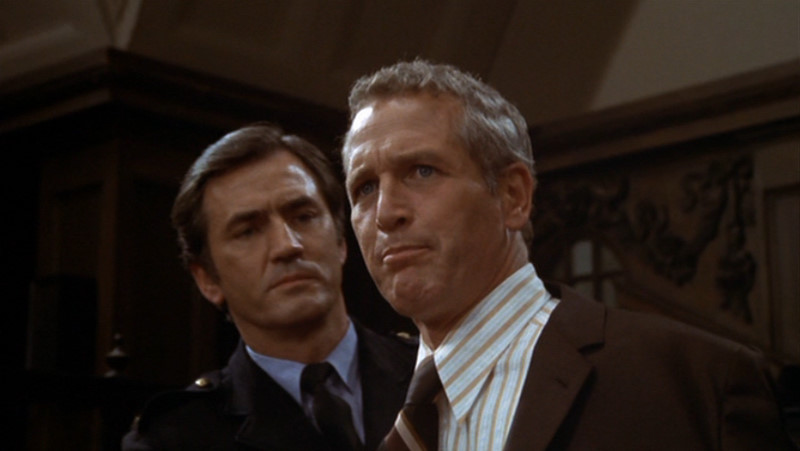
That logic (or lack of it) is much in display in Huston's film of The Mackintosh Man (written by Walter Hill),* a spy thriller the director made in Britain and Malta with Paul Newman.  In it, a British Intelligence agent (Newman) is framed and sent to prison, in order to infiltrate a criminal organization.  But, unknown to him, the deceit goes much deeper, as his superior, Mackintosh (Harry Andrews), is using the mission to ferret out a leak in information in the British government.  Once the agent, named Rearden, is sprung from prison by the conspirators, overseen by an enigmatic figure named "Mr. Brown" (Michael Hordren).  Rearden and another prisoner, Blake (Ian Bannen), are spirited away to an unknown location, drugged and held until the police activity surrounding the prison break cools down.  The escape causes a row in Parliament, led by a law-and-order lord, Sir George Wheeler (James Mason), who rails against the bumbling way in which the prisons and the law are handling it, until he is persuaded to cool down the rhetoric by Mackintosh, himself.

Things get complicated when Mackintosh is run down in the street, and the operation taken over by his deputy, Mrs. Smith (Dominique Sanda), who is now charged with a double mission—Rearden's and the murder of Mackintosh.

Huston barely takes any of this seriously, even if Newman plays it straight, and Sanda—well, it's hard to tell if she plays it at all, her character being so enigmatic as to be undecipherable.  But, it's all staged well (and photographed by the legendary Oswald Morris), especially a car chase through winding Irish country roads that looks dangerous as Hell, and Huston ends on a typically ambiguous note.  But, he's made much better films about duplicity and duty (as has Hill, for that matter), and this one feels like a minor effort before tackling much more ambitious projects.  His next film would be his long-planned adaptation of The Man Who Would Be King.


* This was around the era where Huston was no longer adapting classics, but beginning to take advantage of the scripts of the new college-class of film-makers, including Hill and (for his previous film) John Milius.

Wednesday, June 29, 2011

The Dead


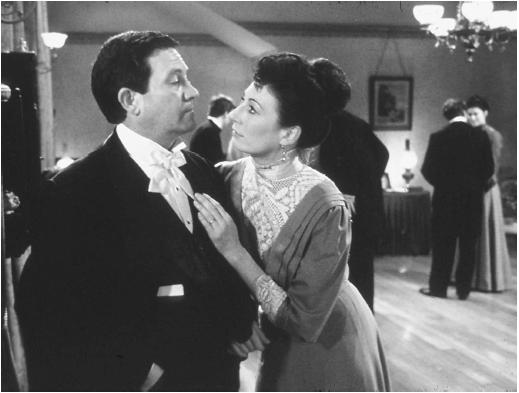
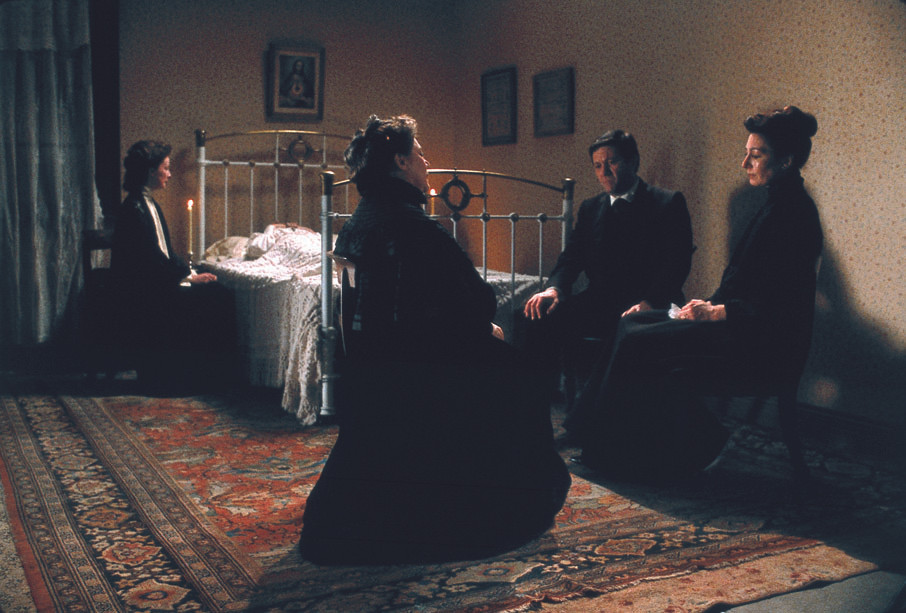
The Dead (John Huston, 1987) An annual Epiphany dinner held by the Morkan sisters (Helena Carroll, Cathleen Delany) creates an epiphany for their nephew, Gabriel (Donal McCann) and his wife Gretta (Anjelica Huston) in the legendary director's last film, a film every bit as strong as his first (The Maltese Falcon way back in 1941) and in many ways far, far more subtle.

You look back on the accomplishments of Huston's career—the classics like Falcon, The Treasure of the Sierra Madre, The African Queen, The Man Who Would Be King, the grandiose films of the '50's, his WWII documentaries, and "unfilmable" projects like Moby Dick, The Bible: In the Beginning..., Reflections in a Golden Eye, Wise Blood and Under the Volcano, and the occasional mis-step like Beat the Devil, Casino Royale, The Life and Times of Judge Roy Bean, Phobia, or The MacKintosh Man*—to "go out" on this simple, elegant adaptation of one of his favorite authors' (James Joyce) short stories, working with his kids (Tony wrote the screenplay, Anjelica stars and in many ways is the "center" of the film), set in the land he loved—Ireland—where he lived and filmed for so many years.  An insatiable gambler on- and off-set, this one he was "all in" and left the table a winner.

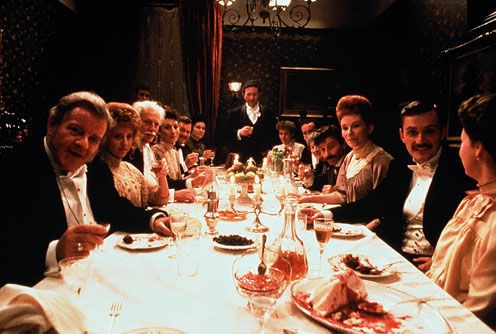
Tough project, too.  Most of it set in one room, a large part around a dinner table, with fine singing (and in one case, not—but the guests are graceful in their praise—and the director moves away from the elderly actress singing, having trouble with lip-syncing the dubbed song, and charitably meanders to another room, dwelling on the cherished collections of that character's rich life, instead).  Huston was in frail health, directing from a wheelchair using a monitor in another room to keep the sound of his by-now always required air compressor from the filming.

Graceful is the word for The Dead, and despite the title, it only periodically succumbs to Irish melancholy.  It centers around a celebration, after all, a once-a-year special ocassion in which, who knows, it may be the last time some of the group might be there.  Best to keep the spirits up, the praise high, and the liquor slightly rationed.  And there aren't any small parts here, if the lines are unevenly distributed, there are bits of business, reaction shots, ensemble acting and quite a bit of dancing to keep things busy.

I just wish (selfishly) the host had stuck around to throw another party.


There is a lot of love in this shot, displayed on-screen and off


* Just imagine if his last film was Annie—which, in itself, was a weird untypical chancey project for him to take on!

Wednesday, May 4, 2011

Wise Blood

Wise Blood (Jhon Huston,* 1979) Flannery O'Connor's excoriating look at religion (in general) and Christianity (in particular) is one bitter chalice of wine, satirical, venomous, and with a savage wit that doesn't seem so comic as you see it playing out.  And the man who directed The Bible (and, rapscallion that he was, cast himself as Noah and The Voice of God), John Huston, takes O'Connor's fire-brand of a novel, and without being too showy, manages to dim the outrageousness and make it a little more real, and a little more relatable.

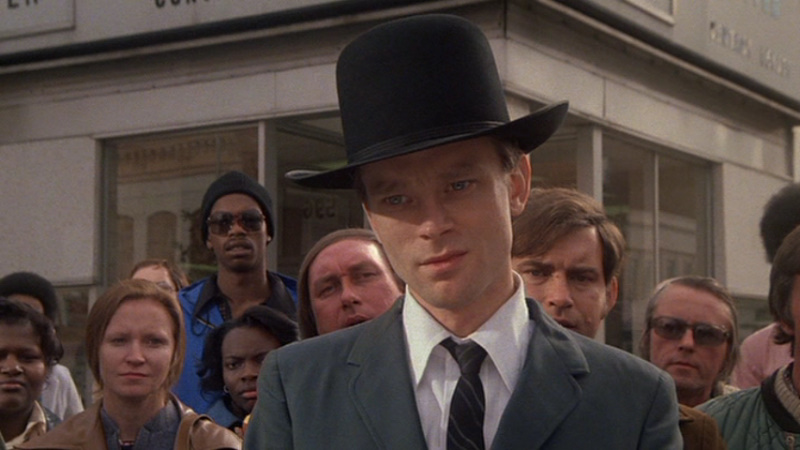
Brad Dourif (a sadly underused actor) heads the cast as Hazel Motes, just off the bus from the Army. He returns home to find the home of his preacher-father (played by Huston) abandoned. You never steer too far away from the family tree, and when Hazel buys himself a new black suit, more than one person says it makes him look like a preacher, which raises Hazel's ire. He intends to live his post-service life as unpreacherly as possible, despite appearances.

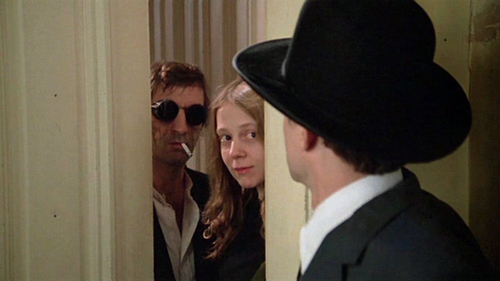
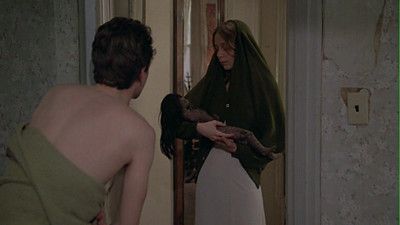
Going to town, he reluctantly gains one disciple, Enoch Emery (Dan Shor), not the most stable of followers, and has a run-in with the un-right Reverend Asa Hawks (Harry Dean Stanton) and his daughter Sabbath Lily (Amy Wright), which incenses Hazel, and shouts that he is going to create his own church, The Church Without Christ, just to show that he can do it, and to expose the chicanery of Hawks, who poses as blind and an interpreter of the word.  No one is what they seem: Sabbath Lily, while pretending to be virginal, is actually slatternly and pursues Hazel, something Asa approves of, as he wants to ditch her and travel light.

Hazel then has problems with another "preacher," Hoover Shoats (Ned Beatty), who creates his own church, The Holy Church without Christ (see the difference?), where its followers can interpret the Bible according to their own personal tastes.  That church takes off, with the help of its own direct interpreter of God's Word (played by William Hickey).  Hazel has lost control of his religious idea (such as it is), losing his Faith and his flock simultaneously, sending him into a murderous frenzy, then into a period of madness in which he rails against false gods, false relics and anything that smacks of devotion, then leading to an ascetic lifestyle that involves wrapping himself in barbed wire, before he can pay for his sins.  Creepy.  And harsh.

Huston keeps a lid on the blackness and bleakness, with an almost matter-of-fact presentation of all this, even being discrete at times.  Not to say the film isn't off-center, it is.  Obviously it is set in America, but one is hard-pressed to determine when.  Filmed in Macon, Georgia, it seems like it could be post-WWII with the attitudes and costumes, but the locals and vehicles are from the period before the filming—1979.  It gives you the sense of backwardness and a slight disorientation, like none of it is real.  Combine that Huston's clear-eyed direction and you begin to not know what to believe.

Apt.


* That's how it's spelled in the Main Titles, designed as a series of road signs with the credits scrawled in chalk on them by a child.  That particular child misspelled Huston's first name but the producers kept it for its childlike innocence.

Tuesday, August 24, 2010

The African Queen

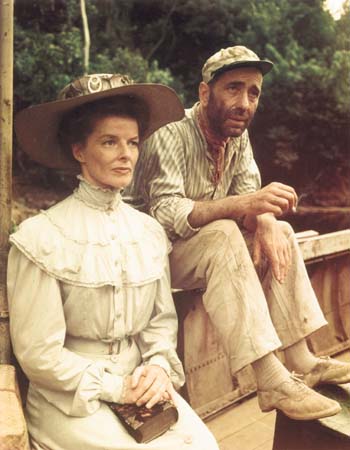
"The African Queen" (John Huston, 1951) An anomaly among John Huston's movies—an unambiguously happy ending (and with the same cameraderie and laughter of his less heroic finishes). Originally set up as a vehicle for Charles Laughton and Elsa Lanchester, then for Bette Davis and David Niven, by the time it crossed Huston's path it became an excuse for Huston to visit Africa (which had just made a cinematic splash in "King Solomon's Mines") and get in some hunting, in a Hemingwayesque quest to conquer new territory. *

Along for the ride were Huston's favorite actor, Humphrey Bogart (with his new bride Lauren Bacall), and the spunky, patrician Katherine Hepburn, who had never worked with Huston before, but was always up for an adventure. **

That always came working with the much-storied Huston.

But, "The African Queen" is a love story, one of those about the transforming nature of love, and the trip down the treacherous rapids on a craft not suited for the purpose is a metaphor for the new experience of love among the ruins—two mature people set in their ways, and for whom love has never been a part of the path.  Love is an adventure, exciting but dangerous, making one vulnerable—but whatever doesn't kill you makes you stronger, and at the end of the coasting, carousing, exploding journey, the couple are adrift but floating, no boat underneath them, but operating on their own power, swimming to an unseen shore, laughing, without a care.  What might have seemed peril before is just one more momentary inconvenience, for the most important thing is the life, the love, and reveling in it.  They start out, bound in dogma and disposition, but in the course of the movie the stick-up-their-butts bend like the high reeds that they must plow through to reach their destination.  Change and accomodating change is all.  At the end, the stodgy individuals are a very zen couple.

Rose Sayer (Katherine Hepburn) is an African missionary when World War I breaks out, and the mission maintained by her and her brother (Robert Morley) comes under attack by German troops.  The mission burned, her brother dead, Rose is taken transit by Candian riverboat captain Charlie Allnut (Humphrey Bogart), who soon finds himself at odds with his passenger.  She is disgusted by his boorish behavior and his drinking, and he is horrified at her stubborn suggestion of using his "African Queen" as a weapon in the war effort.  It's a small skirmish in the world-wide conflict, but the battle of wills softens once the gin is gone and the thrill of the journey kicks in.  The drama comes in the conflict and the crisis, the comedy comes in the duo's new-found dependency on each other and courtliness.  They're an "odd couple," (even the Germans think so!), and the movie veers on a course from drama to high adventure to comedy to horror and even despair, before veering back to its satisfying conclusion.  It's not "The Love Boat," but you'll feel like you've been through the rapids, as well.

I have never seen a version of this movie that wasn't scratched, patched, discolored or broken up.  I've sat through many screenings, horrified, that such a classic (containing Bogart's only Oscar-winning performance) would be allowed to fall into such a state of disrepair.  So, I am pleased to say that, finally, "The African Queen," newly digitized and cleaned up, is available on DVD and Blu-Ray.


* In her book about the filming of "The Red Badge of Courage," ("Picture") Lillian Ross talks about the distraction of "The African Queen" leading Huston to abandoning the Civil War film before it was finished editing, leading to M-G-M (and Louis B. Mayer) cutting the film down from two hours to 69 minutes.

** Two books on the subject of the movie's filming are out there: Hepburn's remembrance of the episode "The Making of 'The African Queen,' or How I Went to Africa with Bogie, Bacall and Huston and Almost Lost My Mind," and "White Hunter, Black Heart" by "Queen's" script doctor Peter Viertel, a roman à clef about the circumstances, much fictionalized—the names have been changed to protect the elephants.

Tuesday, May 19, 2009

Anytime Movies Reloaded: Chinatown

It's Spring-Break for me. Times are busy. The Summer Movie Season is already begun (and I'll be writing about the new ones) and the Film Festivals are grinding away like creaky mills separating wheat from chaff. It's as good a time as any to re-boot a feature I started years ago, when it was suggested I do a "Top Ten" List.

I don't like those: they're rather arbitrary; they pit films against each other, and there's always one or two that should be on the list that aren't because something better shoved it down the trash-bin.

So, I came up with this: "Anytime" Movies.

Anytime Movies are the movies I can watch anytime, anywhere. If I see a second of it, I can identify it. If it shows up on television, my attention is focused on it until the conclusion. Sometimes it’s the direction, sometimes it’s the writing, sometimes it’s the acting, sometimes it’s just the idea behind it, but these are the movies I can watch again and again (and again!) and never tire of them. There are ten (kinda). They're not in any particular order, but the #1 movie IS the #1 movie.

This is the one of the “Anytime Movies” that falls into the category of “Lost Causes and the Futility of Good Intentions,” but lest anyone think these films are depressing, they’re not.

Well, okay, this one is.


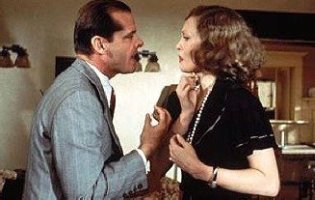
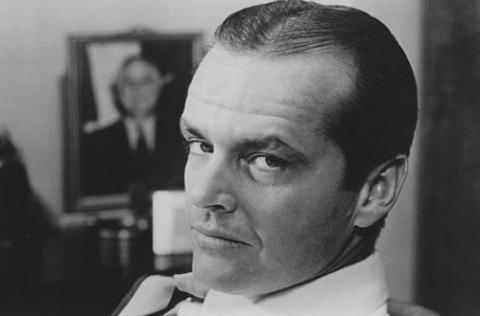
It’s also perfect. Given the nature of the trio of men who oversaw its creation—screenwriter Robert Towne, director Roman Polanski, and producer Robert Evans—the thing could have self-destructed like a fragment grenade. And, in fact, the planned trilogy of films featuring detective JJ “Jake” Gittes investigating three big California crimes (water, land, and nuclear) stopped after the personality clashes that derailed the first attempt at filming “The Two Jakes.” Polanski couldn’t set foot on American soil due to rape charges, and Evans (who was producing and co-starring) and Towne (writing and directing) clashed on the set. The combination of expanded roles and ego following the first film’s success shut down production, and it was only the efforts of star Jack Nicholson, who took over directing, that allowed the film to be made. They say that great films need a miracle – “Chinatown” had it, but “The Two Jakes” didn’t have a prayer.

“Middle of a drought and the water commissioner drown. Only in L.A., huh?”

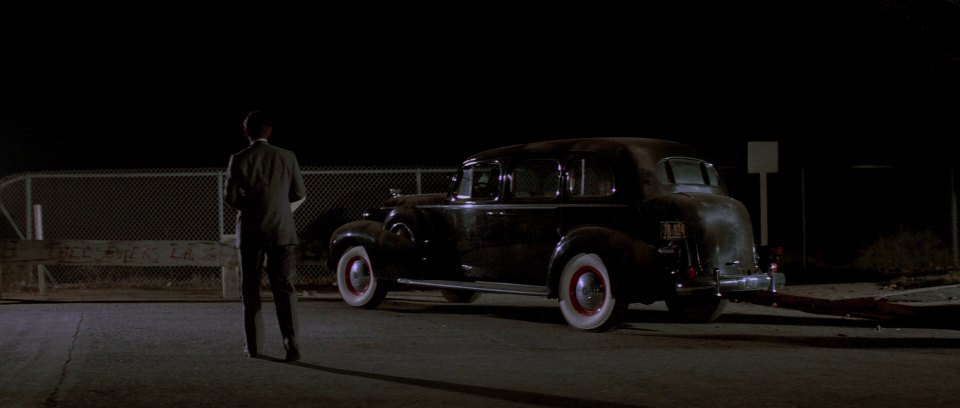
Based loosely on the construction of the William Mulholland designed aqueduct, and the real estate swindles it engendered, “Chinatown” starts out as a mystery even more steeped in the locale of L.A. than Chandler’s Marlowe stories. Here, the very city is a part of the crime and corruption is steeped in its soil and water. Water is the heart of “Chinatown.” Its ebbs and flows are constantly monitored –the original object of investigation is the city’s head of the Department of Water and Power who then becomes the victim of a grisly murder. Water is never too far from the surface of the story. Even Jerry Goldsmith’s shimmering score suggests water in its low harp trills, and the sighing of, yes, water phones.

“Chinatown” gets all its details right—the language, the costumes
—Richard Sylbert’s period work is amazing, and a perfect cast makes the most of Robert Towne’s wise-acre dialog. A perfect cast? Right down to the smallest part. There’s a favorite moment of mine when Gittes, after badgering the secretary of the new head of Water and Power, is distracted by an odd squeaking noise. He, of course, has to investigate, and opens the outside door on the two work-men who are scraping the dead man’s name off the door. The one guy looks irritated—the other guy smiles, nods, and as the door is closing shakes his head ruefully—“Happens every time.” It’s a tiny little moment that feels so authentic, so much more than a mere movie might provide, it provides a moment of truth in a continuous string of truths.

But, that is a moment you can appreciate as it happens. “Chinatown” lives on in the memory. After the mystery is solved, moments come back, as the pieces come together and the journey to the conclusion coalesces. They haunt. On repeat viewings, “Chinatown” is a treasure trove of call-backs and foreshadowing’s.* Little things, like the odd cadence of a name, mispronunciations that can be traced back, a birth-mark—lead you downstream to a resolution that you should, in retrospect, have seen all along. Like Gittes, its only at the end that you get the full story. Of course, like him, you follow the most obvious things that seem out of place or arouse suspicions. ** But the world is a more complicated place and long after the film is finished does it strike you that the two most suspicious people while watching the film are actually the most decent and altruistic ones acting with the best of intentions. Of course, in this world they come to a bad end.


“Do you know how long I've been in this business?”

And here’s where that mix of personalities comes in. Towne’s screenplay is very grey—Jake Gittes at the beginning of the film—the very beginning—gets angry and abusive with his moaning client, Curly (In the film, there’s only an impatient irritation). Later dialog casts a sympathetic spin on water magnate Noah Cross. The original screenplay ends with, if not a happy ending, then a triumphant one. Evans loved the screenplay (though he didn’t quite get it), but in one of those odd bursts of inspiration that sustained him throughout an eccentric career as a producer, decided that the film needed a European sensibility, and so, brought in Polanski, who had left the country and Los Angeles following the murder of his wife Sharon Tate by the Manson family. His perverse take on the city and the material focused it, and made a stronger delineation between good that is good and evil that is truly evil—and provided the ending that doomed those most in need of rescuing. “Chinatown” ends in shock, and with a sense of tragic inevitability. That Jake, in a moment of selfishness and hubris, sets up a series of events that ends up completely bollixing up his good intentions, completes a circle and a character arc that had been percolating below the surface the entire time. He ends up ignoring the lessons he learned in Chinatown (the district, not the film), and paying the same consequences. The final words are ironic--“Forget it, Jake. It’s Chinatown.” Forgetting isn’t his problem. Remembering is. Towne would hammer the point home with the last line of “The Two Jakes”—“Kitty! You never get over it.”

But by that time it wasn’t necessary to say.


Jake wants the truth.
He can't handle the truth.

* On my most recent viewing, I noticed a moment that shocked me. After Jake and Evelyn flee a scene in her car amidst a hail of gunfire, the superbly coiffed Evelyn touches her left eye—as if she has something in it. Whether it was Polanski’s or Dunaway’s choice, it’s a brilliantly sick one.

** Towne’s screenplay is so fully formed that, unlike Chandler’s Marlowe stories, a first person narrative isn’t necessary. We are always aware of what Gittes is doing, and thanks to Nicholson’s performance, what he’s thinking.

Chinatown
Mr. Smith Goes to Washington
American Graffiti
To Kill a Mockingbird
Goldfinger
Bonus: Edge of Darkness

Saturday, November 29, 2008

Across the Pacific

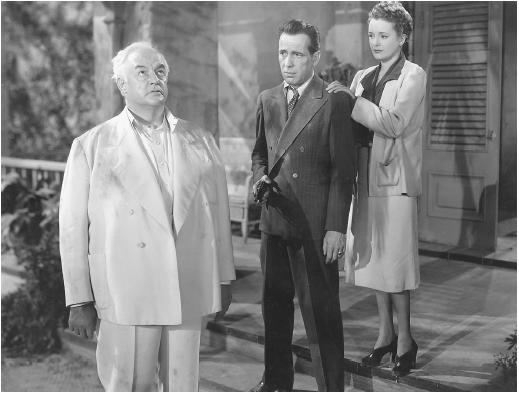
"Across the Pacific" (John Huston, 1943) An attempt by some of the principals of "The Maltese Falcon" to make lightning strike twice...and failing miserably. Director John Huston, stars Humphrey Bogart, Mary Astor and Sydney Greenstreet re-unite to make this larky propaganda film about Japanese collaborators during the Second World War. Bogart plays a disgraced Navy man, but it's a ruse so he can work undercover to infiltrate Japanese spy units (If so, why then do we go through the exercise of seeing him turn in his uniform and being shunned by fellow sailors? Because it's a "movie!") Bogart and Astor meet cute, and then turn all lovey-dovey robbing the two actors of any of the frisson (and resulting sparks) that the Spade-O'Shaughnessy relationship did in "Falcon."

And, look: One has to view films through the lens of the times in which it was made. It's only fair to the movie to acknowledge the attitudes of the time. But the racial stereotyping in this film is beyond the pale, with the one Japanese-American speaking perfect English obviously being a spy. One would think seeing this film that it was a necessary precaution to intern Japanese citizens. That's enough reason to jeer this film. And did one of the Chinatown residents really have to say "theater tickee?"* Huston was a fine craftsman of screenplays; did he really pass muster on this script with all its hackery? To be fair (or fair-er) to Huston, though he directed this thing, he abandoned this film to join the military's photographic unit where he did his splendid documentaries about the the Italian front. One can see why Huston was in a hurry to leave. A disappointing little "programmer" to get the American blood up, the only thing "Across the Pacific" proves is that a movie can be too cute and despicable at the same time.


* I may be stretching this so far it'll snap, but the director John Milius is a conservative with a droll sense of the ironic. He is also a film-student. He's seen a lot of movies. A lot. Conceivably, he might even have seen "Across the Pacific." So, in 1975, he had cast John Huston (the director of "Across the Pacific") as Secretary of State John Hay to Brian Keith's Theodore Roosevelt in his very fine "The Wind and the Lion." At a state banquet, Hay is seated next to the Chinese ambassador, and says to him (about the cutlery) "You likee knif-ee? You likee fork-ee?" and had the cinema-recall to use a joke from "The Searchers" ("You speak good Commanch'. Someone teach you?") after the Chinese Ambassador sits down from making an eloquent, metaphoric toast. He turns pointedly to Haye amd says "You likee speak-ee?," to Hay's evident embarrassment.

Anyway, I like to think he did. I have my own prejudices that way.

Friday, November 28, 2008

The Man Who Would Be King

"The Man Who Would Be King" (John Huston, 1975) The obsessive quest. The lust for riches and the good life it will bring. The realization that the journey may be more important than the rewards. Laughter.

Two ne'er-do-wells cross into unknown territory for riches and are undone by their own greed and discord.

John Huston made this story before--a couple times, in fact. The closest might be "The Treasure of the Sierra Madre," which "The Man Who Would Be King" resembles. But it could also be "The Maltese Falcon," from the villains' perspective. Both films deal with wealth evading their questers' grasp, and both end with some laughter.* In "The Man Who Would Be King," that laughter comes earlier, and provides the miracle that leads the adventurers to achieving their hearts' desires. And gaining wisdom.

Although in each film someone always has to take "the fall."

The story is by
Rudyard Kipling, and story-teller Huston provides the conceit that might have led to the writing of
the tale, as Kipling is featured prominently in the film, portrayed with genial bonhomie and a writer's intrigued fascination at the train-wreck-sure-to-happen by Christopher Plummer. The story, of two confidence men/ex-British militiamen--Daniel Dravot (Sean Connery) and P.T. "Peachey" Carnahan (Michael Caine)--who brave the impossible journey through the Himalayas to find the fabled city of Kafiristan to set themselves up as "kings" held echoes of themes featured prominently throughout the work of John Huston. When he realized his dream of making this film, he was nearly 70 and suffering from emphysema, but the travel and the foreign locations did not dim his enthusiasm at such an age. He said it was one of his favorite shoots in his long-storied career. And one of the easiest.

And it was all due to the casting.

Huston had wanted to make the film in the 50's with
Clark Gable as Danny and Humphrey Bogart as Peachey then later with Burt Lancaster and Kirk Douglas, then Paul Newman and Robert Redford.

It was
Newman who suggested Connery and Caine. The two old friends had never worked together before and seized on the opportunity. Evenings during filming the two would go over the next day's scenes and work out little bits of well-coordinated business that would indicate the relationship between the two con-men, like old vaudevillians who had shared many a stage...and those routines would delight the wolfish Huston when presented with the ideas the next morning.

One wonders what Huston would have made of the film earlier in his career with those teams of actors. Lighter, perhaps. More comedy. Maybe not so hard on the message of the exploitation of conquered nations. But, with Connery and Caine there is a maturity as these two "
soldiers for fortune" go about their business robbing the various "-istan's" "three ways from Sunday."

Would it have ended as it does now, with the grisly but apt ending, and the story-teller becoming so engaged in the telling of the tale, that he is no longer a part of it? Would it have resonated so?

In the end, the point is so moot as to be laughable in itself. "The Man Who Would Be King" is a classic motion picture of any era--a dream project from a master director who had thirty years to perfect it, many chances to get it right, and, unlike his protagonists, the grace and wisdom to appreciate the luck he'd been given and let it live on its own when it was in his grasp.

Not even emphysema could have stopped his laughter at that.

* "The Asphalt Jungle" also has a similar ending...but its low-level crooks do not possess the self-knowledge--or the grace--to laugh at the Cosmic Joke played at their expense.

Wednesday, August 13, 2008

Olde Review: Chinatown

This was part of a series of reviews of the ASUW Film series back in the '70's. Except for some punctuation, I haven't changed anything from the way it was presented, giving the kid I was back in the '70's a bit of a break. Any stray thoughts and updates I've included with the inevitable asterisked post-scripts.

"Chinatown" (Roman Polanski, 1974)

Gittes: Hello Claude. Where'dja get the midget?
Midget: Yer a nosey fellow, kitty-kat, huh? Ya know what happens to nosey fellas, huh? No? Wanna guess? Huh? No? (slices Gittes' nose). Next time you lose the whole thing. Cut it off and feed it to my goldfish. Understand? Understand?!
Mulvehill: Tell 'im you understand, Gittes.
Gittes: I unnerstand!

As opposed to the whimsy of "The Third Man," "Chinatown" is a film of deadly earnest, a perfect example of what is termed "film noir"-which means, in melodramatic terms "when the streets are dark with something more than night," usually the feeling of purveying evil. That is certainly there in "Chinatown," although it would be hard to pin that evil on the influence of the film's all-encompassing villain, or the influence of its director, Roman Polanski, who incidentally played that strangely accented "midget" with a knife you heard in that tape segment.* Polanski shaped this film into a first-rate thriller, even more, into the best film coming out of a major studio in 1974, deserving of every Oscar that "The Godfather Part II" won that year.** As with most of these films, each and every performance is perfectly played from the starring performances of Jack Nicholson, Faye Dunaway, John Huston and John Hillerman, down to a lowly sign painter.***

Chinatown--a section of Los Angeles inhabited mostly by Asian-Americans due to a suppression of their people.

Chinatown--the former beat of two L.A. patrolmen, J.J. Gittes and Lou Escobar; a beat they think in "bad luck" for "you can't always tell what's going on."

Chinatown--the symbol of all evil to Jake Gittes, private detective, for it reminds him of his own tragic failures.

Jake Gittes is hired by a Mrs. Mul'-wray to investigate her "philandering" husband. But as Jake investigates, he realizes that Mr. Mul-wray' is not what he seems, Mrs. Mul'-wray is not what she seems, and Jake finds himself investigating a larger scandal, one encompassing city-wide fraud and personal tragedy. Jake knows all the moves he is supposed to make while investigating--tailing, picking up clues, following them to the next step--and the whole way, he thinks he has the whole case going smoothly. But he doesn't. It is much too big for him to stop. He ignores those little details that he, and we, only can remember later. And Jake Gittes, when the case is over, relives a tragic part of his past, and can only take consolation in the caring words of an associate--"Forget it, Jake. It's Chinatown."

The ending of "Chinatown" is a complete reversal of what the film had, supposedly, been leading up to. It will undoubtedly shock and disappoint you. Some critics have said it is ill-considered and "tacked on." But it isn't. It is perfect for the film that Roman Polanski made, and it makes the experience of viewing "Chinatown" that much more resonant.


Broadcast on KCMU-FM November 11th and 12th, 1975.

Some revisions should be made to this (if I were making revisions). I was being too much of a "nanny" critic, telling people how they should feel. And I kind of blew any surprise that ending SHOULD have by telling an audience to expect it.


And "Chinatown" isn't "the symbol of all evil" for Gittes. That's giving him too much thought of the place. It's just a place to be avoided. Bad luck. Fool me once, shame on you. Fool me twice--

And Walsh's words to Gittes aren't "caring," he says it because there's nothing more to say. "Get over it. What'd you expect?"

I've written about "Chinatown" more extensively
here. But there's more to say. Reading a nearly final script by Towne of this film tells you that Polanski brought more sense of moral rage to the film (interesting, for Polanski). Evil is evil. Good is good. I've always "gotten" the sense that Hollis Mulwray is not only a good man, but practically a saint. There are things implied in Polanski's direction that point even further in that thought. But, in Towne's screenplay, more sympathy is ascribed to the villain. He is not pure evil as the film would have him appear. He is merely weak, and anything can happen in a moment of weakness. Evelyn Mulwray is also less of a victim in that screenplay, though her actions are seen to be a trifle hysterical. There are no easy answers in Towne's early screenplay. Things are not black and white, merely shades of gray. And given Polanski's history--the concentration camps, and his wife, Sharon Tate's grisly murder at the hands of the Manson gang, and his own past films, one would see why he'd tilt it to the side of the devils.

In 1991, "Chinatown" became a part of the National Film Registry.


* Yeah--you don't get the taped segment. Sorry. The transcript will have to do. I've always loved the way Nicholson drawled out "Hello, Claude. Where'dja git the midgit?" It runs a close second to my favorite Nicholson line, from "Five Easy Pieces:" "Don't tell me 'bout the GOOD life, Eldon, 'cuz it makes me PUKE!"

** Although "The Godfather, Part II" also deserved every Oscar it won. Except maybe score. And I don't think that's hyperbole saying the best film coming out of a major studio that year. That's also due to its Executive Producer, the extremely savvy producer Robert Evans. Say what you will about Evans, but under his stewardship, Paramount could not be topped as the dominant movie studio in Hollywood. Look at 'em now, folks.

*** Actually, "Chinatown" is one of the few films where every performance is perfect. And that sign painter--it's one of my favorite bits in movies, because it rings so true. The guy's watching his assistant scrape the name off a door, and that scrape gets detective Gittes to investigate, opening the door. The painters look up at Gittes, who realizing what it is, shuts the door...and AS IT'S CLOSING, the guy in charge replaces his nodding greeting with a rueful shake of his head "Happens every time." Of course it does. But it's the sort of detail "Chinatown" is full of, as so few movies are.

Thursday, August 7, 2008

Olde Review: The Wind and the Lion

Written November 7th, 1975

"The Wind and the Lion" (John Milius, 1975) I avoid seeing films twice unless I really, really love the flm (due to a lack of funds).* When I saw "The Wind and the Lion" the first time, it was as if I was seeing two movies at time. The dialog was really wretched ("Mulai--that's a nice name"), but at the same time the photography, direction and editing were all fabulous. It was a film that had "sweep" (I assume that when a film has "sweep," the camera tends to move along a field, up a wall, through a street, "sweep" through the visual plane of the camera. Oh, but does this movie do that!) "The Wind and the Lion" just swells with movement of all kinds--inside the frame and the frame outside itself.

John Milius is a director I don't tend to think much of. I wasn't too fond of his "Dillinger" film, some good things, but not wholly satisfying. But his direction in 'Wind & Lion" is just marvelous. Some of the shots combined with Jerry Goldsmith's score** are just chillingly beautiful: The trucking shot along a line of berbers silhouetted against a sunset;

A diagonally rising crane-shot that drifts over a dune as an entire army of berbers move down a road while a dark, cloudy sky presses down on the whole scene;

After the Raisuli (Sean Connery) has killed off the final horseman at the leper colony (that was the impression I got anyway) Milius cuts to a stunning shot of Eden Pedecaris (Candice Bergen) watching behind a net in the right foreground, while against a low sun on the ocean-tide, the Raisuli slows his horse and the now-riderless horse of his opponent still charges across the screen;

Theodore Roosevelt (Brian Keith) and "his" bear towering over him, as he reads the "Wind and the Lion" letter.


The second time around, my appreciation of the Milius direction grew. It was what I concentrated on throughout and because of it, the dialog that I was uneasy about went down easer and (My God!) some of that dialog was downright poetic. Roosevelt's speech about the bear as the U.S, symbol, his getting on his desk and growling at the camera for the Smithsonian--things that made me squirm in my seat before--I enjoyed this time around.

This movie is flawed to be sure. Some of the writing is still bad. There are inaccuracies in technique and in history. *** The fellow I went to see it with thought there were too many "riding-in-the desert" shots for his taste, but not for mine. And I heartily enjoyed myself and the film.


I still enjoy it (now that I own it) and all qualms that I had about it are gone, and a lot of the things that I found a bit over-dramatic are things that I now dearly love about it. I neglected to mention the huge contribution that cinematographer Billy Williams brings to this movie, as he carried out some of the beautifully outlandish shots Milius came up with. I wish he was allowed to make more films (he's certainly been allowed to doctor scripts most of his career, and Turner gives him a mini-series or TV movie to do once in awhile). His is a singular voice in Hollywood, and he's smart with what he does on film. Who knows, maybe they'll let him re-boot the new "Ahnold-less" Conan film series, as he did the first one. One would wish.

* This was 1975. It would be another five years before the video-tape boom that allowed folks to watch films in their own home, and even own media of that film. Seems like such a long time ago. Now, if one likes a film, one can buy it, and watch it as many times as they want. That's a great convenience--but it tends to make people cluster to stuff they like, rather than explore and take a chance on a new film.

** An aside from this review here: "Goldsmith just happens to be one of my favorite film scorers. I snap up one of his albums as soon as it appears in the racks, and seldom am I ever disappointed with what I hear. However, one of Goldsmith's pieces doesn't seem to mesh correctly with the visuals--the Raisuli's initial ride on a horse gone hay-wire." Um--that was the point, I think.

*** For instance, an incident like this DID take place during the Roosevelt administration. Ion Pedecaris WAS kidnapped by the Raisuli, in 1904. Ion was male. I'm sure it matters to history buffs, but changing Pedecaris to a woman raises the stakes of the story, and provides a whiff of romance and exoticism. Without "The Wind and The Lion" that incident would have been lost in the sands of time.

Monday, January 14, 2008

Chinatown

This is the first of “Anytime Movies” that falls into the category of “Lost Causes and the Futility of Good Intentions,” but lest anyone think these films are depressing, they’re not.

Well, okay, this one is.


It’s also perfect. Given the nature of the trio of men who oversaw its creation—screenwriter
Robert Towne, director Roman Polanski, and producer Robert Evans—the thing could have self-destructed like a fragment grenade. And, in fact, the planned trilogy of films featuring detective JJ “Jake” Gittes investigating three big California crimes (water, land, and nuclear) stopped after the personality clashes that derailed the first attempt at filming “The Two Jakes.” Polanski couldn’t set foot on American soil due to rape charges, and Evans (who was producing and co-starring) and Towne (writing and directing) clashed on the set. The combination of expanded roles and ego following the first film’s success shut down production, and it was only the efforts of star Jack Nicholson, who took over directing, that allowed the film to be made. They say that great films need a miracle – “Chinatown” had it, but “The Two Jakes” didn’t have a prayer.

“Middle of a drought and the water commissioner drown. Only in L.A., huh?”

Based loosely on the construction of the
William Mulholland designed aqueduct, and the real estate swindles it engendered, “Chinatown” starts out as a mystery even more steeped in the locale of L.A. than Chandler’s Marlowe stories. Here, the very city is a part of the crime and corruption is steeped in its soil and water. Water is the heart of “Chinatown.” Its ebbs and flows are constantly monitored –the original object of investigation is the city’s head of the Department of Water and Power who then becomes the victim of a grisly murder. Water is never too far from the surface of the story. Even Jerry Goldsmith’s shimmering score suggests water in its low harp trills, and the sighing of, yes, water phones.

“Chinatown” gets all its details right—the language, the costumes—
Richard Sylbert’s period work is amazing, and a perfect cast makes the most of Robert Towne’s wise-acre dialog. A perfect cast? Right down to the smallest part. There’s a favorite moment of mine when Gittes, after badgering the secretary of the new head of Water and Power, is distracted by an odd squeaking noise. He, of course, has to investigate, and opens the outside door on the two work-men who are scraping the dead man’s name off the door. The one guy looks irritated—the other guy smiles, nods, and as the door is closing shakes his head ruefully—“Happens every time.” It’s a tiny little moment that feels so authentic, so much more than a mere movie might provide, it provides a moment of truth in a continuous string of truths.

But, that is a moment you can appreciate as it happens. “Chinatown” lives on in the memory. After the mystery is solved, moments come back, as the pieces come together and the journey to the conclusion coalesces. They haunt. On repeat viewings, “Chinatown” is a treasure trove of call-backs and foreshadowing’s.* Little things, like the odd cadence of a name, mispronunciations that can be traced back, a birth-mark—lead you downstream to a resolution that you should, in retrospect, have seen all along. Like Gittes, its only at the end that you get the full story. Of course, like him, you follow the most obvious things that seem out of place or arouse suspicions. ** But the world is a more complicated place and long after the film is finished does it strike you that the two most suspicious people while watching the film are actually the most decent and altruistic ones acting with the best of intentions. Of course, in this world they come to a bad end.


“Do you know how long I've been in this business?”

And here’s where that mix of personalities comes in. Towne’s screenplay is very grey—Jake Gittes at the beginning of the film—the very beginning—gets angry and abusive with his moaning client, Curly (In the film, there’s only an impatient irritation). Later dialog casts a sympathetic spin on water magnate Noah Cross. The original screenplay ends with, if not a happy ending, then a triumphant one. Evans loved the screenplay (though he didn’t quite get it), but in one of those odd bursts of inspiration that sustained him throughout an eccentric career as a producer, decided that the film needed a European sensibility, and so, brought in Polanski, who had left the country and Los Angeles following the murder of his wife Sharon Tate by the Manson family. His perverse take on the city and the material focused it, and made a stronger delineation between good that is good and evil that is truly evil—and provided the ending that doomed those most in need of rescuing. “Chinatown” ends in shock, and with a sense of tragic inevitability. That Jake, in a moment of selfishness and hubris, sets up a series of events that ends up completely bollixing up his good intentions, completes a circle and a character arc that had been percolating below the surface the entire time. He ends up ignoring the lessons he learned in Chinatown (the district, not the film), and paying the same consequences. The final words are ironic--“Forget it, Jake. It’s Chinatown.” Forgetting isn’t his problem. Remembering is. Towne would hammer the point home with the last line of “The Two Jakes”—“Kitty! You never get over it.”

But by that time it wasn’t necessary to say.


Jake wants the truth.
He can't handle the truth.


* On my most recent viewing, I noticed a moment that shocked me. After Jake and Evelyn flee a scene in her car amidst a hail of gunfire, the superbly coiffed Evelyn touches her left eye—as if she has something in it. Whether it was Polanski’s or Dunaway’s choice, it’s a brilliantly sick one.

** Towne’s screenplay is so fully formed that, unlike Chandler’s Marlowe stories, a first person narrative isn’t necessary. We are always aware of what Gittes is doing, and thanks to Nicholson’s performance, what he’s thinking.


Anytime Movies are movies I can watch anytime, anywhere. If I see a second of it, I can identify it. If it shows up on television, my attention is focused on it until the conclusion. Sometimes it's the direction, sometimes it's the writing, sometimes it's the acting, sometimes it's just the idea behind it, but these are the movies I can watch again and again and never tire of them. There are ten. This is Number 7.


IV: -Only Angels Have Wings

V: The Searchers

VII: Chinatown
VIII: American Graffiti


X: Goldfinger