Tuesday, October 22, 2013
The Hurricane (1937)
Among them is Terangi (Jon Hall), newlywed to Marama (Dorothy Lamour), and who works as first mate of the tradeship Katopua, making a regular run to Tahiti. On one of those trips Terangi is ordered to leave a bar by a drunk Frenchman and the resulting fight lands him in jail for six months, unable to return to his new family. The unyielding French governor refuses to pardon him, and Turangi makes one unsuccessful escape attempt after another, only increasing his sentence and his exile.
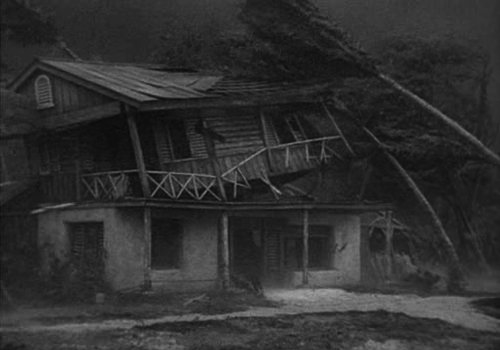
It's a cautionary tale of race prejudice and imperialism that can only be rectified by an Act of God, and at that point second unit director Stuart Heisler takes over with a sequence of live-action, studio-bound mayhem that's horrific to watch, and head-rattlingly impressive. It's also acres above the usual "disaster movie" formula in that Ford and screenwriter Dudley Nichols take the time to actually have the audience familiar with the characters in danger, and place them in the absolute worse situation for their survival, given their traits and prejudices. It's one thing to be wary of an arbitrary natural disaster, but one should always avoid one with a sense of irony (and a sense of reckoning, as well).
Kudos to Ford for actually casting Polynesians as the natives (with the exception of Lamour—who was anything but—and Hall, who was, splitting heirs, half-Tahitian), but the rest of the cast is top-notch with Ford regular John Carradine as a sadistic guard, and an early role for the soon-to-be ubiquitous Thomas Mitchell, who makes an impression with every role. It's not Ford at his most artistic—nor, frankly, did he need to be, but he manages to make the drama on both sides of the cultural divide matter—and letting God sort it out.
Tuesday, November 10, 2009
Dodsworth
"Dodsworth" (William Wyler, 1936) "Why are Americans always such snobs?" asks David Niven's snobbish Capt. Clyde Lockert.
Well, the answer is that there are two kinds of people in this world: people who lump people together with presumptive generalizations and those who don't. And the best place to lump people together is a cruise ship. Just ask the captain of "The Love Boat."
Sinclair Lewis's 1929 novel about "us" and "them," maturity of age or the lack of it, and the pull and drag of greener pastures was adapted for the stage, and then film, by Sidney Howard and directed both times by William Wyler.
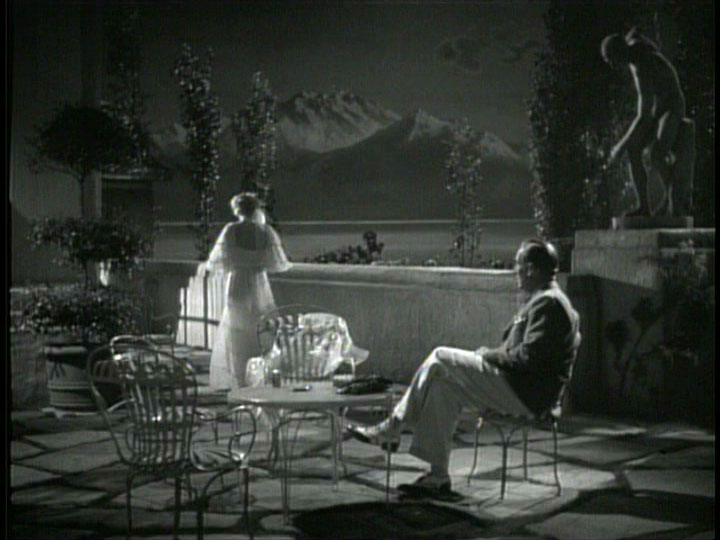
The tale of two small-town empty-nesters—he's a retired auto manufacturer looking for a new challenge, and she's looking for a long-desired European vacation among the sophisticates—is a long, slow sunset of ships passing in the night and the attraction of what has been missed. For Dodsworth (Walter Huston), the trip is an adventure, eye-opening in the possibilities of what the world has to offer. For his wife Fran (Ruth Chatterton), it is an opportunity to move among the elite, whose charm and manners are nothing like her folksy husband's. Eight years her elder, she resents him for making her appear older than she is to the new crowd with whom she seeks attention and company. Attempting to catch a youth-enhancing lightning in a bottle, she begins to have affairs behind his back, risking their marriage and future. The difference between the two after a long marriage with children is the difference between living a life and living a lie—embracing life or avoiding it.
It's a tough movie, even tougher coming as it does from the "speak your piece" 1930's, and it still hearkens to values and the lure of the new and glitzy—of those who jump into life with both feet, and those who choose to remain in the shallow end of the pool. And it's interesting to see a movie that not only focuses on "Can this marriage be saved", but "Should it?" It's amazing how contemporary and timeless "old" movies can be. Their wisdom is always showing up the less mature output of its antecedents.
Wyler's direction is unfussy, placing the camera where it can do the most good, and with a large cast roaming about that usually means some deep-focus shots of the entire "stage." The cast alternates between good actors that you like and you want to slap (although given Huston's robust characterization, what woman wouldn't want a bit of her own limelight?) and the performances, though never vocally subtle—gotta pick up that dialogue!—are helped by the director's intricate lighting and camera placement.
And it's always worth checking out a movie with Walter Huston or Mary Astor.
"Dodsworth" became a part of the National Film Registry in 1990—among the second 25 films chosen—and Time Magazine voted it one of its 100 Greatest Movies of the 20th Century.
Saturday, November 29, 2008
Across the Pacific
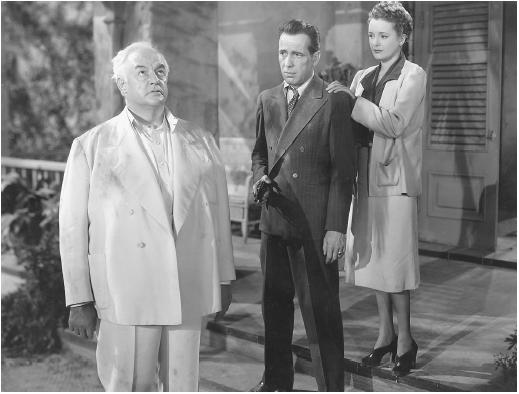
"Across the Pacific" (John Huston, 1943) An attempt by some of the principals of "The Maltese Falcon" to make lightning strike twice...and failing miserably. Director John Huston, stars Humphrey Bogart, Mary Astor and Sydney Greenstreet re-unite to make this larky propaganda film about Japanese collaborators during the Second World War. Bogart plays a disgraced Navy man, but it's a ruse so he can work undercover to infiltrate Japanese spy units (If so, why then do we go through the exercise of seeing him turn in his uniform and being shunned by fellow sailors? Because it's a "movie!") Bogart and Astor meet cute, and then turn all lovey-dovey robbing the two actors of any of the frisson (and resulting sparks) that the Spade-O'Shaughnessy relationship did in "Falcon."And, look: One has to view films through the lens of the times in which it was made. It's only fair to the movie to acknowledge the attitudes of the time. But the racial stereotyping in this film is beyond the pale, with the one Japanese-American speaking perfect English obviously being a spy. One would think seeing this film that it was a necessary precaution to intern Japanese citizens. That's enough reason to jeer this film. And did one of the Chinatown residents really have to say "theater tickee?"* Huston was a fine craftsman of screenplays; did he really pass muster on this script with all its hackery? To be fair (or fair-er) to Huston, though he directed this thing, he abandoned this film to join the military's photographic unit where he did his splendid documentaries about the the Italian front. One can see why Huston was in a hurry to leave. A disappointing little "programmer" to get the American blood up, the only thing "Across the Pacific" proves is that a movie can be too cute and despicable at the same time.
* I may be stretching this so far it'll snap, but the director John Milius is a conservative with a droll sense of the ironic. He is also a film-student. He's seen a lot of movies. A lot. Conceivably, he might even have seen "Across the Pacific." So, in 1975, he had cast John Huston (the director of "Across the Pacific") as Secretary of State John Hay to Brian Keith's Theodore Roosevelt in his very fine "The Wind and the Lion." At a state banquet, Hay is seated next to the Chinese ambassador, and says to him (about the cutlery) "You likee knif-ee? You likee fork-ee?" and had the cinema-recall to use a joke from "The Searchers" ("You speak good Commanch'. Someone teach you?") after the Chinese Ambassador sits down from making an eloquent, metaphoric toast. He turns pointedly to Haye amd says "You likee speak-ee?," to Hay's evident embarrassment.
Anyway, I like to think he did. I have my own prejudices that way.