Showing posts with label Raymond Massey. Show all posts

Friday, December 13, 2013

49th Parallel

49th Parallel (aka The Invaders) (Michael Powell, 1941)
Interesting propaganda film to promote the war effort by the British government, made by "The Archers" (Emeric Pressburger and Michael Powell) before they became "The Archers" and combining the writer-director credits together. More than anything, it was designed to influence isolationist American minds about the threat of the Nazis, by presenting a story where they arrive on our shores.

It is 1941 and a German sub is prowling Canadian waters, sinking any transport they can.  Detected, they make a run for Hudson's Bay and the sub commander orders a landing party to capture an outpost in the area.  But, soon after leaving the sub, the men see it attacked and sunk by a bomber, sent by the Canadian air force, alerted to their presence.  The Commander, Hirth (Eric Portman) continues to land to complete the mission, hoping that they can make their way eventually to the United States which is (gulp!) famously neutral in order to get back to Germany.


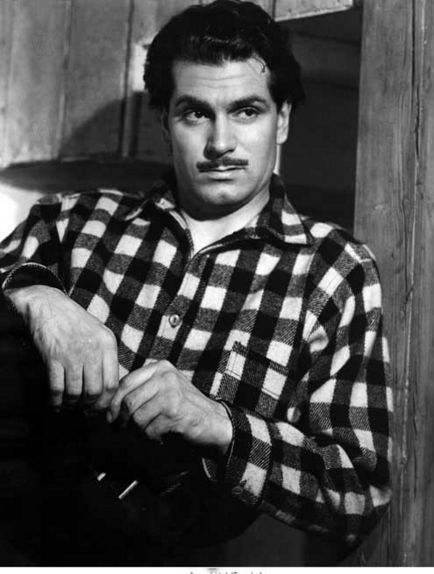
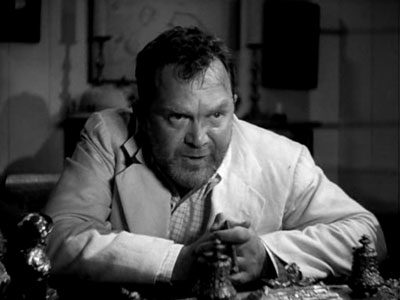
But, first they have to get through Canada.  First stop, a trading post, where Finley Currie and Eskimo guide Ley On are welcoming back French trapper Johnnie (Laurence Olivierwith the wildest accent you've ever heard, eh?) after being up north for eleven months.  The Nazi's take over the trading post, hoping to entice and hijack a plane to get them across the border.  But, it goes badly leading to a skirmish, which barely has the Nazis escaping with their lives.  They then make their way to a German Hutterite community led by Anton Walbrook, who first welcomes the visitors to their peaceful enclave, then when the Nazis' arrogance get the better of them and try to teach the community about their "better" way, Hirth and the community leader engage in a lively debate over the merits of each other's systems.  The Germans are kicked out, making their way to the wilderness where they are captured by the RCMP, but make their escape using an eccentric writer (Leslie Howard) as a hostage, but even that plan does not go as planned.  

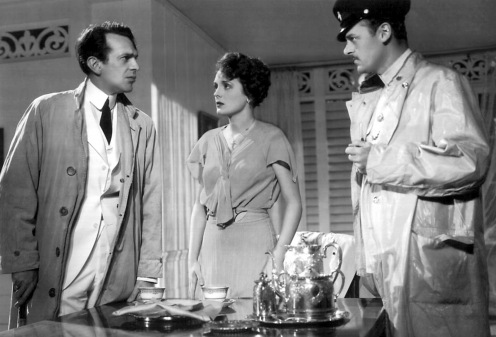
Each encounter has reduced their numbers, and, at the last, only Hirth remains free and on the run.  He hops a freight to try and make it across the 49th parallel into the States, but riding the car with him is AWOL soldier Andy Brock (Raymond Massey), whose sympathies are still with Canada, despite being reluctant to fight, and he makes things very complicated.

It is a propaganda piece, after all, and if the various episodes seem a bit far-fetched and feel like a tortured demonstration on the length and breadth of Canadian diversity ("Meet the Canadians!  Even OUR Germans don't like THEIR Germans"), it is with the intent of contrasting that diversity with the sameness of the Aryan lineage and autocratic group-think of the sub crew.  If the thing gets a little pedantic, it was to educate reluctant Americans about Nazi philosophy in a dramatic fashion and inspire a feeling of "It CAN happen to YOU" to the "American Firster's."  It's a bit clumsy and the fisticuffs are a might ham-fisted, but it's positively sub-tle when you put it up against the thousand goose-stepping hosers of Triumph des Willens.  And Powell and Pressburger were just getting started.

Eric Portman's Commandant wants things a little
more orderly in 49th Parallel


Tuesday, October 22, 2013

The Hurricane (1937)

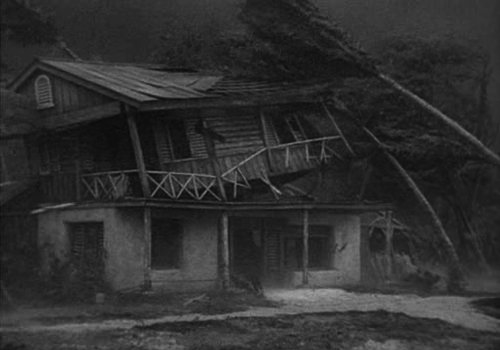
The Hurricane (John Ford, Stuart Heisler, 1937) On a ship sailing through the South Seas, Dr. Kersaint (Thomas Mitchell) waxes nostalgic on the submerged ruins of a building the ship passes, blows it a kiss, and informs a fellow passenger that it was what remains of the island of Manukura, where he lived as a doctor in Paradise, in a time when the Governor was the stuffy bureaucrat DeLaage (Raymond Massey), who was in total contrast to the freer native people.  

Among them is Terangi (Jon Hall), newlywed to Marama (Dorothy Lamour), and who works as first mate of the tradeship Katopua, making a regular run to Tahiti.  On one of those trips Terangi is ordered to leave a bar by a drunk Frenchman and the resulting fight lands him in jail for six months, unable to return to his new family.  The unyielding French governor refuses to pardon him, and Turangi makes one unsuccessful escape attempt after another, only increasing his sentence and his exile.

It's a cautionary tale of race prejudice and imperialism that can only be rectified by an Act of God, and at that point second unit director Stuart Heisler takes over with a sequence of live-action, studio-bound mayhem that's horrific to watch, and head-rattlingly impressive.  It's also acres above the usual "disaster movie" formula in that Ford and screenwriter Dudley Nichols take the time to actually have the audience familiar with the characters in danger, and place them in the absolute worse situation for their survival, given their traits and prejudices.  It's one thing to be wary of an arbitrary natural disaster, but one should always avoid one with a sense of irony (and a sense of reckoning, as well).

Kudos to Ford for actually casting Polynesians as the natives (with the exception of Lamour—who was anything but—and Hall, who was, splitting heirs, half-Tahitian), but the rest of the cast is top-notch with Ford regular John Carradine as a sadistic guard, and an early role for the soon-to-be ubiquitous Thomas Mitchell, who makes an impression with every role.  It's not Ford at his most artistic—nor, frankly, did he need to be, but he manages to make the drama on both sides of the cultural divide matter—and letting God sort it out.

Thursday, September 25, 2008

Action in the North Atlantic

"Action in the North Atlantic" (Lloyd Bacon, 1943) Rousing war-time propaganda film about the Merchant Marines and their attempts to distribute supplies for the war effort while fighting off Nazi air and sub attacks. Directed by Lloyd Bacon whose experience in the WWI Navy lends an undisputed air of authenticity to the scenario, if the visuals don't exactly hold up due to some sub-par model work mixed with chock-a-block stock footage (expertly shuffled by soon-to-be director Don Siegel). Still, the opening sub attack on the vessel Northern Star is impressive for its brutality and its dangerous looking fire work. The actors look convincingly too close for comfort, and the sense of peril is very real. And that's just the beginning of the film. After that first explosive set-piece, there is a lull as the survivors get back to the home front (Skipper Raymond Massey goes home to a young Ruth Gordon, who's a treat to watch). Then it's back to sea as part of an intricately planned flotilla, delivering supplies to...Murmansk, Russia. We're all in this together, comrade.

Massey's the skipper, but the star is
Humphrey Bogart, two steps away from gangsterism, and cracking wise. He's First Mate Rossi, whose "too easy-going to be a skipper," but given a chance could be a cracker-jack commander. Bacon sets up the rules and procedures for the vast convoy, but an attack in the mid-Atlantic separates the "Sea Witch" from the rest of the ships, and the rule-book goes overboard as the ship plays a cat-and-mouse game with a lone sub determined to sink it. While the flotilla attack is dependent on that unconvincing model-work, there's a later Luftwaffe attack on the ship that features amazing wire-work effects, not only on the planes maneuvering through the clouds, but also of bodies being blown from their stations when the ship takes a direct hit. There's no sugar-coating the dangers of war, but the difference between the sides seem to be that the Nazi's scream when they go their watery grave, while the Americans merely have their quips halted. Various strategies are employed to evade the sub, including "going quiet," thanks to the Scottish engine-man who will remind any watcher of a certain star-ship engineer willing to eke out "a wee bit more."

The action doesn't slacken as Bogart's Rossi makes a bold move setting the "Sea Witch" on fire to draw in the sub, and the film ends with a Rooseveltian declaration of solidarity (probably voiced by Stan Freberg), which would prove to be problematic in the 50's when McCarthy went after Hollywood. All in all, an interesting film for all sorts of historical reasons beyond the propaganda factor.

Bogart has a great speech about bravery mid-way through the flick that's worth noting:

"Let me tell ya something about my "iron nerve," son. It's made of rubber, just like everybody else's, so it'll stretch when you need
it. Ya know, people got a funny idea that being brave is not being
scared. I dunno, I always figured if ya weren't scared, there's nothin' to be brave about. The trick is...how much scarin' you can take?"