This week, we're re-publishing some reviews of the films from the post 9-11 environment.
 The Quagmire at Home
This is Paul Haggis' first directorial effort since Crash. In the meantime he wrote three films for Clint Eastwood, The Last Kiss and Casino Royale. He wrote this one for Eastwood, too, but to star in, not direct, which Clintus declined, saying that he's retired from acting. Too bad. This one might have gotten him that Best Actor Oscar. As it is, Tommy Lee Jones has the role, probably does a better job of it, and is certainly deserving of an Oscar. His Hank Deerfield, ex-Army investigator, is a portrait of a guy so meticulous, so disciplined that you wait for him to crack the whole film. It's one of the joys of the film, along with another of Charlize Theron's fine "de-glammed" performances, and Susan Sarandon bringing maximum effort to a small but vital role, all doing great work in a film that tries to be too many things, though it does succeed in many of them.
Part mystery, part war-story, part psychological drama, "Elah," punctuates its story with fragments of media recovered from a cell-phone that, like "Blow-Up" and "The Conversation," give tantalizingly legible glimpses into Deerfield's son's tour in Iraq, and frustratingly opaque clues into his post-Iraq behavior. He's gone AWOL, and Dad Deerfield goes to New Mexico to get to the bottom of it, because that's what he does. Once there, he and a detective try to piece together the evidence, and fight the bureaucratic red tape that hinders their work. Just as Crash owes so much to La Ronde," Elah calls to mind Courage Under Fire, about the death of a Persian Gulf War veteran, where conflicting stories and the subject of post-traumatic stress disorder are dealt with tangentially. Here, it's more overt, but there is an underlying message of the power of doing nothing, or of passing the buck, even ignoring the buck, taking the easy way out, or as the phrase went in Chinatown, the futility of good intentions, when not backed with action. The characters of In the Valley of Elah do "as little as possible" until provoked, challenged and threatened, and its reach is all-pervasive. In the end there is no one perpetrator, but a constant thread of sins of omission, and therein lies the tragedy.
As he did so much in Crash, Haggis telegraphs too many things, with some pretty obvious set-ups that are none too subtle.** The man just doesn't believe in red herrings, and everything gets used. Maybe that's his buttoned-up-in-25-minutes television writing showing. He's become better at cloaking some, though, hiding them in plain sight until they're trotted out for weighty significance. Some will see his final statement as un-American (which they're looking for, I expect), but a careful reading of what's gone before* reveals exactly what he's saying, and its entirely appropriate and, frankly, completely non-controversial. But Haggis seems to invite mis-interpretation. It's what makes him interesting. On top of that, you'll never see better work out of Tommy Lee Jones and Susan Sarandon and their scenes together have a lived-in familiarity and friction that speaks volumes of history and experience. There's some awfully good work in this.
In the Valley of Elah is a solid Matinee.
* Easy for me to say, I take notes!
** According to the Addictionary, this is called "five-shadowing"
Friday, September 16, 2011
In the Valley of Elah

The Hurt Locker
This week, we're re-publishing some reviews of the films from the post 9-11 environment.
 Moonwalking Through the Kill-Zone
or
"Cravin' a burger. Isn't that strange?"
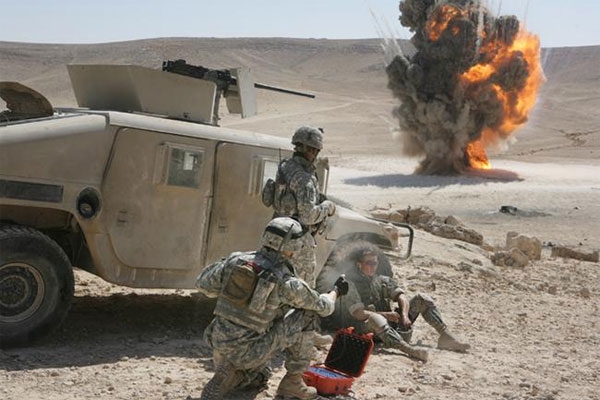
A lone figure walks down an alien landscape in a space-suit of Kevlar and crash-helmet, his only companions are his breath and his thoughts. Death surrounds him, and he walks towards the only certain death he knows of: a make-shift explosive device, conceived in cunning and hate that he must dis-arm in order to save himself, his comrades, and the watching by-standers, one of whom just might be waiting to explode the device. It is not some forbidden planet, or an anarchic Western town, but it could be. It's downtown Iraq, and it comes down to one man walking and facing his fear.Kathryn Bigelow will probably never be considered a "superstar" director.
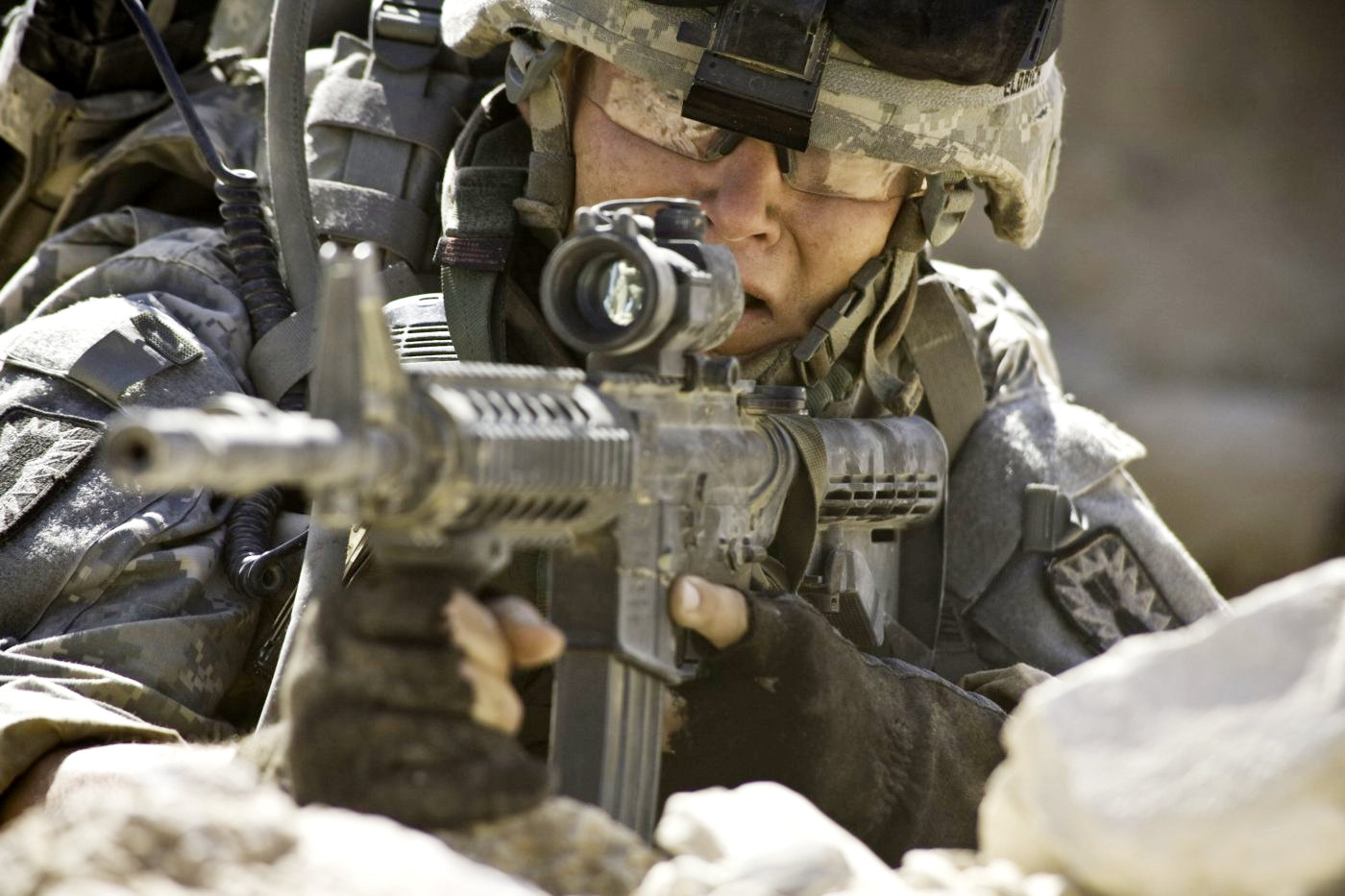
That's too bad, because she miles ahead of the so-called "young Turks" doing action movies these days. Instead of following current trends, she adheres to the rock-solid action direction styles of Anthony Mann and Don Siegel: let the audience know what's going on, and one other thing that too many directors these days forget—an audience has to know the territory their heroes walk through to fully present the dangers they face. In The Hurt Locker she may use a hand-held camera a bit too much to re-create the verisimilitude of war-footage, but it comes in handy to lock you into the searching point-of-view of Bravo Company's of Bomb "Tech's" and "Post-Bomb Assessors"—"The Blasters"—in Iraq's Camp Freedom ("They changed it from Camp Liberty to Camp Freedom because Camp Freedom sounds better," says veteran Sergeant JT Sanborn (Anthony Mackie) to the new Team Leader Staff Sergeant William James (Jeremy Renner, looking like a cross between Nathan Fillion and Brendan Fraser, like most of the principals of "The Hurt Locker," his performance is understated and full of small nuances). James is described as "a rowdy boy" and "reckless." Before his arrival, "the suit," that cumbersome Kevlar get-up which would protect anyone but the man who needs it most, has been the last resort in a disarmament situation. But that's not good enough for James. He likes to disarm the things by hand, and collect the odd bit of equipment for a trophy that "could have killed" him. He'll go in with "the suit" first, and puzzle the thing out, something that doesn't win him prizes with his team-mates, especially Specialist Eldridge (Brian Geraghty), because the longer it takes James to disarm a bomb, the more vulnerable his team-mates are to snipers.
It doesn't take long for the team to realize that James loves his work a little too much, and that it may kill them before their tour is up. Bigelow keeps a running track of the "short-timer" count-down as the situations become more dire and the traps more intricate, electronically and ethically.
War films have gone through a weird evolution from the time they were conscious enough to move beyond the "good guys vs. bad guys" (while still acknowledging that both sides share their share of casualties. But it's been since the Korean conflict that movies started to go deeper into the psychosis of war—not the PTSD issues, but the psychosis of being inside the conflict. One of the counselors at Camp Freedom ineffectually tells Eldridge "You know, this doesn't have to be a bad time in your life." Easy for him to say. All Eldridge can think about is the best outcome of the war—surviving it. And when his orders come down to "Be smart. Make a good decision" it's tough to say what is a good day and what is a bad day. But lately, war-films have taken a look at the man on the line and what makes a good soldier, and it comes down to a blurred combination of self-sacrifice and controlled psychopathy. Whatever the motivations its the results that count. We've seen that theme in Hell is For Heroes, and Patton, Apocalypse Now, The Burmese Harp, Full Metal Jacket, and Flags of Our Fathers. How the soldier compartmentalizes the war experience to survive and even stay sane through the fire determines his ultimate worth as a soldier and as a human being. It is that perspective, of life is brief increments, that keeps a soldier walking alone in The Now, where "The Big Picture" is unseen in the limited view of his path, unknowable and brutally finite—the past a bitter memory, the future an empty promise, and today is walked with the high of High Noon.
The Hurt Locker is a Full-Price Ticket.
Thursday, September 15, 2011
Lions for Lambs
 "Never engage the enemy for too long, or he will adapt to your tactics"
 There are three arenas in play, and as the film begins the protagonists are checking their ledgers and statistics: Lt. Col. Falco (Peter Berg) is checking his strategy briefings; Senator Jasper Irving (Tom Cruise) is looking at dropping poll numbers; Professor Steven Malley (Robert Redford) is checking the quarter's attendance; Reporter Janine Roth (Meryl Streep) is looking at her unopened note-book--an empty slate. Thus begins Lions for Lambs* a polemic about the current Middle-East War, the entities that package and sell it, and the public that may not like it, but won't do anything to oppose it. All the stories intersect a bit and the movie takes place over a few hours. The script is by Matthew Michael Carnehan, who also wrote The Kingdom Its director, Peter Berg, who plays Falco here, said that film was "98% Action, 2% Message." Here, that ratio is reversed, and, man, is it tedious.
First off, there is a heavy veneer of liberal self-satisfaction (though not as much as when conservatives put the hammer down). The senator is a Republican tyro, trying to bolster his party's (and his) poll numbers by setting up a new front in Afghanistan (Senator's can do that? I mean besides Charlie Wilson?) He's given Roth a solid hour (this is supposedly a big deal) to argue his case that this attack (no, really, this one!) will win the war in Afghanistan, the war on terror, the hearts and minds of Afghans (he really says this) and presumably bring the troops back home for Christmas (he doesn't say this, but he might as well have). Cruise was bio-engineered for this role (and you just know this is the part Redford would have taken during his career in the cynical 1960's), an opportunistic-photo-op-ready politico, with flags on the desk, pants-press in the office, and flashing Chiclets in his mouth, while Meryl Streep is all shambling messiness, trying to counter the arguments (is that her job?) that Cruise spins on the head of a pin. Their section is the sort of "greased-pig" argument and obfuscation bull-session that keeps me from watching the "pundit" shows--nothing's less fun or informative than watching two used-policy salesmen, hectoring each other trying to get their feet stuck in the open door of your mind. Finally it gets down to my favorite argument when rats-on-their-hind-legs are cornered--The Multiple Choice Bottom-Liner: "Do you want to win the War on Terror: Yes or No?". ("Well, I don't know, Senator, when did you stop beating your wife?") At one point Streep asks, "When does the new offensive start?" Cruise looks at his (supposed) Rolex. "Ten minutes ago." So much for pre-selling.
And in that ten minutes, the mission is already SNAFU'd, when two grunts are bounced out of a helicopter taking heavy fire, turning the offensive thrust into a rescue mission. Not a good start to winning those hearts and minds.
And by a curious coincidence--or a heavy-handed ploy by the screenwriter--those very two soldiers were both students in Professor Malley's political science class, who, in a school project capped their volunteerism argument by enlisting. Now, Malley uses them to guilt a slacker-student who can't be bothered coming to class because he's "busy with stuff," into considering a more activist stance before the bigger challenges of jobs, mortgages, ball-games, and watching "American Idol" zombies away any chance of him doing any critical thinking for the rest of his life. That's a valid argument to make, whichever side of the aisle you take bribes on. But instead of making the arguments, Malley turns them into three-corner shots that kind of dance around the problem, rather than saying something, oh, like "I would suggest you start coming to class or I will flunk your lazy frat-ass: your call."
The trouble here is that the issues are so immediate that the arguments the film is making were too late four years ago. So, it's a bit like soft-ball preaching to the choir. The arguments are sound, but they have very little relevance to extricating us from the tar-pit of this conflict, and, yes, people are getting chewed up by it, but that's the business of war, and why you try to avoid it, rather than rush in like a damned fool. It's great to be able to say all this with 20-20 hind-smugness, but it's essentially useless. Now tell us something we don't know, and how we can avoid it the next time. "Is he failing you?" a fellow frat asks the student about his meeting. The movie certainly is.
"Lions for Lambs" is a cable-flick.
* The title derives from a phrase from World War I, but, the exact nature of the quote is subject to debate, and its history, like the film, is a bit muddled.
Wednesday, September 14, 2011
The Kingdom
This week, we're re-publishing some reviews of the films from the post 9-11 environment.
 Cries and Whispers
On the American military compound in Rhiyadh, two terrorists command a security vehicle and open up machine gun fire on a family softball game leaving carnage before they are killed. But like the WTC attacks, it's a two-pronged assault, the first wave of terror providing the means for a devastating explosion during the rescue efforts. For four FBI investigators it becomes a personal duty to investigate the scene and find out what happened and who was responsible. They only have five days. They're under constant surveillance by the local police. Their movements are restricted, their presence resented and the attack zone compromised in the clean-up efforts. The only thing they do have is an Exit Strategy, which has been formulated before their arrival, and things have a way of changing. But it's personal, and they have to find a way, doing an impossible task, in an unfamiliar and hostile area, without leaving a trace because it's not exactly sanctioned by the U.S. government. Yeah, good luck with that.
The Kingdom is directed by Peter Berg, whose previous film was Friday Night Lights, a film I greatly admire. Berg shepherded that film over to a fascinating series on NBC, and unlike his previous series "Wonderland," has made it all the way to a second season. He started out as an actor-- was the slightly lump-headed first seduction of Linda Fiorentino in The Last Seduction, and he starred for several seasons on "Chicago Hope," where he first started directing. Berg is a genuine find--an intelligent director who communicates everything-- gives you all you need to know, keeps things logistically decipherable, and lenses with an oblique eye that takes everything in but doesn't beat you over the head with it. An action-director who gives his audience credit for intelligence and propels the film along, trusting that the audience will keep up.
Berg has a flashy cast for "CSI: Rhiyadh" (scripter Matthew Carnehan describes it as "Imagine a murder investigation on Mars") in Jamie Foxx, Chris Cooper, Jennifer Garner and Jason Bateman (as well as Danny Huston, Frances Fisher, and Jeremy Piven--who basically plays his "Entourage" character working for the State department). Everyone's performance is tamped down, but the fact is they're all stars--well, Bateman is there for comedy relief--and unlike the cast of "Friday Night Lights," they stand out like sore thumbs, which actually serves the film well. But the stand-out performance is by Ashraf Barhom, whose Col. Faris Al Ghazi takes his job of providing protection for the team so seriously that he hampers their efforts at every turn. And given that his job is to stand in for the entire Arab world (almost every other local is a bit of a cypher), he carries off the role with a subtlety that doesn't betray the heavy lifting.
Berg has stated that he didn't want to make a "message" film, saying that the ratio for a film to make a point and make an audience is "98% action, and 2% message." That may be overstating the case, as there's a lot more message in the film hidden between the frames. But...though the film does put a face to the Arab world, though it does reflect the heavy-handed presence of America there, though it may bring into sharp focus the folly of having a formalized military presence in a guerilla situation and the dangers that that presence can provide in escalating the conflict--though it may say all these things that point to the folly of invading Iraq, that 98% action still has the effect of having the audience jingo-cheer on the Americans (even with Arab back-up) in a fire-fight in a hotel building. You have to have your message and the action that belies it. That's troubling. But while one contemplates that, the film moves on and delivers a spoken coda that says that, really, we're all not so different after all.
Boo-yah.
"The Kingdom" is a cheap Matinee
Tuesday, August 4, 2009
The Hurt Locker
Moonwalking Through the Kill-Zone
or
"Cravin' a burger. Isn't that strange?"
A lone figure walks down an alien landscape in a space-suit of Kevlar and crash-helmet, his only companions are his breath and his thoughts. Death surrounds him, and he walks towards the only certain death he knows of: a make-shift explosive device, conceived in cunning and hate that he must dis-arm in order to save himself, his comrades, and the watching by-standers, one of whom just might be waiting to explode the device. It is not some forbidden planet, or an anarchic Western town, but it could be. It's downtown Iraq, and it comes down to one man walking and facing his fear.
Kathryn Bigelow will probably never be considered a "superstar" director.
That's too bad, because she miles ahead of the so-called "young Turks" doing action movies these days. Instead of following current trends, she adheres to the rock-solid action direction styles of Anthony Mann and Don Siegel: let the audience know what's going on, and one other thing that too many directors these days forget—an audience has to know the territory their heroes walk through to fully present the dangers they face. In "The Hurt Locker," she may use a hand-held camera a bit too much to re-create the verisimilitude of war-footage, but it comes in handy to lock you into the searching point-of-view of Bravo Company's of Bomb "Tech's" and "Post-Bomb Assessors"—"The Blasters"—in Iraq's Camp Freedom ("They changed it from Camp Liberty to Camp Freedom because Camp Freedom sounds better," says veteran Sergeant JT Sanborn (Anthony Mackie) to the new Team Leader Staff Sergeant William James (Jeremy Renner, looking like a cross between Nathan Fillion and Brendan Fraser, like most of the principals of "The Hurt Locker," his performance is understated and full of small nuances). James is described as "a rowdy boy" and "reckless." Before his arrival, "the suit," that cumbersome Kevlar get-up which would protect anyone but the man who needs it most, has been the last resort in a disarmament situation. But that's not good enough for James. He likes to disarm the things by hand, and collect the odd bit of equipment for a trophy that "could have killed" him. He'll go in with "the suit" first, and puzzle the thing out, something that doesn't win him prizes with his team-mates, especially Specialist Eldridge (Brian Geraghty), because the longer it takes James to disarm a bomb, the more vulnerable his team-mates are to snipers.
It doesn't take long for the team to realize that James loves his work a little too much, and that it may kill them before their tour is up. Bigelow keeps a running track of the "short-timer" count-down as the situations become more dire and the traps more intricate, electronically and ethically.
War films have gone through a weird evolution from the time they were conscious enough to move beyond the "good guys vs. bad guys" (while still acknowledging that both sides share their share of casualties. But it's been since the Korean conflict that movies started to go deeper into the psychosis of war—not the PTSD issues, but the psychosis of being inside the conflict. One of the counselors at Camp Freedom ineffectually tells Eldridge "You know, this doesn't have to be a bad time in your life." Easy for him to say. All Eldridge can think about is the best outcome of the war—surviving it. And when his orders come down to "Be smart. Make a good decision" it's tough to say what is a good day and what is a bad day. But lately, war-films have taken a look at the man on the line and what makes a good soldier, and it comes down to a blurred combination of self-sacrifice and controlled psychopathy. Whatever the motivations its the results that count. We've seen that theme in "Hell is For Heroes," and "Patton," "Apocalypse Now," "The Burmese Harp," "Full Metal Jacket," and "Flags of Our Fathers." How the soldier compartmentalizes the war experience to survive and even stay sane through the fire determines his ultimate worth as a soldier and as a human being. It is that perspective, of life is brief increments, that keeps a soldier walking alone in The Now, where "The Big Picture" is unseen in the limited view of his path, unknowable and brutally finite—the past a bitter memory, the future an empty promise, and today is walked with the high of High Noon.
"The Hurt Locker" is a Full-Price Ticket.
Monday, March 9, 2009
Gallipoli
 Two Australian business men, Robert Stigwood (the man behind the "Bee Gees" phenomenon and flush with money and influence) and Rupert Murdoch, owner of some of the Australian and British tabloids, who would parlay his fortune into acquiring 20th Century Fox Company and turning it into his News Corp., took a chance funding this anti-war film about one of Australia's saddest hours, written and directed by the brightest light in the New Wave of Australian cinema.
As was the case with quite a bit of the Aussie cinema, it seemed like a cross of genres, between British kitchen-sink and the American Western, and its main narrative thrust—of two champion runners from different planks of society who seek their destiny in the Armed Forces—provided an opportunity to present Australia circa 1915 to the world at large. At this point in his career, Weir still had a jarring crutch or two: his use of electronic music—in this case, Oxygene by Jean Michel Jarre* —for the running sequences seems a bit too modernistic for a period piece although the pace is certainly suggested by the bouncy piece of techno.
The two Aussie's, Archy Hamilton (Mark Lee) and Frank Dunne (Mel Gibson) compete in a foot-race with Archy just beating him for, and the two strike up a friendship. Archy wants to join the military's Horse Brigade and do his part in the War effort. Frank decides to try his luck, too, anything being better than his railroad job.
The film follows their paths, diverging and re-joining to the Australian-New Zealand front with the ANZAC** at Gallipoli, where the two men trying to make their mark are just two cogs in the war machine, and where contingency is determiner of life and death. In the confusion and bluster of the battlefield, one is lucky if Fate is allowed into the mix. It's a damning film about the value of worth, and the total lack of morality on the battlefield. Unclouded by politics, staying in the trenches amongst the mud and fog of war, Weir brings the film to a close with a single solitary image in freeze-frame, which wraps up his themes and reverberates in its implications. With this one film, Weir started to remove the ambiguities of his earlier films, and became much more assured as a film-maker.
ANZAC Day, commemorating the landing of the Australian-NewZealand forces at Gallipoli, is celebrated as a national holiday each April 25th.
*He's the son of future Weir composer Maurice Jarre, who wrote the scores for David Lean's last films, including "Lawrence of Arabia" and "Doctor Zhivago."
**The Australian and New Zealand Army Corps
Wednesday, February 4, 2009
Che
 "The Face That Launched a Thousand...Poster Sales"
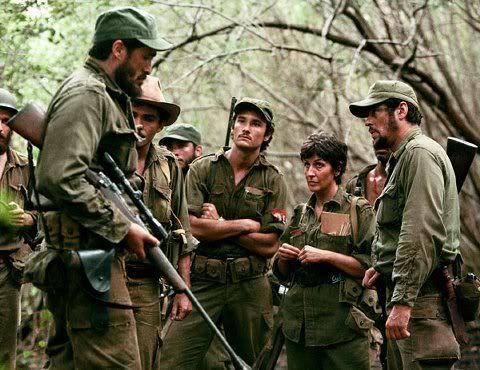
As I did with "W." here are some very brief political comments on the subject of the Ernesto "Che" Guevara bio-pic "Che":* I don't look at the world with red stars in my eyes, and think History has proven that Communism is a flawed political system where human beings are concerned. In the Cuban Chapter of that story, "Che" was The Revolution's question to George W. Bush's answer: An ideologue who thought nothing of spreading his vision to nations other than his own, whose patriarchal attitude towards foreign peoples blinded him to the hypocrisy of spear-heading "revolutions" that he had no part of. While Castro settled to enjoy the spoils of his coup, Che felt the need to "spread freedom" throughout the world, a "freedom" that was inherently in his country's best interests (sound familiar?). This, and other ironies are not explored too deeply in Steve Soderbergh's massive 4 1/2 hour epic, which is less a biography of Che, as it is a necessary chapter in the evolution of the "War film."
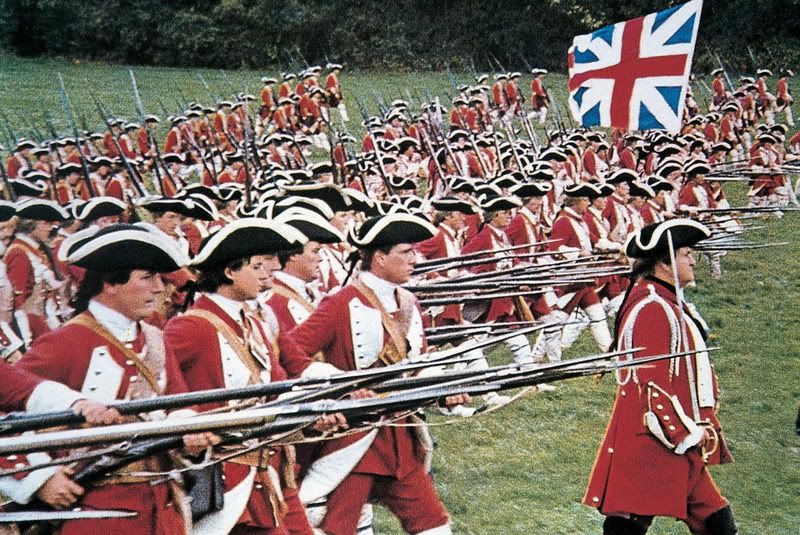
Blame the American Revolution, I guess. When those up-starts chose to battle the British in extremely non-formal (and un-cinematic) patterns, film-makers have been struggling to bring some sort of cohesion to the chaos of men at war. Face it. Watching patterns of soldiers moving forward in massive lines is great cinema. Crowds of men (you've supposedly come to know as characters) rushing forward pell-mell in a panic is tougher to capture and make sense of (though Welles did well, and Gibson). Better to keep the numbers fewer, or better yet focus on one participant, be he John Rambo or Oliver Stone's Pvt. Taylor. Bush-fighting—that's another story.
Soderbergh starts his two films** with maps: of Cuba in Part 1 (subtitled "The Argentine"); Bolivia (And South America), in Part 2 (subtitled "Guerrilla"). The major cities, territories and geographical locations are pointed out one by one, each with their own color (which made me wonder "Is that the color filter he'll be using in that location?") But it's a great technique—so great I'm surprised it hasn't been done more. The familiarization of the territory means you never have to orient the viewer again about what's happening where. And so, Soderbergh and his screenwriters Peter Buchman and Benjamin A. van der Veen don't have to do major scenes of exposition talking about over-arching plans before battles (especially in an improvised war). Tossed off mentions of cities will suffice. The audience will remember.
This allows Soderbergh to streamline the momentum of both movies; We're allowed to focus on characters, survival tactics and the problems of motivating volunteers on a perpetual camping trip with a dodgy supply of weapons and the opportunity for disaster around every corner (but isn't that any soldier's view of war in the field?). Nor is there the need to stop every few minutes and have a Juan Esposito character come in and talk about "The Big Picture." We've been given the run-down of the territory (and despite these being revolutions, all wars boil down to real estate.
That this revolution was a jungle war of fighters coming down from the mountains as self-employed mercenaries to either win hearts and minds of the native populace (it is stated repeatedly that Che was not Cuban, but Argentinian-it's even in the title of the first film) or to re-supply or target a government stronghold. As with any war, a lot of it depends on luck and a lot of it depends on what the other side does not know but suspects. Both elements helped the rebels defeat the Batista government forces...who were Cuban, and felt a loyalty to their homeland, and an affinity to the rebels as they were countrymen. They also didn't have much fight in them, when push came to...nothing much.
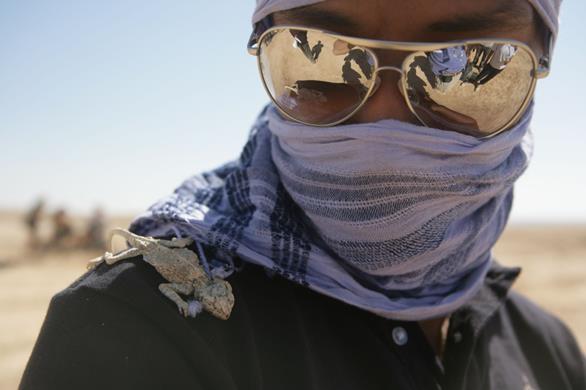
Despite a "to-the-bone" performance by Benicio Del Toro (the film is almost completely in Spanish, although those who would speak English do so), Guevara remains an enigmatic figure. There are attempts to de-mythologize him--his frequent asthma attacks make him a hindrance to the fight, but as a physician he is able to treat it to a certain extent. He starts as being the Chief Medical Officer, and gradually works his way to being a field commander and strategist. By the end of the first film, he is clearly in charge of his small brigade and the film ends with an extended house-to-house battle in Santa Clara that features a surprisingly well-orchestrated train derailment. Soderbergh shoots in an effective hand-held style, as in a news-reel (mostly shot by the director himself) that gives the street-fighting a see-it-now authenticity, rather than a well-orchestrated set-piece (which it had to have been to film).
Taking the myth out of the fight and the romance out of the struggle is a lot of what makes the marrow of "Che." We see the day-to-day problems of the guerrillas fighting disease, starvation, infection and the occasional opportunist. Soderbergh and his screenwriters put forth a Che Guevara who is principled to "The Revolutionary Code," with a piece-meal sense of morality. The portrait is a noble one, but the film-makers subtly undercut it, allowing cracks between the lines, details that are not called attention to. Although a supposedly brilliant strategist, Che (and Castro, nicely portrayed by Demian Bichir) are seen frequently smoking cigars in conversation. Unless the jungle's on fire wouldn't that be a tell-tale sign to patrols that there are humans nearby? Not to mention that those Cuban cigars are made through the exploitation of Cuban nationals (and mostly women at that, in sweat-shop conditions). Women are seen fighting with the guerrillas, but that macho attitude doesn't seem to be applied to them. At one point, Che's second flirts obliquely with him, which he deflects by mentioning his wife and child in Mexico City, although by the start of the next film, he is married to her (with three kids).
Soderbergh is not-so-subtle in one juxtaposition. At the beginning of the second film, Castro reads Che's farewell letter in which he states his intention that should he die, his last image will be the same blue sky seen by his Cuban comrades. When his last moment comes Soderbergh switches (for the first time) to a point-of-view shot to show us the unromantic reality of his last vision.
If there is anything marring Soderbergh's scrupulously lived-in presentation, it is in the "star-cameo's" that occasionally crop up to jar you out of the situation, as much as they do in "The Greatest Story Ever Told." Franke Potente and Julia Ormond (in a blonde wig so as to be unrecognizable, but really, can one make a serious picture these days without Julia Ormond?) are seen in city surroundings where their movie-star looks blend a bit, but jungle scenes of Matt Damon and Lou Diamond Phillips tug right out of the jungle and back into Hollywood.
But the arc of the two movies allows you to see the "Che" you want to see: the "Che" triumphing in adversity of Part 1, or "Che" scrabbling into an inevitable defeat in Part 2. There's a lot of history not gone into in-between, but for the polarized, and the polarizing this will do for now.


.jpg)


.jpg)






* Thus, avoiding Godwin's Law: The longer an Internet string, the more inevitable a comparison to Hitler will be made. I've seen too many comment threads on this film devolve into the "Evil Che" harangue (usually by people who haven't seen it). Thank you. That corner exists on the Internet somewhere and I would suggest going there, even though I'm not entirely unsympathetic. But if it shows up in this comments section it will be erased...permanently. Any attempts to add it again will be erased...permanently. Try to add it again, and you should check into a hospital because you're clearly trying to see a different result from the exact same action and that is a sign of insanity. I have no patience with ideologues who've long stopped thinking. I'm here to discuss the film, and I'll discuss it or "The Birth of a Nation" or "Triumph of the Will." Film is controversy--unless it's "Marley & Me"...and even then...
**After its "Road-Show" performance (which is the one I saw), "Che" will be released separately (if all goes according to plan) as "Che, Part 1: The Argentine" and "Che, Part 2: Guerrilla." IFC, which is distributing the film, is also making it available as a Pay-per-View Event.
***One more thing, completely tangential: During his ill-fated campaign in Bolivia (after his never-mentioned ill-fated campaign in the Congo) Guevara lived under a series of code-names, as he was trying to keep his presence in that country a secret. In Part Two, he's known as "Ramon" and then in his last days, as "Fernando." I walked in not soon after the Inauguration whistling "Black Superman-Muhammad Ali," but walked out with " Fernando" in my head. I don't think the writers of the Abba song were making a connection.
Friday, December 12, 2008
Sahara
 (based on "an incident" in a Russian screenplay) disguised as a war-time action picture. Humphrey Bogart stars as Sgt. Joe Gunn,** a cranky old Yank in a clanky old tank, the LuluBelle, who, making his way back to a friendly base, gathers together a rag-tag crew of Allies (French, British, Australian, South African, Italian and Sudanese) in North Africa. Voted in charge of the make-shift troop, he makes priorities—keep LuluBelle running, find water, deal with the Nazi troops nearby, stay alive. Along the way, through the collective effort, manage to sustain a stronghold against a large Nazi desert-troop. Filmed in the California desert, it still feels like rough duty for the actors amid the sand, the flies and the sweat. Director Korda and multiple screenwriters, including John Howard Lawson and Sidney Buchman keep the surprises and the intrigue sustained through the entire picture, while promoting brotherhood and cooperation between the lines.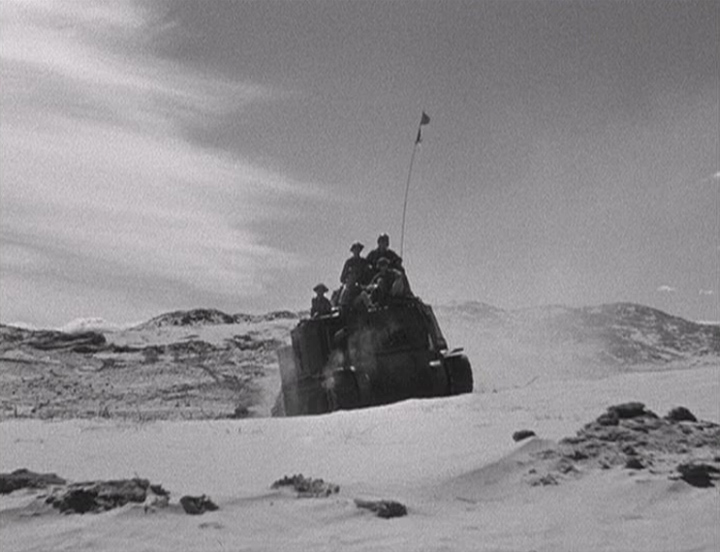
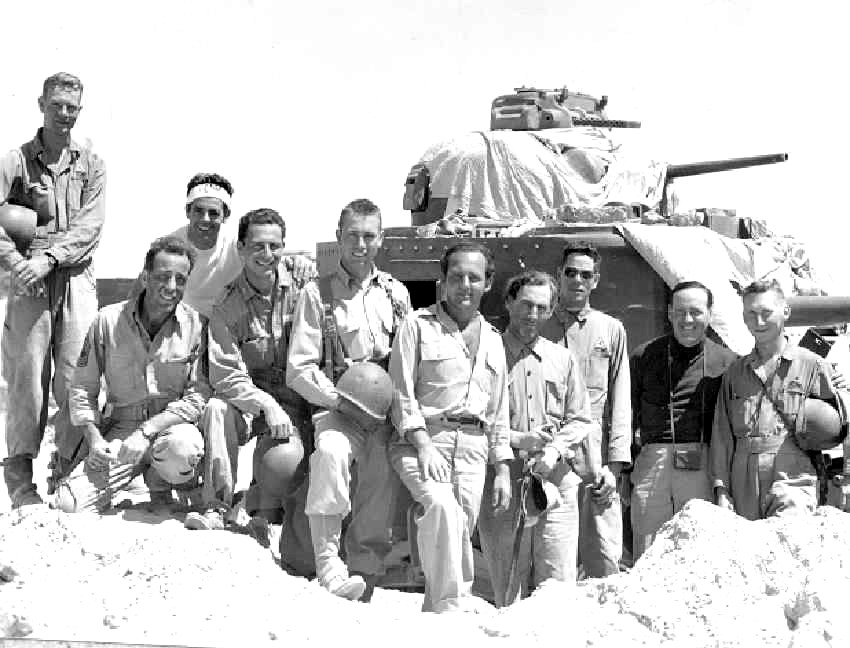
Bogart really has the least interesting part, but he excels at being the crux of the movie and meriting being the guy to whom all eyes turn. It's an effective, oddball role. Of all the films with people of obvious ethnicity pulling together whether in American or Japanese war films, "Sahara" succeeds brilliantly, betraying neither the prejudices of the period, nor moving too far into caricature. The movie even takes a stab at trashing the "master race" theories of the Nazi's.
Amidst the water retrieval methods and the tense negotiations and full-on battle scenes featuring big guns and deceiving trench-warfare, the stranded Allies still have time to compare cultures and rememberances of home. "The things you learn in the Army," says a smiling Texan to the Sudanese in conversation.
There's your recruitment headline right there.
* Not to be confused (as if it could be) with the 1983 Brooks Shields vehicle, or the 2005 Clive Cussler adaptation with Matthew McConaughey and Penelope Cruz.
** Presumably Luger being too German, and Beretta to be used in a 70's cop show and Joe Rifle...sounding as dumb as Joe Gunn, frankly.
Friday, October 3, 2008
A Very Long Engagement
"A Very Long Engagement" aka "Un long dimanche de fiançailles" (Jean-Pierre Jeunet, 2004) Epic war film, reuniting Jeunut with his "Amelie" The lighthouse stirs to life star Audrey Tautou, that tells the story of one woman's search for her lost lover who went to WWI and never came back. The film is full of story and incident (and Jeunet's wind-up mechanism way of telling a story) that it makes the 134 minute film feel a lot longer.
The film starts as a story told in flash-back of five soldiers who were court-martialed for self-mutilation (shooting themselves in the hand by various means) in order to get themselves out of the war and the hellish existence in the trenches on the front line. One of them is the Manech (Gaspar Ulliel), lover of Mathilde (Tautou), whose fantasies and re-imaginings of the circumstances of the war make up the bulk of the film's realisation. By various means, she begins to piece together the story of her lover's court-martial and punishment (he and the others found guilty are thrown out of the trenches into "no-man's land" to fend for themselves), which are told "Rashoman"-like from different angles and perspectives.
The war-scenes are appropriately grisly, Jeunet displays his usual penchant for things grotesque--there's a murder of a rotund general by a prostitute that's particularly...interesting--that are part and parcel of his films, and there's the tendency to turn his films into little Rube Golberg-esque mechanisms, that can become tedious as much as they can delight (He always has to thrown in "the mechanism of sex" joke somewhere, too).* Still, as distracting as his eye for the unusual shot can be, there are moments of "gee-whizzery" and CG-wizardry that are pretty wondrous, and stay in the head long after the details of the movie fade. Jeunet is a master of bending reality to meet his artistic goals, whether lighting and dressing an area to its maximum potential, or employing digital tricks to make it conform to his vision or the past's.
Examples of some of the amazing frames of "A Very Long Engagement," some courtesy of Evan Richards and his wonderful blog "Cinematography, Etc." A make-shift field hospital set in a dirigible hangar is engulfed in flames when a bomb sets off the contained hydrogen.
 A sinister night meeting is made even more so in Jeuneut's composition--as the one must come down to the other's level.
 Going a long way for a visual pun-a farmer is met by gendarmes to join the war-effort, and the wind from their car sweeps aside the tall grass leading to their wagon. "Draft," indeed.
 Jeuneut makes incredible use of depth-of-field here, as Mathilde seeks out the wife of one of the condemned in a market-place (Yes, that is Jodie Foster, whose french is impeccable)
 A CGI recreation of WWI-period Nice, France. Quite Nice, in fact
 The crippled Mathilde must stand on her rickety wheelchair to reach for war records.
 "MMM"--the initials "Manech's marrying Mathilde" --is a constant icon throughout the film. Here, Jeuneut cranes up from the carved initials to Mathilde's obvious bliss. The shot will continue further up to include an albatross-symbol of tenacity.
 The young Mathilde fantasizes that her new boy-friend will save her from falling from the lighthouse. The next scene will have them embracing as they gaze from the light in a mock-Hollywood shot.
 Jeuneut makes the stair-way leading to the light-house lamp a "golden spiral.
 From the impossibly soaring crane-move preceding it, it's obviously a set, but the breathtaking sun-set looks quite real, even if it is computer-enhanced.
 Jeuneut makes Mathilde's family's home warm and earthy by accentuating the color palette of the scene.
 The Fog of War--Jeuneut drains the color out of a stark battlefield to shades of gray.
 A hospital is drained to a sepia tint, not unlike the jaundiced color of old medicine bottles.


Ultimately, it is such a polyglot of a movie that one can't help feel it might split any potential audience. Those wanting a purely romantic film will be put off by the war scenes and the occasional blunt sexuality, as well as the prolonged sense of hopelessness the film radiates. Those interested in the mystery aspect will be frustrated by the lack of momentum in the progress of acquiring facts and the diverging stories leading to blind alleys. What spurred me on was seeing the amazing scenes like the preceding ones, and seeing a new one around every splice.
It's an amazing film, if not everyone's cup of tea.
* It occurs to me that in the unlikely event Steven Spielberg ever wants to hand over the reins of the "Indiana Jones" films to another director Jeunet would be the perfect choice.
Thursday, September 25, 2008
Action in the North Atlantic
 war-time propaganda film about the Merchant Marines and their attempts to distribute supplies for the war effort while fighting off Nazi air and sub attacks. Directed by Lloyd Bacon whose experience in the WWI Navy lends an undisputed air of authenticity to the scenario, if the visuals don't exactly hold up due to some sub-par model work mixed with chock-a-block stock footage (expertly shuffled by soon-to-be director Don Siegel). Still, the opening sub attack on the vessel Northern Star is impressive for its brutality and its dangerous looking fire work. The actors look convincingly too close for comfort, and the sense of peril is very real. And that's just the beginning of the film. After that first explosive set-piece, there is a lull as the survivors get back to the home front (Skipper Raymond Massey goes home to a young Ruth Gordon, who's a treat to watch). Then it's back to sea as part of an intricately planned flotilla, delivering supplies to...Murmansk, Russia. We're all in this together, comrade.
Massey's the skipper, but the star is Humphrey Bogart, two steps away from gangsterism, and cracking wise. He's First Mate Rossi, whose "too easy-going to be a skipper," but given a chance could be a cracker-jack commander. Bacon sets up the rules and procedures for the vast convoy, but an attack in the mid-Atlantic separates the "Sea Witch" from the rest of the ships, and the rule-book goes overboard as the ship plays a cat-and-mouse game with a lone sub determined to sink it. While the flotilla attack is dependent on that unconvincing model-work, there's a later Luftwaffe attack on the ship that features amazing wire-work effects, not only on the planes maneuvering through the clouds, but also of bodies being blown from their stations when the ship takes a direct hit. There's no sugar-coating the dangers of war, but the difference between the sides seem to be that the Nazi's scream when they go their watery grave, while the Americans merely have their quips halted. Various strategies are employed to evade the sub, including "going quiet," thanks to the Scottish engine-man who will remind any watcher of a certain star-ship engineer willing to eke out "a wee bit more."
The action doesn't slacken as Bogart's Rossi makes a bold move setting the "Sea Witch" on fire to draw in the sub, and the film ends with a Rooseveltian declaration of solidarity (probably voiced by Stan Freberg), which would prove to be problematic in the 50's when McCarthy went after Hollywood. All in all, an interesting film for all sorts of historical reasons beyond the propaganda factor.
Bogart has a great speech about bravery mid-way through the flick that's worth noting:
"Let me tell ya something about my "iron nerve," son. It's made of rubber, just like everybody else's, so it'll stretch when you need
it. Ya know, people got a funny idea that being brave is not being
scared. I dunno, I always figured if ya weren't scared, there's nothin' to be brave about. The trick is...how much scarin' you can take?"
Wednesday, April 23, 2008
The Burmese Harp
 "The Burmese Harp" ("Biruma no tategoto")(Kon Ichikawa, 1956) Sublime Japanese war story about an Imperial troop in Burma set during the last days of the Second World War. Led by a former choir-master, Captain Inouye, the men comfort themselves with song, and on the practical side, communicate in hostile territory through a code of music. Leaving aside the fact that music might not be the perfect sound to "blend" in the jungle, the film does make the point of it as a universal language in one miraculous scene. As the troops sit huddled in a hut in a Burmese village awaiting an ambush by Allied forces, the tension becomes unbearable. As a ruse to draw them in and trick the enemy that they are relaxing rather than poised over their weapons, the men begin to sing "Hanyu No Yado," a plaintive song of home. To their astonishment, the Allies begin to chime in, as the melody bears a remarkable similarity to passages of "Home, Sweet Home." For a time, the enemy forces combine as they perform and listen and unite. The war has ended. The Allies are there to inform the Japanese troops and confiscate their weapons, and the music's common ground has provided a demilitarized zone between cultures. No one dies that night.
But the war goes on. The Americans are having a tough time convincing die-hard Japanese soldiers that hostilities have ended. In their temporary prison camp, the troop is asked to help in bringing in the still-fighting men. Mizushima, the self-taught player of the difficult Burmese lute, volunteers and is seemingly lost in a battle to the death among British and Japanese forces. But, on their way to the Mudon prison camp, Captain Inouye passes a lone Buddhist monk, who resembles Mizushima, and speculation begins about his fate.

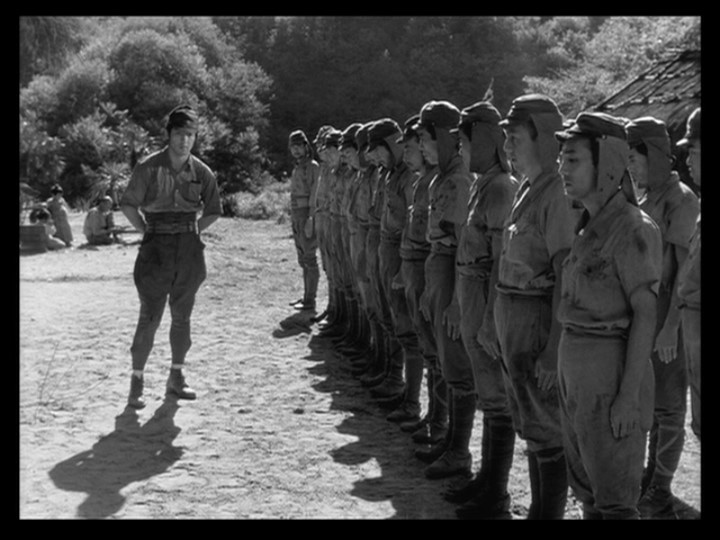
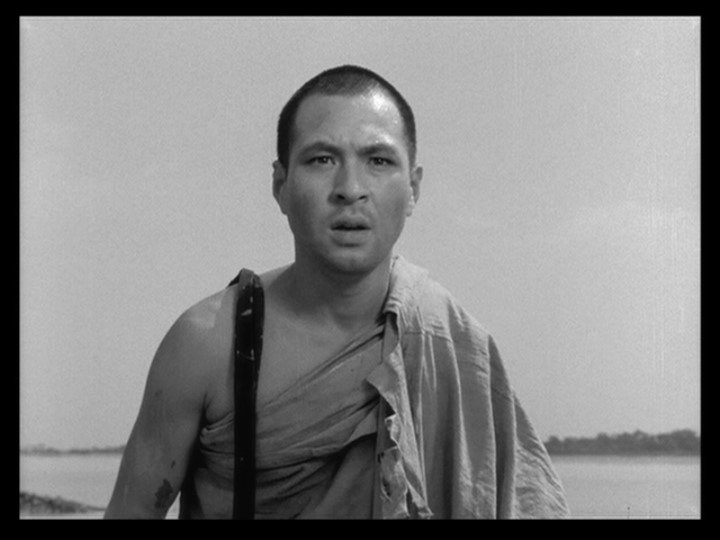
It's a moving, satisfying film about comradeship and duty and how the two combine and divide us. It's also beautifully composed and shot. I can't recommend it highly enough.


Kon Ichikawa was a replacement director on the project, but it was a story that he particularly loved. His troops aren't interchangeable soldiers, they are individuals who react to situations differently, dream of home and family and are frequently repulsed by the nature of their war. Ichikawa uses the jungle settings as vast backdrops that dwarf the men--swallows them, throwing them back in time amidst the stone idols that litter the landscape. Slow, stately and passionate, "The Burmese Harp" is one of the greatest war films I've ever seen.


Kon Ichikawa died February 13, 2008, one of the masters of the Japanese cinema.