Showing posts with label Tom Cruise. Show all posts

Wednesday, October 30, 2013

The War of the Worlds Through the Years

Seventy five years ago tonight (at 8 pm EST, in fact), Orson Welles chose to do a radio broadcast just for Hallowe'en—a radio adaptation of H.G. Well's novel of "The War of the Worlds" on his "Mercury Theater On the Air" broadcast on the CBS radio network. 
  
Welles' show was not that popular, and so a lot of people didn't hear the introduction of the piece stating clearly that it "presenting 'The War of the Worlds' by H.G. Wells"; most of those listening to the radio at that time of the evening were listening to the more popular "The Chase and Sanborn Hour", which featured ventriloquist Edgar Bergen and his dummy Charlie McCarthy (yes, a show with a ventriloquist was very popular on radio).  But, twelve minutes into the comedy show, there was a song interlude, and people did then what they do now—they surfed the dial, looking for something better until the segment was over and they could turn back.

And what they found was this:


At about twelve minutes in, the broadcast was just getting interesting: a faux dance music program was being presented and interrupted by "news bulletins" reporting that plumes of incandescent gas had been seen leaving the planet Mars and headed for Earth. A "return to scheduled programming."  Then another interruption saying that meteorites have landed near Grover's Mill, New Jersey (as opposed to Woking, Surrey in Wells' novel) and Princeton expert Professor Richard Pearson (Welles) is brought in to speculate that there is no life on Mars.  The next segment is a "live report" from Grover's Mill where "reporter Carl Phillips" (played by Frank Readick, who had "prepped" for this segment by listening to reporting of the explosion of The Hindenburg) reports on the opening of the cylindrical meteorites, the appearance of tentacled creatures wielding a death beam that incinerates the crowd...

And then...silence.

The original script (by the ubiquitous Howard Koch) was deemed to dull by Welles, and a new draft was created, inspired by an Archibald MacLeish radio-play "Air Raid" (in which Welles had appeared).  The idea was not to dramatize events as in the novel, but to use the medium of radio to provide the context and the drama of how such an invasion might play out under the circumstances and over the air-waves.  More than the audio of a staged play (as most of these things were), it was very much of its source—a radio-play, by, of, and about the experience of getting the news live over this new medium, unfiltered and immediately...without a chance for resolution. 

"Panic" may be too strong a word for the result, and the newspapers played it up to discredit the reliance of radio for news,* but there were many, many, many people who heard the simulated news-casts and, now used to recent advances that allowed "news flashes" interrupting programming, and at a time when Germany was making moves on Austria and Czechoslovakia, took them for the real thing.  A cursory search on the dial would have told them that the only network broadcasting the events at Grover's Mill was CBS, but the events were so compelling that not many switched away.  Some merely left their radios in their panic to avoid "the coming invasion." It wasn't until the 43 minute mark in the broadcast (which ran no commercials as it was not sponsored) that the network broke in to remind listeners that they were, in reality, listening to a radio-play.  This was necessitated as the CBS switchboard in New York was flooded with calls to the point of incapacitation. 

For Welles, three things happened: he became a nationwide celebrity, "The Mercury Theater On the Air" got a sponsor and became "The Campbell Soup Hour", and Welles was lured to Hollywood by RKO Studios, where they hoped he might make a film of "The War of the Worlds," to cash in on the notoriety. He had other plans.  

A film of "The War of the Worlds" would have to wait.


••••••••••••••••••••••••••••••••••••••••••••••••••••••••••••••••••••••

The War of the Worlds (Byron Haskin, 1953) Twenty five years after Welles' broadcast, George Pal made a Technicolor movie out of Wells' novel.  Like the radio broadcast, it updated the story for the times.  The time is the present and the phenomenon is world-wide while the film concentrates on cylinders landing in Linda Rosa, California, outside of Los Angeles.  By chance, Dr. Clayton Forrester (Gene Barry), a scientist involved with America's development of the atomic bomb happens to be fishing nearby when the nearest craft zooms overhead.  Investigating, he finds a crowd of people, including Linda Rosa residents Silvia van Buren (Ann Robinson) and pastor Matthew Collins (Lewis Martin), her uncle.  The glowing craft is giving off radioactivity and so three locals elect to stand guard until the thing cools down enough to be investigated, and Forrester elects to wait until morning in town.  

Before he can return the meteorite opens up and a snake-like periscope rises from the crash.  As the three men approach, the scope emits a shrieking heat-ray that atomizes them on the spot, and knocks out power to the town, alerting Forrester that something's happened and he finds out that Earth is under attack from Martian war-machines, shaped like flying manta-rays.**


** Although not a tripod as in the novel, the Martian attack-ships start off
elevating on three beams of energy that then disappear
(no doubt owing to the cost of animating)

 
The 1953 movie is interesting for its inclusion of nuclear power and weaponry into the mix—eight years after Hiroshima and amid other films that, at the time, used atomic energy to produce horrors in Nature.  Religion is given far more importance in the 1953 movie than the novel (where Wells dismisses it entirely), although it proves ineffective in the short term, but is given the credit for the long-term outcome.  Forrester stands in for Wells' unnamed narrator, separated from his fellow survivors and struggling to evade the war machines to get back to his wife—in the movie's instance, its the newly reunited Ms. van Buren, Forrester's former student.  

Pal's version became a classic, one of the few science fiction films that the Hollywood establishment took notice of besides its receipts (in no small part due to Cecil B. DeMille's championing of it), winning a de facto Oscar for its spectacular effects combining wire-and-model work and animation (the machines were so popular they were re-used in Pal and Haskin's Robinson Crusoe on Mars).  It is still well-regarded as a superior sci-fi adventure film. The Wells estate was so enthusiastic with the result that they gave Pal the pick of any of Wells' stories to make a film of.  His choice was "The Time Machine," which was released in 1960.


War of the Worlds (Steven Spielberg, 2005) Fifty two years after George Pal's film and sixty seven years after Welles' broadcast, Spielberg completed his unofficial trilogy of Earth invasion films (after Close Encounters of the Third Kind and E.T. the Extra-terrestrial) with his own version of the Wells story, again, updated for the times, and without the article "the" in the title.  The invasion is, once again, world-wide, although attention is centered on the east coast of the United States.

This "War" was made within the memory of the 9/11 attacks, as Spielberg staging large infrastructure-dusting battles that tip over intersections and vaporize human beings (leaving their clothes to float empty to the ground).  The attackers are not named as "Martians" but acknowledged as "other-worldly" with a suspiciously complicated origin—evidently, they've been long buried in the Earth, only needing the transmission of a spirit via lightning storm that simultaneously energizes the war-machines and knocks out the surrounding power grid.  These machine are more the design of Wells original intent—ungainly tripods that still manage to do sizable damage with its heat-rays, black smoke, and red vegetation that carpets the area in a means of terra-forming (all from Wells' source). 


Although it may seem like a "typical" Spielberg project, it is an odd blend of Wells' and Spielberg's sensibilities, and in fact, anti-Spielberg sensibilities. Wells story was about his narrator trying to get back to his wife amidst the chaos of the war.  Spielberg has the same story-line, but his protagonist is another Spielberg "common man" (or as common as Tom Cruise will allow himself to be), who must rise to the occasion—in this case Cruise's Ray Ferrier is a dead-beat, uninvolved dad who must get his kids back to his estranged wife, amidst all the chaos.  Given that CE3K and ET were films by a less mature Spielberg that broke families apart, offering a glimpse of the heavens, this time, Spielberg's protagonist is doing everything he can (as in Wells' novel) to re-unite his family.  Spielberg had grown up by the time these aliens visited Earth.  And yet, for all his heroics, the film has more in keeping with the ending of John Ford's The Searchers, as Ferrier is left standing in the street of his in-laws' brownstone (and they're played, naturally, by Gene Barry and Ann Robinson from the '53 version), satisfied enough that he has brought them together, but acknowledging that he is still an outsider without regard for acceptance as reward.  He's done what he should have been doing all along.  And mature enough now to not expect anything from it.

It's one of my favorite Spielberg endings.


* The Slate article preceding this asterisk debunks the myth by citing lack of evidence—not the most reliable indicator—but what's strange is that when stations repeat the stunt (as reported on Radiolab's episode about the broadcast), the results tend to skew the same way.  There are always going to be a few that will panic, and with mob-mentality as an accelerant, things can get out of hand...even for Martians to handle.

Saturday, May 4, 2013

Oblivion

Finding Oneself in the Future
or
Scavenging the Sci-Fi Landscape

The new Tom Cruise vehicle Oblivion (written and directed by Joseph Kosinski from his "unpublished" graphic novel* and whose previous film was Tron: Legacy) is a science fiction tale that borrows very liberally from the last 30 years of movie sci-fi to the point where you swear you've seen the movie before.  

You have, but which one depends on the reel of the film you're watching.  

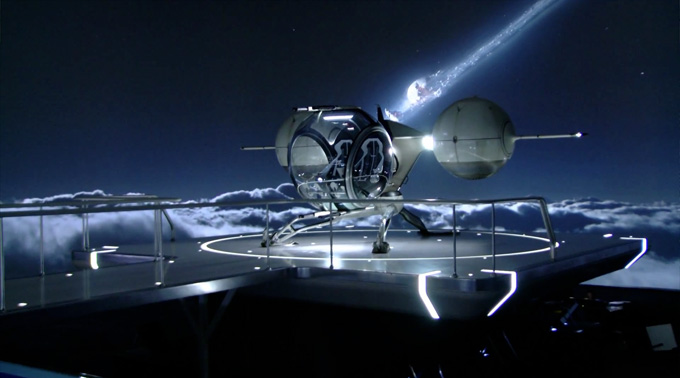
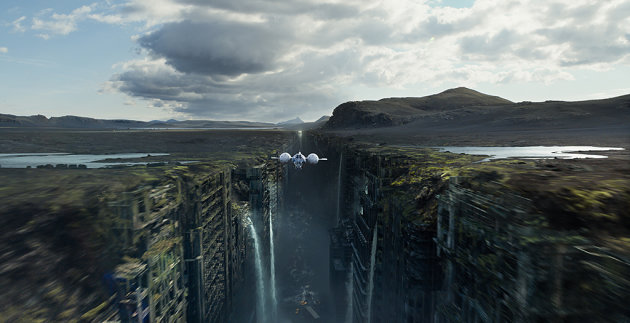
The year is 2077.** Earth has just survived a long, devastating war with an alien race that, in its final act to "poison the well" destroyed Earth's moon, creating dire ecological conditions for the planet, wiping out civilization and leaving its coasts under hundreds of feet of silt from tsunamis and tidal devastation.  Folks have moved to the moon Titan, off the rings of Saturn, the last remaining humans being Jack Harper (Cruise) and Vicca (Andrea Riseborough), a mated team of tech-mechanic and monitor whose job it is to keep the giant moisture evaporators running Titanville or wherever and keep them up and running from complications, both natural and unnatural.  The natural being wear and tear and the unnatural the last vestiges of the die-hard combatants—Scavengers—who are still trying to tear apart the fragile mining of Earth's resources to defeat the human race.  Jack monkey-wrenches and Vicca runs data, all under the watchful work-schedule of Sally (Melissa Leo) who oversees their efforts from a large rectangular control station in orbit around Earth, called the Tet.***

So far, so hum-drum.  Yes, there's a lot of background that Cruise has to spew  in the first ten minutes, but basically he's playing another working class stiff doing a dirty job in the future.

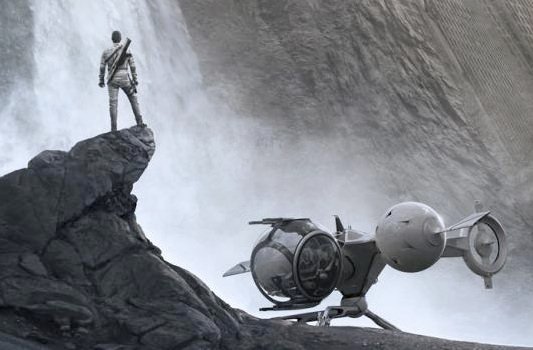
Jack and Vicca are a happy-in-love working team, awaiting the day when they can get off this rock and join civilization on Titan.  Jack, bothered by dreams of the observation deck on the Empire State Building and a smiling beauty (Olga Kurylenko) in the New York crowd, gets in his dragonfly of a jetcraft, repairing busted defender drones, and keeping a wary eye on "scav's."  


Cruise's futuristic mechanic keeps an eye on those moisture-vaporators
That's just the set-up.  Things, as they are wont to do, "get complicated" and to say how would start a cascading spoiler effect that will ruin the movie.  I can't even talk about influences without giving away key pieces of information that will kill the "reveals" (even if one does see some of this stuff coming from light-years away), so let's just say that you'll spend the same amount of time playing "name that reference" in post-screening mode, as you do actually watching the movie.  (Would one call that deja-viewing?  And shouldn't a science fiction movie be looking forward, rather than backwards?****

One key sequence echoes Planet of the Apes. Jack's patrol sector is the former northeast coast of the U.S. (and we get a respectful nod at the decimated Statue of Liberty), but only that section, as there's a radioactive "border" he can't cross.  He is told at one point to go explore beyond his limitations and into the radiation zone if he wants answers.  One could easily hear Dr. Zaius echo the words "You won't like what you find..." in the background. This leads to the biggest revelation of the film, but, instead opf answers, it just leads to more questions, which the film goes into warp-drive trying to explain, not very successfully, as plot-holes and logic disconnects begin to eat away at the movie like nano-viruses.

And science-fiction movies usually have a message for us livers-in-the-now, either cautionary or revelatory.  Oblivion fails there by having as its message that we are replaceable cogs in the wheel of society's meat-grinder.  That message was delivered by Fritz Lang's Metropolis way back in the silent era of movies in 1927.  Here we are in the 21st Century (when we should all be wearing jet-packs) and that's all we get...besides the obligatory shoot-outs and chase sequences?  If there's a message there it's along the lines of "Take out the recycling."

Oblivion is a re-treaded Rental made up of spare parts.

*—"well, then, it doesn't really count, does it?"—

** The film is extraordinarily exposition-heavy in the beginning in a long narration spoken by Cruise.  So much so, that one wonders why they didn't just make a movie of the events spoken of in the exposition.  The reason why makes up the plot of the movie and reveals the Cruise character to be the most unreliable of narrators.

*** Amusingly, the first sign we get of the orbiting Tet is a glimpse of it, traversing the globe on the new logo for Universal Studios at the film's beginning.

**** And, appropriately, into the future.  One of the previews preceding Oblivion is for Elysium, the new film by District 9's Neil Blomkamp, where the 1%ers have moved to an idyllic space station, while the rest including cyborg-ish freedom fighter Matt Damon robo-cops attitude against the machinery of the uber-klass.  The two movies could be book-ends for each other.  Think of the double-bill (and the headline): "Oblivion /Elysium/ Expatriatic/ Tedium"

Saturday, December 24, 2011

Mission Impossible: Ghost Protocol

"Mission: Incredibles"
or
"I'm Spit-Balling—It's Not All Going to be Gold"

The first Mission: Impossible film (based on Bruce Geller's TV series) was darned good—script tinkered by Robert Towne, nice set-pieces by Brian De Palma—while the second, not so much, a Woo-fest where star-egos and director-eccentricities clashed—and the third, directed by J.J. Abrams, a slight improvement, more gritty and down-to-Earth if nothing to really write home about.

The fourth, numerically neutral and titled Mission Impossible: Ghost Protocol, is actually the best of the bunch, much more in keeping with the original series' intent: a team of operatives plan out an unlikely spy-mission, fading into the wood-work, disguised and deceptive, insert themselves into scenarios that inevitably go wrong at some point, and they have to punt in order to get out alive and successful.  The big problem with the movie series (and its chief departure from its small-screen inspiration) is that Tom Cruise is the star and everybody takes second-seat to him, the other members of the team being merely escort planes to the Big Cruise Missile.  His character, Ethan Hunt, is supposed to be something of a cypher—all the IMF agents are—but more attention is paid to his character, while not really defining who he is, and as a result, you don't really care what happens to him.  There are no character peccadilloes or habits that one can relate to or identify as such, and what there is—no vodka martinis, but he always favors a celebratory beer at the end—is rather pedestrian.  So the movies are this weird yin-yang of Big Star/Small Character that crowds everybody else out.  The stunts are the stars.

That changes here.  Even though it is a "Tom Cruise Production" (executive-produced by J.J. Abrams), MI:GP is very much a team effort, with nice strong characters in the group (Cruise, Paula Patton, Simon Pegg and Jeremy Renner) who are thrown together from a previous mission that goes "somewhat" awry and leads the President to invoke "the ghost protocol:" The IMF is entirely "disavowed" and The Secretary (there's been one each movie—Henry Czerny, Anthony Hopkins, Laurence Fishburne, and this time Tom Wilkinson, the job must be the least secure in Washington D.C.) arranges for the closest team—Hunt's—to carry out a risky mission as they're already privy to inside information, and they're already deeply implicated in what has happened—which could see the resurgence in Cold War rivalries that will accelerate to nuclear-hot mighty fast.

So, it's just the four agents against the world, on a tight timeline and even tighter high-wire act to prevent terrorists from striking the match to the series' signature fuse.  And the nice thing is, it's not Cruise's show alone, it can't be, and Renner, Patton and Pegg are strong enough personalities, that Cruise doesn't even have to generously step out of the limelight for themIt is a team effort, finally, the way the series was initially envisioned.  And the writers and director have set up some nifty clockwork scenarios that nicely merge into each other to create a steady stream of nifty sequences that make you stop and say..."Huh...Haven't seen that one before."

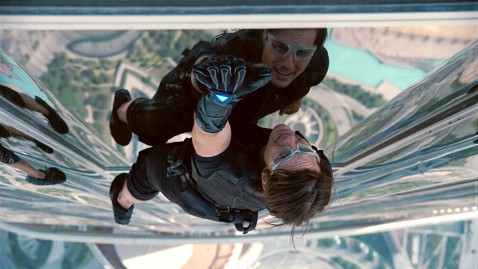
A lot of the credit should go to director Brad Bird, former animator and Pixar grad (he made The Iron Giant, The Incredibles, and did the "save" on Ratatouille), who keeps things elegantly focused, tightly synced, and throws in more than a dash of surprising absurdism throughout the film.  Yeah, a lot of it's over-the-top—that's kind of the way it is with the MI films—but there is no stoic acceptance of the risks this time.  In fact, there's a bit of slap-dashery to the whole thing—everything that can go wrong does—the timelines, the tech and the teamwork, and the four are left scrambling trying to pick up the pieces.  Along the way there are nice little touches, like the comic bend given to the usual "this message will self-destruct in five seconds" bit, or an extended sequence of guard-fooling that wouldn't seem out of place in a "Roadrunner" cartoon.  Even the big set-piece—Hunt in Dubai having to spider-man up the glass face of the world's tallest building ("eleven stories up and seven over") is played for grins, albeit with the teeth chatteringThere is no Cruise brio in evidence for the stunt, his character doesn't want to do it, but he's the only one who can and...the clock's ticking.  That Bird milks it for all the tension it's worth and manages to make it pay off spectacularly and...with humor...shows he owes more to Buster Keaton than to typical action-directors who take this stuff so deadly seriously (credibility issues).

Credibility is the least of the concerns for the director of The Incredibles.  Instead, he and the MI team have provided a spy-romp that aims to be a thrill-ride that leaves one chuckling.  In that case, mission accomplished.

Mission Impossible: Ghost Protocol is a Matinee.

Thursday, September 15, 2011

Lions for Lambs

This week, we're re-publishing some reviews of the films from the post 9-11 environment.

"Never engage the enemy for too long, or he will adapt to your tactics"


There are three arenas in play, and as the film begins the protagonists are checking their ledgers and statistics: Lt. Col. Falco (Peter Berg) is checking his strategy briefings; Senator Jasper Irving (Tom Cruise) is looking at dropping poll numbers; Professor Steven Malley (Robert Redford) is checking the quarter's attendance; Reporter Janine Roth (Meryl Streep) is looking at her unopened note-book--an empty slate. Thus begins Lions for Lambs* a polemic about the current Middle-East War, the entities that package and sell it, and the public that may not like it, but won't do anything to oppose it. All the stories intersect a bit and the movie takes place over a few hours. The script is by Matthew Michael Carnehan, who also wrote The Kingdom Its director, Peter Berg, who plays Falco here, said that film was "98% Action, 2% Message." Here, that ratio is reversed, and, man, is it tedious.

 First off, there is a heavy veneer of liberal self-satisfaction (though not as much as when conservatives put the hammer down). The senator is a Republican tyro, trying to bolster his party's (and his) poll numbers by setting up a new front in Afghanistan (Senator's can do that? I mean besides Charlie Wilson?) He's given Roth a solid hour (this is supposedly a big deal) to argue his case that this attack (no, really, this one!) will win the war in Afghanistan, the war on terror, the hearts and minds of Afghans (he really says this) and presumably bring the troops back home for Christmas (he doesn't say this, but he might as well have). Cruise was bio-engineered for this role (and you just know this is the part Redford would have taken during his career in the cynical 1960's), an opportunistic-photo-op-ready politico, with flags on the desk, pants-press in the office, and flashing Chiclets in his mouth, while Meryl Streep is all shambling messiness, trying to counter the arguments (is that her job?) that Cruise spins on the head of a pin. Their section is the sort of "greased-pig" argument and obfuscation bull-session that keeps me from watching the "pundit" shows--nothing's less fun or informative than watching two used-policy salesmen, hectoring each other trying to get their feet stuck in the open door of your mind. Finally it gets down to my favorite argument when rats-on-their-hind-legs are cornered--The Multiple Choice Bottom-Liner: "Do you want to win the War on Terror: Yes or No?". ("Well, I don't know, Senator, when did you stop beating your wife?") At one point Streep asks, "When does the new offensive start?" Cruise looks at his (supposed) Rolex. "Ten minutes ago." So much for pre-selling.

And in that ten minutes, the mission is already SNAFU'd, when two grunts are bounced out of a helicopter taking heavy fire, turning the offensive thrust into a rescue mission. Not a good start to winning those hearts and minds.
And by a curious coincidence--or a heavy-handed ploy by the screenwriter--those very two soldiers were both students in Professor Malley's political science class, who, in a school project capped their volunteerism argument by enlisting. Now, Malley uses them to guilt a slacker-student who can't be bothered coming to class because he's "busy with stuff," into considering a more activist stance before the bigger challenges of jobs, mortgages, ball-games, and watching "American Idol" zombies away any chance of him doing any critical thinking for the rest of his life. That's a valid argument to make, whichever side of the aisle you take bribes on. But instead of making the arguments, Malley turns them into three-corner shots that kind of dance around the problem, rather than saying something, oh, like "I would suggest you start coming to class or I will flunk your lazy frat-ass: your call."

The trouble here is that the issues are so immediate that the arguments the film is making were too late four years ago. So, it's a bit like soft-ball preaching to the choir. The arguments are sound, but they have very little relevance to extricating us from the tar-pit of this conflict, and, yes, people are getting chewed up by it, but that's the business of war, and why you try to avoid it, rather than rush in like a damned fool. It's great to be able to say all this with 20-20 hind-smugness, but it's essentially useless. Now tell us something we don't know, and how we can avoid it the next time. "Is he failing you?" a fellow frat asks the student about his meeting. The movie certainly is.

"Lions for Lambs" is a cable-flick.

* The title derives from a phrase from World War I, but, the exact nature of the quote is subject to debate, and its history, like the film, is a bit muddled.


Thursday, June 24, 2010

Knight and Day


"Planes, Trains and Automobiles on Cruise-Control"
or
"Every Man His 007 (And Every Woman, Too)"

June Havens (Cameron Diaz) is going through a life-transition and doesn't even know it.  She's getting on a plane to Boston to be a brides-maid (never a bride) at her little sister's wedding, and letting go of the past by putting the finishing touches on her father's dream-project, restoring a pre-70's GTO, and giving it to her sister as a wedding present.


But, she's keeps running into this "guy," literally—the last time at the airport before she boards her plane, and finds that...sorry, the flight is full-up.  The "guy," Roy Miller (Tom Cruise) enigmatically says, "Some times things happen for a reason" and boards the plane.

Truer words.  Before you can say "Non-res" she's on the plane and chatting up Miller, who's personable, quiet, and (when she's not looking) scoping out the plane.  It's the first instance of her not registering what's happening to her, but it won't be the last.  Don't be too hard on herShe's a "newbie" at counter-espionage.

It starts tracking like a Hitchcock film—the "innocent" caught up in the intrigue—but it ends up morphing into Hitchcock's bastard love-child, the James Bond series.  Cruise has always wanted to play Bond (incorrigibly American and too short, despite Daniel Craig's height issues—and some of the sets are low-ceilinged to disguise Cruise's short stature), hence the "Mission: Impossible" series that turned a team-effort into a one-man show.  But, this is as close as he'll come, and he and the film do well by it, with the typical derring-do, a lot of homages to Bonds of the past, and doing one thing that the Bond's have never done:  this is a "Bond" film for women.

With all the variations on the theme the Bond producers have explored over the years, there's one thing they haven't done: looked at the adventure from the woman's perspective.  As Kim Basinger said about "Never Say Never Again," her part didn't amount to much because "it's all about Bond, anyway."  Deft analysis.  It is always from Bond's perspective, and the women dragged into the scenarios, with or against their wills, are just chaff blown about in the fire-storm (or the "Thunderball"), accoutrements like his cuff-links and his wristwatch, though usually less functional.  Bond walks into their world, blows it up, and the best they can do is end up in the boat with him, ahead of the shock-wave.  Even the most important and dynamic of the Bond-girls, Natalya Simonova from "Goldeneye"—she's the one who saves the world at the end—is along for the ride in all of the instantly disposable vehicles.  Appropriate, as they're instantly disposable, too, the inevitable break-up happening between films never to be seen again in the series.  Even the original books' author, Ian Fleming, tinkered with the idea, making "The Spy Who Loved Me," entirely from "the girl's" perspective.

And that's what this is, too.  We're focussed more on June and her "learning the ropes," frequently knocked out and dragged from one exotic location to another, by good guys and bad guys alike, a pawn in this battle of knights, Alice in "Thunderland." 

The great thing about "Knight and Day" is that it doesn't have the "Bond cache" where he's always in charge, and stretches the formula to resolve a lot of the women's issues about control and taking charge in a satisfying, and complete, manner.

Of course, the "big" issue with a Tom Cruise movie is...how is Cruise?  He's always been the eager-beaver, and sometimes (as we'll show in this Sunday's "Don't Make a Scene"), most times, in an effort to fill the void of the camera-frame, he'll take things so far as to be ludicrously over-the-top, practically mugging in an effort to create a character that registers.  He's learning.  He's antic and funny in this, especially in the action scenes ("Alright, nobody move, or I shoot myself, and then the girl!"), sure, and sometimes frustratingly practical when the bullets are flying ("promiscuously" as they say in "The Wind and The Lion") at him on the roof of car.  But, in the quieter moments, he's relaxed and subtle, and emitting a mega-wattage star-power—somewhat less than Cary Grant, but certainly in the Christopher Reeve/Pierce Brosnan range, where he knows less is more.  The camera loves him, and he accepts that love, without having to push it.  He's GOOD in this, and Diaz, as ditzy as she can be, manages to make her "every-girl" sympathetic and identifiable.

This is the Bond movie that the wife/girl-friend won't sit in frustration during, as it's been nicely laser-etched with a "chick flick" by James Mangold, (and a bevy of screen-writers, starting with Patrick O'Neill and also passing though the PC of the great Scott Frank) with a cast rounded out by good actors like Paul Dano, Peter Saarsgaard, and Oscar nominee Viola Davis (Good to see HER again!).  "Knight and Day," you are the one.

"Knight and Day" is a Matinee.

Thursday, July 16, 2009

Saving Stanley Kubrick

A Slight Alteration to "Eyes Wide Shut" (10 Years After the Fact)

Today marks the tenth anniversary of the release of Stanley Kubrick's final film, "Eyes Wide Shut." He died after delivering his first cut of it, and because emotions were running high and it was the director's own initial assemblage of the film he'd spent two years making with the two most bankable stars in Hollywood (who'd formed a familial bond with the Kubrick family), it was declared that that assemblage—rough, with obvious redundancies and a bit pedantic—would be Kubrick's final word on the subject.

The movie went through its scheduled post-production process (where it actually was digitally altered to achieve a contract-specified "R" rating in America), and opened to some of the most blistering reviews of Kubrick's storied career (filled with blistering reviews). Some even went so far as to say "
Eyes Wide Shut" cast a pall over Kubrick's life-work—as if this one film could negate the effect of his earlier ones. The sad fact of the matter is there's only one thing wrong with "Eyes Wide Shut."

Stanley Kubrick died.

He was found, sprawled at his editing table by his family, his meticulous sleepless schedule finally proving to be too much for his 71 year old body. He was warned to pace himself and to take it easier. But, Stanley Kubrick rarely took anyone's advice without an overriding dose of his own input. He worked around the clock.
Just as he would have if he'd lived.


"Wait a minute, Nick.  I'm sorry.  Am I Missing Something Here?"

All of Stanley Kubrick's films went through a rigorous and brutal post-production process, which usually involved previews and the disciplined editing of sequences that slowed the film down or, in retrospect, undercut the movie. The list is legendary: The final pie-fight in the War Room as Armageddon enveloped the world in "Dr. Strangelove"; several sequences in "2001" of life on-board the Discoverythe daily routine, and a slightly altered shot-for-shot recreation of Frank Poole's prepping for his fatal EVA (which came right after the Intermission); "Barry Lyndon" lost a candle-lit sex scene between Ryan O'Neal and Marisa Berenson; "The Shining" lost an entire performance by the great Anne Jackson (I managed to see this before orders came down to cut that part out), as well as an enigmatic coda hospital scene between Danny, Wendy and Mr. Ullman (the late Barry Nelson); large chunks of "Full Metal Jacket" were shot and never used. Kubrick would work on his final cut of the film up through and even after the film opened in theaters—gauging audience reactions, looking for that perfect length that told the story he wanted to tell without causing audience-impatience in theaters.

"You're a Long Way from Home..."

And "Eyes Wide Shut" was a special case to the point where the audience lost the point. It's taken me nearly ten years to figure out "Eyes Wide Shut," because the Truth of it (appropriately) was looking me right in the face. "Eyes Wide Shut" is a dream-movie in which a jaded husband is confronted with the shocking news that his attractive wife...might actually be attracted to other men. Over the next few days, he risks everything—his marriage and his life—in the obsessive quest to...what? To make real—for him—what his wife just imagined. The rest of the movie is a yin-yang in which Cruise's Dr. Harford (named, according to scripter Frederic Raphael, because they were writing it with Harrison Ford in mind) nearly has extra-marital sex, and seemingly the rest of the world tries to prevent it—in any way possible.* But nothing gets through. As the title implies, his eyes are, literally, wide shut.** Deliberately not seeing.***

When I say it's a dream-movie, I'm not being film-theorist florid—the film is a repeating set of the self-obsessed Dr. Harford walking down long corridors of his own mental maze of mirrors that reflect internally in scenes (paintings on the wall reflect the situation in the rooms), or with other scenes (the film takes place at Christmas and one constant of the set-design is Christmas lights, whether they are string of multi-colored lights, or curtains of white lights their appearance reflects on scenes taking place in similarly illuminated places). But, again, no matter how well-lighted the areas, Harford is not seeing. The Rosetta Stone for this one is the late scene with Cruise and Sydney Pollack where Pollack's Victor Ziegler tells Harford to very bluntly knock it off, let it go, go any further and you're going get hurt, and the scene takes place in Ziegler's rec room. The center-piece of this room is a red pool table. You can't help but notice it, and notice that the color is wrong—not the traditional green. Why did Kubrick do that? He obviously did it on purpose; it was no accident. He did it so that YOU would notice it. "It's not green, it's red!"


"Guys, you're looking at me. You're looking at each other. You need to look at the table!"
 

And in films, as in that other means of public manipulation—traffic, "Green" means "Go," "Red" means "Stop" (Next time you look at Hitchcock's "Vertigo," keep that in mind). And in this scene, something traditionally green is deliberately red. Something that should say "go," says "stop." And for much of the scene, Dr. Harford is staring straight at it, but not seeing it, or paying too much attention to the explanations of Ziegler. He only becomes aware of just how self-destructive his path is when he goes home, and a symbol of his outings—the mask he wore to the elite orgy at which he very nearly lost his life—is on the pillow next to his sleeping wife (instead of him, it doesn't need to be pointed out).

His errant search has come home to roost. It is then—and only then—that he breaks down and 'fesses up. In the final scene, we're not sure of the fate of the Harfords on a family outing (to presumably
F.A.O. Schwarz, though the entire movie was filmed on British sound-stages) as they surreptitiously talk around what they both finally know about each other. Alice sums up her feelings: "I do love you and you know there is something very important we need to do as soon as possible." What's that, says the cowed Harford.


"What's that?" Wait a minute. Hold that thought.

Have sex, basically. But that's not what she says. She uses the common term for it, and for some reason (for me, at least) it's a groaning let-down. After all the dancing and the cloaked conversations and the surreptitious "I'm not going to say what I mean, but I mean to say it" talk, the last line thuds down with the hammer-like subtlety of an "F-bomb."

Which is what is. Honest it may be, yes, (which makes it stand apart from the whole of Harford's dialogue), but in a movie that toys (ahem) with an ephemeral dream-state, that plays with the Mystery of Sex and by delineation the Mystery of Women, and the Mystery of the Mind, to end on so blunt an anglo-saxon term is not only wrong-headed, it seems inadequate as the last word for the movie, subject and director. There's something...dissatisfyingly ordinary about it.

To me, as brilliant as the movie may have been before, that last moment feels disappointing and hollow, things that rarely could be said for the endings of Kubrick movies. It so hits the nail on the head (while seeming oddly prudish) that it feels like it should end another movie, the one that the preceding (mystery-explaining and literal) red pool-table scene (in the form it stands now) is trying so desperately to deflate.

And so, I would—meekly, humbly, still an acolyte of Kubrick's—suggest an alternate ending. It's barely an alternative. It's merely a substitution.

I suggest it knowing that, as a solution to my qualm, it's problematic to be sure and for audiences it may have been disappointing, but rather than Alice's direct reply, it might have been better to just hold on her face and fade into a sequence that is already dropped fairly innocuously and somewhat counter-intuitively into the assemblage—the teaser-trailer footage of a naked Alice in front of the mirror, to be joined by a naked Harford and their subsequent love-making which ends with the enigmatic look of Alice's as she considers them both in the mirror...

...giving the Kubrick stare at the camera, the mirror, herself—the ultimate private Unknowable, the one thing that Dr. Harford shouldn't take for granted (and does/is still doing/will always do). That eye—that window to the Soul—that he cannot know and will never know...and in the typical Kubrickian maze-trap, is destined to keep circling again...and again...and probably again. Cut to black. The scene's song-backdrop "Baby Did a Bad Bad Thing" (a song suggested to Kubrick by Kidman) takes us to the end of the Main Credits, ending with one of Kubrick's silent "thud's" and the credits are finished up with what's there now—the Shostakovich "Waltz 2 from Jazz Suite."

That's my solution to a problem that a great many people feel doesn't exist. They feel that "Eyes Wide Shut," as is, is what the director intended and are content with that. I may feel that way some day. But I still wonder what Kubrick would have done further, given the one thing even a perfectionist like Kubrick couldn't control—time. Maybe it's my own way of mourning his loss.

It's like the story about
Billy Wilder and William Wyler leaving director Ernst Lubitsch's funeral. "Well, no more Lubitsch," said Wilder. "Worse than that," said Wyler. "No more Lubitsch pictures."

No more
Kubrick pictures
, either.

It's less direct to be sure. And it ends on what the audience expected to see—"Tom and Nic' gittin' it on,"**** but ends with that most appropriate of images: an askance angle of Kidman


Kidman channelling Kubrick himself for her less-challenging "Kubrick Stare"

* The movie's central trap for the hero is, as always, one of his own making. But, this time, as in "2001" the Universe is attempting to rescue him from it.

** The title comes from a buried phrase in, of all things,
John le Carré's "Tinker, Tailor, Soldier, Spy" (le Carré , or I should say David Cornwell, was a close friend of Kubrick's).

*** Kubrick shows his hand early. We're allowed to see Kidman naked in the title sequence, and then when the Harfords are dressed and on their way to Ziegler's Christmas party, she asks him "How do I look?" "Perfect!" he says, not looking.

**** It may be a bit of a cheat—Kubrick used the sequence as a teaser trailer—a great one—that probably oversold the movie as a sexy romp (after all, wasn't "
Full Metal Jacket?" *ahem*).


Large Association of Movie Blogs


Wednesday, January 7, 2009

Valkyrie

"Tom Cruise Takes on Adolph Hitler, Single-Handed"

Man, they've been rough on this movie and particularly Tom Cruise. It's been "Nacht der Langen Messer" for a lot of gossip columnists who fancy themselves critics (but had second-hand facts from their "sources").

Among the rumors that were cackled about was Cruise's lack of a German accent (there aren't any in the film and Singer makes a big show of having Cruise narrate the beginning of the film in German--a rather stilted, halting German--before transitioning to English), that he rather grossly takes out a glass eye in the film (he does--with his back turned to the camera), that he does a weird Nazi salute (his character—
the very real Count Von Stauffenberg—gets away with forgoing the usual "nicety" throughout the film until, in one the film's best scenes, the War Minister (Tom Wilkinson) calls him on it—"I would hear you say it, Colonel"—and Stauffenberg, irritated that 1) he can't get away with it and 2) he's being forced to give allegiance to a man he's conspiring to kill, pointedly turns and yells the "Heil" while giving the standard right-handed salute—only he doesn't have a right hand, having lost it in the war, the stump of his arm protruding from his jacket, making a point. Good scene, that.)

Look, I don't like
Tom Cruise, either. His performances have dragged down many a movie, especially the vain-glorious ones. The man seems incapable of portraying more than one emotion at a time, and whenever his character must choose options Cruise falls back on an open-mouthed blank look.* Listening to him in interviews I get the impression that his acting process runs something like: "I have to do this, then I have to do this, then I have to do this, and then I have to do this."

But, though he's the King of Hollywood and the "
Jesus Christ of Scientology," one could cut him some slack; none--none--of those rumors are true in the final analysis, and no one making those rumors is held accountable for them, shoddy and unprofessional as they are. But that's "Entertainment Reporting" for ya.**

Enough about the 800 pound top-gorilla. How's the movie? Good, actually. It is a true story and screenwriter
Christopher McQuarrie and Director Bryan Singer (the team behind, and still trying to top, "The Usual Suspects") lay everything out in a clear time-line, do their best to cast faces that have a 1940's German feel and maintain the illusion that it's that time and place. They keep the tension taut and make the most of the story's quirks and coincidences--the kind that make you say "if it weren't true, you couldn't write this." The fascination of the story is that the German bureaucracy that was running the war (badly in the minds of the conspirators) was just as responsible for the conspiracy coming apart, and Stauffenberg was the only one with the Hoden who would push if there was any chance of success, to his credit and the conspiracy's detriment. It's a real-life version of the "Mission: Impossible" scenario, something that Cruise is all-too familiar with.

What's nice is that the film-makers turn the process of pushing through policy-changes into tense set-pieces that have just as much verve as a pistol shoot-out. In fact, there is a small fire-fight later in the film and getting Hitler to sign a policy-change (
the "Valkyrie" operation of the title) is far more exciting. And the central gambit—there's a satchel with a bomb in it that's set to go off in a room full of men—is the classic Hitchcock example of tension versus surprise.

The film is top-heavy with fine British actors: Wilkinson, Terence Stamp (another fine portrait of an ineffectual pol), Bill Nighy, Eddie Izzard (!!), Ian McNeice and Kenneth Branagh. That's a lot of impressive talent for a movie not written by Richard Curtis. And they're all spot-on. Branagh is particularly good as an initial conspirator who is whisked away to the front before the bombing of the Führerhauptquartier Wolfsschanze.

If there's a problem with the movie, it is
Singer's sometimes too-elaborate direction—the most egregious example being a circular camera move that catches up to a record (and it's a 78!) so that it can stabilize on the label to read the word "Walkure" while the rest of the world keeps on spinning—an awful lot of effect for not much return. As such it parallels the story of the movie.*** The film of that story—of conscience over the brutal status quo—is much more successful.

"Valkrie" is a Nachmittagsvorstellung.

* As opposed to Brad Pitt, another Hollywood pretty-boy, but who's managed to pick interesting roles (on occasion) and has grown as an actor of depth and subtlety. Something Cruise used to do. Cruise once was attached to "The Curious Case of Benjamin Button."

** My favorite bit of bone-head journalism from Hollywood came from the "reporter" who asserted that Russel Crowe had gone off the deep-end because he said something about "Bob being his uncle." Shhyeah! Been out of Hollywood much?

*** There is such a rich vein of fascinating stories that came out of the ashes of World War II that would make compelling films. A similar story—of the elaborate civilian aassassination of Hitler's "Golden Boy" (and probable successor) Reinhard Heydrich in 1942 I've always thought would make a compelling story of uprising. But one couldn't tell it without mentioning Hitler's utter crushing of the town of Lidice in reprisal for the attack.