Showing posts with label Essays. Show all posts

Saturday, May 25, 2013

Star Wars and Me

36 years ago tomorrow. Star Wars premiered and changed the space-time continuum of movies forever, for good or ill. ** Here's a look back.  Tomorrow, a scene.


For some reason, the nation has latched onto May 4th as "Star Wars Day," the forced, lispy association between "May the Force..." and "May Fourth" being the main stretch. Not buying it, not for a "parsec."* "Star Wars Day" is May 26th—the day it opened in 1977, with little fanfare and low expectations, at a handful of theaters (many of them forced to show it) across the country.

I remember it clearly. I was a junior in college, and at the time I was doing reviews for the college radio station, KCMU, on the weekly student union film series and broadcast on a whopping 10 watts of power. My first glimpse of
Star Wars was a preview attached to The Rocky Horror Picture Show, the copy of which was suffering from having the sound swapped out on two of the reels. That preview had no music by John Williams playing underneath it, but a non-descript tension piece. It had few FX scenes, but scenes of the robots, Darth Vader, some Tatooine shots, and the rope-swing across the Death Star chasm.


I was intrigued by it, but I'd been following the career of George Lucas with high expectations since seeing his first film, THX-1138, in the theater (it was the bottom-half of a double-bill with the lackluster Soylent Green). It's odd sociological look at a neutered futuristic society, told in an immersing, non-linear manner, intrigued me. This was intelligent science-fiction on a shoe-string budget where the special effects were ideas rather than matte paintings and super-imposed shots. It's ingenious use of sound inspired me to enter the field of audio post-production which would dominate my life for the next 20 years. Lucas' subsequent film, American Graffiti, also told a story of heroic empowerment seeking a better way of life, but in the milieu of a low-budget high-school film, about a last Summer night where the majority of teens cruised an endless loop of city-streets, symbolizing their own townie instincts—endlessly circling the same comfortable known patterns of their lives. Only one character realizes that to advance, he must escape and leave his past behind.

So, as I say, I was looking forward to it, however odd-looking and "
Wizard of Oz-ish" it looked in the previews.

I wish I could communicate to younger readers what a world before Star Wars was like and how the movie was a game-changer. In one film, Lucas opened up the commercial potential of a space fantasy, while at the same time narrowing the expectations for a film devoting itself to speculative fiction. The ideas took a back-seat to the visual aspects of the story, and subsequent films carried a similar tall-tale aspect that harkened back to the past, rather than imagining the future. Star Wars made more films in the genre viable in the marketplace, and science-fiction less cultish, while also limiting the template. The genre tilted to space-gun swashbucklers that straddled both past and future.

But, there had been nothing with such a flair for the beaten down-exotic: no robots with chemical formula names, the determined combination of fairy tale and sci-fi, wizards of arcane powers, the polyglot of exotic alien life-forms not limited to bi-peds, or the editorial (the way the Death-Star hatches zoomed open and shut) and sonic flourishes (a main character who only communicated through electronic chirps). Oh, one or two of these things might have showed up in a past movie, but Star Wars did something odd every few seconds, and paced it like a long compilation of a D-movie serial. That ingenuity is missing from most modern sci-fi films, where the FX dazzle the eye while the mind goes blank.

But, I put it on my "to-do" list and let a few folks know of my interest and shared what little knowledge I had of it, gleaned from some non-specific articles in "Starlog" magazine. One of my fellow disc-jockeys went to an opening day matinee and came back gob-smacked. He returned to the radio station and babbled at whoever would listen about the creatures, the ships, the fire-fights, the crazy "to-infinity-and-beyond" prologue scroll. It was all "too much information." I got on the phone and called my clutch of high-school buddies. "I'm going to see Star Wars tomorrow at noon. I'm going to be there to stand in line at 10 am and hold places. If you want to see it, find me in line, but I don't think you want to miss this."

The next day, waiting-book in hand, I was among a nerdly few who stood in line at that hour, and, one by one, my friends showed up, and the line grew geometrically as the time to open the theater doors approached until it stretched around the block, and, incredibly, started to form a line for the
next showing. The obsession had already begun, spurred by glowing reviews in the newspaper and a lengthy article in Time Magazine. And the audience I attended it with loved it—the film had an extended run for more than a year.


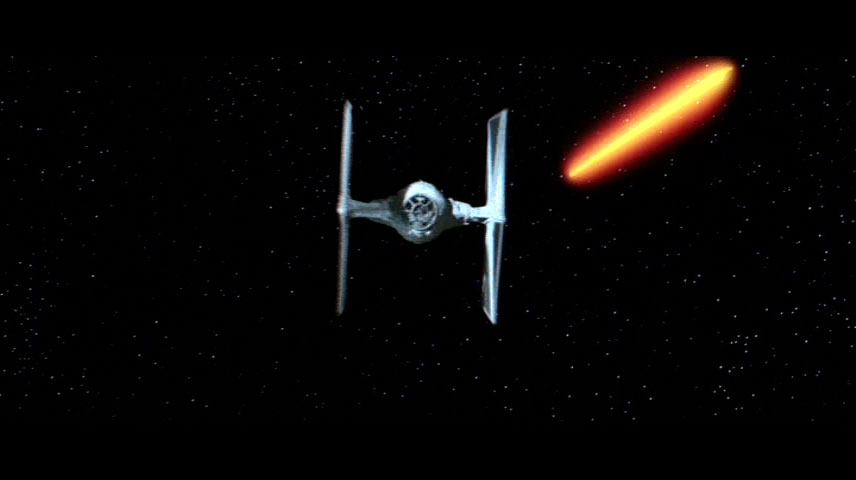
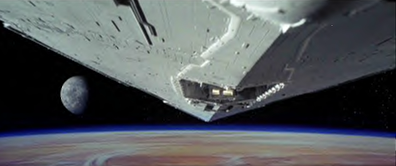
I knew the thing was going to be a ride with its first bravura shot—one of the ballsiest to announce just what its intentions were: panning down from the disappearing chapter head, its fanfarish opening fading to a discrete twinkling as we contemplate the stars, the view descends and narrows its scope while expanding its horizons—taking in a floating moon and then settling on a frame-defining planet's edge. Then a sleek ship zooms over our heads into view with tracing laser blasts flashing from it and towards it, causing flashes of damage. Then, the pursuing ship defines the top of the frame—first a wedge of a bristling ship that expands and expands and expands, with ever-more complex details including a large empty bay. It grows to impossible proportions until finally the vast nozzles of its engines blue-glow into frame, accompanied by the sound of crackling plasma-sounds that pierce the thudding hunter's drums of John Williams' martial music with a romantic's flourish. The intention is to dazzle, and to change our perspective of what is possible in this techno-fairy tale, filled to bursting with arcana, culled from the rich history of cinema and make-believe.

It flew by, with dozens of fun little touches: the blue specters of holograms (merely realized by filming
Carrie Fisher's lines from a variety of angles on low-res video screens—she can still remember that speech), the bones of a dinosaurish creature on the crest of a Tatooine dune while Williams' score recalls Stravinsky's "Rite of Spring," which served as the backdrop for the dinosaur segment of Disney's Fantasia, the hob-goblin Jawas-used "droid" salesmen of the desert, the varieties of robots and aliens, the casual conversations of the stormtroopers, one denizen of Mos Eisley space-port ("You will never find a more wretched hive of scum and villainy") represented by stork-legs that brush by the camera (you never see the whole creature, just a suggestion of it), Alec Guinness' inscrutable wizard, Han firing first and proving his worth by diving out of the Sun like a WWI Ace, the nothing-made-of-it reaction shots between the scruffy Chewbacca and Princess Leia, the dangerous sparking sizzle of whooping light-sabers, the nerve-wracking go-for-broke flights through the trenches of the Death Star, the initial dives into those trenches done with a Wellesian slight of hand, transitioning from long model-shot to three-dimensional close-up by a cut disguised as a blast of laser-fire.

It was stunning. I exited the theater with a stupid kid's smile on my face, the main thought in my head being just wanting to get back in line to see it again...right now. The huge line of people, though, was daunting. An impatient yuppie who'd been in line since I'd entered the theater had to ask me: "How was it? Is it any good?"

I babbled: "Wow...I just...it's absolutely...amazing...it's...it's...it's"

He looked at me piteously. "Are you high?" the guy asked.

Truth is, I was. As high as any really good, ingenious film can make me (and still can).

I dragged friends, family, girlfriends to see it just to see what their reactions would be—I wanted to see their sense of wonder, if there was any. But I also wanted to see it again and again to see if I'd missed anything (telling answer—Nope, only its flaws). And the memory of that Summer day lingers on, like a particularly joyful memory, a force that informed my life.

May the Force (or Something Like it) Be with You. Always.

(And I still have that poster that's perching up there at the top of this article).


* One of my favorite stories about "Star Wars" involves Carl Sagan going on "The Tonight Show" with Johnny Carson and railing about the inaccuracies of "Star Wars." It was the usual stuff—no sound or turning ship flight-paths in space, distance between systems, yadda yadda yoda. But one thing really irked Sagan: "they've got one guy who said he made a trip in parsecs—a parsec isn't a measure of time, it's distance!" This, in turn, really irked Lucas. He knew that. The line was there to show that Solo's not too good with technical details and a bit of a blow-hard—hence Obi-Wan Kenobi's pitying reaction to him saying it. In space, no one can hear you grind your teeth in frustration.

** Subsequently, I participated in a blog meme of "What Movie Do I Wish Was Never Made" and I chose Star Wars for the effect it had on the movie industry to this day.  That article is here.

Tuesday, January 15, 2013

2012 National Film Registry, Part 2

Conflicts of Interest

Every year since 1989, the Library of Congress solicits nominations for the National Film Preservation Board to select films for the National Film Registry deemed to be "culturally, historically or aesthetically significant" and thus preserved by the LoC.   Unlike most year-end awards shenanigans, this is not a popularity contest, but a way to hold forever the way we looked, the way we thought, and what we thought was important enough to be preserved on film...and eventually preserved for our descendents to contemplate.

Here is the complete list of selected films from 1985 ro 2011.

And here are the films from 2012


“Kodachrome Color Motion Picture Tests“ (1922): The two-color (greenish blue and red) film was the first publicly demonstrated color film to attract the attention of the film industry.


A League of Their Own (1992): Penny Marshall’s box office hit comedy about the All American-Girls Professional Softball League of the 1940s and early 1950s.  Marshall's baseball movie, based on the women's baseball leagues that had a brief surge in popularity, while the male players were in the last innings of WWII.  Marshall had a solid script (by Ron Howard's regular writers Ganz and Mandel) and a solid cast—Geena Davis, Lori Petty, Rosie O'Donnell and Madonna (in their most effective roles), Bill Pullman, Jon Lovitz, David Straithairn, Garry Marshall (Marshall's brother and director), and, in his first attempt to toughen up his image, Tom Hanks as the broken-down drunk of a coach who coined the immortal baseball and movie adage "there's no crying in baseball!"

There are very few rom-com concessions.  It's more about women who loved to compete and had no outlet until the men cleared out.  If the story is ultimately something of a downer, at least Marshall found a way to end it on a high, and inspiring, note, and A League of Their Own is one of the best baseball movies...in any league.


The Matrix (1999): Andy and Lana -- then known as Larry -- Wachowski directed this visually groundbreaking sci-fi thriller starring Keanu Reeves and Lawrence Fishburne. I'm still amazed that a surface-flash kind of movie like The Matrix is as well-regarded and the subject of unquestioning devotion as it is.  Yes, it looks cool, but the "bullet-time" effects displayed (created by the 360° capturing of simultaneous images) had been employed in advertising for ten years by that time.  And the Wachowski siblings' conceit—that we're all just sleeping drones living a fantasy that we're in control of our machine-clockwork society is kind of fun...for about forty-five minutes.  But the movie keeps droning on with unexplained character transformations and a not-so-veiled superhero exo-skeleton.  The action sequences go on forever, even without the benefit of slo-mo, and the characters are non-existent, depending on flat expressions and sepulchral voices.  It has bags of style, but no substance (as was made abundantly clear when the team tried to expand the concepts with ever-deepening contrariness in two vapid sequels.


“The Middleton Family at the New York World’s Fair” (1939): Technicolor industrial film produced for the 1939 New York World’s Fair.


“One Survivor Remembers" (1995): Oscar-winning documentary short about Holocaust survivor Gerda Weissmann Klein.


“Parable” (1964): The Protestant Council of New York produced this controversial, acclaimed silent allegorical Christian film for the 1964 New York World’s Fair.  I remember seeing this film in public school classes as an interpretive study in allegory and religion.   Directed by Rolf Forsberg and Tom Rook, it tells the story of a sadistic circus manager who uses his employees as puppets, until a harlequin arrives on a donkey and. seeing their suffering, takes their place.  It's a direct Christ allegory, but the controversial aspect of it, despite its simple message of sacrifice and redemption which parallels the crucifixion of Christ, is that Jesus is portrayed as a clown.  Controversial, but the message is clear, and so preaching is done without being so tied to the Gospel.  Not to far removed from the Christ technique of parables.  The idea was (oh, let's be kind) "re-imagined," by others in the hippy-dippy 70's as the musical "Godspell."


“Samsara: Death and Rebirth of Cambodia” (1990): Ellen Bruno’siversity master’s thesis documents the struggle of the Cambodian people to rebuild their shattered society after Pol Pot’s killing fields  http://www.brunofilms.com/samsara.html


Slacker (1991): Richard Linklater’s indie comedy follows a group of diverse characters over the course of one day in Austin, Texas.
Linklatter's first commercial success is the ultimate "walk and talk" movie, set in Austin, Texas in one 24 hour period, filled with random acts of...randomness. The format is simple—photograph a conversation down the street, until it's interrupted, either vocally or pictorially, then the camera follows the interrupter, always a new set of people and a new subject.  It's never boring and never cyclical. "This town is full of crazies," says an older anarchist, at one point. "I wouldn't have it any other way."  Less a running gag—more like a "walking gag"—of a town full of underachievers and over-talkers (bloggers without the internet), saturated with conspiracy theories and apocrypha taken as gospel and regurgitated without opposing argument.  Sounds like it'd be dull if it weren't so familiar and universal.  Yes, our lives are like individual houses, but there's an awful lot of spackle in it.

Sons of the Desert (1933): Stan Laurel and Oliver Hardy star in one of their funniest vehicles.


The Spook Who Sat by the Door (1973): Ivan Dixon directed this controversial thriller about an African American who infiltrates the CIA in order to create a black nationalist revolution. "Well, like it or not," says a CIA chief, "looks like we're integrated."  A cynical political move to get votes sparks an initiative to actually hire and train black agents in the all-white intelligence bureau.  Even though the odds are stacked against, one man gets through, Dan Freeman (Lawrence Cook), who ingratiates himself with his superiors, in order to advance through the ranks, until such a time as he begins recruiting radicals to undermine the white infrastructure in key U.S. cities.  Despite the amateurish acting and "Movie of the Week" production values, there are some interesting ideas here, if mightily simplified to come in under 90 minutes, and the film ends on an open-ended note as an armed revolutionary movement spreads throughout the country.


“They Call It Pro Football” (1967): The first feature from NFL Films utilized Telephoto lens and slow-motion to offer a primer on the game.

The Times of Harvey Milk (1984): Academy Award-winning documentary about San Francisco’s first openly gay elected city official who was slain in 1978.  Actually a much better film than the Sean Penn/Gus Van Sant bio-pic of a few years' back, and provides a more concise and passionate explanation and portrait of the gay rights activism in San Francisco that inspired Milk's political career.  Add to that...you get to see the man himself in his own words and in his own times.  The film is available to view on HuluPlus and Amazon.com.


Two-Lane Blacktop (1971): Director Monte Hellman’s existential road picture  "Existential," maybe.  But that may be code for "nothing much happens."  Not even the characters have names, but "identifiers"-"Driver" "Mechanic" "GTO" "The Girl."  You can't even call it a "character study" as the characters are archetypes, albeit played by James Taylor and Beach Boys drummer Dennis Wilson.  They pick up a hitch-hiker (Laurie Bird), and have a cross-country race from Needles, California to Washington, D.C. with worldly wise "older guy" Warren Oates, along Route 66.  It's not far removed from its hip-youth movie roots ala Easy Rider, with generational conflicts played out on the road, and where the emphasis is on competition, rather than finding America.  As such, it's a bit closer to the bone of the American spirit than its "Easy" counterpart.  It's also held up better, with less editing trickery, more disciplined cinematography (a lot of gorgeous landscape work here), and a more professional movie-making sense.  It's become a cult classic, and inspired the "Cannonball Run" competition.


Uncle Tom’s Cabin (1914): This silent adaptation of Harriet Beecher Stowe’s landmark 1852 anti-slavery novel is said to be the first feature-length film that starred an African American actor -- Sam Lucas, who had appeared in the 1878 stage version.


“The Wishing Ring; An Idyll of Old England”“ (1914): Maurice Tourneur’s charming cross-class romance.

Saturday, January 12, 2013

2012 National Film Board Selections, Part 1

Conflicts of Interest

Every year since 1989, the Library of Congress solicits nominations for the National Film Preservation Board to select films for the National Film Registry deemed to be "culturally, historically or aesthetically significant" and thus preserved by the LoC.   Unlike most year-end awards shenanigans, this is not a popularity contest, but a way to hold forever the way we looked, the way we thought, and what we thought was important enough to be preserved on film...and eventually preserved for our descendents to contemplate.

Here is the complete list of selected films from 1985 ro 2011.

Here a first look at the films from 2012 (more on Tuesday):


3:10 to Yuma (1957): Delmar Daves directed this western based on a short story by Elmore Leonard. Full review here. Even after James Mangold remade the thing in 2007, the original still holds up as a superior "psychological" western, giving Glenn Ford the most interesting role of his career, and Van Heflin, his most stalwart.  To save his farm and family, the latter's character must transport a charismatic and crafty desperado and get him on the train to the Marshall's for trial, despite being pursued by Ford's gang from without, and the manipulations of Ford from within.   


Anatomy of a Murder (1959): Otto Preminger directed this courtroom thriller that made headlines for its frankness in language and adult themes. Ya...ya..ya know...this is just about the talkiest courtroom drama ever filmed.  And...and when you got Jimmy Stewart starring that explains the nearly three hour length.  Yeah, it's "frank"...mentioning rape as a motivation for revenge killing and everybody saying "panties" every few minutes.  But the cast does amazing work...it's a thrill to see a passionate Stewart squaring off against the cool-as-a-cucumber fancy-pants prosecutor George C. Scott.  There're also great turns by Ben Gazzara, Leigh Remick, Murray Hamilton (at his weasliest), Eve Arden, and Arthur O'Connell, and the judge is played by Joseph Welch, the attorney who "shamed" Joe McCarthy on national TV.  Plus, there's a fine score by Duke Ellington.  It wasn't really Earth-shaking as it seemed, but Preminger keeps it lively, despite it being a one-room movie.

“The Augustas” (1930s-1950s): A 16-minute film by traveling salesman Scott Nixon, who was a member of the Amateur Cinema League, chronicling some 38 streets, storefronts and cities named Augusta.  Click on the linke above to see the film.


Born Yesterday (1950): Judy Holliday won a best actress Oscar as not-so-dumb-blonde Billie Dawn in this political satire directed by George Cukor.  Holliday is an acquired taste, but she was at her sharpest and craftiest (and was used to her best effect) in this performance, as the dingbat mistress of millionaire Harry Brock (Broderick Crawford), who's in the Nation's Capitol to grease a few politicians' palms.  Worried that "Billie" will make him look bad in front the pols, he hires journalist Paul Verral (a bespectacled William Holden) to teach her manners and "couthness" to avoid a scandal.  It's a comedy, albeit a satirical one, based on the play by Garson Canin (who was friends with director Cukor and, even though he wasn't invited to write the screenplay, he was inveigled to punch up the script a bit).  Directed by Cukor, with his usual non-judgemental tolerance and bite.

Breakfast at Tiffany’s (1961): Audrey Hepburn plays one of her quintessential roles -- the quirky Manhattan call girl Holly Golighty -- in this romantic dramedy based on Truman Capote’s novella.  Can you believe it?  I'm a big fan of the work of Blake Edwards, but I've never seen this cult favorite, adapted very freely (George Peppard plays Truman Capote??) by George Axelrod (although I've watched the final kiss in the rain with the cat hundreds of times and watched Hepburn sing "Moon River" just as many).  It will be interesting to see how it holds up (especially Mickey Rooney's role as a Japanese landlord *shudder*), but it's one of those movie confections made of so many excellent elements and players...Axelrod, Hepburn, Edwards and his comic timing, Henry Mancini's score...that one can forgive the straying so far from the original melancholy material.


A Christmas Story (1983): Humorist Jean Shepherd narrates this classic holiday comedy based on his memoirs of growing up in Indiana and hoping to receive a Red Ryder BB gun for Christmas.  It wasn't a hit when it came out, but it has since became a "Christmas Classic" on perpetual TV rotation around the Holidays, on a par with It's a Wonderful Life.  I'm sure "Shep" is amused by this occurence.  Shepherd worked on the script and narrated, and director Bob Clarke was creative enough to mine the material for as much laughs and nostalgia as possible. He also had a terrific cast in Darren McGavin as "The Old Man" (a role he was born to play given his dramatic/comedic gifts) perpetual Mom Melinda Dillon, and Peter Billingsley, who is the "Chalie Browniest" kid I've ever seen. There's something about Billingsley's dead-pan proto-human I find inherently funny, and as the focus of A Christmas Story—an exhausting role for a kid, to be sure—Clarke found the perfect "Ralphie."   


“The Corbett-Fitzsimmons Title Fight” (1897): Chronicle of the famed boxing match between James J. Corbett -- aka “Gentleman Jim” -- and Bob Fitzsimmons that was held on St. Patrick’s Day in Carson City, Nev.  We talked about Raoul Walsh's film on the life of "Gentleman Jim" last year.  Now, the real life Corbett is immortalized and his ring take-down preserved for all time.

Dirty Harry (1971): Clint Eastwood introduced his iconic role as maverick San Francisco Det. Harry Callahan in Don Siegel’s influential action-thriller.  When it first came out, Pauline Kael called it a "single-minded attack on liberal values" and Roger Ebert decried it for a "fascist moral position."  It was the ultraviolent Christmas movie season of 1971, so they hadn't seen anything yet.  But what peace-nik director Don Siegel was trying to say was that the police were fighting a losing battle trying to keep civilized society civilized.  The film is very pro-police, even if finding them weal and ham-strung by regulations, and anti-criminal (they're cyphers, moving targets, unexplained, unmotivated and unsympathetic.  Andy Robinson's Scorpio (based on San Francisco's Zodiac killer) is pure venality, as unconstrained as the cops are hand-cuffed.  The only way to stop him is to go beyond regulations or people die.  It's why Eastwood's Harry Callahan, that purveyor of aggressive buzz-phrases, tosses away his badge, High Noon-style, at the end of the film.  "Well, do ya, punk?"

“Hours for Jerome: Parts 1 and 2” (1980-82) : Experimental filmmaker Nathaniel Dorsky’s silent tone poem.

“The Kidnappers Foil” (1930s-1950s): Dallas native Melton Barker traveled through the South and Midwest for three decades filming local kids acting, singing and dancing in two-reel films he called “The Kidnappers Foil.” A few weeks after shooting, the townspeople would get a copy of the film for screening at the local theater.


Thursday, July 16, 2009

Saving Stanley Kubrick

A Slight Alteration to "Eyes Wide Shut" (10 Years After the Fact)

Today marks the tenth anniversary of the release of Stanley Kubrick's final film, "Eyes Wide Shut." He died after delivering his first cut of it, and because emotions were running high and it was the director's own initial assemblage of the film he'd spent two years making with the two most bankable stars in Hollywood (who'd formed a familial bond with the Kubrick family), it was declared that that assemblage—rough, with obvious redundancies and a bit pedantic—would be Kubrick's final word on the subject.

The movie went through its scheduled post-production process (where it actually was digitally altered to achieve a contract-specified "R" rating in America), and opened to some of the most blistering reviews of Kubrick's storied career (filled with blistering reviews). Some even went so far as to say "
Eyes Wide Shut" cast a pall over Kubrick's life-work—as if this one film could negate the effect of his earlier ones. The sad fact of the matter is there's only one thing wrong with "Eyes Wide Shut."

Stanley Kubrick died.

He was found, sprawled at his editing table by his family, his meticulous sleepless schedule finally proving to be too much for his 71 year old body. He was warned to pace himself and to take it easier. But, Stanley Kubrick rarely took anyone's advice without an overriding dose of his own input. He worked around the clock.
Just as he would have if he'd lived.


"Wait a minute, Nick.  I'm sorry.  Am I Missing Something Here?"

All of Stanley Kubrick's films went through a rigorous and brutal post-production process, which usually involved previews and the disciplined editing of sequences that slowed the film down or, in retrospect, undercut the movie. The list is legendary: The final pie-fight in the War Room as Armageddon enveloped the world in "Dr. Strangelove"; several sequences in "2001" of life on-board the Discoverythe daily routine, and a slightly altered shot-for-shot recreation of Frank Poole's prepping for his fatal EVA (which came right after the Intermission); "Barry Lyndon" lost a candle-lit sex scene between Ryan O'Neal and Marisa Berenson; "The Shining" lost an entire performance by the great Anne Jackson (I managed to see this before orders came down to cut that part out), as well as an enigmatic coda hospital scene between Danny, Wendy and Mr. Ullman (the late Barry Nelson); large chunks of "Full Metal Jacket" were shot and never used. Kubrick would work on his final cut of the film up through and even after the film opened in theaters—gauging audience reactions, looking for that perfect length that told the story he wanted to tell without causing audience-impatience in theaters.

"You're a Long Way from Home..."

And "Eyes Wide Shut" was a special case to the point where the audience lost the point. It's taken me nearly ten years to figure out "Eyes Wide Shut," because the Truth of it (appropriately) was looking me right in the face. "Eyes Wide Shut" is a dream-movie in which a jaded husband is confronted with the shocking news that his attractive wife...might actually be attracted to other men. Over the next few days, he risks everything—his marriage and his life—in the obsessive quest to...what? To make real—for him—what his wife just imagined. The rest of the movie is a yin-yang in which Cruise's Dr. Harford (named, according to scripter Frederic Raphael, because they were writing it with Harrison Ford in mind) nearly has extra-marital sex, and seemingly the rest of the world tries to prevent it—in any way possible.* But nothing gets through. As the title implies, his eyes are, literally, wide shut.** Deliberately not seeing.***

When I say it's a dream-movie, I'm not being film-theorist florid—the film is a repeating set of the self-obsessed Dr. Harford walking down long corridors of his own mental maze of mirrors that reflect internally in scenes (paintings on the wall reflect the situation in the rooms), or with other scenes (the film takes place at Christmas and one constant of the set-design is Christmas lights, whether they are string of multi-colored lights, or curtains of white lights their appearance reflects on scenes taking place in similarly illuminated places). But, again, no matter how well-lighted the areas, Harford is not seeing. The Rosetta Stone for this one is the late scene with Cruise and Sydney Pollack where Pollack's Victor Ziegler tells Harford to very bluntly knock it off, let it go, go any further and you're going get hurt, and the scene takes place in Ziegler's rec room. The center-piece of this room is a red pool table. You can't help but notice it, and notice that the color is wrong—not the traditional green. Why did Kubrick do that? He obviously did it on purpose; it was no accident. He did it so that YOU would notice it. "It's not green, it's red!"


"Guys, you're looking at me. You're looking at each other. You need to look at the table!"
 

And in films, as in that other means of public manipulation—traffic, "Green" means "Go," "Red" means "Stop" (Next time you look at Hitchcock's "Vertigo," keep that in mind). And in this scene, something traditionally green is deliberately red. Something that should say "go," says "stop." And for much of the scene, Dr. Harford is staring straight at it, but not seeing it, or paying too much attention to the explanations of Ziegler. He only becomes aware of just how self-destructive his path is when he goes home, and a symbol of his outings—the mask he wore to the elite orgy at which he very nearly lost his life—is on the pillow next to his sleeping wife (instead of him, it doesn't need to be pointed out).

His errant search has come home to roost. It is then—and only then—that he breaks down and 'fesses up. In the final scene, we're not sure of the fate of the Harfords on a family outing (to presumably
F.A.O. Schwarz, though the entire movie was filmed on British sound-stages) as they surreptitiously talk around what they both finally know about each other. Alice sums up her feelings: "I do love you and you know there is something very important we need to do as soon as possible." What's that, says the cowed Harford.


"What's that?" Wait a minute. Hold that thought.

Have sex, basically. But that's not what she says. She uses the common term for it, and for some reason (for me, at least) it's a groaning let-down. After all the dancing and the cloaked conversations and the surreptitious "I'm not going to say what I mean, but I mean to say it" talk, the last line thuds down with the hammer-like subtlety of an "F-bomb."

Which is what is. Honest it may be, yes, (which makes it stand apart from the whole of Harford's dialogue), but in a movie that toys (ahem) with an ephemeral dream-state, that plays with the Mystery of Sex and by delineation the Mystery of Women, and the Mystery of the Mind, to end on so blunt an anglo-saxon term is not only wrong-headed, it seems inadequate as the last word for the movie, subject and director. There's something...dissatisfyingly ordinary about it.

To me, as brilliant as the movie may have been before, that last moment feels disappointing and hollow, things that rarely could be said for the endings of Kubrick movies. It so hits the nail on the head (while seeming oddly prudish) that it feels like it should end another movie, the one that the preceding (mystery-explaining and literal) red pool-table scene (in the form it stands now) is trying so desperately to deflate.

And so, I would—meekly, humbly, still an acolyte of Kubrick's—suggest an alternate ending. It's barely an alternative. It's merely a substitution.

I suggest it knowing that, as a solution to my qualm, it's problematic to be sure and for audiences it may have been disappointing, but rather than Alice's direct reply, it might have been better to just hold on her face and fade into a sequence that is already dropped fairly innocuously and somewhat counter-intuitively into the assemblage—the teaser-trailer footage of a naked Alice in front of the mirror, to be joined by a naked Harford and their subsequent love-making which ends with the enigmatic look of Alice's as she considers them both in the mirror...

...giving the Kubrick stare at the camera, the mirror, herself—the ultimate private Unknowable, the one thing that Dr. Harford shouldn't take for granted (and does/is still doing/will always do). That eye—that window to the Soul—that he cannot know and will never know...and in the typical Kubrickian maze-trap, is destined to keep circling again...and again...and probably again. Cut to black. The scene's song-backdrop "Baby Did a Bad Bad Thing" (a song suggested to Kubrick by Kidman) takes us to the end of the Main Credits, ending with one of Kubrick's silent "thud's" and the credits are finished up with what's there now—the Shostakovich "Waltz 2 from Jazz Suite."

That's my solution to a problem that a great many people feel doesn't exist. They feel that "Eyes Wide Shut," as is, is what the director intended and are content with that. I may feel that way some day. But I still wonder what Kubrick would have done further, given the one thing even a perfectionist like Kubrick couldn't control—time. Maybe it's my own way of mourning his loss.

It's like the story about
Billy Wilder and William Wyler leaving director Ernst Lubitsch's funeral. "Well, no more Lubitsch," said Wilder. "Worse than that," said Wyler. "No more Lubitsch pictures."

No more
Kubrick pictures
, either.

It's less direct to be sure. And it ends on what the audience expected to see—"Tom and Nic' gittin' it on,"**** but ends with that most appropriate of images: an askance angle of Kidman


Kidman channelling Kubrick himself for her less-challenging "Kubrick Stare"

* The movie's central trap for the hero is, as always, one of his own making. But, this time, as in "2001" the Universe is attempting to rescue him from it.

** The title comes from a buried phrase in, of all things,
John le Carré's "Tinker, Tailor, Soldier, Spy" (le Carré , or I should say David Cornwell, was a close friend of Kubrick's).

*** Kubrick shows his hand early. We're allowed to see Kidman naked in the title sequence, and then when the Harfords are dressed and on their way to Ziegler's Christmas party, she asks him "How do I look?" "Perfect!" he says, not looking.

**** It may be a bit of a cheat—Kubrick used the sequence as a teaser trailer—a great one—that probably oversold the movie as a sexy romp (after all, wasn't "
Full Metal Jacket?" *ahem*).


Large Association of Movie Blogs