Showing posts with label O. Show all posts

Tuesday, June 11, 2013

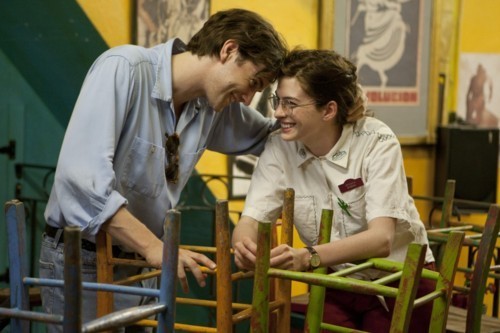
Oz the Great and Powerful

What a World, What a World;
or
There is no Baum in Gilead

Any movie attempting to resuscitate L. Frank Baum's "Oz" books has to deal with the series' own Wicked Witch of the West—that being M-G-M's musical version The Wizard of Oz, which had Judy Garland in it, and set the bar very high as far as expectations go (for quality that is, whereas for the box-office TWoO was not a box-office success at the time of its release and only became a classic after a couple decades worth of Thanksgiving showings on network TV).  Walter Murch's attempt to take an OZ story back to its roots, 1986's Disney's Return to Oz, was an abysmal failure, although artistically it was a terrific show--but probably butted heads with too many memories for its own goodness as, for instance, the Lion, Tin Man, and Scarecrow were not vaudevillians in theater-suits, as was the 1939 version, but looked more in line with the book's illustrations.

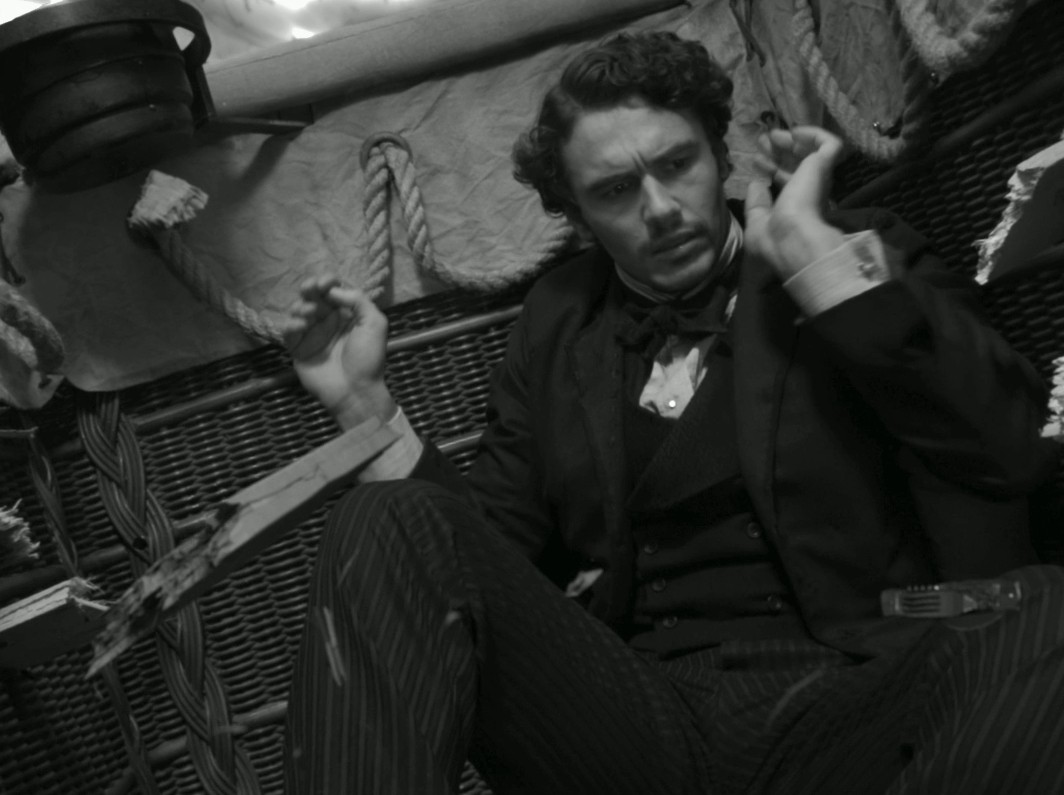
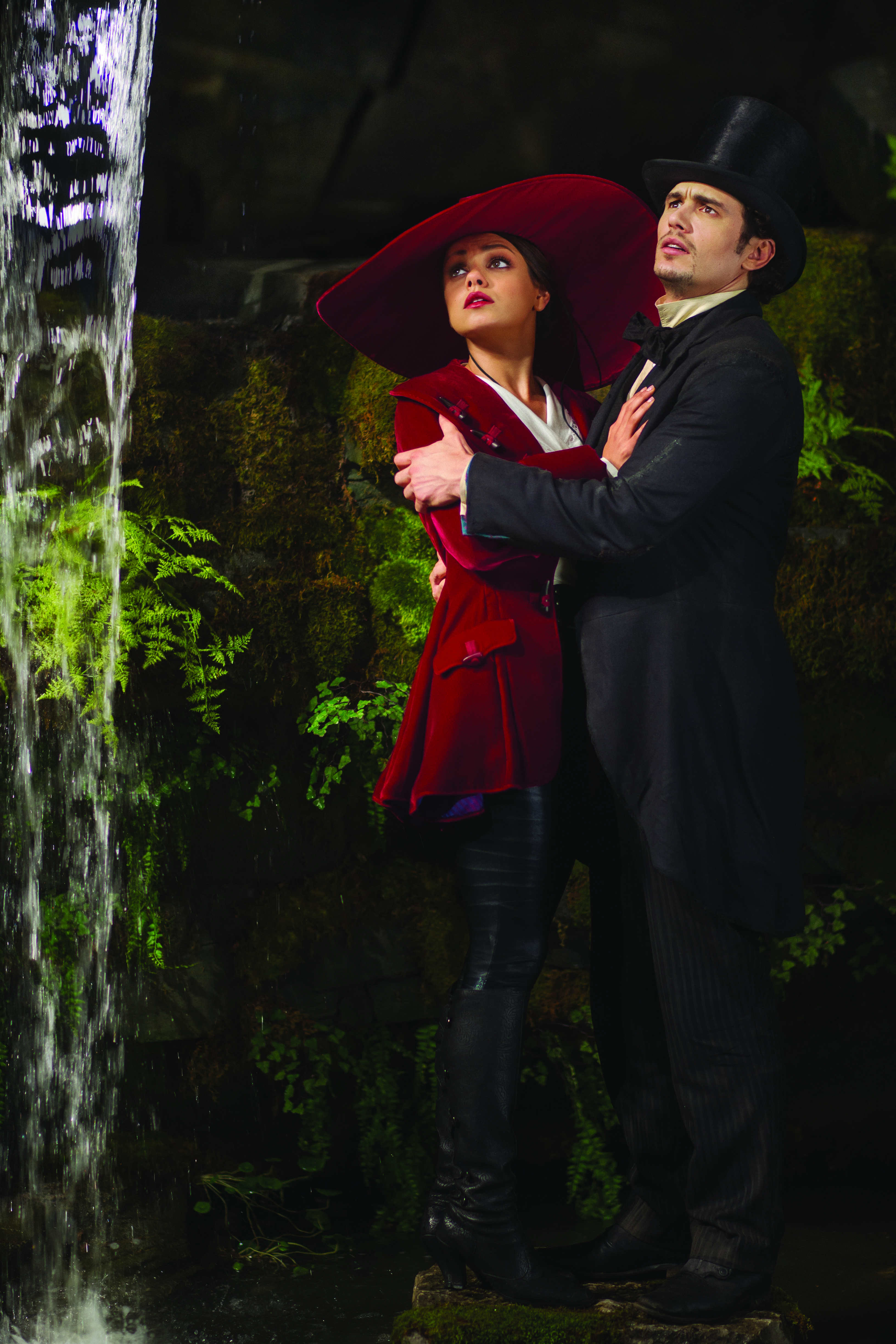
Sam Raimi, he of larkey horror films and the Tobey Maguire Spidermen, is probably a very good choice for doing an OZ film, as he has equal qualities of sweetness and sour, where Tim Burton (the next usual suspect*) would have made the film travel heavier to the morose.  Raimi's Disney's Oz the Great and Powerful (as convoluted and punctuationally challenged a title if ever, oh ever, there was one) manages to be its own thing while bowing and occasionally scraping to the previous' yellow brick road (which is revealed, as an aside, to have potholes, which nicely sums up the movie's respect, and lack thereof).  A prequel, kinda sorta to The Wizard of Oz, it starts out in a black and white box-square format (with a special effect detail amusingly violating it here and there) on a sound-staged Kansas that creepily recalls the musical version.  There scam-magician Oscar Diggs (James Franco) is conning rubes and comely assistants alike, and taking advantage of his stage-assistant, Frank (Zach Braff).  He's a jerk, only revealed to better purposes when a lost love (Michelle Williams) comes to visit to tell him she's going to marry farmer John Gale (father of Dorothy, making her mother of), and he takes the higher road, telling her she chose the better man.

But his past catches up with him...or tries to...and his road goes even higher, escaping a vengeful cuckolded circus strong-man in a helium balloon.  Kansas being Kansas, he is caught up in a tornado—one that presumably opens up a rip in the space-time continuum through some sort of meteorological consequence, and winds up in the storied land of Oz, where, true to movie-form, everything turns to color and the screen expands to wide-screen proportions.


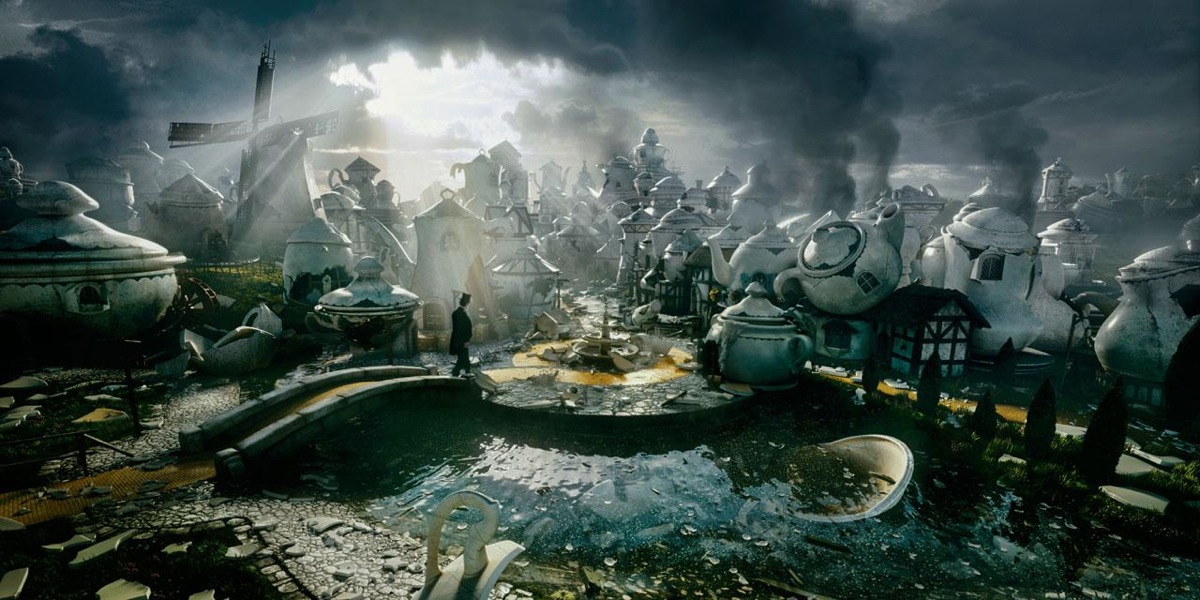
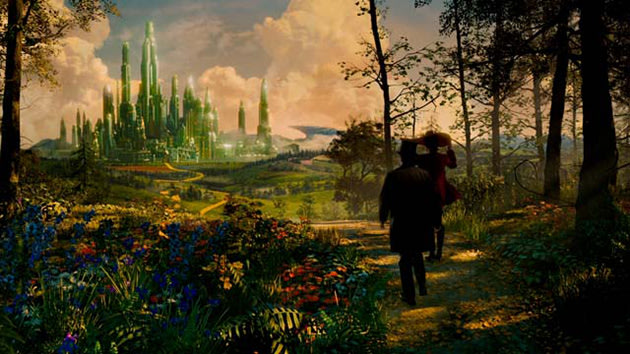
The pattern is set—Diggs is an outsider, a stranger in a strange land, but enough of a rouĂ© that any sense of wonder he initially feels is soon replaced by annoyance (Franco is great at that).  Oh, it's nice to have a minor seduction with the first female he stumbles on, Theodora (Mila Kunis), but the flying monkeys (in the form of Finley, voiced by Braff), and the girl who comes from hummle beginnings, the fragile porcelain girl (who comes from the neighboring land of Chinatown and voiced by Joey King), but before long he's embroiled in Oz's matriarchal politics between witches Theodora and her evil sister Evanora (Rachel Weisz), who are lording it over the Emerald Cityand the witch Glinda (Williams again), who is protecting the provinces from the influence of the Big Bad City.  This troika of females all think that Oscar will bring some sort of balance to Oz, and despite himself, he's got enough answers to help Finely and China, who become devotees.  Evanora is the first to see Oscar and think "there goes the neighborhood," and the plot and the make-up thickens in a battle royale between the various forces of magic, Evanora and Theodora in the Emerald City, and Glinda and Oscar and her army of tinkers, winkies and munchkins.  Tinkers and winkies and munchkins.  Oh my.


As Donald Rumsfeld said, you fight with the army you got.


And just to show this isn't Gramma's OZ (or Louis B. Mayer's) when we get welcomed to Munchkinland this time, and the town's welcome wagoneers start into a bouncey little song with high, tight voices (provided by composer Danny Elfman), Diggs just calls the whole thing off: "Stop!  Stop it!"  Musical numbers are not tolerated in this more cynical fantasyland.  Nor is anything approaching the good-heartedness of Baum or Fleming.  Even Glinda the Good Witch turns out to be something of a bad-ass here, far badder than in the '39 version.  And that's just a little backwards because the original has an empowered little girl who saves the day, while in this one it's a man, a messiah, who must sort things out in the messy rule of a matriarchy.  


This is progress?


The movie ends with some fantasy-nastiness.  Glinda is captured, tortured, and made to grovel before the sisters, Oscar comes to the rescue with his own Earth-bound pyrotechnics, similar to what he's use in the future.  But the movie feels very much like a movie of today—things end not with a splash of water, but a lot of impressive fireworks.  You want something a little meatier, though, something that might last and impress longer, but given the Oz that will come post-prequel, there's really nothing much to do about it.  The great and powerful Oz is merely a humbug, the man behind the curtain.  The evil sisters will remain evil, although Evanora's fashion sense (especially regards hosiery) will take a serious hit.  And Oscar will become a patriarch based on big promises with nothing much to back it up.  Sounds like any politician, really.  This Oz is not so magical, not so great and not so powerful.  What it needs is more brains, more heart and more courage.


Disney's Oz the Great and Powerful is a Rental.


Yellow Brick Road?  Check.  Emerald City? Check.  Dark Forest?  Check.
Now we just needs brains, a heart and courage.


Oz, the Great and Powerful is available on DVD starting today.


And the original is forever.
 
* Frequently recalled as this film is scored by Burton co-conspirator Danny Elfman.

Saturday, May 4, 2013

Oblivion

Finding Oneself in the Future
or
Scavenging the Sci-Fi Landscape

The new Tom Cruise vehicle Oblivion (written and directed by Joseph Kosinski from his "unpublished" graphic novel* and whose previous film was Tron: Legacy) is a science fiction tale that borrows very liberally from the last 30 years of movie sci-fi to the point where you swear you've seen the movie before.  

You have, but which one depends on the reel of the film you're watching.  

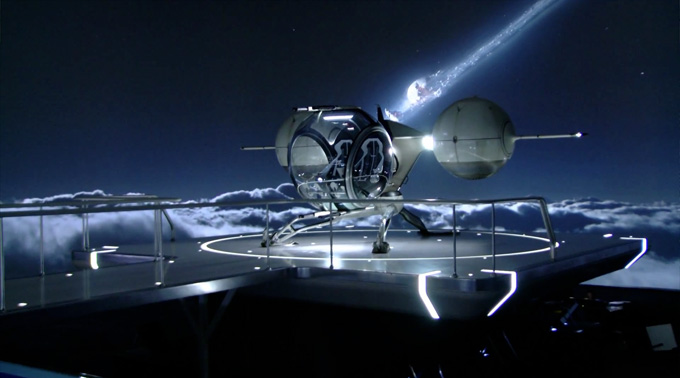
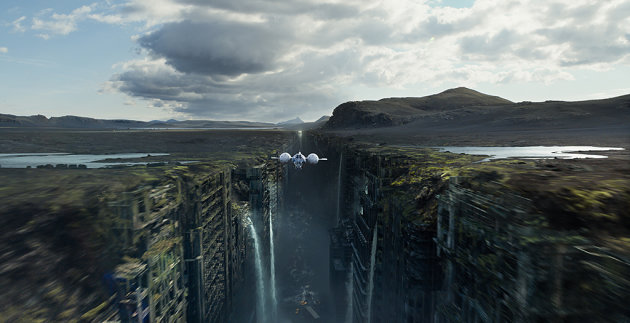
The year is 2077.** Earth has just survived a long, devastating war with an alien race that, in its final act to "poison the well" destroyed Earth's moon, creating dire ecological conditions for the planet, wiping out civilization and leaving its coasts under hundreds of feet of silt from tsunamis and tidal devastation.  Folks have moved to the moon Titan, off the rings of Saturn, the last remaining humans being Jack Harper (Cruise) and Vicca (Andrea Riseborough), a mated team of tech-mechanic and monitor whose job it is to keep the giant moisture evaporators running Titanville or wherever and keep them up and running from complications, both natural and unnatural.  The natural being wear and tear and the unnatural the last vestiges of the die-hard combatants—Scavengers—who are still trying to tear apart the fragile mining of Earth's resources to defeat the human race.  Jack monkey-wrenches and Vicca runs data, all under the watchful work-schedule of Sally (Melissa Leo) who oversees their efforts from a large rectangular control station in orbit around Earth, called the Tet.***

So far, so hum-drum.  Yes, there's a lot of background that Cruise has to spew  in the first ten minutes, but basically he's playing another working class stiff doing a dirty job in the future.

Jack and Vicca are a happy-in-love working team, awaiting the day when they can get off this rock and join civilization on Titan.  Jack, bothered by dreams of the observation deck on the Empire State Building and a smiling beauty (Olga Kurylenko) in the New York crowd, gets in his dragonfly of a jetcraft, repairing busted defender drones, and keeping a wary eye on "scav's."  


Cruise's futuristic mechanic keeps an eye on those moisture-vaporators
That's just the set-up.  Things, as they are wont to do, "get complicated" and to say how would start a cascading spoiler effect that will ruin the movie.  I can't even talk about influences without giving away key pieces of information that will kill the "reveals" (even if one does see some of this stuff coming from light-years away), so let's just say that you'll spend the same amount of time playing "name that reference" in post-screening mode, as you do actually watching the movie.  (Would one call that deja-viewing?  And shouldn't a science fiction movie be looking forward, rather than backwards?****

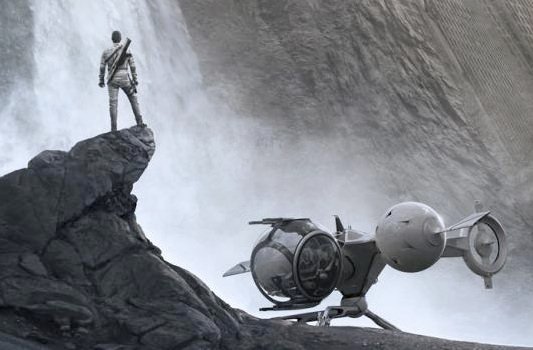
One key sequence echoes Planet of the Apes. Jack's patrol sector is the former northeast coast of the U.S. (and we get a respectful nod at the decimated Statue of Liberty), but only that section, as there's a radioactive "border" he can't cross.  He is told at one point to go explore beyond his limitations and into the radiation zone if he wants answers.  One could easily hear Dr. Zaius echo the words "You won't like what you find..." in the background. This leads to the biggest revelation of the film, but, instead opf answers, it just leads to more questions, which the film goes into warp-drive trying to explain, not very successfully, as plot-holes and logic disconnects begin to eat away at the movie like nano-viruses.

And science-fiction movies usually have a message for us livers-in-the-now, either cautionary or revelatory.  Oblivion fails there by having as its message that we are replaceable cogs in the wheel of society's meat-grinder.  That message was delivered by Fritz Lang's Metropolis way back in the silent era of movies in 1927.  Here we are in the 21st Century (when we should all be wearing jet-packs) and that's all we get...besides the obligatory shoot-outs and chase sequences?  If there's a message there it's along the lines of "Take out the recycling."

Oblivion is a re-treaded Rental made up of spare parts.

*—"well, then, it doesn't really count, does it?"—

** The film is extraordinarily exposition-heavy in the beginning in a long narration spoken by Cruise.  So much so, that one wonders why they didn't just make a movie of the events spoken of in the exposition.  The reason why makes up the plot of the movie and reveals the Cruise character to be the most unreliable of narrators.

*** Amusingly, the first sign we get of the orbiting Tet is a glimpse of it, traversing the globe on the new logo for Universal Studios at the film's beginning.

**** And, appropriately, into the future.  One of the previews preceding Oblivion is for Elysium, the new film by District 9's Neil Blomkamp, where the 1%ers have moved to an idyllic space station, while the rest including cyborg-ish freedom fighter Matt Damon robo-cops attitude against the machinery of the uber-klass.  The two movies could be book-ends for each other.  Think of the double-bill (and the headline): "Oblivion /Elysium/ Expatriatic/ Tedium"

Thursday, April 5, 2012

The Ox-Bow Incident

The Ox-Bow Incident (William A. Wellman, 1943)  Guy (Henry Fonda) walks into a bar with his buddy (Henry—nee Harry—Morgan).  He just came off the trail and is a might ornery.  His girl's left town, without a word, he hasn't had a bath in...well, he can't remember...but, the whiskey's good, even if the company ain't.  Then the fight happens; before too long, Fonda's character is just full enough of piss and vinegar (and whiskey, which from the looks of the bar, could be the same thing) that he picks a fight with a local tough (Marc Lawrence) using the bar to support him while delivering a nasty double kick to his head, until the barkeep clobbers him with with a bottle which shatters over his thick skull, and sends him (rather blissfully) into the arms of Morgan, who drags him like a sack of potatoes to a waiting cane-chair.


Welcome to the rough-and-tumble world of "Wild" Bill Wellman, a director of such sensibilities that you can practically smell the sweat coming off the denizens of Bridger's Wells, Nevada.  In a simple scene, Wellman differentiates himself from the more genteel sensibilities of Ford and Hawks, and into his own greasier, meaner, no-nonsense view of the West.  He's the better choice to present an immorality tale like The Ox-Bow Incident. about rough, western "justice" being meted out for the murder of a local rancher by a team of cattle rustlers.  The Sheriff's out of town, the deputy's itching for action, the local judge is ineffective blow-hard, and the posse-in-lynch-mob clothing have motivations, diverse but petty, such as false moral rectitude, mean-spiritedness, opportunism, and just plain boredom.  Truth to tell, they're a pack of wolves waiting for prey to abuse.


They find three mena new rancher nobody knows (Dana Andrews), who's had recent dealings with the dead man, an old, demented hand (Francis Ford, John's brother), and a Latino tough (Anthony Quinn) just corrupt enough to know not to play along...with anybody.  Lip-service is paid to justice, process, and prayers, but ultimately the purpose is to string the three up and get revenge as quickly as possible.  In this court by mob rule, the flimsiest of circumstantial evidence is not as important as the sturdiness of the rope, and waiting for facts just gets in the way of the excitement—it's a necktie party in all senses, except common ones.  The cooler heads are seen as weak, obstructing, or just plain kill-joys.


No good can come of it and Wellman (working with Lamar Trotti from Walter Van Tilburg Clark's 1940 novel) writes a case for due process whatever the cost, even if the only thing wasted is time.  Vigilance is not the same as vigilantism and the two should be frequently opposed.  And if one were to be so foolish to think that Westerns are no longer relevent to the issues of today, you haven't been reading the papers.


This was one of Henry Fonda's favorite films he appeared in, and in 1998, became part of the National Film Registry.

Thursday, September 8, 2011

One Day

"July 15ths with Emma and Dex"
or
"Same Time Next Year"

Can a man and woman "just" be friends? (the question posed by When Harry Met Sally)  I've gone 'round and 'round with this one. I've said "Yes" for many years, and then that became "No," then back to "Yes," and now, it's something of a toss-up. "It's possible," I say noncommittally (which is the basis for many of the male-female problems, friendship or no).

But anything is possible.
"One Day" was a nifty best-seller by David Nicholls, smart, tight and funny, a romance told in snap-shots of one day that was realistic about the vagaries of life and love and the "yin" and "yang" of both. What makes the novel special gets distilled somewhat in celluloid form, making One Day feel a bit less exceptional, the humor muted somewhat, and given the twenty year time-span of the movie, some of the anniversaries celebrated are given short shrift, skipping to the more complicated "good parts," as opposed to those years when nothing much happens...you know, like "life."*

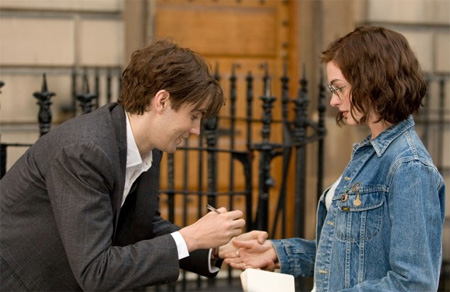
Dexter (Jim Sturgess) and Emma (Anne Hathaway) have "just met" at their graduation as they string along with their mutual friends, a couple.  Emma is bookish, unstylish, a bit of a character—has a "nice personality"—Dexter is boyishly handsome and knows it, and Emma is "crushing."  An awkward "overnight" happens, where it is unclear what transpired, but it's important enough that Dexter is helping Emma move when the next 15th of July occurs, but not important enough that Dexter isn't moving to Paris to teach.

July's come and July's go, as Emma suffers through waitressing at a London Tex-Mex restaurant and Dexter jumps from job to job, eventually becoming  the smarmy host for a late-night dance teen program. Where Emma is a busy bee, droning through know-where jobs until she catches her big break, Dex is a moth attracted to the brightest (or blondest) thing in the room. They're devoted to each other, but only so far. As her star rises, his sets—first Mom (the ever-reliable Patricia Clarkson) dies of cancer, then his fortunes go South, followed by years of over-indulgence. Before you can say "This is Mrs. Norman Maine," he is seeking her out, where she has nearly given up. As traditional as this is, what is nice about One Day is that Emma does just fine without him, she makes her way in the world without a man's help (and frequently, they're a hindrance), whereas in most films of the romantic genre, everything can be solved by anything in pants.

The director, Lone Scherfig, previously made An Education, which, while well-acted and elegantly directed, suffered from a distinct lack of heat and a little too much posh.  The former problem still applies here. The film is decidedly chilly in tone, and while this is a welcome change from the day-glo color, syrupy music rom-coms that chirp incessantly about Moon, June, (premarital) Honeymoon," poking you in the heart-area that "Love is Great, right? RIGHT?" One Day makes it hard to feel anything beyond "Gee...that sucks."

Maybe it's the skipping around from year to year, but there's a distinct lack of focus in the story, as it spreads itself around a bit too thin, the ancillary characters populating the movie to make life difficult for Emma and Dexter, necessary irritants and bothers that will drive them into each other's arms every year.  Plus, the story arcs of the two main characters run precipitously up and down, without any jolts of happiness amidst the gloom, or hurdles to happiness on the ascent.* Things settle down as people "settle" and, although One Day manages to avoid many of the cliches of the romantic genre, it also hasn't found anything as compelling to replace them. Plus, with the mutual reversals of fortune, there seems to be a dramatically required "level of the playing field" in order for things to resolve "the way they should".

One should be grateful that one is asking these questions about a romance movie (haven't done that in a while), so it's nice to see somebody making the attempt. But, one gets the idea that the same old "Love Potion No.9" is being hawked. All they've done is change the shape of the bottle.


One Day is a Rental. 


* One of my favorite quotes is by Anton Chekhov: Any idiot can survive a crisis; it's the day-to-day living that wears you down.

**  Well, that's not entirely true, but we don't want to give anything away. 

Wednesday, March 23, 2011

OSS 117—Lost in Rio

OSS 117— Lost in Rio (Michel Hazanavicius, 2009) Another one that got away from theaters last year and ended up in the video aisles.  Too bad.  Because the first of the OSS 117 spoofs starring Jean Dujardin (Cairo: Nest of Spies) was an amusing spoof of the James Bond films, circa early 1960's under the direction of Terence Young—all high-light filming (it didn't rain in a Bond film until 2006's Casino Royale), clueless cool, casual absurdism, DuJardin's cheery resemblance to Sean Connery mixed with James Coburn's cheesy grin, and a pace that didn't give you a chance to question "Q'est-ce que c'est?"

Cairo: Nest of Spies nailed it.  And the sequel: Lost in Rio (literal translation: "Rio Doesn't Answer") was to be filmed partially in the city of Brasilia, a 60's construct that could have been designed by Bond-architect Ken Adam—and played a role in the french spy spoof That Man from Rio.

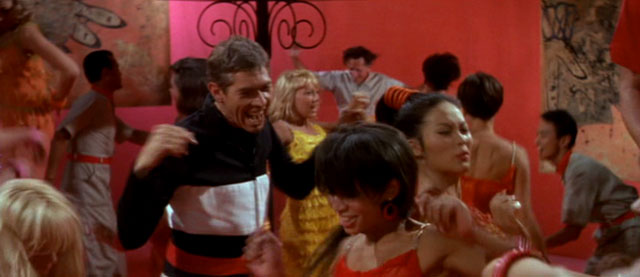
Lost in Rio doesn't disappoint.  Establishing the time-frame as 1967, French agent Hubert Bonisseur de La Bath (with newly long side-burns) enters the play-room of his Swiss villa in Gstaad, and begins to twist with a bevy of snow-bunnies in his Jean-Claude Killy snow-suit to Dean Martin crooning "Gentle on my Mind," documented in groovy split-screen (the year it was used extensively at Expo '67).  The OSS spoof trademarks are trotted out—the adherence to Young's photographic style, that de La Bath's Walther ppk fires an endless supply of bullets from its clip (that's okay, as the enemy's Lugers do the same), he is still cluelessly sexist and racist in his attitudes, this time being particularly rude dealing with the Mossad and the Chinese.  This time, he's helping Israeli agents track down yet another Nazi in Rio de Janeiro, with the passive-aggressive assistance of the CIA's Bill Trumendous (Ken Samuels).  But, while paying homage to the Bond style, it also goes after Hitchcock (particularly his penchant for staging precarious situations on national monuments)—seems de La Bath was once a circus gymnast where an accident gave him a phobia for heights.

The humor is all over the map from subtle film references to absurd slapstick and Dujardin is still an amiable lizard presence.  This one wasn't as successful as the first film (hence its straight-to-video status), but here's hoping they do more.


Thursday, January 27, 2011

Our Man in Havana

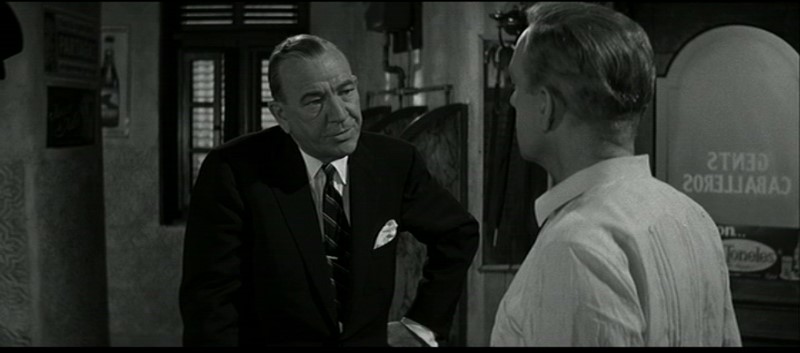
Our Man in Havana (Carol Reed, 1959) A fascinating serio-comic counter-point to author Graham Greene and Reed's post-war classic (made a decade previously) The Third Man.  Reed's camera still swoops (courtesy of d.p. Oswald Morris), making sure that the Cinemascope frame is filled to the corners with detail, and the dark streets of Havana (filmed after the revolution and with the permission of Castro) at night, could be mistaken for post-war Vienna.  The sun shines brighter, though, and so the internecine work of spies is done in the relative low-light of bars and brothels.

Greene's book was a cynical look at how Intelligence forces can show a distinct lack of intelligence when confronted with mis-information, but it is Reed's nifty idea to cast it with comedic actors, though not always playing for laughs.  With such as Burl Ives, Noel Coward, Ralph Richardson, Ernie Kovacs (he plays a corrupt Cuban police official straight, but it is still funny) and Alec Guinness, it seems more a comedy of errors:  British ex-pat Jim Wormold (Guinness) is scraping by a living selling vacuum cleaners in Havana, while his daughter (Jo Morrow) is developing a taste for the expensive horsey set—something that could be provided by Captain Segura (Kovacks), who has an eye for the blonde girl.  Wormold has other plans for her, like an expensive Swiss boarding school.  But where to get the money?

He is approached one day by Hawthorne (Coward, out of place in his dark suit and bowler hat in the mid-day sun of Havana) of the British secret service—or, as he is known, Agent 29500—to set up a bureau station for the service.  For Wormold, it is extra cash, an all-expenses paid membership to the exclusive country club, and a more lavish life-style, all for keeping his daughter close.  All the Service wants is results, which Wormold has trouble setting up—he is, after all, only a vaccuum cleaner salesman.  Soon, he starts filing bogus reports, recruiting strangers as fellow agents (without their knowledge), building his station in importance to the delight of Hawthorne and his superior 'C' (Ralph Richardson).

However, becoming an important secret agent draws attention.  He is soon assigned a secretary (Maureen O'Hara) by his superiors, wanting to build him up, and targeted for assassination by his enemies, wanting to shut him up.  Doesn't matter if the information he's sending is all wrong; with so many resources at his command, he's sure to dig up something sooner or later.  Scrutinized from both sides, the spy-game stops being so rewarding, and turns downright dangerous.

It's all played with a bit of a wink, with great comic actors under tight rein to let the material be funny without goosing it.  Definitely worth seeing for the literate script, Reed's classic direction and the fine performances.  John le CarrĂ© would later use the basic subject matter for his book (and subsequent John Boorman film) The Tailor of Panama. 


Thursday, August 26, 2010

The Other Guys

"Did That Go the Way You Thought It Was Gonna Go? Nope."
or
"Anything You Say Can and Will Be Used...(what's the rest?)" "As a Flotation Device..."

More comedy, and this one's even very funny for its first half, but then, once one scene goes sideways and doesn't work, the whole thing falls apart like a hostage situation gone wrong.  And the audience is the hostage, waiting for it to kick back in...but it never does.

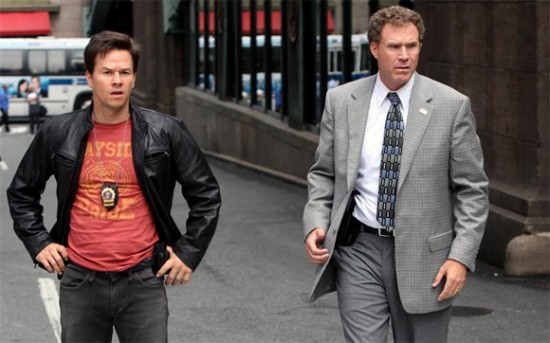
Allen Gamble (Will Ferrell) and Terry Hoitz (Mark Wahlberg) are two New York City detectives working in the considerable shadow of detectives Danson and Highsmith (Dwayne Johnson and Samuel L. Jackson in nice parodies of their "serious" screen-work), a team of glory-hounds for whom property damage is all in a day's conflagration, but who refuse to do the paperwork.  Gamble is self-described as "an accountant for law-and-order," and Hoitz is riding a desk-job after a shooting that goes wrong.*  Gamble loves the mundane filing, but his partner Hoitz, itches to be "in the field."  "I'm a peacock!" he is fond of remonstrating.  "You've got to let me fly!"   At which point, he is reminded that peacocks do not fly.**

Unperturbed, and when advancement in the ranks becomes possible, the two glom onto a white-collar crime that Gamble has discovered that has connections to a series of high-profile robberies.  The mis-matched pair (Hoitz is volatile, Gamble is eerily up-beat) are completely street-dumb and their investigation is constantly being dis-railed (sometimes literally) by distractions and their lack of ability to resist the charms of their high-rolling suspect's lifestyle.  Their increasing frustration with the case and each other (as well as Hoitz's relationship problems, in contrast with the milquetoast Gamble's inexplicable attractiveness to women) is fertile ground for situations that explode in conflict.

It works and works gang-busters for the first hour.  The combination of loose script and improvisation is beefed up by all the actors (especially Ferrell and Michael Keaton,*** who does quick-silver wonders with the cliche "harried Captain" role), especially when the story is building and we're getting to know the characters.  The "left-field" surprises come fast and loose, and the timing by the actors (and the editing) is crack.  One senses trouble early on when Anne Heche (uncredited, by the way) is given a thankless role in which she's really not allowed to do anything funny...or much of anything.  But Ferrell, for the most part, is at the top of his game playing the contrary stiff in a room full of crazies, and Wahlberg who, depending on the material, can be brilliant, plays pathetic frustration hilariously.  Even Eva Mendes acquits herself well in the mix, milking laughs out of the role of Gamble's absurdly perfect wife—Gamble's sexual magnetism makes for a great series of running gags throughout the movie.

But, right at the point where Bob, the union rep, gets dissed and leaves the room, the entire movie goes flat.****  Maybe the improv was getting too expensive and they decided to "coast."  Maybe the assurance of an "action-filled" finale made them scrimp on the script.  Maybe the irrelevant story-line getting in the way changed the tone.  Maybe everyone got tired.  But, for whatever reason, "The Other Guys" is two movies..."Good Cop" comedy and "Bad Cop" comedy.

Interestingly, the most useful part of the movie is the end credits where the increasing disparity between the incomes of the top 1% earners and the rest of us is presented in chilling graphic detail.

"Wilhelm" Alert @ 1:30

"The Other Guys" is a Rental.

* Hint:  He's called "The Yankee Clipper" around the squad-room.

** What can I say?  It's New York, and the Bronx Zoo is the closest they come to a peacock.  Peacocks do indeed fly, but it's a brief, clumsy, scary thing to watch—which I think was the point of bringing it up in the movie.

*** Yeah, yeah, I know, it won't happen and it would be recast with Tom Cruise and Denzel Washington in the roles, but I'd love to see Keaton and James Woods go head-to-head with each other...in anything.  It would be dizzying...and probably only discernible at half-speed.

**** It's funny I can pinpoint it, because that's where the movie became NOT funny, and I thought to myself..."Well, THAT didn't work..." and watched to my amazement as very little worked after.

Thursday, June 25, 2009

Once...Again

"Once" (John Carney, 2007) A bitter Dublin busker (Glen Hansard) runs into a charmed Czech immigrant (Markéta Irglová), also musically inclined, and for a time they make great music together.

That's it. That's the whole story. The characters don't even have names! It's shot ungracefully, edited abruptly, and mostly ad-libbed on the streets. For all that, it's got all the charm and whimsy of a multi-million dollar M-G-M musical. It works. And works beautifully. You're sad to see it end.

You could say that it now takes so little to make a great movie. Economically, you'd be right. But "Once" is full of those ingredients that money can't buy—the little miracles that great films have to have that makes them rise above merely gargantuanly filmed examples of style. Miracles like chemistry, simple construction, and the openness of performance. And they get the music right. Early on, there is an impromptu duet in a music shop.
* One can see the musical moment coming, as pre-planned as a Howard Hawks sing-along, until "the guy" mentions "It's in C." "I can see that," says "the girl" looking at his fingers on his guitar neck.

Of course, she can. She's a musician, too and she's learned her craft. It's not like she's going to burst spontaneously into song like most movie musicals. There was a learning journey for these two to take before they started playing music, and that training is acknowledged.

I also particularly liked the recording studio sequence, when "The Busker" goes to make his demo CD. The substitute engineer—the studio was rented for cheap—is under-enthused when he sees the motley crew of street musicians he has to record for a weekend. That he perks up when he hears "the music" is a bit of a cliche, but not the celebratory road-trip to see how it sounds "in the car." That's exactly true—you check the mix to see how it sounds in bad circumstances as well as good, and most studio engineers choose to listen in their cars.

"Once" is a charming miracle of a movie, pointing out that in today's chip-age, nothing can stop you (save the Seven Deadly Sins)** from making a movie; "Once" started out with an idea, two actor-musicians, and a lot of will and a lot of talent and taste...and that was it.

It's a testament to the creativity that comes from collaboration, and the shared vision between film-makers, and the communication between film-makers and audience. Informal, practical and not showy, "Once"*** has the welcoming shining air of discovery of an incisive chat with a new friend.

Brilliant.

* The ubiquitous "Falling Slowly," which won the Academy Award for "Best Song."

** Worried about the "R" rating? Don't be. It's for pervasive use of the "F" word—which sounds charming with an Irish accent.

*** Just a stray thought: If there's a sequel, would it be called "Twice?"

Friday, May 22, 2009

Anytime Movies Reloaded: Once Upon a Time in the West

It's Spring-Break for me. Times are busy. The Summer Movie Season is already begun (and I'll be writing about the new ones) and the Film Festivals are grinding away like creaky mills separating wheat from chaff. It's as good a time as any to re-boot a feature I started years ago, when it was suggested I do a "Top Ten" List.

I don't like those: they're rather arbitrary; they pit films against each other, and there's always one or two that should be on the list that aren't because something better shoved it down the trash-bin.

So, I came up with this: "Anytime" Movies.
Anytime Movies are the movies I can watch anytime, anywhere. If I see a second of it, I can identify it. If it shows up on television, my attention is focused on it until the conclusion. Sometimes it’s the direction, sometimes it’s the writing, sometimes it’s the acting, sometimes it’s just the idea behind it, but these are the movies I can watch again and again (and again!) and never tire of them. There are ten (kinda). They're not in any particular order, but the #1 movie IS the #1 movie.


Landscapes.

That’s what’s featured in
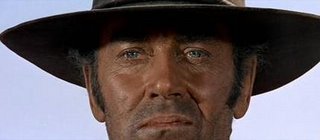
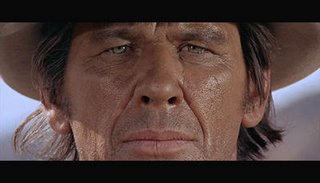
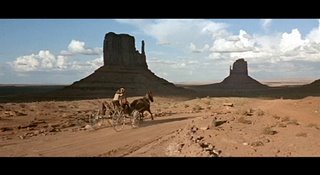
Sergio Leone’s “Once Upon a Time in the West.” Whether it’s the vast, aboriginal spaces of Monument Valley—an affectionate genuflection to the films of John Ford—or the intricately chiseled planes of the faces of Charles Bronson and Henry Fonda—you spend a lot of time looking at both in “Once….”—as well as deep close-ups of the faces of Jason Robards and Claudia Cardinale. There is one shot where Bronson ever so slowly relaxes a smile out of existence. Bronson does it so subtly you don’t know what’s happening until it’s happened. It’s one of the things I look forward to in the Dance of Death of “Once Upon a Time in the West.” Here are some others:


1. “Looks Like We’re Shy One Horse…” The first twelve minutes. A dilapidated train station in the middle of nowhere. Three long-coated bad-men wait for a train. They while away the time, each in their own unique fashion. Driven mostly by sound and filmed in extreme close-ups, the sequence, accompanied by the homely squeak of a windmill—one of the out-sized sound effects typical of Leone’s westerns—and the jokey placement of the credits, rolls on and on until a confrontation ends explosively. It’s an opening of great economy and intricate film-making. Few words are spoken throughout. I’ve shown students this sequence to show just how much presence and atmosphere simple sound effects can bring to a scene. Here’s the ending of the sequence. It’s just the opening gambit in a plot by two men who are playing against each other. It will take the entire movie to explain why.


2. “You Don’t Know How To Play” The gist of “Once Upon a Time in the West” is a chess game with lives and futures as the playing pieces. As scripted by Sergio Leone and his co-scenarists--the soon to be master of Italian horror films Dario Argento and the young Bernardo Bertolucci--the movie is a series of moves and counter-moves by the antagonists, each one trying to tame the frontier in their own way, and taking their own sweet time about it. Each has to make the pieces fall their way. For the first-time viewer it can be maddening following the strategems of the four participants in the story, but by the end the motivations and loyalties—or lack of them—become clear.


3. “People Scare Easier When They’re Dyin’” The villain of the piece is the meanest, rottenest most conniving scumbag to ever walk a dusty street and spit on it. “Frank” is a sadist who smiles when he kills and for the first time in his life he has a patron with a vision—one big enough for Frank to start to see how there might be such a thing as a future, and that one man can own it. He just can’t understand why people are getting in his way.


4. “Instead of Talking, He Plays. And When He Better Play, He Talks.” The composer and the director did it backwards.
Ennio Morricone wrote the music for the film first and Leone built his sequences around the music, playing it on-set to establish mood. There are two spectacular pay-offs--one in the previously mentioned Monument Valley sequence. But the other is at a train station where Claudia Cardinale, has just arrived from New Orleans to find no one to meet her. After a long wait (which is actually mercifully short for a Leone western) she decides to hire passage. Sounds disappear as she is seen through a station window talking to an official, and then the camera HEAVES up and over the roof, and in a burst of music reveals a burgeoning western town full of life and activity. It’s as if all of America is presented in that one astounding crane shot. My wife audibly gasped when she saw the shot in some movie clip program on TV, so stunning is the effect. And more than a little of the power of that shot is due to Morricone’s music and the angelic voice of Edda Dell’Orso, wordlessly cooing an ode to the country and to the protagonist around whom the movie and the future hinges.


5. “Ma’am, It Seems To Me You Ain’t Caught The Idea” For the first time in a Leone western, a woman is the hero, but like her predecessor—"The Man with No Name"—she is flawed and has some learning to do, and it’s up to Leone’s trio of men – another man with no name (going under the aliases of dead men), a wolf-like vagabond-thief, and the villain, Frank—to push, prod, blackmail, challenge and coerce her into a new role. It’s a role each man knows they’ll have no part of, and that, for a time, she is reluctant to fulfill. In the last shot of the film, she is seen bringing water to the railroad work-crew who will be bringing people and prosperity to what will be her town. It may seem a servile role, but as we pull away and follow the disappearing tracks to the frontier, leaving her to her future, she begins to bark orders, to direct and take charge. Her station will become a cornerstone of the push west. “This movie drips with testosterone,” a colleague once told me after a screening. Yes, but Leone includes a healthy shot of estrogen as, for the first time, he is dealing with a story that not only leaves the past behind, but also looks forward to the future.


Once Upon a Time In the West
-Only Angels Have Wings
The Searchers
Chinatown
Mr. Smith Goes to Washington
American Graffiti
To Kill a Mockingbird
Goldfinger
Bonus: Edge of Darkness

Tomorrow: Robots that go clunk!
Sunday: A "Scene" for Memorial Day
Monday: Our annual (now) Memorial Day War Movie review
Next week: We wrap up "Anytime Movies," bid them adieu, and start afresh.

Thursday, May 21, 2009

Anytime Movies Reloaded: - Only Angels Have Wings

It's Spring-Break for me. Times are busy. The Summer Movie Season is already begun (and I'll be writing about the new ones) and the Film Festivals are grinding away like creaky mills separating wheat from chaff. It's as good a time as any to re-boot a feature I started years ago, when it was suggested I do a "Top Ten" List.

I don't like those: they're rather arbitrary; they pit films against each other, and there's always one or two that should be on the list that aren't because something better shoved it down the trash-bin.

So, I came up with this: "Anytime" Movies.

Anytime Movies are the movies I can watch anytime, anywhere. If I see a second of it, I can identify it. If it shows up on television, my attention is focused on it until the conclusion. Sometimes it’s the direction, sometimes it’s the writing, sometimes it’s the acting, sometimes it’s just the idea behind it, but these are the movies I can watch again and again (and again!) and never tire of them. There are ten (kinda). They're not in any particular order, but the #1 movie IS the #1 movie.

While in college, I worked as a movie projectionist, and had an opportunity to show many great films for the various film courses being taught. But one film left a distinct impression—over the course of five days I had to show it eight times. I got to know it pretty well. Its name is “-Only Angels Have Wings” and it was directed by one of the great director-producers, Howard Hawks.

Hawks directed all types of movies, many of them classics of their genre: westerns (
Rio Bravo, Red River); mystery/noir (The Big Sleep); adventure (To Have and Have Not, Hatari!) and comedy (Bringing Up Baby, His Girl Friday). He even produced one of the first truly classic science fiction films (The Thing! [From Another World]), and an iconic musical (Gentlemen Prefer Blondes). Despite the genre, and despite the decade in which it was produced each film is unmistakably a Hawks film – a group of men (and women, but usually men) of diverse talents must come together to achieve a singular goal, be it to drive a huge herd of cattle to Missouri, or contain the alien threat, or capture a live rhinoceros, or get the bad guy to the Marshall (alive if possible) or ferry the refugees to safety, or find the dinosaur clavicle, or land a millionaire.

Conflict is achieved by introducing a newcomer to the mix who doesn’t understand the synergy of the group and who must learn “the code” to belong, and that keeps the group in cohesion. And so much the better if they do it without talking about it much.

That’s the Hawks formula, and he was able to create enough variations in the design that his films all seem different, even though they’re always telling the same basic story—a story that’s a metaphor for movie-making.
*

“Hello, professional”

Why “-Only Angels Have Wings” out of all those classics? It is the ultimate Hawks movie. Watch any of those others and you’ll hear similar lines and see similar situations, but in “Angels,” everything is distilled to the basic essence of the tale to become the best Hemingway story Hemingway never wrote. Distilled? The majority of the film takes place in one set! For this band of professionals, the goal is to fly the mail from the port city of Barancca through a narrow passage in the Andes utilizing one of a number of prop aircraft, all in need of repair. The men realize they’re merely links in a chain getting the mail…or a doctor…or a shipment of nitro-glycerin…to its destination with the threat of death flying right alongside. So hazardous is the job for these civilian-pilots that their base is a revolving door for the new blood who have to prove themselves. It’s "The Right Stuff” twenty years before Tom Wolfe popularized the phrase.

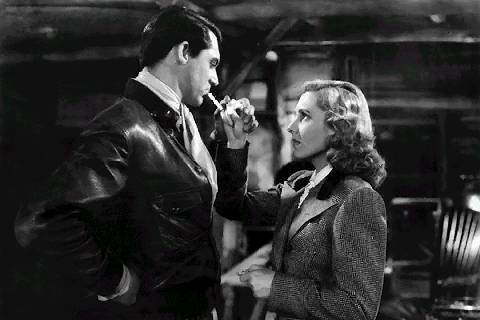
And it’s prime Hawks. For instance, watch the cigarettes. In a Hawks film, they’re visual short-hand for relationships—who’s in need and who can provide, who’s giving, who’s dependable, giving, taking, reading other's thoughts, . More than any other Hawks film, except perhaps “Rio Bravo,” the flame that’s there when you need it is a gambit that crams twice the information into the film, and reveals more about the characters than their deliberately circumspect dialog—what
Frank Capra called Hawks’s “three-corner dialog”—was allowed. To come right out and say things point-blank, well, not only would it be corny and unbelieveable…it just wasn’t done in Hawks's circles.

Hawks also liked to use music to convey mood. But it usually isn’t a Hollywood background score it's indigenous music—in this case, the bar band at Dutchy’s bar/mercantile and air terminal (this is a couple of years before “
Casablanca”). They set the mood, provide a little extra entertainment value, some local color for a set-bound movie and when the time is right and there’s a meeting of minds it’s reflected in a musical number in which everyone
participates. Again, no one has to come out and say ”We’re all thinking the same way.” They’re all singing the same song, so it’s understood.

"Boy, things happen fast around here, don't they?"

There’s also the unspoken ethos of the professional—you do your job to the best of your ability and you don’t talk about it. You don’t brag. You don’t cut corners and you don’t dwell on it. You do your job, you move on. You do your job right and people will notice. Do your job wrong and everyone suffers. In this way the group can depend on each other while staying out of their debt. In this movie-atmosphere, bit-players are allowed to shine. Yeah, the movie revolves around
Cary Grant (and the only role where he would be more stoic than he is here would be playing the icy spy Devlin in Hitchcock’s Notorious”) and the delightful Jean Arthur—she could turn on a dime from tragedy to comedy and not miss a step— but even the lowliest of character-actors get great moments of screen-time. Also of note are a very young Rita Hayworth at the start of her career and Richard Barthlemess—a former silent screen star who didn’t make the transition to “talkies.” He plays a pilot who must prove himself to the others and that he can “cut” it in their world. Art imitates life.

And then there’s
Thomas Mitchell, who might well be the greatest character actor to never achieve name-above-the-title status. A veteran of many a Frank Capra comedy—and whose most prominent role would be as Scarlett O’Hara’s father in “Gone with the Wind”—here he plays a character with the title “The Kid,” even though he’s the oldest of the pilots. So much of the movie centers on him that his one character fulfills every plot device except love interest, although with Hawks one could never be too sure of that, either. **

Ultimately it’s Mitchell’s Kid who provides the means for Grant’s character to express his feelings, which, typically, he does without really having to, and in a way that makes it obvious to everybody involved. And as if anybody missed the point how dependent everyone is on each other, most of the pilots wind up injured, “winged” so that by the end of the movie, two pilots have to perform the job of one to fly each mail-run. Perhaps the better title may have been “-Only Angels Have Two Wings.”

It’s all done so economically, so breezily and with so little in the way of “action” that one may get through the entire movie before realizing that mostly everybody just talked…without really coming out and saying what they mean. Everything is shot at eye-level. There’s nothing fancy in the camera-work. The story is the King, and everyone is working towards making it work…like professionals.


Cary Grant needs a match. Jean Arthur carries a torch.

* Hawks was well-known for taking different stories and turning them into the Hawks formula, sometimes rewiting the entire film on a day to day basis to get there. The most extreme example of this is “El Dorado,” which after ten minutes of one story suddenly veers into becoming a remake of the earlier Hawks-John Wayne western “Rio Bravo.” When Hawks called John Wayne to ask if he’d star in yet another western, “Rio Lobo,” Wayne knew exactly what he was getting into. “Do I get to play the drunk this time?” he drawled.

** Someday, someone far more intelligent than I is going to go through the Hawks filmography with an eye towards sexual politics—whether it’s the leering banter between
Montgomery Clift and John Ireland in “Red River,” or Cray Grant in drag in “Bringing Up Baby” (“I went GAY all of a sudden!!”) and “I Was a Male War Bride,” or some of the more bizarre stagings of musical numbers in “Gentlemen Prefer Blondes.” And then there’s the long line of husky-voiced women in his movies who are one of “the boys,” from Rosalind Russell to Lauren Bacall all the way up to future Paramount Studios exec Sherry Lansing. For all the macho posturing exhibited in his movies, there are hints that Hawks never completely “bought” into it and is enjoying winking at it. He may well be second only to James Whale in sneaking so much gay subtext into his movies.


-Only Angels Have Wings
Chinatown
Mr. Smith Goes to Washington
American Graffiti
To Kill a Mockingbird
Goldfinger
Bonus: Edge of Darkness