Showing posts with label Ralph Richardson. Show all posts

Saturday, June 9, 2012

The Wrong Box (1966)*

The Wrong Box (Bryan Forbes, 1966) Forbes is a British director not known for a light touch, not as a writer or as a director.  So to see him in charge of a comedy leaves one a bit non-plussed as opposed to amused.  Same can be said for this film, which tries very, very hard to be funny, but ends up evoking feelings of pity (which just won't "do" for a comedy).

The story of a tontine—a trust created for a clutch of privileged school-boys that will go to the last man standing—should have the same breakaway, mean-spirited greediness of, say, It's a Mad, Mad, Mad, Mad World (Stanley Kramer you wouldn't think of being able to do a comedy, either, but look at that result!), Those Magnificent Men in Their Flying Machines, or The Great Race, but instead has a leaden lethargy sometimes punctuated by awkward transitions, ill-timed (and rather unnecessary) close-ups, and the frequent appearance of title cards (to explain something the direction does not adequately provide) in a black-out format that recalls silent movie transitions.  It's Forbes imitating Richard Lester, and as slap-dash as the latter could be at times, he at least could tell a story, and give it the momentum so it would never flag.

Great cast, though: Michael Caine, Peter Cook and Dudley Moore, John Mills and Ralph Richardson; Peter Sellers has an extended cameo as a fraudulent doctor that starts slowly but finally picks up a weird head of steam.  And there's an odd love story between Caine and Forbes' actress-wife Nanette Newman that seems unconvincing.  The screenplay is by Larry Gelbart and Burt Shevelove, who wrote the book for the Broadway musical "A Funny Thing Happened on the Way to the Forum" (Lester's film of which was released the same year—coinicidence?) John Barry's galumphing score works overtime to make it frothy, but this is one granite souffle.  What is missing is whimsy, rather than desperate manicness, and it fortunately is found in Sellers' work, and in the odd performance of Wilfrid Lawson as the harried (not that you'd know) butler, Peacock.


* The asterisk is used that it isn't confused with the silent version of Robert Louis Stevenson's novel (with Lloyd Osborn) done in 1913—not that a lot of people have seen it.

Thursday, August 25, 2011

Time Bandits

Time Bandits (Terry Gilliam, 1981) As a filmmaker, Terry Gilliam grew up on Time Bandits, while still maintaining the childish sense of fun and menace that permeated his work before and during the Monty Python days.  It's a work of pure imagination, a circus-y freak show that just might kill you, where time is the scene of the crime, and even God and Satan are susceptible to the charms of a precocious little boy and a voracious team of avaricious little people.  One's tempted to say it's Gilliam's version of "Snow White" or a flipped version of "The Wizard of Oz," but that would be taking the piss and anarchy out of it.

11 year old Kevin (Craig Warnock) is fascinated with Ancient Greece, which some parents might find a sign of a curious intellect but inspires nothing but neglect in his parents.  One night, the wardrobe in his bedroom is shattered by a horse-bound knight who bursts through it and gallops down a forest road that has suddenly appeared—clearly something is amiss in the space-time continuum!  The next night, Kevin wants to go to bed early, but instead of a knight-errant, he's visited by a crush of six thieving "little people." They're demoted employees of The Supreme Being (voiced by Tony Jay, but will appear later as a doddering Ralph Richardson)—seems their previous job of designing trees and bushes was sub-par and they're now tasked with fixing rends in the fabric of space-time.  But, being particularly (how should we say?) "entrepreneurial" they've seen that their map of black holes can take them to other Earth-eras, from which they can pillage whatever they can carry in a necessarily brief time.  "Necessarily" because they're being pursued by extremes of Good and Evil (aren't we all?), with TSB wanting his map back and the personification of Evil (David Warner, clearly relishing the role) coveting the map, so that he can fix TSB's mistakes and make the Universe more to his liking.

Gilliam's film then hops and darts and falls into an episodic structure, where the diminutive fugitives "crash" various eras, including Sherwood Forest in the era of Robin Hood (John Cleese, doing a hilarious version of Prince Charles), a campaign of Napoleon Bonaparte's (a nearly incomprehensible Ian Holm), who is obsessed with puppet shows (because they're smaller than him), the HMS Titanic (served "neat"), and, to Kevin's delight, Ancient Greece, where he befriends King Agamemnon (Sean Connery*), who is first seen battling a Minotaur

Most of it works and works hilariously, even when Gilliam veers into the surreal...and the budgetarily spare.  Still, the low-tech miracles Guillam pulls off with limited resources (5 mil' financed by George Harrison's Handmade Films) are awe-inspiring, not only for their realization on film, but also for the sheer visual splendor—and squalor—Gilliam's considerable imagination envisioned (and still does).  It's an amazing spectacle, and if the film stutters a bit pace-wise (especially during the Napoleon segment), the delights to the eye tend to gloss over any story-telling problems.  Gilliam's eye would become bolder and his subject matter richer, but Time Bandits was the transition-point between a sketch-comedian/animator and a true film-maker and visionary.


What all the fuss is about


* The script read: "The warrior took off his helmet, revealing someone that looks exactly like Sean Connery, or an actor of equal but cheaper stature." Gilliam was shocked that not only had Connery read the script, he wanted the part, and even suggested a disconcerting cameo at the end.

Thursday, January 27, 2011

Our Man in Havana

Our Man in Havana (Carol Reed, 1959) A fascinating serio-comic counter-point to author Graham Greene and Reed's post-war classic (made a decade previously) The Third Man.  Reed's camera still swoops (courtesy of d.p. Oswald Morris), making sure that the Cinemascope frame is filled to the corners with detail, and the dark streets of Havana (filmed after the revolution and with the permission of Castro) at night, could be mistaken for post-war Vienna.  The sun shines brighter, though, and so the internecine work of spies is done in the relative low-light of bars and brothels.

Greene's book was a cynical look at how Intelligence forces can show a distinct lack of intelligence when confronted with mis-information, but it is Reed's nifty idea to cast it with comedic actors, though not always playing for laughs.  With such as Burl Ives, Noel Coward, Ralph Richardson, Ernie Kovacs (he plays a corrupt Cuban police official straight, but it is still funny) and Alec Guinness, it seems more a comedy of errors:  British ex-pat Jim Wormold (Guinness) is scraping by a living selling vacuum cleaners in Havana, while his daughter (Jo Morrow) is developing a taste for the expensive horsey set—something that could be provided by Captain Segura (Kovacks), who has an eye for the blonde girl.  Wormold has other plans for her, like an expensive Swiss boarding school.  But where to get the money?

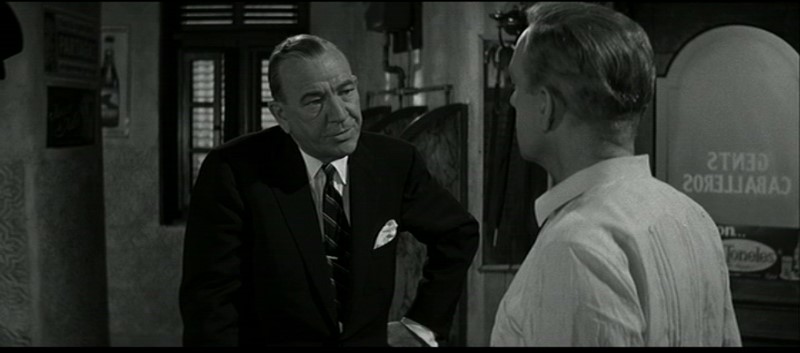
He is approached one day by Hawthorne (Coward, out of place in his dark suit and bowler hat in the mid-day sun of Havana) of the British secret service—or, as he is known, Agent 29500—to set up a bureau station for the service.  For Wormold, it is extra cash, an all-expenses paid membership to the exclusive country club, and a more lavish life-style, all for keeping his daughter close.  All the Service wants is results, which Wormold has trouble setting up—he is, after all, only a vaccuum cleaner salesman.  Soon, he starts filing bogus reports, recruiting strangers as fellow agents (without their knowledge), building his station in importance to the delight of Hawthorne and his superior 'C' (Ralph Richardson).

However, becoming an important secret agent draws attention.  He is soon assigned a secretary (Maureen O'Hara) by his superiors, wanting to build him up, and targeted for assassination by his enemies, wanting to shut him up.  Doesn't matter if the information he's sending is all wrong; with so many resources at his command, he's sure to dig up something sooner or later.  Scrutinized from both sides, the spy-game stops being so rewarding, and turns downright dangerous.

It's all played with a bit of a wink, with great comic actors under tight rein to let the material be funny without goosing it.  Definitely worth seeing for the literate script, Reed's classic direction and the fine performances.  John le CarrĂ© would later use the basic subject matter for his book (and subsequent John Boorman film) The Tailor of Panama.