
No kidding...
He could also talk about the various strata of life stages and work-worth going on, of folks who are successful, or post-success, or craving success in their lives and how their attractions are reflected not only in their choices of who to imprint on (and they are choices), but also in how they regard other folks inside their strata and more importantly outside of it (Oh, this is getting complicated...and we haven't even gotten to the irony of success and getting to do what you want having nothing to do with happiness or self-worth, but, man, I keep digressing further and further here...).
The point is "everybody loves the wrong person" is such an obvious and simplistic break-down of The Sea Gull that you want to shake Lumet and say "anything else?" Oh, it's there, and the actors are superb in playing it, but Lumet, as a director, imposes his technology on it in a ham-fisted way, choice of angles, edits, he's still directing for television and for a "rube" audience that might not get it if he doesn't beat you over the head with it, and as it's a character piece, any decision that the director chooses to show his hand (and the material's) just gets in the way of the communication between actors and audience. We'll get to that in a second.

It's a less than idyllic retreat at the lake side getaway of Sorin (Andrews), who's in failing health. His sister Irina (Signoret) has brought her lover, the successful writer Trigorin (Mason) with her to visit her son Konstantin (Warner), an aspiring playwright whose ambition for the stay is to stage an esoteric play about the death of the Earth with his love Nina (Redgrave, Vanessa), an aspiring actress, who lives on the neighboring estate. Sorin's place is being maintained by an out-of-work civil servant (Ronald Radd) and his wife (Eileen Herlie) and their daughter Masha (Kathleen Widdoes), who is pursued by Medvedenko (Alfred Lynch), despite that she is in love with Konstantin. Konstantin is in love with Nina, though Nina is enamored of Trigorin. The bailiff's wife is in love with Dr. Dorn (Denholm Elliott), whose affections are suspect.
Things begin to get complicated when Konstantin stages his play within the play, an avant-garde work of the future Earth describing its decay at the hands of its now extinct population of human beings, a role played by Nina. Irina scoffs at the play, Trigorin dismisses it by his lack of of commenting on it, and Konstantin storms off, humiliated, while Nina, despite the group's apathy, is entranced with her time on stage. It sets in motion the group's interactions as Konstantin, coveting Trigorin's success while critical of his work, and jealous of the writer's relationship with his Mother, increases his anti-social behavior, which further drives a wedge between him and Nina, who is drawn to Trigorin.
It's Lumet's presentation of the Konstantin's play here that frustrates and, frankly, its effect that keeps me from fulling embracing Lumet as a master film-maker. How he presents the play is to keep the stage (and Redgrave performing her scene) out of focus, and keeping the far field across from a lake IN focus. Dramatically and intellectually, one might defend it—the play within a play has Nature "speaking" and so maybe it makes some sort of sense to have the scenery in focus instead of the foreground action, or it's out of focus to reinforce that it is a "bad" play. However, those contrarily focally challenged shots are intercut with the reaction of the people watching it and they are very much in focus, which creates this bizarre unease to the watcher of the film. Is this a mistake? Is there a "point" being made? If so, why ruin it by interrupting it with sharply photographed reactions that call attention to the falsity of the effect? And if it is to show that it's a "bad" play, isn't that communicated by the reaction shots?
It is this "going for a temporary effect," even on an intellectual level, at the expense of the experience of everyone in the scene as a whole, and the film's naturalism in toto. Film is an illusion already, there's no point in calling attention to the fact, unless you want to just explode the whole intention of presenting a moment in time truthfully to the best of your craft. And Lumet, especially, in his earlier films, has a tendency to just grand-stand at the risk of the film entire.
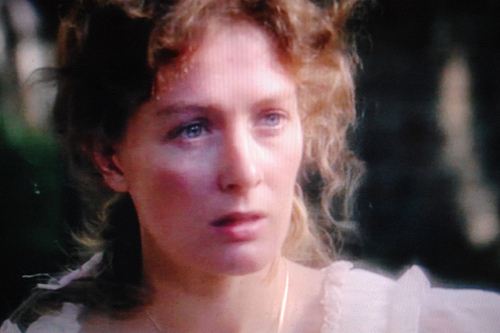
Still, it's a brilliant cast—Mason is a marvel here, and one should be grateful that we get a chance to see Redgrave's Nina (even if she might be a bit old for the part). One cannot fault the amazing performances, even if the frame, pacing, cutting scheme might show them at a disadvantage.




.jpg)


