Showing posts with label 1968. Show all posts

Thursday, November 14, 2013

The Sea Gull (1968)

The Sea Gull (Sidney Lumet, 1968) Reading Sidney Lumet's book "Making Movies" he mentions that he got the idea to make this film of Anton Chekhov's play when working with James Mason, Simone Signoret, Harry Andrews and David Warner on The Deadly Affair in 1966.  Lynn Redgrave, sister of Vanessa, also worked on The Deadly Affair. By the time the financing was arranged and filming was set for Sweden, Lumet pretty much had his dream cast. Also, a couple times in the book. he announces "the theme" of The Sea Gull: "Everybody loves the wrong person."

No kidding...


He could also talk about the various strata of life stages and work-worth going on, of folks who are successful, or post-success, or craving success in their lives and how their attractions are reflected not only in their choices of who to imprint on (and they are choices), but also in how they regard other folks inside their strata and more importantly outside of it (Oh, this is getting complicated...and we haven't even gotten to the irony of success and getting to do what you want having nothing to do with happiness or self-worth, but, man, I keep digressing further and further here...).


The point is "everybody loves the wrong person" is such an obvious and simplistic break-down of The Sea Gull that you want to shake Lumet and say "anything else?"  Oh, it's there, and the actors are superb in playing it, but Lumet, as a director, imposes his technology on it in a ham-fisted way, choice of angles, edits, he's still directing for television and for a "rube" audience that might not get it if he doesn't beat you over the head with it, and as it's a character piece, any decision that the director chooses to show his hand (and the material's) just gets in the way of the communication between actors and audience.  We'll get to that in a second.


It's a less than idyllic retreat at the lake side getaway of Sorin (Andrews), who's in failing health.  His sister Irina (Signoret) has brought her lover, the successful writer Trigorin (Mason) with her to visit her son Konstantin (Warner), an aspiring playwright whose ambition for the stay is to stage an esoteric play about the death of the Earth with his love Nina (Redgrave, Vanessa), an aspiring actress, who lives on the neighboring estate. Sorin's place is being maintained by an out-of-work civil servant (Ronald Radd) and his wife (Eileen Herlie) and their daughter Masha (Kathleen Widdoes), who is pursued by Medvedenko (Alfred Lynch), despite that she is in love with Konstantin.   Konstantin is in love with Nina, though Nina is enamored of Trigorin.  The bailiff's wife is in love with Dr. Dorn (Denholm Elliott), whose affections are suspect. 

Things begin to get complicated when Konstantin stages his play within the play, an avant-garde work of the future Earth describing its decay at the hands of its now extinct population of human beings, a role played by Nina. Irina scoffs at the play, Trigorin dismisses it by his lack of of commenting on it, and Konstantin storms off, humiliated, while Nina, despite the group's apathy, is entranced with her time on stage.  It sets in motion the group's interactions as Konstantin, coveting Trigorin's success while critical of his work, and jealous of the writer's relationship with his Mother, increases his anti-social behavior, which further drives a wedge between him and Nina, who is drawn to Trigorin.

It's Lumet's presentation of the Konstantin's play here that frustrates and, frankly, its effect that keeps me from fulling embracing Lumet as a master film-maker.  How he presents the play is to keep the stage (and Redgrave performing her scene) out of focus, and keeping the far field across from a lake IN focus.  Dramatically and intellectually, one might defend it—the play within a play has Nature "speaking" and so maybe it makes some sort of sense to have the scenery in focus instead of the foreground action, or it's out of focus to reinforce that it is a "bad" play.  However, those contrarily focally challenged shots are intercut with the reaction of the people watching it and they are very much in focus, which creates this bizarre unease to the watcher of the film.  Is this a mistake?  Is there a "point" being made?  If so, why ruin it by interrupting it with sharply photographed reactions that call attention to the falsity of the effect?  And if it is to show that it's a "bad" play, isn't that communicated by the reaction shots?

It is this "going for a temporary effect," even on an intellectual level, at the expense of the experience of everyone in the scene as a whole, and the film's naturalism in toto.  Film is an illusion already, there's no point in calling attention to the fact, unless you want to just explode the whole intention of presenting a moment in time truthfully to the best of your craft.  And Lumet, especially, in his earlier films, has a tendency to just grand-stand at the risk of the film entire.

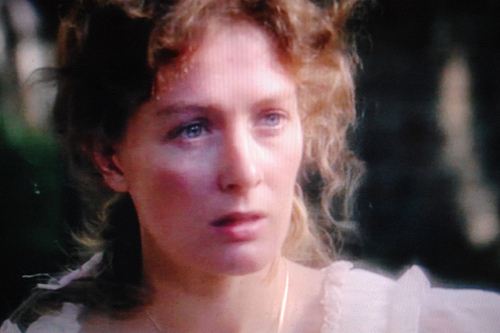
Still, it's a brilliant cast—Mason is a marvel here, and one should be grateful that we get a chance to see Redgrave's Nina (even if she might be a bit old for the part).  One cannot fault the amazing performances, even if the frame, pacing, cutting scheme might show them at a disadvantage.


Saturday, August 31, 2013

Ice Station Zebra

Ice Station Zebra (John Sturges, 1968) The movie that was (supposedly) Howard Hughes' favorite movie—one that he would watch obsessively.
One can only wonder why.  It is not exactly inspired, entertainment, though competently directed by John Sturges.  It was also one of the last of the prestigious "roadshow" presentations , shot in "Super-Panavison-70" and featuring "Overture" music and an Intermission at the theater.  But, beyond that, the film may be one of the dullest thrillers ever filmed. 


ISZ has the same stolid air of other adaptations of Alistair MacLean adventure yarns (The Guns of Navarone, Where Eagles Dare).  It's just not as adventurous, and the locations—studio-created—are claustrophobic and closed-in, as opposed to having any dramatic vistas or intriguing locales of other MacLean stories.  Here, it's meeting rooms, a submarine and a burned out polar station on a floating ice flow.  People don't get out much, and the whole film feels close and boxed-in (quite a trick in "Super-Panavision-70). Oh, there are intrigues—it wouldn't be a MacLean story if there wasn't one or two double-crosses thrown in—but they're fairly typical.  The sub' has to have a debilitating leak, and as befitting a Cold War drama (the coldest!), there are dueling loyalties and the to-be-expected double-agent (but who?).  It never rises above the slightly edgy to the exciting and is mostly cliché-ridden, especially when it comes to the "whodunnit" aspects.


Fairly good cast with not much to do except glower at each other, and top-liner Rock Hudson isn't at his best at that, and is ham-strung by the script (by MacLean, Douglas Hayes—he wrote Kitten with a Whip, after all—Harry Julian Fink, and W.R. Burnett, no slouches, any of them) from doing anything interesting, like humor.  Patrick McGoohan has one interesting scene where he loses it, but mostly he's clipped and acerbic in hyper-Danger-Man mode.  Jim Brown matches him frown for frown—twin performances by actors playing characters hating each other, and Ernest Borgnine does a Russian accent.  A lot of testosterone, mostly going to waste, in material which is stretched to the breaking point.

Supposedly there's going to be a remake, so there's a lot of room for improvement. 


Patrick McGoohan recreates my expression watching this movie


Thursday, May 23, 2013

The Power

The Power (Byron Haskin, 1968) A sci-fi "who-thunk-it" by the producing-directing team of George Pal and Byron Haskin, whose work included the 1953 War of the Worlds, When Worlds Collide, and Robinson Crusoe on Mars.  The subjects of the Pal-Haskin team were usually puerile, with sophisticated special effects that dazzled the child in anyone, no matter their age.  The Power, however, is light on special effects, and the sub-text is less extra-terrestrial than sensorial.

A team of scientists (George Hamilton, Suzanne Pleshette, Richard Carlson, Earl Holliman, Nehemiah Persoff, and Arthur O'Connell) are working on a top-secret project testing astronaut endurance.  They are visited one day by their government liaison Arthur Norlund (Michael Rennie) who is skeptical of the worth of the whole project, other than the ideas of the team crack-pot, anthropologist Henry Hallson (O'Connell) who is convinced by his survey studies that one of the subjects has paranormal abilities.  His outbursts embarrass the entire board, especially Dr. Tanner (Hamilton) who tries to beat down the doctor's ideas at every opportunity.  However, a simple test proves that one of the scientific team has extraordinary mental powers.


Before you can say "Agatha Christie's 'Ten Little Indians'" the scientists start being knocked off in strange ways that only we, the audience, are privy to.  First Dr. Hallson is found dead, centrifugally squished in a centrifuge run amok.  Then Dr. Tanner is fired from the project, accused of never having attended college, and faking his way into his position.  He teams up with fellow researcher (and main squeeze) Marge Lansing (Pleshette) to try and track down who the murderer could be.  In the meantime, more of the research team end up incapacitated, and it becomes readily apparent to Tanner and Lansing that they're going to end up on a slab unless they can find the killer.  But who is it?


The movie is quite clever in how it clicks along, even if the love story feels a bit tepid, and Haskin's stage sense is always assured at making the strange either commonplace or particularly fascinating.*  For instance, the scientists work in a facility where their offices are separated by glass, so everybody can keep tabs on everybody else, making hiding the killer a difficult project.  Once Tanner is fired, however, the confining space is taken out of the equation, and the individual attempts at messing with people's minds are given free reign and can come out of anywhere...and nowhere at the same time.


As far as the acting is concerned, it's a bit cheesy, with O'Connell over-emoting until you wonder about his credentials, and Hamilton smolders throughout, as if told he'd be the leading man, but not told how.   He's at his best convincing us that the illusions he sees are real, and the horror/confusion that he feels play across his face.  That's when he truly bonds with his audience, and is the filmmakers' best asset in making the movie come across.


  * Haskin had worked with Disney live action films, and did the more superior episodes of the original version of "The Outer Limits" as well as the first pilot for a little series called "Star Trek."


Thursday, October 18, 2012

Targets

Targets (Peter Bogdanovich, 1968) The day after the insane shootings at the midnight showing of The Dark Knight Rises in Aurora, Colorado, Glenn Kenny, in his fine blog Some Came Running, made a comment on it, without making a comment.  He simply took frame-grabs from Peter Bogdanovich's directorial debut, Targets.  One could only nod one's head in acknowledgement of the aptness.

The project started out as the most bizarre of industry favor-granting. Bogdanovich had done some work for B-movie king Roger Corman, and the AIP producer emeritus granted the writer an opportunity to direct his first project—with some stipulations: he had some work due from Boris Karloff by contract, and the aging horror star had to be worked into the storyline, and there were some left-over scenes from a past Karloff movie The Terror (featuring as well, a pre-star Jack Nicholson) that Bogdanovich could avail himself of.  Other than that, Bogdanovich could do whatever he wanted, as long as he stayed on-time and under budget—about $125,000.  With then-wife Polly Platt, who also served as production designer, Bogdanovich came up with a twisted storyline that followed two storylines that would come together at a drive-in theater, the favored venue of most AIP releases.  In his commentary for the film, Bogdanovich goes out of his way to acknowledge the considerable help he had in fashioning the script from director-writer Samuel Fuller, who fleshed out and added resonances to the story.


One of the stories follows Bobby Thompson (Tim O'Kelly), as typical a young American as can be.  He's sells insurance after having toured in Vietnam, wife's a nurse, and the young couple lives with the Thompson parents, where they have a normal domestic life of communal dinners (with grace said beforehand), and a family evening of television.  Son and Dad have a hobby of target practice, in which the son takes great pride in his accuracy, no matter the caliber, no matter the weapon.  Before the day is out, he'll grow weary of stationary targets.

Meanwhile, across town Byron Orlok (Karloff) is souring on the movie business.  He's just screened his latest low budget horror flick, directed by a kid, Sammy Michaels (played by Bogdanovich), who's pressuring him to star in his next film, while the studio is assuming that the star will keep churning the  stuff out.  But Orlok announces he's retiring—oh, he'll do publicity for this one, but, really, with the very real horrors going on in the world meted out by tin-gods and commonsters, what relevance is the costume theatrics he's appearing in.  He feels old, quaint, and antiquated, pretending horror when the world shows a proclivity for it with no bounds.

The two, Bobby and Byron, cross paths twice in the film, one completely unbeknownst the older star, and the other at a moment of destiny, when the two meet again at the world premiere of Orlok's new picture.  Both reveal their true selves at the drive-in, and the film ends, as Bogdanovich is wont to do, on a note of ambivalence.

The film was so good that Corman was able to sell it (at a profit) to Paramount Studios for release.  Bogdanovich fills it with telling cold-blooded details, especially in the planning and fulfillment of Bobby's activities, which become more and more erratic as things go astray from his plans, and those touches, some ironic, some despairing, are rich and feel like a tribute to the director the film is most in the style of—Alfred Hitchcock.  Hitchcock is always a good primer for film-makers starting out in the low-budget fields, as his films are like blueprints in basic film-making techniques—direct, bald, and effective.  But Hitchcock's subtleties—the stuff that fills the frame of the cutting scheme—are tougher to match.  And it takes a better breed of film-maker—like Spielberg, Bogdanovich, and DePalma—to take the Master's schematics and improvise with the form.  One can do all the planning one wants, but it's in the finishing touches that make a house a home, and a movie a film.


Wednesday, December 29, 2010

The Detective


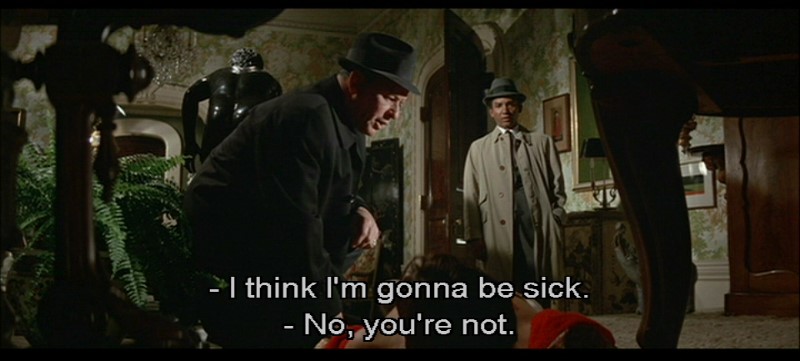
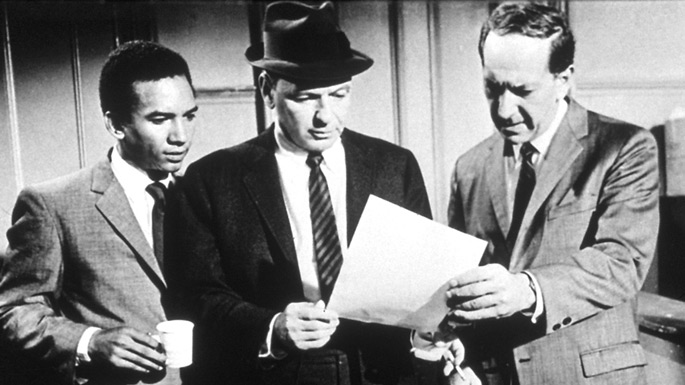
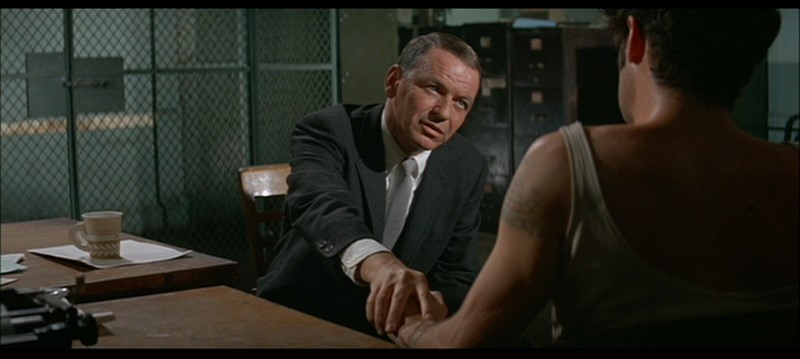
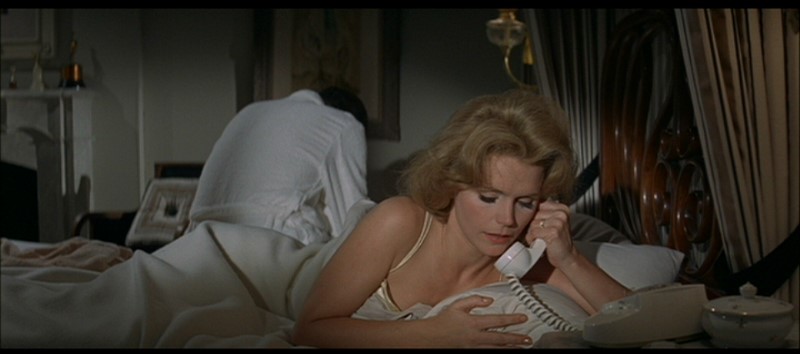
The Detective (Gordon Douglas, 1968) You spend a lot of time looking into the wearily dead blue eyes of Frank Sinatra in this one, as he tries to come to grips with a world he no longer understands, driving in the rain, looking for the clue to
where it all went wrong.

This film hasn't aged well.  What was daring and "adult" at the time of the film's release (the forced underground homosexual culture, along with nymphomania) now seems dated and "quaint," even.  More compelling, and ground-breaking is the police procedural in the foreground—a murder investigation that has a ritual aspect to it.  The victim's house-mate (Tony Musante) is noticeably absent, and Leland leads the investigation to track the man down, leading to his arrest, trial and execution.  Textbook, it's thought. 

But, later, he's approached by Norma McIver (Jacqueline Bisset) the wife of a prominent suicide (William Windom), who committed the act very publicly, and Leland's investigation leads him to question his earlier actions and those of his authorities.  All this, while reconciling his difficulties with his wife (Lee Remick).  The fallibility of the cops to follow their prejudices, and pressure from corrupt superiors was something new to the genre.  These cops had flatfeet of clay.

The director, Gordon Douglas, was a favorite of star Sinatra, shooting quickly and efficiently, letting Sinatra do his set-up's in the minimal number of takes that he preferred.  The cast also has prominent roles for Ralph Meeker, Jack Klugman, Al Freeman Jr. and Robert Duvall as other detectives in Leland's squad.

There were other novels in the "Leland" series by Roderick Thorp, including one, "Nothing Lasts Forever,"in which The Detective tries to save his family from terrorists in a high-rise professional building.  That's right, it's the book on which Die Hard was based. Now, just imagine if John McLaine had said "Dooby-dooby-doo" instead of "Yippie-Kye-yay..."

Saturday, October 31, 2009

Night of the Living Dead (1968)

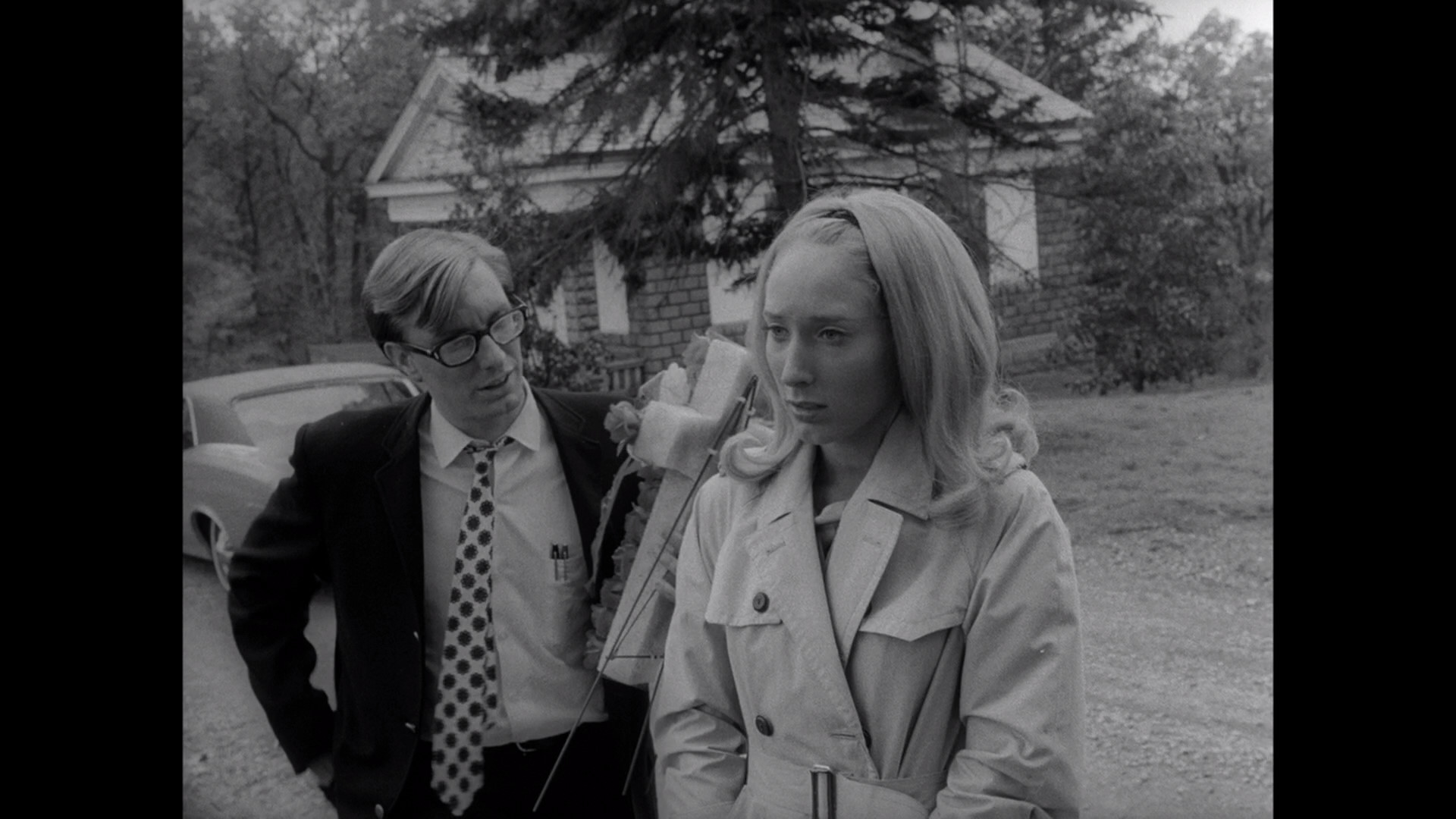
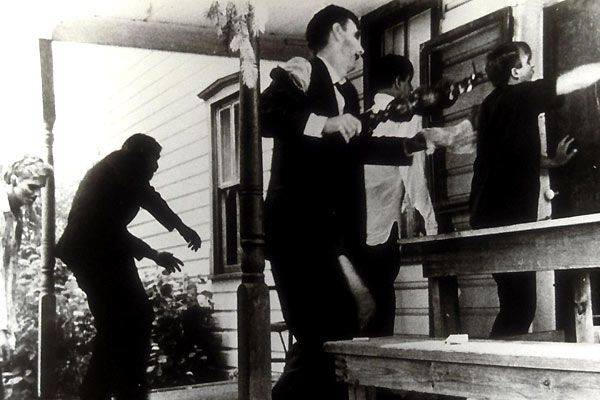
"Night of the Living Dead" (George A. Romero, 1968) Johnny and Barbara (Russell Streiner and Judith O'Dea) are two dutiful kids who schlep all the way up to a high hill-top cemetery outside of Pittsburgh to put a rememberance on their father's grave. It's a big deal to Barbara, but not to Johnny (who hasn't been to church lately) and, according to his grandfather, is "goink to Hale!" It's the Summer Solstice, 8 pm at night but still light out, and there's a thunderstorm a-brewing.

Boy, howdy!

There's not a soul around at the cemetery, but that doesn't mean there's no activity.
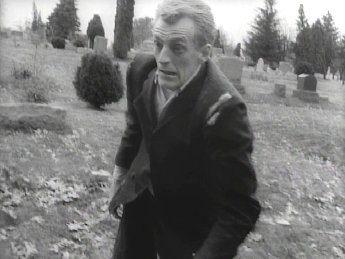
There's that tall unsteady guy in the dark suit over there (S. William Hinzman), looking a little pale. In fact, it looks like he hasn't had a bite in days! But Johnny, still the same disrespectful cut-up he was when he and Barb were kids, can't help making fun: "They're coming to GET you, Barbara..." he dramatically intones, not realizing that he may be right for once in his miserable life. Before he knows it, that tall pale guy is attacking Barbara, and when Johnny steps in, the thing attacks him, trying to bite his neck. Before long, Johnny is taking a dirt-nap with a tombstone for a pillow, and "Gary Shambling" is chasing Barbara out of the bone-yard.

Then, it's all down-hill from there.

Within ten minutes she's trapped in a farm-house surrounded by flesh-eating zombies
trying to get in—good thing they seem unable to open doors! And it's a good thing that Ben (Duane Jones) has happened to run out of gas nearby. The reason? Barbara is probably the last human being alive you want to be trapped with during a zombie attack (that is described by a newscaster as "wholesale murder"—life being cheap, I guess) Hysterical and useless, she seems incapable of doing anything except the exact-opposite of what should be done in a crisis, and is at her best when she's numb with shock.* Ben, on the other hand, is smart, competent, logical and efficient, well aware that this is no "Sunday School Picnic," and a fast study, figuring out that perforating zombie brain-pans with anything from bullets to tire-irons is the only way to stop them.

Ben may be the greatest hero in all of horror films; that he is African-American, the only black face in a crowd of white—and whiter—is just one of the sign-posts that "Night of the Living Dead" may be doing something more than target practice. Director George Romero protests up and down that Jones was hired because he was the best audition (and, indeed, he gives the best performance of the non-grunting, teeth-gnashing roles), but the fact that his Ben is so unquestionably in charge and handling the situation, despite his dithering neighbors in the buffet—and nothing is made of it—speaks volumes for a film made in 1968.

But you can read all sorts of social messages into "Night of the Living Dead," if that's what it takes to keep peeking at it through your fingers. It could be a treatise on race relations, sure. It could be a cautionary tale, as most of the victims are killed due to the actions of someone they loved. It could be a political statement of using unity against an implacable foe (like soulless communists), whether attacking from within or without. It could be a warning against the Tyranny of Science (radiation is the cause of it all, but that's as useful as being in a control group). Or it could be a protest against
neighbors who drop by at odd hours to chew the fat. Maybe it's promoting vegetarianism. Whatever the reason, "Night of the Living Dead" sinks its teeth into more dynamic issues than "Is it better to be upstairs, or in the basement?" (Answer: Outside with "The Gun-Club").

Inspired by Herke Hervey's low-budget "Carnival of the Souls," Romero, who also made industrial films—and filmed shorts for "
Mr. Roger's Neighborhood"—drew style-points from Richard Matheson's "I Am Legend," (and it's first screen adapation "The Last Man on Earth"), but amped up the dynamics with quickly cut hand-held shots and frequent close-ups of angry antagonists squaring off in low-light conditions. Romero also made a more grisly movie than folks were used to, although the gore was decidedly low-tech: for blood the crew poured Bosco over the victims (probably just made them more delectable for the zombies!).

"Night of the Living Dead" is a boiler-maker of a movie, determined to keep activities at a feverish pitch, and has none of the care of yesterday's "Carnival of the Souls." But, the sheer adrenaline that courses through the film makes it a dynamic film-going experience—upsetting, nihilistic, and cynical. In the public domain, it was made part of the National Film Registry in 1999. It has spawned more remakes and sequels (with more on the way) than just about any movie ever made.

You can watch "Night of the Living Dead"...for free...here.

Have a Safe and Sane Hallowe'en. Remember, no candy for zombies!

* That being the case, the first thing Ben should have told her was: "Barbara! Stay inside the house and whatever you do, don't go out there with those zombies!" It's a "win" either way!

Friday, May 22, 2009

Anytime Movies Reloaded: Once Upon a Time in the West

It's Spring-Break for me. Times are busy. The Summer Movie Season is already begun (and I'll be writing about the new ones) and the Film Festivals are grinding away like creaky mills separating wheat from chaff. It's as good a time as any to re-boot a feature I started years ago, when it was suggested I do a "Top Ten" List.

I don't like those: they're rather arbitrary; they pit films against each other, and there's always one or two that should be on the list that aren't because something better shoved it down the trash-bin.

So, I came up with this: "Anytime" Movies.

Anytime Movies are the movies I can watch anytime, anywhere. If I see a second of it, I can identify it. If it shows up on television, my attention is focused on it until the conclusion. Sometimes it’s the direction, sometimes it’s the writing, sometimes it’s the acting, sometimes it’s just the idea behind it, but these are the movies I can watch again and again (and again!) and never tire of them. There are ten (kinda). They're not in any particular order, but the #1 movie IS the #1 movie.


Landscapes.

That’s what’s featured in
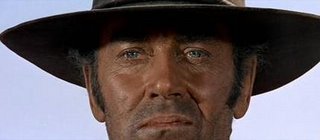
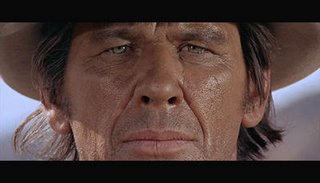
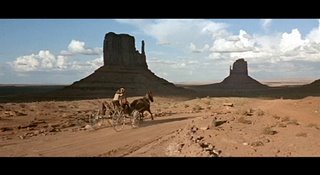
Sergio Leone’s “Once Upon a Time in the West.” Whether it’s the vast, aboriginal spaces of Monument Valley—an affectionate genuflection to the films of John Ford—or the intricately chiseled planes of the faces of Charles Bronson and Henry Fonda—you spend a lot of time looking at both in “Once….”—as well as deep close-ups of the faces of Jason Robards and Claudia Cardinale. There is one shot where Bronson ever so slowly relaxes a smile out of existence. Bronson does it so subtly you don’t know what’s happening until it’s happened. It’s one of the things I look forward to in the Dance of Death of “Once Upon a Time in the West.” Here are some others:


1. “Looks Like We’re Shy One Horse…” The first twelve minutes. A dilapidated train station in the middle of nowhere. Three long-coated bad-men wait for a train. They while away the time, each in their own unique fashion. Driven mostly by sound and filmed in extreme close-ups, the sequence, accompanied by the homely squeak of a windmill—one of the out-sized sound effects typical of Leone’s westerns—and the jokey placement of the credits, rolls on and on until a confrontation ends explosively. It’s an opening of great economy and intricate film-making. Few words are spoken throughout. I’ve shown students this sequence to show just how much presence and atmosphere simple sound effects can bring to a scene. Here’s the ending of the sequence. It’s just the opening gambit in a plot by two men who are playing against each other. It will take the entire movie to explain why.


2. “You Don’t Know How To Play” The gist of “Once Upon a Time in the West” is a chess game with lives and futures as the playing pieces. As scripted by Sergio Leone and his co-scenarists--the soon to be master of Italian horror films Dario Argento and the young Bernardo Bertolucci--the movie is a series of moves and counter-moves by the antagonists, each one trying to tame the frontier in their own way, and taking their own sweet time about it. Each has to make the pieces fall their way. For the first-time viewer it can be maddening following the strategems of the four participants in the story, but by the end the motivations and loyalties—or lack of them—become clear.


3. “People Scare Easier When They’re Dyin’” The villain of the piece is the meanest, rottenest most conniving scumbag to ever walk a dusty street and spit on it. “Frank” is a sadist who smiles when he kills and for the first time in his life he has a patron with a vision—one big enough for Frank to start to see how there might be such a thing as a future, and that one man can own it. He just can’t understand why people are getting in his way.


4. “Instead of Talking, He Plays. And When He Better Play, He Talks.” The composer and the director did it backwards.
Ennio Morricone wrote the music for the film first and Leone built his sequences around the music, playing it on-set to establish mood. There are two spectacular pay-offs--one in the previously mentioned Monument Valley sequence. But the other is at a train station where Claudia Cardinale, has just arrived from New Orleans to find no one to meet her. After a long wait (which is actually mercifully short for a Leone western) she decides to hire passage. Sounds disappear as she is seen through a station window talking to an official, and then the camera HEAVES up and over the roof, and in a burst of music reveals a burgeoning western town full of life and activity. It’s as if all of America is presented in that one astounding crane shot. My wife audibly gasped when she saw the shot in some movie clip program on TV, so stunning is the effect. And more than a little of the power of that shot is due to Morricone’s music and the angelic voice of Edda Dell’Orso, wordlessly cooing an ode to the country and to the protagonist around whom the movie and the future hinges.


5. “Ma’am, It Seems To Me You Ain’t Caught The Idea” For the first time in a Leone western, a woman is the hero, but like her predecessor—"The Man with No Name"—she is flawed and has some learning to do, and it’s up to Leone’s trio of men – another man with no name (going under the aliases of dead men), a wolf-like vagabond-thief, and the villain, Frank—to push, prod, blackmail, challenge and coerce her into a new role. It’s a role each man knows they’ll have no part of, and that, for a time, she is reluctant to fulfill. In the last shot of the film, she is seen bringing water to the railroad work-crew who will be bringing people and prosperity to what will be her town. It may seem a servile role, but as we pull away and follow the disappearing tracks to the frontier, leaving her to her future, she begins to bark orders, to direct and take charge. Her station will become a cornerstone of the push west. “This movie drips with testosterone,” a colleague once told me after a screening. Yes, but Leone includes a healthy shot of estrogen as, for the first time, he is dealing with a story that not only leaves the past behind, but also looks forward to the future.


Once Upon a Time In the West
-Only Angels Have Wings
The Searchers
Chinatown
Mr. Smith Goes to Washington
American Graffiti
To Kill a Mockingbird
Goldfinger
Bonus: Edge of Darkness

Tomorrow: Robots that go clunk!
Sunday: A "Scene" for Memorial Day
Monday: Our annual (now) Memorial Day War Movie review
Next week: We wrap up "Anytime Movies," bid them adieu, and start afresh.

Thursday, September 11, 2008

The Bride Wore Black

"The Bride Wore Black" aka "La Mariée Était en Noir" (Francois Truffaut, 1968) Like most film-scholars turned directors, Francois Truffaut spent a fair amount of his early years paying tribute to films he loved in the film he was the author of. This film, and to a certain extent, "Farenheit 451," were part of his chilly "Son of Hitchcock" period, using strategies, if not direct shots, from the Master of Suspense in his own films. But where Hitchcock's films had an eerieness derived from the rigid structure of his films, Truffaut's seemed sterile, artificial, aping Hitchcock's structure, but without the lengths to which Hitchcock would try to simulate life. For example, in "The Bride Wore Black," there's a sequence where Jeanne Moreau is walking around a bachelor's apartment that she describes as cluttered, but it is personified by a single tie hanging over a rod. Pretty specific clutter! Compare that to The Master's meticulous recreation of real locations on-set. Hitchcock did not start out directing; he began as an art director in films and worked his way up.

Truffaut began as a critic.

It's for that reason that his plot structure for "
The Bride Wore Black" has the deliberate pace of a funeral dirge. One by one, "The Bride" seeks out disparate men who seem to have nothing in common and devises intricate ways to win their trust and take their lives, each crime pre-meditated and carried out with a cold efficiency--Moreau barely registers any emotion at all. But, why? What's the reason? Why these men? Truffaut takes his time revealing everything, but by that time the audience may be getting impatient with so many murders and no punishment. Truffaut even has an answer for that in his movie machinations.

One can see Truffaut still experimenting with his medium with varying results. For example, the frightening of a chamber-maid by "The Bride" would play a bit better if Truffaut hadn't insisted on a flash-cut of only a couple of frames. Moreau barely registers before the angle has changed immediately, and the maid has spun around (impossibly fast, given the split-second amount of time that bridging shot took). And after utilizing Hitchcock's best composer,
Bernard Herrmann, for the earlier "Farenheit 451," here Herrmann's score is a bit too lush for the visuals that Truffaut has shot. It's heart is on its sleeve, whereas the rest of the movie doesn't seem to have any heart at all. Perhaps Herrmann was over-compensating for the movie he saw, and went over the top to express the emotions that Truffaut keeps submerged.


Finally, one can't watch the movie and help but think this is where Quentin Tarantino got his inspiration for "Kill Bill," only tarted it up with his obsessions--prolonged violent sequences, cribbed movie styles, and the expected but ultimately pointless comic-book discussion. Somehow, "The Bride Wore a Yellow Track Suit" just doesn't cut it.*

*no pun intended.

Thursday, July 10, 2008

Olde Review: Rosemary's Baby

This was part of a series of reviews of the ASUW Film series back in the '70's. Except for some punctuation, I haven't changed anything from the way it was presented, giving the kid I was back in the '70's a break. Any stray thoughts and updates I've included with the inevitable asterisked post-scripts.

This Saturday's ASUW films in 130 Kane are Roman Polanski's "Rosemary's Baby," and Robert Wise's "The Haunting."

"Rosemary's Baby" (Roman Polanski, 1968) "Rosemary's Baby" opens with this theme:* it's a lullaby, sung charmingly off-key by Mia Farrow, its star, but underscored with even more off-key, sometimes baleful accompaniment. And as this lullaby oozes out on the soundtrack, the image we see is of a line of New York apartments--not an unusual opening shot for the beginning of a movie, in fact, it's pretty much of a cliche. And so is the opening situation--two young newly-weds-in-love house-shopping. We've seen it hundreds of times. It's an everyday occurrence. The apartment is lovely, the couple buys it, and everything is quite normal. Until a new-found friend of Rosemary's commits suicide, and Rosemary's relationship with her eccentric neighbors turns rather familial, and a bizarre fate befalls the fellow who got her husband's job. Now, that it looks like success for them, they decide it's time to have a kid...and see, there's this chocolate mousse...

Well, I don't have to go any further for I'm sure the legend of "Rosemary's Baby" has preceded it. But what separates "Rosemary" from other gothics is the perverse outlook of its director, Roman Polanski. Yes, everything's normal, and it is that very normalcy that makes the intrusion of Demonic Forces so doubly terrifying. One can accept odd happenings on a dark and stormy night on a cliff-top castle, but on a sunny day in a New York apartment complex?** It makes the horror so much more palpable to be surrounded by normalcy for it increases the possibility of something happening to you. And thus, Polanski places threats in such "normally" innocent and reassuring things as a chocolate mousse, or Ralph Bellamy (who had hawked aspirins for years on the tube) playing a "witch" doctor, if you'll excuse the pun. It's an unorthodox approach to the Gothic Horror Story...at least it was in 1968, when it was released, and to paraphrase an ad for Polanski's latest film, "The Tenant," "No one does it to you like Roman Polanski."***--not William Friedkin in "The Exorcist," or Richard Donner in "The Omen." Polanski's "Rosemary's Baby" is head and shoulders...and horns, above them.

Still true, but, my God, after Polanski's conviction of child-rape, that's one hell of a movie tag-line on "The Tenant!" Polanski's arrest, trial and conviction would come later two years after that film was released, but it sure is the ultimate sick joke.
As for "Rosemary's Baby," it still takes the prize as the best "Devil Walks Amongst Us" movie, and it's no small part due to Polanski's sick sense of humor--Orson Welles referred to him as "one of those morbid boys"--and his way of mixing the mundane and the sacrilegious. The most entertaining part of "Rosemary" are the elderly and uncomfortable neighbors--the legacies of the Bramford Hotel, and the best of them is sprightly Ruth Gordon, who won an Oscar for her role. It resurrected Gordon's career, and she went on to star in a long list of films in her twilight years.

Broadcast on KCMU-FM on October 22 and 23, 1976


* Yeah, there's nothing wrong with your computer--there is no song. I usually backed my radio-reviews with an appropriate piece of music, and for this one, I used the actual theme on the soundtrack.

** Ironically enough it's the high-end and rather exclusive Dakota building, standing in for the "Bramford." John Lennon would be shot in front of the Dakota a decade later.

*** EEE-Yikes!

Thursday, July 3, 2008

Olde Review: 2001: A Space Odyssey

This was part of a series of reviews of the ASUW Film series back in the '70's. Except for some punctuation, I haven't changed anything from the way it was presented, giving the kid I was back in the '70's a break. Any stray thoughts and updates I've included with the inevitable asterisked post-scripts.

SPOILER ALERT: I give away the entire plot of "2001" in this review, and with no apologies. There are some who might find this a good thing. Like Rock Hudson, who famously walked out of the premiere yelling "Will someone tell me what the hell this is about?" He was one of the 217 people who walked out of the premiere of "2001." That is an exact number. Kubrick was in the audience. He counted. Then he cut the film by some 20 minutes.

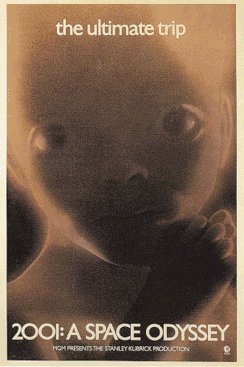
"2001: A Space Odyssey" (Stanley Kubrick, 1968) "2001"-now there's something to get excited about! I've seen it a dozen times and I have always been spell-bound and elated by it. It is, so far, Kubrick's masterpiece.* Certainly, it is the finest example of science fiction in film to date, undoubtedly one of the greatest films of the 60's and possibly of all time.** It is Stanley Kubrick's version of mankind's first contact with a life off of our planet, with the added twist that that extra-terrestrial life is out "God," which "created" us in such a way as to satisfy both Biblical and Darwinian theories of that momentous occasion (which in Kubrick's visualization, it certainly is) For anyone who hasn't figured it out yet, this is the very simple story-line:

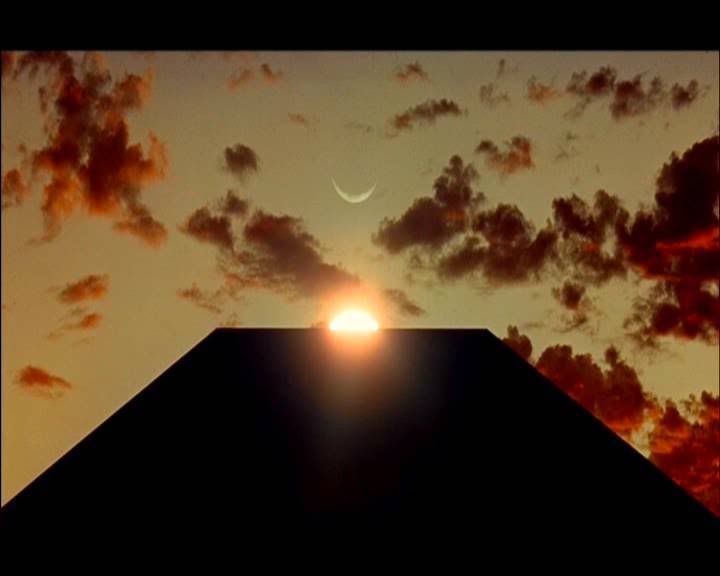
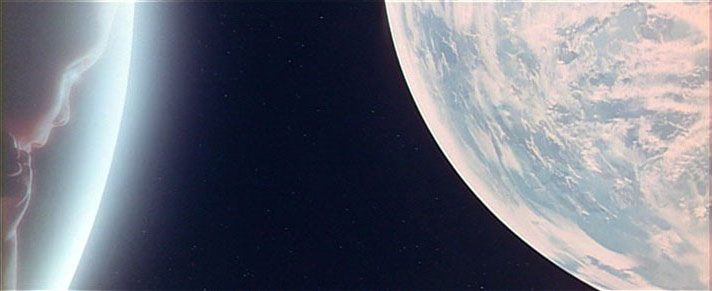
An extra-terrestrial life visits earth in its pre-historic past and finds a stagnating man-ape community and teaches it to use a tool, a bone, for killing, for food, and that lesson boosts man-ape several rungs up the evolutionary ladder. To continue their experiment the ET's bury a signalling device on the Moon, so that they may know when their creation has reached out into space. Of course, it is discovered and that signal*** is traced to Jupiter. A team of astronauts is sent to investigate. In Kubrick's version, the man of 2001 has stagnated much like the man-apes. He has reached the point where he has recreated himself mechanically, right down to his own neuroses. He has nowhere to go as such, and so, when Man, in the form of Astronaut David Bowman, arrives at Jupiter, he finds a transport to the ET's planet, where he is kept and studied the rest of his life. When he dies, he is "reborn" by his captors into a higher form of Man, much like the man-apes were, and the film ends with this "Star-Child," this "super-man" hovering over the Earth, watching, and considering his next move.

None of this is explained out-right, you have to figure it out through the film's images. Only a third of the film has dialog, most of it unimportant as far as plot development--and the plot development comes slowly, I wouldn't be surprised if some cretins actually got bored by it.**** You never see the ET's; it would be impossible to do it believably.***** But...even if you don't understand "2001," it still succeeds as being a visual and aural experience, something to be marvelled at. I think it can safely be said that no science fiction film can help but be compared with "2001" and compared unfavorably. I don't think I can do "2001" any justice in the time allotted, but I can personally say it is one of my ten favorite films, and it is the one that sparked my own interest in film several years ago.

Another thing--this might be your last chance to see "2001" before it is shown on TV and butchered by commercials and (the restrictions of) a square screen, so...go see it...as it should be.

Nothing to add that hasn't been said here. There are worse films to have as a Film-going Rosetta Stone. I've written about "2001" so much that I fear it to be obsessive, so I try to avoid it, actually. Such a thing can be limiting. But I do think it's one of the few "pure" science fiction films, willing to make an audience try to grasp an alien (in both meanings of the term) concept, and challenge them in intellectual, if not dramatic ways. Most science fiction is some other genre with jet-propulsion added.

Finally, this is one film that necessitates being PROJECTED. It really does need to be seen BIG and WIDE, not crimped by the confines of a small TV. Okay, that's it. I've written enough. On to the asterisks.

* And now, almost a decade after Kubrick's death, it's safe to say it still is, although "Dr. Strangelove" is still in the running, as well as "Barry Lyndon," his much-maligned brilliant film of the "me" decade of the 80's...1780's.

** Obviously, I like this film. Still do.

*** It's a solar-powered alarm. When it's dug up and the sun hits it for the first time, it sends its signal out into the Universe.

**** This is terribly unfair. I know a lot of intelligent people who are bored by it, and don't mind saying so. It is paced slowly. I'm in love with the film, so I just don't notice it--for me, it moves like a bat out of hell. But then, my eyes are constantly scanning the frame of "2001" picking out the details -- and that is tough to do on video (Not long ago, an acquaintance finally saw it in a theater and expressed shock: "My God, all those little windows are filled with people!" Yeah. They are. So, if you're wondering why it takes a minute for the moon-lander to descend through the landing bay, rather than worry about it, or the next thing, take a look around Kubrick's world. It's pretty damned full.

***** Something I still believe despite the parade of Spielberg's emaciated Pillsbury dough-boys, and the pantheon of alien life exhibited in the "Star Wars" and "Trek" universes. I still never really "buy into" a representation of alien life. I keep wondering who their agent was, and what their make-up clause was like.


Large Association of Movie Blogs

Wednesday, June 11, 2008

Olde Review: Ramparts of Clay

This was part of a series of reviews of the ASUW Film series back in the '70's. Except for some punctuation, I haven't changed anything from the way it was presented, giving the kid I was back in the '70's a break. Any stray thoughts and updates I've included with the inevitable asterisked post-scripts.


"Ramparts of Clay" aka "Remparts d'argile" (Jean-Louis Bertuclucci, 1968)"Ramparts of Clay" was on John Hartl's ten best list this year--that doesn't mean anything, it's just a fact--also a fact that a co-worker at KCMU thought it was an extremely oppressive film, and I respect his opinion, as well.

Okay, this is just to tell you that the opinions very, and my opinion is just one in the crowd's. "Ramparts of Clay" is oppressive; its narrative moves at a snail's pace, and there is almost no truely-defined dialog (what there is, is elliptical at best).

Depressing prospect for ninety minutes' viewing, isn't it?

But there are many other films with these qualities: Nicholas Roeg's ("Walkabout"), Richard Lester's "Petulia," Stanley Kubrick's "2001: A Space Odyssey." The burden of these film's story-telling abilities falls on the shoulders of the images, and you have to be damned talented with your camera to pullit off. Jean-Louis Bertucelli is awful-damned talented, and so is his camera person Andreas Winding. It's a shame the print being shown on Saturday has so many scratches that distract from the beauty of the images. But you can glean some satisfaction from it, if you concentrate and let your eyes tell you the story, and let Bertucelli's elemental film-making--the way stories were told in silent (film) times--give you the information and direct your mind to what's going on.

On the other hand, you may find the film dull, but that is your opinion and it is the last one--and the one that's most important.

Cee-ripes! Way to "commit," Mr. "Reviewer!" Could we be any more vague? One of two things are happening here: either I didn't see the film (or fell asleep during it--not unlikely, although I do remember "Ramparts of Clay" and being moved by it) and I'm tap-dancing, or I didn't want to hurt that co-worker's feelings by saying they were "full of it" and a "film-weenie" just because the film was being told solely by images, which they considered "oppressive."

I'm way over that these days.

These days I don't quibble, or consider other people's opinions--I just tell them they're wrong, and, quite possibly, an idiot. Then, I'll compound the problem by telling them WHY they're wrong, and expect that to convince the poor soul that, yes, they truly are an idiot, thank you, thank you, Yojimbo, for opening my eyes to that fact, woe is me.

That doesn't happen much.

But I will say that any film drawing comparisons to "2001," "Walkabout," or "Petulia," is in august company, and worth another look-see.

Thursday, March 27, 2008

Danger: Diabolik!

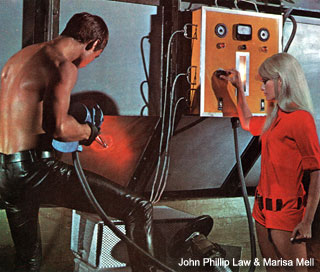
"Danger: Diabolik" (Mario Bava, 1968) Mario Bava's psychedelic adaptation of the Italian comic about a master-thief who preys on the pompous and the puerile owes an awful lot to the "Batman" Tv-show (though the panel of "experts" in the Features documentaries say "No, no, nothing could be further from the truth!" Ri-ight.) as a masked man runs rings around the local constabulary and the Treasury, stealing their riches and making them appear like fools. Then, mission accomplished, he drives his souped up Ferrari to his high-tech underground lair with his mini-skirted girl-friend to endulge in some high-tech something-or-other, and then some nude frollicking in the money. John Phillip Law does all of his acting with one eye-brow, which is one muscle more than Marisa Mell is willing to use. Adolfo Celi is the mafioso willing to deal with the police to get the master-thief out of his hair. The tone is a malevolent light-heartedness, combining James Bond with comic book hi-jinks. Nothing is meant to be taken too seriously, which might explain why Terry-Thomas is inexplicably in the cast! The movie did inspire Roman Coppola's CQ, a few years back.

Monday, January 14, 2008

2001: A Space Odyssey


Why is “2001” my favorite film?

1. It completely does away with the three-act play structure that hems in most films. It’s four acts—like a symphony.

2. It contains very little dialog, and insists on telling its story (about discovering extraterrestial life) and providing key dramatic information visually and aurally—something that too few films actually try to do--fully utilizing the stregths of the medium.

3. It dispenses with the traditional sense of screen-acting which depends on emoting high-points (which is not standard drama, but is, in fact, melodrama), that has long been the crutch of what is considered great screen acting.

4. It comes up with a rather nifty solution for the Evolution versus Creation argument, which is: “Why can’t it be a little bit of both?” Trust
Kubrick to answer a question with another question.

5. It is that very rare item in movie history—a true Science Fiction film. It is not a standard genre film (ie. a western or detective story) set in the future with gadgets, like “
Star Wars” or “Close Encounters” or “Blade Runner” or “Outland” or “Forbidden Planet.” There are no comfortable, reliable concepts in “2001.” It asks audiences to consider the unconsiderable and make leaps of knowledge and faith. And it doesn’t wait for that audience to catch up, despite protestations of a “glacial” pace.

6. It obeys the rules of space and uses them dramatically. There is no sound in space. Trips in space take a long time. Isolation is a problem. Don’t get caught without your helmet. Ask your computer how its doing every so often. When you're dining over at a stranger's house, don't break the crystal. If a black monolith crosses your path, don't reach for it unless you're prepared for your life to change. Rules like that...

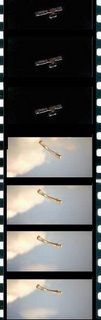
7. It takes advantage of the one unique element that separates film-making from any other artform, and presents the single greatest edit in movie history. To wit:


My Dad took me and my friend Jerry Fortune to see "2001: A Space Odyssey" on my thirteenth birthday. I was a space kid. I lived and breathed the Apollo program. I knew every Astronaut’s name and every mission. What went right and what went wrong. The names of landing sites and prominent craters nearby.

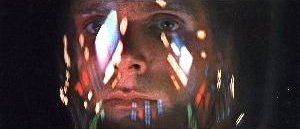
But I couldn’t make heads or tails out of this movie. Like my father, I “liked the middle parts,” but I couldn’t figure out what was up with the monkeys, what all that wierd screaming was about, what was with those streamers when they get to Jupiter, who was the old guy and what was that baby at the end?

I mean, huh?

I was determined to figure it out. It was a space-movie for cryin’ out loud. And, at that time, they only came around once in a blue moon (the last being “
Planet of the Apes,” hardly a space-movie) and I wasn’t going to waste this one.

So it made me dig. I researched. I found out it had to do with the search for extra-terrestrial life (it did?), then I read Clarke’s book, and although Clarke and Kubrick deviated quite a bit, it let me in to what Kubrick was trying to communicate.

Then I got it. It made me realize why he did what he did, why he chose particular scenes to portray, why he framed shots the way he did, and what he could get away with without making his movie look stupid. For Kubrick, a suggestion was better than hitting you over the head by showing bug-eyed children in baggy suits and rubber masks ala Spielberg. There was no narrator to tell you what it all meant (Kubrick had cut out a prologue of talking heads discussing E.T. concepts). The film-maker trusted that his audience would figure it out. Some did.* Some just liked all the colors.

And it left a lot of people (including one thirteen year old and a good number of complacent critics) in the moon-dust.

It still boggles this mind that Kubrick was able to take Arthur Clarke’s slim concept in “The Sentinel” (alien beings leave a "burglar" alarm of sorts on the Moon), and take it to a logical beginning, wrap it in mythic proportions and take it to an inevitable, and, for me, heroic, end. It still is one of the few movies that purport to be science fiction with a deep sense of mystery and wonder, even a kind of visual poetry--something its sequel, the literal-minded “2010,” dispensed with to its drab, short-shelf-lifed detriment.

Where did that inspiration come from? How did those concepts appear? For me, the movie fits the description of the Black Monolith in the film (and are its last spoken words) “It’s origin and purpose, still a total mystery.”

I may have seen "2001: A Space Odyssey" over a hundred times, and it never, ever bores me or fails to thrill me.

Such is the power of this movie over me.


* A site that "explains" "2001" and touches on some philosophical aspects


Anytime Movies are movies I can watch anytime, anywhere. If I see a second of it, I can identify it. If it shows up on television, my attention is focused on it until the conclusion. Sometimes it’s the direction, sometimes it’s the writing, some times it’s the acting, sometimes it’s just the idea behind it, but these are the movies I can watch again and again and never tire of them. There are ten (kinda). This is Number 1.


1. 2001: A Space Odyssey